While washing your face, the headband slips off toward the back, or only your bangs fall onto your face. And if you keep pulling it back up, you end up touching your hair with foamy hands. First, take a look at whether the whole band is moving or whether only the hair left outside the fabric is falling.
Here we introduce how to adjust a fabric headband used for face washing and skincare before you wet your face. Thin hair bands, sports headbands and towel-wrap types may be built differently. Check how to use your own band and its care label, and aim for a state where your hair stays in place comfortably rather than tightening the band hard.
Look separately at the whole band slipping and at how the hair comes out
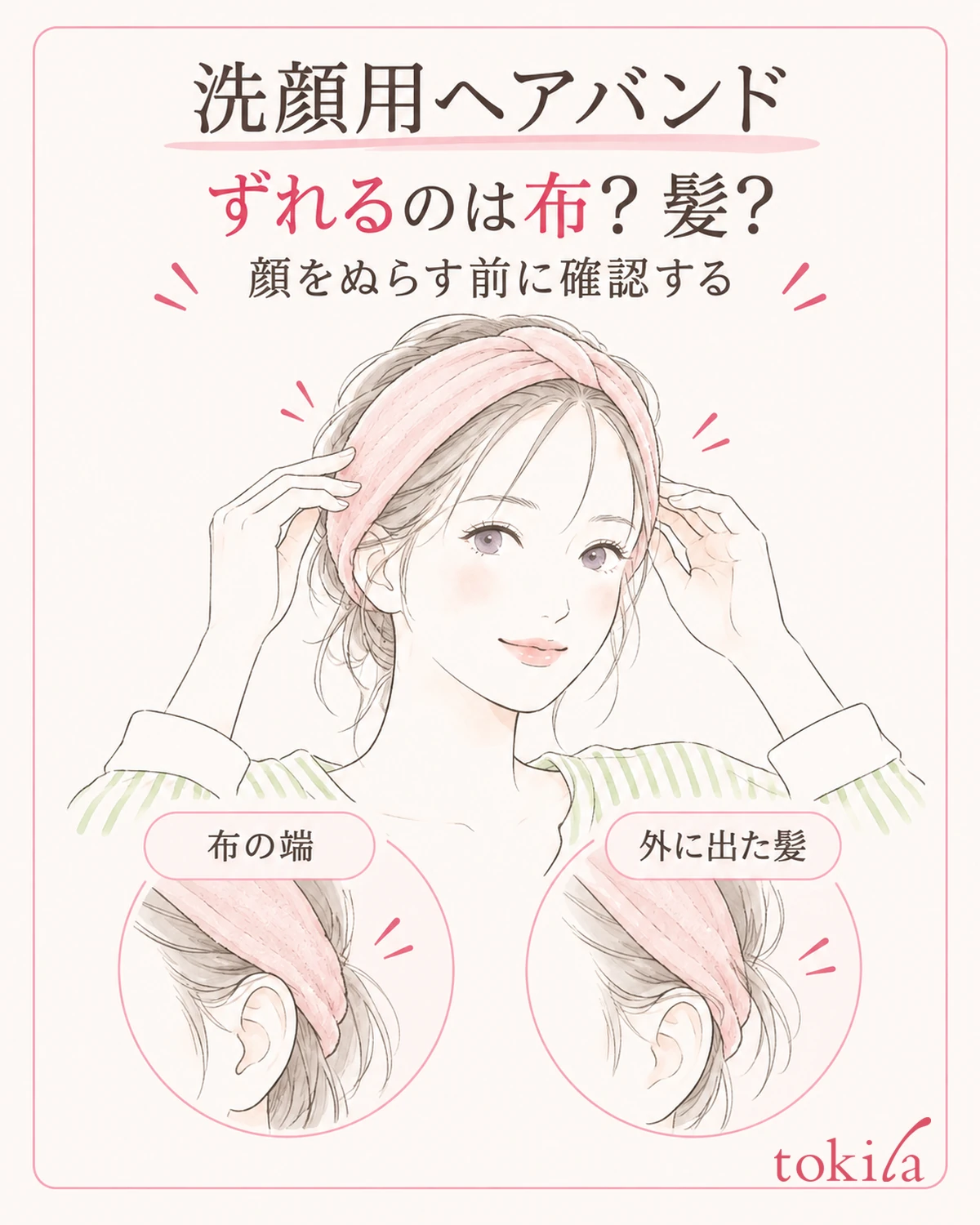
Put the band on with dry hands and check from the front and from the side in a mirror. Look at three places: the edge of the fabric touching your forehead, around your ears, and the back of your head. If the forehead-side edge is not moving but only your bangs are falling, reviewing how the hair is tucked in is the first thing to try. If the edge of the fabric itself is moving, check in order the direction you put it on, any folds, and how well it fits.
If you pull the band hard toward the back right after it slips, it becomes hard to tell where it started to move. Stop washing for a moment, rinse off any foam on your hands, and then take the band off. Before putting it on again and again, look at it on a desk to see whether the fabric is twisted or one side is curled up.
When comparing left and right, step back a little from the mirror instead of fixing one side and immediately moving the other. If you only look at the edge of the fabric up close, it is easy to miss the back riding up or other hair falling over your face. Separate the spots that bother you from the front from those visible from the side, and check that neither feels strained.
The way it moves is not always the same: it may slide forward and cover the forehead, slip off toward the back, or rise on just one side. Rather than lumping it together as "it always slips," check once whether it settles when you stand and whether it moves when you look down, and it becomes easier to choose what to change next. You do not need to decide the cause based only on head shape or hair type.
You also do not need to pull the band as far back from the hairline as possible to make your forehead look wider. Within the way your own band is meant to be worn, look for a position where the fabric does not cover the area you wash and your bangs are less likely to fall onto your face. If it feels tight or painful, stop using it and consider another size or another way of tying up your hair.
Check the structure you have, such as ring-shaped or openable types
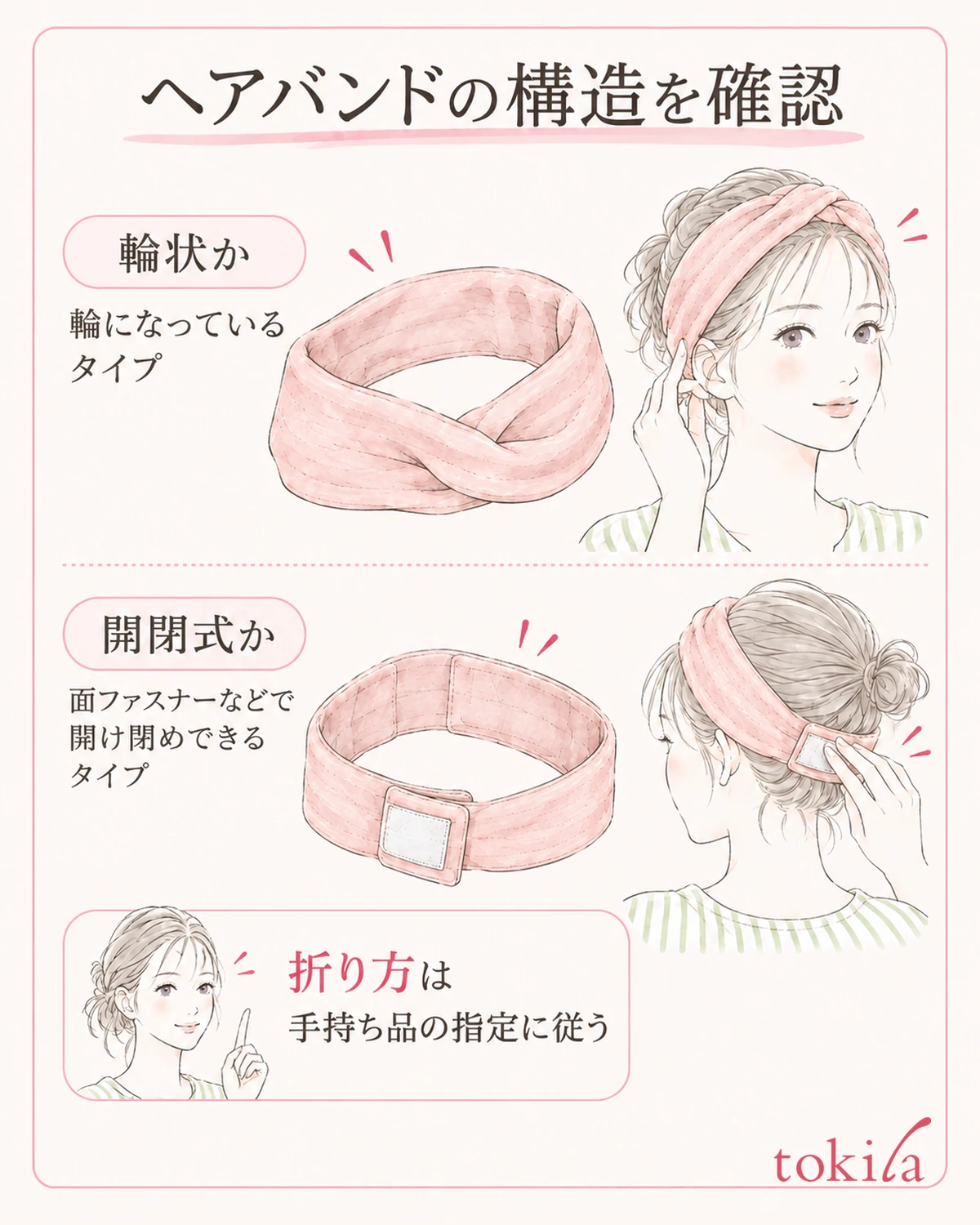
Even under the same name of headband, there are stretchy ring-shaped cloths, ones that open and close with hook-and-loop fasteners and the like, and ones whose width can be adjusted by folding. First spread it out after taking it off, and check whether there is a part that opens, whether front and back are specified, and where decorations and seams are. Do not guess front and back from a ribbon or tag alone; compare with the packaging or the diagrams in the instructions.
Ring-shaped types are put over the head in the way the instructions show. If it catches on glasses, earrings, hair accessories or the like while you are putting it on, do not try to pull it off as it is; stop moving and check where it is caught. Think of cutting the ring or undoing the seams to widen it as separate from everyday position adjustment.
For an openable type, check the position of the fastener and the range of overlap before putting it on. Rather than increasing the overlap to the limit because it slips, see whether it stays comfortably within the specified range. Check around the edge of the fabric before fastening so that no hair gets caught in the hook-and-loop fastener. If the fastener has come off or is damaged, do not keep using it by applying force.
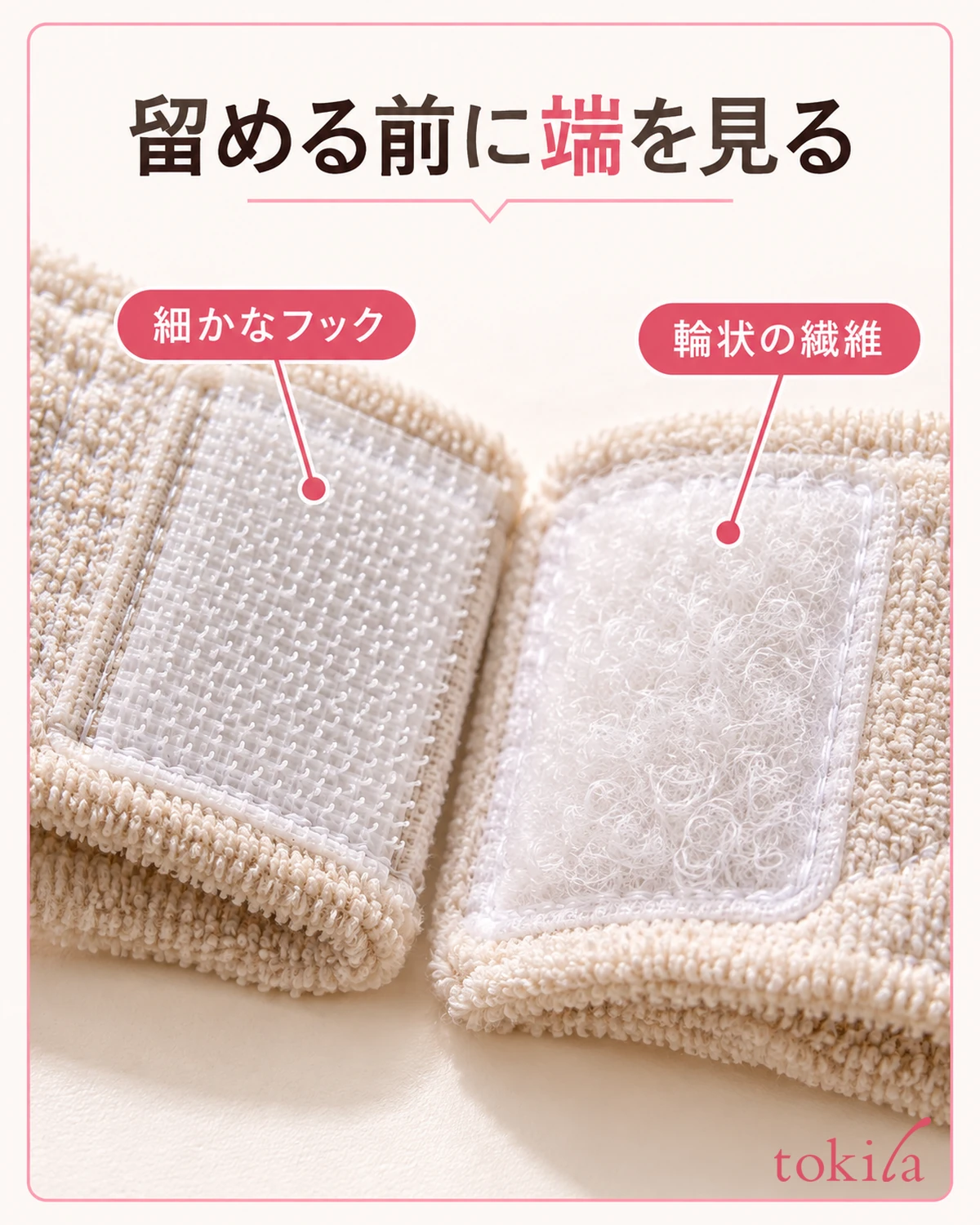
If you do not have the instructions on hand, check the name or model number on the package. Simply being wide does not tell you whether it is a type meant to be folded. Even if you cannot find any front-and-back specification, do not make up your own rule such as always putting the seam at the back; start by checking for twists and for the presence of a fastener.
Even for products whose width can be changed by folding, the number of folds and the folded width are not the same for all. If you roll a fixed-width band into a narrow shape, it ends up worn in a way it was not meant to be. Follow the procedure only when a way of folding is shown, and check that the thickness and twisting are not different on the left and right. It is important not to apply how a particular product is used straight to a band of a different shape.
Tuck in the bangs and the hair around the ears without pulling
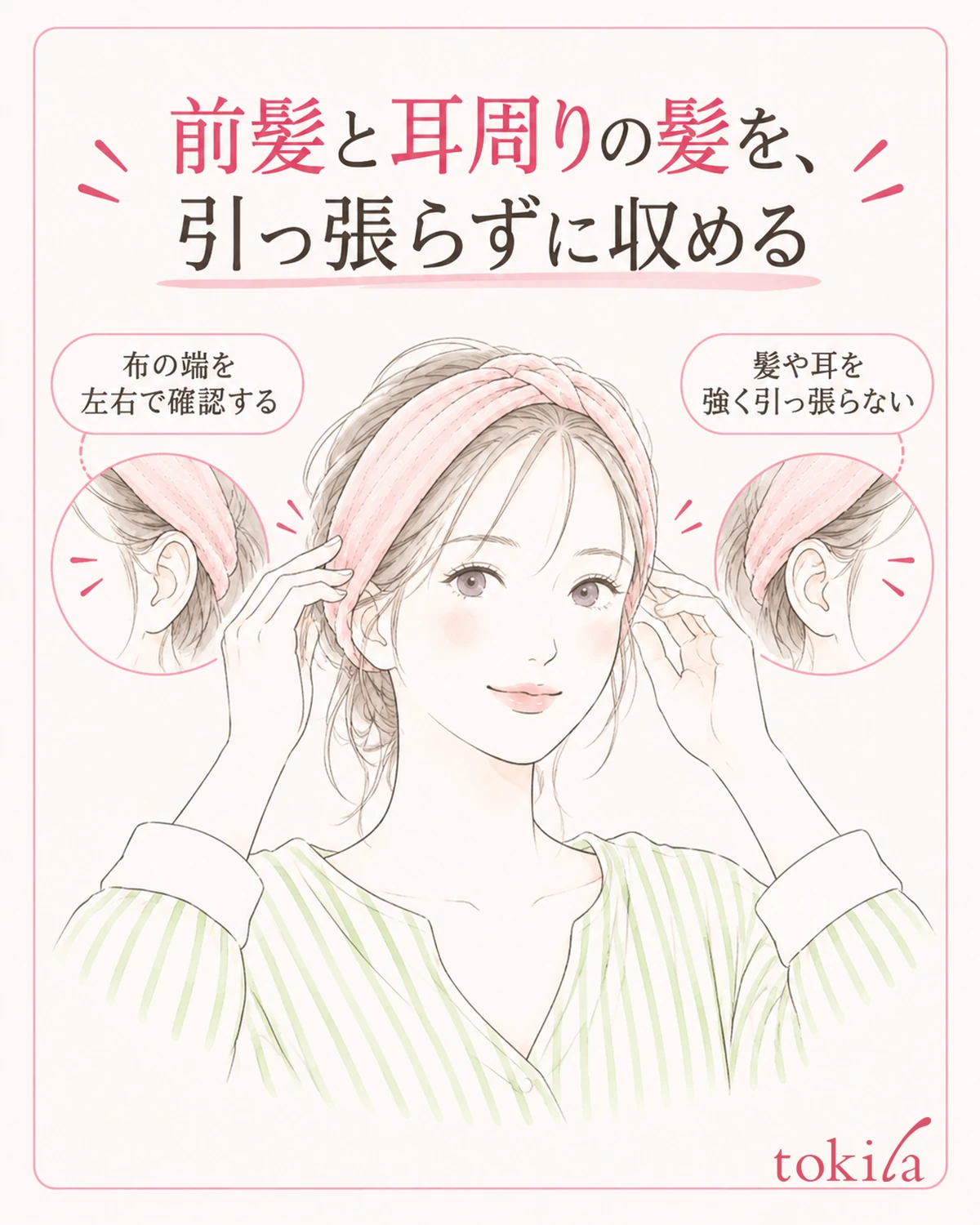
When putting it on again, first separate with dry fingers the bangs that fall over your forehead and the hair that falls beside your cheeks. Arrange the hair a section at a time, tuck it into the area the band holds, and then check the edge of the fabric on both sides. This makes it easier to spot hair left outside than trying to carry the hair along by pulling only the fabric toward the back.
If short bangs come out from the edge, check whether that part is folded back or whether the edge of the fabric is curled up. Taking the band off, arranging the bangs and putting it on again is better than rubbing it up again and again while wearing it. To push in every single fine hair, there is no need to rub the scalp hard or dig in with your nails.
If you have already applied a hair styling product, also check that it has not gotten onto the fabric. Even if it feels slippery, you do not need to add yet another product to your hair or to the fabric. Rather than trying to change the fit by wetting a dirty band on the spot, set aside the one that needs care and prepare one that is ready to use.
Around the ears, check that a thick bundle of hair has not slipped under the fabric on just one side. Do not force your ears to fold in or pull them with the edge of the fabric; arrange the left and right in turn. If hair you leave at the side of your face touches your cheeks while washing, switch to a way of tying it up that keeps it away from your face while you wash.
If it is hard to stuff the long hair at the back into a single band, you can also tie the back hair up separately. Rather than prioritizing a tight fit, check that nothing pulls when you move your neck. If you also use a hair accessory, check that it is in a position where it will not hit you when you bring your face close to the sink. For how to check when a clip bites into your hair, the article on hair clips may also help.
Look down before washing and review only the part that moved
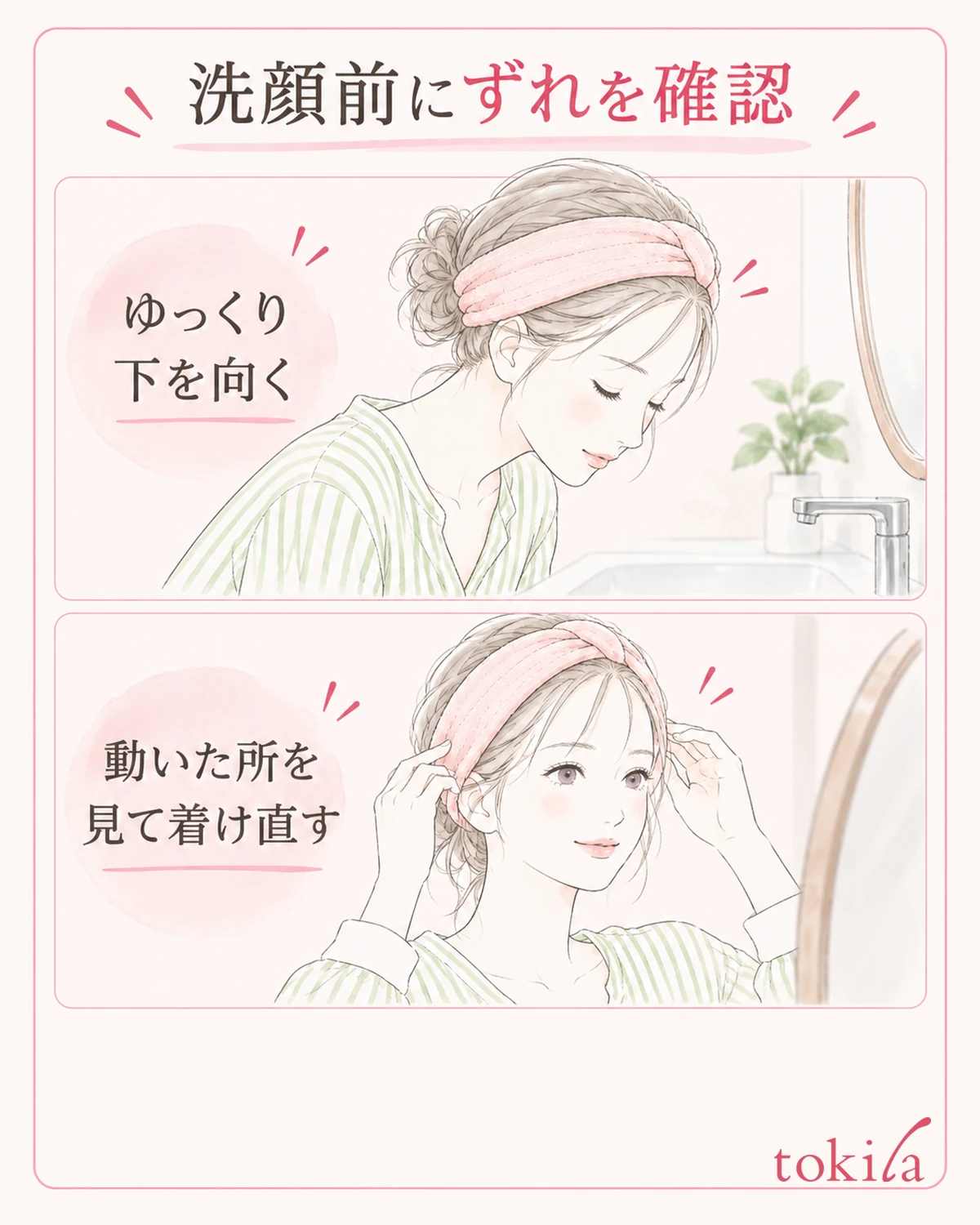
Once your hair is tucked in, without wetting your face yet, slowly look down as you would when washing your face. In front of the sink you usually use, check that the bangs do not touch your face, that the fabric does not slide down onto your forehead, and that the back does not slip off. This is a check to see how it sits when worn, not a test that guarantees it will not come off with any movement.
If it slipped, return to a standing posture, check the part that moved, and then take it off. If the forehead side is stable and only the hair at the side falls, change only how that hair is tucked in next. If the fabric was twisted, fix the twist and check in the same posture. Not changing the position, the folded width and the way of tying up the hair all at once makes it easier to judge which state is easiest to use.
If it keeps coming off and also feels very tight, do not go further in the direction of making it tighter. With the size or shape you have, it may be hard to keep your hair in place. Switching to a different size or structure, or to a way of tying up the hair, is also an option. Do not make your own modifications, such as applying adhesive or cosmetics as anti-slip or shrinking it with heat.
For the check, the posture you take in your usual face washing is enough, rather than shaking your head vigorously. When you return to the mirror, look not only at the position of the fabric but also at whether hair is falling around your eyes or on your cheeks. Do not make not slipping the only condition for passing; judge together whether there is no pain or pressure on the ears and whether it does not get in the way of washing.
If it moves while you are washing, do not grab the fabric with foamy hands; rinse your hands first and then adjust it. Also be careful not to rub your face hard to fix the band. Once your hair is in place, go on with your usual face washing, and do not skip rinsing the hairline because you are worried about the position of the band. For how to take foam from a face-washing net, see the article on face-washing nets.
After use, check the care label and the condition of the fabric and elastic
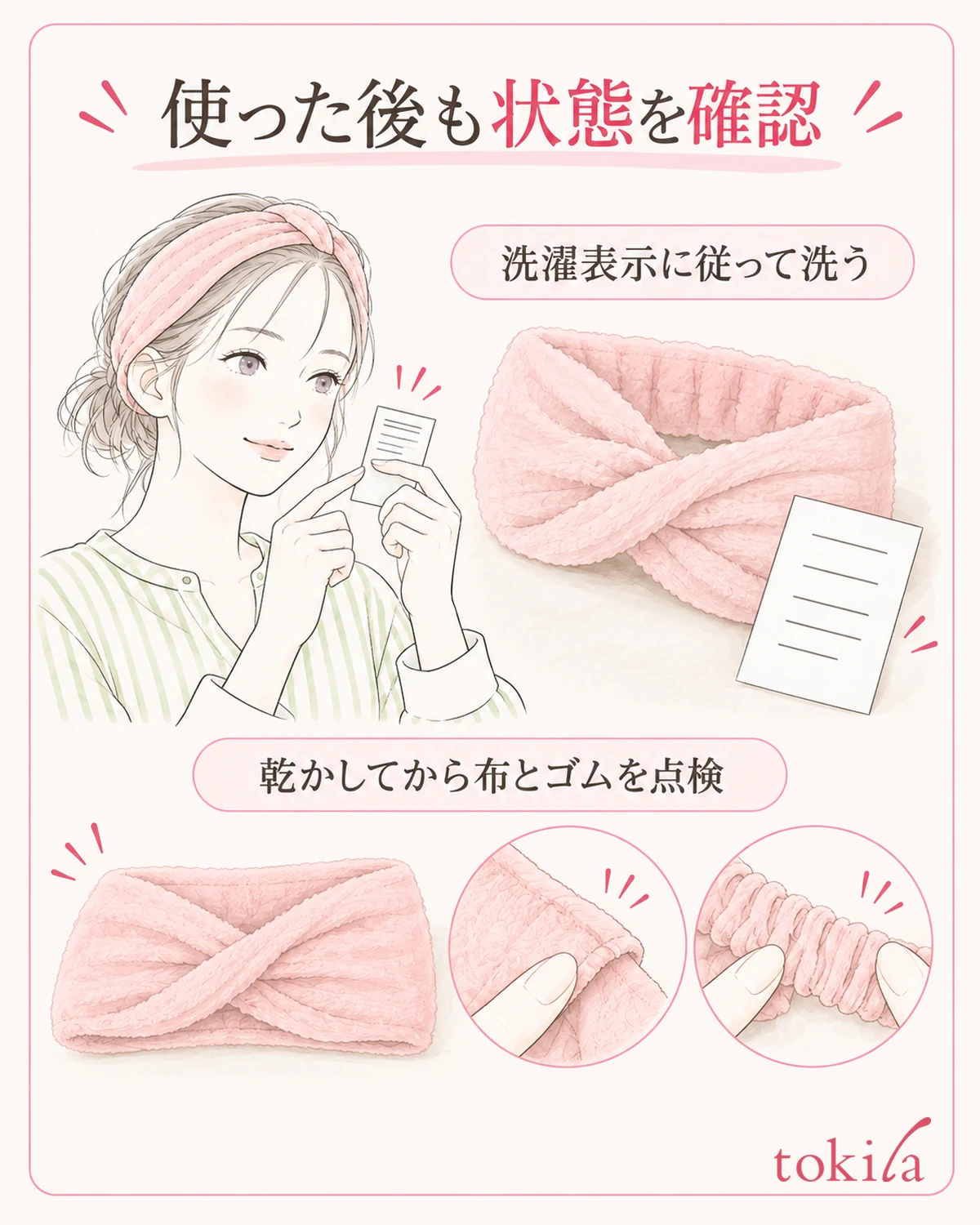
Check whether the band you took off has foam or moisture on it. Rather than rolling it up damp and putting it back in a pouch, wash it in a way that matches the care label, dry it, and then put it away. Just because it is made of fabric does not mean everything can be washed in a washing machine or put in a dryer. If it has fasteners or decorations, check how to handle those as well.
For conditions such as laundry nets, hand washing, how to dry it and tumble drying, follow what is shown for your own band. If the label cannot be read, do not substitute the description of a similar-looking different product; look up the information that corresponds to the description at purchase or the model number. Do not try to restore the fit by shrinking it with hot water or hot air when you are not sure.
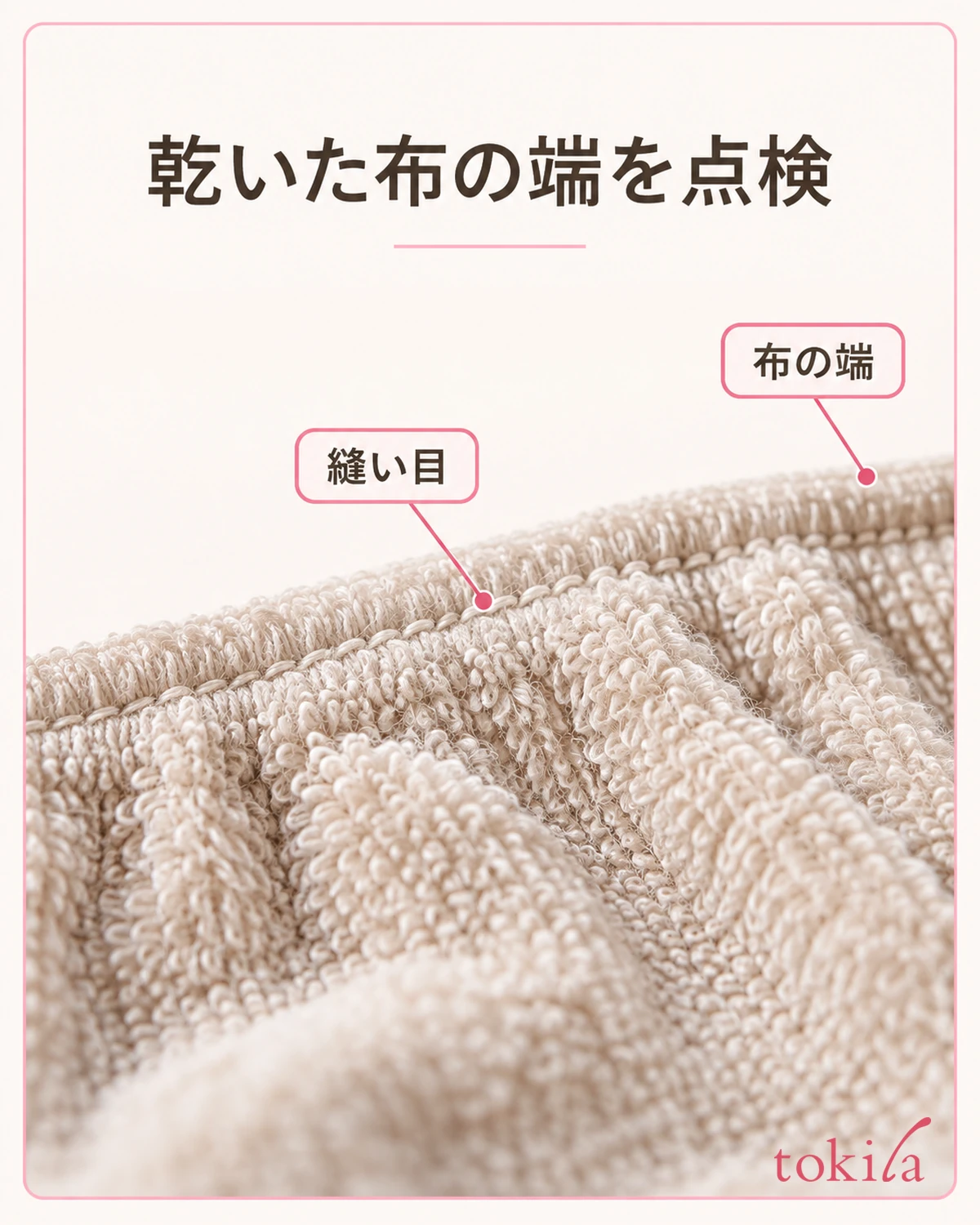
Once dry, look at the edge of the fabric, the seams and the elastic on a flat surface. Check whether the edge stays curled, whether the left and right differ in shape, and whether any thread is fraying. Even if it feels looser than before, do not treat stretching or damage as just a position problem; review whether it is still in a condition to keep using. The time to replace it cannot be decided uniformly by the number of days used.
Another point is not to compare the stretched state right after washing with the dry state as if they were the same condition. Once it is dry, put it on in the same way of tying up your hair as last time and check. Avoid stretching it while wet to restore the width, or pulling the elastic over and over to loosen it, and if a sense of something being off remains even after care, review what you use.
For your next use, it helps to remember specifically what happened, such as "it moves toward the back when I look down" or "only the right bangs come out." If it is still not stable even after you adjust how the hair is tucked in, do not keep using the same band by force; choose the size and shape again. Preparing for face washing starts not with adding more tightness, but with checking that you can use it comfortably with your hair kept away from your face.