Every time you pick up your bag, the bottom board tilts. Once you put your things in, one side of the base sags, or a corner of the board presses into the lining fabric. When that happens, before you push the shifted board down from above, take everything out and check the shape of the base and how the board is attached. Look at the size of the board itself and the way you place your belongings as two separate things.
Here, I explain the order of checks, focusing on removable bottom boards found in everyday totes and similar bags. This is not a procedure for removing a core that is sewn in or a part that is fixed in place. Follow the care instructions for your own item, and if you are unsure of the orientation or see damage, stop at the checking stage without modifying anything.
1. Take everything out and find where the bottom board moves
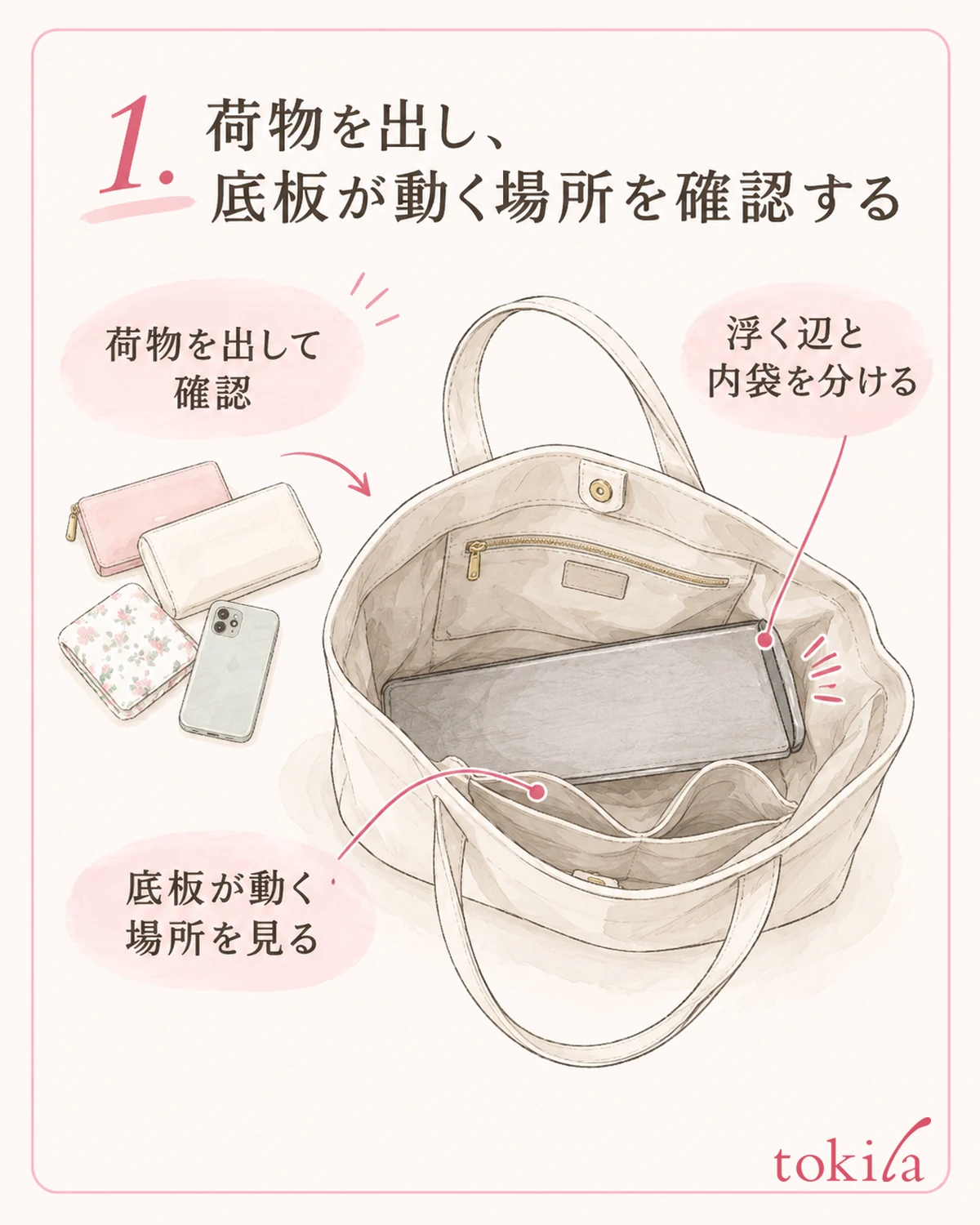
Place the bag on a clean, flat surface and take out everything, including what is in the pockets. Keep the opening wide so you can see the base, and arrange the handles and metal fittings so they do not dig into the outer fabric. There is no need to slip your fingers under the board and lift it hard while things are still inside.
First, look at which side of the board is rising. What to check next depends on whether only one short edge lifts, the middle of a long edge warps, or the whole board slides sideways. Even if you think the bottom board is moving, it may actually be only the inner lining being pulled, so look at the board and the fabric separately.
Also sort out whether the bottom board came with the bag or was added later. If it came with the bag, look for instructions on the direction and fastening for putting it back. If you added it yourself, recalling whether it has moved since you first used it or only since the day you changed what you carry will help you choose whether to review the size or the storage first.
Before touching the base, also check for foreign objects or leaks. If there is dirt, handle it according to the care labels of the bag and the board separately. If you shift the board and clean it at the same time, it is easy to put it back with moisture or residue still on it.
Some bags have only a core under the fabric, with no visible board edge. Feeling an outline is not the same as being able to take something out. Without unpicking inner seams or cutting the lining, check the shape of the base within what you can see. If the structure cannot be removed, start by reviewing how you place your things, as described in the later sections.
If you want to keep a record of the state before checking, take one photo from the opening that shows the whole base and the direction of the board. A photo of the board alone makes it hard to tell front from back and its position relative to the pockets. Use it as a record for putting things back, and do not judge fit or strength from the photo alone.
2. Tell a removable board from a fixed core
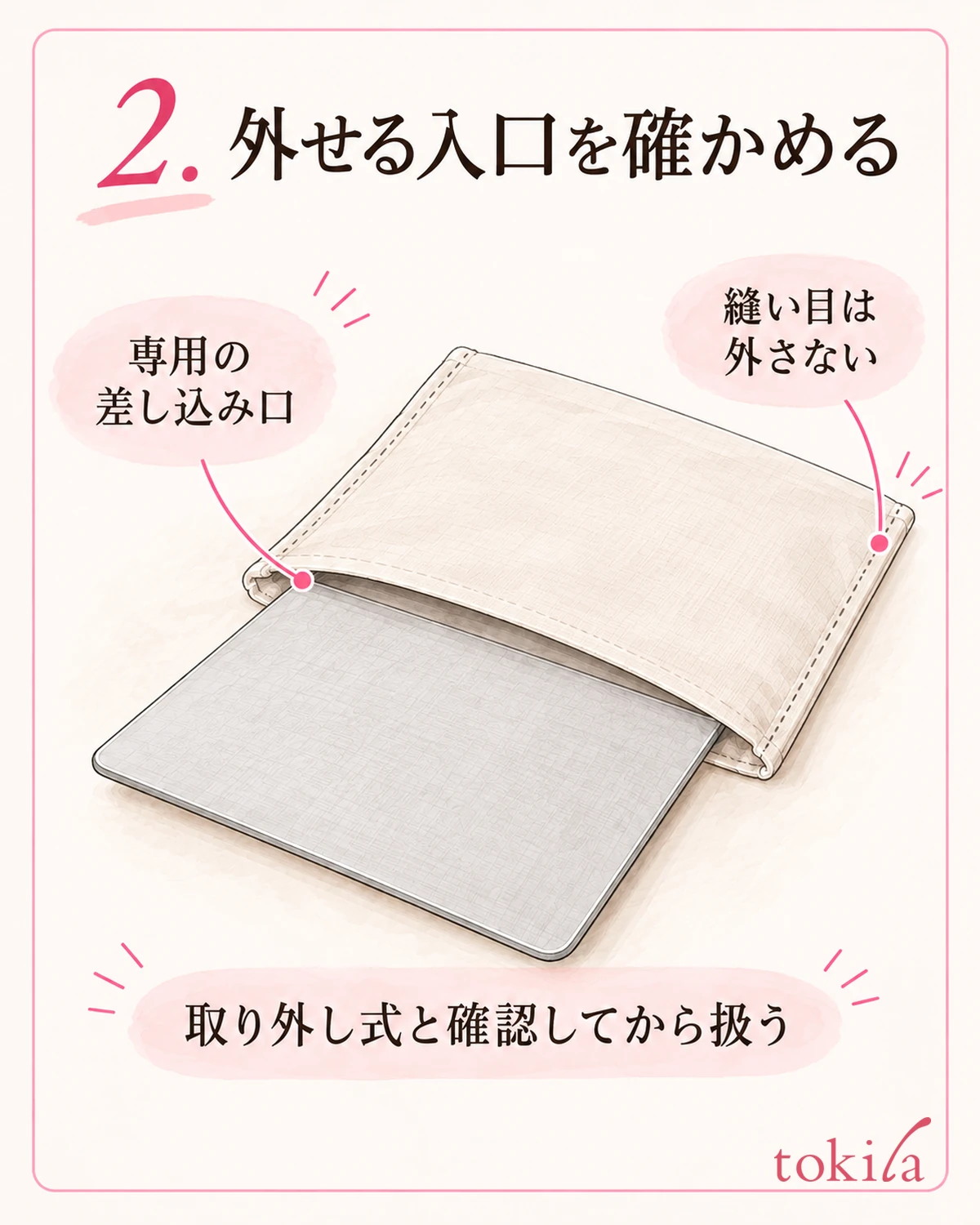
Removable bottom boards include ones that are simply set on the base, ones that go into a dedicated slot, and ones held with hook-and-loop fasteners or the like. Boards that look the same do not always work the same way. Before moving anything, check whether the edge of the board is connected to the inner fabric, and whether there is a fastener or a storage opening.
For a slip-in type, confirm where the real entrance is. Do not mistake a gap in a seam for an opening and spread it, and do not pull the board so hard that it turns the fabric inside out. Even if the entrance looks narrow, check the direction for inserting the board and the handling instructions before adding force.
If there is hook-and-loop tape, look at where it fastens and how the fabric around the board overlaps. Handle only the parts you have confirmed can be detached, and do not peel off the base of a fastener that is sewn on. If the fastener is there but you cannot reach it, check the board's orientation and whether the fabric is caught first.
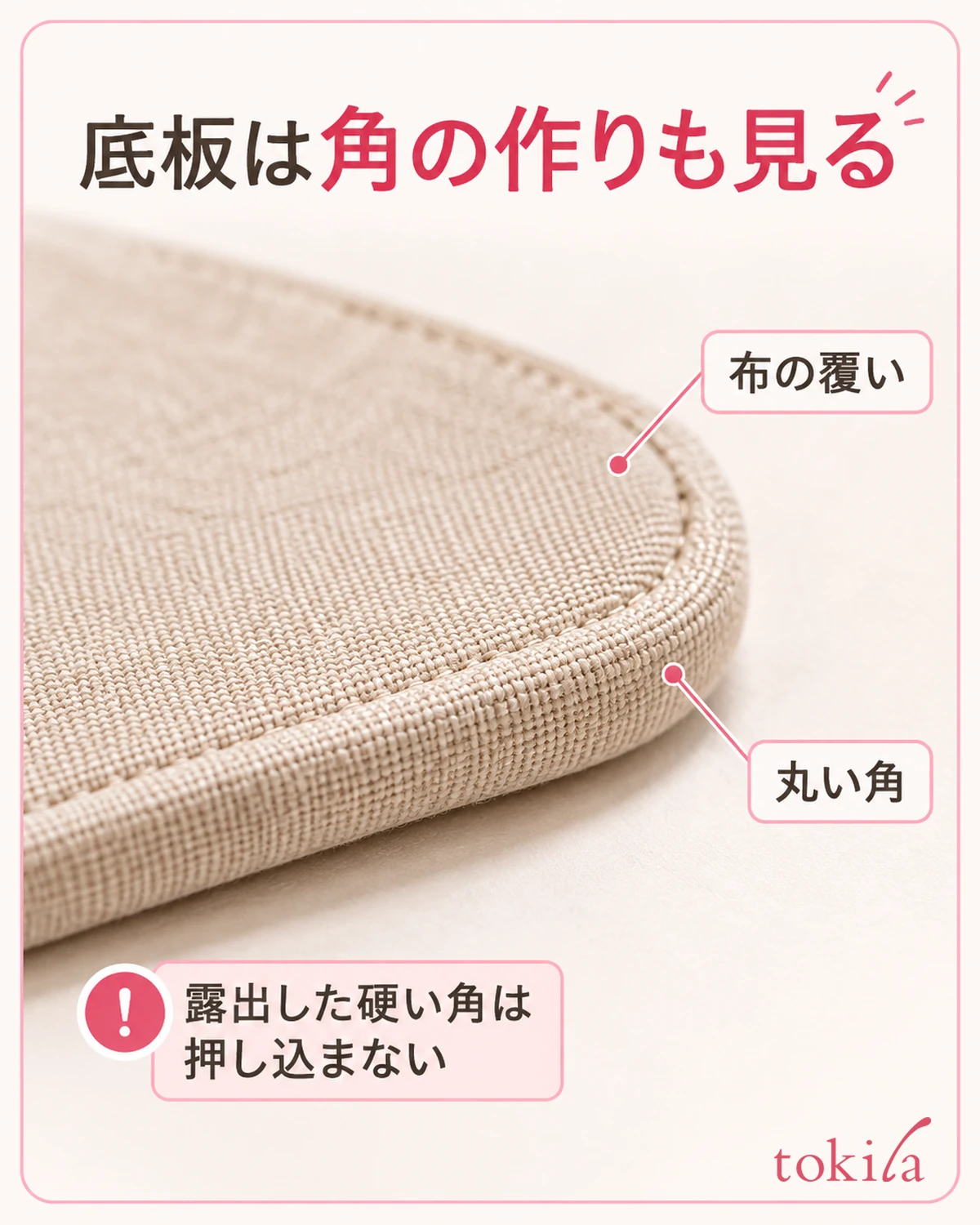
The corners of a removable board are wrapped in fabric or rounded off. Even boards that look thin do not all have the same edge finish. Look at the shape of the corners and the state of the covering, and then check where they touch the inner fabric. If the covering is peeling back or a hard corner is exposed, do not push it in as it is.
Some items differ between the front and back of the bottom board in texture or in having a pocket. However, do not decide that the soft side must always face up. Check the instructions for the accessory and its original position, and return it to the intended orientation. It is important not to apply the way a similar-looking bag is set up to your own bag as it is.
If you do not know how to remove it, stop the removal for now. Photos of the whole base, the visible edges and the fasteners will make it easier to explain when you check the original handling instructions. Avoid the order of taking it apart yourself first and then wondering whether you can put it back.
3. Check the shape of the base, the board's orientation and how the edges sit together
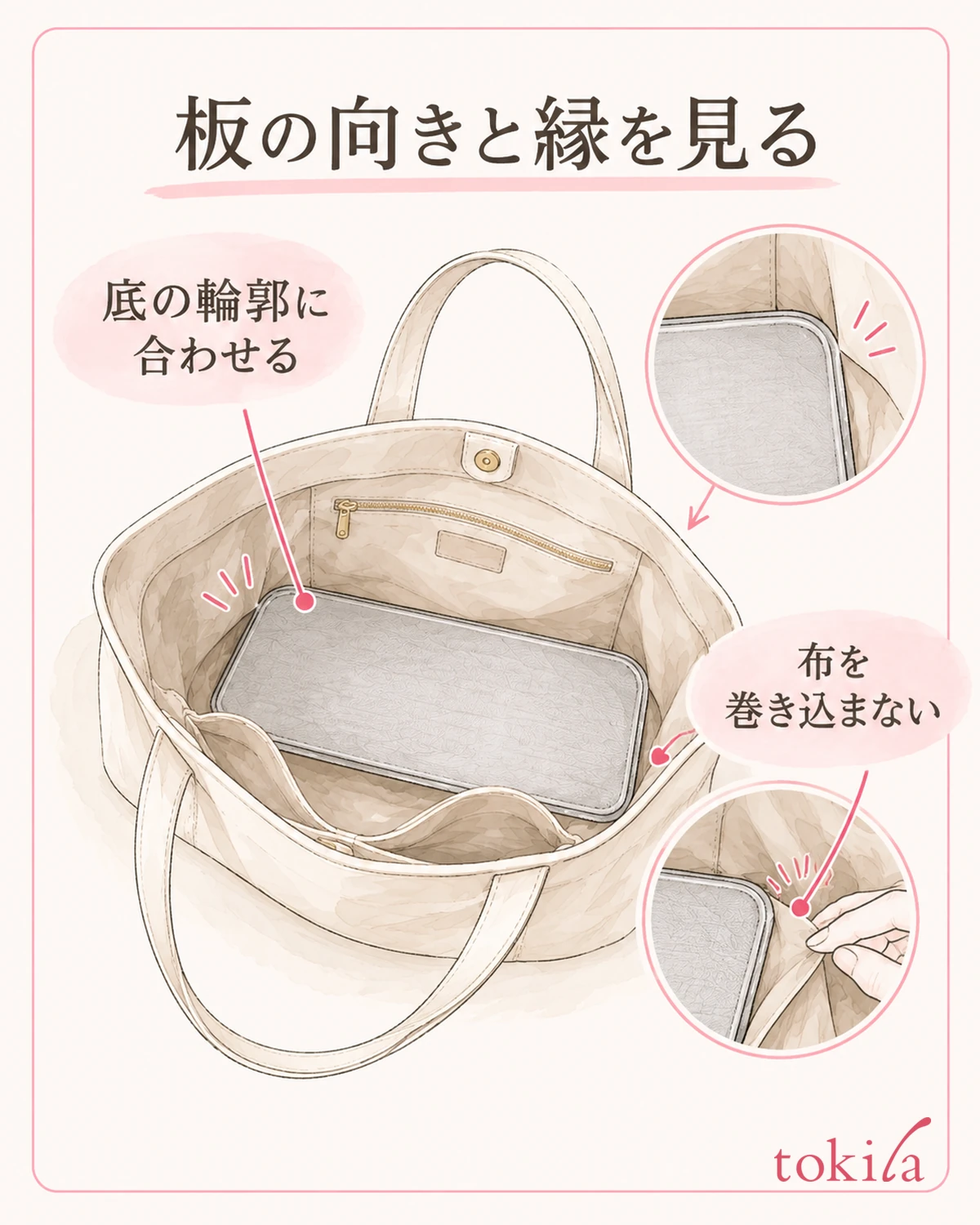
Take out a board you have confirmed is removable in a way that lets you tell its original front and back. With the bag empty, compare the outline of the base with the shape of the board. The width of the opening and the outer dimensions alone do not tell you how much usable area there is on the inner base. Check with the seam allowances and inner pockets in mind.
Even a board that looks rectangular may have a direction, such as one side being narrower or the corners being rounded differently. If you recorded the original position, return it there, and if there are instructions, follow them first. If it is hard to insert, do not force it in at an angle; recheck the front and back and which sides are long and short.
For the set-on type, check that you have not trapped the inner lining or seam allowance under the board. Rather than pulling the fabric hard to flatten it, adjust only the folded-in excess that you can put back. For a dedicated slip-in type, check the entrance and the back position, and put it back by the specified method.
Once the board sits in the base, look at the four corners and the middle of the long edges. Check whether the edges are pushing the fabric up and whether the board alone is floating at an angle. A bag with a soft base may not become perfectly flat on the outside. Do not judge fit only by whether the bag stands up on its own.
Even if it seems too big, do not trim the accessory board with scissors on the spot. Cuttable aftermarket boards also have their own specifications, such as material and corner finishing. Making it smaller will not necessarily fix the problem, so before any modification, check the type that fits and the specified size.
If there is warping, cracking or peeling at the edges, stop pressing the board flat with your belongings. Treat any process of restoring the shape with water or heat as separate from ordinary position adjustment. Check not only the board but also the inner fabric for damage, and see whether replacement or repair is needed.
4. Put your belongings back little by little and watch for shifting and snagging
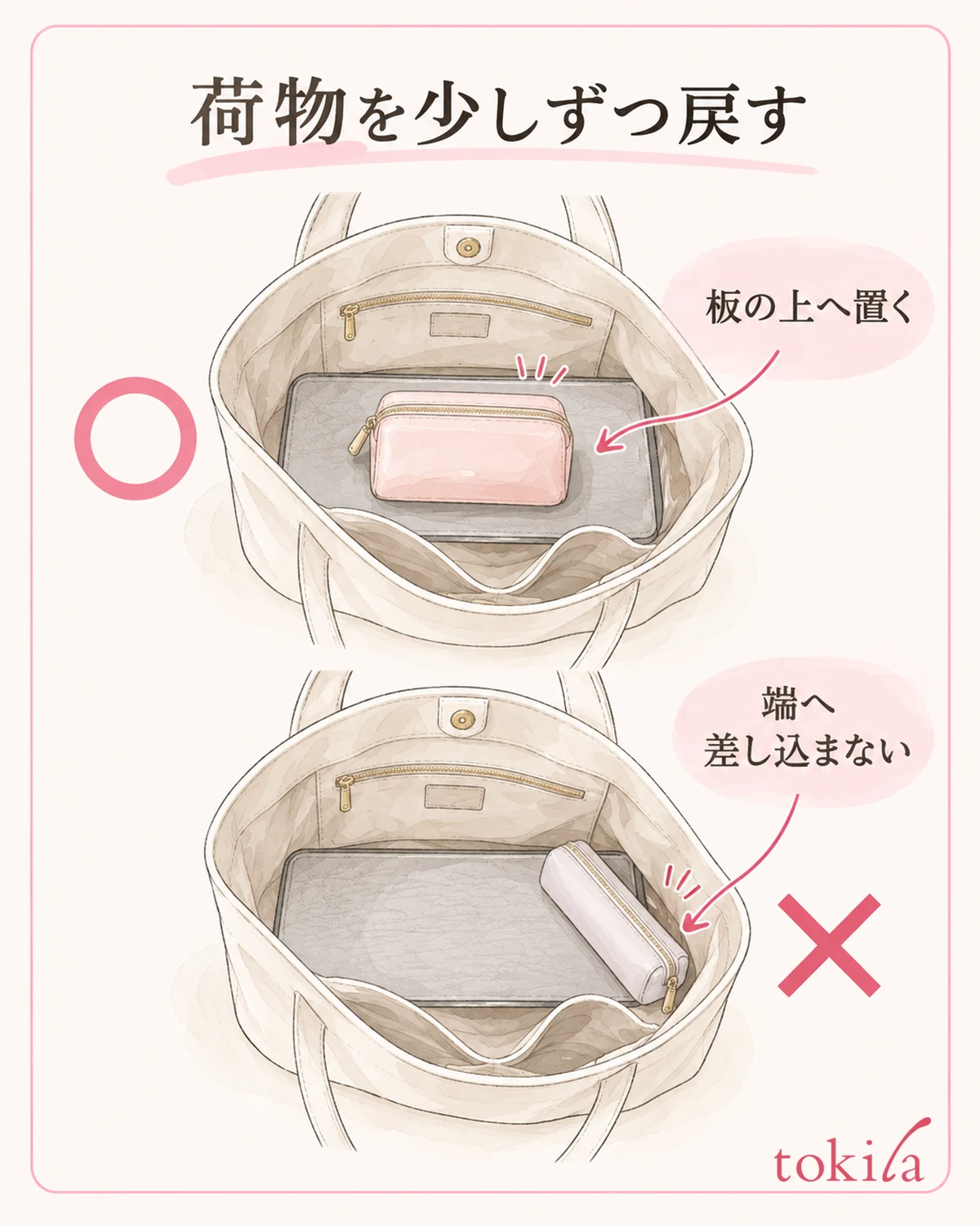
Once the orientation is right while the bag is empty, bring back your usual belongings little by little. Do not pack everything in from the start; begin with an amount that lets you check the board's position each time you add something. If the board fits when empty but a corner lifts when a particular pouch goes in, you can review how the items sit as well as the size of the board.
Set things on the surface where the board sits instead of pushing them into its edge. If a thin item slips between the board and the inner lining, the board is easily lifted along with it when you take the item out. Do not pin things by pushing them under the board; use separate places to store them.
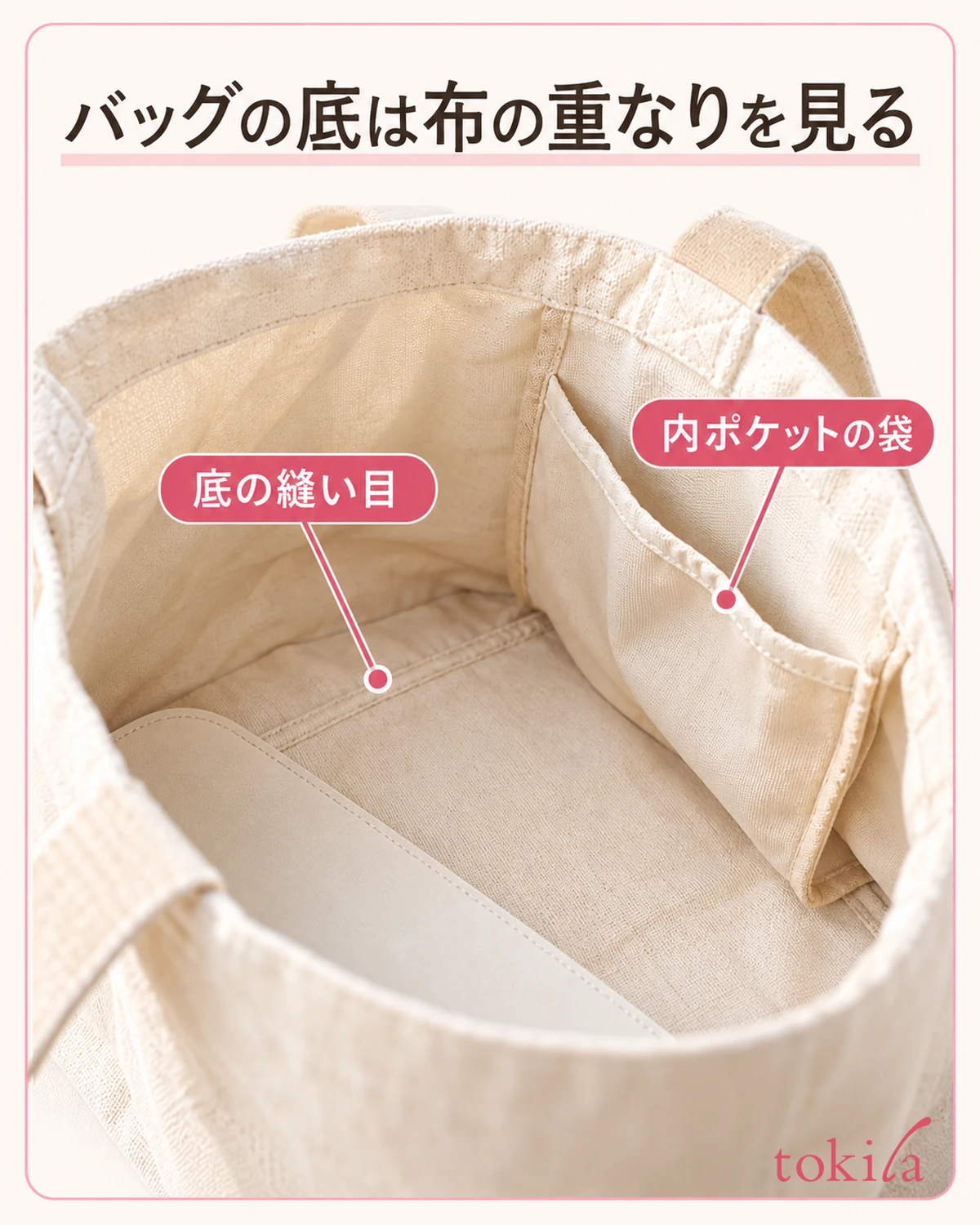
Also check whether the fabric of the inner pockets or dividers is folded over between the board and your belongings. The place where the seam at the base rises is different from the place where the pocket bag hangs down. Once you know which fabrics overlap, you may be able to fix the problem just by changing where the items sit, without moving the board.
If you have gathered the heavy items on one side, change where you put them within a range that keeps the bag easy to use. Do not assume that adding a bottom board increases the weight the bag can carry; keep to the bag's conditions of use. Even when carrying precision equipment, do not judge that the bottom board alone protects it from impact or scratches.
After putting things back, support the body of the bag low and lift it slightly, then set it down on the surface again. See whether the board moves when you lift or when you take items out. You do not need to test durability by shaking it hard or adding heavy items.
If you are also bothered by how the bag sits on your shoulder, you can also review checking a twisted bag shoulder strap as a separate step. Rather than changing the bottom board and the strap length at the same time, first sort out the conditions under which the base moves, and then check how you carry it.
5. Check the condition before putting it away so you can return it to the same orientation
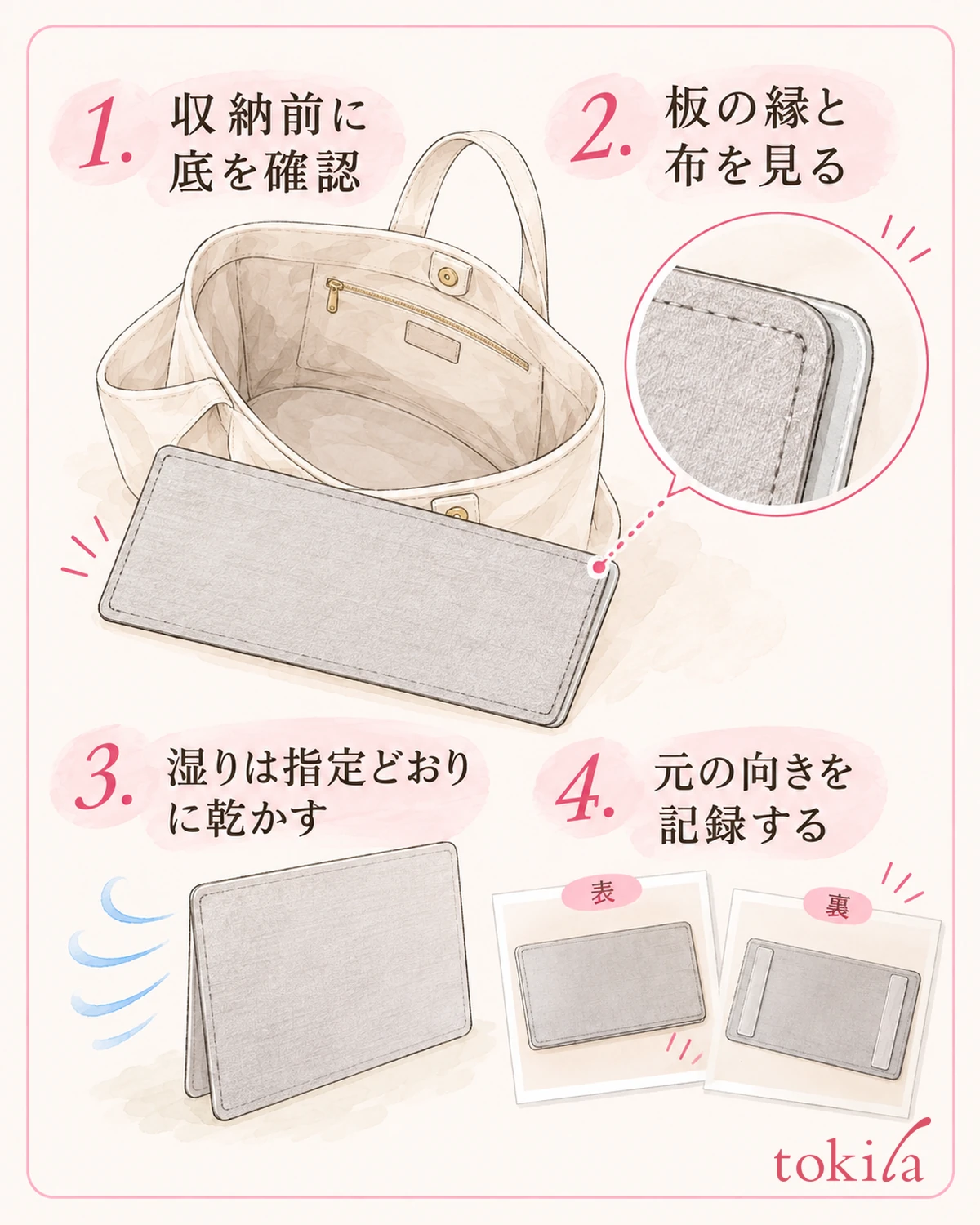
When you finish using the bag, take out your belongings and small bits of trash, and look at the edges of the bottom board and the inner fabric. If you find new scuffs or marks where the same corner keeps rubbing, keep them as points to check before the next use. Before you keep using it with tape over the marked area, check whether the board fits and whether it is damaged.
Do not assume the bag and the bottom board can be washed together; follow the instructions for each. Even for a board wrapped in fabric, the material inside may not be water-safe. If the label is unclear, do not go straight to washing it whole; check the dirt or dampness first and then look up how to handle it.
For items that are damp, follow the specified drying method, and do not store the board and fabric pressed together while still wet. Whether to take the bottom board out or leave it in during storage also depends on the bag's design. If you take it out, make sure it does not get mixed up with the board of another bag, and keep a record of its front, back and fastening alongside it.
In your storage place, avoid putting strong creases in the board or pushing the whole bag under something heavy. Even if there are instructions to stuff the bag to keep its shape, do not use so much filling that it forces the base wider. Storage methods vary by material, so think of shaping the bag and stretching it tight as separate things.
If it moves every time even after you put it back in position, if a corner presses on the inner lining, or if the board is damaged, do not force it to stay in place; review the conditions of use. When you ask for advice, telling them whether it came with the bag or was added later, which edge lifts, and whether it moves even when empty helps sort out the situation. Check these before moving on to repairs that fix it with adhesive or holes.
When the bottom board moves, a good starting point is this order: take everything out, work out how it is attached, check the shape and orientation of the base, and put things back to see when it moves. Do not make keeping the board from moving your only goal; get the bag you already own into a condition where you can use it comfortably without the board pressing on the inner fabric.