You pick up your eyebrow scissors but can't tell which side should face up, or whether you switch hands for the opposite brow. In that case, before testing the direction near your face, check the type of tool and the hand it is made for. Even among small scissors, the blades, handles and the structure of any attached comb are not all the same.
This article goes through the checks before using manual eyebrow scissors in this order: shape, the right-hand/left-hand marking, preparing to hold them, handling a comb type, and putting them away. It treats these separately from the steps of how short to trim your brows or what shape to cut. Start by not bringing the blades near your brows while you are unsure, and compare against the instructions for the product you have.
1. Tell apart the shapes: regular blade, thinning blade, and comb type
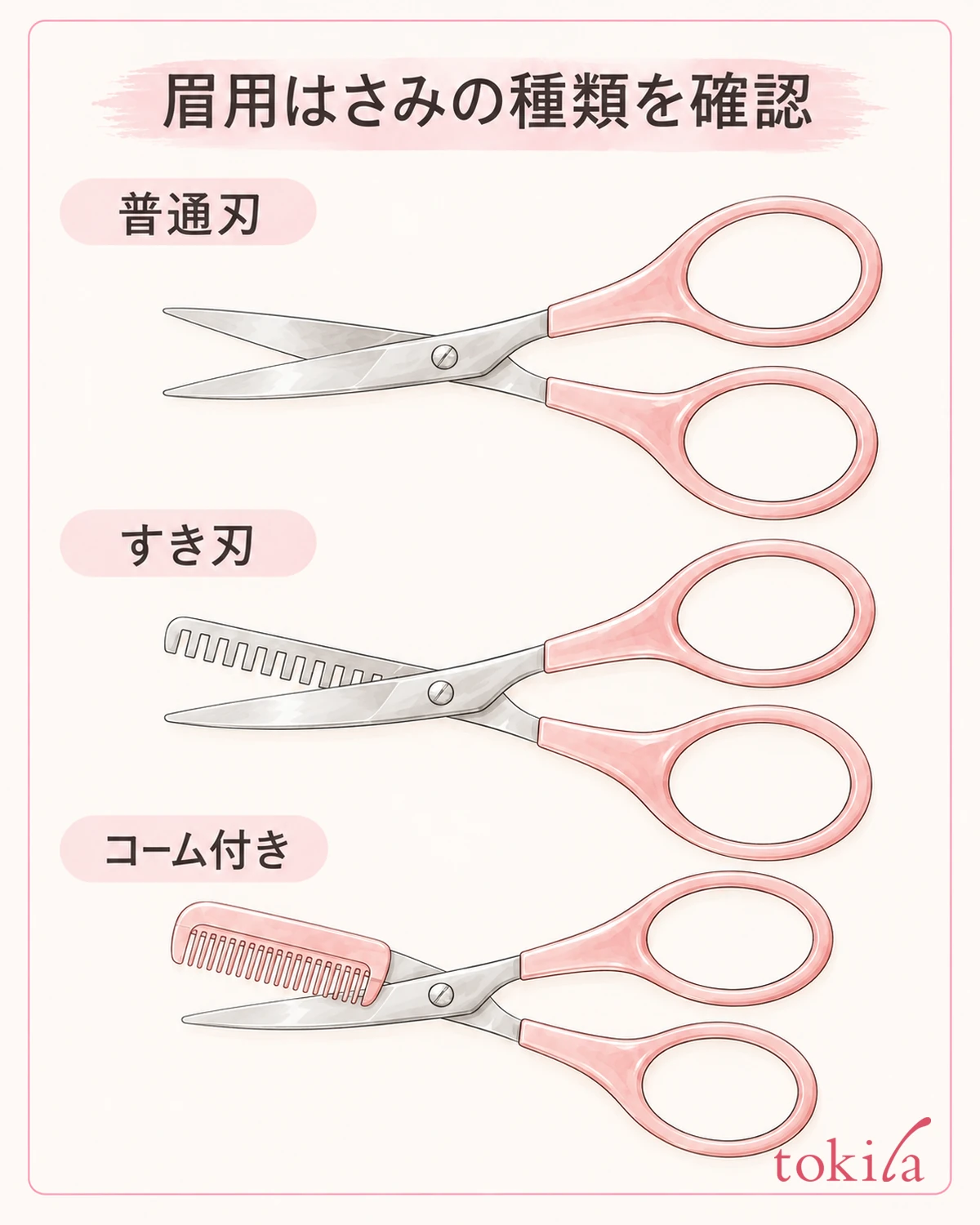
At first, keep the blades closed and look at the whole thing on a stable desk. Check not just the name "for eyebrows" but the shape of the blades, the shape of the handles, and whether there is a comb near the blades. There is no need to slide a finger along the edge to test how sharp it is. For parts that are hard to distinguish, don't feel them out by touch; compare with the names and diagrams on the packaging.
Scissors with ordinary blades are tools for cutting hair ends and the like to adjust length. On the other hand, some thinning blades are meant for adjusting volume. If you use them with the same feeling as a tool that cuts length in a straight line, the action may differ from the finish you are aiming for. First, put into words whether the product adjusts length or volume.
Some types with a comb on the blade are built so that the comb scoops up the hair and you cut the part that sticks out. Check separately the brow comb you hold in your other hand and the part that attaches to the scissors themselves. Don't assume that just because it has teeth, it can be used the same way on both the left and right brows and with both hands.
There are also thin, curved blades and handles bent so that your hand doesn't bump into your face. Don't think such curves are a defect and straighten them or bend them back the other way. A shape that is not symmetrical and a hand that doesn't match are separate things to check.
It is also important not to substitute a small pair of scissors whose purpose you don't know just because the shape is similar. Check on the label the differences between those for eyebrows, nose hair, eyelashes or false lashes, and so on. If you don't have the original packaging, note down the model number of the item you have and confirm how to use it before preparing.
2. Separate right-hand/left-hand from right-brow/left-brow
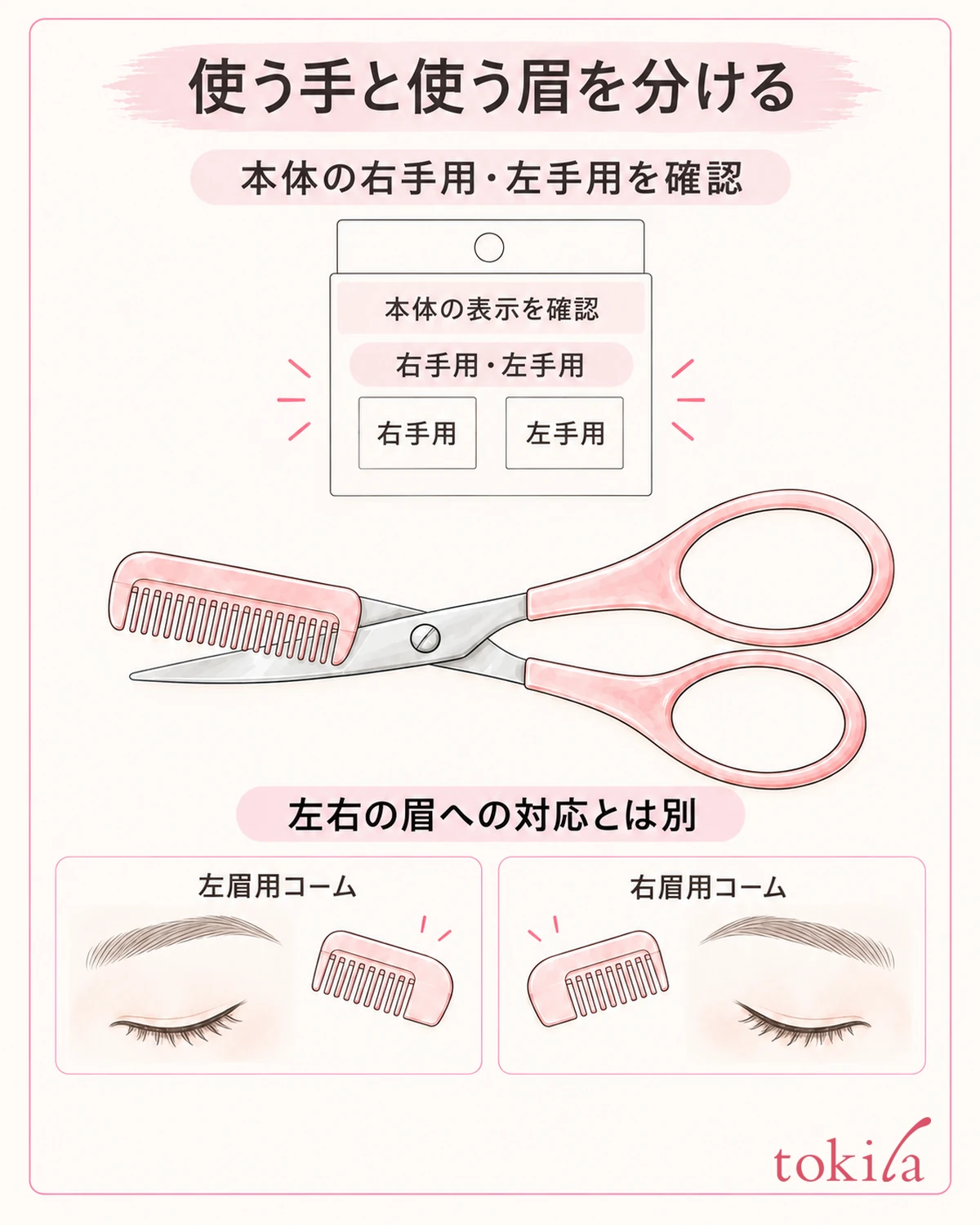
Next, look at the markings about which hand to use, such as for right hand, for left hand, or for both. Even if you always use scissors with your right hand, you can't assume you may switch to your left hand to cut your left brow. Thinking separately about the hand the tool is made for and the side of the brow you want to groom helps sort out mix-ups in direction.
Be especially careful with types that come with combs matched to the left and right brows. Even when there are two kinds of combs for the left and right brows, some products have a body that is for the right hand. "Can be used on both brows" and "can be used with either the right or left hand" do not mean the same thing. Don't judge by the number of accessories alone.
When reading the instructions for your product, first check the hand for the body, then the type of comb, and last the direction for each brow. Rather than trying to memorize all three at once, organize them in the order written for that product, such as "use with the right hand" and "for the opposite brow, switch to the specified part."
For example, if a right-hand body comes with combs for the left and right brows, what you check when moving to the left brow is the comb specification. That is a separate matter from changing to a left-hand body. Conversely, if the body is for the left hand, take that specification as the standard. Read the markings on the actual item one by one, and do not mix the two meanings of the hand to use and the brow.
If the hand in the diagram looks different from your own orientation, don't turn the blades in the mirror to check. Put it back on the desk once and view the actual handle and the handle in the diagram in the same orientation. Because left and right are easily perceived differently in photos and mirrors, take the markings on the actual item as the starting point of your check.
If you find it does not suit the hand you use, don't force it by switching your fingers around or by operating it with the blades turned over. Consider changing to a tool that matches. Rather than suddenly changing to an unaccustomed hand, you can also decide to finish today without cutting. If you are just bothered by differences between left and right, review that separately from how to draw brows while checking height, length and density.
3. Hold them away from your face and check the handle and opening and closing
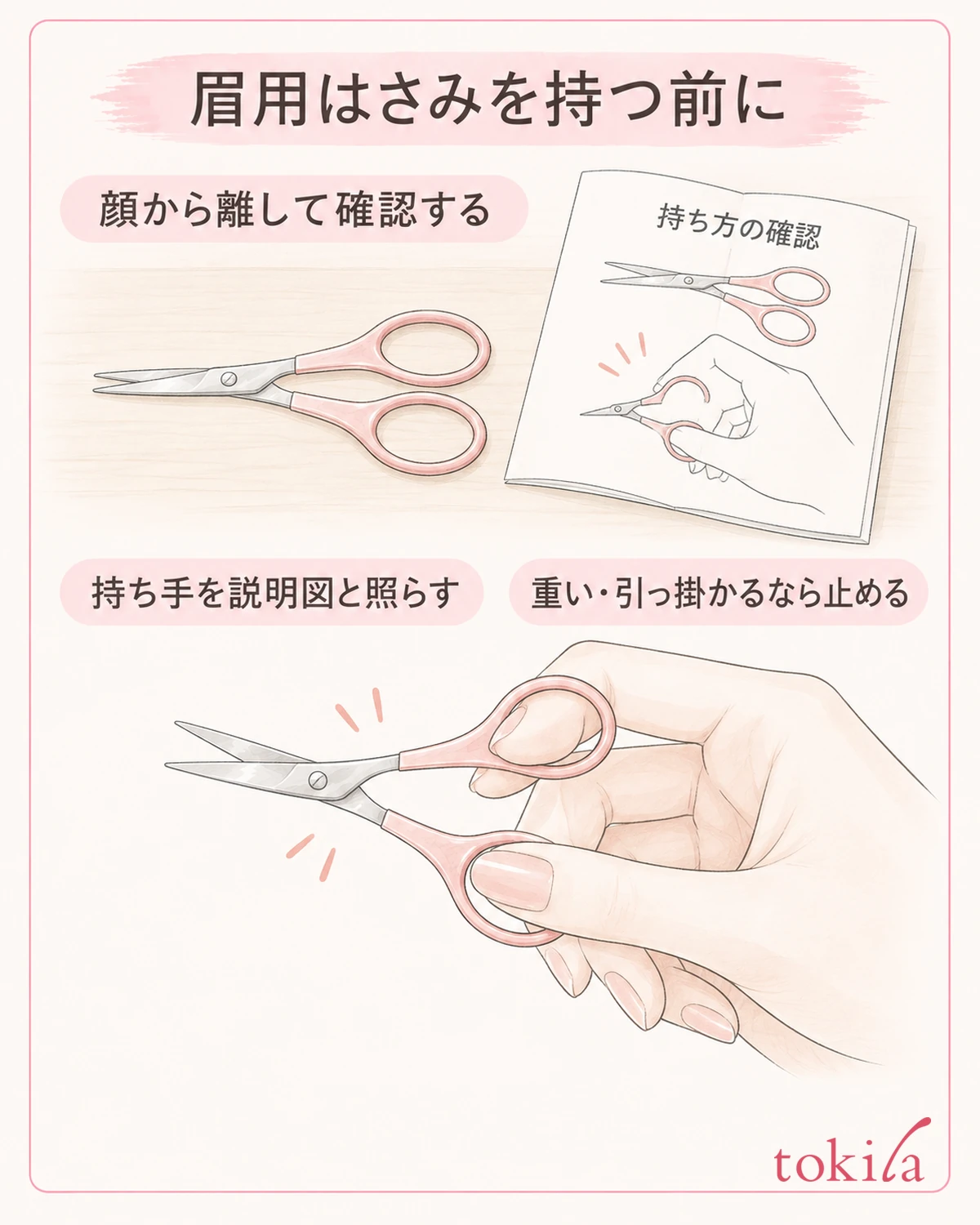
Once you've confirmed which hand to use, make sure your hands are dry and clear off the desk. If slippery cosmetics remain on your hands, tidy up your hands first. For ones with a cap, hold the handle of the body steadily and remove the cap in the specified way. Avoid taking it off by grabbing the blades and pulling.
Match the position for your fingers to the diagram in the instructions for your product. Because the size of the rings and the angle of the handles differ, don't apply the same finger depth or direction to all eyebrow scissors. If your fingers are pressed hard, or you can't support them without regripping, don't lift them to your face as is; review the size and the hand they are made for.
Holding them as the instructions say, point the tips away from your face and open and close them a little above the desk. Here you are not testing the sharpness; you are just checking whether you can move the handle and whether there is any catching. Do not add actions such as opening them fully or snapping them shut repeatedly and forcefully.
If opening and closing feels heavy, moves suddenly, or the blades look misaligned, do not try to work them in by force. Before tightening a small screw yourself or bending the blades, stop using them and check how to handle the product. Do not check how they work while cutting your brows either.
If another action becomes necessary during the check, such as picking something up or moving your hair aside, close the scissors and set them down in a stable place. Do not move your hand near your face while holding open blades. Separating the preparation of the mirror and your bangs from the time you hold the tool lets you concentrate on checking the direction.
After checking how to hold them and the condition of the tool, place the mirror in a stable position. Rather than looking for the orientation of your other hand while supporting the mirror with one hand, securing your field of vision first and then handling the scissors lets you separate the actions. If you are unsure about the light or placement at your vanity, you can also refer to Checking the Position of Your Makeup Mirror and the Shadows.
4. For comb types, compare even how it is attached with the instructions
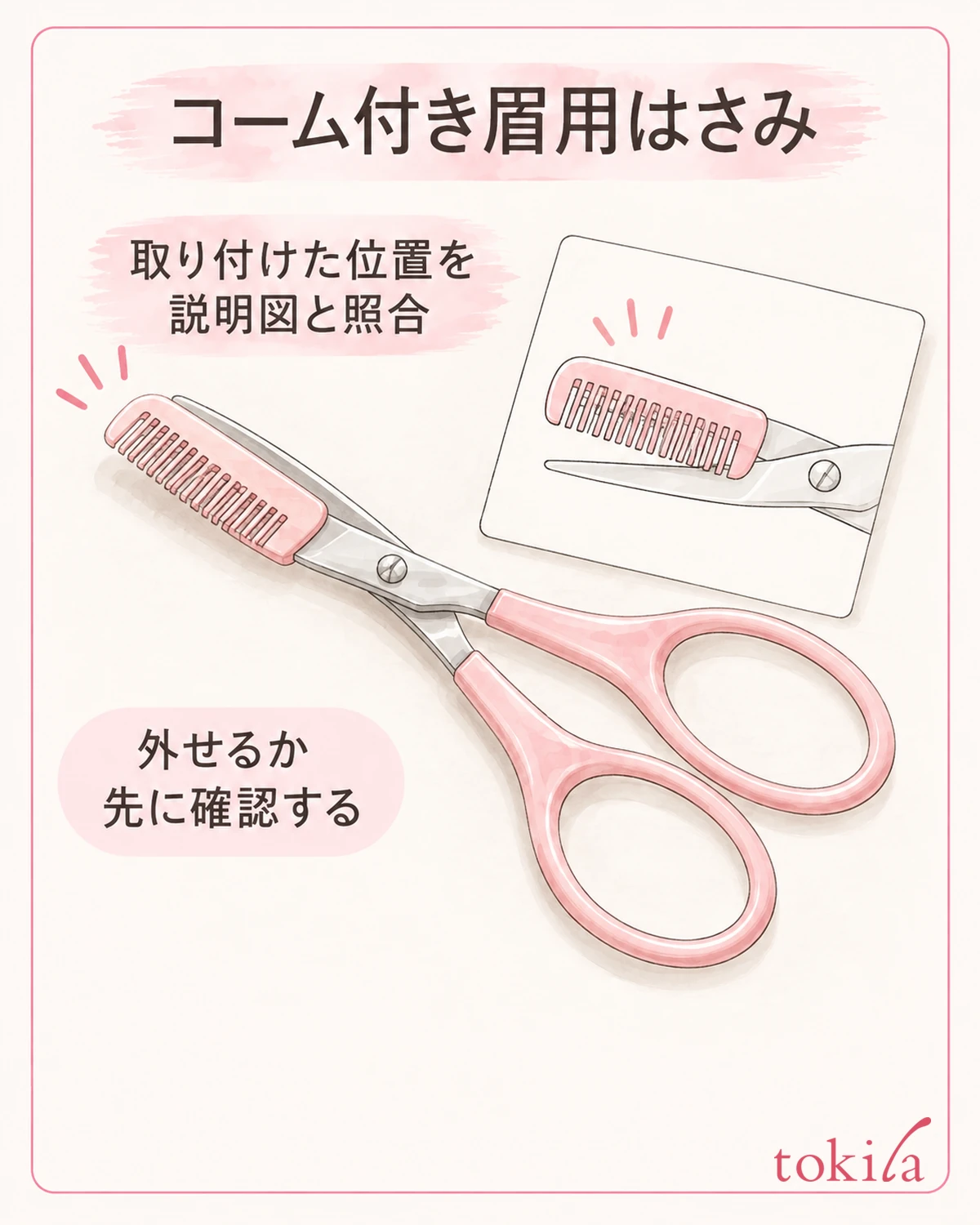
With products that have a comb, check away from your face that the part is attached correctly. Some can be removed and some are fixed, so don't assume you can take everything off and change the direction. Check, using the diagram for your product, whether it can be attached and removed, where you hold it to move it, and its position after attaching.
If the instructions say to swap the comb for the left and right brows, do not pull the part out while it is against your brow; bring it back to your hands once. Close the blades and change to the necessary part using the specified method for attaching and removing. If it is hard to remove, don't move it by pulling hard on the teeth or prying it with another tool.
After attaching it, compare the direction of the comb's teeth and its position relative to the blades with the diagram. If you see wobbling or cracks, do not use it with a temporary fix of adhesive or tape. When the parts are not all there, do not push in a comb from another product just because the size fits; check whether it is a compatible part.
For products where the instructions say to scoop up the hair with the comb and cut what comes out, the relationship between comb and blade is important. However, you cannot simply carry over the scooping direction or how you apply it to a different model. The diagrams in this article show the checking of parts. When you actually put it to your brow, follow the usage diagram and precautions for that product.
Even for products that can be used as ordinary scissors with the comb removed, removing it is not necessarily required. Leaving out an accessory changes how it is handled, so check the purpose and the instructions for using it with the comb removed. The point to check is not to remove only the comb without knowing how to use it and treat it like your usual small scissors.
5. On days when you don't know the direction, don't cut; put the tool away
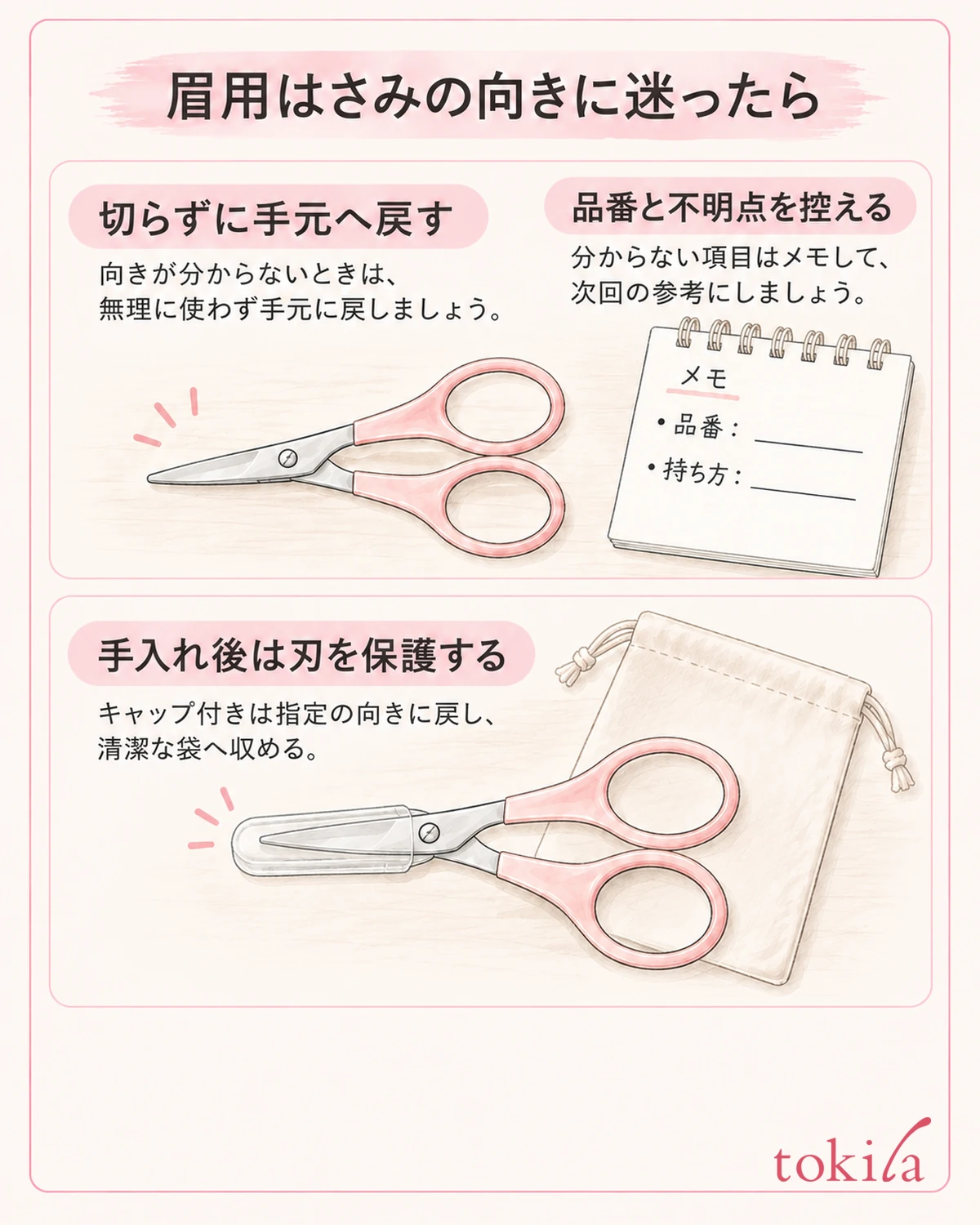
If the direction still isn't settled in the end, narrow what you don't understand down to one item. Noting separately whether it is the hand the body is made for, the position for your fingers, or how to attach the comb decides where to read the instructions next. Rather than summing it up as "I don't understand how to use eyebrow scissors at all," keep the model number of the actual item as well.
When you're in a hurry, you want to avoid checking while bringing the blades close to your face, or continuing to switch your grip in front of the mirror. On days when you aren't ready, put them away without cutting, and if needed, groom with the brow makeup you normally use. Don't make shortening the hair a required condition of that day's finish.
After use, keep them well away from your brows and face, close the blades, and check the care instructions. The way to remove stuck hair, the extent to which they can be washed with water, and how to dry them differ by product. Do not wipe by inserting a finger between the blades, or look only at the comb part and wash the whole body; care for them in the specified way.
If there is a cap, after finishing the necessary care such as drying, support the handle and return it in the proper direction. If the cap will not go in when you push it, don't add force; check that the blades are closed and that the parts are positioned as the instructions say. Store them so that exposed blades do not get mixed in with small items in your pouch.
When you consider buying a replacement, check first the hand you use, the handle that fits your fingers, and the functions you need, rather than color or appearance. It does not mean that comb types are always easy, or that everyone holds regular blades the same way. Choose a tool you can check in your hands and handle with an understanding of its direction and operation.
If you are unsure about the direction of eyebrow scissors, tell apart the type and the hand to use, and check the handle and opening and closing away from your face. For comb types, compare even the specification of the parts, and do not start cutting while anything is unclear. In this order, prepare in a way that suits the item you have.