When you put on a pair of pants, only the side pocket seems to gape open. It settles down when you press it with your hand, but the moment you let go, it bothers you again. In that case, don't jump to the conclusion that the size is too small. Check, in order, what is in the pocket, the fabric on the inside, and where you are wearing the pants.
Here we introduce how to review pockets whose openings near the hips lift away unintentionally. Some openings are cut at an angle, and some are made three-dimensionally. The goal is not to close every pocket perfectly, but to look at the shape of the garment together with how comfortably you can move in it.
1. Empty the pockets and compare in the same posture
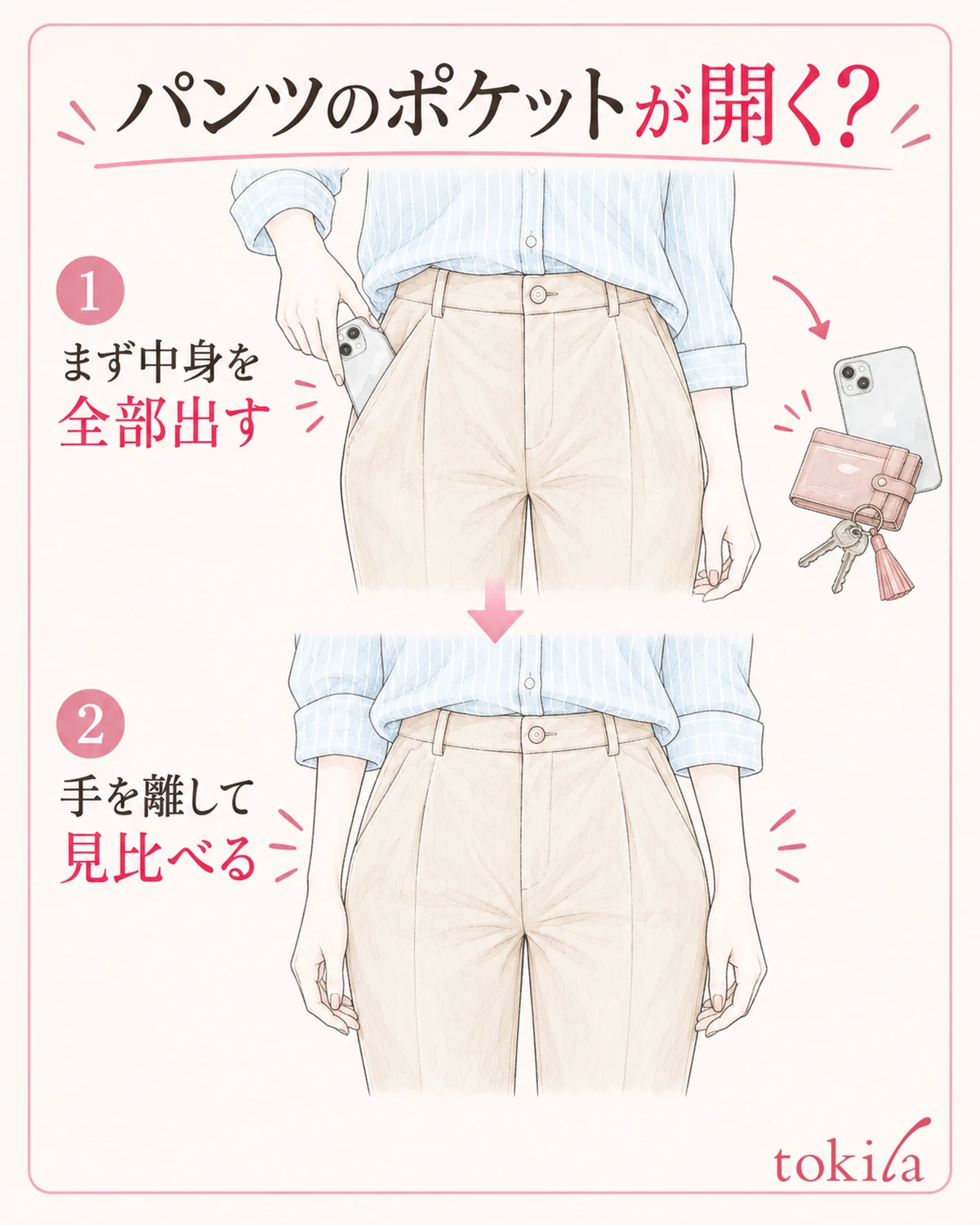
First, take out everything, such as your smartphone, keys and handkerchief, and set your belongings down in a safe place. Don't leave anything in just one side; make both sides empty. If you push the opening back into place with things still inside, you can't tell the bulge from the contents apart from the shape of the garment itself.
Stand naturally in front of a mirror with your arms down. Without twisting your body to one side or pulling in your stomach hard, look from the front and from an angle in a posture close to your usual one. The opening widens if your hand stays inside the pocket, so take your hand out when you check. If there is a difference between left and right, remember which side it is.
If the pocket settles down once you take things out, one idea for that day is to move bulky items into your bag. If you put thin items back one at a time and check, you can tell what bothers you when it is inside. Rather than thinking that packing the same number of items on each side will tidy things up, look for the amount at which the garment keeps its shape without strain.
If nothing changes even when the pocket is empty, stop fiddling with the amount of contents and move on to the condition of the fabric inside. It is enough to sum up what you saw in a short note, such as "even when empty, only the right side gapes" or "it changes only on the side where I put my smartphone." There is no need to decide at this point that it is because of your body shape.
Do the comparison with the same pants, the same inner layer, and the same standing position. If you also change the distance from the mirror or how your jacket hangs at the same time, it becomes hard to tell what made the difference. If a jacket covers your hips, arrange it first so that it is out of the way, and carry out the next checks under those same conditions.
For garments that have a zipper or a flap on the pocket opening, set their opening and closing to the state you normally use as well. Just because there is a part that can be closed, you do not need to push in bulging contents to shut it. Check that things can go in and out and that the fastener is not under strain.
2. Check whether the pocket bag on the inside is folded or caught
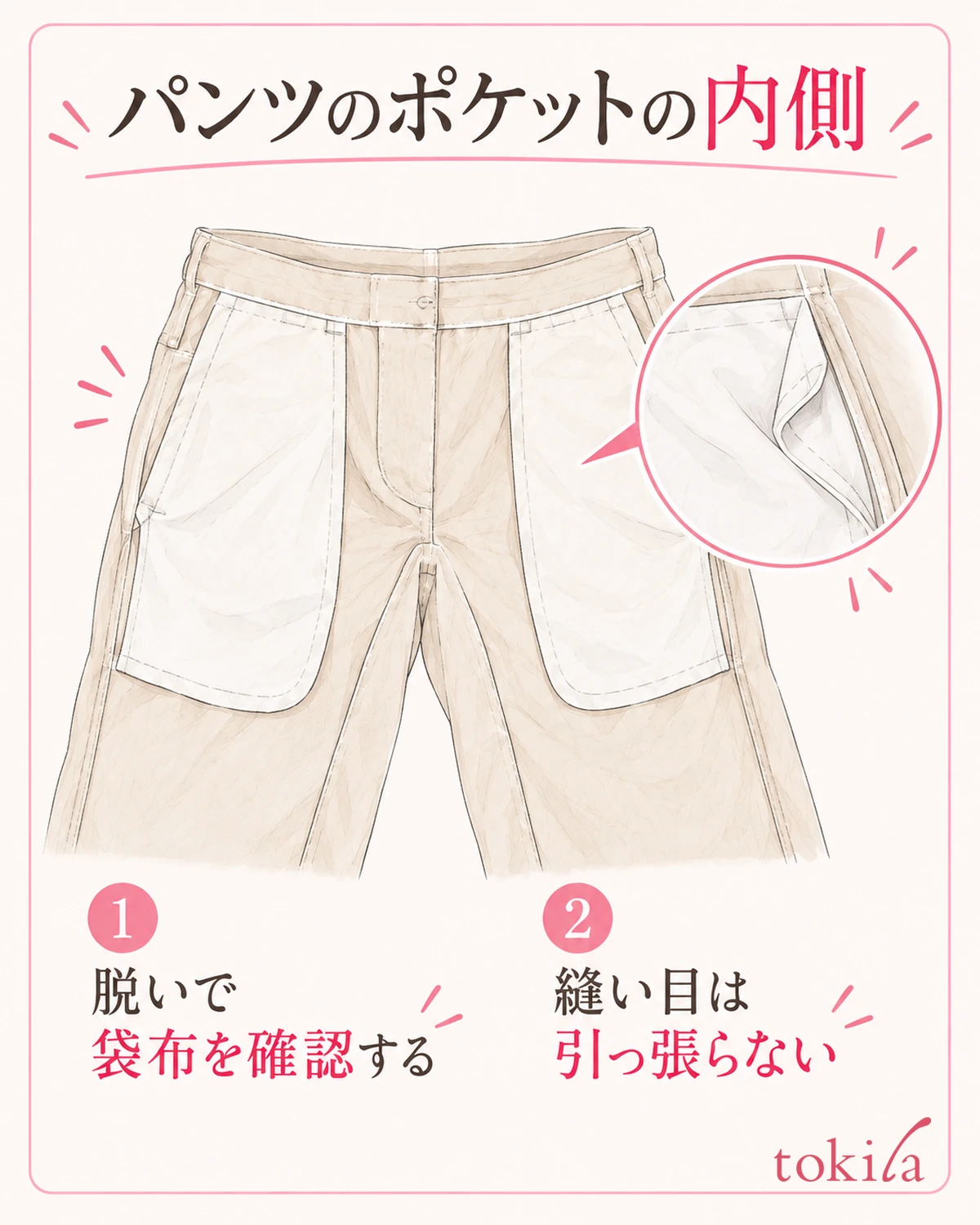
Inside the pocket is a bag-shaped piece of fabric for holding things. Take off the pants in a place where you can change clothes comfortably, so that you can see the inside. Rather than pulling it out forcefully while still wearing the pants, you can calmly check where the fabric is folded and what it overlaps.
If the inner fabric is twisted, its edge is folded back, or it has bunched up together with the hem of your shirt, don't pull on the sewn parts; just spread it out with your hands as far as it moves. Do not force it to stretch all the way to the bottom of the bag, and do not tug the outer pocket opening sideways. If you feel resistance after smoothing it, stop.
Some garments have part of the pocket bag fastened to the body. Be careful not to cut that thread thinking it is the cause of the twisting. How it is fastened inside and its shape differ from garment to garment. If you cannot tell whether it is a basting stitch that can be removed or a seam that keeps the structure, don't undo it on your own; set the check aside.
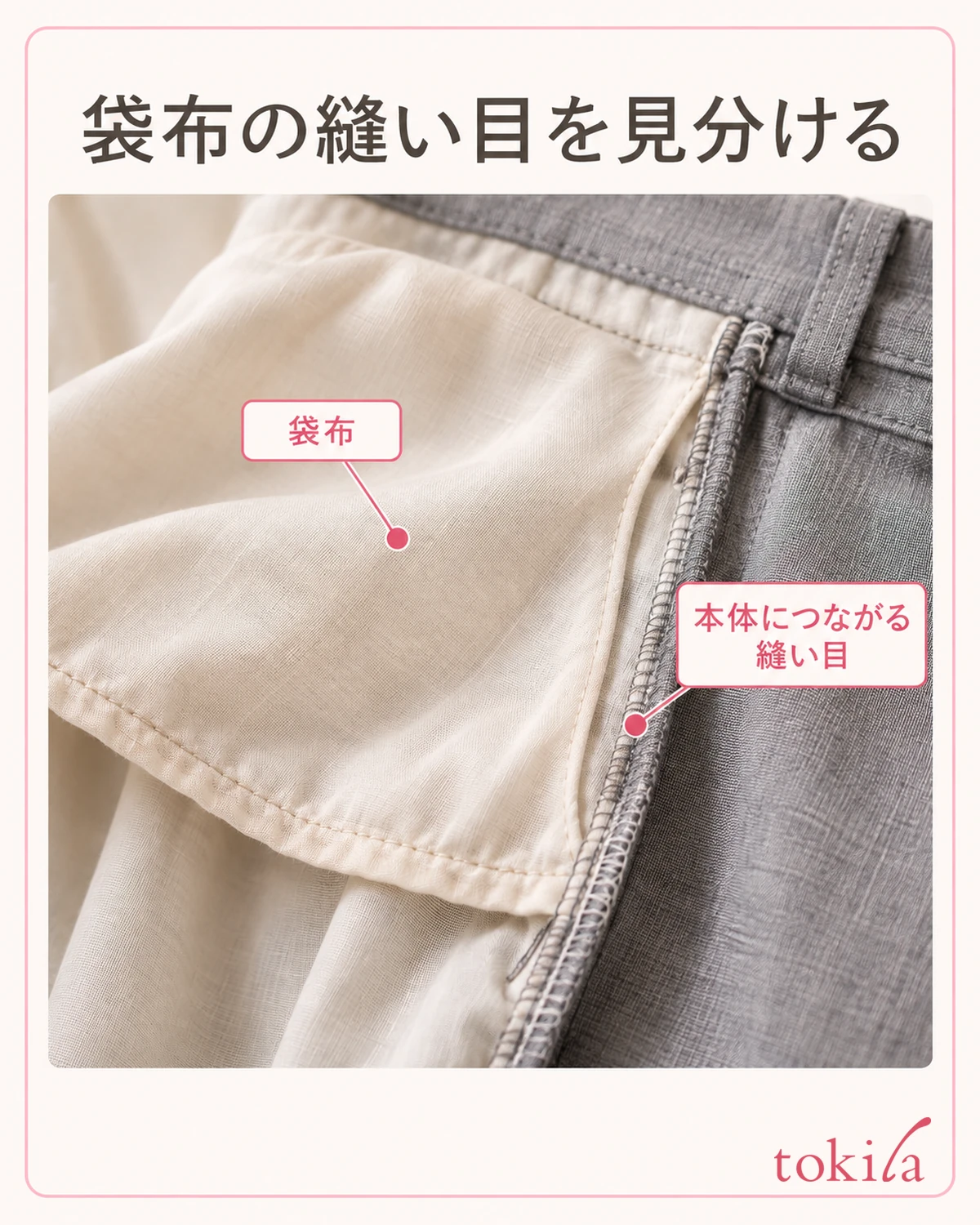
If you find a tear, fraying, or a seam that has come apart on just one side, don't try to fix it only by adjusting where you wear the pants. Take a photo, and move on to deciding whether to consult a repair service or choose a different pair of pants. We do not recommend closing the pocket opening with a safety pin or an adhesive to hide the pulling when you move.
Once you have smoothed the inside, first put the pants back on with nothing in them. See whether the pocket lies flat only while you press it with your hand, or whether it stays in place when you let go. If nothing changes, don't keep pulling out the pocket bag; check the position around the waist next. Before changing the shape by washing or ironing, finish the checks you can do while the garment is dry.
When comparing left and right, also look at whether the pocket bags are made in the same shape. There are cases where the construction is different from the start, for example when only one side has a small inner pocket. Don't try to match only the amount of visible fabric; stop at the point where you have returned it to a state without folds or tucked-in parts.
3. Restore the waist position and the overlap of tucked-in clothing
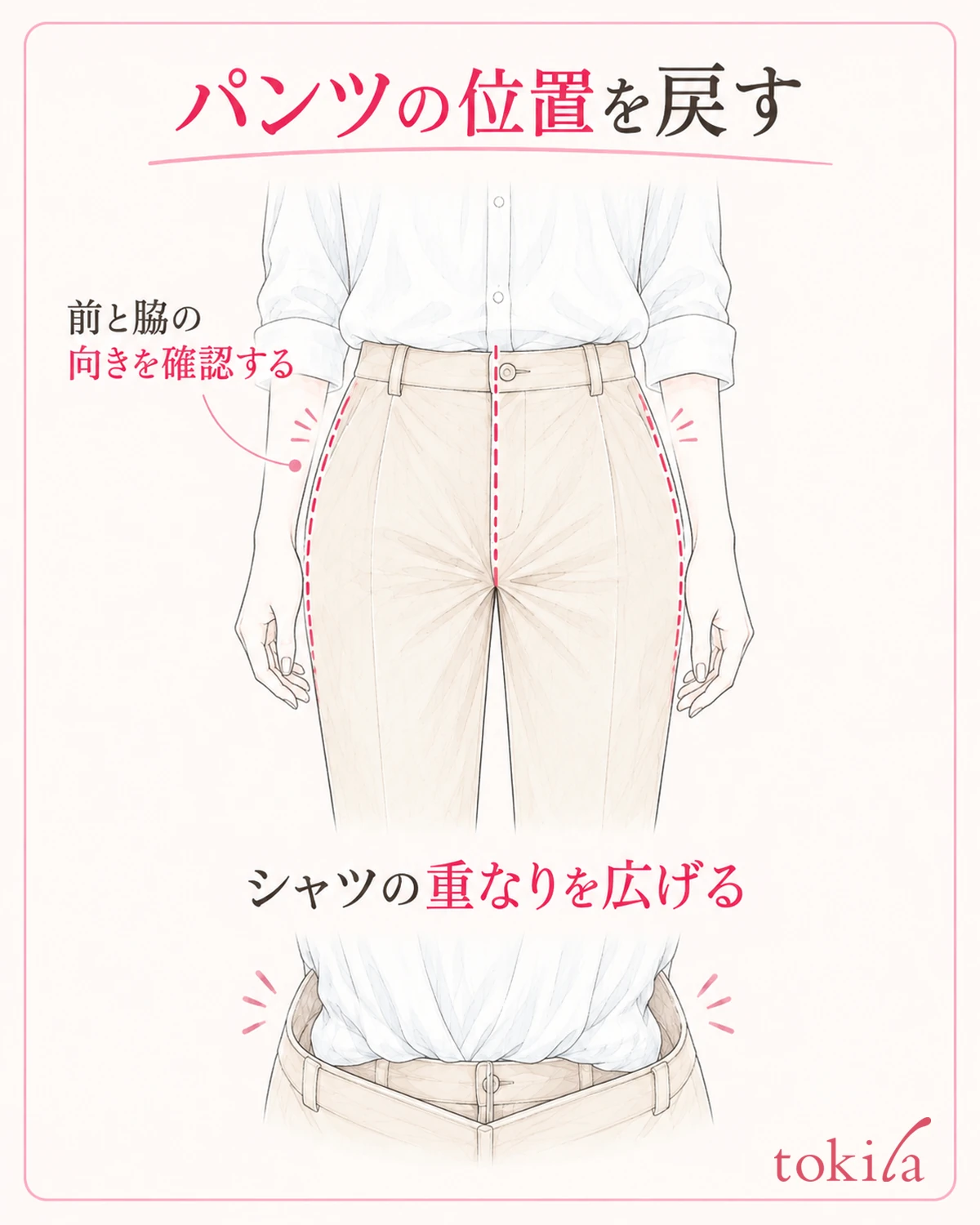
Look at the center front of the pants and the left and right side seams, and check whether the whole garment has rotated at an angle. In a place where you can adjust your clothes, loosen the fasteners only as much as needed and return the garment to the position where it naturally sits. Rather than lifting just one pocket to line it up, look at the orientation of the pants as a whole.
If you force down a garment designed to be worn high, or pull up a garment meant to sit low, another area may become tight. Rather than treating one position, such as "right here on the hip bone," as the correct answer for everyone, use as your guide the position where the shape of your garment and its fasteners sit without strain.
If you have your shirt tucked in, also check whether the hem has bunched up behind the pocket. Loosen the fastener, spread out the fabric, and undo the overlap that has been pushed into one spot. If how you tuck in the hem itself bothers you, please check how to review your shirt hem separately.
If you wear a belt, don't try to close the opening by tightening it hard; look at it in your usual comfortable state. If wrinkles gather around your hips only right after you tighten the belt, return it to how you wore it and check again. Even when the pocket settles only if the pants are so loose that they would slip down, don't try to solve it by position alone.
After you close the fastener, check that it does not get in the way of your breathing or small movements. It is important not to keep holding in your stomach for appearance's sake, or look in the mirror while pulling on the fabric. If the pocket stays open even after you restore the position, record that result and move on to the sitting check.
4. Try sitting and standing, and look at the surroundings as well as the pocket
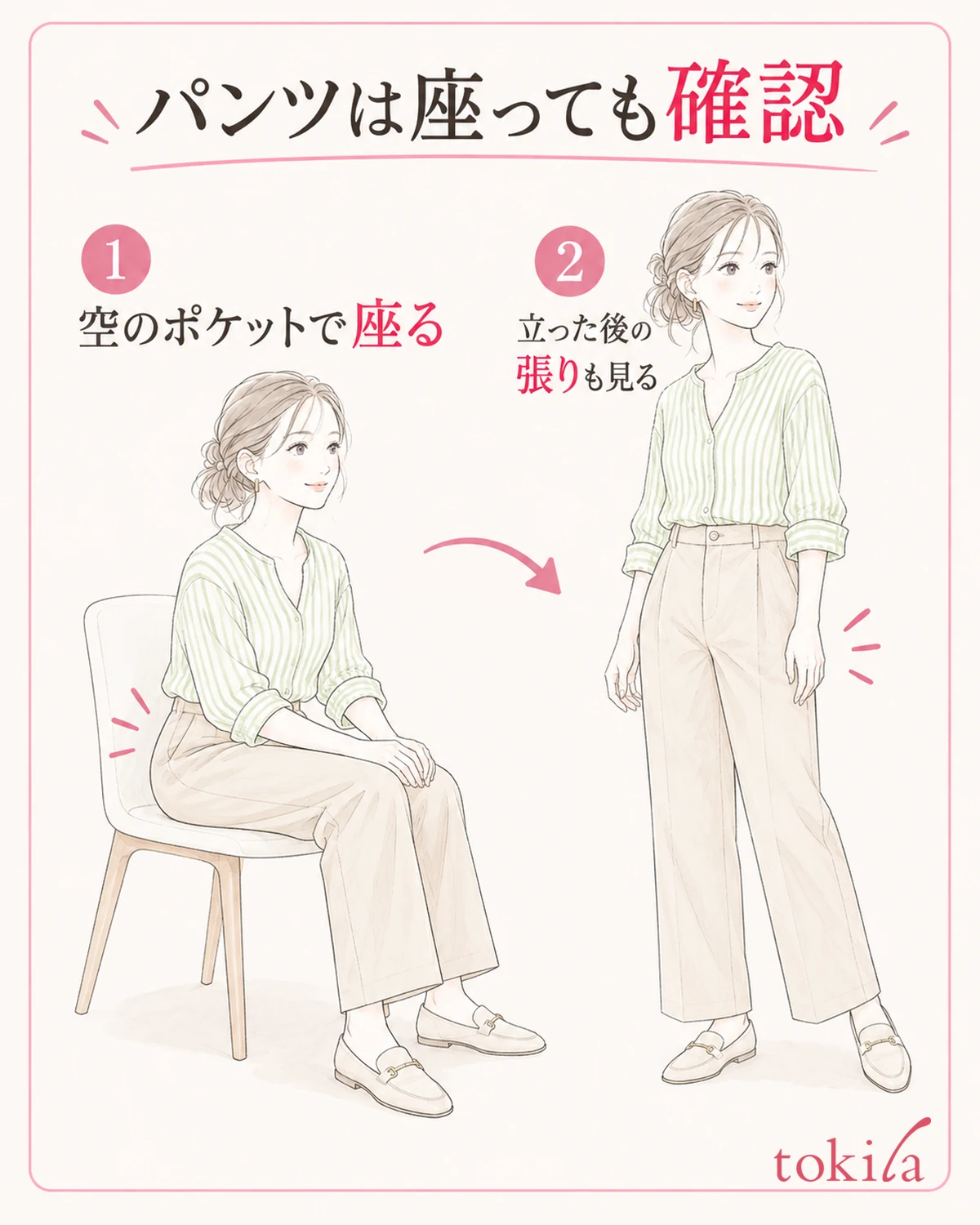
With nothing in the pockets, sit on a stable chair the way you usually do. There is no need to crouch suddenly or force your legs apart. Check the area around your hips, the front fastener, and how easily your thighs move, and if you feel tightness or strong pulling, stop that check.
If the pocket opens only when you sit and returns to normal when you stand, don't conclude from that change alone that the garment is defective or the wrong size. Clothes change shape as you move. Separate from your preference for appearance whether there are real problems, such as things falling out easily, the pocket bag poking out, or the pants being hard to sit in.
After you stand up, lower your arms again and look in the same posture as at the start. Check not only the widening of the opening but also whether strong horizontal wrinkles or diagonal pulling remain around it. Don't pin down the cause from a single wrinkle; also judge by how it feels to wear, such as a fastener that is hard to close or a snug feeling when sitting.
When you look at the difference between left and right, avoid comparing with only one leg stepped forward. Reposition your feet naturally and check from the same angle. Don't arch your back to make the shape look better or hold the opening with your hand; the point to check is whether you are satisfied with it when you let go.
If you put the things you usually carry back in, do it after you have finished checking with the pockets empty. If you separate the steps, such as putting one item back and sitting, then standing and looking, it is easier to tell the ease of the garment apart from the effect of what you carry. Don't repeat it many times trying to stretch the fabric; stop once you know under what conditions it causes trouble.
5. If the gaping remains, compare differences in shape as well as size
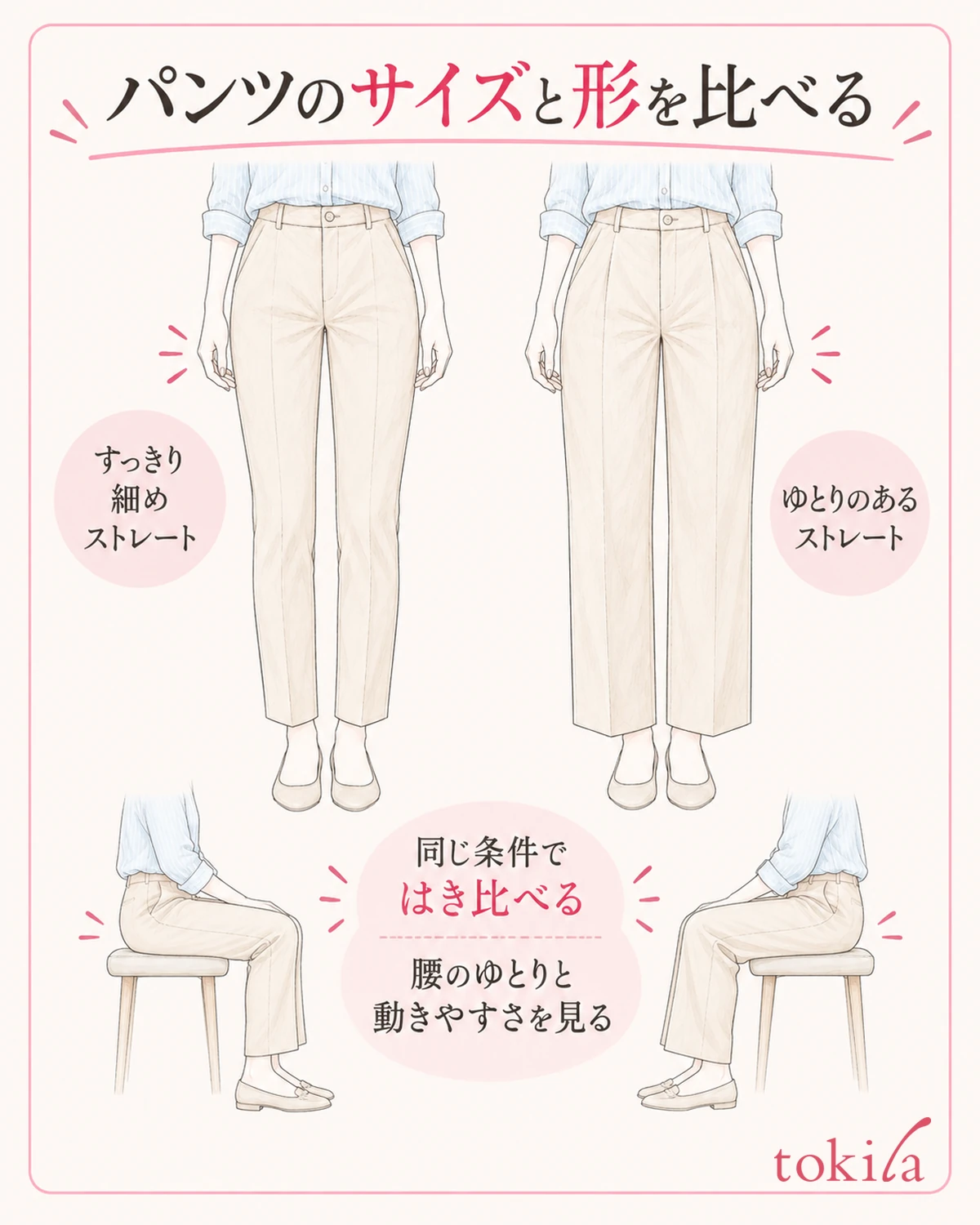
If it still bothers you after checking the contents, the pocket bag, and the position, compare with pants of a different size or shape. Don't choose on the assumption that going up one size will definitely fix it. Even if the area around your hips becomes more comfortable, the waist may slip down, so you need to look at the overall fit together with your movements.
If you can compare, try separately the same style in a different size and a different style with about the same measurements. Don't line up many pairs at once; with your current pair and one candidate, keep the same order: empty pockets, the same inner layer, then standing and sitting. Don't decide how comfortable they are just by whether they have tucks; look at the actual room at the hips and thighs.
When you look at measurements, don't confuse numbers that describe the body with finished measurements taken from the garment itself. Even with the same size label, measurements differ from product to product. When you compare with a pair of pants you find easy to wear, also match the points where you measure not only the waist but also the hip, the rise, and the thigh width.
Even if the finished measurements are close, how it feels to wear changes with the thickness and stretch of the fabric and the size of the pocket bag. Don't assume that the same numbers mean the same shape; use the size chart as a guide for narrowing down candidates. If you compare at home, check the return and exchange conditions first, and confirm only within what you can try on without removing the tags.
Pockets also differ in shape. With an angled opening, a nearly vertical opening, or a bag sewn on the outside, the visible lines and bulges are not the same. If the pants already have a three-dimensional look when you take them off and lay them flat, don't treat that as a failure of wearing them; separate the original shape from the changes that appear when worn.
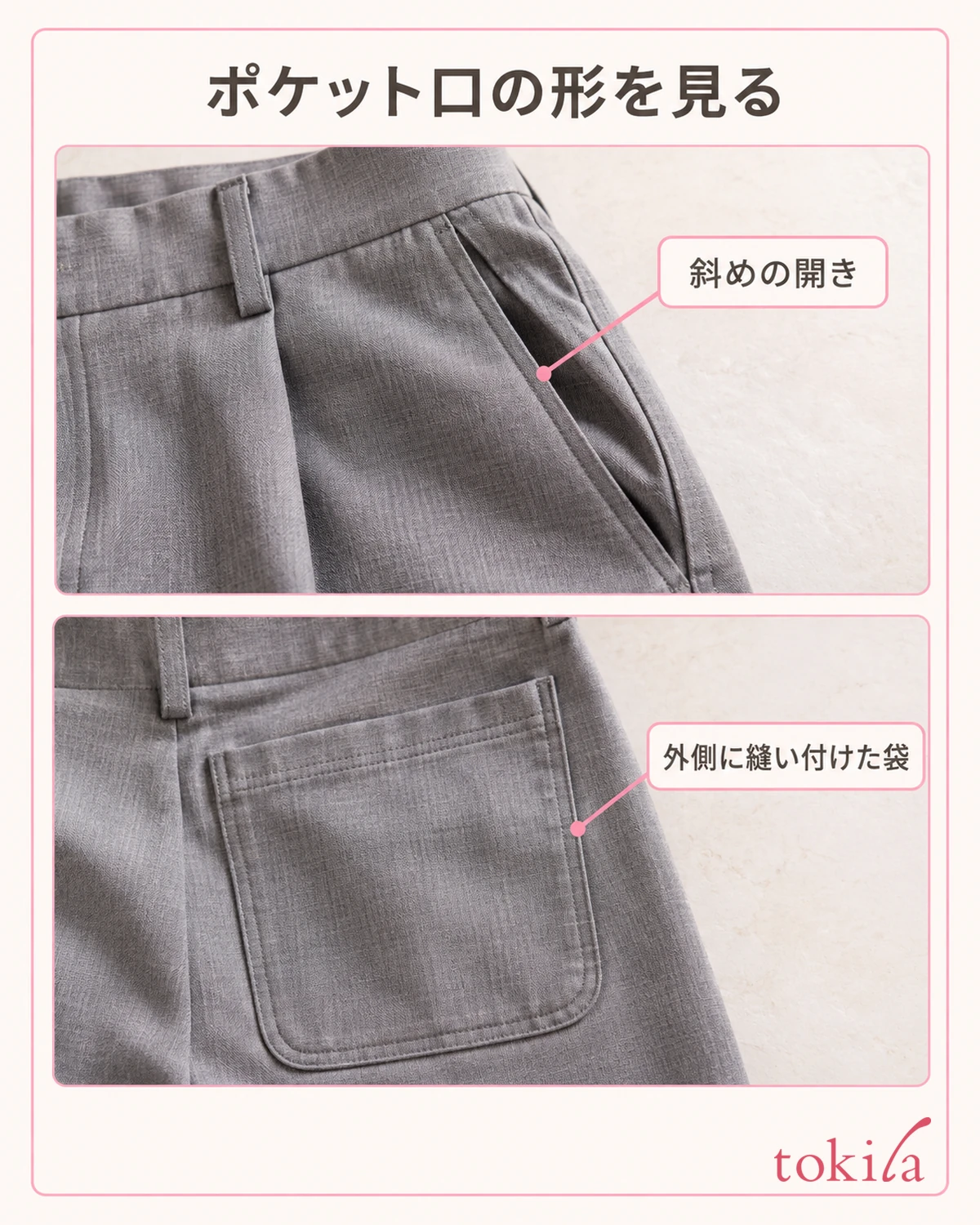
If you like the shape but only one side keeps lifting, consulting someone about sewing it down or repairing it is also an option. Before sewing the opening shut yourself, sort out whether you need to put things in it and whether it pulls when you move. If you decide to buy a replacement, first look back at fashion know-how and the clothes you already own, and make the conditions that trouble you specific.
A record for next time can be a short sentence such as "it settles when empty," "it changes when I undo the bunched hem," or "my hips feel tight when I sit." Rather than closing the pocket opening completely, value that the things you want to carry fit without strain and that sitting is not uncomfortable, and choose between adjustments you can make with your current clothes and the decision to change garments.