When the mesh of a face powder moves, it can be hard to tell whether it is coming loose or is a part that is meant to move. Before you try to push it back, look separately at the mesh that lets the powder through, the tray that holds the puff, and the outer lid. Even among similar-looking containers, the way the mesh is set in and the parts used for refilling are not the same.
This article covers loose face powder and sorts out preparation before opening the container, checking the parts, how to pick up the powder, refilling, and putting it away. Match the names in your product's instructions with the actual parts, do not take apart or repair anything that is not specified, and check at which stage it became hard to use.
Look at the mesh, the inner lid, and the puff tray separately
First, clear a flat place where you can set the container upright. If there are small items around, it is easy to lose track of removed parts or spilled powder, so tidy your work surface before opening the lid. Rather than lifting the container and pulling at the edge of the mesh, look from above to see where the powder comes out.
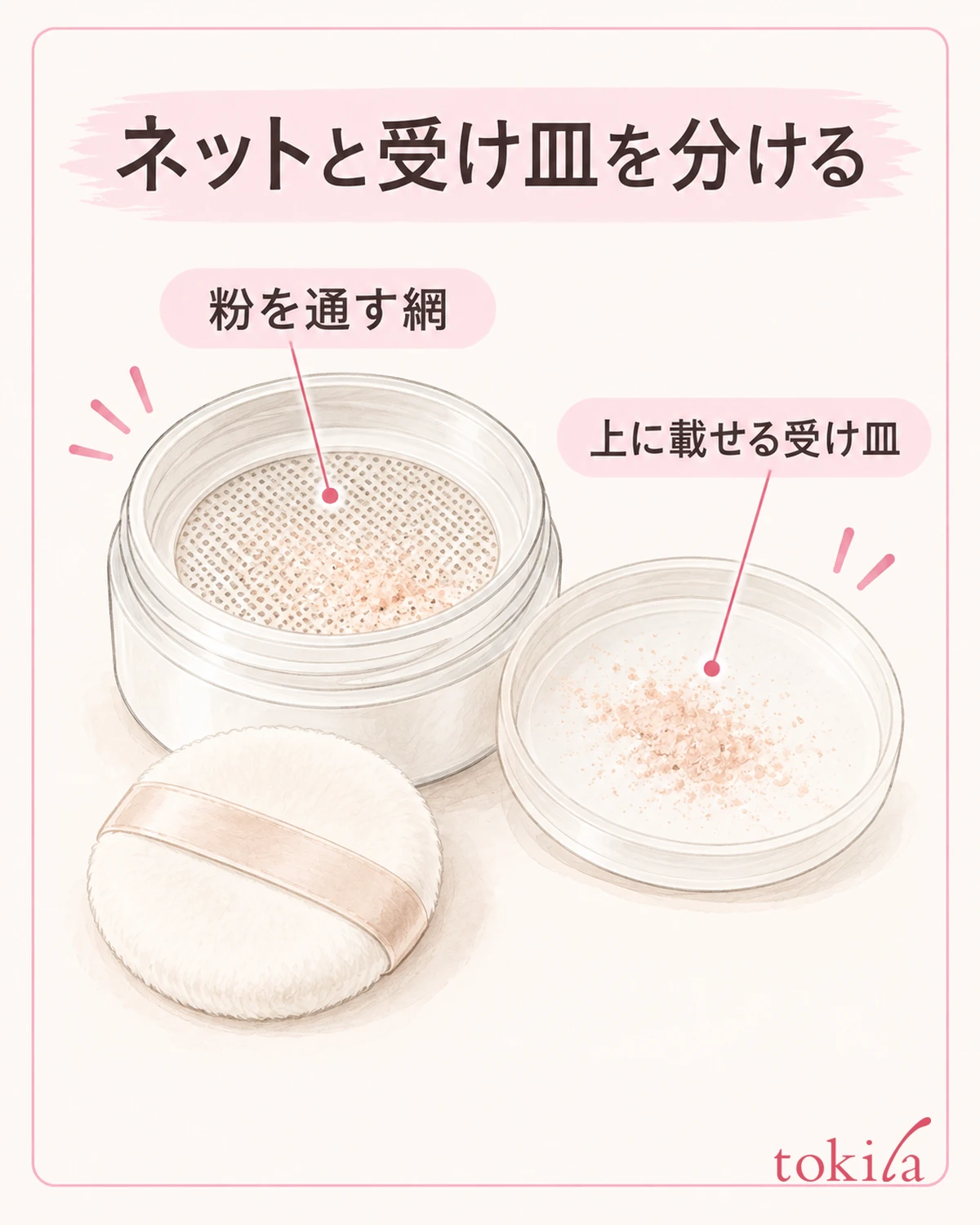
The surface where fine threads cross and let powder through is the part called the "inner mesh" or "mesh." Some types, on the other hand, use a hard inner lid with holes in it. Even if there is a pattern that looks like a mesh, it is not necessarily made of soft threads. It is important not to decide how to press it or remove it from looks alone.
The flat tray or inner lid placed over the mesh is a separate part from the surface that lets powder through. There are also cases where the tray moved along when you lifted the puff, and it felt as though the mesh had come off. Check which part lifted, dividing it into two: the surface with the powder and the surface where the puff rests.
Also match which part your instructions mean by "inner lid." Even when the names are similar, it can refer to a part with a mesh or to a plate that covers the top of the mesh. If you match the shape in the diagram, the knob, and the position where it sits, you can avoid applying the steps for a different container.
The aim at this stage is not to look for a removable part and pull it out. It is to confirm the name and role of the part that moved. Do not judge that it is removable just because the edge of the mesh is visible; compare the instructions that came with the container, or the packaging you have kept, with the actual product.
When you compare removed parts, rather than touching them with a finger to feel the difference, look from above and at an angle in a bright place. A fine mesh looks like a single surface from the front, but if you change the angle it is easier to follow the crossing of the threads and the thickness of the frame. There is no need to scrape with a fingernail to expose a part hidden under a lot of powder.
If the mesh moves, check whether it is a structure that sits on top or one that is fixed in place
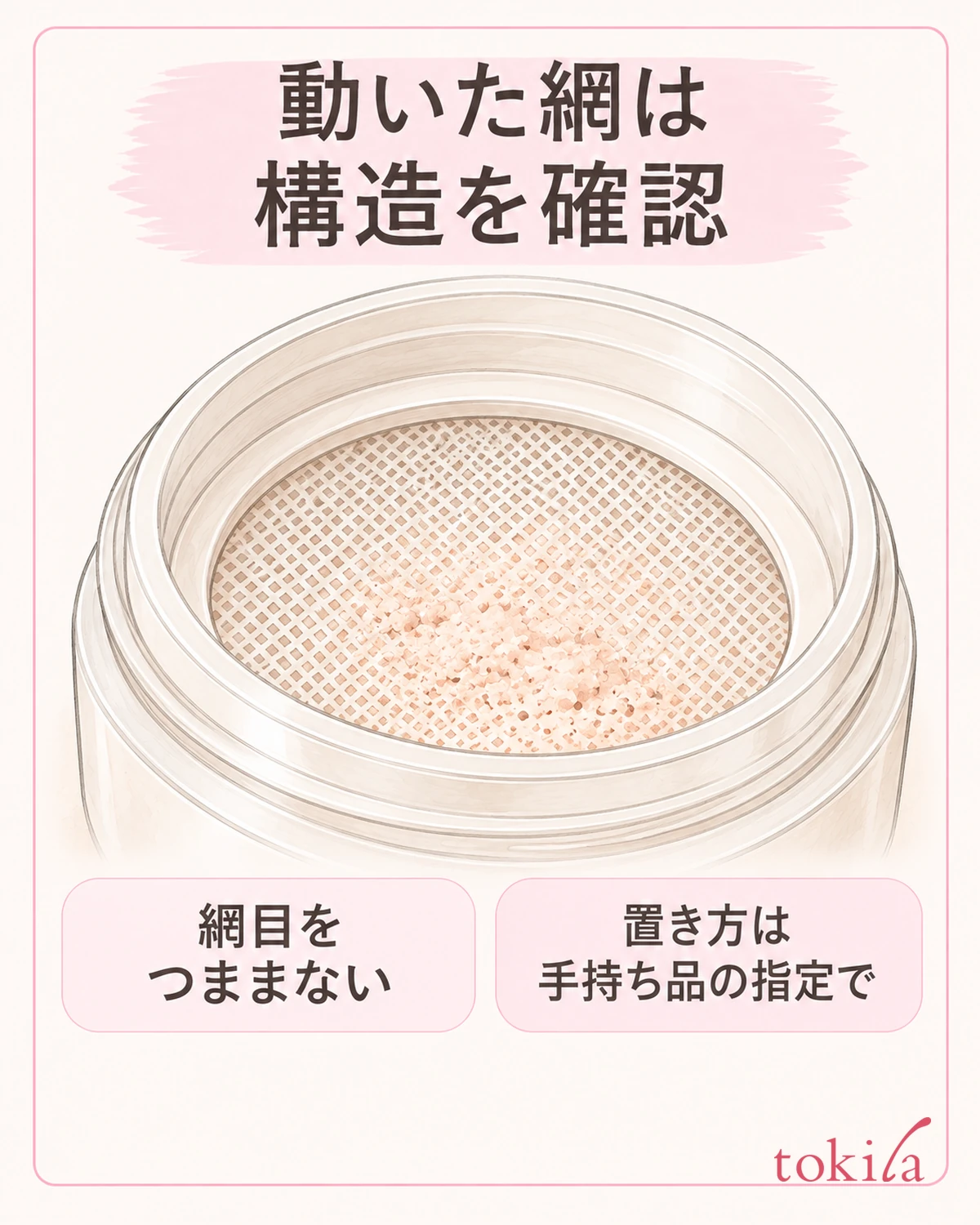
Some structures are used with the mesh placed directly on the powder, and others have the mesh built into the opening of the container. You cannot treat the way the former moves as the same as the latter coming loose. First stop picking up powder, and check in the instructions where the mesh is meant to be placed and what is specified about removing it.
If the instructions describe a method of "placing the mesh on the powder," check where to place it according to that product's steps. Do not think that you need to force the rim of the mesh into the case or add adhesive to fix it. Sort out first the difference between a set-on type and a snap-in type.
For a container in which the mesh is stretched over a frame, look separately at the mesh itself and the hard frame around it. From an angle, you can see that the surface where the threads cross and the raised edge of the frame are different parts. This is a check for seeing the structure, not a signal to put a fingernail or a tool into the step of the frame to remove it.
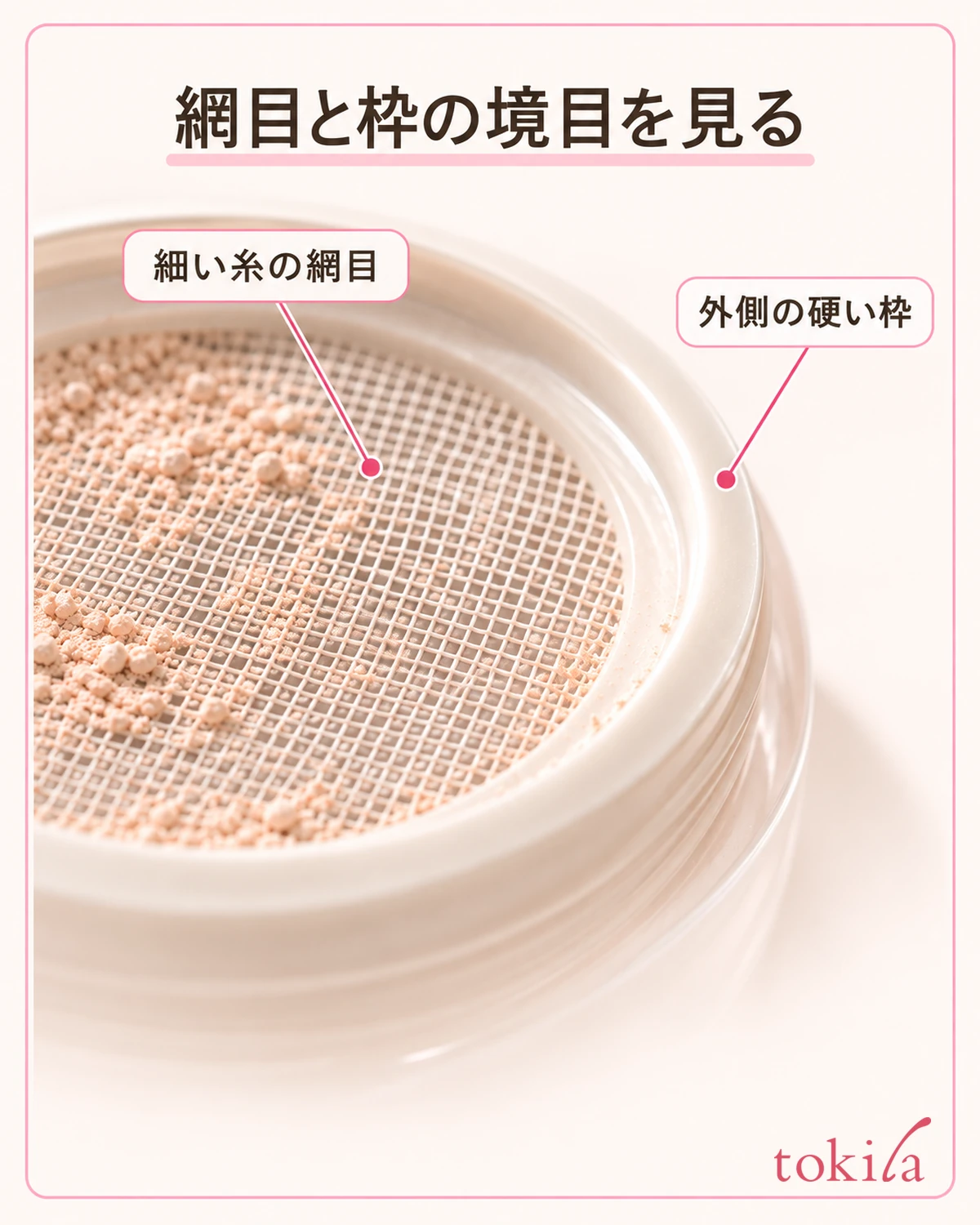
If you see a condition different from before, such as one side lifting, a cracked frame, or broken threads, do not keep pressing on it. If you do not know the steps for removing and fixing it, keep the container and parts so that they can be checked. Avoid spreading out a torn mesh and continuing to use it.
The example of another container where "it went back when I pressed it lightly" does not settle the correct way to secure your own product. Handle it as the instructions say only when you can confirm the order and position of the parts. When you do not know the correct position, the next step is to stop taking out powder for the time being.
As far as you can tell, also sort out whether it has moved since you started using it or began moving after being dropped. This is not to declare it defective or normal from memory alone, but to give you a lead for explaining what has changed from before. Do not carry it around in an opened state; store it so that no part is lost, and then check it.
When picking up powder, do not press the mesh hard; check the state of the puff
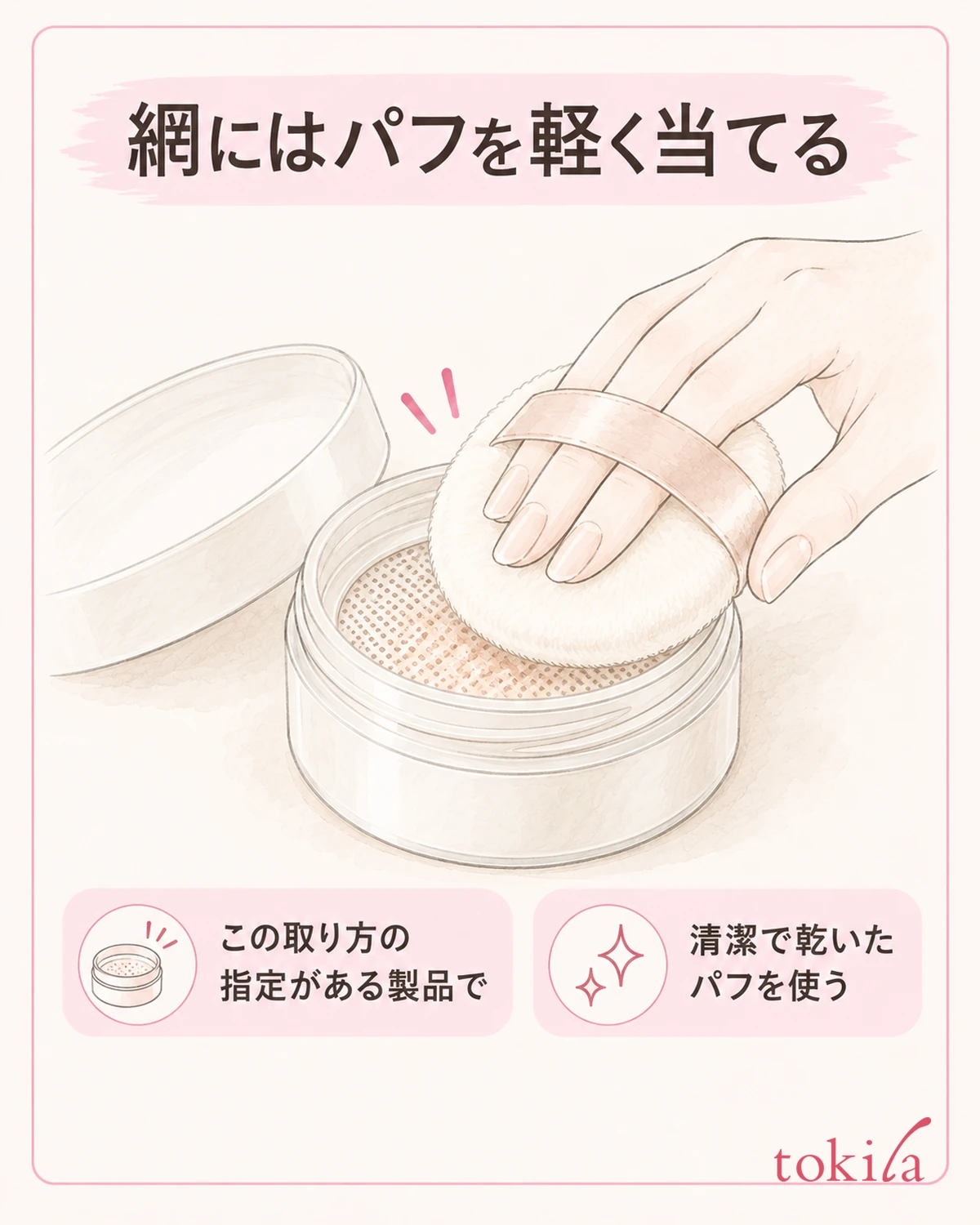
For products where you lightly press the puff against the mesh, follow that way of picking up the powder. Even if there seems to be little powder, do not push as if sinking the mesh to the bottom, or jab the same spot hard many times. Check the amount you picked up with the puff, and if it is not enough, pick up a little more at a time by the specified method.
The step of "turning the container upside down" for products that release powder through an inner lid with holes cannot be applied across the board to mesh types. Before turning it upside down, check whether that operation is written for your product. Give priority to the structure of the part that lets the powder through and the method of use, rather than to the container looking similar.
Review the usable surface of the puff as well. A dirty puff may take up powder less well. If the previous product is conspicuous on the surface or the fibers have clumped together, do not try to fix it by pressing even harder on the mesh; check the instructions for caring for or replacing the puff.
If you use a washed puff, put it back only after it has dried thoroughly. Pay attention not just to the surface but also to dampness when you hold it with your fingers, and to the overlapping parts. Do not press a damp puff onto the mesh, or add water to the mesh or the powder itself, to try to make it easier to pick up.
Think of the mesh moving and the powder being hard to pick up as separate matters. First check that the parts are in their specified positions, and then review the state of the puff and the amount of pressure, and you will be able to tell what changed. For adjusting the amount after the powder is on your skin, you can also refer to the steps for reviewing when you apply too much face powder.
For refilling, first separate the parts you keep from the parts you replace
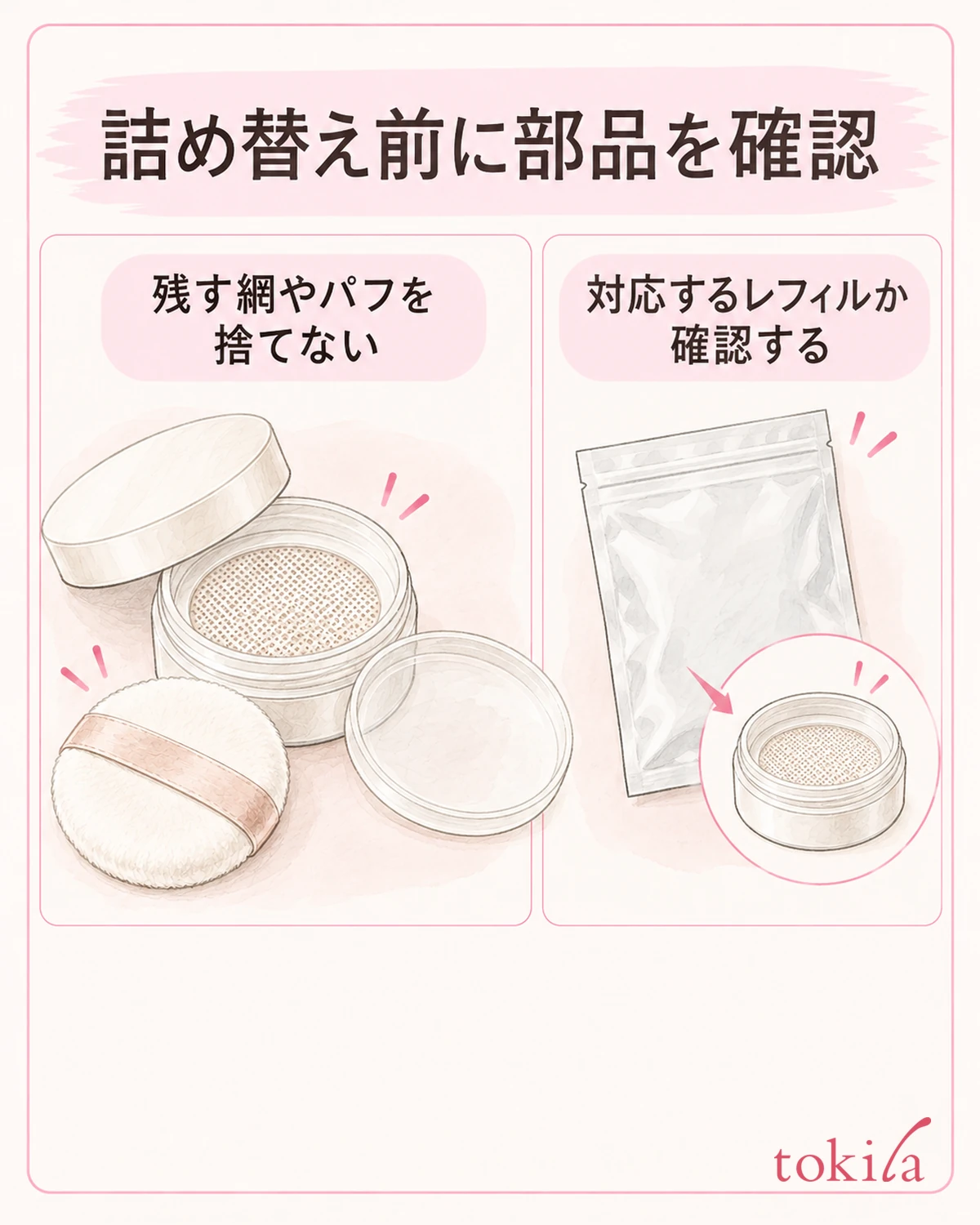
If you plan to use a refill, before you use up the powder and hurriedly take things apart, check which refill corresponds to your main body. Even with the same brand or a similar size, it is not necessarily usable with that container. Match the name of the case you have with the compatible products listed on the refill.
For products where the mesh or puff does not come with the refill, you may continue to use the parts you have. Do not throw them out along with the powder just because they are left in the container. The key is to check what is included and what you keep before opening the new bag.
Handle only the parts that the instructions specify for removal, in the order given. If the place to hold is shown in a diagram, use that position, and do not pinch and lift the threads of the mesh. Do not judge that a gap in the frame is a groove for removal just because it is there.
Place removed parts on a clean, dry work surface in a way that shows which way they were facing. Avoid putting them directly on a surface where powder has spilled or on a wet sink. If there are several parts, such as the outer lid, puff, tray, and mesh, lining them up in the order you actually removed them lets you check when you put them back.
If, partway through refilling, you notice that the shape does not fit, a part is left over, or the lid will not close, do not force it; recheck the compatible product and the order. Rather than switching to methods such as mixing it with other leftover powder or reusing the mesh from another container, review whether you can finish the work with the specified combination.
For a product you do not refill, you do not need to imitate this process and remove the mesh. Whether to wash used parts also follows the product's instructions. Do not judge that, because the puff can be washed, the main body containing powder or the frame with the mesh can also be washed with water. Separating the parts you can care for also becomes preparation for putting things back.
When you finish, check the order of the inner lid and puff before closing
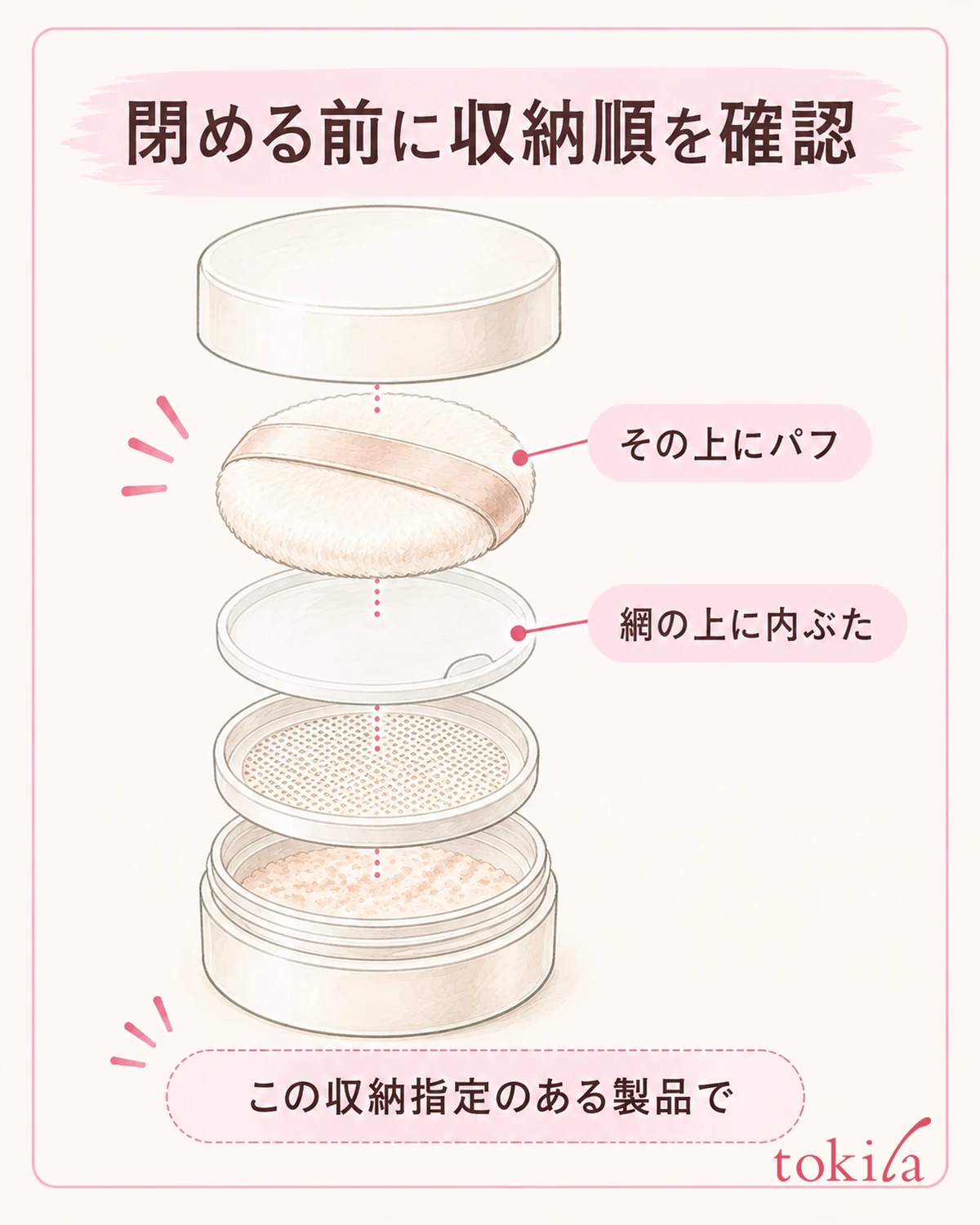
At the end, before putting the puff in, check whether there is a tray or inner lid to put back on top of the mesh. Some products specify closing the outer lid after placing the puff on the inner lid. Rather than closing the lid by pushing the mesh down with the puff, return the parts in the storage order for your product.
If you look at the edge and bottom of the tray from an angle, you can confirm that it has no fine holes like a mesh and has a surface for the puff to rest on. This helps you tell apart the mesh that lets powder through from the part that covers it. Do not think that because it is a shallow dish it can stand in for the mesh, and do not throw it away as unneeded packaging.
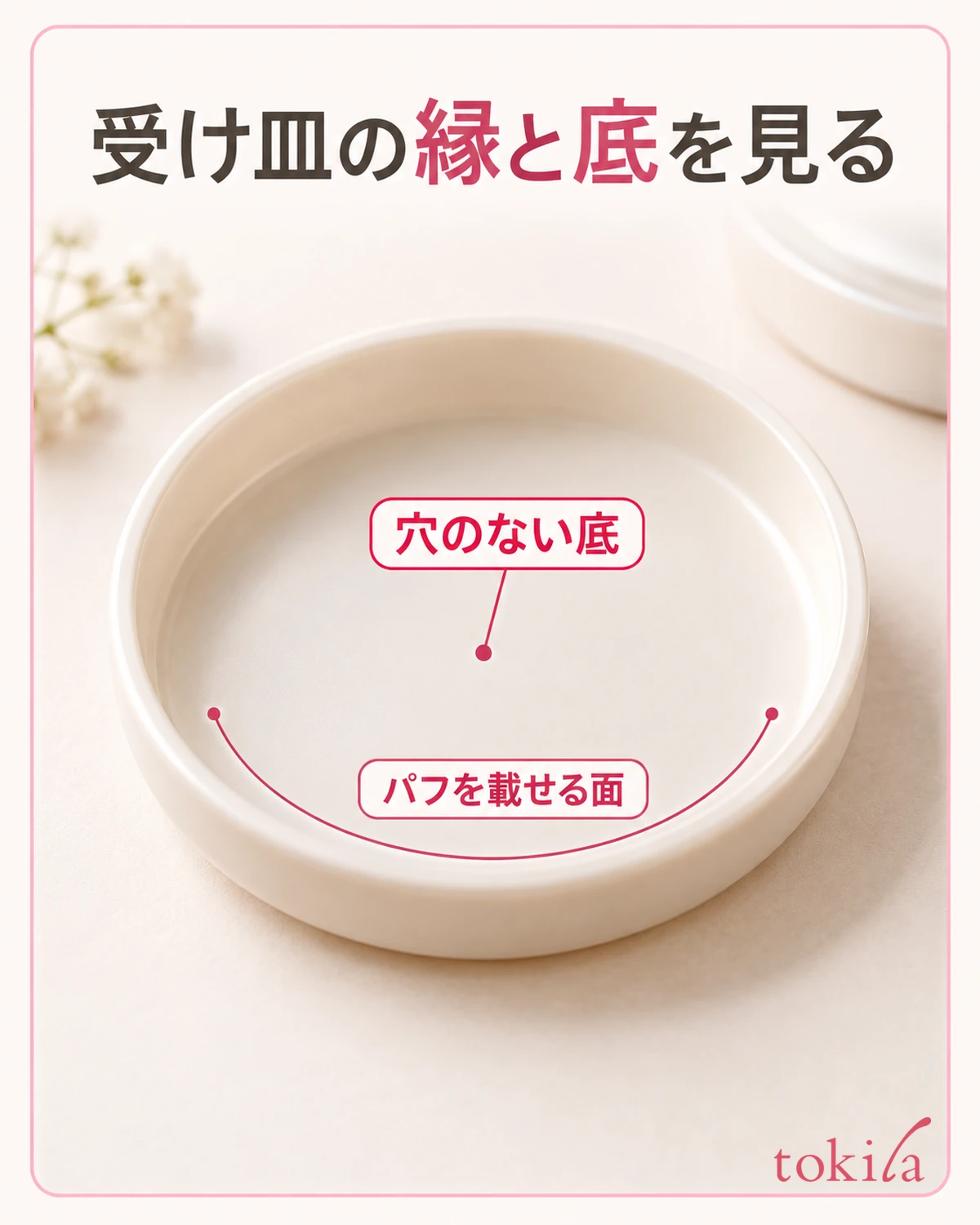
If the lid stops partway, put it back for the moment and look at the positions of the puff and tray. Check by eye whether the edge of the cloth is sticking out, or whether any part is sitting at a slant. Even if it closes when you remove a part, do not leave out the specified inner lid and carry it around.
After closing, it is also important not to confuse the motion of shaking to release powder with the direction of storage. With some products, tilting the container in storage or a shock can leave a lot of powder stuck on the inner tray. Check your product's storage instructions, and if it says to avoid direct sunlight, high temperatures, or high humidity, return it to a place that meets those conditions.
If the same part shifts again the next time you use it, check separately at which point it moved: at the start of use, after picking up powder, or just before closing the lid. Use as your guide whether you understand the structure, whether you can return it to the specified position, and whether you can store it without applying undue force, and decide whether to continue or stop.
When you move a small container to another pouch, put it in after checking that the lid has closed. On a day when you are concerned about the mesh moving, it is also helpful to look at where the powder is after carrying it, so that you can separate changes during picking up powder from changes during transport. Do not immediately conclude that the mesh is broken just because an unusual amount of powder has stuck to the tray; check first.