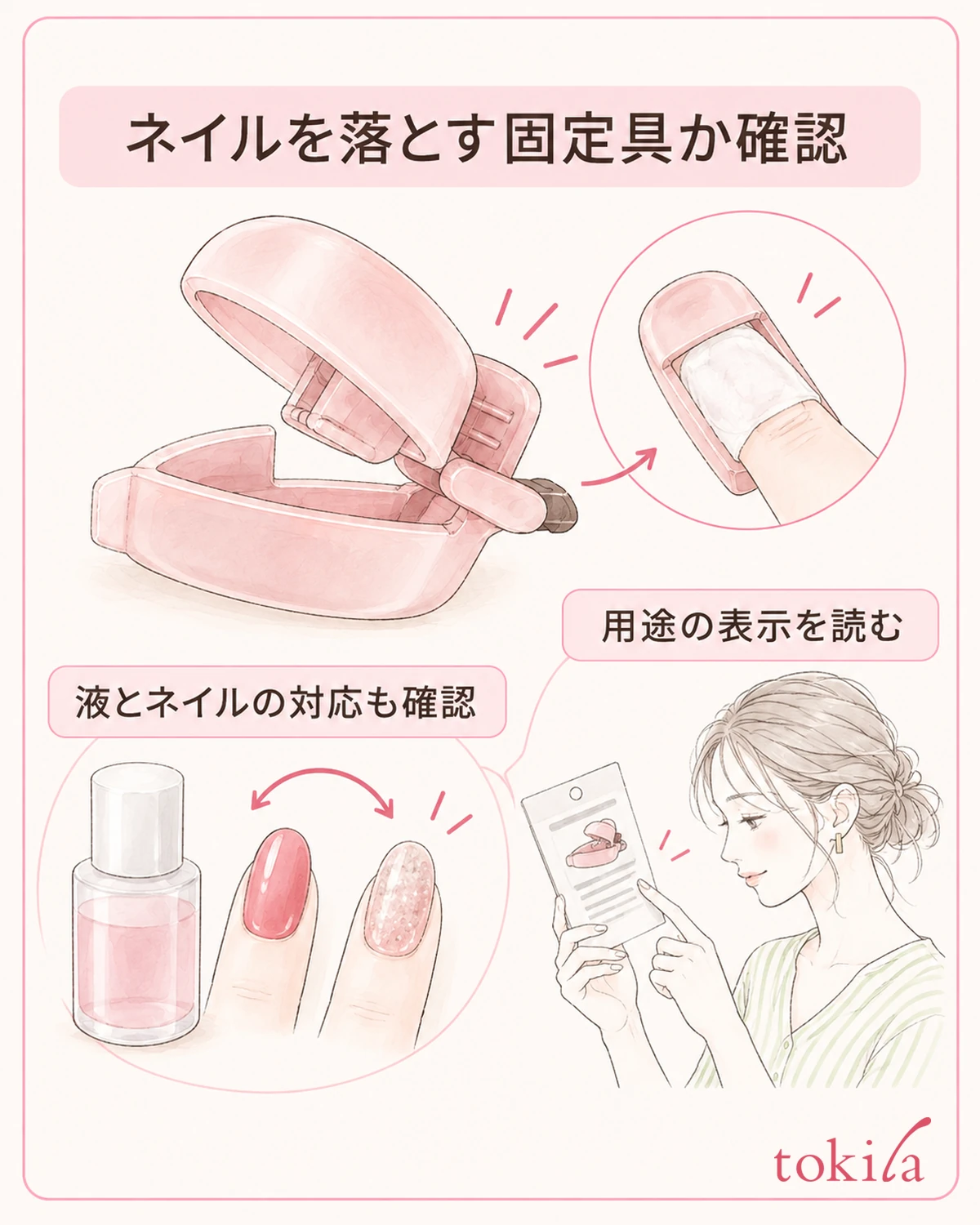
After using toner and emulsion, you can no longer tell which of the two caps lined up in front of you is the original pair. Choosing whichever one closes seems fine, but even if the outer diameters are similar, what has stuck to the inside is not necessarily the same. Stop for a moment and check the body and lid one pair at a time.
This article covers what to check when you have mixed up caps removed from skincare containers, and how to set them down so they do not get mixed next time. It is not about reusing a container with a different product in it, or about repairing parts. If another product may already have touched, it is important not to resume use just by putting the lid back on.
1. Before Closing, Check the Body and Its Original Cap One Pair at a Time
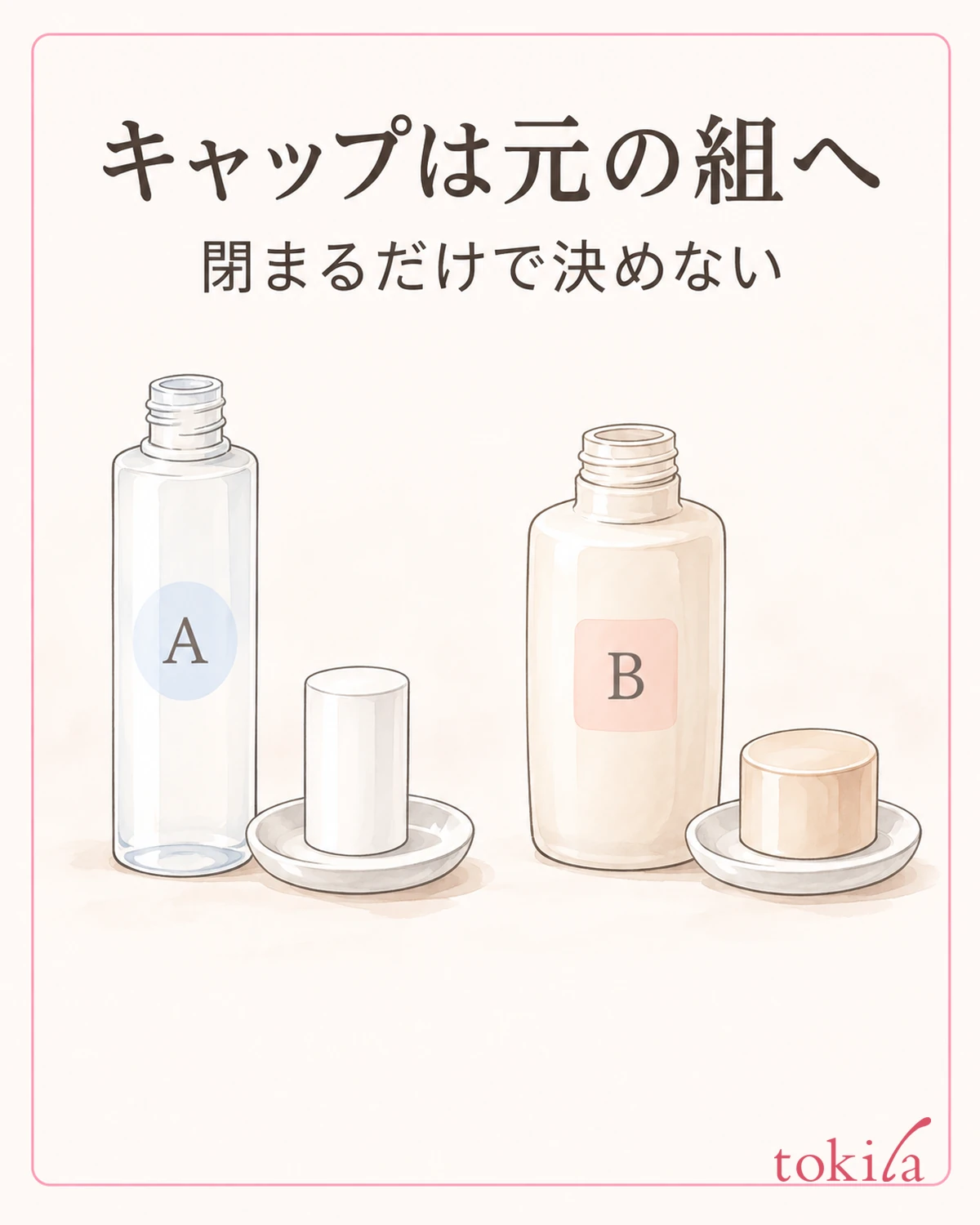
First, set the product that is open now on a stable surface. Avoid trying similar lids one after another while holding the body that contains liquid. Look over the body, the removed cap and the outer box and instructions within reach, and recall which products you opened and in what order. You do not need to open products that are still closed just to compare.
What you match is not just color or size, but information that confirms the original pair. Use clues such as a record you kept of the body and cap photographed together, packaging you have kept, and how things were arranged just before use. Do not extend your own memory that "the white lid is for the emulsion" into a rule that holds for other series.
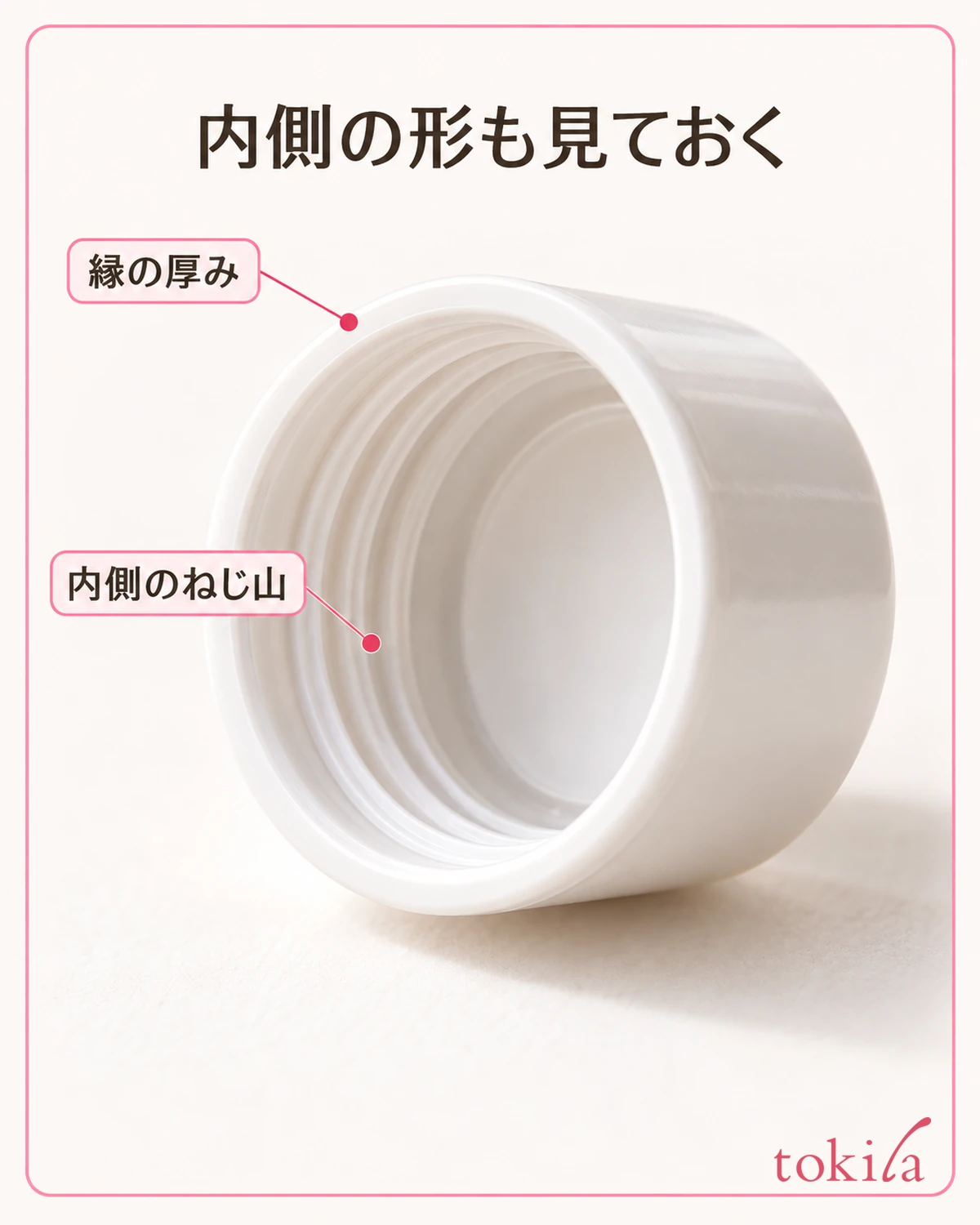
The mouth of the container and the inside of the cap have threads, steps and plug-like protrusions. Even if they look alike on the outside, the inside shape may differ, so check what you can see on the table. This is not a test to judge a fit from shape. That the dimensions are close, that it turns partway or that it makes a sound is not, by itself, evidence of the original pair.
Group only the items whose original pair you know into a separate area, and keep them apart from those you cannot identify. If you keep putting different lids on the body you think is correct to check, it becomes hard to trace which part touched where. Separate the matching before they touch from the checking after you close them.
If a lid has already been put on a different body, do not decide that "putting it back ends it"; move on to the next check. Even if nothing seems to be stuck on it, you cannot judge that it is in the same state as before contact. Do not trace the inside with a finger or bring your face close to smell it; give priority to not increasing the number of things you have opened.
If you cannot tell what product the body is, or the label has peeled off and cannot be read, do not guess the contents from the color of the lid. Look for the original packaging or a record from purchase, and hold off on using anything you still cannot confirm. Avoid moving something you cannot identify into an empty container and putting it back on the same shelf as the ones you do know.
2. Look at Deposits on the Inside of the Cap and the Mouth Without Touching Them
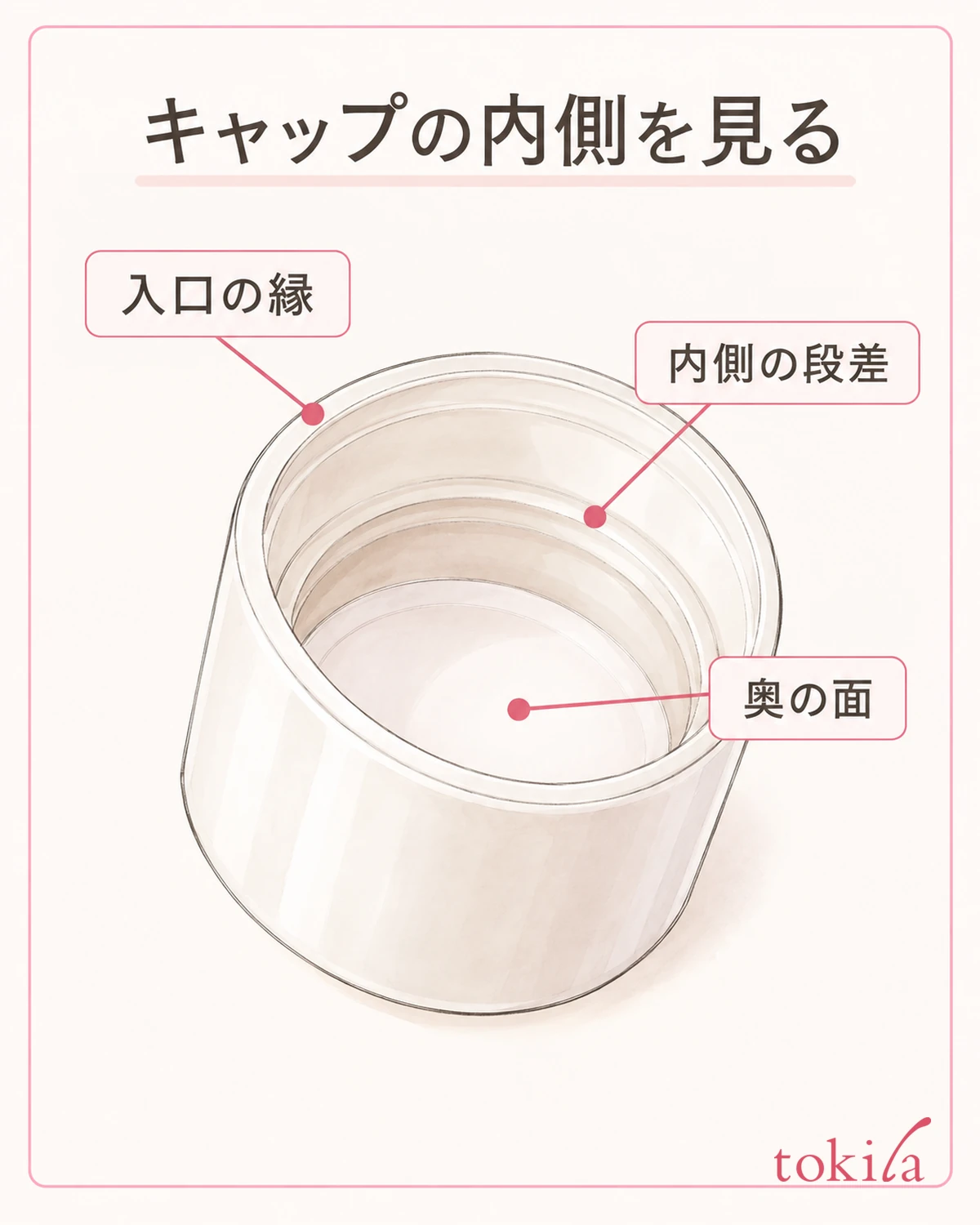
Reposition the lid so that you can see the opening and the depths of the inside in a bright place. Look separately at the part that touches the mouth of the container and the part you grip from outside. Even when the outside of the cap is clean, a thin film or small droplets may remain on the inside. You do not need to take anything apart to check the inside.
When you opened toner and emulsion one after the other, what remained on the inside of the cap may touch the body. Sort out what you saw and what you did separately, for example: you may have put a lid with a white deposit on a body containing a clear liquid. It is also important not to conclude what a deposit is from its color alone.
The places to look are the rim at the entrance of the cap, the step on the inside, the surface at the back, and the mouth of the body. Make it easier to see, for example by placing it on a white background, and check only where there was a deposit. Methods such as pouring in water to compare clarity or pushing a cotton swab into the depths of the hole are not added to the checks here.
If you find a deposit, check which body the lid was taken from and which container it touched afterward. Do not treat marks from your hands on the outside and contents on the surface that touches the mouth as one kind of dirt. If you keep photos, taking the pair of body and lid and the state of the inside separately makes it easier to explain the situation.
Conversely, not seeing a deposit does not prove that nothing else has mixed in. If you have already put it on another container, or do not remember what it touched, keep that uncertainty on record as well. Rather than changing how it looks by opening and closing it many times, keep it in a state where you can check it as it is.
Care of the cap and the mouth is limited to the places and methods the item allows. Do not substitute a guideline for wiping the outside with paper with rinsing the inside of the container with water or disinfecting it with alcohol. The point is not to assume that wiping the lid will also remove another product that may have moved inside.
3. If Another Product May Have Touched, Hold Off on Using It
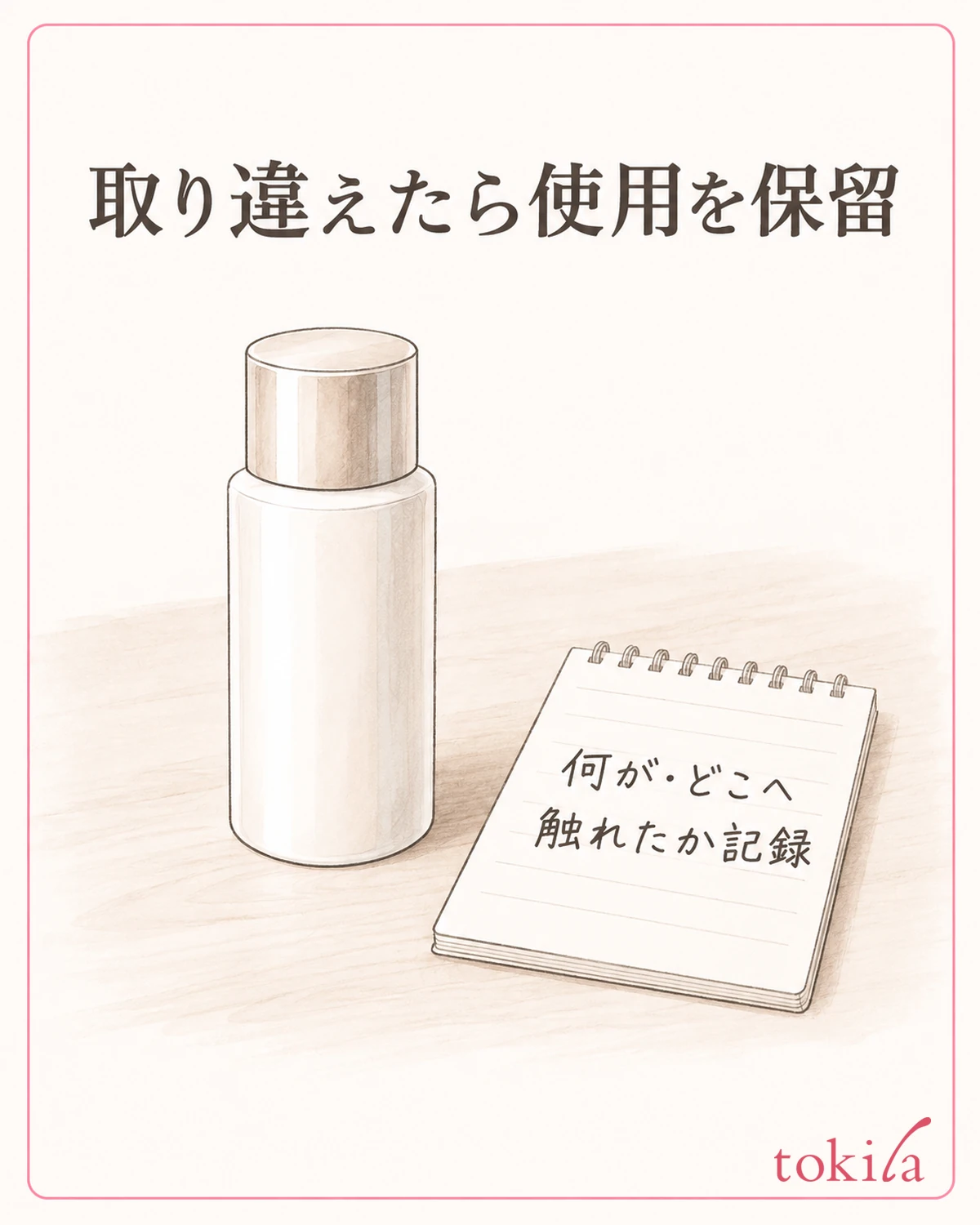
If you notice after putting on the wrong cap, pause before using it. Briefly record which product's lid went on which body and when. Separating what you know for certain from the "maybes" lets you sort out the order of contact when you explain it later.
Even if the color or clarity of the toner seems different from usual, do not decide that the mix-up is the only cause. Appearance alone cannot tell you whether it is the original properties, a change during storage, or other factors. Do not keep shaking it to make the change go away, and do not add another toner to dilute it.
Even if you put the lid back with its original pair, the possibility remains that another product got into the body. Do not judge that you can restore the original quality by do-it-yourself operations such as skimming off the surface, pouring out a small amount or filtering. Trying it on part of your skin to see whether there is a problem is also not a way to find out whether anything has mixed in.
For checking, use the product name on the container, the outer box if you still have it, when you started using it, and the situation in which you noticed the mix-up. Keep the product name and contact information shown, and follow the product's instructions to confirm whether it can be used. Being able to explain the situation is separate from diagnosing the ingredients yourself.
Keep the product you are holding off on separate from the ones you will pick up right away for your next routine. One way is to write the reason to recheck, such as "checking the cap pairing," in a note on the outside. Do not stick large tape that hides the label or put a mark inside; keep the information readable on the original container.
If you have already used it on your skin and feel something is wrong, take action such as stopping use in accordance with the product's cautions. The procedure here is not for judging skin symptoms. Do not mix the work of checking the original pair with the response to changes that have happened to your skin, and do not turn it into a flow of continuing to use it to see how it goes.
4. Close Only Items Whose Original Pair and Care Method You Know, as Specified

For items with no reason to suspect contact with another product and whose original pair you have confirmed, go back to that product's way of putting things away. If there is guidance to wipe off deposits on the mouth with a clean tissue or similar, tidy the specified area before closing. Do not carry the used side of the paper over to other products; keep it separate for each body.
Check how to close that suits the lid's type, such as screw-on or press-on. Do not borrow the rotation direction or stopping position from another container; compare with the normal state and the instructions for that one. If it tilts partway, catches, or clearly leaves a gap, stop before adding force.
It is important not to assume that difficulty closing is always a lack of tightening force. Check in order whether it is the original pair, whether anything is caught in the mouth, and whether you can see cracks or deformation. Do not move on to closing it by processing it, such as tapping the cap, filing the threads or deforming it with hot water.
Containers with an inner lid or accessory parts may not have the cap alone fulfill every role. Follow the product's instructions for the necessary parts and the order to put them back. Also refer to checking before opening the inner lid of a cream, and do not treat all types of lids as one.
Finally, check by eye that it is in a closed state that matches the instructions, and return it to a stable place. Not every product makes the same sound or leaves the same gap. Rather than turning it upside down and shaking it to test for leaks, do not send anything that cannot be closed as specified along to carry with you.
When you lose the original cap, too, do not decide that a lid of the same diameter is a substitute. Do not treat covering it with plastic wrap or tape as a replacement for the normal storage state. Keep the container's information, and until you can confirm the corresponding part and how to handle storage, do not choose to transfer it to another container and keep using it.
5. Next Time, Use One at a Time and Do Not Leave the Lid Too Far from the Body
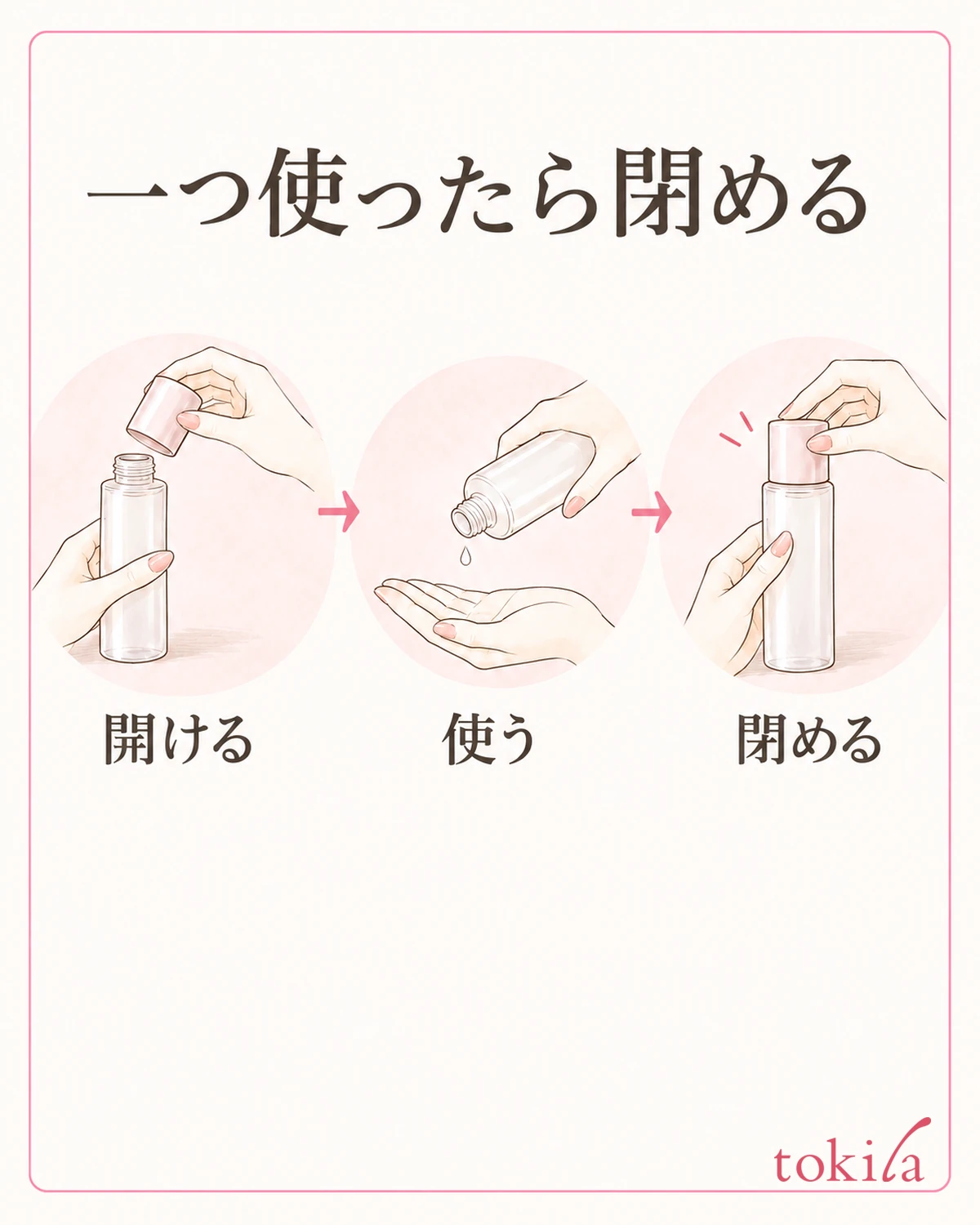
At your next routine, try the flow of opening one product, using it, closing it, and then opening the next. This makes it easier to keep each cap paired with its body than taking off all the caps first and gathering them in a row. You do not need to change the order; start by reviewing the operation of keeping only one thing open at a time.
Put the place where you temporarily set the lid in a position that is clean, stable and clearly right next to the body. Avoid paper with product on it, a wet sink and places where it overlaps other caps. Which way to set it down also depends on its shape, so do not make a common rule such as turning every lid face down or turning every one over.
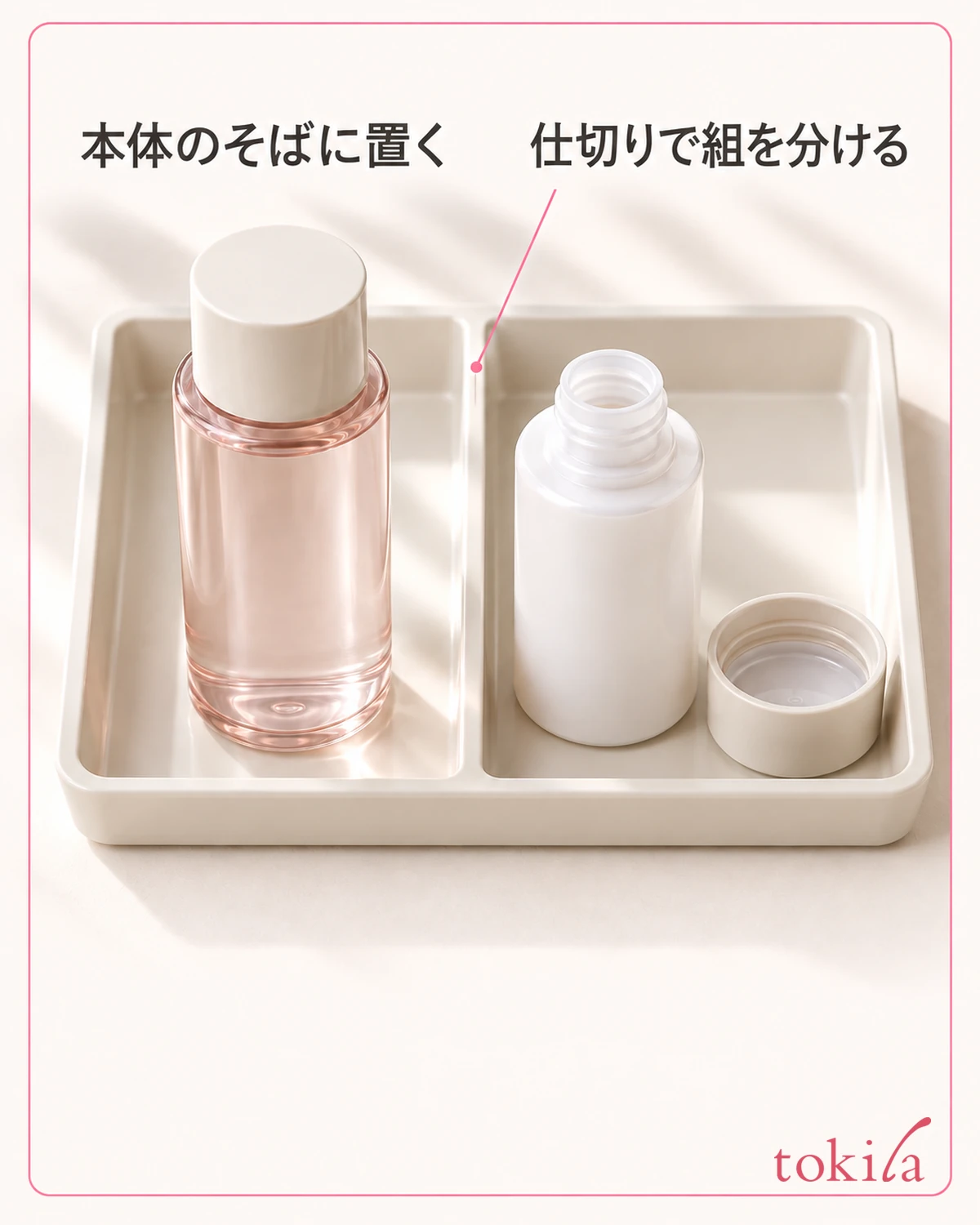
On shelves where similar containers line up, there is also a way to handle each body and its lid in the same compartment. Dividers are an aid to arrangement that reduces mix-ups; they are not meant to change the shape of the containers or to put foreign objects inside. Leave room so that labels are not hidden and so that you do not knock over the neighboring product when taking one out.
If several people use them, do not mix what you opened with what others are using. If you want to mark a lid, consider a way of leaving an identifiable record on the outside, and do not stick a sticker on the mouth or the inside. Keeping an arrangement where you can read the product names comes before memorizing by color alone.
When taking them on a trip, do not swap the lids to match heights; keep the original containers and parts paired. Connect the packing to checking before taking skincare on a trip, and check whether it can be carried and whether there are specifications for how to close it or storage conditions.
When in doubt, go back to the order of first matching the original pair before they touch, and, if they have already been mixed up, recording the circumstances of contact. Do not guarantee quality by appearance, hold off on products you cannot identify, and next time open and close them one at a time. Try tidying up what is within reach with small changes in arrangement so that the same confusion is less likely to repeat.