You moved the clasp of your necklace to the back, yet before you know it, it is at the front of your chest again. Before you rush to pull on the chain, check whether the pendant or the clasp has moved and whether anything is caught on your clothes. The clasp turning to the front does not by itself mean the necklace is broken or that you are wearing it wrong.
This article covers a typical chain necklace, in this order: identifying the positions, checking the construction, sorting out how it overlaps with your clothes, taking it off and putting it back on, and considering your options if it keeps happening. Adjust the length and open or close the clasp only in the ways and within the range given in the instructions you have.
1. Check whether the clasp turned or the pendant moved up
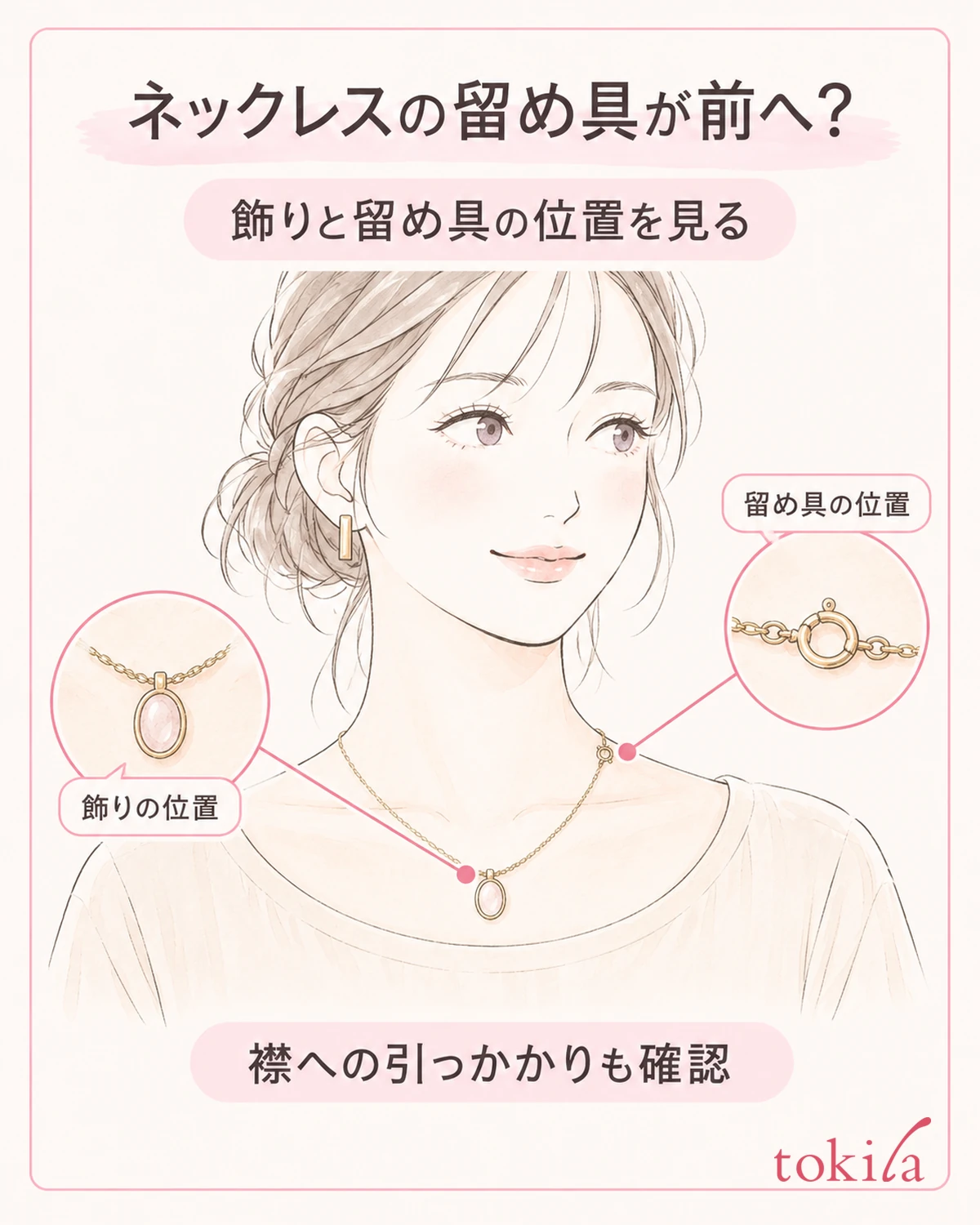
First, stand in your usual posture in front of a mirror that shows your upper body, with both arms hanging naturally. Do not only lean your face toward a small mirror; also check from a distance where your collar and the whole necklace are visible together. For the back, use a hand mirror, or check the position as far as you can without straining.
There are three things to check: the position of the pendant, the position of the clasp, and where the chain touches your clothes. Distinguish whether the pendant stayed on your chest while only the clasp shifted to the side, or whether the pendant itself has moved up toward your neck. A pendant that has flipped over should also be looked at separately from a clasp that has turned.
If the clasp has moved, do not pinch the thin chain and turn it all at once; first look for anything caught in your hair or collar. If hair is trapped or the chain is caught on a thread of your clothing, do not apply force as it is. Even if you cannot see where the resistance is, stop moving it for the moment.
Try to recall whether this happened for the first time with that day's clothes, or whether it also happens when you wear the same necklace with other clothes. It is enough to note whatever clues you can, such as it bothering you only with high collars, or the position changing after you layer clothes. Do not judge your own body's condition from the fact that it always moves in the same direction.
If you want to keep a record of the position you saw, jot down the clothes and the parts together, such as "white shirt, pendant in the center, clasp on the right." If you use a photo, keep it for your own checking and capture your chest and collar in the same shot. There is no need to deliberately pull the chain to reproduce the movement on a large scale.
You do not need to twist your neck to check the clasp at the back, which you cannot see from the front. Move to a place where you can take it off and check, or, if someone can help, ask them to see whether it has caught your hair or clothes. Prioritize stopping to understand the position over searching with one hand while walking.
2. Check how the pendant is connected and whether it can move
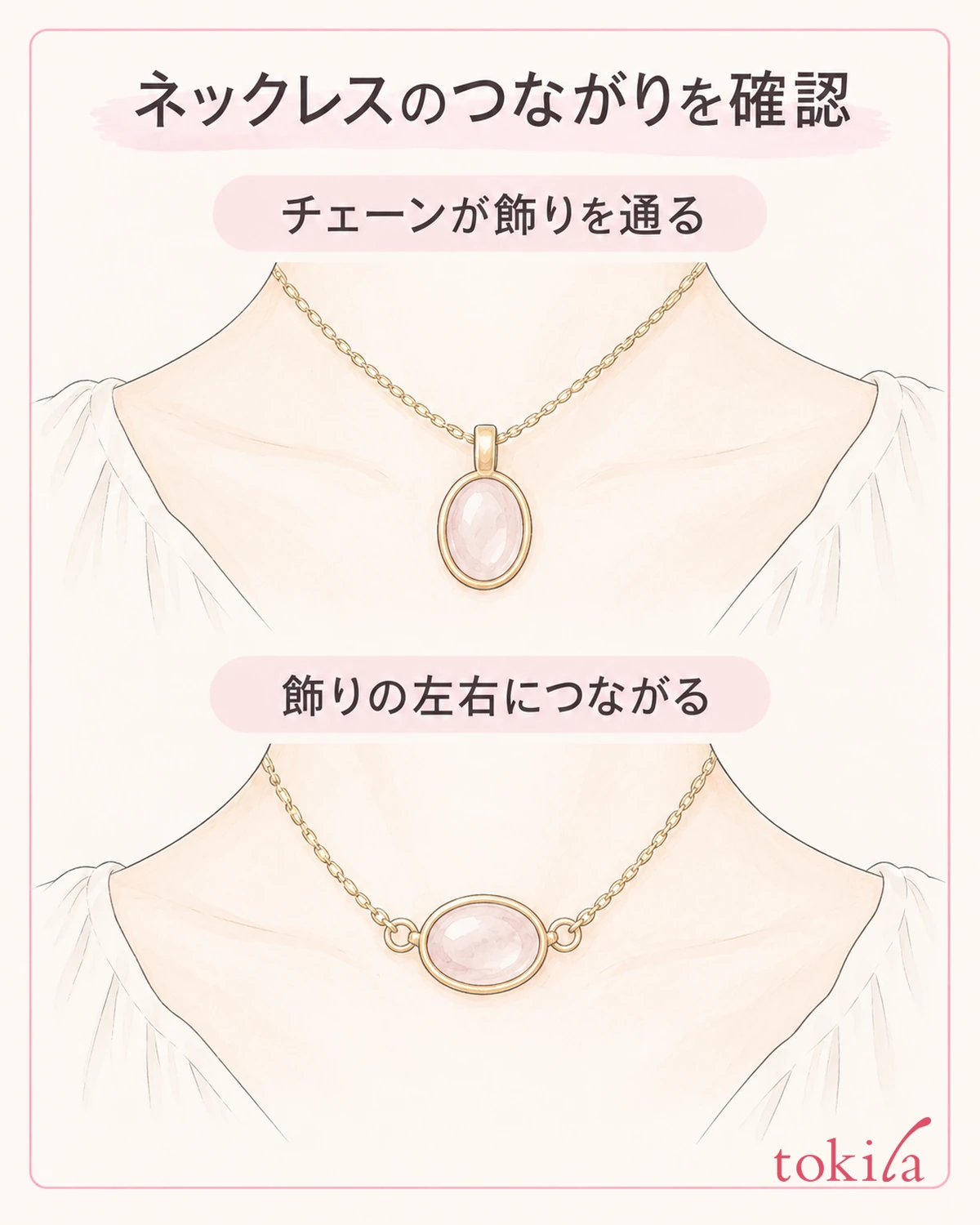
Take the necklace off in a place where you can, and lay it on a flat surface where it will not fall. First look at how the pendant and the chain are connected. The range in which the pendant can move differs between a chain that passes through a hole or ring in the pendant and a chain connected to the left and right sides of the pendant. If you cannot tell by appearance alone, compare it with the instructions.
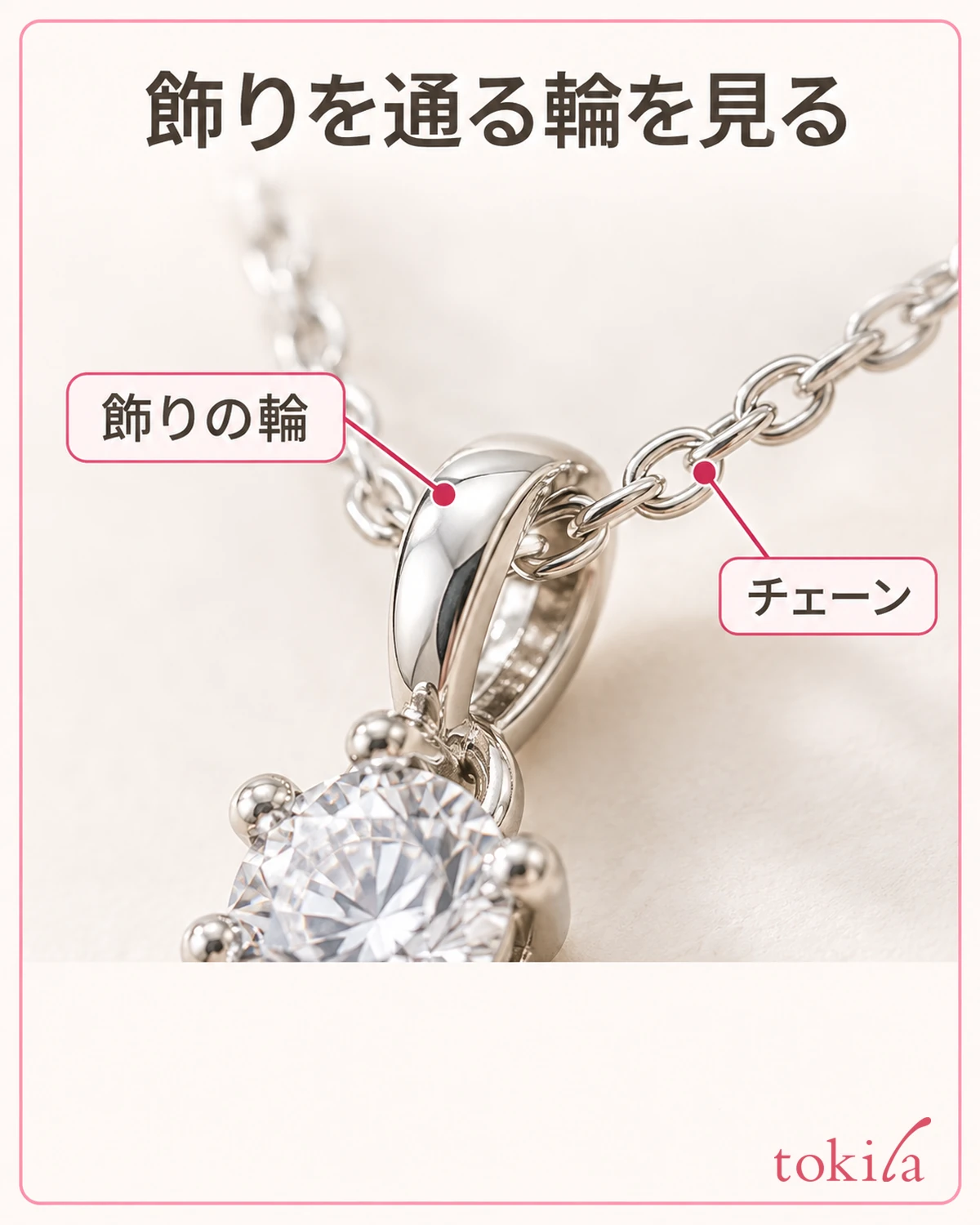
With a type where the chain passes through, the pendant and the chain may be able to change position separately. Even when the clasp comes to the side, the pendant may remain in the center, so do not judge the orientation of the whole necklace by looking only at the pendant. When you move the pendant to check, do not try to force it past any part that resists.
Distinguish a type where the left and right sides are connected from a type where the pendant slides freely along the chain. However, a fixed pendant does not mean it will never shift. You need to check the necklace as a whole as worn, including how it sits at the neck, its contact with your clothes, and its length.
If there is an adjuster chain hanging near the clasp, also check which side it is designed to come out on. Do not treat the ring used to change the length and the small rings that connect the parts as the same thing. Avoid hooking it onto a ring that is not designated to shorten it, or squeezing a joint with pliers.
If you see a deformed fitting, a clasp that does not close fully, or a kinked chain, remove it from the repositioning stage. The mere fact that the seam of a part is visible does not always mean something is broken. Rather than opening and closing the rings yourself to fix it, check the original construction and then consult the shop where you bought it.
Even if the shape of the pendant looks similar, the attachment part is not necessarily the same. Trace one by one whether a ring is visible in the center or there are connecting parts on the left and right, and do not move a construction you do not understand just to guess. If the instructions include a diagram, match the positions of the parts to the actual item in your hands.
3. Review contact with your collar, layers and hair one by one
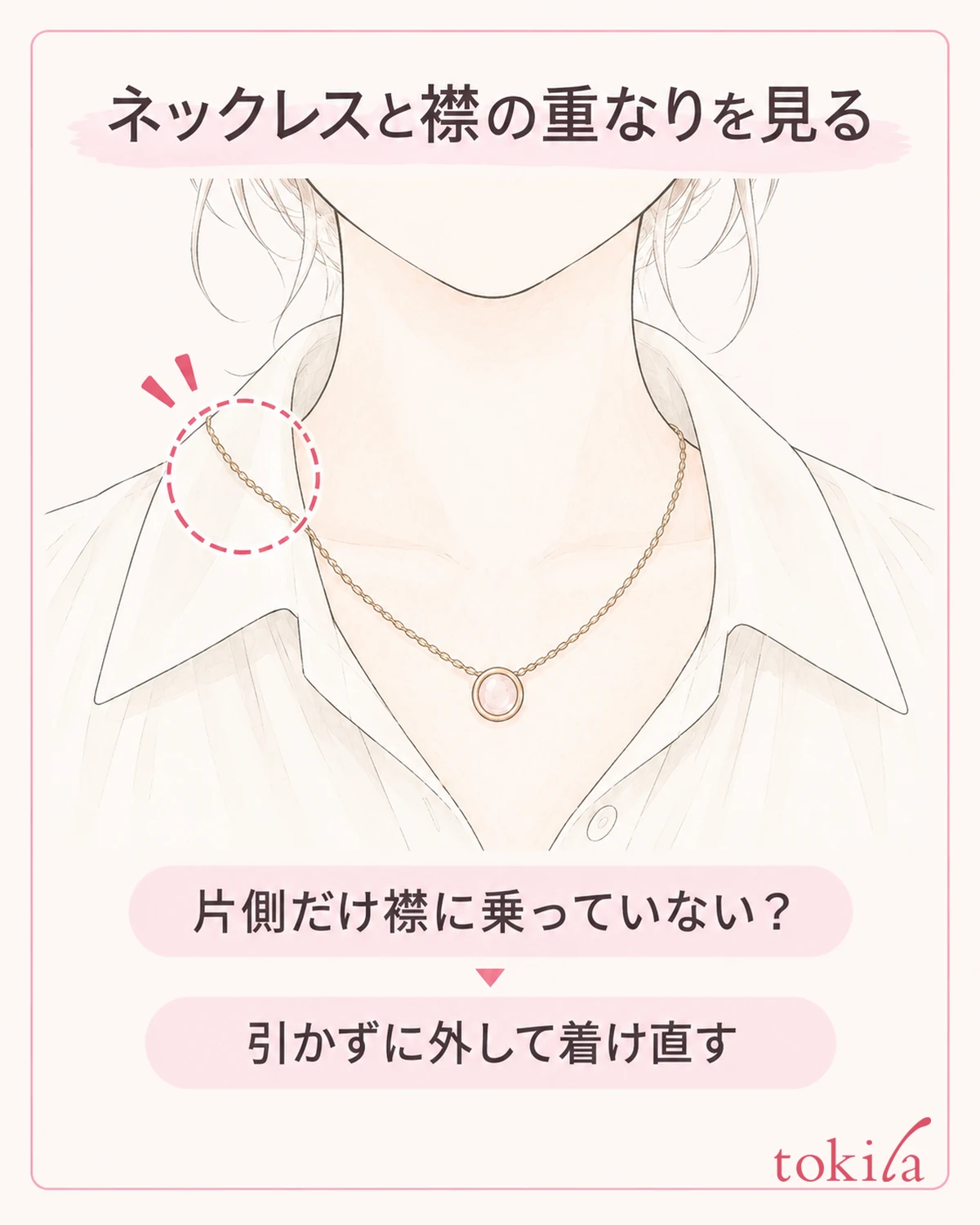
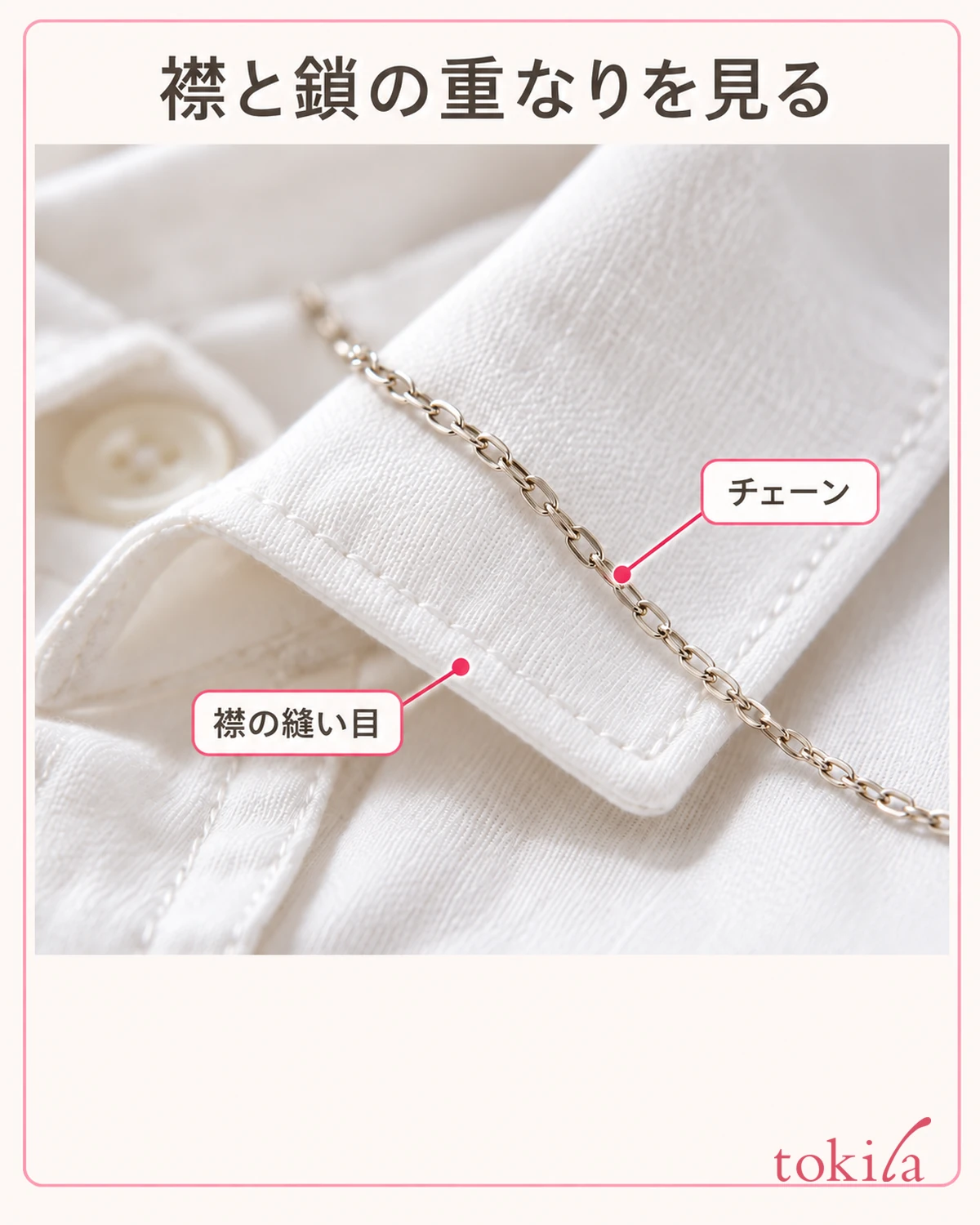
When you put the necklace on, check that the chain is not resting on only one side of the collar. If one side is on your skin and the other is under the collar, it becomes hard to tell where it is touching. If you feel a snag, take it off, straighten your collar first, and then put it back on in a comfortable position.
If the pendant is long enough to rest on the edge of the collar, decide whether to show it above the collar or let it lie outside your clothes, to suit those clothes and the shape of the necklace. Wearing it directly on the skin is not a requirement for everyone. If it does not suit the specified material or the way it feels to wear, you can also choose clothes with a different collar or a different accessory.
On days when you layer clothes, also check that the chain has not slipped in between the inner garment and the outer layer. Do not pull the pendant downward to fix its position while one side is caught in the fabric. If it is easier to handle by taking it off before dressing or undressing, prepare a case first and then take it off.
On days you wear your hair down, check that no strands overlap near the clasp. When moving hair out of the way, do not grab the chain along with it; gently separate only the hair. If hair is already caught or it hurts, do not try to pull it out; judge whether you can calmly take it off where you can see what you are doing.
On days when the shape of the collar itself gets out of place, first straighten the garment using the steps for checking how a blouse collar overlaps, which makes it easier to see where the chain touches. If it still turns after you fix the garment, do not add another measure at the same time; go on to the next re-fastening.
On days when you layer a scarf or stole over the necklace, also check your neckline after taking them off. So that the pendant is not pulled along when you pull the cloth off, take the necklace off first if there is any contact. For combinations that make you fix the position more often, also consider using a different accessory that day.
4. Take it off, then put it back on at the designated position and length
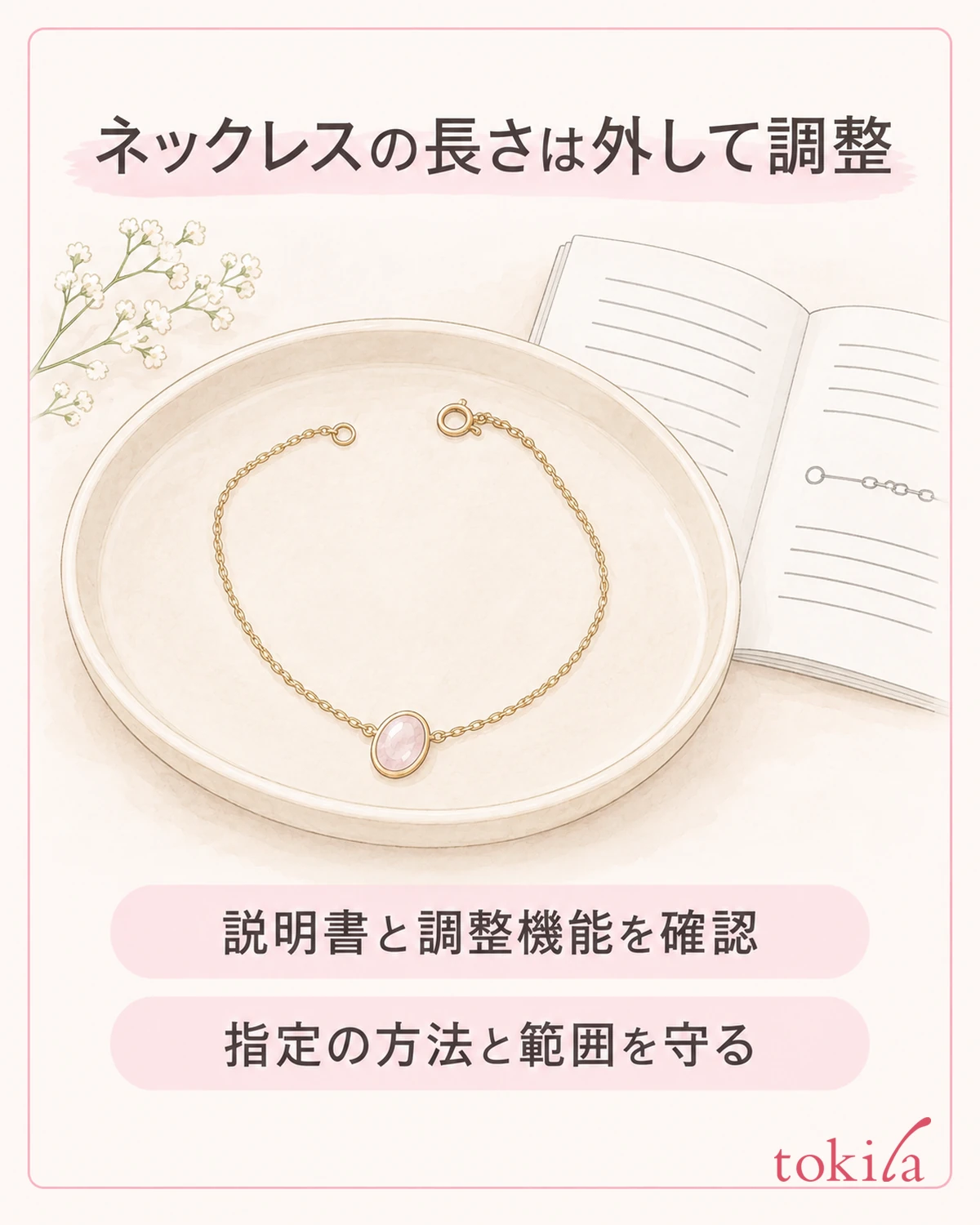
Before putting it back on, choose a place such as a desk where you can easily find it if you drop it, and keep a case nearby. Handle the clasp as the instructions say, and do not pull the thin chain to force the fitting open. If you cannot see your hands well even in the mirror, avoid continuing to work only at the back of your neck in a hurry.
Once it is off, follow the chain all the way around and check for tangles or kinks. Even with a type that the pendant can pass over, there is no need to slide it all the way to the end by force. Do not try to undo a small, tight tangle by pulling the chains on the left and right. If it is difficult, skip wearing it that day.
If you want to change the length, first check whether your necklace has an adjustment feature. Some types hook onto a designated adjustment ring, and others have parts that move. Because the method differs from one to another, do it as specified while it is off, and do not change the length by pulling the chain while it is being worn.
If there is no adjustment feature, do not create length by knotting the chain or hooking it onto a thin link partway along. Even for adjustable ones, a shorter length does not always make it less likely to turn. Check where the collar and pendant meet and how much room you have at the neck, and if it feels tight or pulled, go back to the original length.
When you have finished putting it on, check that the clasp is closed and return to your usual posture. After normal movements such as arranging your hair or lowering your arms, look in the mirror once more. Do not shake it hard or pull the chain to test its durability. If the clasp will not close, stop using it.
5. On days it keeps happening, choose a different combination with your clothes or a different construction
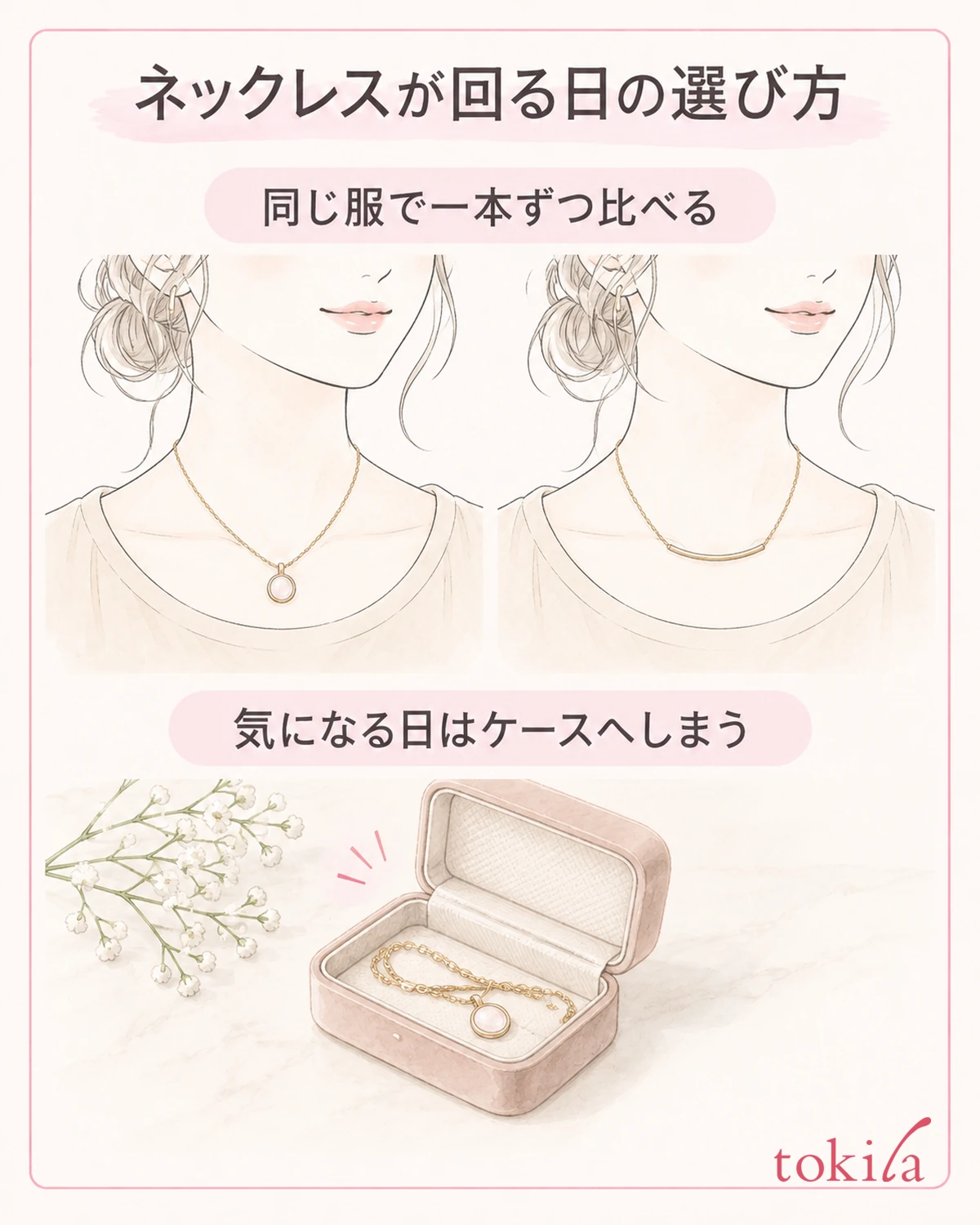
If it keeps turning even after you put it back on, sort out whether it happens with any clothes or only with a particular collar or layering. If you change clothes to check, do not change the length of the same necklace, and look at how the places it touches have changed. This makes the differences easier to sort out than changing the clothes, the length and the pendant all at once.
If you have another necklace, wear them one at a time with the same clothes and compare. Rather than layering two to suppress the turning, look at each one's clasp, how the pendant is connected, and how it sits at the neck. Whether it is fixed or movable is a clue for choosing, but it is not a guarantee that it will not rotate.
To suppress the turning, there is no need to add a heavy charm or a large fitting on your own. Add extra parts only if you can confirm the matching chain and the way to attach them, and do not use them when you do not know whether they fit. Also avoid fixing it with adhesive to your skin or clothes as a way of adjusting the position in daily life.
On days when fixing it repeatedly while out bothers you, it is fine to take the necklace off and let your ears or hands take center stage. How to decide the focal accessory and its placement can also help you choose a combination without being fixated on the neckline. Store the ones you take off separately so they do not tangle with other accessories.
If a fitting is deformed or catches, or you do not know where it can be adjusted, consult the shop with the instructions and your purchase information. Telling them separately, for example "with this outfit the clasp comes to the right" and "even when it is off, it is bent here," makes clear what you want checked. Rather than looking for one trick that stops it from turning, choose a combination you can wear comfortably.
If you are thinking of replacing it, do not choose by apparent length alone; check how the pendant is fixed, whether the length is adjustable, and whether you can handle the clasp comfortably. If you make the problems with the one you have now specific, it is easier to avoid just choosing the same construction again.