You try to slip your fingers through the ribbon of a powder puff, but it is tight and only the tips go in. Or the opposite: your fingers go in, but the puff spins and is hard to hold. In that case, before you stretch the ribbon hard, check what the puff is for, which side you hold, and the shape of the part where your fingers go.
This article sorts out what to check before use when the ribbon or band of a makeup puff does not fit your hand. It is not mainly about how much powder to pick up or how to apply it to the skin. Rather than fixing the number of fingers or how deep to insert them, choose a way of holding that matches the instructions for the puff you own.
1. Check which puff it is, and separate the side you use from the side you hold
First, check what the puff is meant for. Puffs for face powder, for cushion foundation, and small puffs for detail work differ in size, shape and the way they are held. Do not apply the way of using one puff to another just because both are round and have a ribbon.
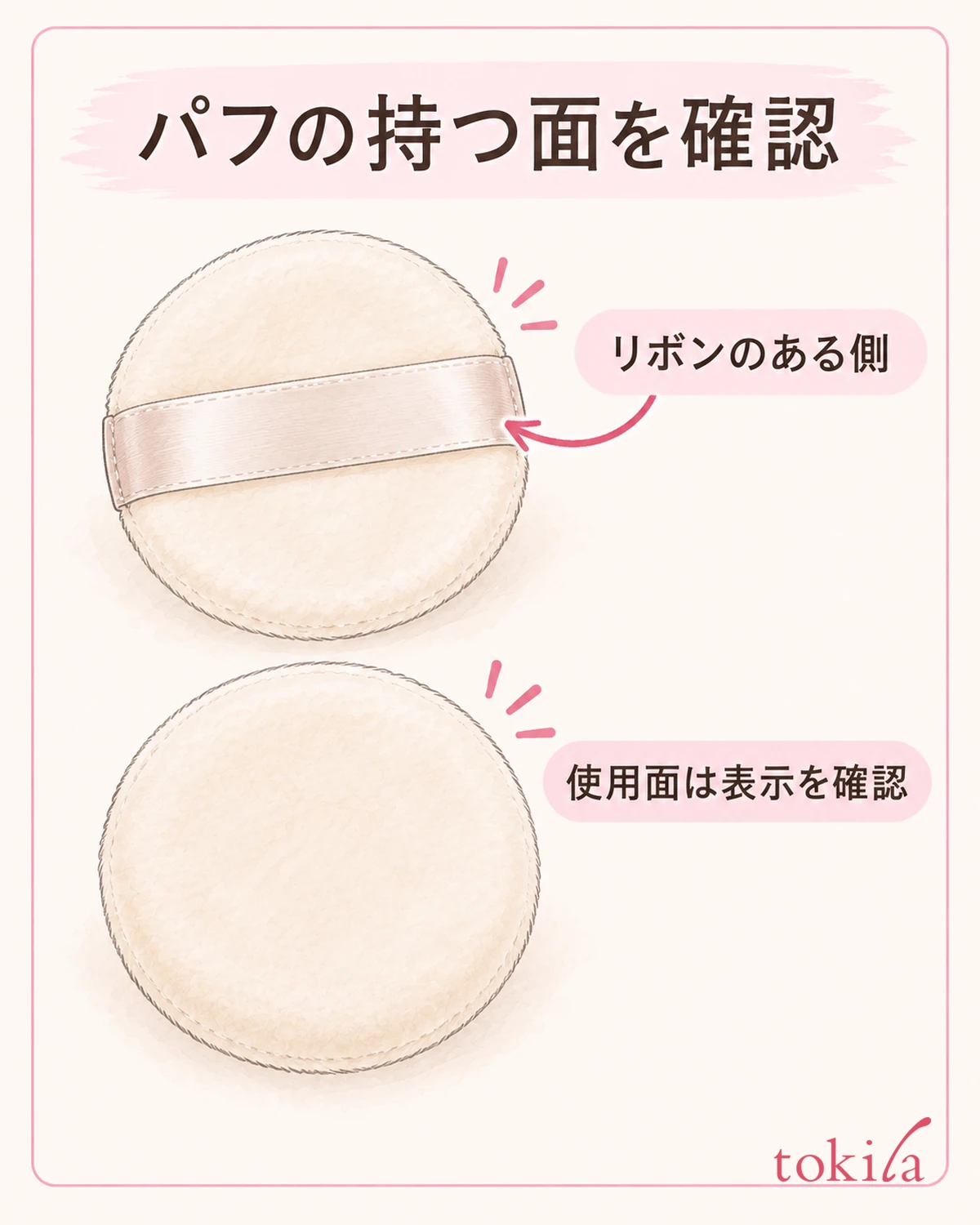
If the bag or the instructions mark a front and a back, follow that marking. Some puffs are held by the side with the ribbon and pick up product with the other side, while others use both sides. You do not need to decide that one side is the working side from its color or sheen alone.
If you look at the ribbon side from an angle, you can see the gap between the band and the puff where a finger goes. The small weave or stitching on the surface is separate from the opening for your finger. Do not pry the fabric open with your nails or push your finger between the layers of the puff.
If a protective film or packaging remains on a new puff, check which parts are meant to be removed. Do not go on to peel the surface of the puff just because there is a transparent layer. Distinguish parts that are meant to be removed from surfaces that are originally one piece with the puff.
Wash your hands and, in a place where the puff will not roll away if dropped, check how to hold it before putting any product on it. Deciding which side you hold and which way your fingers go first makes the steps easier to separate than picking up powder or liquid on the working side and turning it over again and again.
If the puff has already been used, also check whether the difficulty in holding it is actually caused by dirt or dampness. Handle it after washing as the product label directs, and let it dry before use if it needs to dry. Cleaning makeup brushes and sponges sorts out the points to check for each material.
If product has gotten onto the side you hold, check the care instructions before testing how easily your fingers go in. There is no need to add powder or liquid to the band to make it slide better. Think of how you hold the puff before use and how you care for it after use as separate matters.
2. Look at the gap and the base of the ribbon, and stop before you pull
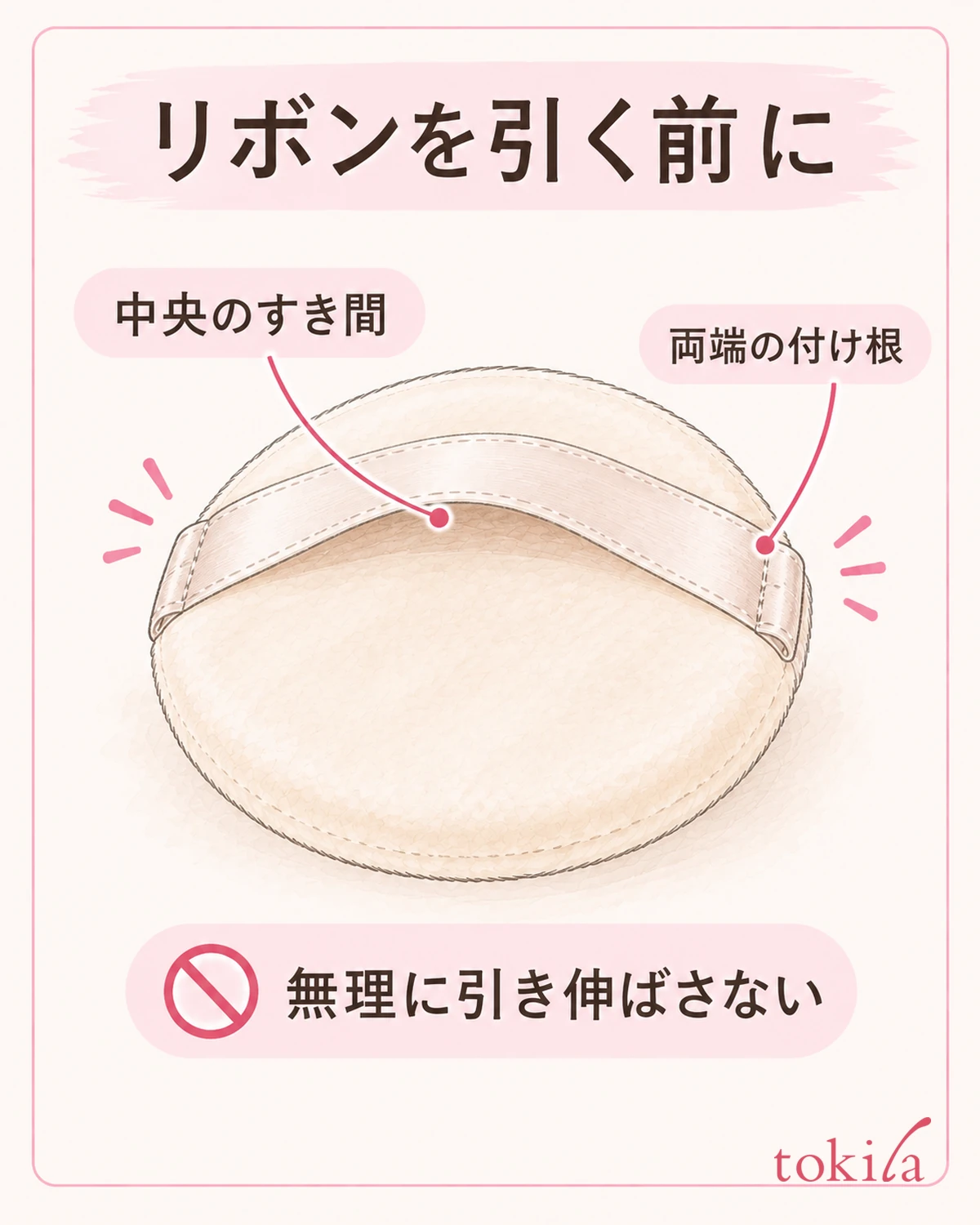
Place the puff on a table and look at where the two ends of the band are attached. The part where the finger goes comes in various shapes: a band that is slightly raised in the middle, a thin strap, or a wide band. The word "ribbon" alone does not tell you whether the material stretches.
If you look from the side at the space between the middle of the band and the body, you can check the opening where the finger goes in separately from the attachment points at both ends. Rather than pressing and stretching the base of the band first, look to see where it is open. Even if the band looks twisted, you do not need to undo the stitching to fix it.
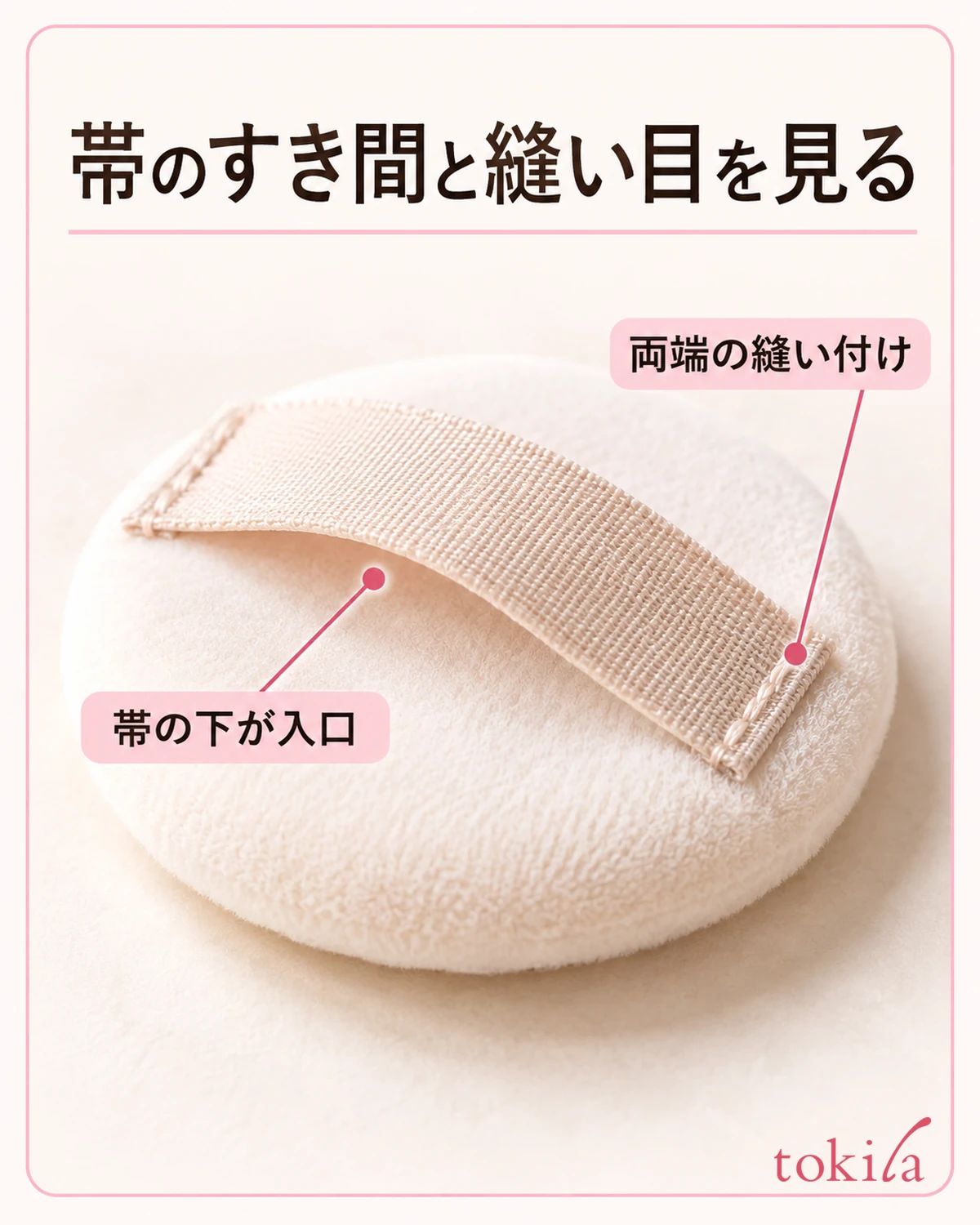
Even if a puff is described as having a stretchy ribbon, that does not mean you can pull it as far as you like to make it bigger. Avoid repeatedly pulling a band whose elasticity is unknown to fit your finger. If the stitching opens, the band lifts, or the layers of the puff separate before or after you insert your finger, stop.
If the gap feels narrow, before pushing your finger in, check whether you have mistaken some other place for the opening. Modifications such as pinching and tearing the edge of the puff with your nails, cutting the band to widen it, or applying heat are not part of adjusting how you normally hold it.
If you cannot find instructions for the puff you own, note the product name and model number that remain on the bag or the underside. Do not decide how to use it from images of puffs that merely look similar; check the instructions that apply to your item. Until you know a way to hold it without strain, set it aside without picking up any product.
If thread is coming out at the base, the band is coming off, or the surface is cracked or peeling, treat that separately from the tightness of the ribbon. Do not assume you can restore it to a condition suitable for the skin with glue or re-stitching; check how to handle its use or replacement.
3. Do not copy a finger count; insert your finger at the position the instructions describe
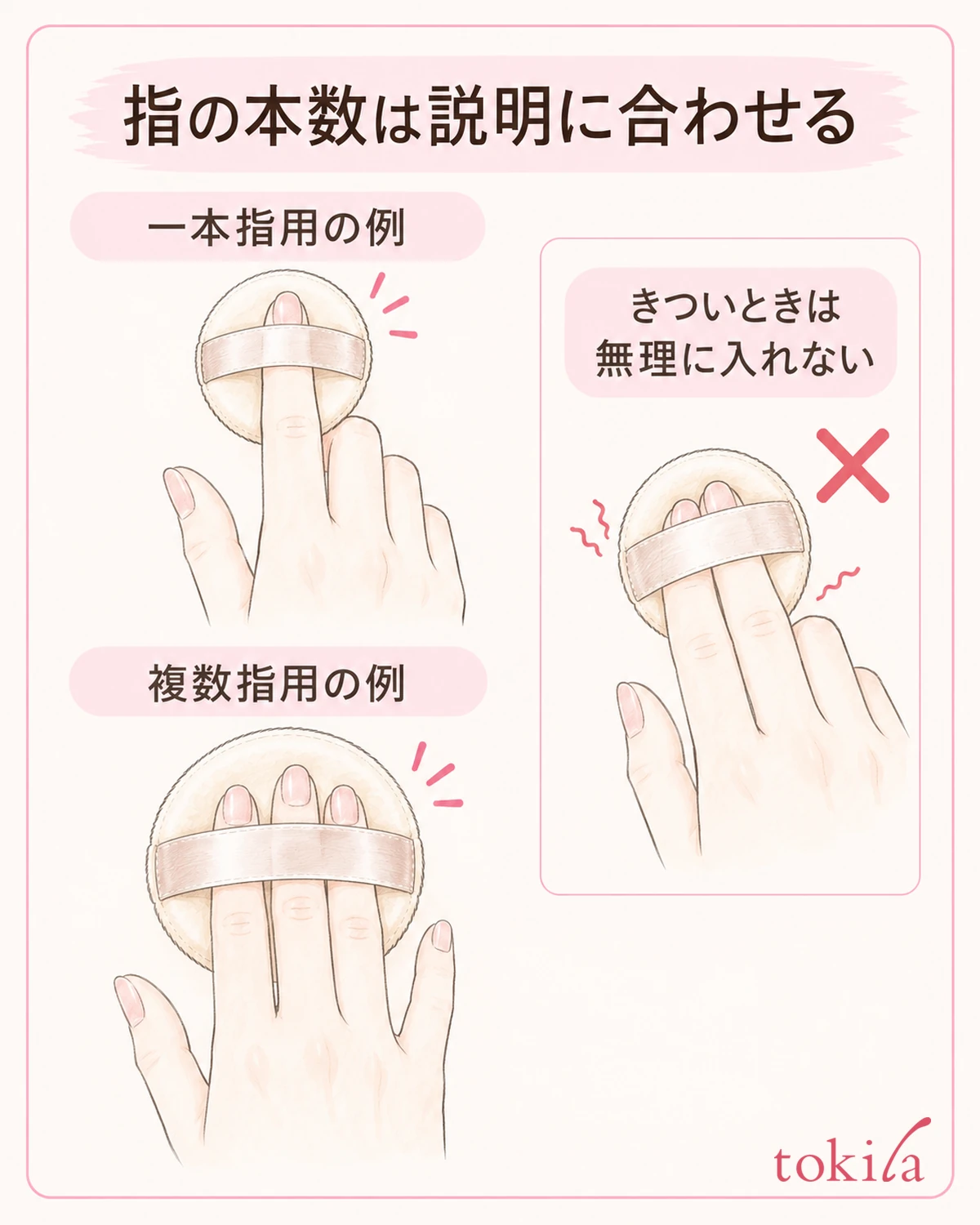
If the instructions for holding the puff mention the number or position of fingers, first check by following the guidance for that puff. A small puff for one finger and a puff that takes several fingers do not need to be held the same way. The number of fingers that worked for another puff is not necessarily right this time.
Insert your finger into the gap between the band and the body while feeling for resistance. If your nail catches at the entrance, do not push on; pull out once and reconsider the direction. Do not switch to pulling the band up hard with your other hand while pushing your finger in.
The depth is also not something to push all the way to the knuckle just to match a sample photo. If your finger feels squeezed, or you feel pain or numbness, take it off. Do not treat a hold that is painfully secure as a sign that you are holding it correctly.
Conversely, if the puff spins when you hold it lightly, first review which side you hold, the direction of the band, and the position of the finger it is meant for. If it is still unstable even when held as described, think about whether that puff suits your hand before adding more fingers or tying the band.
Before pressing it to your face, check that you can support the puff in your hand. Also check that your fingertips do not stick far out beyond the edge of the puff in a way that could let your nails touch your skin. At this stage, with no product on it, you can check your finger position while looking at the working side.
With your finger inserted, also check that force is not concentrated only at the base of the band. You do not need to fold the body hard to hold it in place. Operations such as folding the puff to work powder in should be treated as a step only when the puff and the cosmetic you own give such instructions.
4. Separate the difficulty of holding from the difficulty of using the working side
Even when your finger goes into the ribbon without strain, the face that touches the skin may still be unstable. Check whether you are pressing a single point of the puff with only your fingertip, or supporting the face the instructions describe. Review the tightness of the ribbon and the force you use when applying product separately.
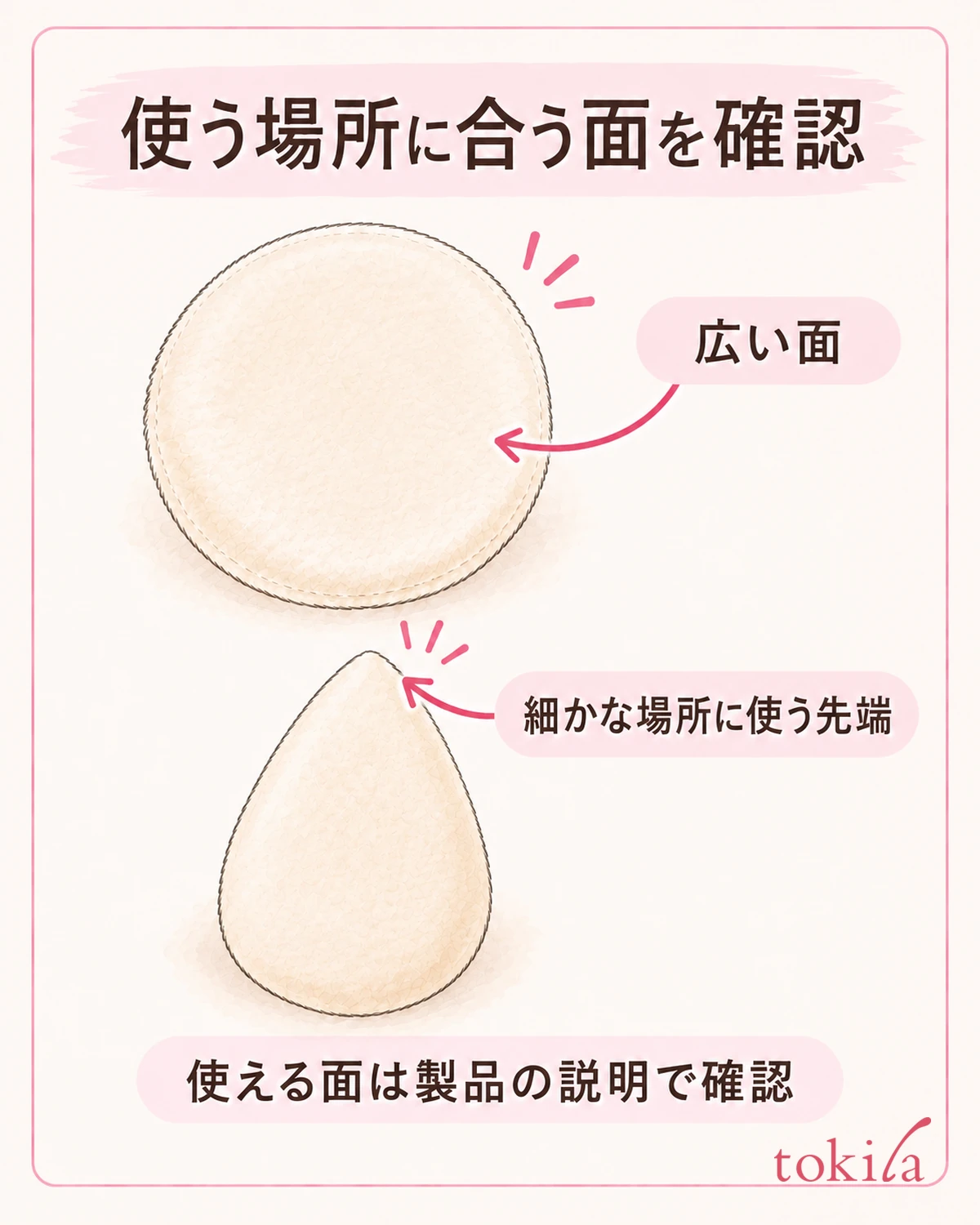
Puffs for large areas and puffs for small areas also differ in the role of their tip or wide face. Instead of forcing a round puff into a small area, check whether the puff you own has an edge or face that its instructions point to. Cutting the shape to make it smaller is not an adjustment to how you use it.
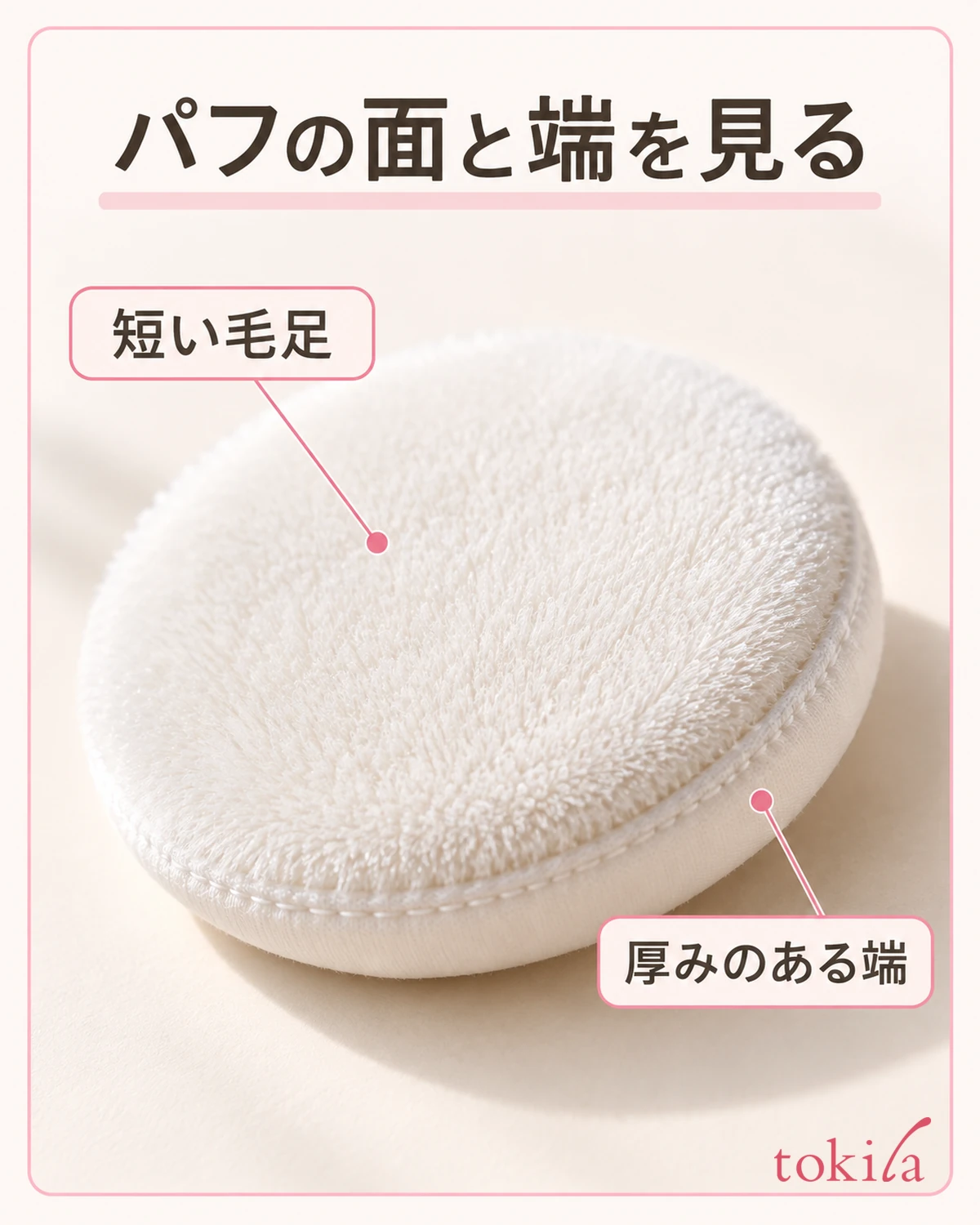
The pile length, fine pores and edge thickness of the surface are features distinct from the ribbon side. In photos, look for these differences between faces, and check the side you actually use against the label. It is also important not to decide a puff's purpose from texture alone, such as assuming a fluffy one is for powder only or a smooth one can be used with water.
Once you can hold a powder puff, go back to the instructions on how to pick up and how much of the powder you use. You do not need to press harder just because it is easier to hold. If you are concerned about using too much powder, see how much face powder to use and how to fix it.
If you use a puff made for another purpose, such as a cushion puff, instead, check compatibility on both the cosmetic and the puff. A ribbon that your finger enters easily and a puff that suits that cosmetic are not the same condition. Choose the material of the working side and how it handles water according to the instructions for the item.
On days when the product goes on streaky or sticky, or too much powder comes out, do not try to solve it just by inserting your finger deeper. Look back separately at the amount used, the face used and the condition of the puff, and stop before pressing it against your skin over and over.
5. When replacing it, also check the purpose, dimensions and storage
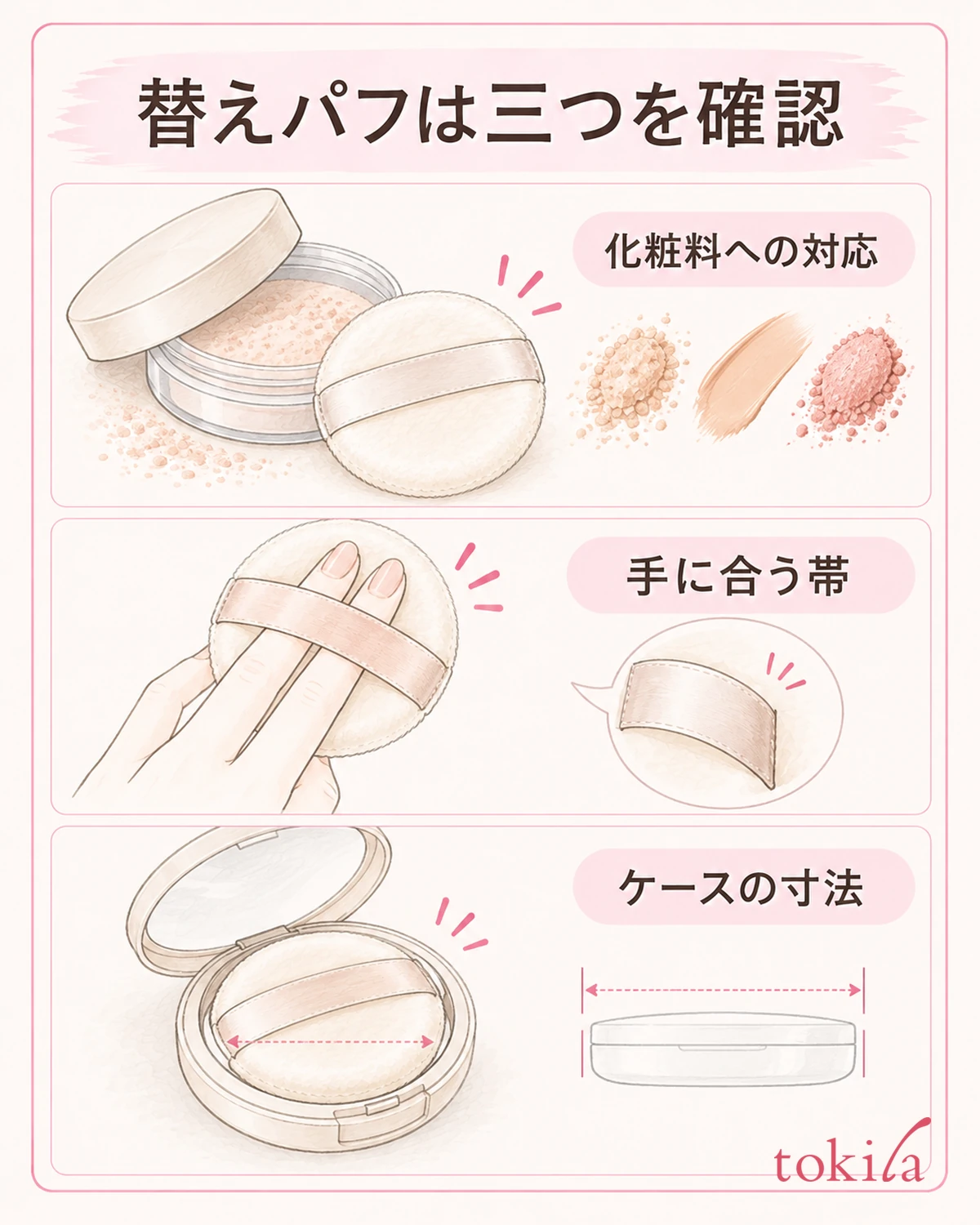
If tightness or instability remains even after following the instructions, consider a different puff that fits your hand. In addition to compatibility with the cosmetic you use, compare the size and thickness of the body, the shape of the band and the guidance on which fingers to use. Do not decide on the basis that smaller is easier for everyone to hold or that larger is more stable.
When replacing, noting the product name and purpose of the one you use now makes it easier to match. Be specific about what troubled you, such as whether you need a stretchy band or prefer one for a single finger. In a store as well, follow the rules for display items and testers, and do not touch the working side of your own puff unnecessarily.
If you will put it in a case, check not only the width but also the thickness and room for the band. Do not crush it to make it fit, or close the lid with the ribbon caught in the rim. For a case that specifies a compatible replacement puff, give priority to that combination.
After use, check the care instructions for the puff and the labels on the storage items separately. Do not keep lifting it by the band alone; support the body when taking it in and out. Even for a washable puff, do not assume the same conditions for water temperature, drying method and state before storage.
Before the next use, look not only at the part where your finger goes but also at dirt on the working side and the base of the band. If it has become harder to hold than before, check its condition before applying force. When considering replacement, you also do not need to apply a number of months or uses common to all puffs.
First the purpose and front and back, then the entrance and base of the band, then the finger position that matches the instructions. Checking in this order, and not trying to solve tightness by forcing it to stretch, is the starting point. Confirm both a way of holding that fits your hand and a way of using that suits the cosmetic before you go ahead with your makeup.