When choosing face oil, you will find all kinds of ingredients and containers. Even among beauty oils, fragrance, the feel after application, and where they fit into your usual routine differ. Before settling on a popular ingredient, organize what you want to compare.
This article explains what to compare before buying cosmetic beauty oil for the face. Rather than application movements for a bottle you already own, it covers narrowing down candidates by formulation labeling, feel, the steps before and after it, packaging, and budget. It does not cover substituting cooking oils or essential oils for facial cosmetics.
Check that it is facial beauty oil and why you want to add it
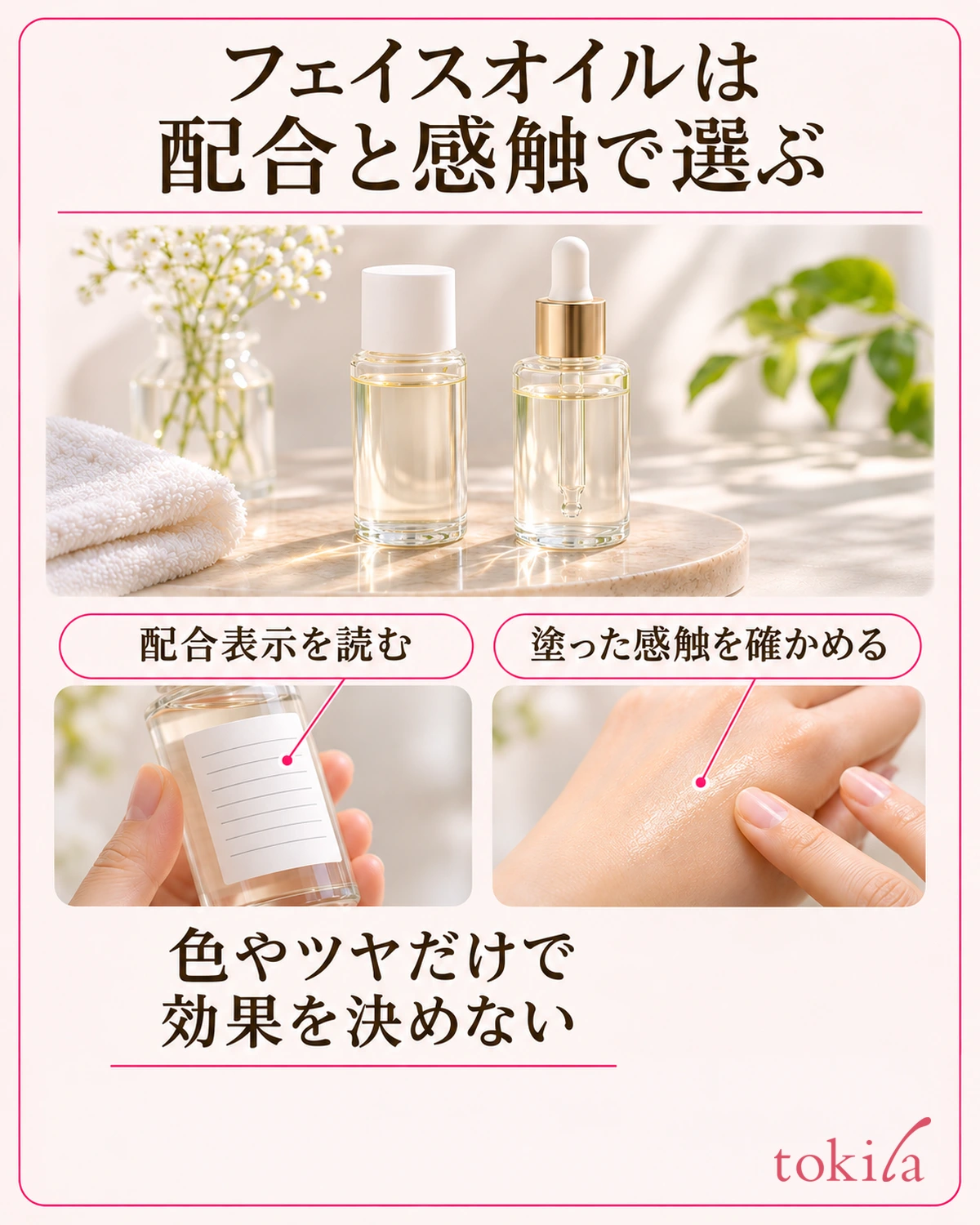
First, check that it is a cosmetic suitable for moisturizing the face. Do not group cleansing oil, hair oil, or aromatic essential oils with the same candidates just because their containers look similar. Read the purpose and permitted areas before focusing on the word "oil." For a product suitable for multiple areas, find its facial-use instructions.
Next, put into words what you want to add to your current routine. Do you want another option for nighttime moisturizing, a feel suitable for mornings too, or something without fragrance? Setting one purpose gives you a comparison point beyond an unusual ingredient or an attractive bottle.
If you already like your emulsion or cream, you do not have to assume you need another bottle. Read whether the candidate oil replaces those products or is layered separately before considering why to add it. Avoid assuming oil universally fulfills the roles of several products.
For example, if you want it before morning makeup but can only confirm nighttime instructions, you lack enough information to choose it for mornings. Note separately its appeal for nighttime use and its suitability for mornings. Rather than expecting one bottle to do everything, consider how it matches when you will use it.
Short notes such as "for the face," "candidate for nights," or "want to try the scent" are enough before buying. Keep this separate from treating skin disease or severe problems with cosmetics. If your skin currently shows abnormalities, prioritize following the precautions rather than trying a new oil to resolve them.
Read the full ingredient list and fragrance labeling rather than relying on ingredient names
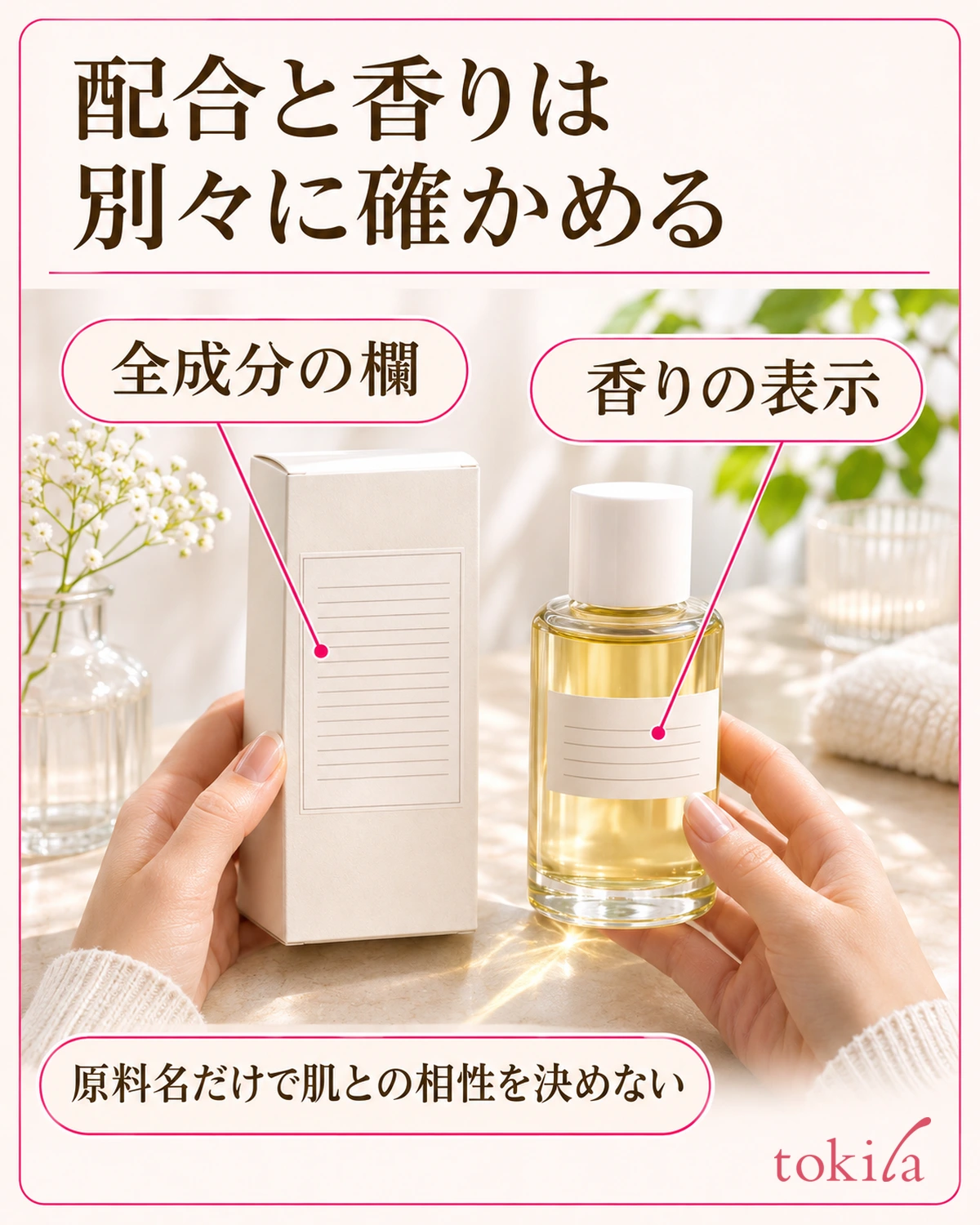
You can search using ingredient names such as squalane or plant-derived oils. However, a prominently featured name does not necessarily describe everything in the bottle. Match the stated formulation purposes with the full ingredient list to check whether it contains a single ingredient or combines multiple oils and other ingredients.
Do not assume a simple formulation will definitely suit your skin, or that more kinds of ingredients mean greater moisturizing power. Origin and the number of ingredients help you understand a candidate. "Plant-derived" and "natural" also do not mean irritation cannot occur in anyone. If there are ingredients you want to avoid, check their labeling specifically.
Whether you want to enjoy fragrance or prefer something with less noticeable scent is another selection point. A "fragrance-free" label and the smell you actually notice are not the same thing. Read the labeling about added fragrance and, if you can try it, check that bottle's scent too. Do not infer scent strength from the ingredient name.
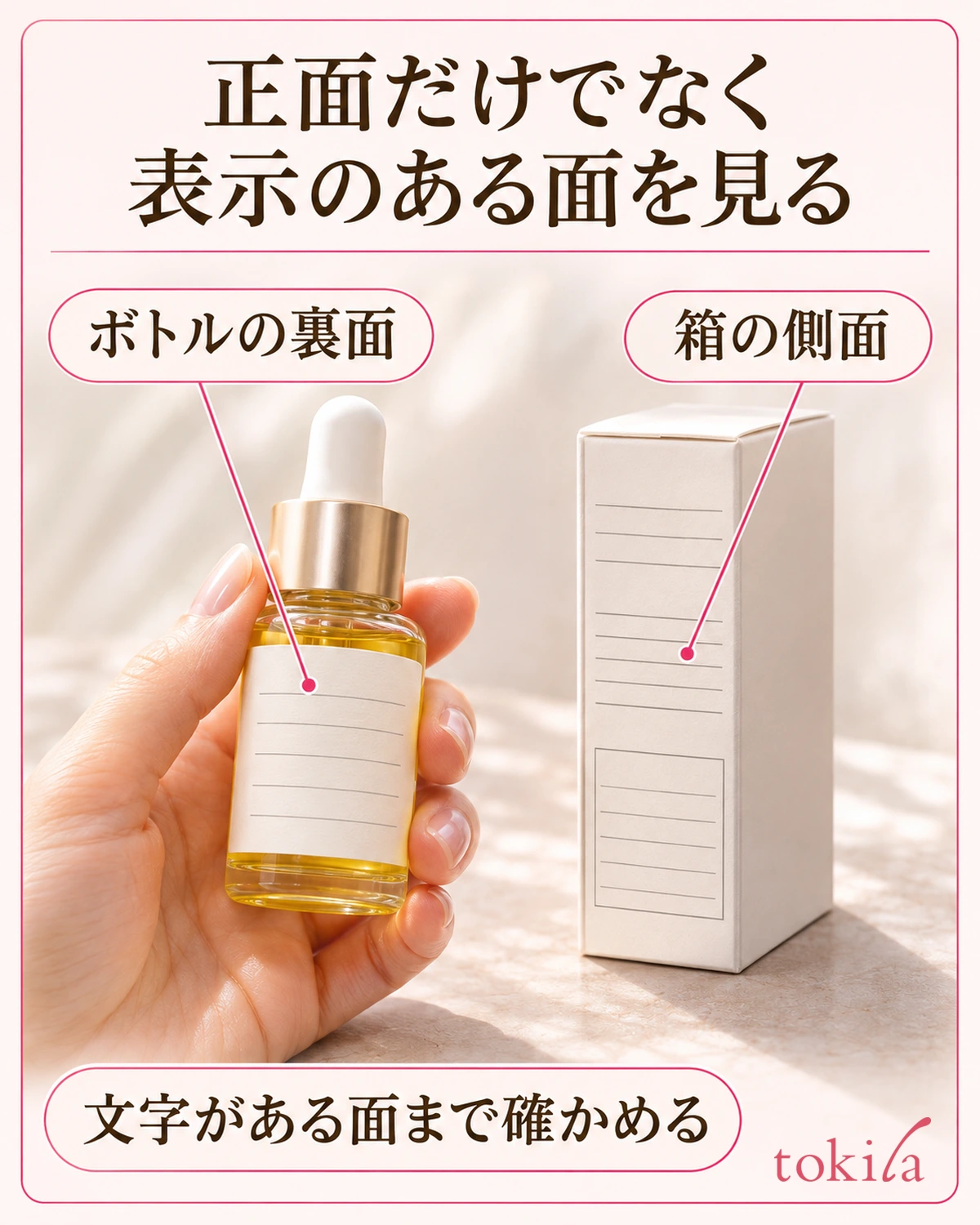
The supplemental photo shows an example with information on the back of the bottle and the box's ingredient panel on different surfaces. A front-facing store photo may not let you read ingredients or instructions. It illustrates turning to the surface with the text you want to check while shopping, rather than showing the superiority of any product or ingredient.
If comparing it with a previously used product bearing the same ingredient name, reread the current candidate's labeling. Even if names match, the overall formulation, fragrance, and order of use may differ. Read the conditions and notes accompanying any testing claim as well, and do not turn it into a guarantee that you will experience no abnormalities.
Compare the feel while spreading and the surface feel afterward separately
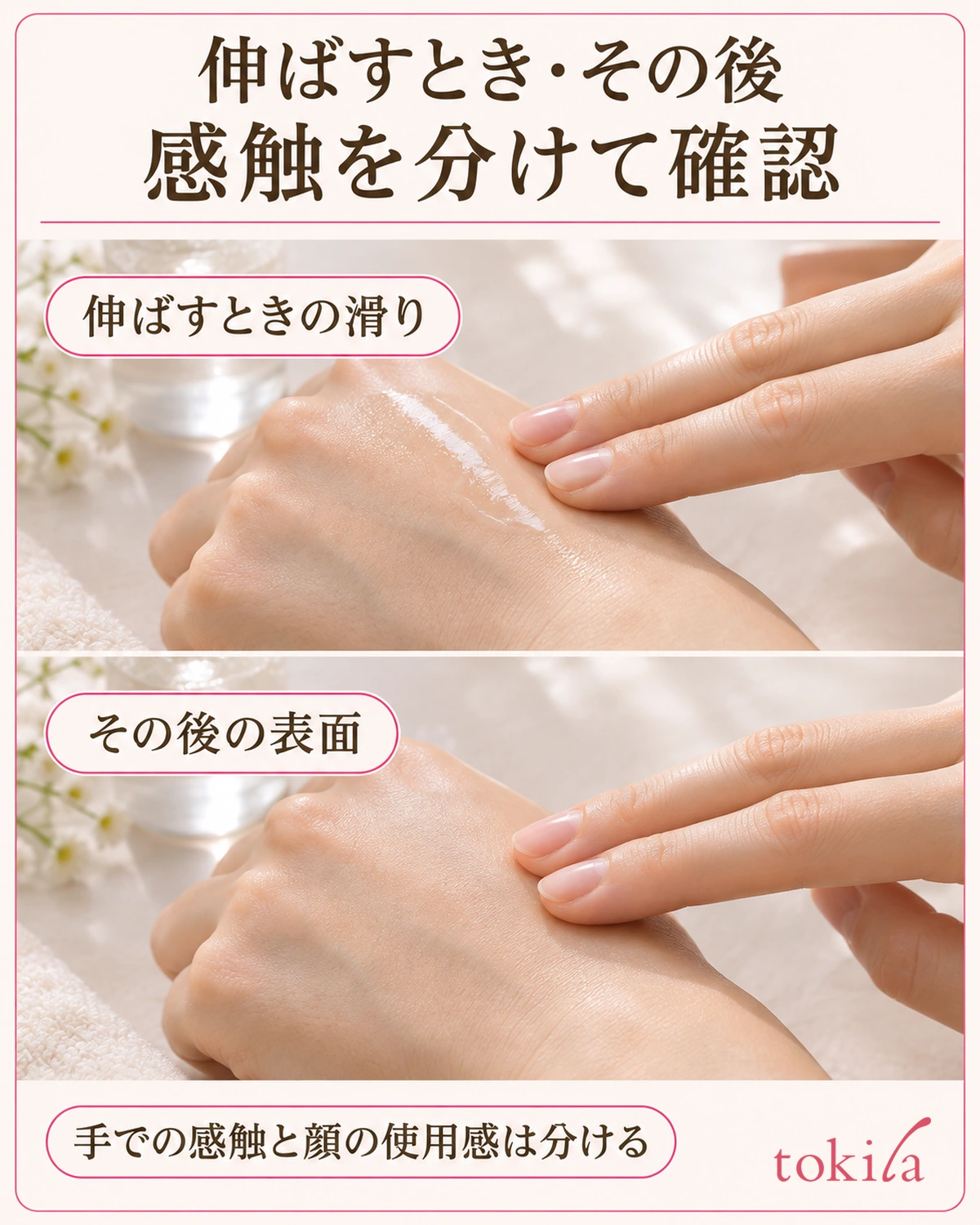
Where testing is available, follow the store's guidance and check the initial spreading feel separately from the surface after working it in. Choose points relevant to when you will use it, such as whether it spreads lightly, leaves a lasting slippery feel on the fingers, or how you perceive the scent. A photo alone cannot tell you how it feels to your fingers.
When trying two products, do not dispense more of just one, or treat one applied over toner and the other on a dry hand as equivalent results. Follow each product's conditions and record any conditions you could not match. The feel on the back of your hand may not be the same as on your face or before makeup.
Neither shine intensity nor oil color alone determines moisturizing performance or how well it settles on the skin. The question here is whether you find the feel after application acceptable. Do not use photos under different lighting or brightness differences between areas of an arm as evidence of differences in cosmetic performance.
If you want morning use, also check the conditions for combining it with your existing makeup primer or sunscreen. Distinguish briefly testing it in a store from successfully incorporating it into your usual morning routine. Do not declare an untried combination "won't disturb makeup"; leave it as unconfirmed.
Even if a candidate seems light, do not assume you will use more than directed. Also avoid choosing it on the assumption that you can reduce necessary moisturizer or sunscreen amounts because it feels heavy. You can return to another candidate if the feel does not suit your preferences, or postpone buying if you cannot test it.
Check how it fits your routine, the container, and one application
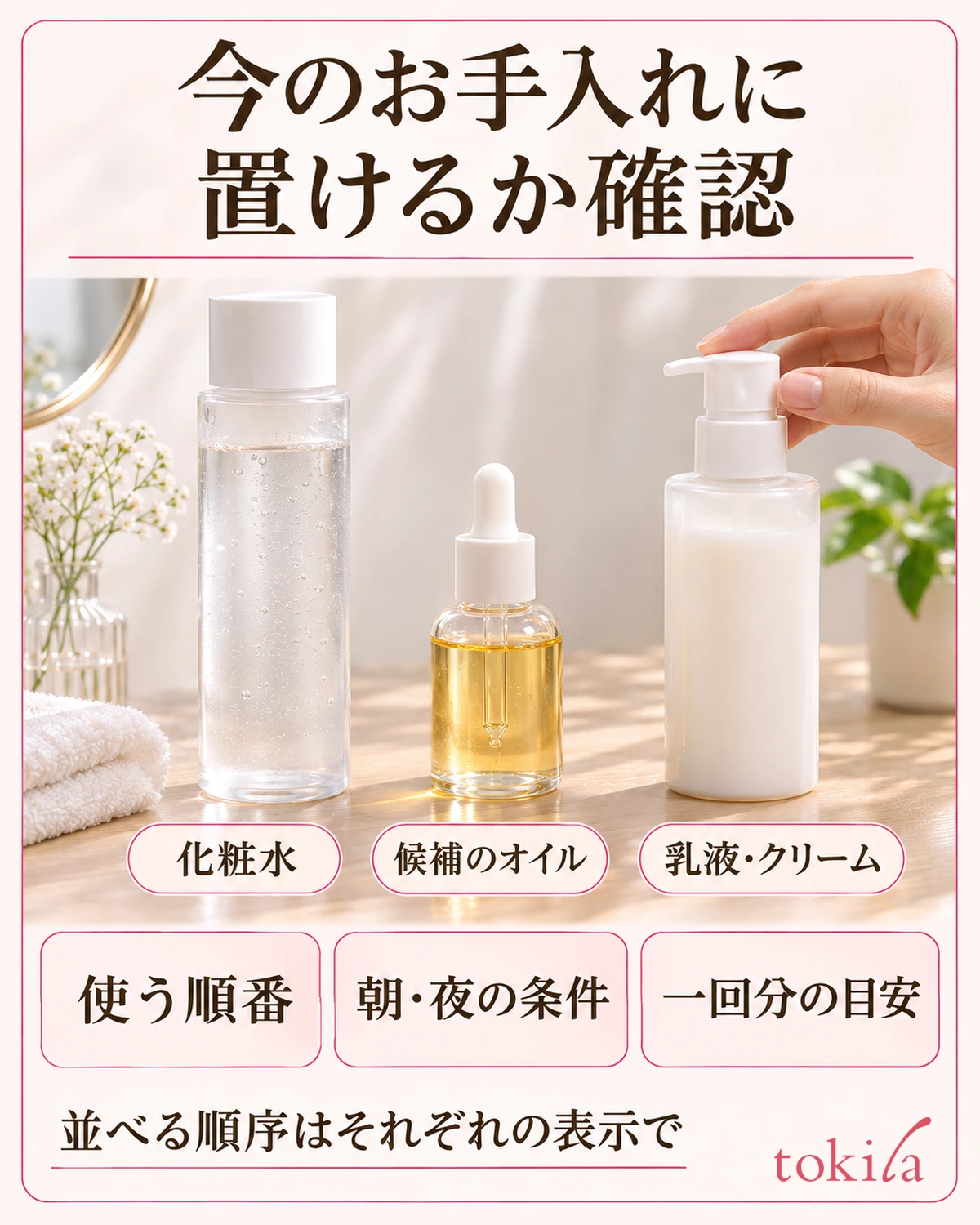
Order of use matters while choosing, not only after buying. Check its position relative to toner, how emulsion or cream is handled, and whether it is for morning or night, then add a line to your usual routine. It is important not to decide "first" or "last" based solely on how light it is or the ingredient name.
If there are instructions about skin condition, such as applying while moisture from toner remains, include those conditions. Do not transfer them to another candidate; compare using each bottle's own instructions. For questions about combinations, prepare the names of your current products and their order so you can ask clearly.
Packaging also affects ongoing ease of use. A small opening you tilt, a dropper, and a pump require different dispensing movements. Consider ease of handling while getting ready in the morning and opening and closing it where you keep it. However, do not calculate on the assumption that identical container shapes mean identical drop sizes.
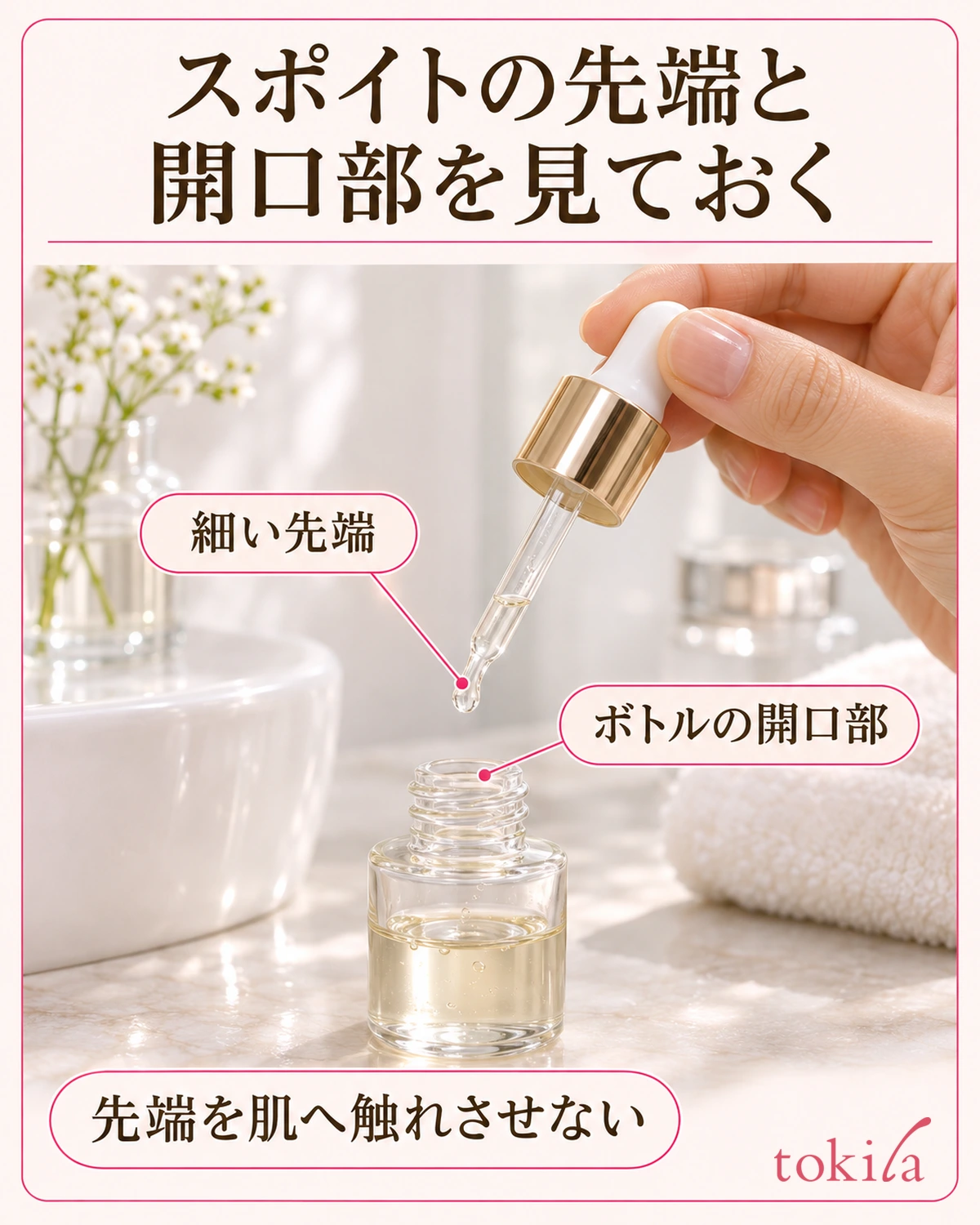
The supplemental photo shows the distance between the thin dropper tip and the bottle opening. It does not demonstrate dripping oil directly over the face. This close-up helps you picture the dispensing shape and handling that keeps the tip from touching skin. Check the purchased container's instructions for the actual dispensing method.
If you plan to carry it, read how to close the original container and any carrying guidance before buying. Do not assume transferring it into a smaller container preserves the same conditions; choose a size whose storage requirements you can follow. Beyond the value of a large bottle, whether you can manage it comfortably is another selection point.
Ask both candidates the same questions and choose one or postpone
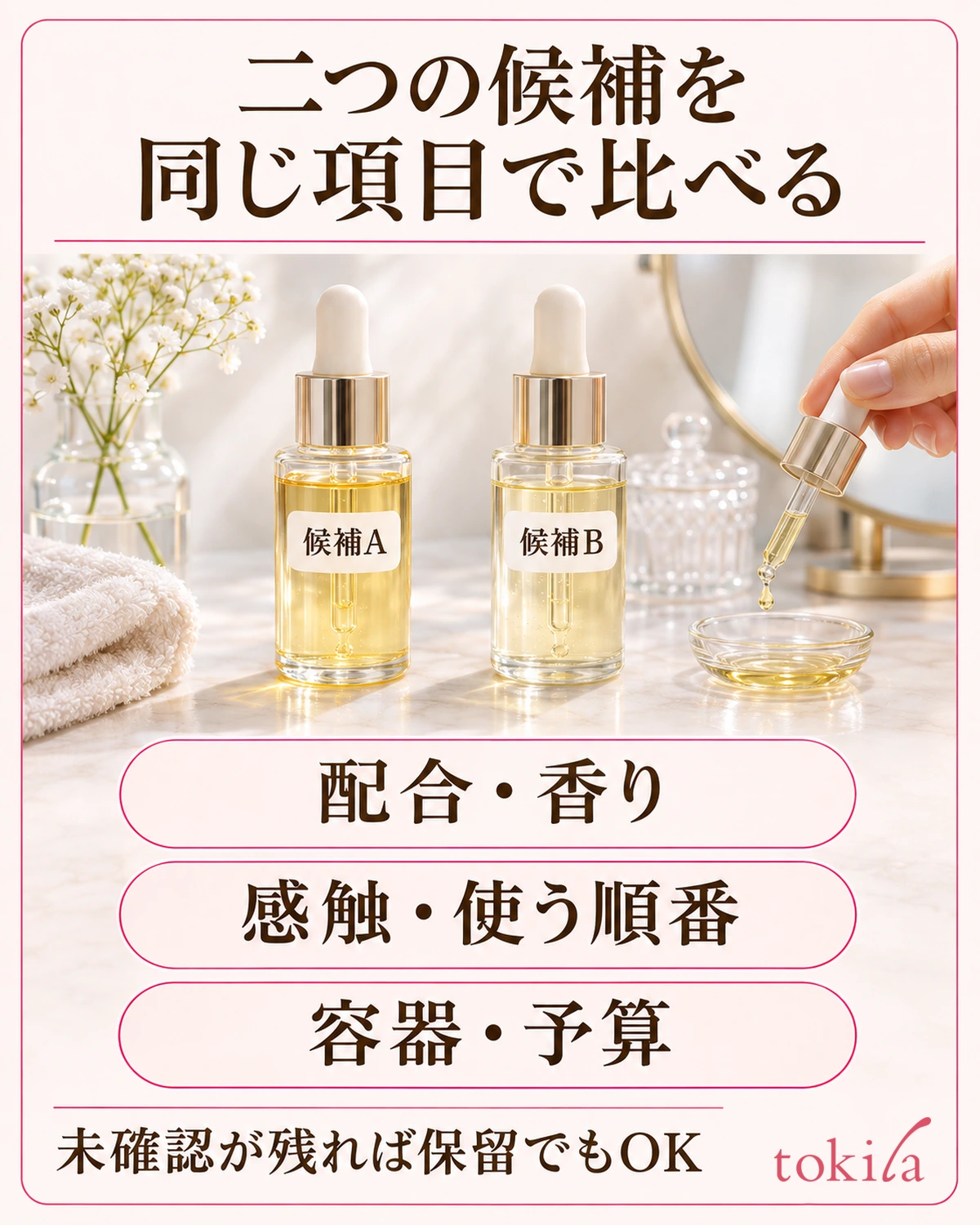
Finally, compare two candidates on five points: "for facial use," "formulation and scent," "tested feel," "steps before and after," and "container and budget." If you have been comparing one ingredient name with the other's package appeal, return to the same questions. Separating confirmed and unconfirmed details shows what else you want to know.
Consider price together with volume, but differing amounts and frequency of use mean volume alone does not determine how many days it lasts. Rather than calculating cost as if any number of drops were equivalent, consider the directed amount and when you will use it. For a first-time candidate, also check whether you can handle the volume while following storage conditions.
You can leave one specific reason for postponing, such as "I like the nighttime feel, but the scent is unconfirmed." Instead of adding many more candidates with missing information, checking that one unknown may make choosing easier. Someone else's account that it suited their skin is not evidence that you can use it the same way.
Once you choose a bottle, you can organize the actual application steps using How to Apply Face Oil together with your product's labeling. Keep purchase comparisons separate from adjusting amounts and movements after starting use, and avoid changing several products at once from the outset.
With face oil, start by looking for a bottle that fits your facial routine rather than competing over unusual ingredients or beautiful shine. Read the formulation, check the feel you can test, and compare surrounding steps and packaging. Including the options of not adding it or not deciding yet, consider whether a reason to use it in your current life remains.