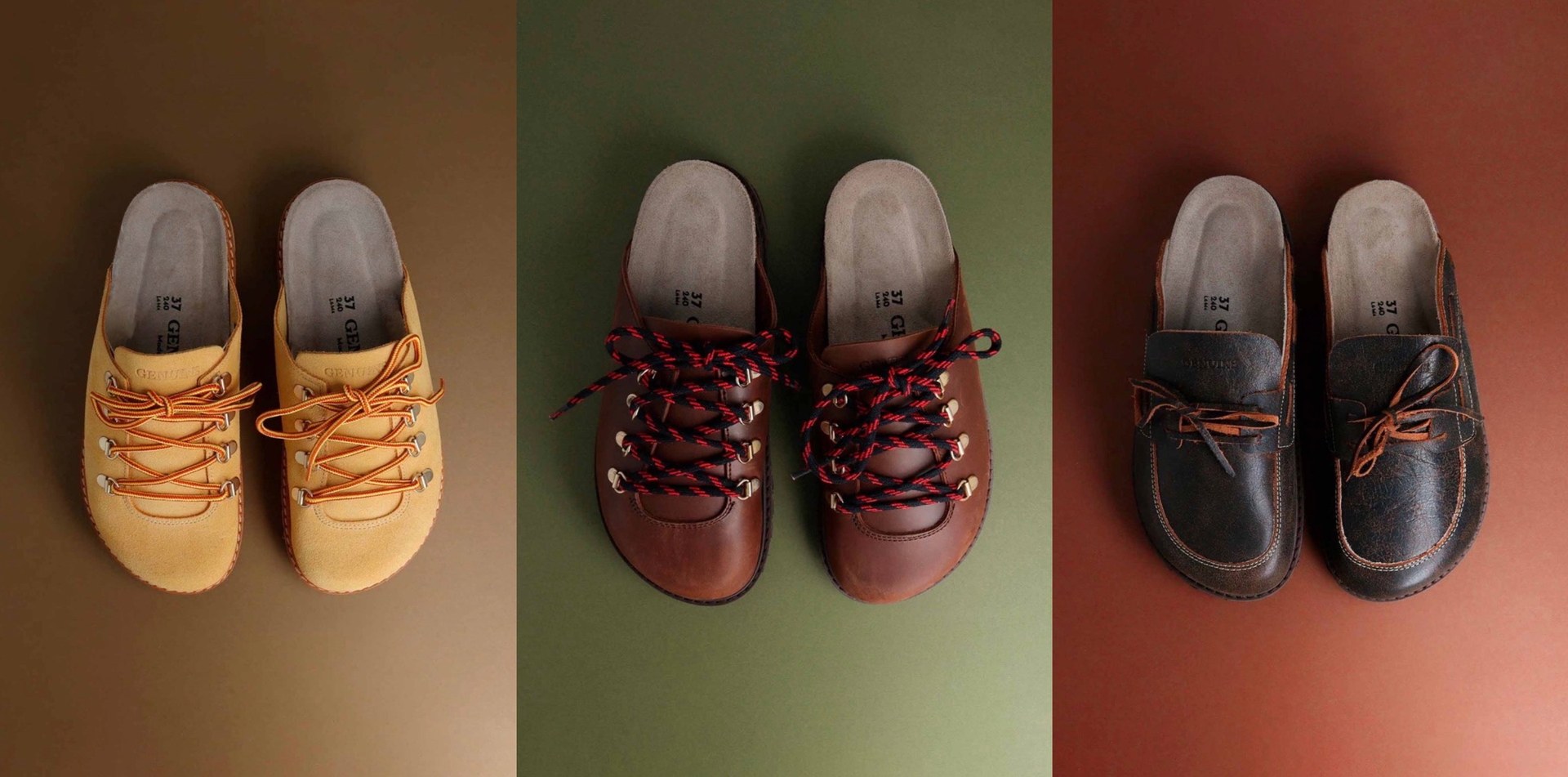
You want to change your shoelace color, but you can't choose by looking at the shoes alone. Or you threaded in a color you like and the knot ended up standing out more than your clothes. In that case, before settling on a color name, try checking the lines visible across the top of the shoe and the knot separately.
This article introduces a way to compare shoelace colors with your clothes while keeping one pair of lace-up shoes you own fixed. Rather than settling on a single correct color, you compare an option that blends into the shoes with an option that shows off the laces. First, also check whether the laces can be replaced and whether you have the length you need.
1. Separate the laces you see across the instep from the color of the knot
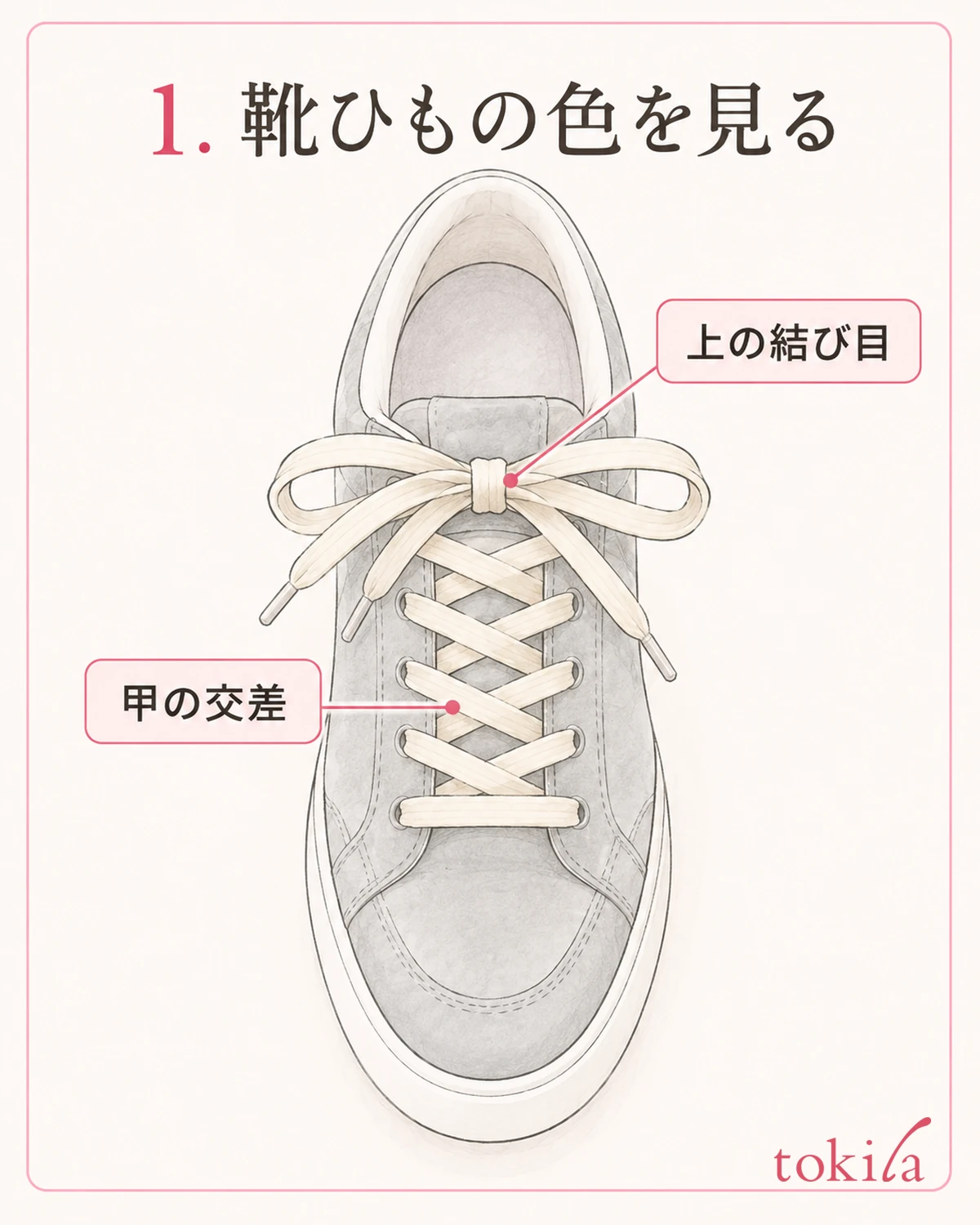
First take off the shoes, place them in a bright spot, and look at the instep from above. Look separately at the part where the lace goes back and forth through the eyelets, the knot at the very top, and the leftover ends. Even with a single lace, the amount of color you see differs between a stretch of thin crossings and a place where the loops overlap.
Also check the color of the shoe body, the area around the eyelets, the tongue under the laces, and the sole. Even if you think of the shoes as white, if the tongue is ecru and the area around the eyelets is dark gray, the colors touching the laces are not a single color. Choosing the one boundary that bothers you most today makes it easier to narrow down candidates.
Flat, wide laces and round laces look different on the surface. If a flat lace is twisted partway, you see the wide face and the thin side alternately. If the color seems uneven, check the direction of the laces you have and the shadows before looking for a new color. You don't need to pull them hard just for looks.
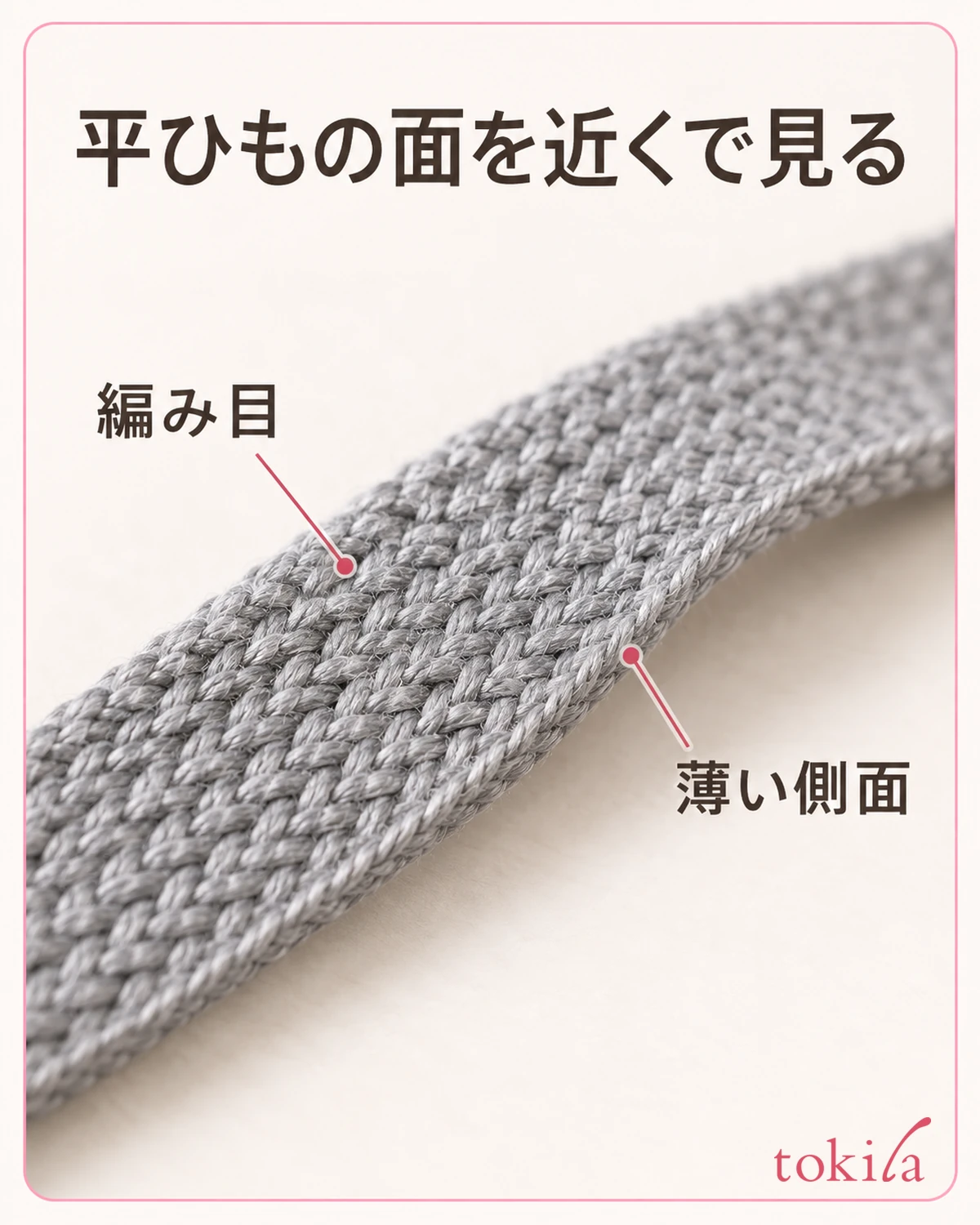
It is also worth looking at the fine weave of the surface up close once on the actual item. This is so you don't mistake the shadows that fall in the narrow grooves or the way the threads catch light for a pattern in another color. If there is dirt, separate color choice from care, and follow the labels for those shoes and laces on how to wash and dry them.
About two color candidates are enough. Keep your current laces as one option and place the other next to them. At this stage you may line the candidates up beside the instep without wearing the shoes. Do not walk around wearing laces that have only been laid on temporarily.
Some laces cannot be removed or are integrated with a dedicated fastener. Do not take them apart just because you can't see the knot; first check whether they are replaceable parts. Think of preparing to enjoy color and work that changes the shoe's structure as separate things.
If you try different candidates on the left and right, stick to a comparison with the removed shoes lined up in the same direction at first. Do not move around comparing with only one foot wearing a shoe; when you actually use them, adjust the tightness and length on both feet. If one side has strong light, swap the positions of the shoes and check the difference in light as well.
2. Compare a color that blends into the shoe with a color that shows off the laces
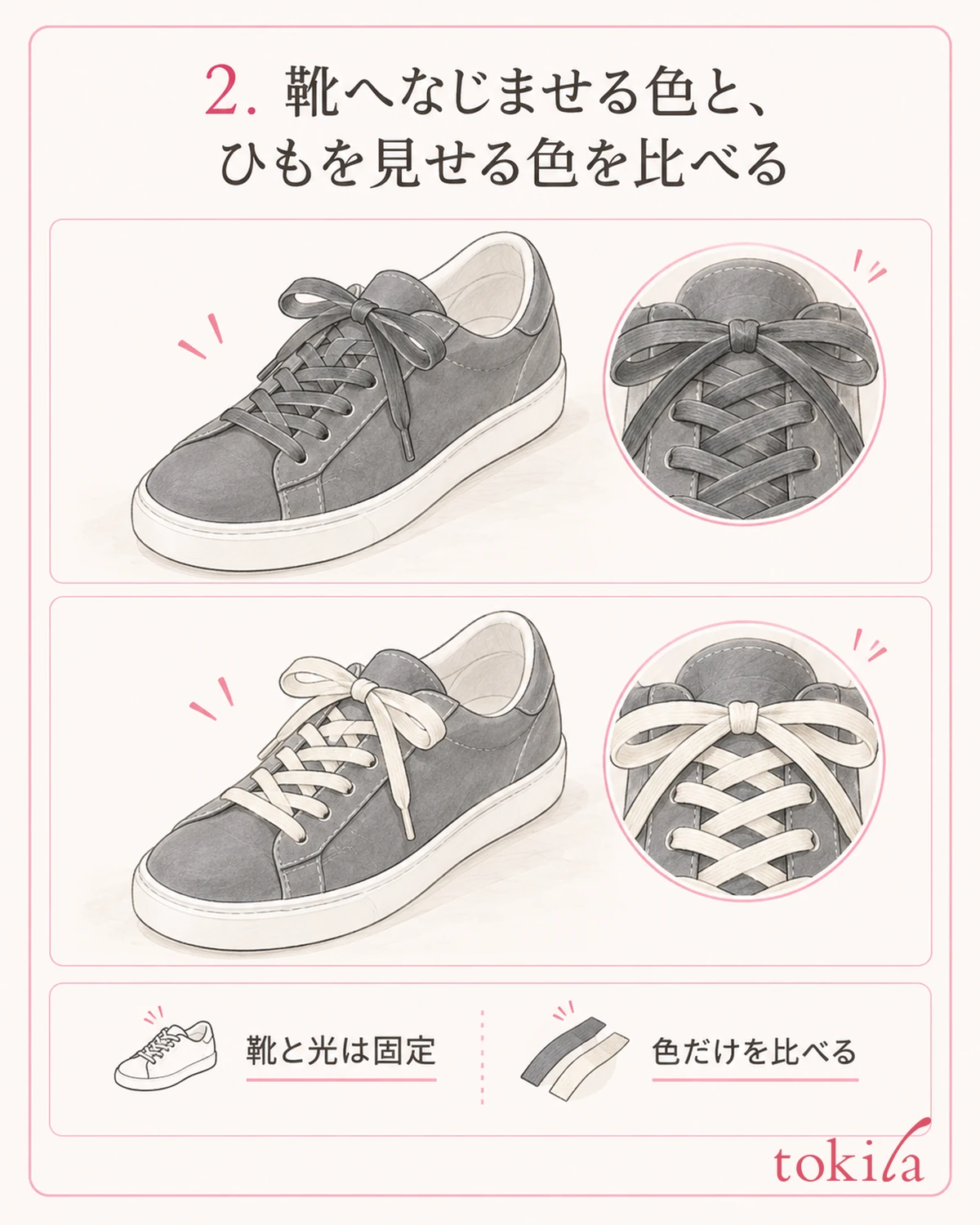
At first, line up candidates close to the brightness of the instep. The starting point is to make a dark color one option for a dark instep and a light color one option for a light instep. You do not need to match the exact same color name. Check whether you want the lines of the laces to look subtle.
Next, place candidates whose brightness differs from the instep. With light laces on dark shoes, see how the crossing lines and the knot look. Looking strong is not in itself a failure; choose by whether you want to show off that part today.
When comparing two options, fix the shoe, the direction you place it and the light. If one lace is thick and the other is round, differences other than color are included. It is fine if no candidates are under perfectly identical conditions, but do not assume the difference in impression is purely an effect of color.
It is also important not to fix assumptions such as that whitish colors suit anything, or that black is always subtle. On a white instep, black laces show up as lines, and on a dark instep, white laces can stand out clearly. Look at the relationship between the shoes and laces on the real items.
If you want the laces to be the star, also look at where the lines overlap other patterns on the shoe. If the instep has a large pattern, the crossing lines may feel as if they have multiplied. Do not change the number of eyelets or the lacing method to hide a pattern; first check whether you like it as it is now.
If you are torn, put into words which is closer: "I want it to blend into the shoes" or "I want to show the knot." This is not to rank options or sort types of people who suit them. It serves as a marker for judging, after you change candidates, whether the look matches the purpose you set first.
3. Check the lace's thickness, surface and length before replacing
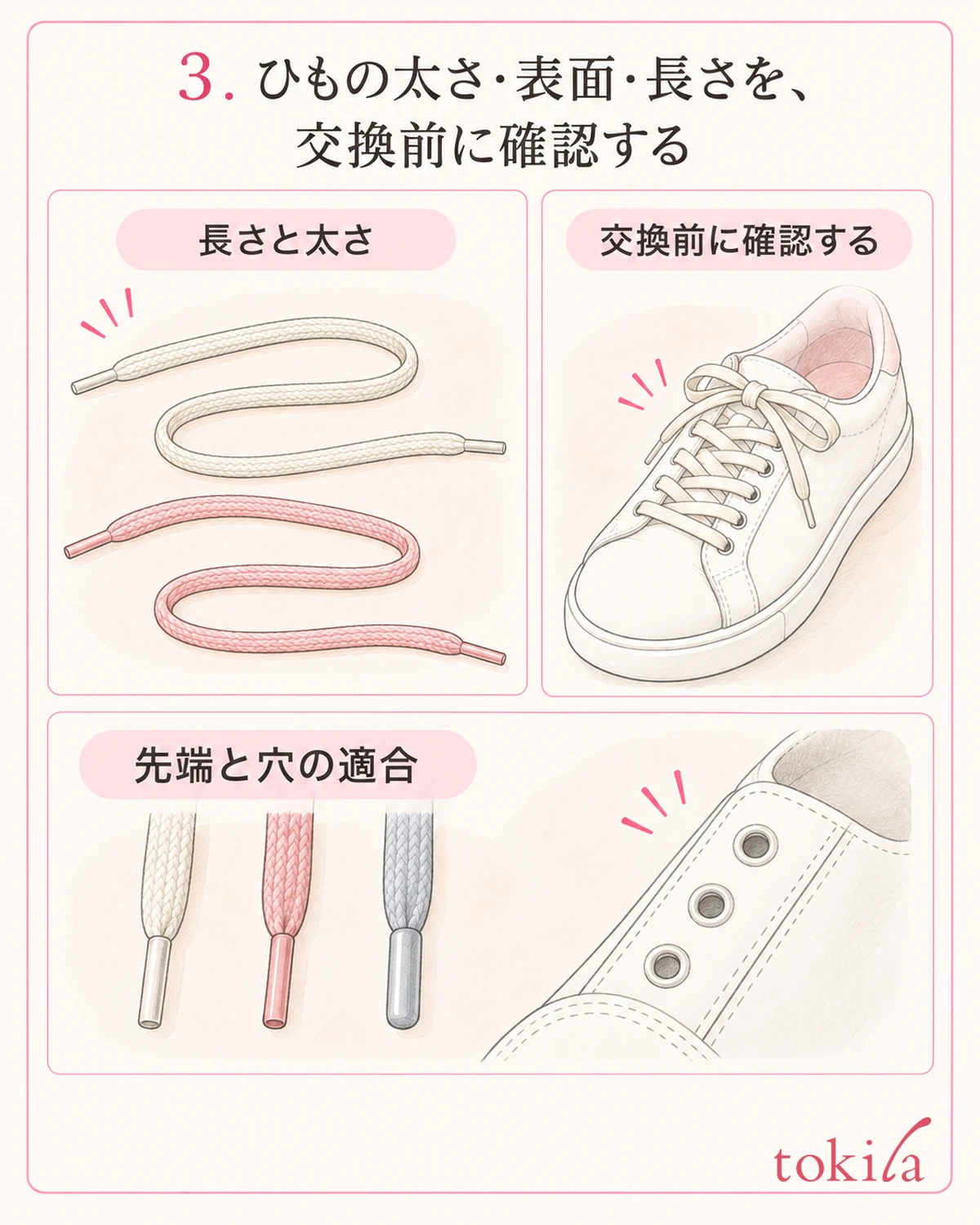
Once the color candidates are decided, check whether the laces can be used with the shoes you own. Place the original lace and the new candidate side by side and look at the length, thickness, whether flat or round, and the shape of the tip. Even if you like the color, do not force through a lace that will not go through the eyelet.
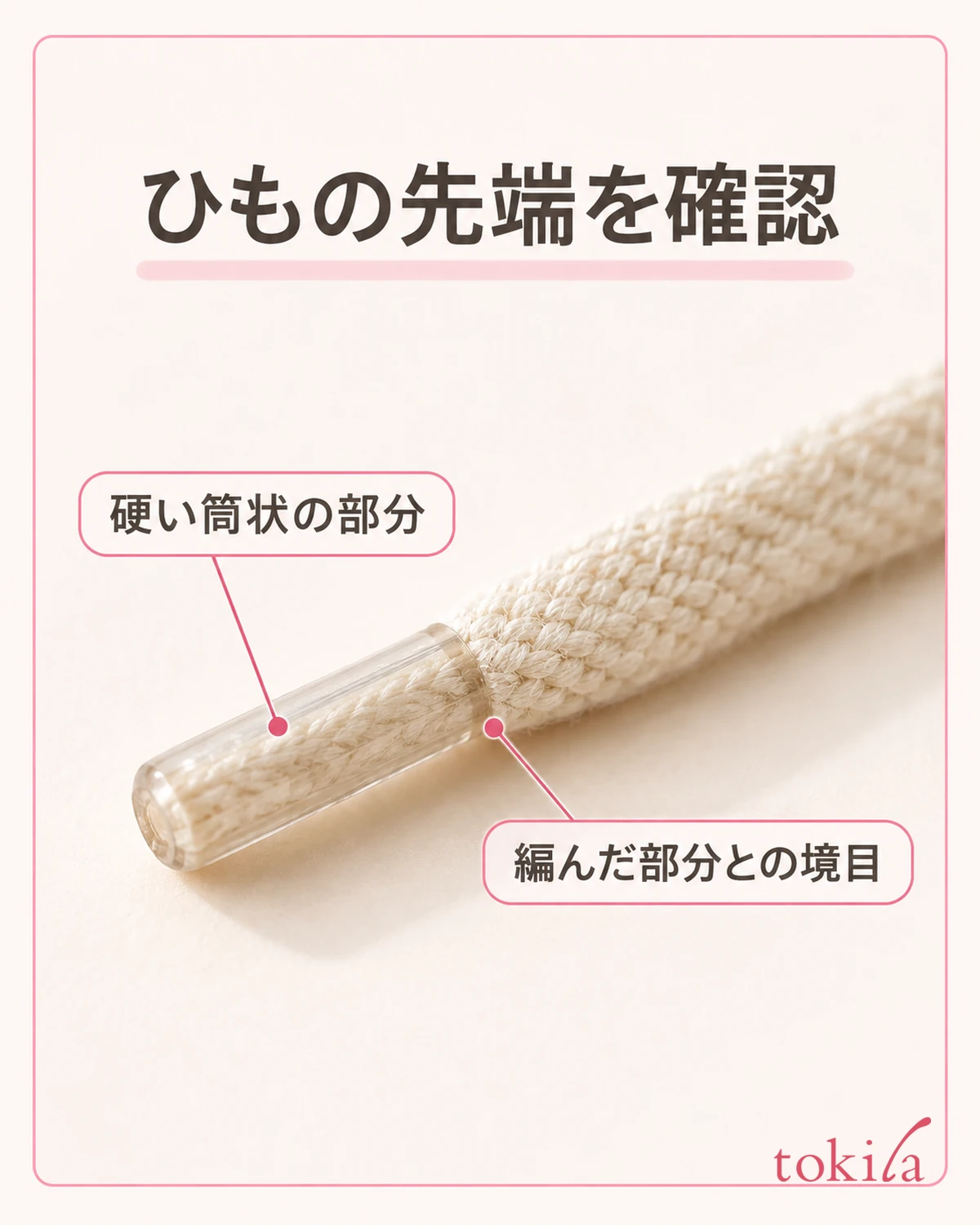
At the tip there is a hard tube-shaped part that gathers the braided section into a thin point. If it is too thick, split and flared, or the boundary with the lace is damaged, do not force it through and instead check whether it can be used. Do not process it by cutting or shaving it into a shape that will go through.
Do not decide the length uniformly by the number of eyelets alone. The required length also changes with the shape and size of the shoe and the lacing path. Check the fit guidance for your item, and when measuring the length of the original lace, lay it naturally without stretching it for comparison.
If too much is left over beyond the knot, reconsider the length before you test it by walking. Rather than tucking the excess inside the shoe so it only looks tidy, choose again from candidates of a usable length. With a candidate that is too short to tie, do not make up for it by pulling tight.
Laces with a glossy surface and laces that reflect light softly give a different impression even in the same color name. After checking the material up close, step back and return to the whole instep. Separating whether you want to show off the texture or the lines of color leaves you with a reason for your choice.
When replacing, leaving the original lacing pattern in photos or notes gives you a clue for putting it back. For shoes with a dedicated lacing method or fastener, give priority to that guidance. To match the color scheme, do not make adjustments such as skipping necessary eyelets or changing the tightness drastically.
Before buying new laces, also check what you like about your current ones. If there are conditions other than color you want to keep, such as how easy they are to tie or how they behave when you untie them, add them to your notes. Even if you like the sample color, you still need to check separately whether it fits the shoes you will use.
4. Match the socks and trouser hems, and look again at the whole outfit
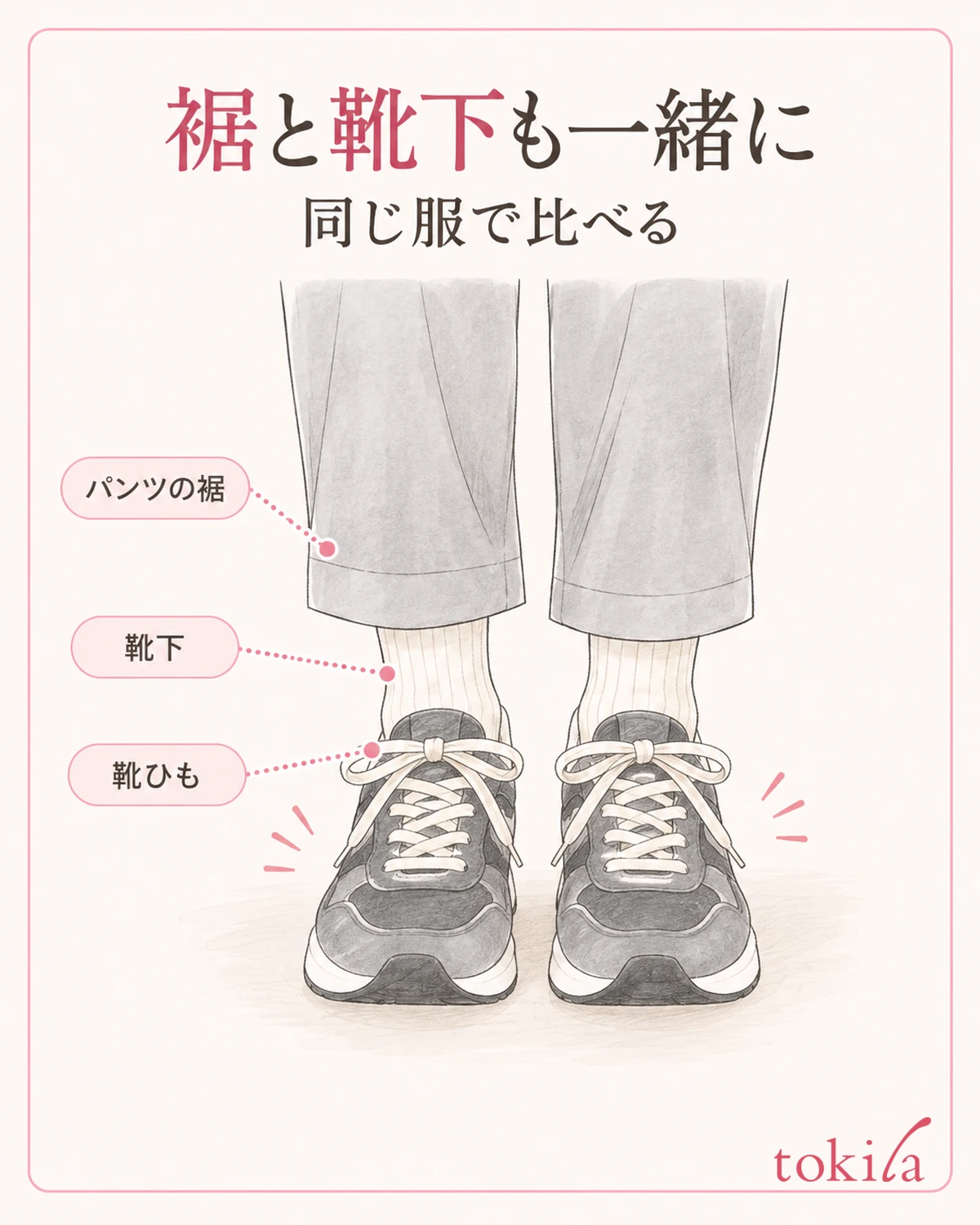
Once you have narrowed down to candidates you can actually thread and tie, look at them with your usual socks and clothes. Put on the shoes, tighten both sides appropriately, and check that they don't come undone. Even when comparing color schemes, put comfort and ease of walking first.
In the mirror, don't get close to just the laces on the instep; include the hem and socks as well. Check whether the laces look close to the socks or are partly hidden by the trouser hem. For clothes whose hem rides up when you sit, also look at the knot and the surrounding colors in that posture.
First, compare lace color candidates without changing your clothes and socks. Then, if you want to link the color to your outfit, change just one item you already own, such as socks close to the lace color. If you change the trousers and jacket at the same time, it is easy to lose track of what you liked.
Even if the same color appears nowhere else in the outfit, you can choose the option of leaving color only in the laces. Conversely, some days you like picking up a color from a bag or a small pattern on your clothes. Rather than making it a rule that it must match some item, decide based on the place you want to show off.
If you are also unsure about how much of the socks shows, you can also check how to compare sock colors with the clothes around them. Here, fixing the laces to one option first and then moving on to the socks means you don't have to consider more candidates at once.
Turn slightly to the side and look at the side of the shoe as well. Even if the laces look strong from above, the colors of the body and sole may take up a wide area in the whole outfit. Don't decide by only the nearby instep or only the distant full-body view; return to your everyday look and check.
5. If it looks too strong, undo just one thing, and note your preferred conditions
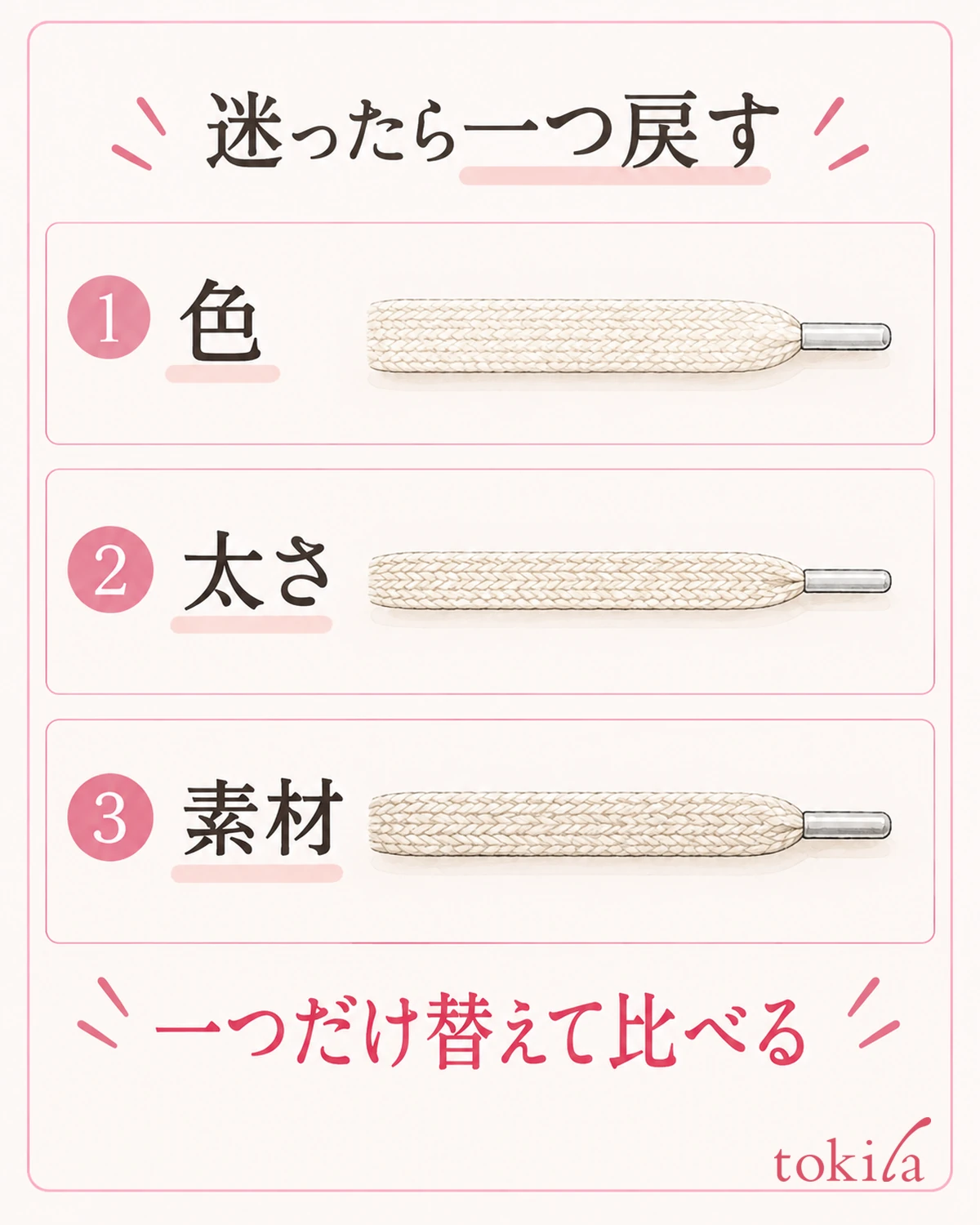
If you feel only the laces look too strong, pick one reason it bothers you. Is it the difference in light and dark, a thick line, or the size of the knot? Before changing the color, also check whether the way you tie and the length suit those shoes.
If you want to tone down the difference in color, go back to a candidate close to the brightness of the instep. If the surface gloss bothers you, compare only if you have a different material on hand. Do not record a result where you changed both thickness and material at once as simply the merit or demerit of the color.
During the comparison, use the same mirror and light, and when you move to another place, look at your clothes and shoes together. Do not compare only your memory of a color you saw earlier with what you see now. Do not take one spot where strong light reflects as the color of the whole lace; turn slightly and look again.
If you keep photos, shooting the full outfit and the area near the instep separately makes them easier to review. A photo is an aid for remembering a combination. Colors change with the screen and automatic correction, so don't use it as material to prove a precise match or the real color.
Briefly note the color and place, such as "show the line with pale laces on a dark instep" or "pair ecru laces with the same socks." Adding which shoes and which hem you compared with gives you a starting point for trying with your next outfit. The color you chose today does not have to be the answer every time.
If you are short on time, it is fine to go back to the laces you are used to. By looking in order at the instep, the knot, the material and the clothes around it, you can sometimes choose even before adding more color candidates. Look for a combination that keeps both a color scheme you like and a length and comfort you can use without strain.
In places with a dress code, first check the colors and shoe conditions that are allowed. Also, if you are comparing dirty laces with new candidates, differences in color and condition are mixed together. Separating whether your current laces need care or whether you want to try a new color is also a judgment to make before buying more.