You go to put your cushion foundation away, and the inner lid pops up, the puff gets caught, or only the outer lid looks closed. When that happens, before pressing down hard, check which lid is not closed. The shape of the case and how it closes differ from product to product, so it may not be handled the same way as another compact.
This article focuses on cases that have an inner lid covering the product, and explains the order in which to check the puff's position, dirt on the rim, and the combination of refill and case. It is not a repair method for taking apart parts that are hard to open and close, or for adding water to a dried-out product. It is a set of steps for reviewing whether you can store your compact comfortably, according to the labeling and structure of the one you own.
1. Tell the outer lid, inner lid and puff storage spot apart

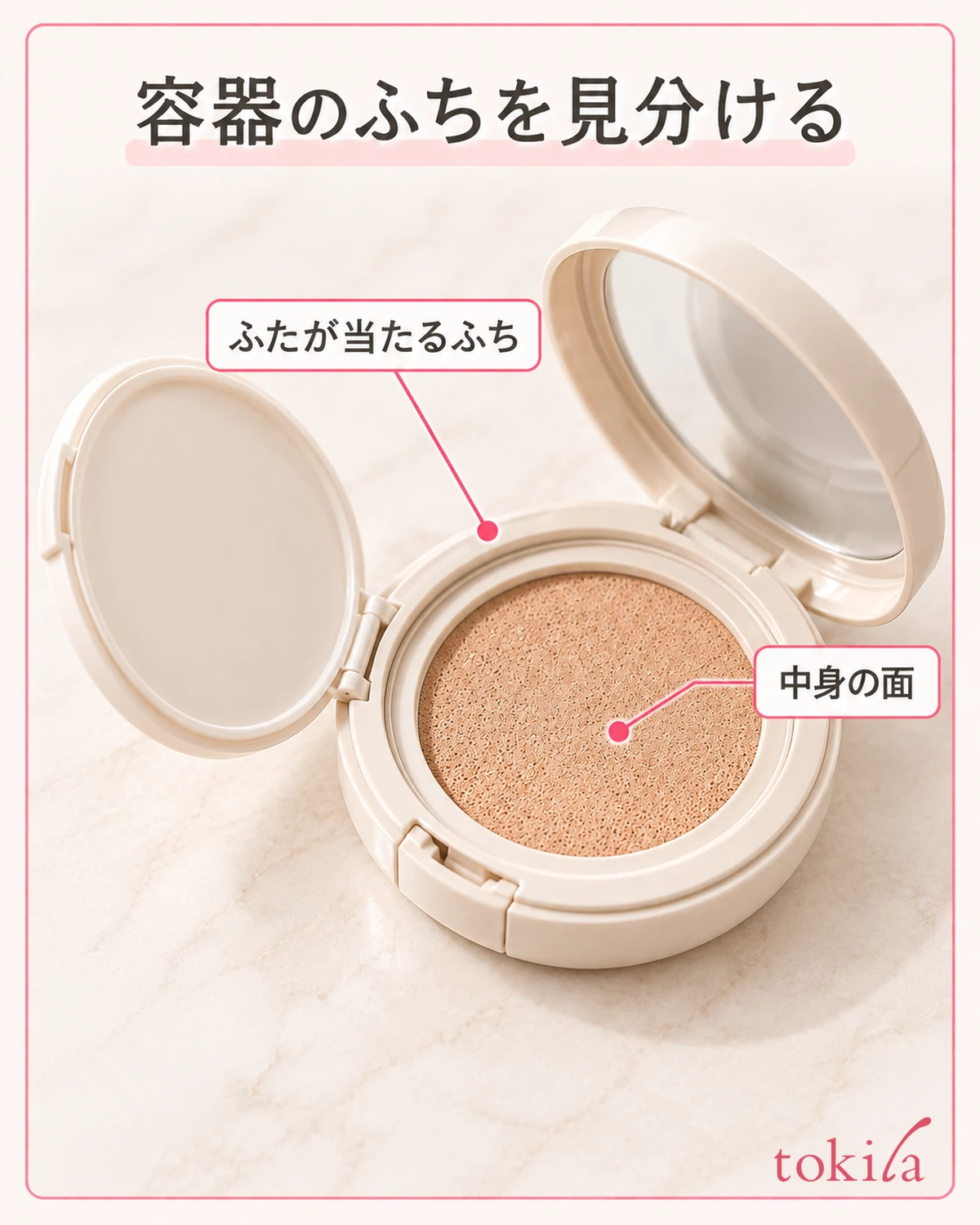
First, place the case on a flat, stable surface. With clean hands, open the lid without bending it back more than necessary, and look in turn at the outer lid, the inner lid that covers the product, and the spot where the puff is kept. Even if the outer lid with the mirror closes, check separately whether the inner lid beneath it has closed properly.
Structures vary: some hold the puff on top of the inner lid, and some link the outer lid and the inner lid. The inner lid here means the lid that keeps the product from drying out. Do not confuse it with the protective seal you remove first, or the mesh that covers the surface of the liquid. Whether to peel off the seal or leave the mesh in place should also be confirmed in that product's instructions.
Before going out, check the rim, which is hard to see in the mirror's reflection, in a bright place. You do not need to put a finger into the surface from which the product is picked up. Rather than tilting the case to test it, keeping it flat and looking from the side to see where it is lifting makes the condition easier to sort out.
If it is hard to tell where it closes, check by eye the position of the knob, the rim of the lid and the latch. Do not assume you can press the same spot on every product; give priority to the positions and order shown for the one you own. For a structure that makes no sound, there is no need to press again and again until you hear a click.
Also try to remember whether it was hard to close from before, or whether it started after you changed the refill or the puff. If it was right after a change, look first at the combination and how it fits; if it was after carrying it around, look first at whether the puff has moved or the case is damaged, and you can narrow down what to check. Do not jump to a cause; check what you see one thing at a time.
There is no need to add a lid from another case to a product that has no inner lid. The figures are schematic diagrams for telling the roles of the parts apart. If part of your case differs from them, do not try to match the shape in the figure; read on using your own case as the standard.
2. Check that the puff and ribbon are not caught in the rim
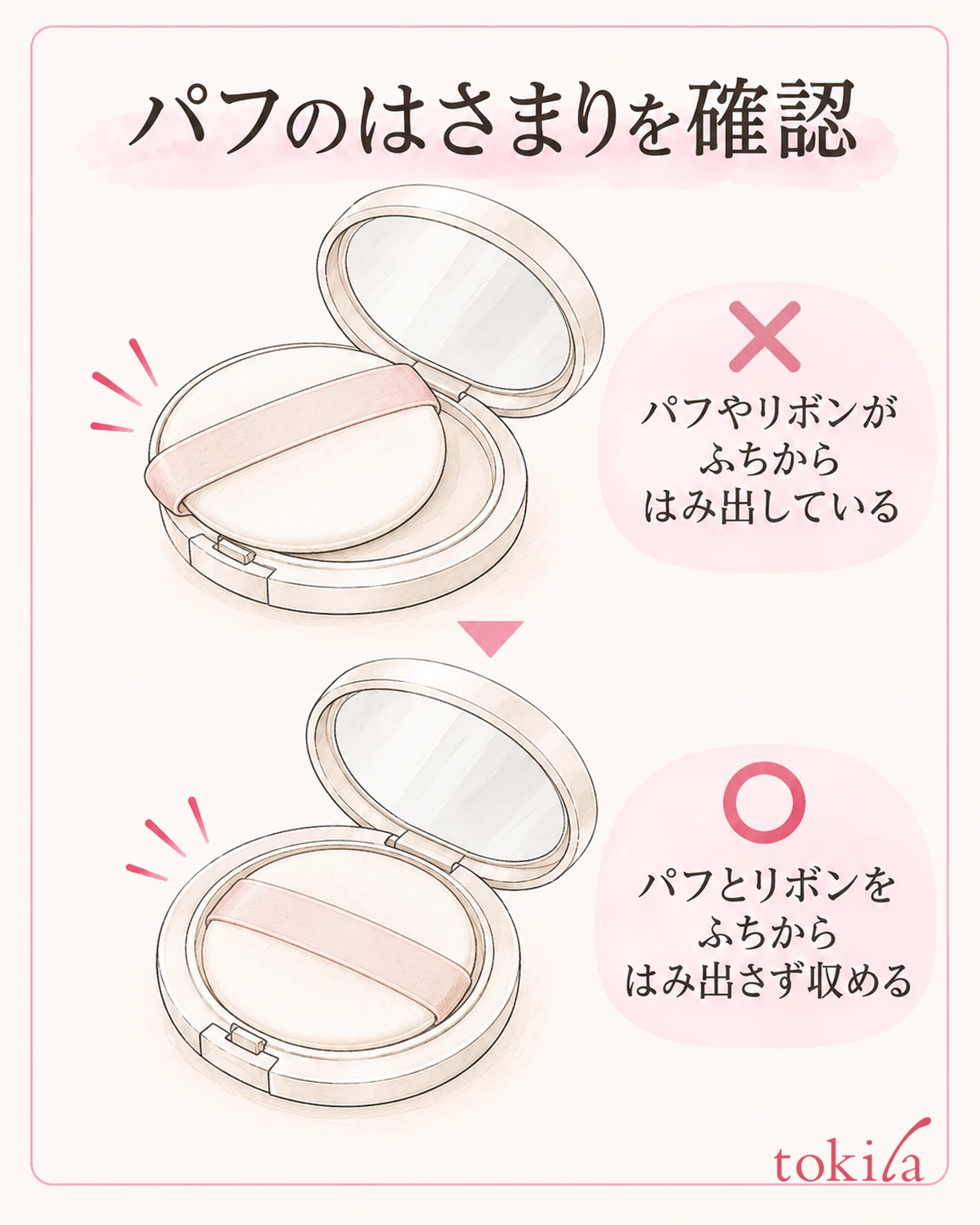
Take the puff out once and move it to a clean place. If the inner lid covering the product and the puff's storage area are separate, first check the inner lid without the puff. Avoid pushing the outer lid shut while the edge of the puff is still resting on the rim.
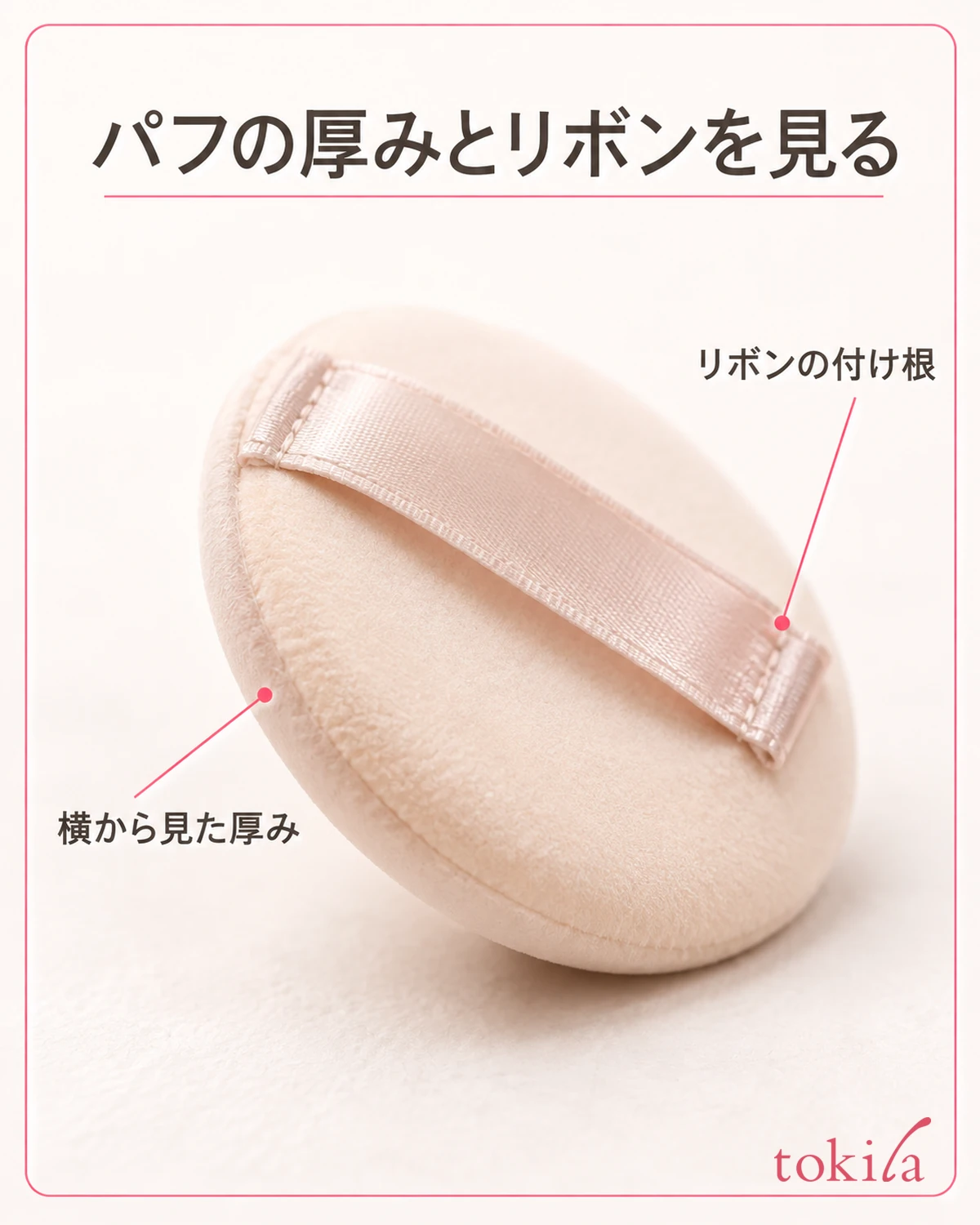
If the puff has shifted from its designated position, put it back so that it does not overlap the rim. Also check that the ribbon you slip your finger through is not sticking out, and that a folded edge has not gone into the latch. Rather than squashing the puff itself to change its thickness, the steps are to take it out once and correct its orientation and position.
If you use a replacement puff, check not only its diameter but also its thickness and shape. Even a tool that can be used on the face will not necessarily fit in the case's storage area. Do not judge compatibility only because it looks similar to the included accessory; confirm on the label whether it is a compatible item or a product intended to be stored in the case.
Also check that you have not put a washed puff back while it is still damp. Wash washable tools by the specified method and use them only after they are fully dry. Do not dry them while they are in the case, or store damp puffs stacked on top of each other. Washing is covered in Caring for makeup brushes and sponges.
If you put paper or a thin sponge into the inner lid as an extra divider, you can no longer check how it is meant to close. Even when you work out a way to store it, start by returning a compatible puff to its designated position, rather than adding something where the lids meet.
If it closes with the puff removed and pops up when you put it back, that gives you a clue to review the storage position and the combination with the puff. However, that alone does not mean the case has no defect. If you can see that the lid is misaligned or damaged, do not keep forcing it open and shut.
3. Look at the rim of the case and tidy up dirt following the handling instructions
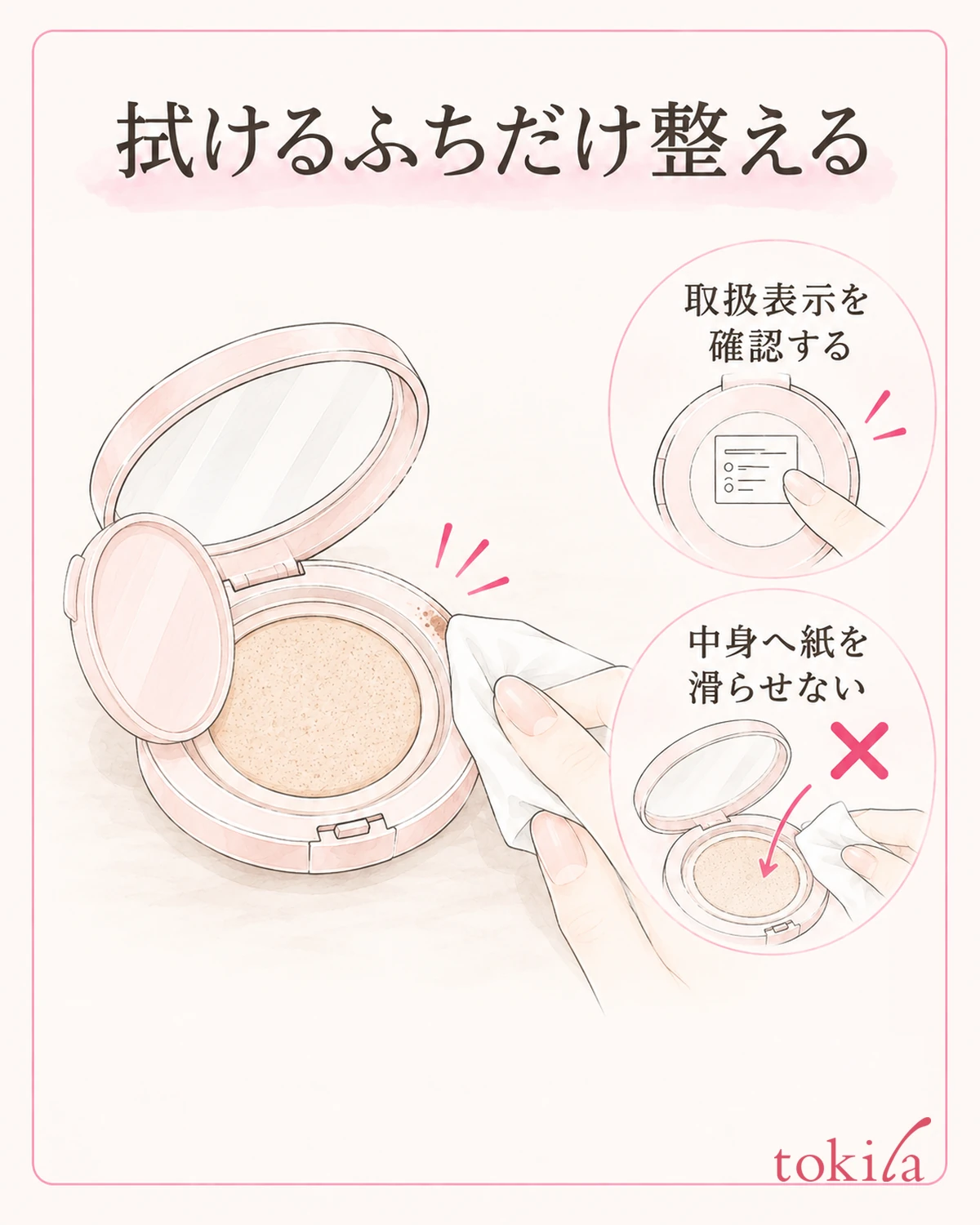
Look at the rim where the inner lid sits and around the latch. Even if you see foundation residue, puff fibers or hair, do not immediately dig it out with a fingernail or a pointed tool. Do not let dirt fall onto the product, and deal only with the outer parts you can reach.
If the instructions say the mouth of the case can be wiped, gently wipe off the dirt with something that meets the specification, such as a clean tissue. Fold the dirty side inward so you do not keep spreading dirt with the same surface. It is also important not to slide the tissue from the outside of the rim toward the cushion inside.
If you push paper into tiny gaps, fibers may be left behind. Do not rub hard at clumps that will not come off; stop at that point. Do not treat pouring alcohol, remover or detergent directly on the case, or rinsing the whole case in water, as common care. What you can use and which parts can be washed differ from product to product.
The cushion and the mesh are separate from the rim of the case. Do not cover the surface of the product with dry paper thinking you are wiping the rim, or remove the mesh to wash it. The back of the inner lid also has different roles, such as the surface that touches the product and the surface used to adjust the amount, so check the description for the one you own.
After wiping, check by eye that no scraps of paper remain. If the way it closes does not change even after the dirt is removed, it is not a stage for scrubbing harder. Go back to checking the puff's position and the compatible case, or review whether there is any damage.
4. Confirm that the refill and case are compatible, and close in the specified order
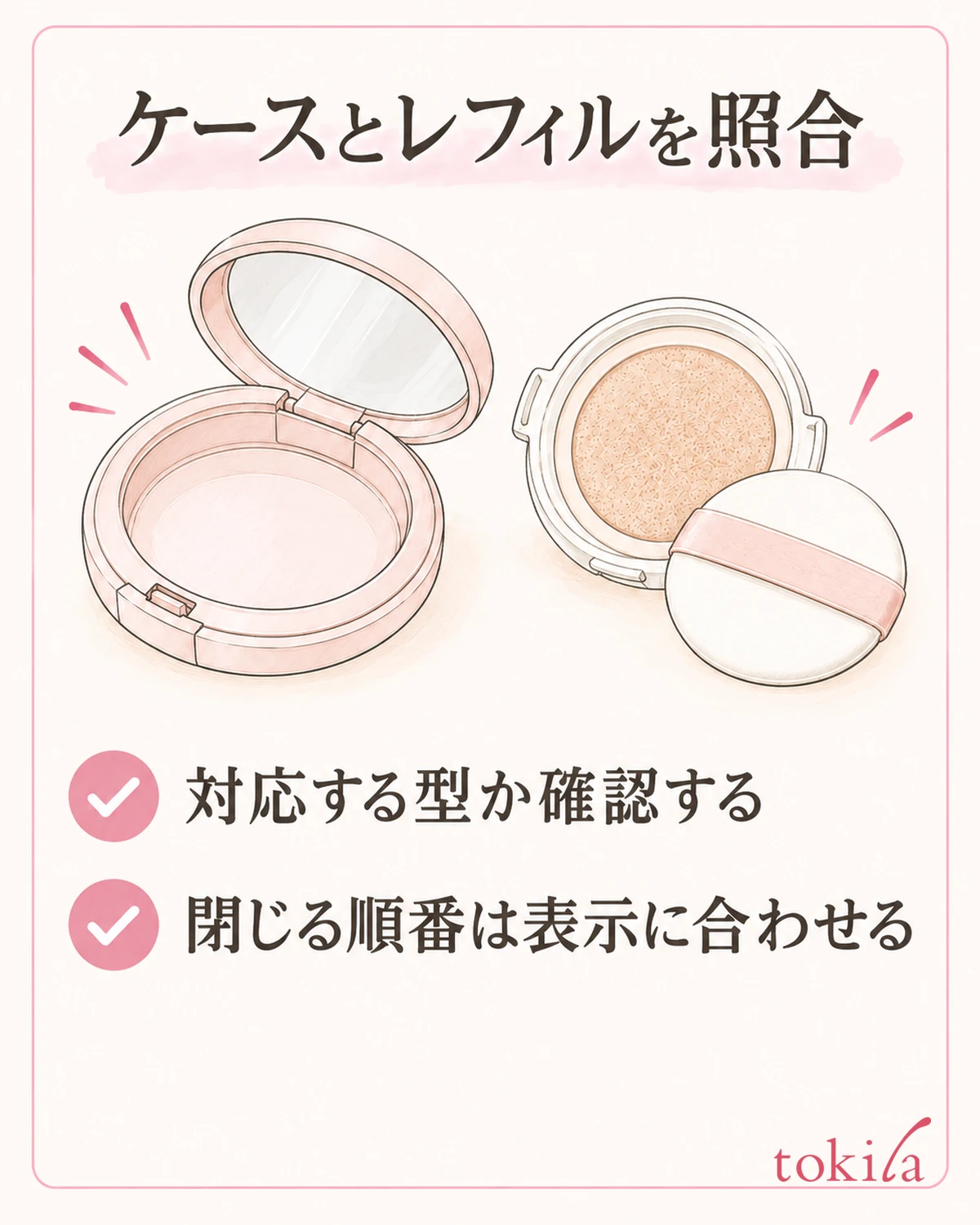
If it became hard to close after you changed the refill, check the combination of case and product. Even round cases that look alike may differ in where they latch, their height, and the direction the lid opens. Do not assume that a different model is compatible just because the brand or series is the same.
Look at the labeling on the outer box and the bottom, and check whether the case is the one specified for the refill you are using. When compatibility is unclear, there is no need to move the refill into a spare case or to shave down the latch. Handle any part that needs attaching according to the replacement steps for the one you own.
Even if the refill looks as if it is floating at an angle, do not press the outer lid down from above to force it in. If it is a structure you replace yourself, confirm the specified way of holding and operating it before trying again. Do not replace that with levering up a part that is hard to remove using a hard tool.
If the instructions say to close the inner lid and then the outer lid, do it in that order. Put the puff in its designated storage position, check that the ribbon and edges are not sticking out, and then close the outer lid. For a structure linked to the outer lid, give priority to the steps that suit that mechanism.
If you have not kept the instructions, noting the product name and model number on the bottom gives you information for confirming compatibility. Do not apply the opening and closing steps of a different product just by looking at the case; also check which refill you are combining it with.
After closing, check by eye that the rim is not lifting. Whether you check by sound, resistance or appearance should also follow the product, and strong force or pressing again and again is not a passing condition. If the refill moves or the latch shifts as you close it, check how to handle it before you continue using it.
5. Do not carry it around unclosed; check the condition of the case and the product
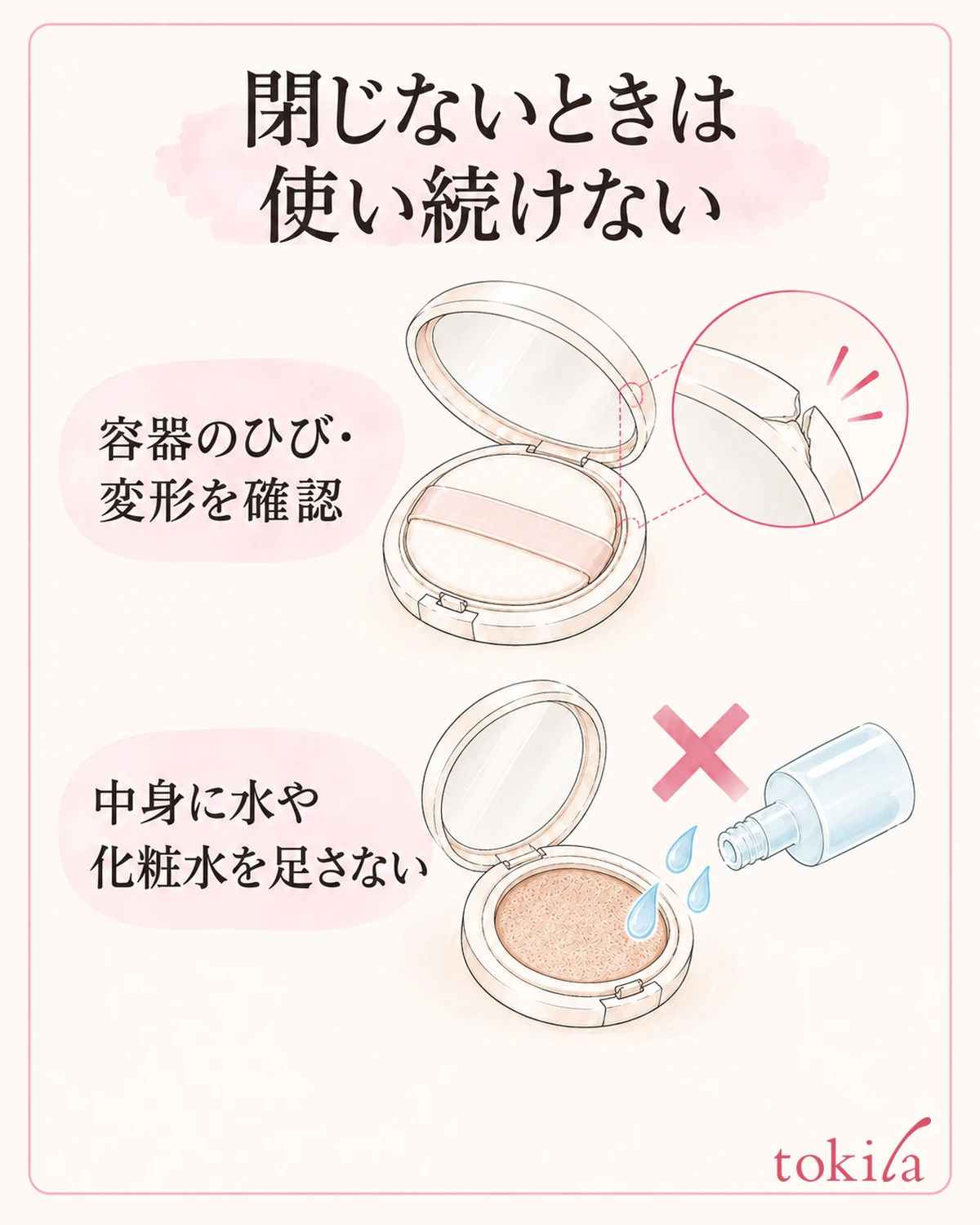
If the inner lid still pops up after you have put the puff back and tidied the dirt following the instructions, do not treat it as solved by fixing the outside with a rubber band or tape. If there is a crack in the lid, a chipped latch or deformation, stop using it without repeatedly opening and closing it. Also avoid gluing a damaged spot and using it in a state where it touches the product.
If you push a case that will not close fully straight into your pouch, you can no longer check its condition once stored. Do not force yourself to carry it; put it somewhere you can check the case's labeling and think about how to deal with it. Do not return leaked cosmetic product to the inside, and tidy up any stains on the pouch according to the handling label of the storage item.
If the color, smell or separation of the product seems different from usual, do not keep using it. Even if it looks the same, you cannot judge its quality only from how long it was left open. Do not set a single number of months for how long it can be used for all products; check it including the condition after opening and the storage conditions.
Even if it dries out and no longer picks up on the puff, do not try to restore it by adding water, toner or oil. Warming the case or turning the cushion over should likewise not be treated as a uniform remedy. If there are instructions for how to take it to use it up, handle it within those.
Putting it away is easier to check if you set an order that suits your own structure each time, such as "close the designated inner lid," "tuck in the edge of the puff and the ribbon," and "check the outer lid for lifting." After use, do not leave it open longer than necessary, and also check the storage labeling, such as avoiding direct sunlight and high temperature and humidity.
If you also find powder stains throughout the pouch, move on to the separate article on checking the source of the leak and separating tools. For a lifting inner lid, the starting point is to check the puff, the rim and the fit in that order before adding force. If it still does not close with the correct steps, do not keep using the case by force.