You put on a belt in a color you like, and only the waist stands out. Even when you thought you chose the same color as your clothes, the glint of the hardware or the visible width can bother you. In that case, before buying a new belt, try looking at the colored band and the buckle separately.
Here we sort out how to compare a colored belt you already own against your clothes. We do not aim only at blending in; we also leave open the option of showing a color you like as a small accent. This is not a way of deciding a single correct answer by body type, or an effect of looking slimmer. Keeping the way you usually wear it, choose one condition at a time to change.
1. Separate the band color from the buckle, and pick the spot that bothers you
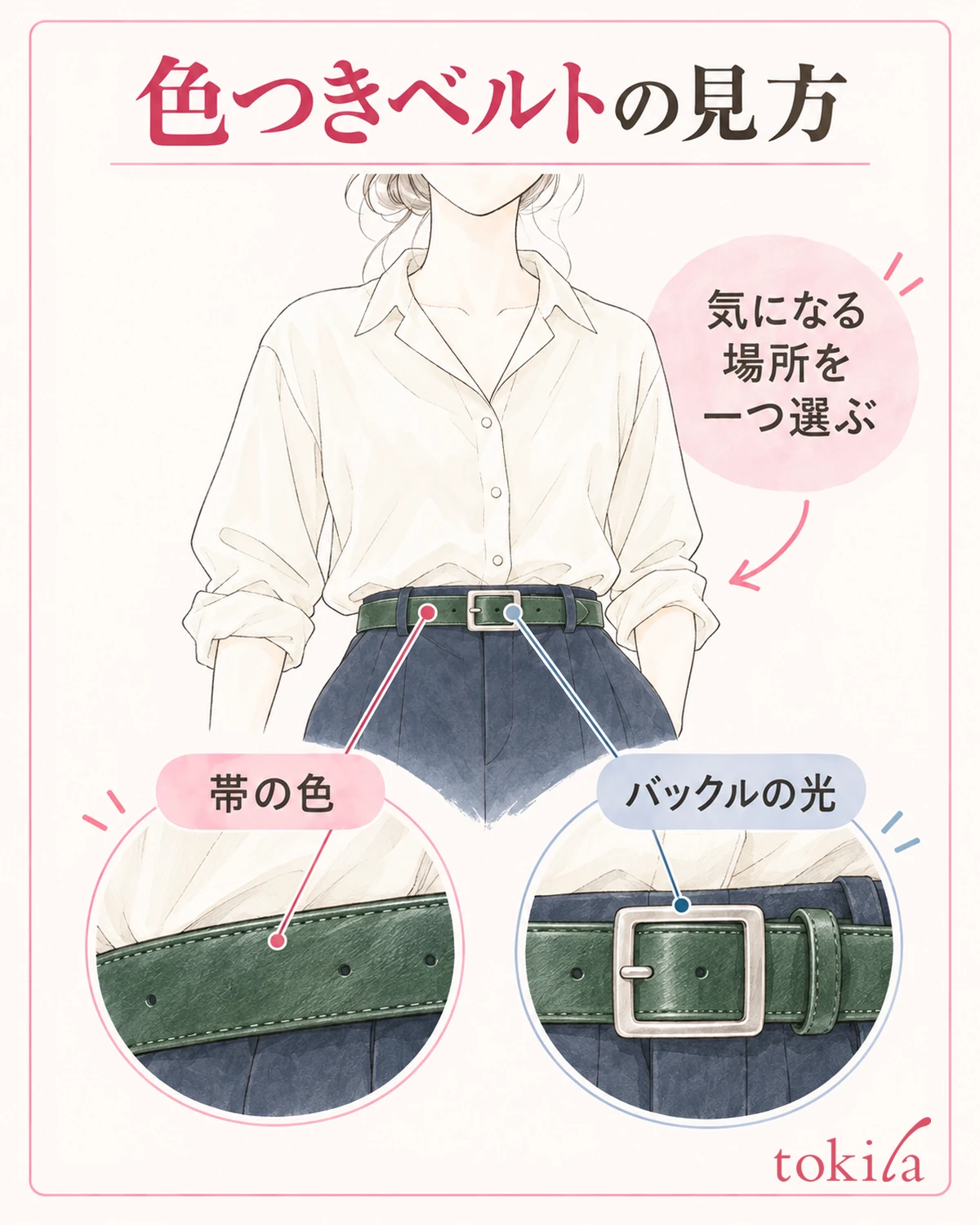
First, put the belt on in your usual position and stand in front of a mirror. Set aside your jacket and bag for now, and look at just the top, the bottom, and the belt. Pick one thing that bothers you: the vividness of the band, the boundary with your clothes, or the bright reflection of the buckle. Rather than lumping it together as "nothing goes together," this makes it easier to decide what to compare next.
For the band part, look at the surface as well as the color. Something smooth, something with a weave, and something with a different color visible at the edge give different impressions even under the same color name. If you separate the center visible from the front from the part that wraps to the side, you can also see where the color shows up most. You do not need to judge the type or quality of the material from appearance alone.
For example, if a green band has a silver buckle, separate whether you "want to connect the green to your clothes" or "want the silver glint to feel subdued." For the former, move on to comparing the color of your clothes; for the latter, to comparing other hardware and how the light hits. If there is nothing wrong with the band, you do not have to redo your color choice only because the hardware bothers you.
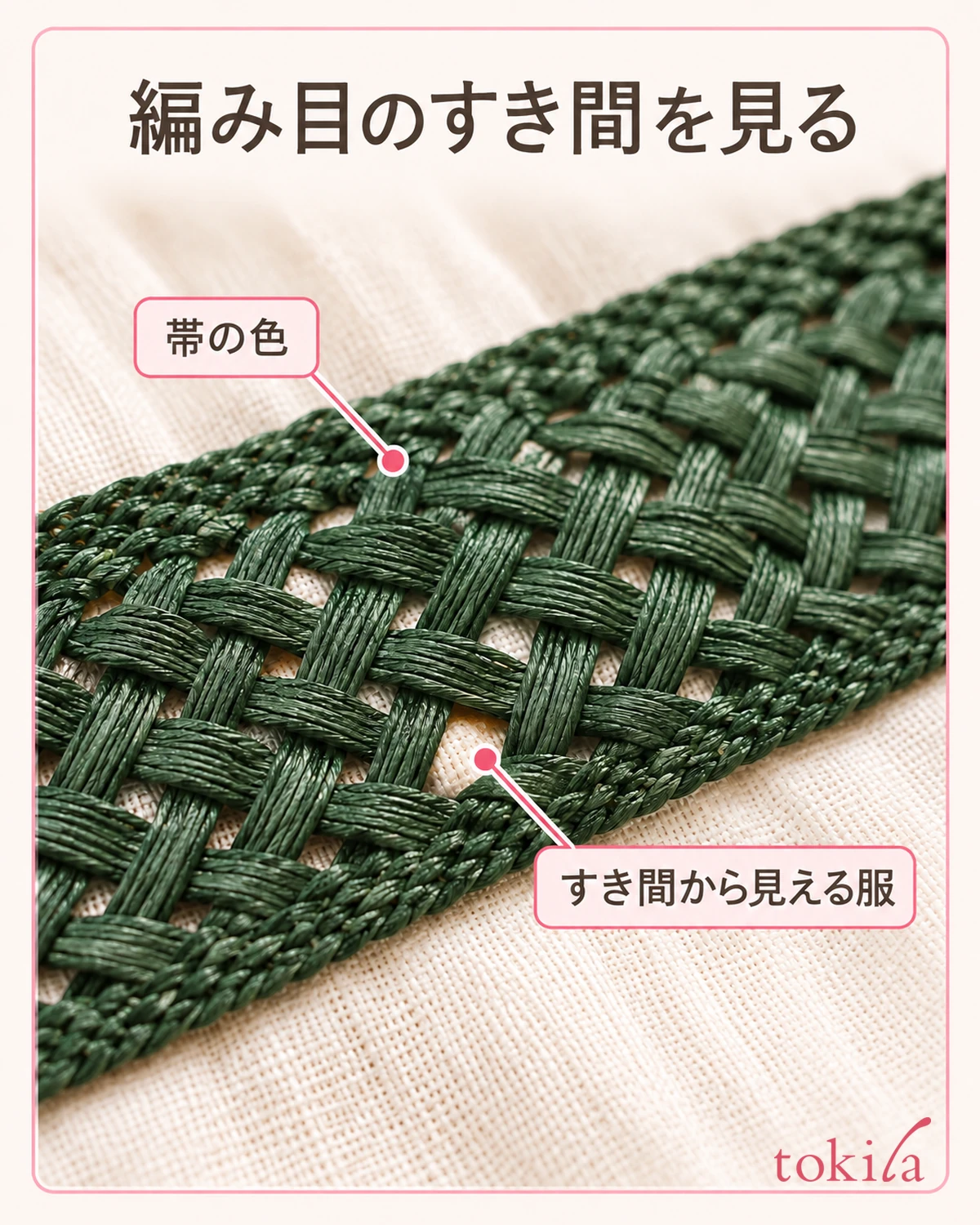
With a woven band, up close the clothes underneath may peek through between the weave. Check how it actually looks, including those gaps, and not only the green on the surface. A comparison that merely lines up color swatches on a screen does not show this kind of overlap. The front and back of what you own and the color at the edges also become material to check.
Do not change how tightly you fasten the belt in order to look at the color. Methods such as cinching until it is uncomfortable to make the band look thinner, or loosening it so it drops lower, are left out of color adjustment. If the leftover length or how the tip tucks in bothers you, read checking what to do when the tip of the belt is left over separately, and first get your normal way of wearing it in order.
What you decide at this stage is your own preference, such as "today I want to show the colored band" or "I want it to blend into my clothes a little." You do not have to treat standing out as a failure, and you can choose clothes while keeping the part you like. Before counting the number of colors, put into short words where you want to enjoy it.
2. With the same belt, compare the colors of the clothes next to it
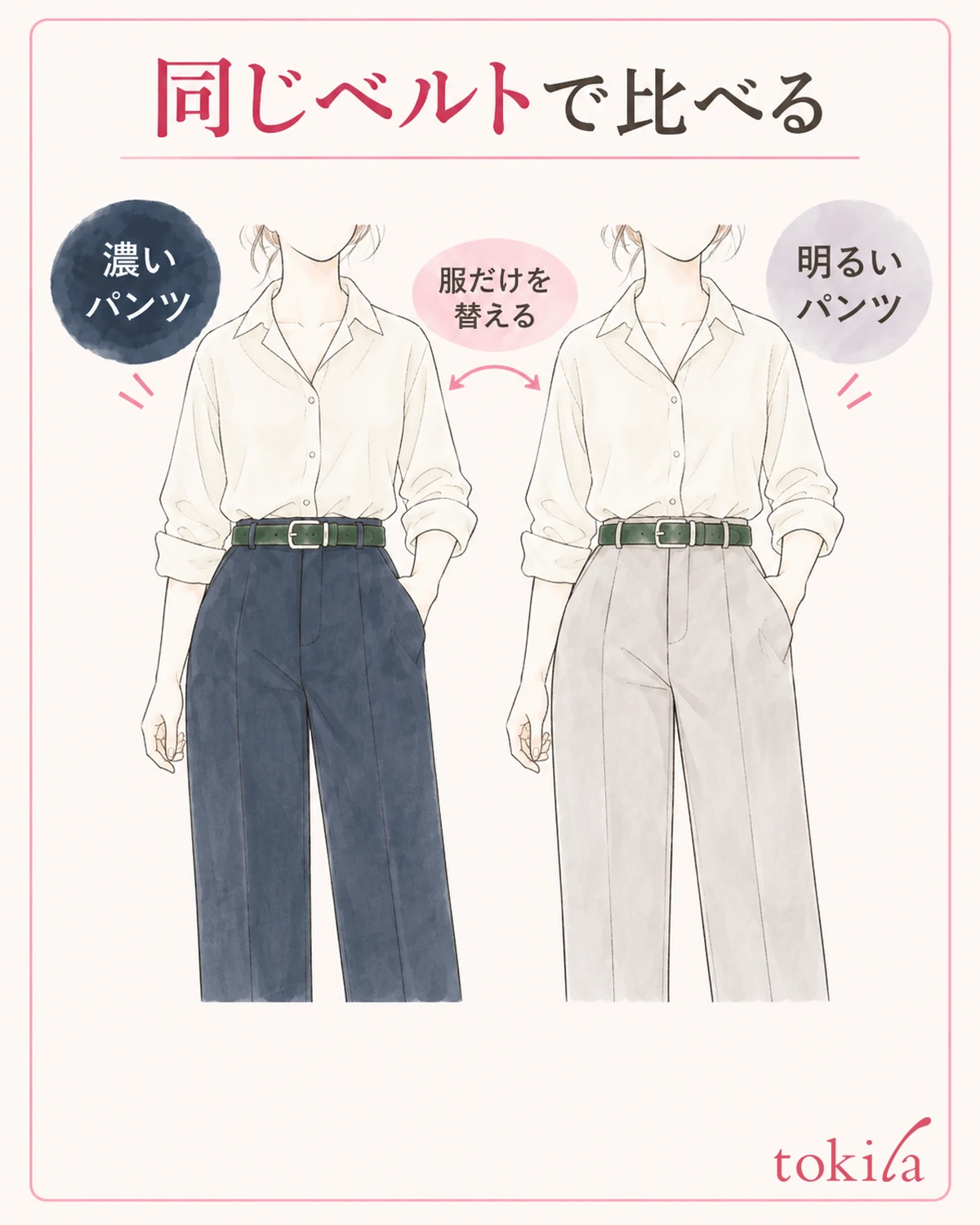
Don't change the belt; change only one of the top or the bottom. At first, choosing two pieces close in shape and material makes it easier to follow the relationship with color. Keep the mirror, lighting, and where you stand the same, and look at which colors touch directly above and below the belt. Add a jacket only after comparing the two pieces.
If you want to blend in, you can try pairing it with clothes of a brightness close to the band. With a deep green belt, try a dark-colored bottom and a light-colored bottom in turn, and see how the outline of the band feels. You do not need to look for new clothes in the same green. Keep both the connection when the colors are close and the accent when they are different.
On days when you want to show the color, there is also the option of toning down everything but the belt. For example, add a green belt to an ecru top and navy pants, and look from a distance from the mirror. This is not an example of a combination that will definitely suit you; use it as an entry point for a comparison that makes the one belt you own the star without changing your clothes much.
If one piece is a thick knit and the other a thin shirt, the shape of the hem and the shading change along with the color. In that case, don't conclude that "it worked because the color was bright"; take it as simply liking the combination with that garment. On days when you want to check only the color, comparing again with clothes of similar shape is enough.
With patterned clothes, there is also the option of linking one color in the pattern with the color of the band. However, don't merely pick up a color in a small pattern up close; check whether that color is still visible from a distance. If you want to sort it out in detail, you can also use steps for matching accessories to the colors of patterned clothes. Keep open, too, the choice of making both the pattern and the belt the star.
If you are unsure, go back to the first outfit and then try the other one. Going back and forth between two options makes it easier to remember the differences you liked, more than changing the belt and clothes together many times. If you take photos, use the same place and brightness, so that color differences from photo correction are not mixed with differences in the real thing.
3. Look at the color and reflection of the buckle separately from the band
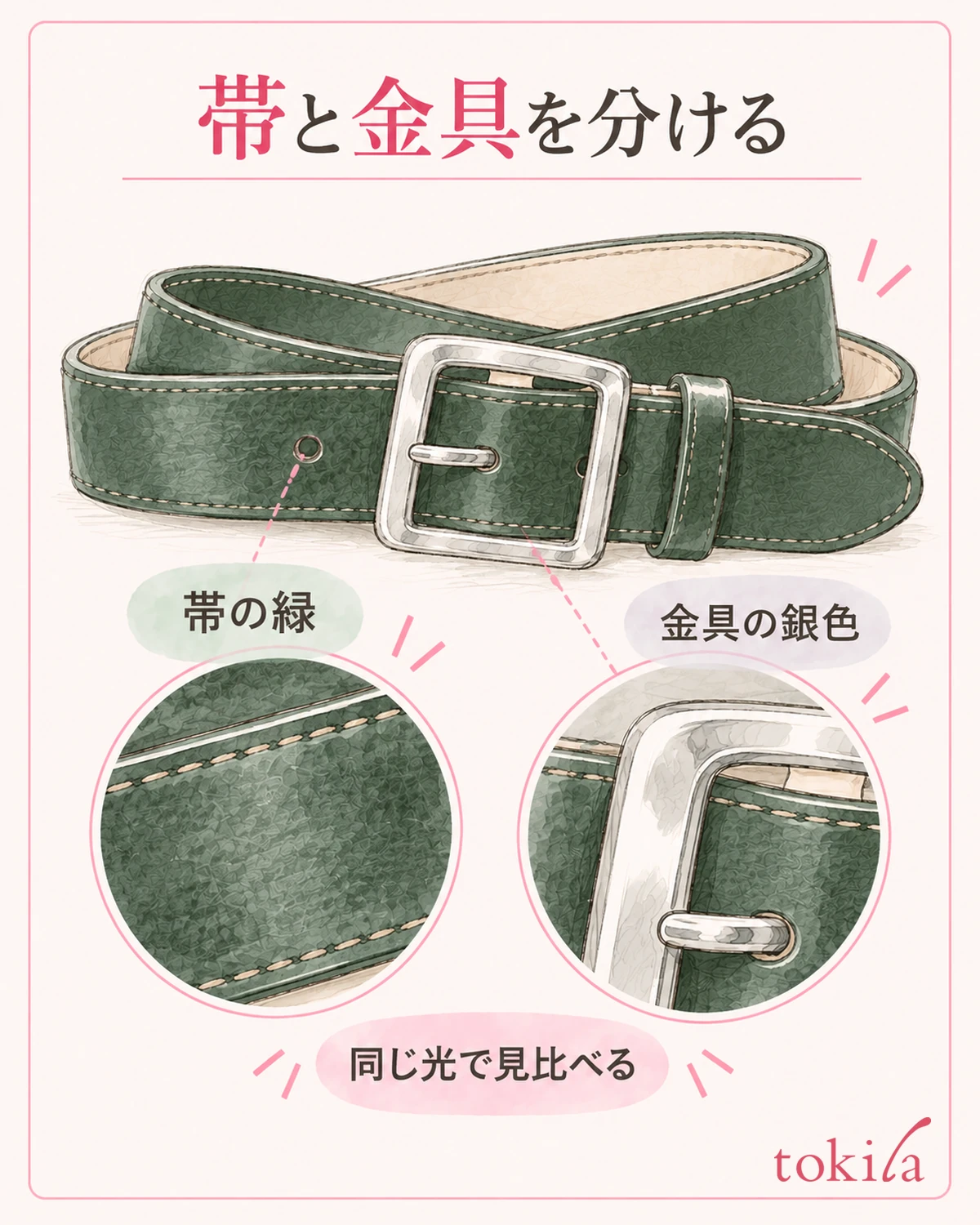
If the band color looks calm but only the center bothers you, check the buckle. Whether it is gold or silver, and whether light is reflected on its smooth face, are separate points of observation. If the bright area moves when you change the angle of the light slightly, think about how it looks in your usual appearance, including that reflection.
Near the buckle, different light may appear on the edge and on the flat surface. Don't decide the color from looking at one spot up close; check it also on the whole from a distance from the mirror. The difference between a surface with fine lines and a smooth surface gives you a clue you can confirm with your eyes, without touching or scraping it.
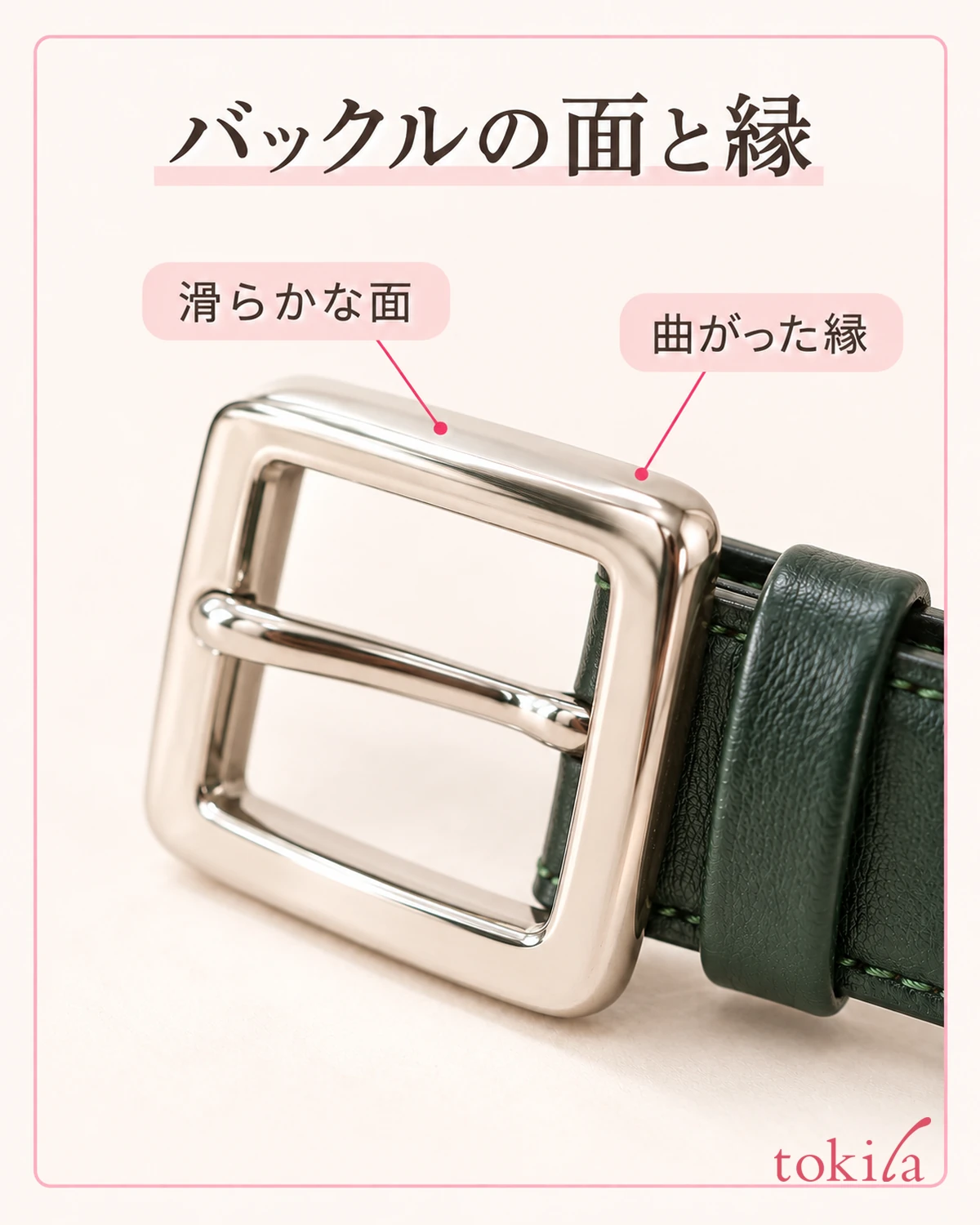
When you want to tie it in with the hardware of a bag or accessories, try adding just one. Compare repeating hardware of the same color against leaving only the buckle in a different color, and choose which you like. You do not need to unify all the metals, and not changing the color of your clothes at the same time helps you find the difference.
If there is a large piece of hardware at the center of the band, even with the same belt the amount visible differs between wearing your jacket open at the front and wearing it closed the usual way. Try it in a state you can comfortably keep as a way of wearing the clothes. Do not make adjustments such as pulling your clothes down hard or tucking fabric against the hardware to hide the buckle.
Processing such as polishing to change the shine, or applying something to the hardware, is not included among the ways of comparing color combinations. Whether surface treatment or care is possible differs by item. Look first for a combination you can enjoy as it is now, and if care is needed, go back to the handling instructions for what you own.
4. Check the length of band visible from your clothes in your usual movements
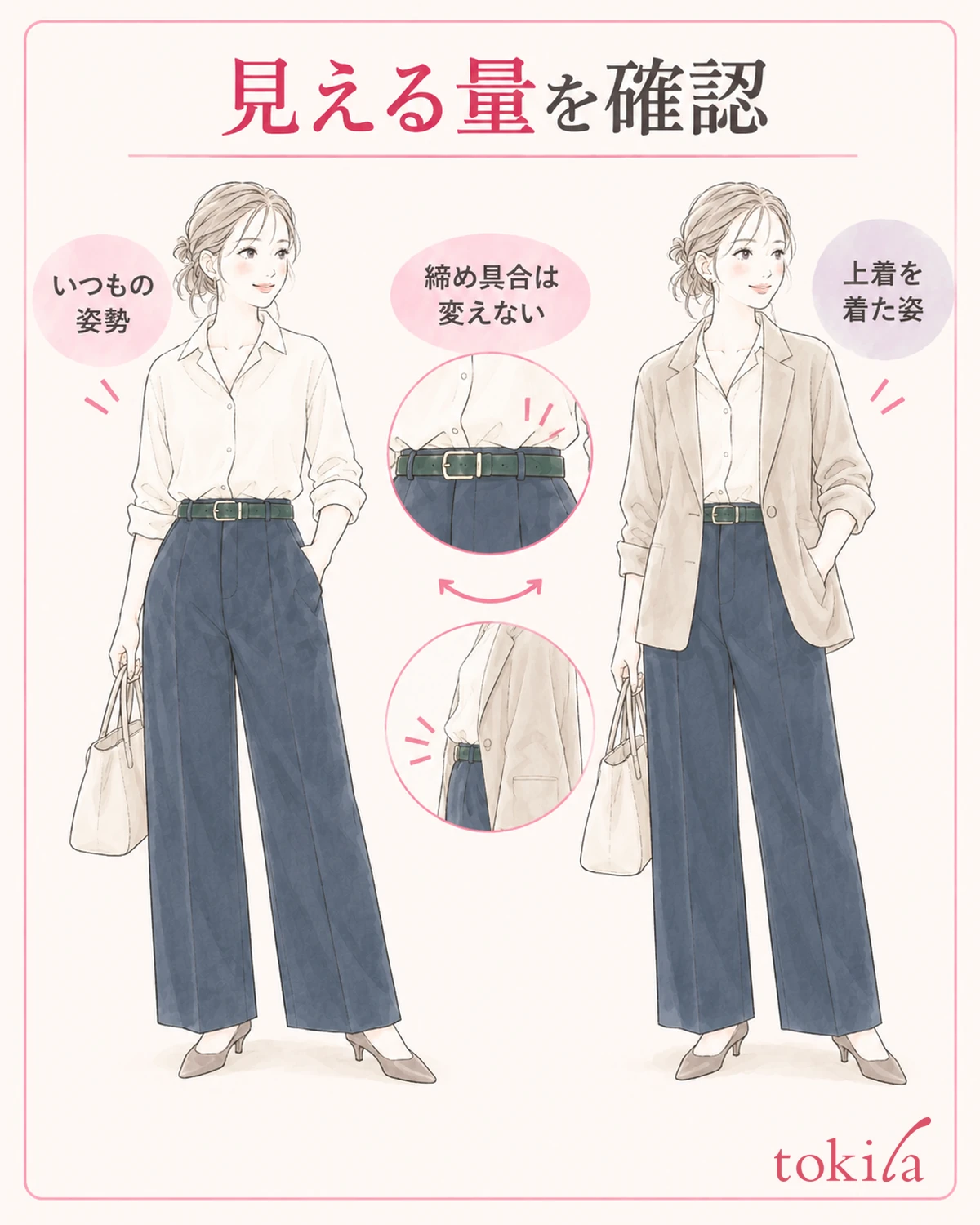
Even with a belt of the same width, the amount of color that shows in your outfit differs between when the band appears continuous from the front and when it shows only in the gap of the jacket. Here, without altering the width of the belt itself, we check how far it actually shows with your usual clothes. When the color feels strong, this is what to look at before changing the band color.
For clothes you wear tucked in, arrange the hem in your usual way of tucking. Conditions change between the tucked state and a different garment you originally wear untucked, so don't make it a simple comparison of color alone. For the sake of color coordination, use a way of wearing it that you can actually keep, rather than creating a hem shape that springs back right away while you wear it.
After looking at the front, lower your arms and turn slightly to the side. A band that looked like a thin line from the front may look broad and continuous at the side. Don't decide from a standing photo alone; also check how it relates to your clothes when you sit normally on a chair. If it feels tight or catches, give priority to reviewing how you are wearing it over how the color looks.
On days you use a jacket, add the look with it on to the final comparison. If closing the front of the jacket hides the belt, you do not need to keep wearing it open in a forced way just to show it. You can choose to suit how you spend the day, including that the visible parts change between when you're moving around and when you're indoors.
Even if you want to change slightly how much color shows, do not go on to modifications such as cutting the belt, adding holes, or folding it to make it narrower. When you switch to a thinner one, also check separately how it fits with the loops and size of your clothes. Keep the impression from width to a comparison of preference, and do not make it a rule that a particular width works for everyone.
5. Add back one accessory, and choose the combination you like for the whole outfit
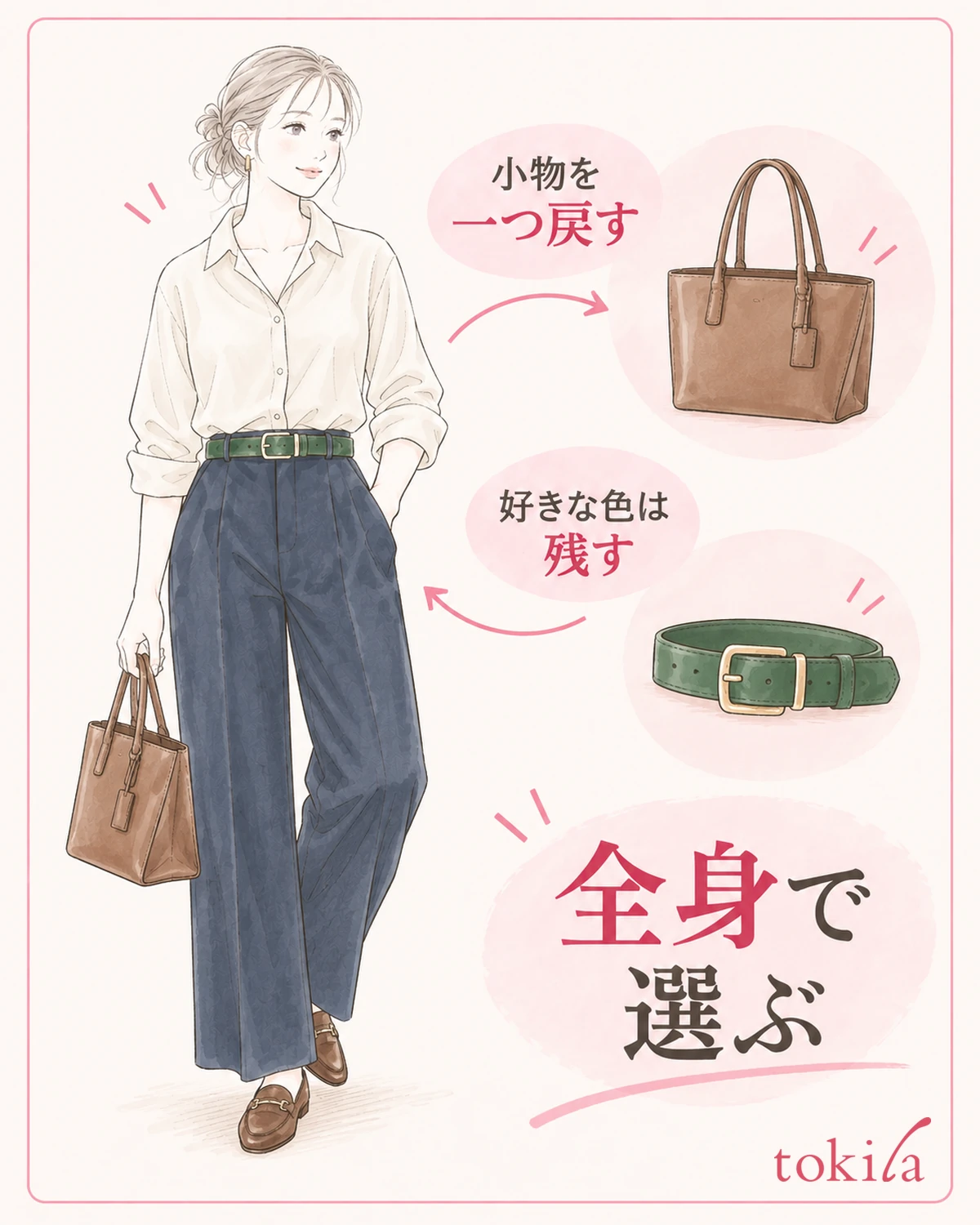
Finally, add shoes and a bag, step back a little from the mirror, and look at your whole outfit. The positional relationship of the colors may feel different from when you were looking at the waist for a long time. Check whether you are showing the belt you like, and whether there is any part where you are torn between it and other accessories.
If the colors feel scattered, add back just one of the accessories you added. Make it a comparison in which you can tell what you changed, such as returning to your first bag or taking off one accessory. Rather than buying same-colored accessories one after another just to go with the belt, leaving options open with the clothes and accessories you already have makes it easier to try.
Conversely, on days when you want to enjoy the color of the belt a bit more, there is also the option of repeating a similar color in just one spot far away from it. Try it with what you have, such as part of a bag or a small accessory. Even with the same color name, a different shine or material changes how it looks, so it doesn't need to be a search for an exact match.
On days when your workplace or a place you're visiting has dress conditions, choose the color combination within that range. Once you have settled on a combination you like, noting briefly which clothes you wore and whether you enjoyed the band or the hardware gives you an entry point for the next time you choose. If you also remember the day's light and jacket, it is easier to find the reason when the impression differs on another day.
First separate the band and the hardware, compare the adjacent clothes one piece at a time, and finally choose with your usual movements and your whole outfit. Try fitting this order to the one belt you own. Keep both the option of blending in and the option of making it an accent, and find the combination you would like to wear out.