You love your patterned bag, but when you pair clothes with it, something feels off. On days like that, before using every color in the bag for your outfit, try separating the base color and the pattern colors that you can see from a distance. If you start from the large surfaces that stand out when you are carrying it, rather than the thin lines you notice up close, it becomes easier to choose where to change your clothes.
Here we introduce the order for pairing plain clothes you own, starting from a patterned bag. The options are to blend with the base color, pick up one color from the pattern, and look at the connection with the handle and shoulder strap. Don't make any one of them the right answer; choose from what you love about the bag and what you will wear that day.
1. Carry the bag, and look at the base color, pattern, and handle separately
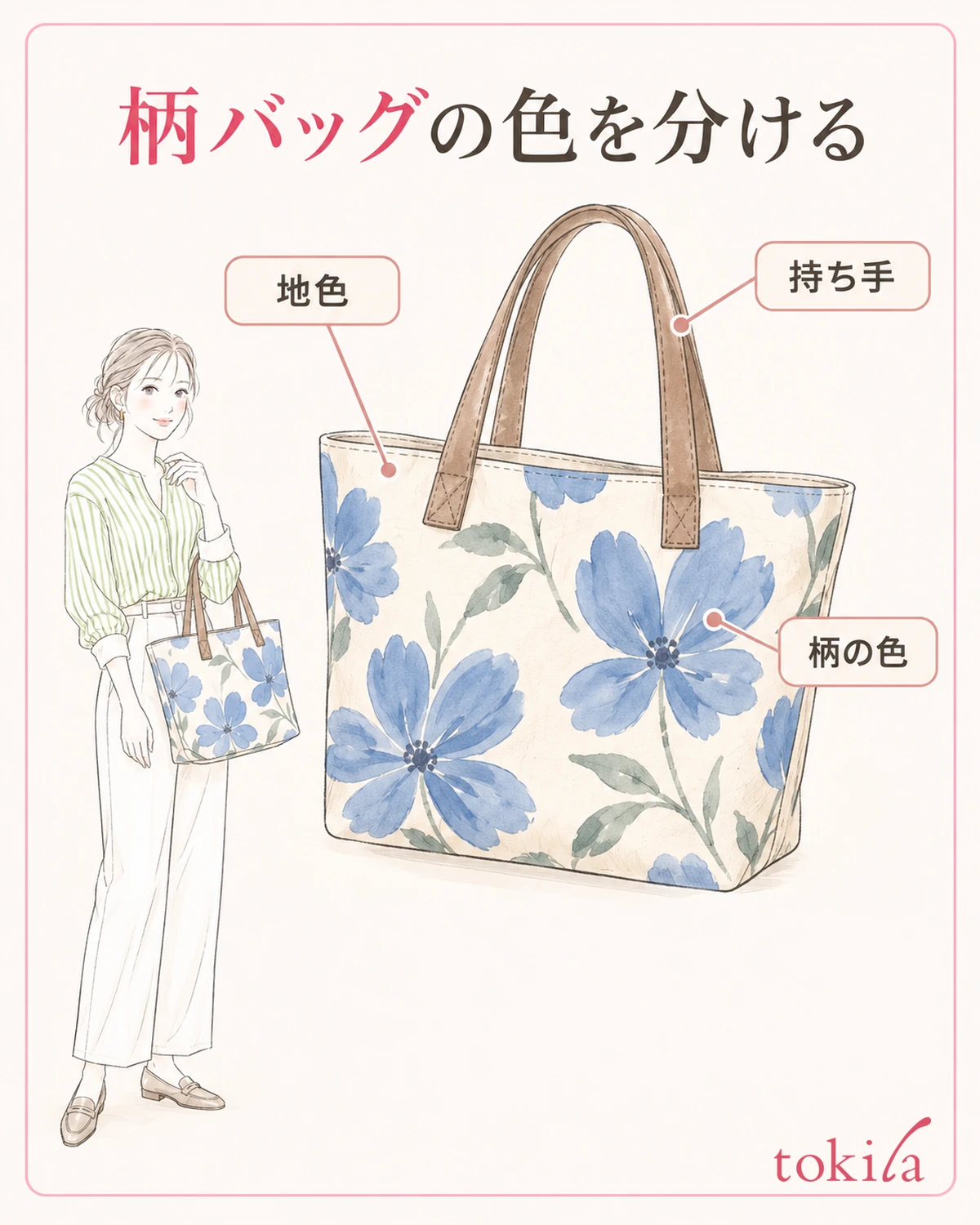
First, put your usual belongings in the bag you want to use, and stand in front of a mirror holding it the way you usually do. Carrying it by hand, over the shoulder, or across the body changes which surface overlaps with your clothes. While deciding on the color scheme, keep the way you carry it the same, and don't judge by lifting the bag up close to your face.
Look at the front of the bag and separate the color that serves as the background of the pattern from the colors that draw the flowers, lines, dots, and so on. Here, the background is called the base color and what you see on top of it the pattern. If the whole bag has a fine pattern, you don't have to force yourself to decide on a base color; it is fine to start from the color that catches your eye first when you step back a little.
Next, look at the handle, the edge, and the shoulder strap. If they are a plain color different from the body, remember them separately from the number of colors in the pattern. For example, with a blue floral pattern on an ecru ground and a brown handle, you can choose which of "ecru, blue, and brown" to connect with your clothes. You don't have to assign all three colors to separate pieces of clothing.
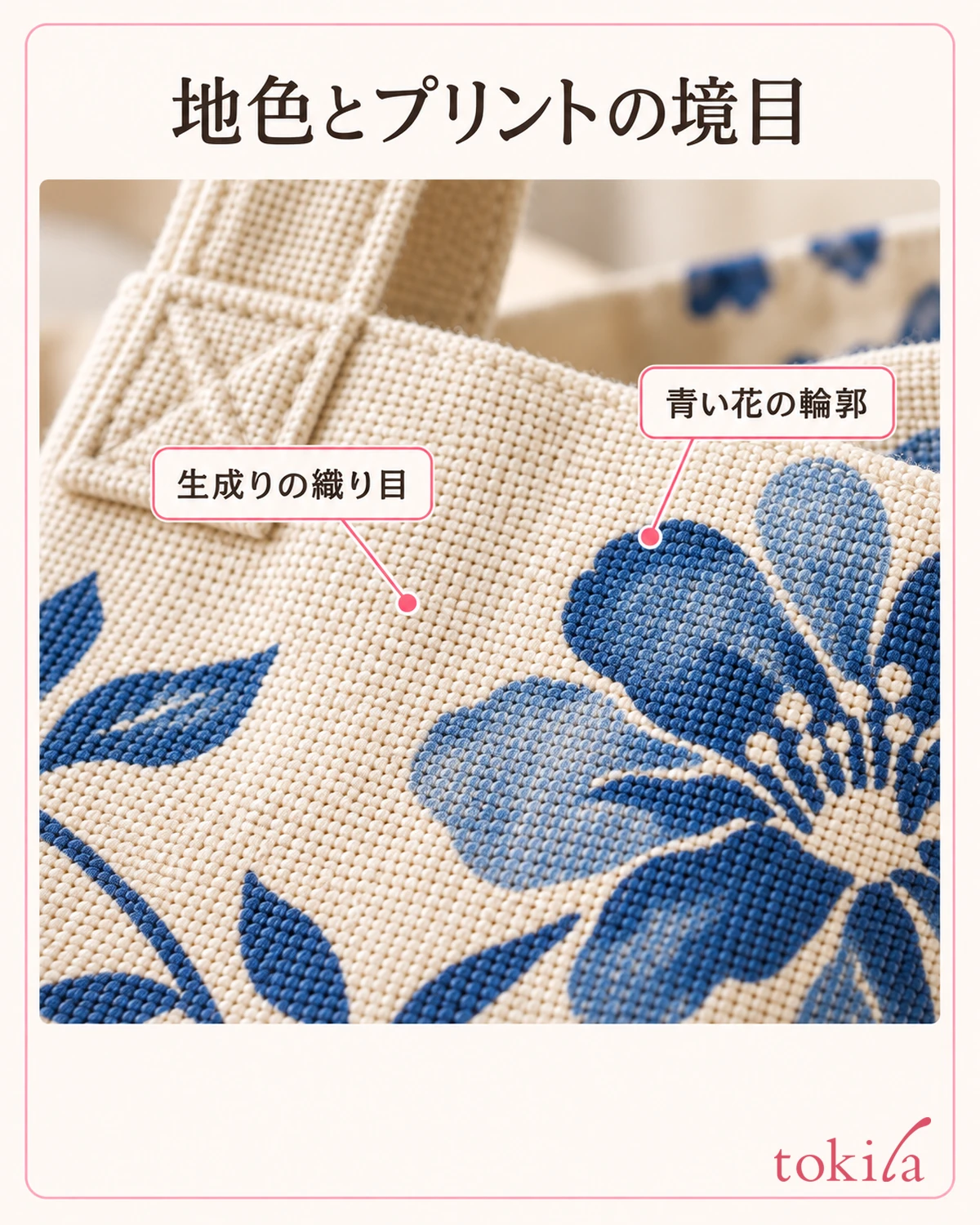
After looking up close, step back to a distance where your whole body fits. The centers of small flowers and thin stitching may not stand out from afar. It isn't that you must not choose colors invisible from a distance, but on days when you want to see the connection with your clothes clearly, starting from a color you can also pick out in the mirror makes comparison easier.
If the pattern appears differently on the left and right, or front and back, check the side that actually faces outward. Rather than continuing to hold it in an unnatural way to show the pattern, look at whether you like it in the orientation you normally use. Don't fold it in a way that makes pockets or fasteners unusable, or forcibly shorten the shoulder strap.
Put into words one spot that bothers you right now, too. Being specific, like "I want to show the blue flowers," "only the brown of the handle looks detached," or "it overlaps with the pattern of the clothes," settles the next options. Instead of deciding that the whole bag is flashy, think about which surface of the clothes you want to change while keeping the pattern you like.
2. On days you want a quiet look, try plain clothes close to the base color
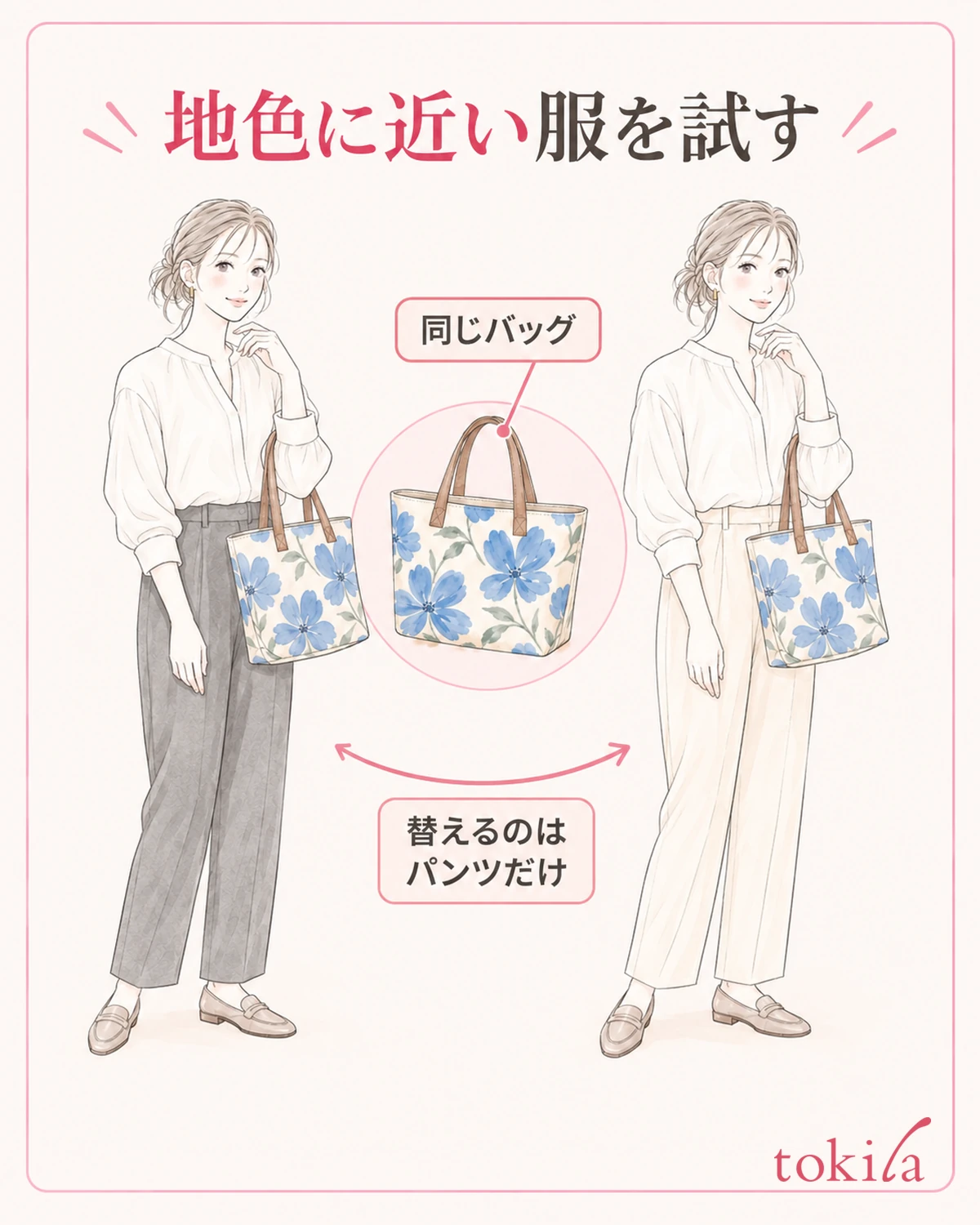
If you want to keep the bag's pattern while pulling the whole look together quietly, first try one piece of plain clothing close to the base color. The idea is ecru-toned pants for an ecru ground, and a navy-toned jacket for a navy ground. Rather than matching the color name exactly, look at the real items together and check how you feel about the boundary.
If you start by changing the clothes where the bag overlaps, it is easier to follow the change. For a bag hanging at your hip, pants or a skirt are candidates; for a bag held under your arm, a jacket is. Don't change both top and bottom at once; change only the piece behind the bag and compare it with the first outfit.
Even with clothes close to the base color, a difference in brightness leaves a boundary. Near-white ecru and deep beige, or near-black navy and bright blue, look different even though they sound like the same family. Choose in the mirror whether you want to blend in or keep the outline of the bag, and don't buy more by relying on the name alone.
If the pattern is so fine that the base color is barely visible, tentatively hold up a plain piece whose brightness is close when seen from a distance. This is not a method of mixing the colors of the pattern into a single color. It is a starting point for trying whether the clothes settle in as a background when you carry the bag.
When changing clothes, also look at the sheen of the material. Even in the same ecru, glossy satin and knitwear with a nap show their surfaces differently. While comparing colors, stand in the same bright place, and don't judge the reflection of light alone as a difference in base color.
If, after blending in, even the flowers you love seem less noticeable, don't think of it as a failure; you can try the next color. There are days you want the bag to be the star and days you want it to melt into your whole look. Keep the clothes you chose here as one idea and use them as a benchmark for comparing with other directions.
3. Connect one color of the pattern to your clothes and keep the rest of the current combination
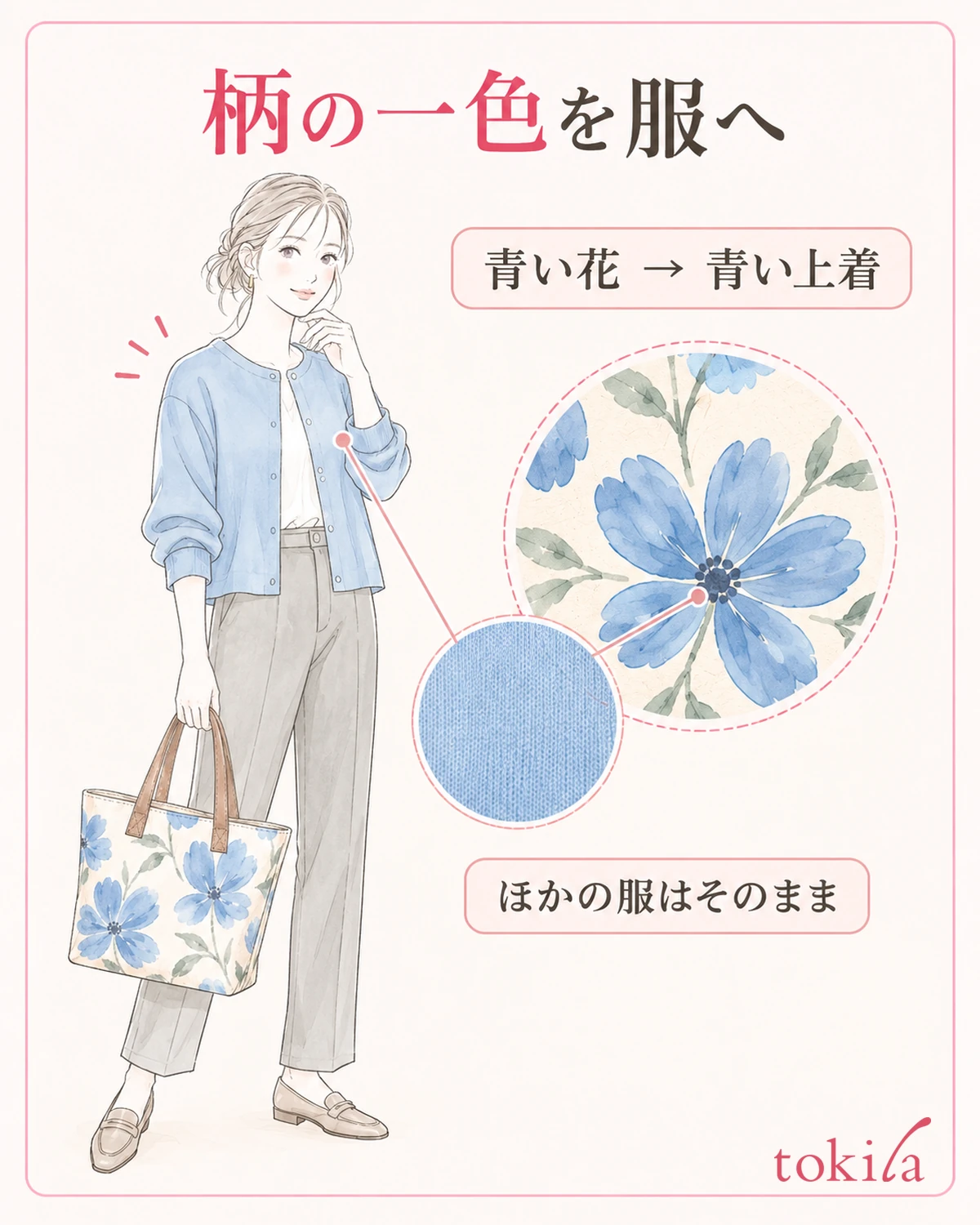
On days you want to enjoy the colors of the pattern, pick just one color from the flowers or lines and connect it to your plain clothes. For blue flowers on an ecru ground, the idea is to pair one piece of blue-toned outerwear or bottoms. Because this shows a different place than the idea of blending with the base color, compare them not by which is better but by which is closer to your mood today.
The color you choose doesn't have to come from the smallest motif. Start with a color that is easy to find in the mirror and that you like. Even if both red berries and green leaves are included, you don't need to add both to your outfit. Once you have decided on one color, keep your shoes and accessories as they are and check the change.
When fine color differences bother you, look at the bag held close to the clothes, then return to the position where you will actually carry it. Blues that differ up close may still feel connected across the whole body from a distance. Conversely, even when the colors are close, a large area of clothing can make that color look like the star, so don't decide by what's at hand alone.
If you want to show the flowers but the blue of the clothes feels strong, you can try a slightly softer blue you own, or clothes with a smaller visible area. This is not a rule that you must switch to a paler color. On days you want both clothes and bag to stand out, you can enjoy that combination.
If you want to pair patterned clothes, it is easier to sort out by choosing a candidate in plain first and then going back. Once the clothes also have a pattern, the size and spacing of the motifs change, not just the color. This time we stop at narrowing down color candidates, and don't decide that patterns will match just because the colors are the same.
If you have no clothes in the same family, you don't need to force the idea of using one color of the pattern. Returning to the base color, thinking from the color of the handle, or leaving the difference are also ways of choosing. Before looking for new clothes, check whether you have decided what you want to show.
4. Check the handle, shoulder strap, and the area where the pattern shows
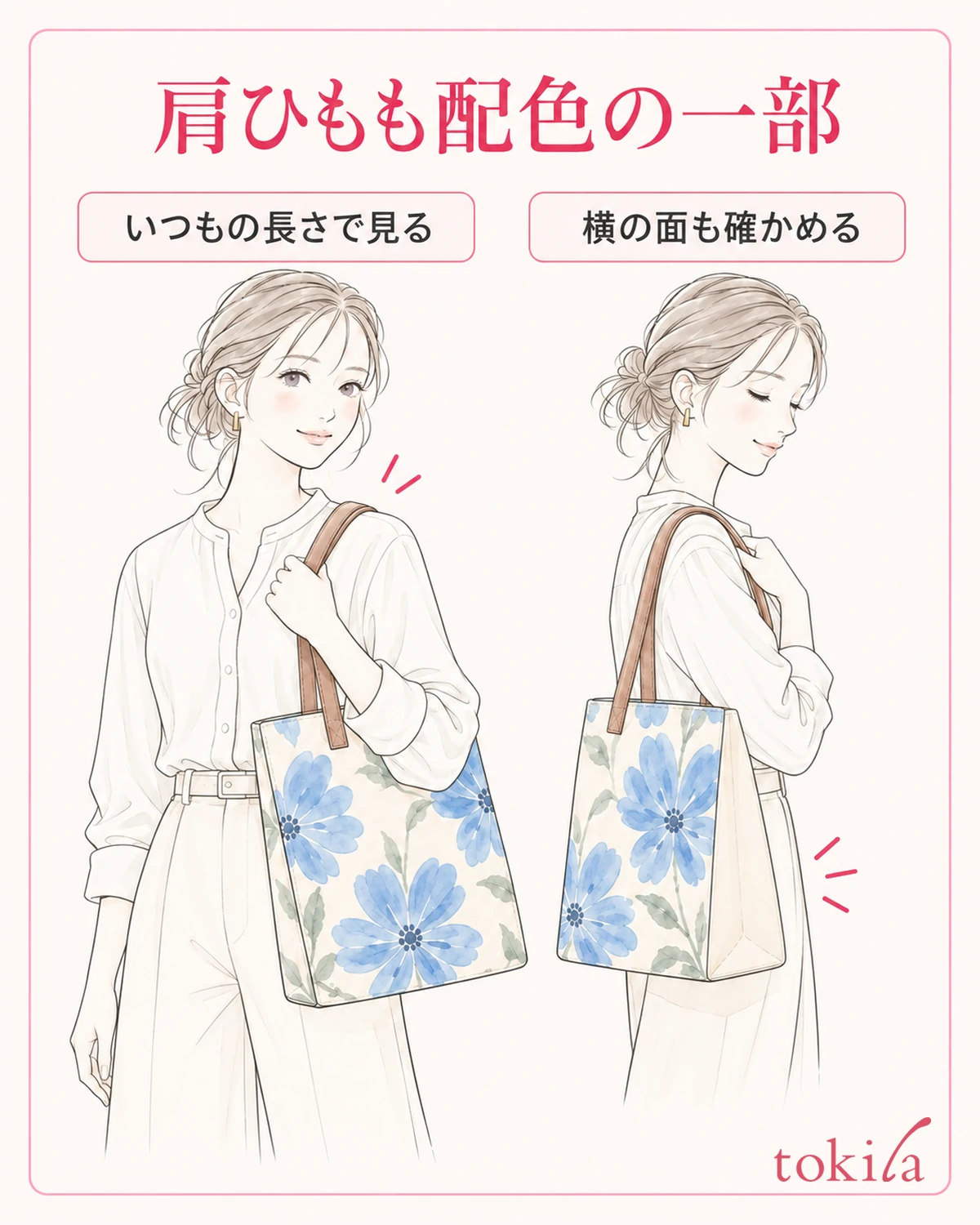
Even when you like the body's pattern and the clothes, sometimes only the handle looks detached. On such days, before choosing the body again, look at whether the color of the handle is already connected somewhere in your clothes or shoes. For a brown handle, one idea is to pair brown-toned shoes or a belt you own.
That said, you don't need to match all your accessories to the handle's color. Add just one first, and return to the whole body while carrying the bag. A thin handle and a wide shoulder strap show different amounts of color. Check not only whether the colors match, but also where and how much of it is visible.
For a bag whose shoulder strap runs diagonally across your jacket, look at that band as part of the color scheme too. Even if the length is adjustable, adjust it within the range where you can easily put things in and take them out and walk. You don't have to fix it in an awkward position just to make the line of color look shorter.
The area where the pattern shows is not decided by the bag's size alone. Holding it in your arms, a jacket overlapping, or turning sideways hides part of it in your usual movements. Don't choose only from the view with the pattern facing fully front; also look in the mirror with your arms down and turned slightly sideways.
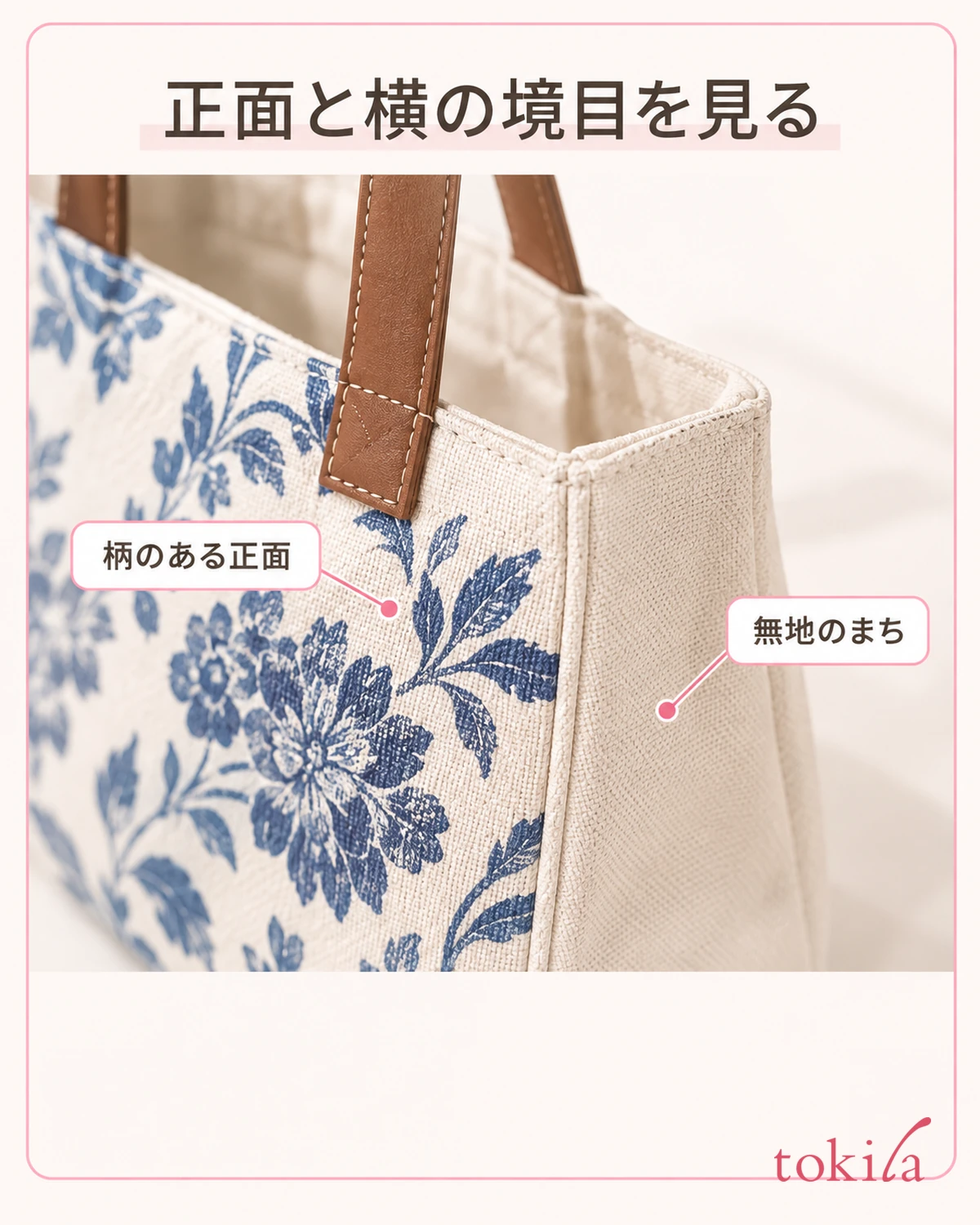
If the pattern appears differently on the front and the side, check the two in turn. With a bag that shows a plain gusset when you turn sideways, the impression you chose from the front may change. Before trying to add more pattern, thinking about whether you like it including that change makes it easier to picture yourself walking around with it.
There is also no need to wrap extra fabric around to hide the handle or hardware. This time is the process of choosing clothes and accessories. Don't extend it to altering the bag's structure; use the colors and area that show on the day you use it as they are for your judgment.
5. If you are unsure, go back one piece, and decide with your whole outfit for the day you use it
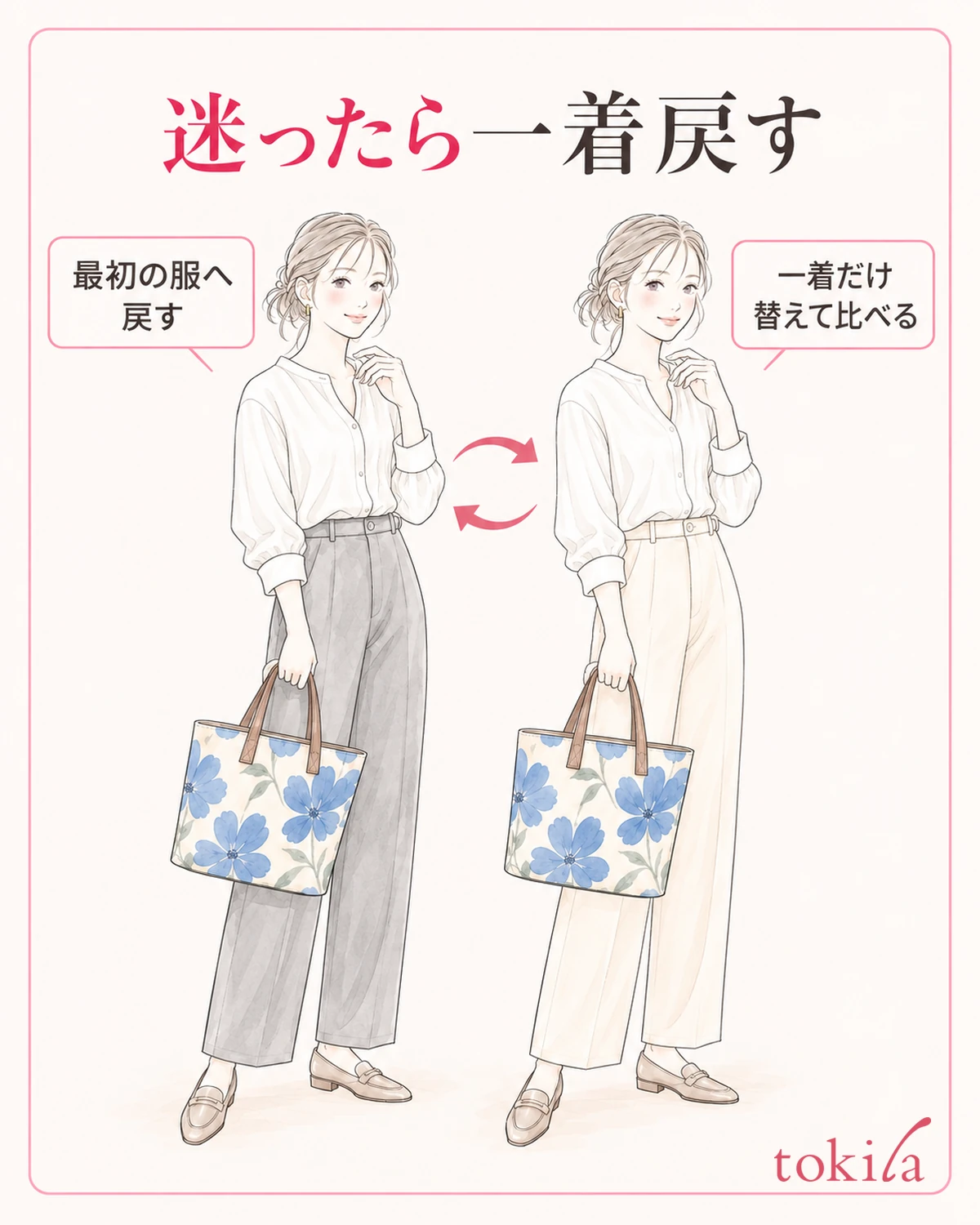
If you lose track while comparing, go back to the first clothes and bag. Recall whether you preferred the idea of blending with the base color or the idea of using one color of the pattern, and change just one piece where you can see the difference. Changing fewer places, rather than adding candidates, makes it easier to keep judging.
If the whole look seems scattered, put back one of the shoes or accessories you added last. If you loved the bag's pattern but your eye goes to the color of the clothes, review the idea of clothes close to the base color. Conversely, if it feels lacking, put back one color of the pattern and so on; compare one at a time to match your original goal.
Put on the outerwear you will wear when going out, too. When you close the front, the color behind the bag changes, so look at it in the state you will actually wear. If you plan to take it off indoors, you can check that look as well, but there is no need to put up with cold or restricted movement for the sake of color.
When checking under different lighting, move the bag and clothes together. Don't compare your memory of the clothes seen indoors with the bag you took to the window. If you keep a photo, take it of your whole body at the same place and distance, and don't treat screen correction as evidence of fine color differences in the real items.
A short line is enough for the record, such as "blue flowers and navy pants" or "ecru ground and a light jacket." Noting which part of the pattern you picked also gives you a starting point the next time you use the same bag. You don't have to try a new color scheme every time; you can enjoy repeating a combination you like.
On days you want to choose accessories starting from patterned clothes, you can also use the steps for picking one color from a pattern. On days the bag is the star, decide which you like among the base color, the pattern, and the handle, and try it with the clothes and the way you carry it on the day you use it.