Looking at the socks alone, you love the color, but once you put your shoes on, only your feet seem to stand out. When that happens, before rushing to buy another color, try checking the shoes, bottoms and how much of the socks shows, all together. Even the same pair of socks gives a different impression depending on how much shows between the hem and the shoe.
This article explains the steps in this order: decide on the shoes and clothes you will wear today and change only the sock color, check how much of the socks shows, and look at yourself standing and sitting. It does not settle on a single color that suits you, or claim that a particular color will always make your legs look slimmer. Instead, it helps you look for combinations you like with the clothes you already have.
1. Decide on the shoes and bottoms before the sock color

First, put on the shoes and bottoms you will use today. The colors you see around the socks are different when you pick them holding only the socks in your hand and when you actually wear them. Check in a mirror that shows not just your ankles but also above your knees, to see whether the socks continue above black shoes or peek out from under a light hem.
Next, sort out what feels like it stands out. Look at whether the boundary with the shoes suddenly becomes sharp, whether a light band forms between the hem and the shoes, or whether the color itself is vivid. Rather than stopping at "somehow it doesn't match," deciding on one spot where your eye stops will help you narrow down the candidates to compare next.
When comparing, rather than wearing different colors on the left and right and walking around, wear one pair at a time on both feet and look at them in the same place. The light from a window and the direction of your legs can change between left and right. To avoid adding differences other than color, start from your usual stance with your feet together.
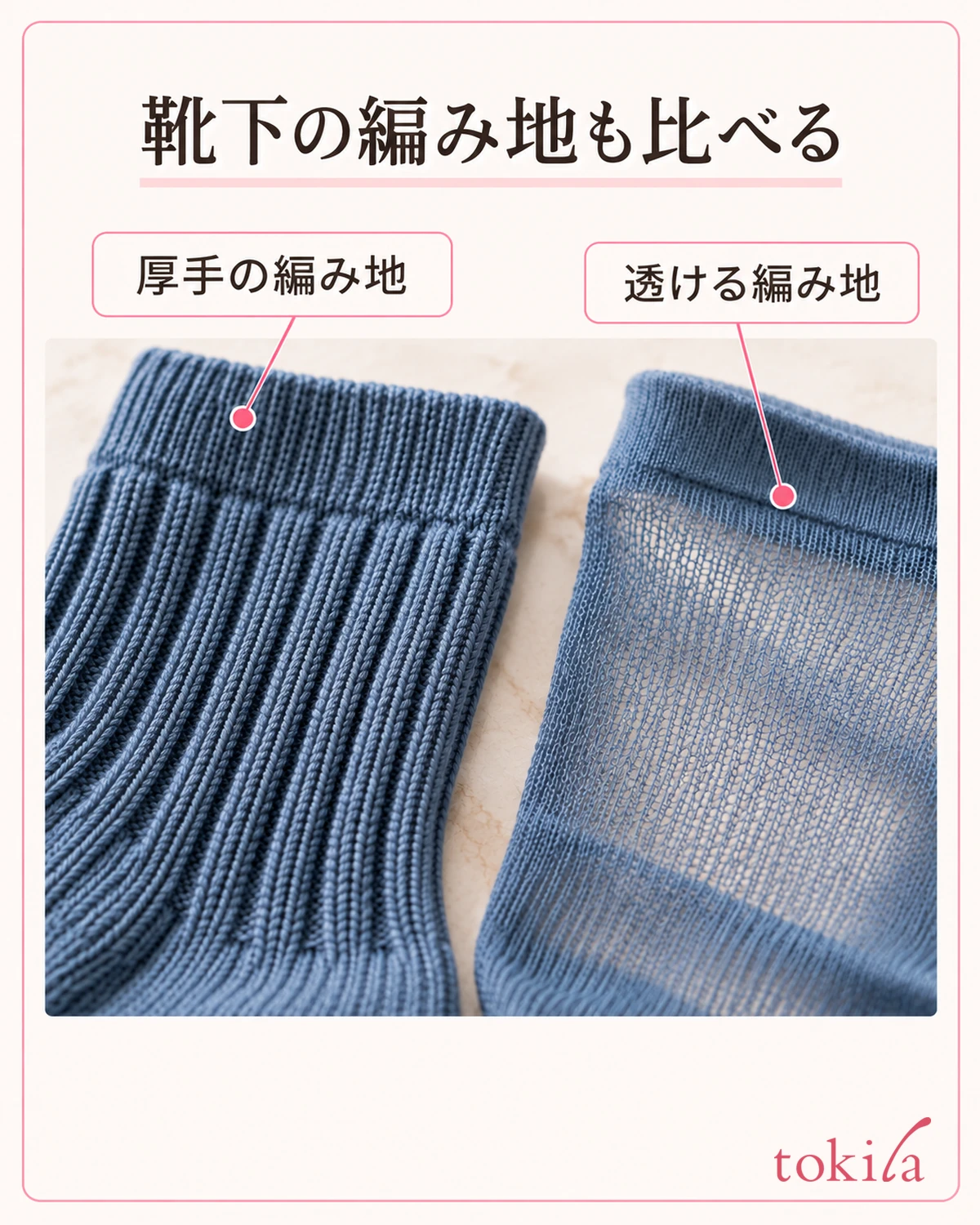
Two pairs from your own wardrobe are enough as candidates to begin with. If one pair is thick and the other is sheer, there is a difference in texture as well as color. You don't need two pairs in exactly the same conditions, but remember that the comparison is not only about color. Steps for checking when you match clothes of the same color may also help with comparing clothes that share a color name.
On days when you are unsure, first decide which is closer: "I want my feet to blend in" or "I want the socks to be an accent." Standing out is not a failure in itself. Use these words to check for a gap between your goal and the result, such as wanting to be understated today but having that spot look strong.
Also avoid changing the shoe material in the first comparison. Even in the same black, the boundary looks different on glossy leather shoes and cloth sneakers. Settle on one pair of shoes, judge whether you like the combination with those shoes, and then try other shoes on another day.
2. Compare a color close to the shoes with a color close to the bottoms
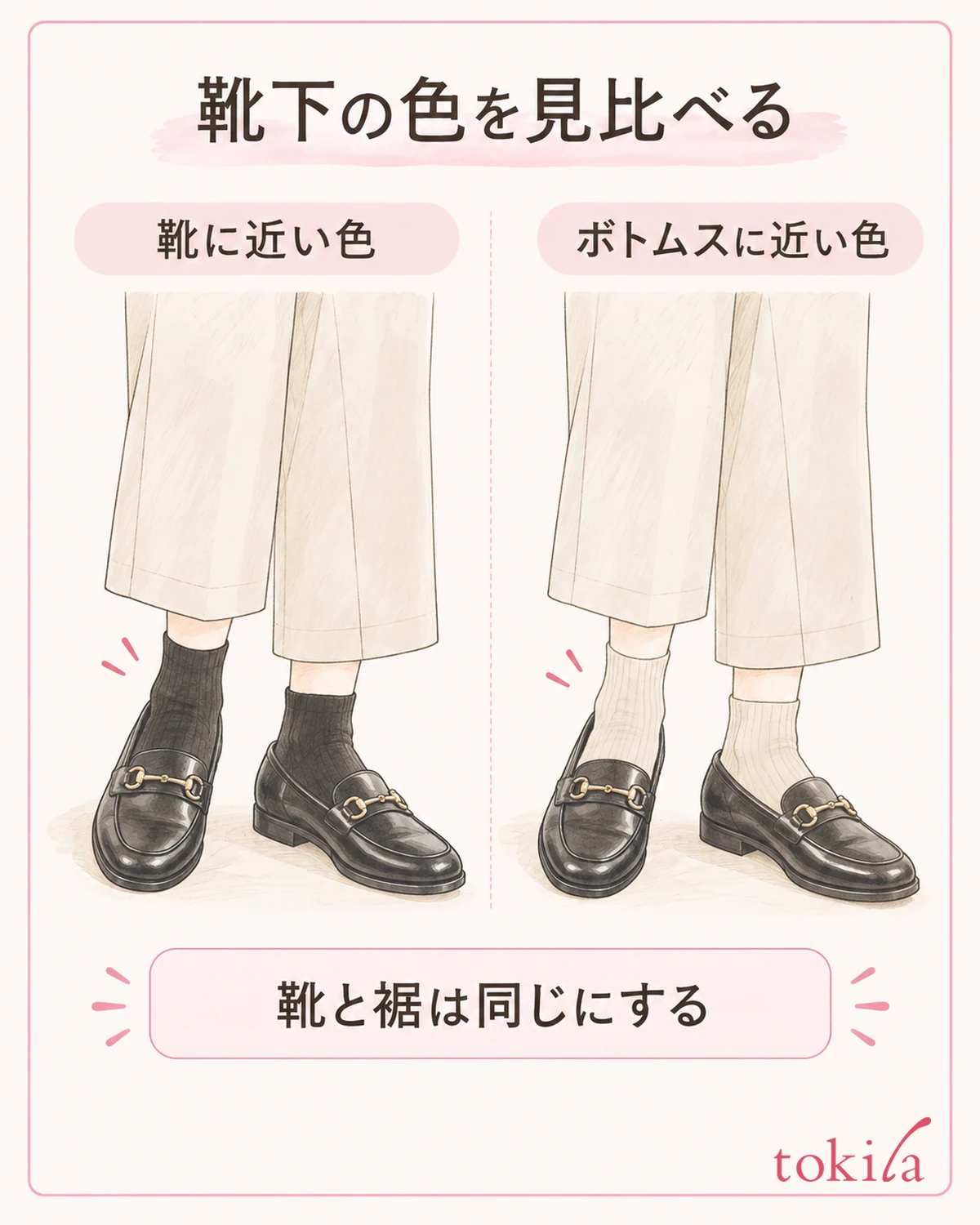
When you want to calm things down, try socks in a color close to the shoes as one option. Choose from what you have, such as black or dark gray for black shoes, or a similar brown for brown shoes. Even if you don't have exactly the same color, first put on a pair of similar brightness and see how the boundary with the shoes looks.
Next, keep the shoes as they are and switch to socks close to the color of the bottoms. For example, on a day with dark pants and light shoes, you can compare how dark socks look connected to the hem side and how light socks look connected to the shoe side. Rather than asking which is right, choose based on which part you want to look like one unit.
Here, also try to keep the visible width of the socks the same. If you stretch one sock up long and let the other scrunch down, the area changes as well as the color. Match the heels and toes first, and without pulling too hard, arrange each sock in its natural position.
If colors that are close still feel mismatched, look at the yellow or red undertone and the shine as well. Even among browns, a reddish brown and a strongly yellowish brown differ. Rather than forcing them to be called the same color, you can also try a candidate that is clearly different in brightness and check whether you prefer showing the difference.
Don't assume that white socks go with everything, or that black never stands out. Between light bottoms and shoes, black can look like a band, and between dark tops and bottoms, white can stand out clearly. Don't decide just by laying the candidates on the floor; go back to wearing the shoes and judge.
On days when the shoes and bottoms are similar in color, you can compare an option with socks in a close color and one with socks in a slightly lighter color. Bringing them closer does not always pull things together. If you feel the dark colors run on too long, keep changing the brightness a little as an option.
3. Try vivid colors after deciding where you want them to show
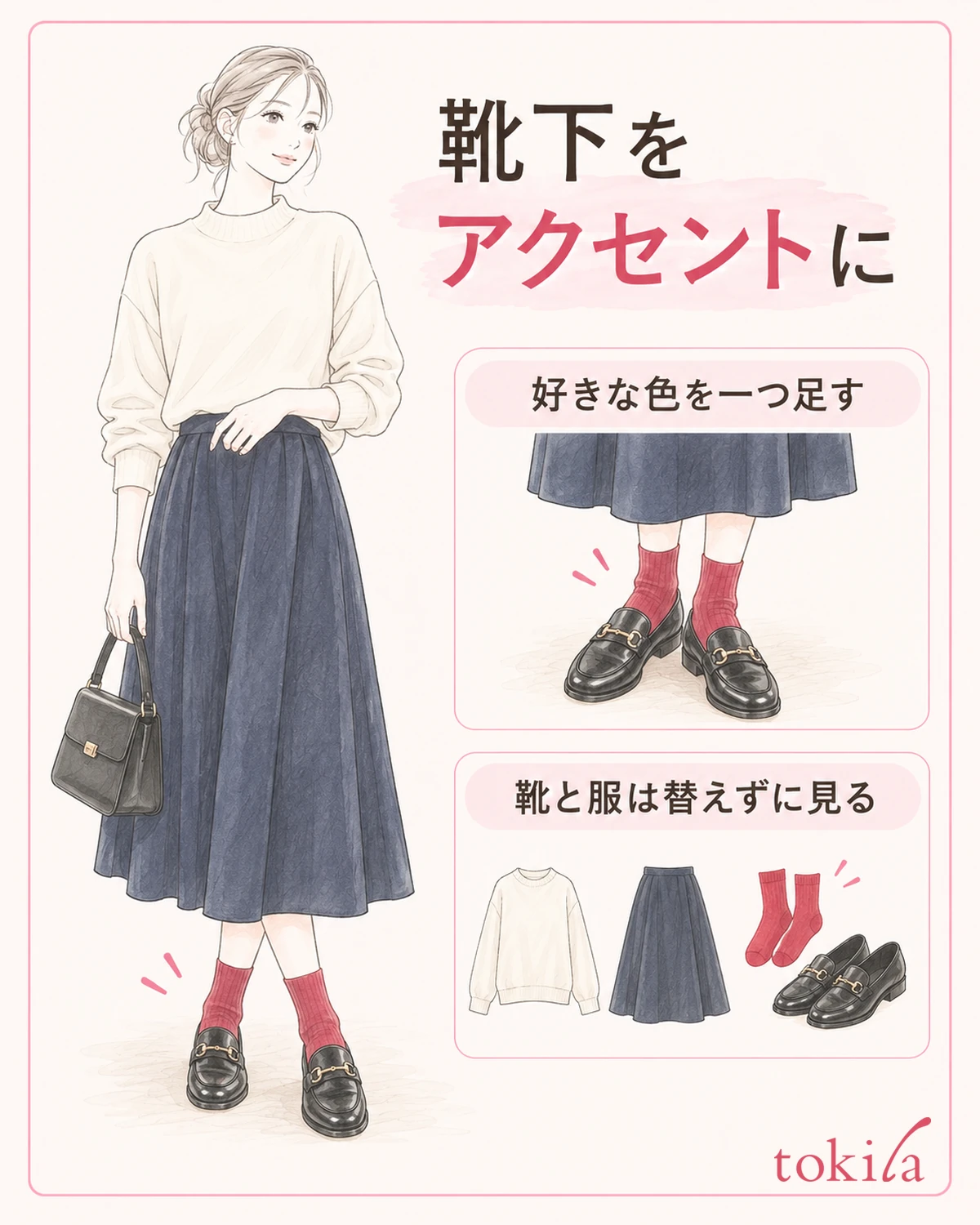
On days when you want the socks to be an accent, choose one pair in a color you like. First keep the shoes and bottoms fixed, change only the socks, and look at the whole. You don't need to avoid a color just because it is vivid, but if you add colors other than at your feet at the same time, it becomes easy to lose track of what you want to be the star.
If your clothes or bag have a pattern, you can try socks close to one color in the pattern. Even if it is not exactly the same as the large areas of color, check whether you can see a shared color. This way of choosing from a pattern can be sorted out together with steps for matching accessories to the colors in a pattern.
If the color feels too strong, don't change your top and bottom right away; if you have one, switch to a calmer pair in the same color family. For example, red to dark red, or bright green to deep green. However, if the material or thickness is also different, remember that this difference is adding to the impression.
You can also choose a combination with just one color you like at your feet. You don't have to repeat the same color in your upper body. It is enough to compare the look where you match your accessories with the look where you leave color only in the socks, and decide which you like with today's clothes. Don't make buying more to match the count a condition.
Sheer socks look different on because your skin and the inner color show through. Even if they look vivid when folded, they can give a different impression when worn. Don't layer socks unnaturally just to choose a color; first put on your shoes with a single pair and also check the thickness and whether the toes feel cramped.
With patterned socks, look at the base color and the pattern color separately. Fine patterns can blend together from a distance, so don't look at the pattern only up close; step back a little from the mirror. When judging color, take care not to pull the fabric hard to stretch out the pattern.
4. Check the space between the hem and the sock cuff, standing and sitting
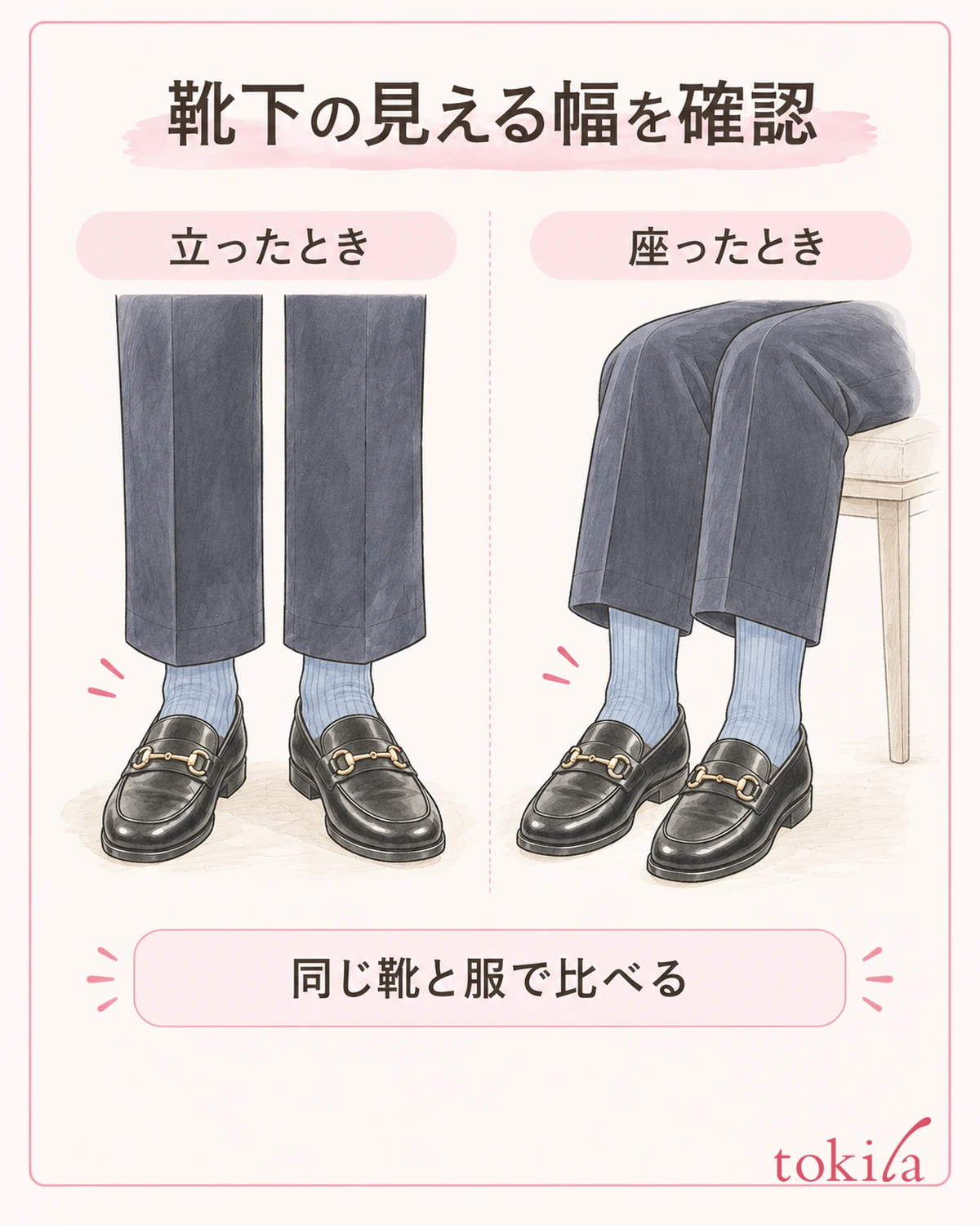
Once you have narrowed down the colors, look at the area from the hem to the opening of the shoe. Check whether only the socks show there, whether skin shows too, or whether the sock cuff sits partway. With short pants or skirts, the top edge of the socks also becomes a boundary in the color scheme.
Next, sit on a chair. When the hem of your pants rides up, colors and patterns that were hidden when you stood can show. Check whether you still like it sitting, and whether the boundary between skin and socks bothers you. You don't need to keep pulling things up to suit only the standing view.
If you feel the visible area of color is too wide, try socks of a different length if you have them. If the clothes allow the hem to be adjusted, you can also compare by folding it up as long as it doesn't lose its shape. However, this stage is a comparison to see the area. If you change the hem, the shoes and the color all at once, it becomes hard to tell which one affected the change.
If you pull the socks down to reduce how much shows, check that they don't bunch up thickly at the ankle and make the shoes cramped. Don't change the length by folding the cuff several times or shifting the position of the heel. Not putting up with discomfort just to tidy up the area of color is also a condition when choosing.
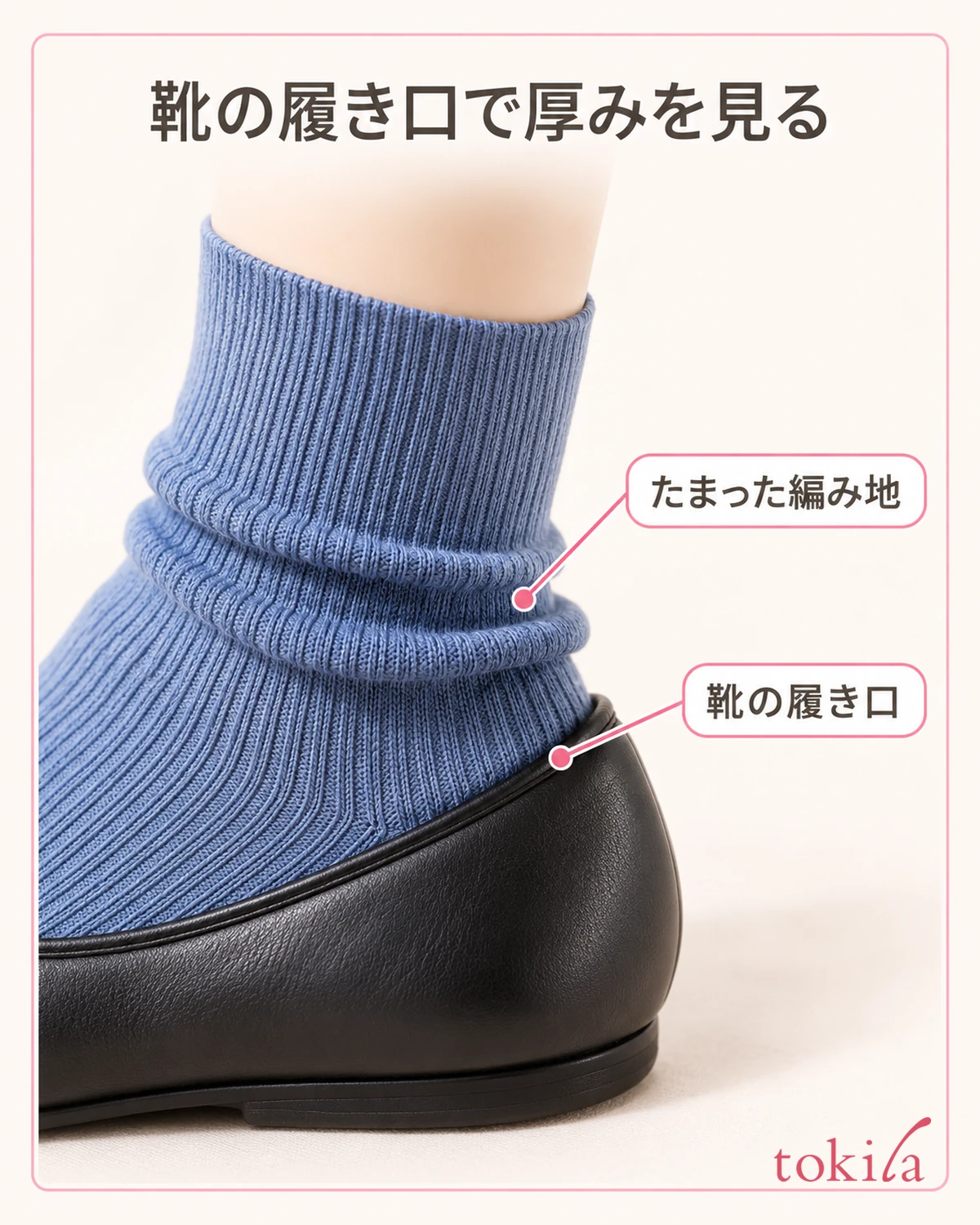
Finally, walk a few steps and go back to how you look after the socks have shifted. Check whether you like the width that shows in your usual movements, rather than a state tidied up for a single moment of photographing. With skirts too, check the range that shows when you sit, and don't set one correct length for everyone.
If the sock cuff presses hard on your skin, give priority to choosing a size and shape that fit over adjusting how it looks. Don't try to solve it by shifting the position that squeezes; take them off once and check whether the cuff and heel fit. There is no need to stretch them to use them.
5. If it doesn't come together, go back one step in either color or visible width
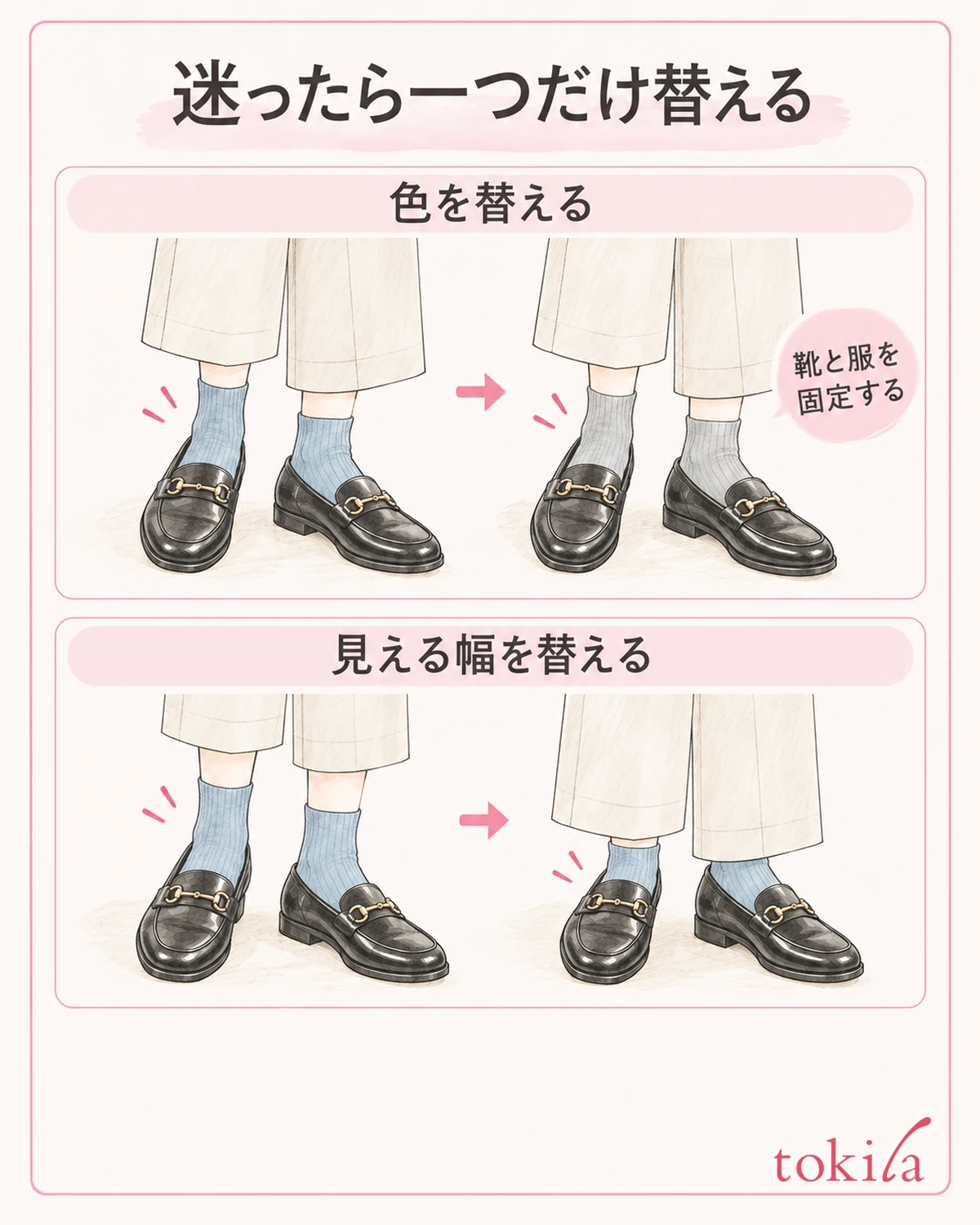
If you change many things and get unsure, go back to the combination you put on first. From there, choose just one: change only the color, or keep the same color and change the length. Take care not to change the shoes and bottoms at the same time and then conclude that the sock color alone was the cause.
If the boundary bothers you, go back to a candidate close to either the shoes or the bottoms. If the vividness of the color bothers you, try a calmer one from what you own. If the area bothers you, fix the color and look at the length. Going back one step at a time to match the reason you are bothered will turn up adjustments you can make before buying anything.
When you keep photos, take them with the same mirror, in the same place and facing the same direction. If you shoot with only one side closer to your feet, the proportion the socks take up in the whole looks different. Screen brightness and automatic correction also change colors, so don't rely on photos alone and look at the real thing in the end.
On days when you are short on time, it is fine to go back to the shoes and socks you usually like. On a day when you have time, fix today's bottoms and compare two pairs. If you only have one candidate pair, checking the visible width standing and sitting is enough. There is no need to prepare a new pair just for comparison.
When you find one you like, record not only the color but also the surrounding combination, such as "gray with dark pants and black shoes" or "a little blue showing with light shoes." In places with a dress code, check those conditions first. Try adding, bit by bit from what you already own, combinations that keep both the colors you like and comfort.
The record doesn't have to be only photos; a short note such as "I like it when the color is close to the shoes" or "the blue looks wide when I sit" is enough. Knowing the conditions you want to check next time is helpful. Your preferences change with your clothes and plans, so don't turn a color you chose once into a rule for every time.