You put on a blouse and look in the mirror, and only one collar tip is tucked in toward your neck. You thought you had pulled it out, yet it folds in again when you put on a jacket. When that happens, before tugging hard at the collar tip, look at what fabric it is overlapping with.
This article is about blouses and shirts with a fold-over collar, and it separates a collar that tucks in while you wear it from a fold that remains even after you take it off. It is not about forcing a design that folds on only one side, or a collar with different shapes left and right, to match. Check the garment's original shape, and tell apart what you can put back by hand from what needs care.
1. Tell whether it is only the collar tip or the whole neckline
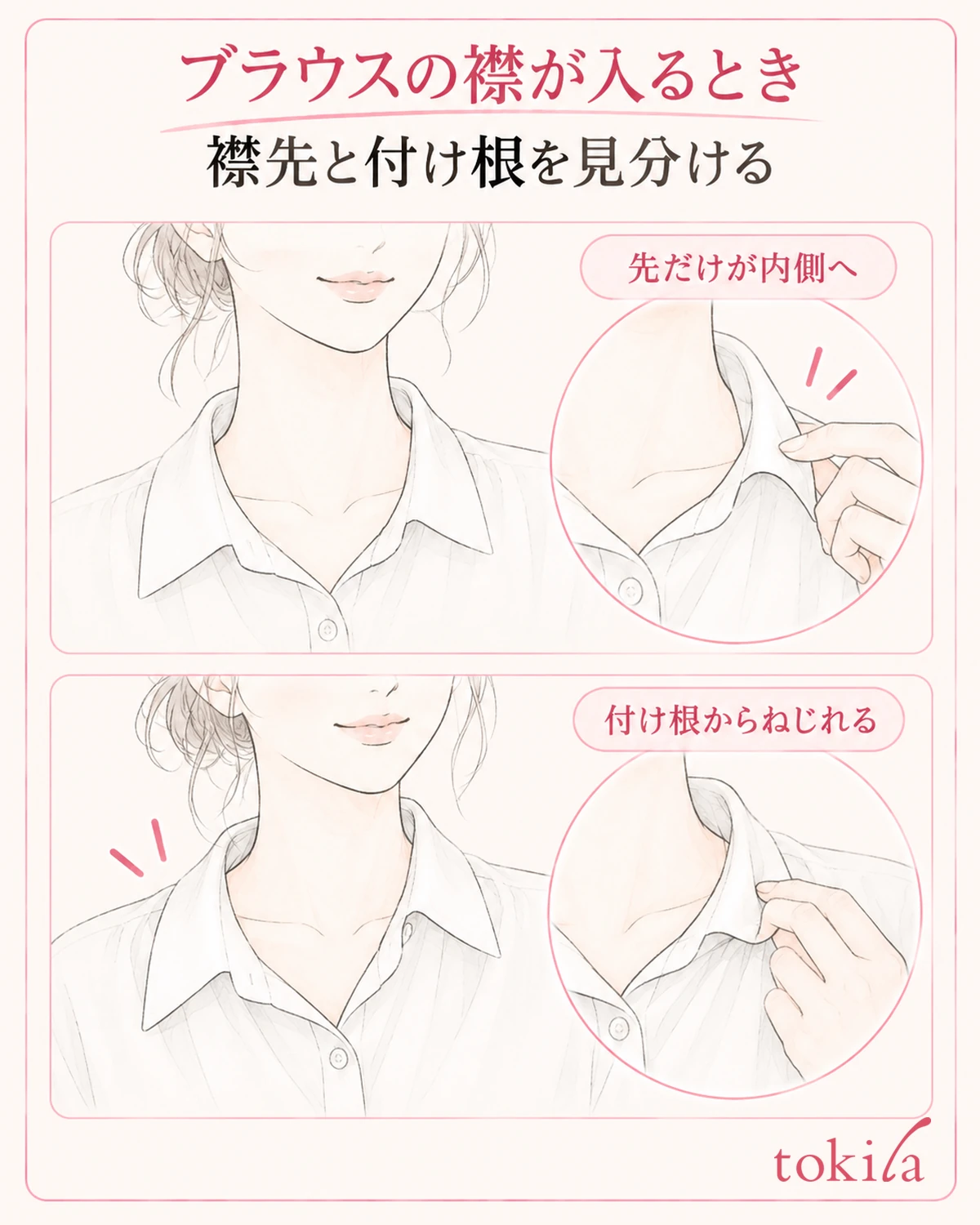
Stand in front of a mirror with your arms hanging naturally, without tensing your shoulders. If you turn your face far to one side, the fabric at your neck moves too, so look from the front first. Separate whether only one collar tip is tucked into the front opening, or whether the whole collar is twisted from its base. If your hair hides it, move your hair aside so it does not catch on the clothes, and check.
If only the collar tip has gone into the front opening, look at what it is caught on. Check what it overlaps with: the opposite front panel, your inner layer, or the collar of your jacket. Rather than feeling around and pulling it out without seeing it, it is easier to check if you take off your jacket and make it visible.
If the base of the collar has shifted to one side and the shoulder seams have moved too, do not pull only the collar tip to even it out. Move on to repositioning the whole blouse. If you have misbuttoned the front, treat that separately from the collar problem; you can also check how to check the buttons against the buttonholes.
It also helps to look at the garment once when it is off, to see its original shape. Lay it on a flat clean surface and spread the left and right collars and their stitched parts lightly. If it is made with different widths or tip shapes on the left and right, or has an intentional fold-back, use that design as the baseline. Do not decide that a left-right difference in appearance alone means a defect or a wearing mishap.
At this stage, apply no water or heat; only look at the condition. If you point to the place that folded while you were wearing it with your finger before taking it off, it is easier to find the same spot after you put the garment down. Does it tuck in only when you wear it, or does it stay folded inward even when laid down? Use this difference as a guide for your next step.
The back of the collar may just look dark in the shade of the lighting, so separate a difference in color from a fold in the fabric. When you look with a hand mirror, check which side the edge of the fabric goes in, and do not try to pull out everything that looks dark. If the front and back of the collar are the same color, following the seam at the edge makes the direction easier to find.
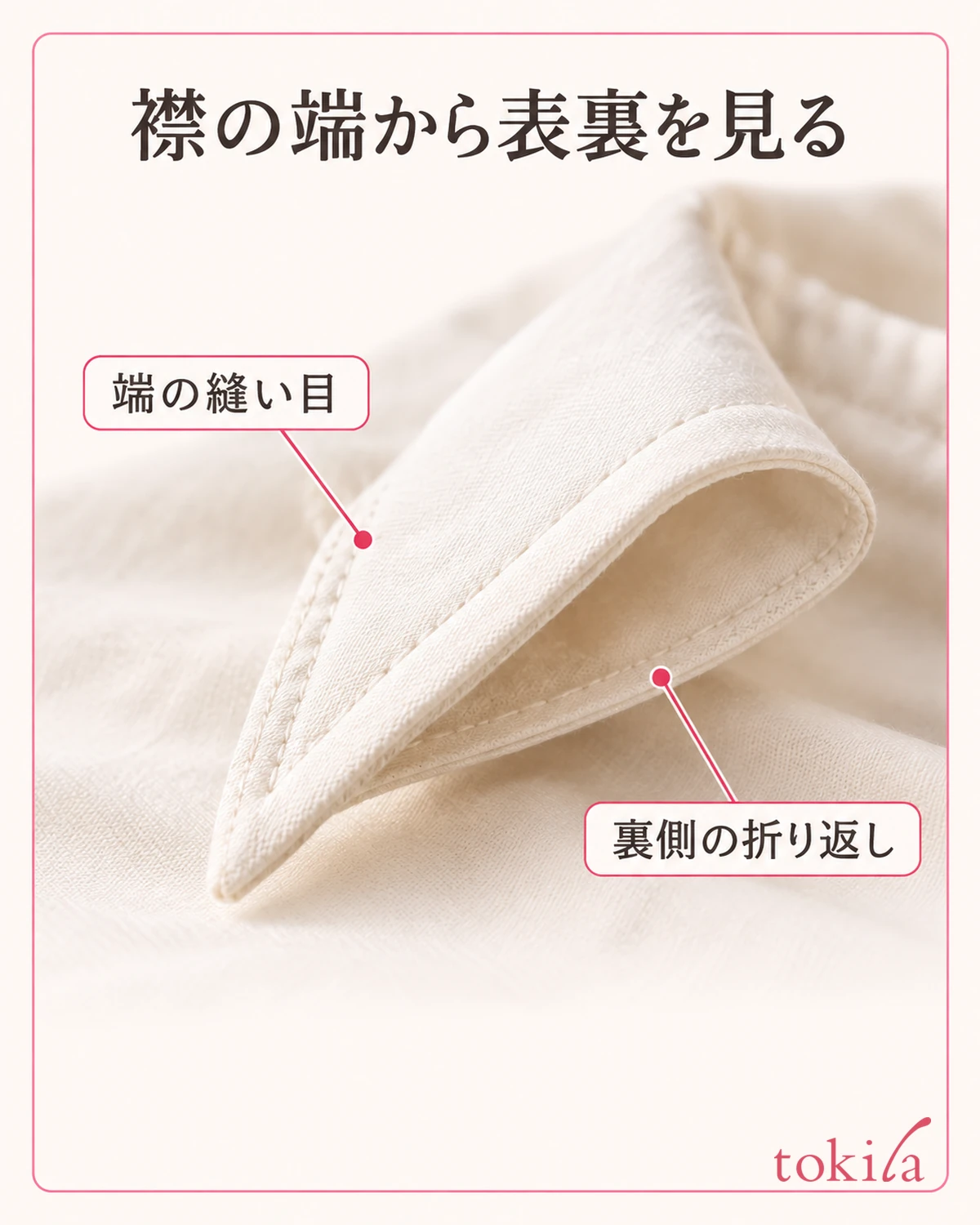
2. Separate the overlapping fabric and put the collar fold back
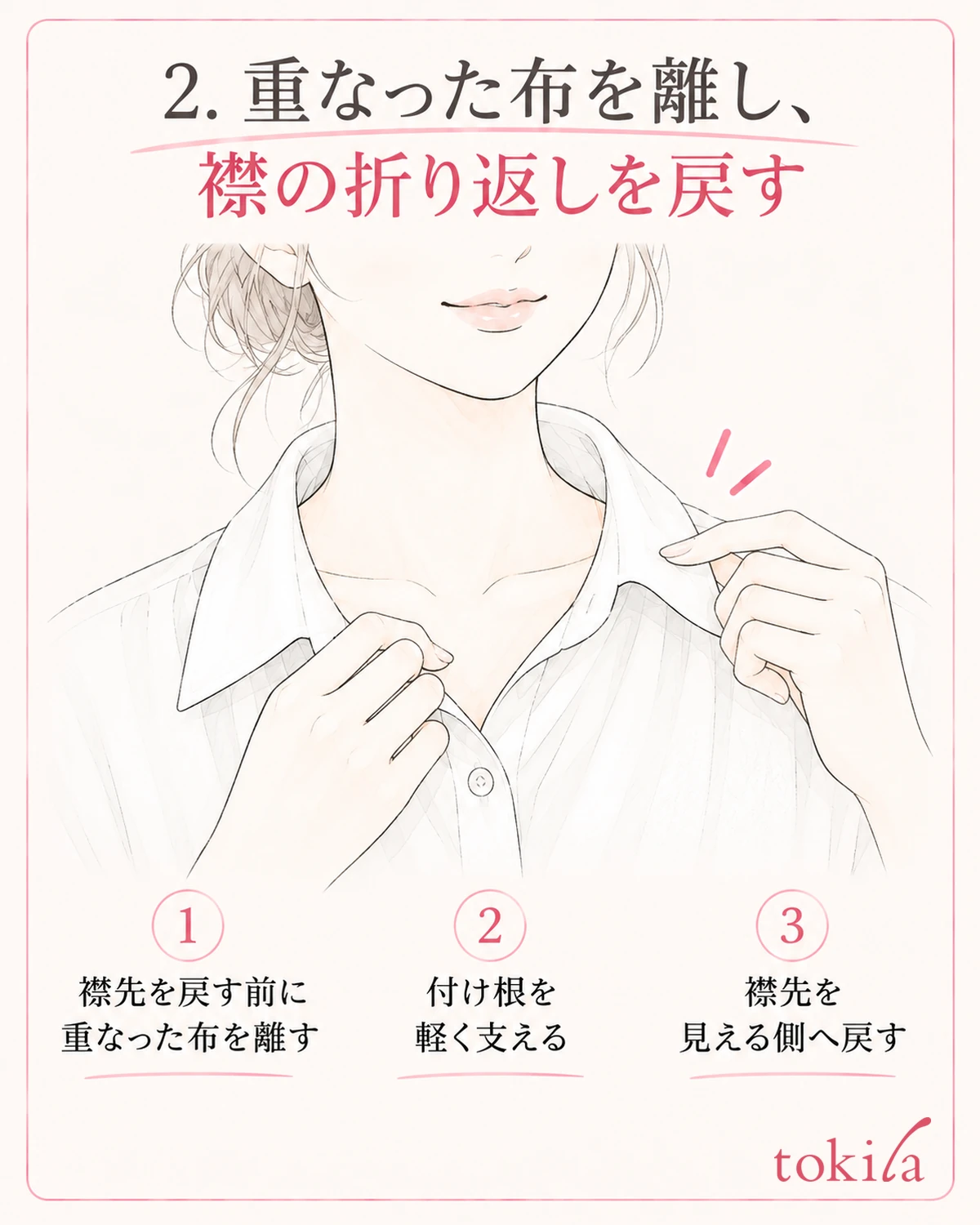
When fixing an overlap while you are wearing the blouse, first take off your bag and any wrap, and take off your jacket. If you pull only the tip while the blouse collar is caught under another garment, it becomes hard to tell where the resistance is. If it is hard to get a hand inside the neckline, move to a place where you can calmly put the garment on again.
For a garment that opens at the front, undo the top buttons as far as needed so that the fabric moves easily. For clothes without buttons or with embellishments, it can be easier to take them off once, depending on the construction. Do not force open parts that do not open; proceed only as far as you know how to undo the fasteners.
With one hand, lightly support the fabric near the base of the collar, and with the other, return the tucked-in collar tip to the visible side. Instead of pinching the tip and stretching it downward, the feeling is to separate the fabric that is pinching it and set the fold back in a position where it connects naturally. Do not dig in your nails, and take care not to catch decorations or seams.
Once the collar tip is back, check whether any small tucked-in folds remain between the base and the tip. Smooth the fabric only by lightly stroking it with the pads of your fingers, and do not keep pulling at places that resist. Check, as far as you can see, for tacking stitches or fasteners. You do not need to cut any thread you find or take out the interfacing.
Do not aim only to make the height of the left and right tips the same. The visible length changes depending on how the front opens and the shape of the collar. Check that one side is not rolled inward and that it folds back naturally from the base of the collar. If it springs back as soon as you let go, do not press it hard again and again; take the garment off once and look at its condition.
3. Put the blouse on again and check with a jacket layered over it
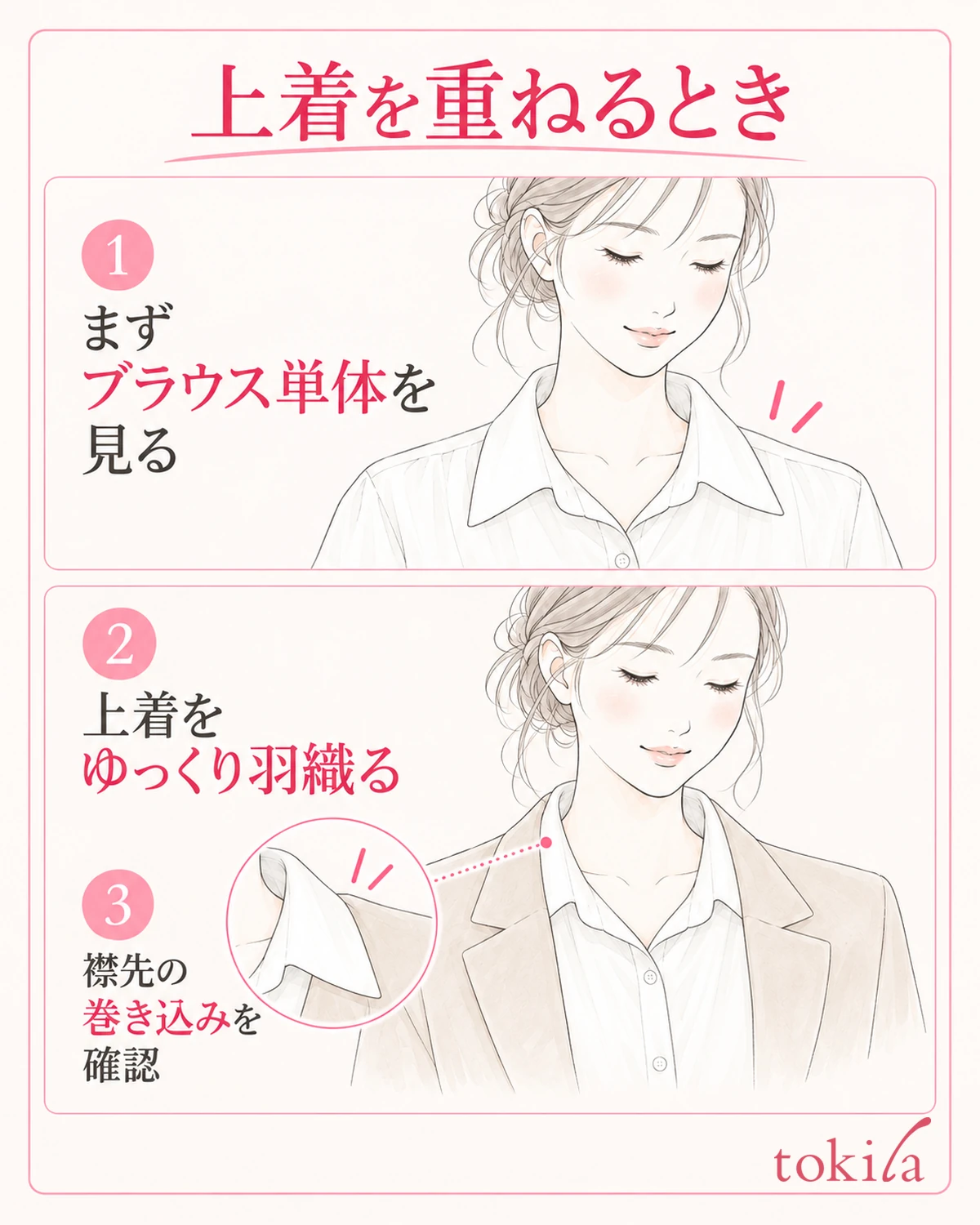
If the whole collar has drifted to one side, put the blouse on again. Return the fabric at each shoulder to its natural position and undo any twist in the back and front panels. Do not hold one collar and move the whole garment; move the broad part of the body of the garment little by little. Also check that your inner layer has not been lifted along with it.
After fastening the buttons, face the front and check your neckline and shoulders. Tell apart a state that looks neat only while you hold the collar tip down from a state that stays settled after you let go. If your neck feels tight, the front panels are pulled strongly or gaps open between buttons, you do not need to put up with it just to make the collar look neat.
Before putting on a jacket, look at the position of the blouse collar on its own. Then put the jacket on slowly and see whether the jacket's collar or front edge is drawing in the blouse collar tip. If it has gone in, separate the jacket's overlap slightly and then put the blouse side back. Do not try to pull out only the thin collar tip from under heavy fabric.
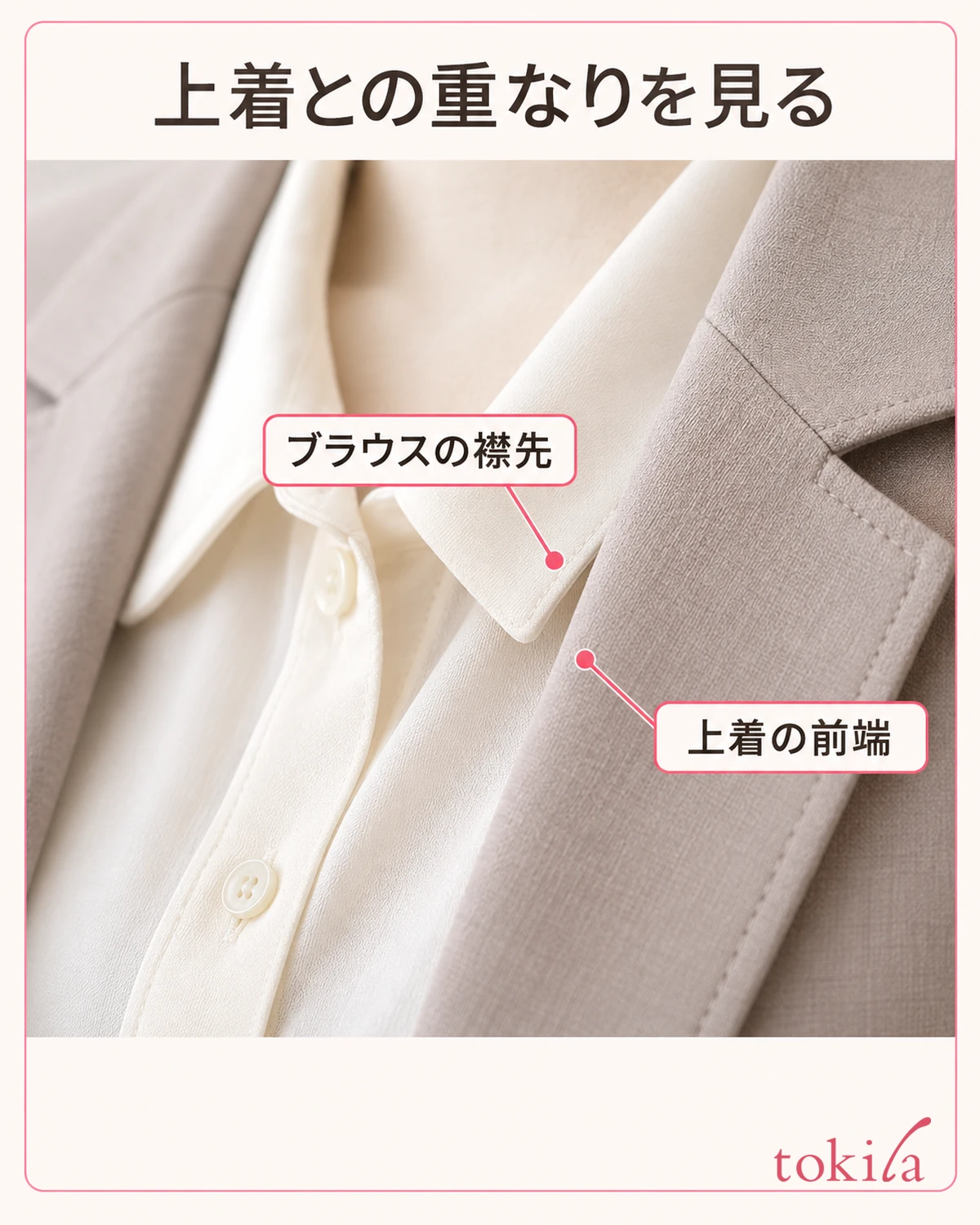
Whether to wear the collar outside the jacket or tucked inside depends on the shape of both garments and how you wear them today. There is no rule that outside is the right answer for every combination. Check that one side is not caught by accident, and if it is hard to tuck in, review the collar opening or the combination with the jacket.
If your neckline is pulled only when the hem is tucked in, do not pull back from the collar; check the room in the fabric around your waist. After making adjustments to how you tuck in a shirt hem and its ease, look at the collar again. The point is not to try to solve it only at the neckline, but to also check whether the garment is being pulled somewhere away from it.
If the collar returned just by taking off the jacket, that is not an immediate reason to iron the blouse. Layer the same combination again and check whether you can see where it gets caught. When you compare by changing clothes, change only the jacket rather than both top and bottom at once, and the difference in overlap is easier to see.
4. If the fold remains after taking it off, read the care label
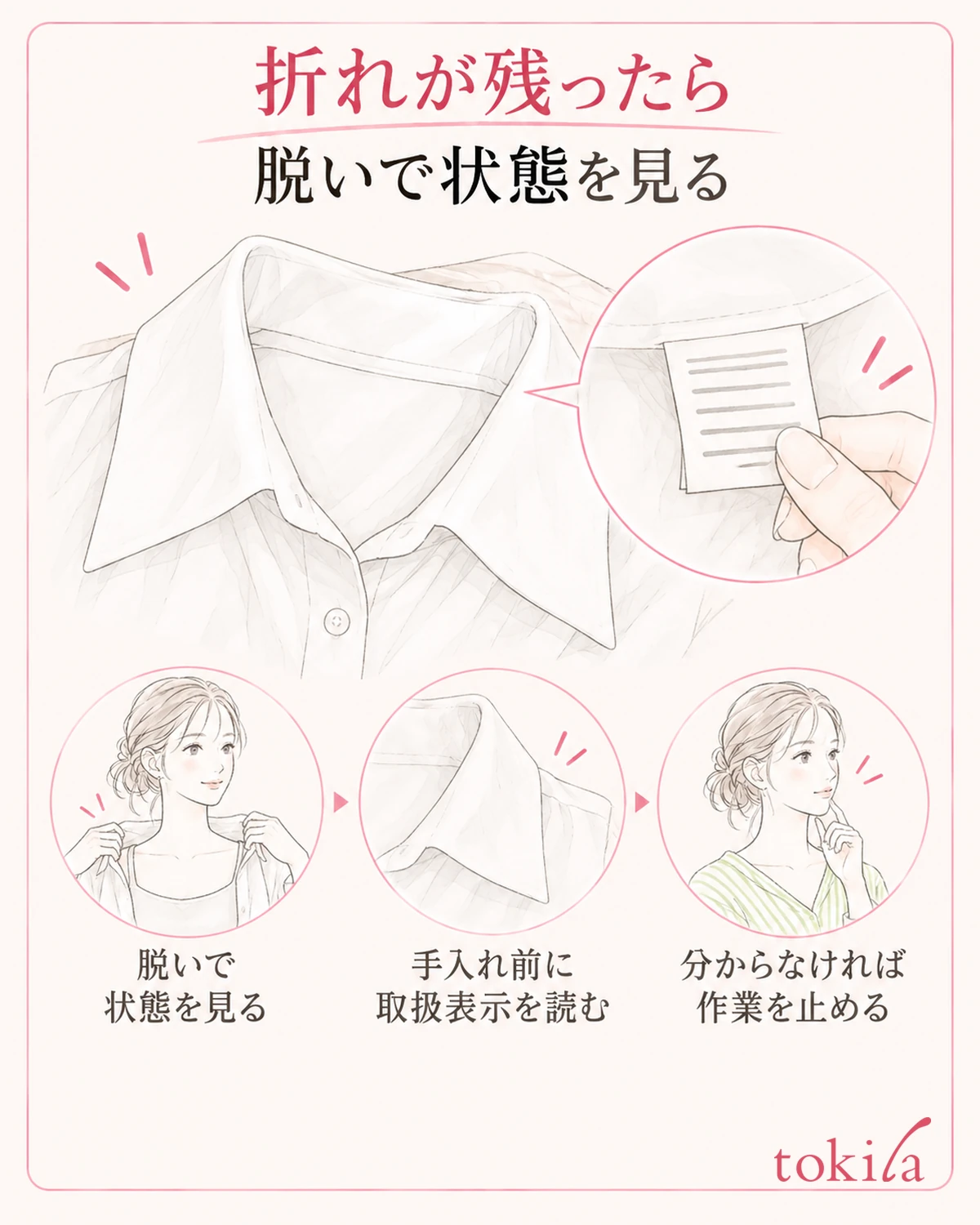
If the collar still folds in when you take the blouse off and lay it flat, treat it separately from an overlap while worn. Check the current condition, such as whether a crease line remains in the fabric, whether the stiffness differs left and right, or whether the stitched part looks puckered. Do not assert a cause from appearance alone, and do not repeat the work of putting it back by hand.
Before thinking about care, read the care label and the cautions attached to the garment. Check whether you can use an iron, the upper temperature limit, steam restrictions, and instructions such as using a pressing cloth. Do not decide by material name alone, such as "it's a blouse so low heat" or "it contains cotton so high heat"; give priority to the label on that particular garment.
Do not apply heat to a garment where ironing is prohibited, thinking that a short time should be fine. Even where it is allowed, take the garment off, lay it on a work surface, and check both the garment's and the appliance's instructions before you start. Here we set no temperature or number of seconds common to all collars. Match the conditions of the item you have, including decorations and interfaced parts.
Do not assume that a spray bottle or a steamer can be used freely just because it is not an iron. Some garments change in feel with moisture or steam, so check the label and the additional notes. If you do not know, stop, and consider consulting the shop where you bought it or a dry cleaner about the specific condition, with the care label legible.
Before adding adhesive or double-sided tape to fix a fold, or undoing seams, check the range of care suited to the garment. If you see discoloration, wear or fraying of the fabric, do not try to fix it only by putting it on again; do not pull it any further and ask for advice on how to handle it. On a rushed morning, you can also decide to switch to another garment.
5. Check after moving too, and decide what to look at next time
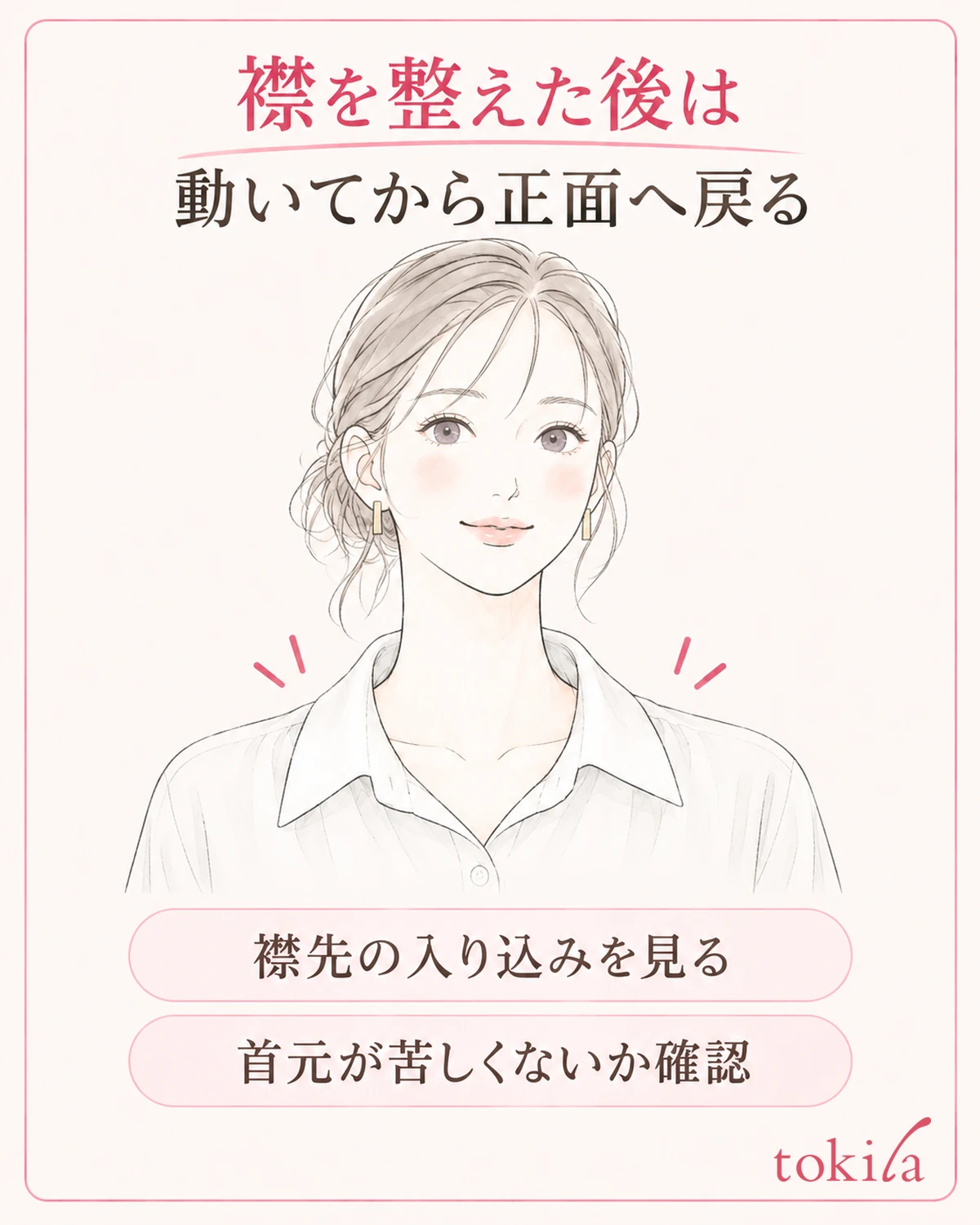
After putting the collar back, look once while standing facing the front with your arms down. Then do small movements one at a time within your usual range, such as turning your face left and right or reaching your arms forward. Rather than comparing the shape left and right during the movement, look at whether the same collar tip has tucked in again when you return to facing the front.
If the blouse alone stays settled but it folds only after you put a jacket on, next time check the overlap right before and right after you put the jacket on. If it folds right after you put the blouse on again, review the position of the shoulders and body, the front opening, and the collar when the garment is off. Separating the situations in which it happens means you do not have to change care and the way you wear it all at once.
You do not need to arrange left and right at exactly the same angle every time you check. The position of the fabric changes a little with the direction of your face and your movements. Use as your guide that the collar tip is not caught inside, that your neckline is not tight, and that you can wear it comfortably even after letting go. Do not keep pulling to correct even small differences in appearance.
After taking it off, store it according to the instructions of the item you own, so that the collar is not pushed under other clothes while still folded in. Whether you hang it or fold it, check the condition of the collar where you can see it before putting it away. Do not assume that a particular storage method will certainly prevent folds; adapt to the garment's shape and where you keep it.
Next time you wear it, remember one situation that bothered you with your own clothes, such as "look at the collar tip after putting the jacket on". Separate the adjustments you can make that day from the care you do later by checking in this order: separate the overlap, put the whole garment on again, and read the label if it remains after taking it off. That way you avoid pulling hard on the tip over and over.