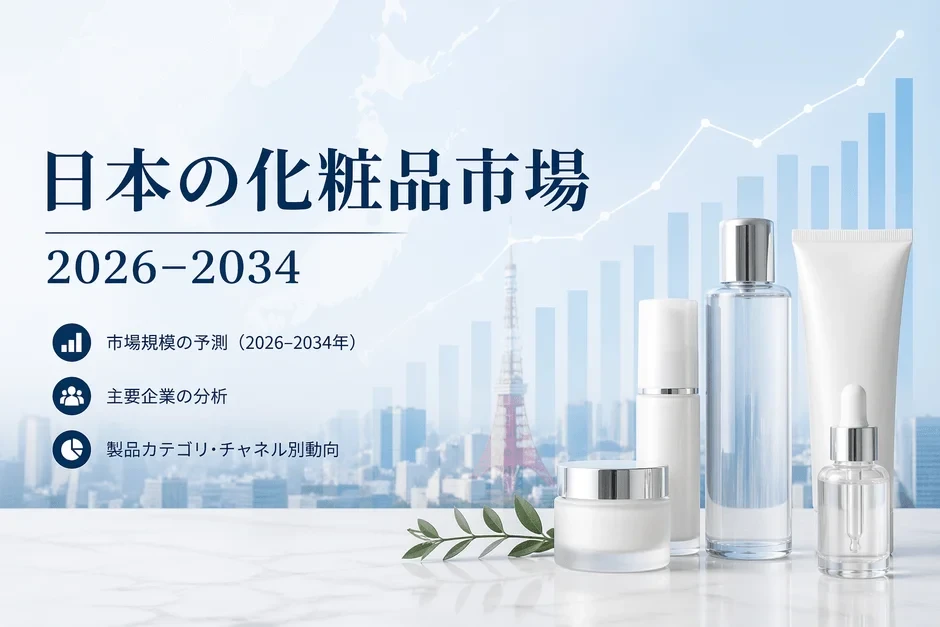
IMARC Group has released its latest report, "Japan Cosmetics Market: Industry Trends, Share, Size, Growth, Opportunities and Forecast 2026-2034."
According to the report, the Japanese cosmetics market was valued at US$28.66 billion in 2025 and is forecast to reach US$40.75 billion by 2034. It is expected to grow at a compound annual growth rate (CAGR) of 3.87% from 2026 to 2034.
Japan's cosmetics market to grow past US$40.7 billion by 2034
IMARC Group's latest report provides a detailed analysis of trends and the future outlook of the Japanese cosmetics market.
The market size reached US$28.7 billion in 2025, and growth is expected to continue, reaching US$40.7 billion by 2034. This growth rate is projected at an average of 3.87% per year over the period from 2026 to 2034.
You can request report details and a customized report from the links below.
Key trends driving the Japanese cosmetics market
Japan's cosmetics market is known as one of the most sophisticated, innovation-driven markets in the world. Its foundation lies in a world-renowned skincare culture, consumers' high standards for product formulation quality, and Japan's standing in beauty technology and ingredient innovation.
The market covers a wide range of categories, including skincare and sun care products, hair care products, deodorants and fragrances, and makeup and color cosmetics, spanning from conventional to organic products.
Distribution channels include supermarkets, hypermarkets, specialty stores, pharmacies and online stores, serving male, female and unisex consumer groups through a highly developed beauty retail ecosystem.
Japan's multi-step skincare culture supports premium, steady consumption across the facial care, sun care and body care product categories. The adoption of organic and clean beauty formulations is accelerating as more consumers emphasize transparency about natural ingredients, reduced exposure to chemicals and environmentally considerate product development.
Changing cultural awareness of men's beauty has significantly expanded the adoption of men's grooming and cosmetics. This is creating new growth opportunities in the skincare, fragrance and color cosmetics categories. The recovery of inbound tourism is also a factor driving sales of premium beauty products at duty-free stores and in destination beauty shopping. The mutual influence between K-beauty and global cosmetics trends also continues to affect domestic cosmetics innovation in Japan.
How AI is transforming the cosmetics market
AI technology is reshaping consumer discovery and purchasing behavior in Japan's cosmetics market. The specific changes are as follows.
AI skin analysis and personalized beauty advice: AI-powered skin analysis platforms use computer vision and machine learning algorithms to analyze each consumer's skin type, tone, texture, pore condition, moisture level and specific skin concerns from smartphone camera images. This enables highly personalized recommendations of skincare products and cosmetics matched to each user's skin, foundation shade matching, and customized beauty routine suggestions. This is said to promote product discovery, purchase and improved brand loyalty.
Generative AI for product innovation and shade development: AI-powered cosmetic formulation and color development platforms analyze consumer trend data, ingredient performance databases and the global beauty innovation pipeline to accelerate the creation of new product concepts and the optimization of formulations. Generative AI tools are said to help Japanese cosmetics R&D teams develop novel combinations of active ingredients, predict consumers' sensory preferences, and optimize color variation development for makeup and color cosmetics that suit Japan's diverse skin tones.
Personalized e-commerce and virtual try-on: With AI-powered augmented reality (AR) virtual try-on platforms, Japanese cosmetics consumers can digitally preview the color, finish and overall composition of makeup products before deciding to buy online. Machine learning algorithms analyze each person's face shape, skin undertone and features to provide realistic and accurate virtual product visualization, which is expected to significantly reduce hesitation over online purchases and return rates, and to improve consumer trust and satisfaction in Japan's beauty e-commerce channels.
Market segmentation in detail
IMARC Group's report analyzes the Japanese cosmetics market by dividing it into the following segments.
Insights by product type
Skincare and sun care products
Hair care products
Deodorants and fragrances
Makeup and color cosmetics
Others
Analysis by category
Conventional
Organic
Insights by gender
Men
Women
Unisex
Insights by distribution channel
Supermarkets and hypermarkets
Specialty stores
Pharmacies
Online stores
Others
Analysis by region
Kanto region
Kinki region
Chubu region
Kyushu-Okinawa region
Tohoku region
Chugoku region
Hokkaido region
Shikoku region
Competitive landscape and key companies
The competitive landscape of Japan's cosmetics market is analyzed in detail, including market structure, positioning of key players, key strategies for success, a competitive dashboard and a company evaluation quadrant. The following companies are named as key companies.
Shiseido Co., Ltd.
Kao Corporation
Kose Corporation
Pola Orbis Holdings Inc.
Kanebo Cosmetics Inc.
In March 2026, major Japanese cosmetics companies announced they would expand their organic and clean beauty product lineups across the skincare, hair care and color cosmetics categories. By adopting sustainably sourced plant-derived active ingredients and innovations in environmentally considerate packaging, they say they will respond to consumer demand for eco-friendly beauty products.
In addition, in February 2026, major cosmetics brands are said to be introducing AI-powered virtual try-on and personalized skin analysis platforms across digital consultation channels at e-commerce sites and physical stores in Japan. This is thought to be giving consumers access to highly personalized beauty product recommendations and digital product visualization tools, improving their confidence in online purchases and the quality of customer engagement at specialty stores.
About IMARC Group
IMARC Group is a global management consulting firm. It provides comprehensive services for market entry and business expansion, including market assessments, feasibility studies, company incorporation support, factory setup support, support for regulatory approvals and licensing, branding, marketing and sales strategy, competitive landscape and benchmarking analysis, pricing and cost research, and procurement research. The company also provides market research reports.