The moment you pick up toner, it runs between your fingers or toward your wrist. It spills on the way to your face, and you lose track of how much you actually applied. Before you rush your hands, try looking separately at the moment the toner leaves the container and at what happens after it lands in your hand.
This article covers the steps from taking a toner that can be used by hand to working it into your face. While following the single-use amount and the tool specified for your own product, it explains in 5 illustrations how to position the container, form the hollow of your palm, and use the fingers of your other hand. It is not a method of uniformly cutting the total amount you need just because it spills.
1. See where it spills, and check the single-use amount and the tool to use

First, recall at which moment it spills. Does it miss your receiving hand when you tilt the bottle? Does it run between your fingers after it lands in your hand? Does it drip down to your wrist on the way to your face? Instead of lumping everything together as "too much," pick the first place where it ran, and it becomes easier to decide which movement to change.
Next, check the directions for use on the toner bottle or outer box. Read whether it can be used by hand, whether it specifies a cotton pad, and how the single-use amount is indicated. Do not switch a cotton-only method to your hand just because it seems less likely to spill. Some products use different amounts for hands and cotton, so check the tool and the amount as a pair.
Even when it says "an appropriate amount," do not apply the coin size or pump count of a different toner as is. How easy it is to take depends on the thickness of the liquid, the shape of the opening, and the structure of the pump. Use the directions of the bottle you are using now as your standard, and do not carry a large puddle to your face when you do not know the amount.
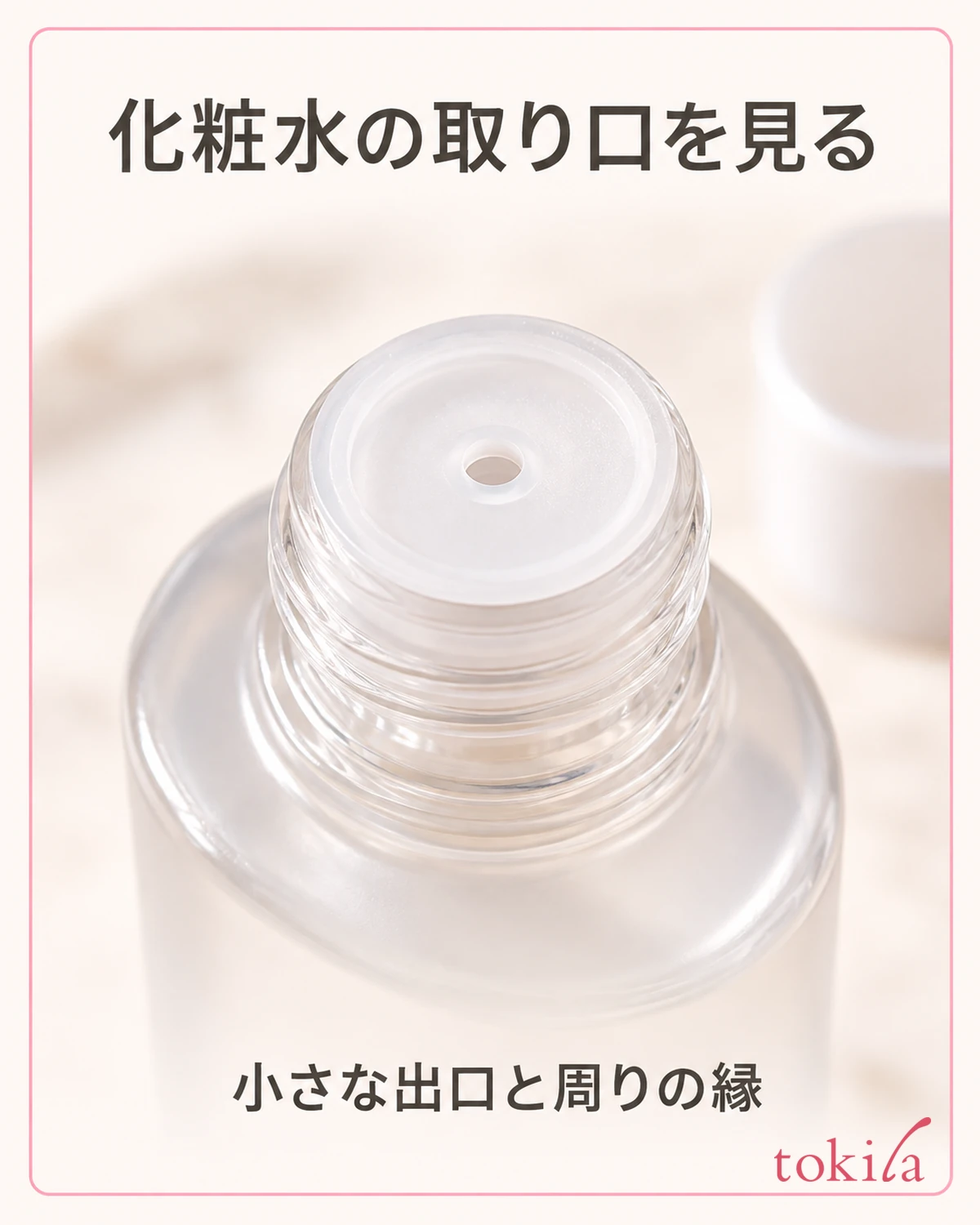
The amount you dispense into your hand is not necessarily the same as the amount that actually ends up on your face. Even so, if you keep adding more by eye to make up for what spilled, it is easy to lose track of the total. Before you keep adding after it has run, set the container down and check where the liquid has ended up. Avoid collecting liquid that has fallen and putting it back on your face.
Also read the instructions to follow before use, such as shaking, removing the cap, or unlocking the pump. Adding an unnecessary shake or taking the container apart changes the conditions from your usual routine. First prepare as the label says, and then work on your receiving hand and how you dispense.
If water droplets remain on your face after cleansing, separate the steps before you take the toner. If the towel stage is where you are struggling, you can also check how to press a towel after cleansing. Cutting down on searching for a towel with toner already in your hand makes the work easier to follow.
2. Keep your fingers together and make a shallow hollow in an upturned palm
Before taking the toner, make your hands clean and wipe off the water droplets from washing. If water remains between your fingers or on your wrists, it is hard to tell apart from the liquid you are about to dispense. You do not need to rub your hands repeatedly to dry them completely; just remove the surface droplets so you can hold the container calmly.
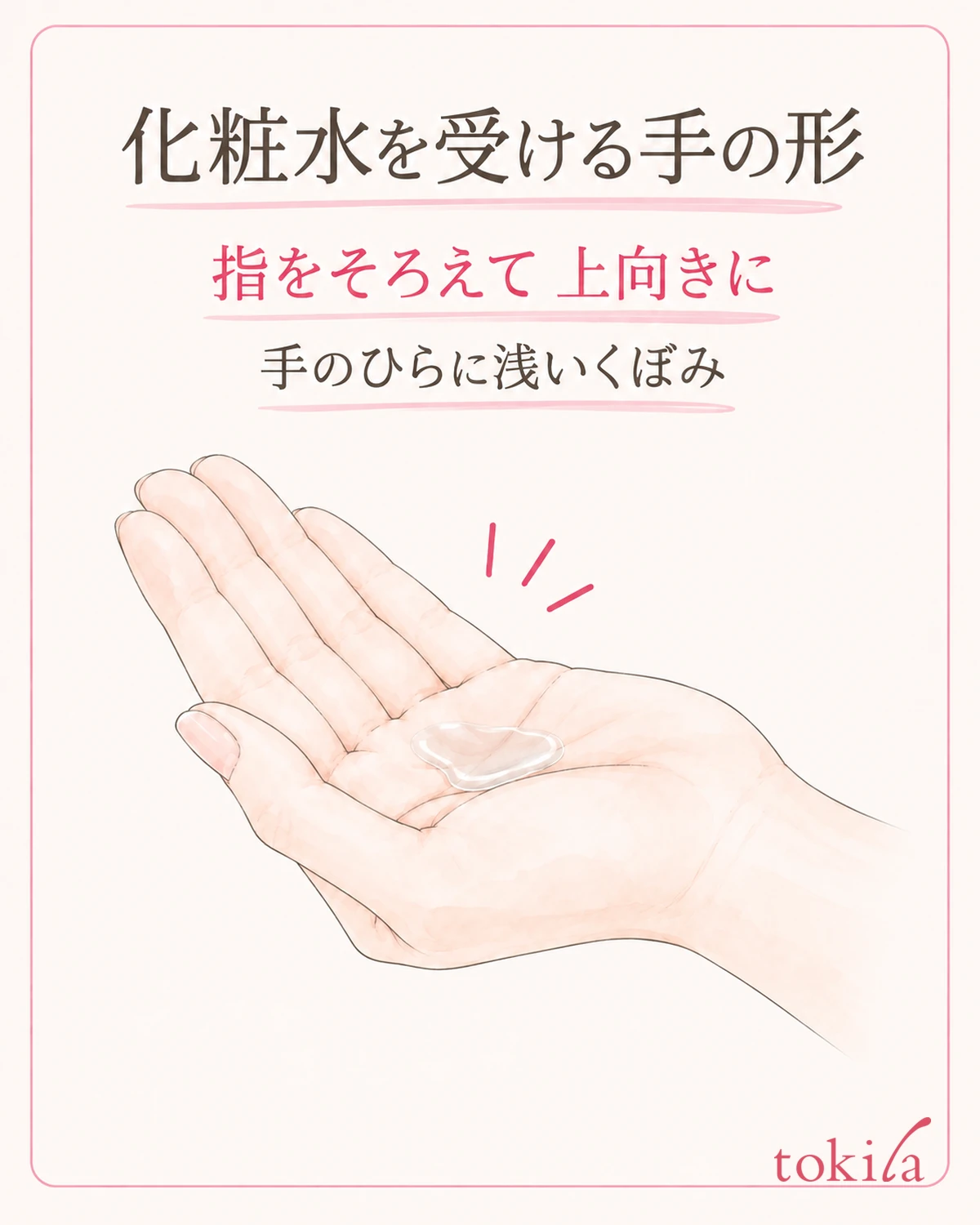
Turn the receiving hand palm up and keep your four fingers naturally together. Bend your fingers slightly and make a shallow hollow in the center of your palm. Rather than gripping your fingers tightly to make a deep bowl, watch which way the liquid is likely to flow and look for a position where you do not tilt your wrist too far. Do not hold the shape so rigidly that your hand starts to hurt.
If you receive the liquid only on your fingertips rather than the center of your hand, it falls easily through the gaps between your fingers. Check that the hollow of your palm is right under the outlet. If it flows toward the thumb side, see whether that side has become lower. Hand size and ease of movement differ, so you do not need to match the bend exactly to the illustration.
Before you raise both hands high while looking in the mirror, take the toner where you can see your hands. If your elbow juts out and your receiving hand ends up slanted, relax your shoulders and also adjust the height of the hand holding the container. Deciding where to receive the liquid first and then bringing the container close breaks the movement into steps better than making your hand chase the bottle's outlet.
If the amount coming out is too much for the shallow hollow, do not try to support it with shape alone. Before you tighten your fingers harder, put the container back and return to the dispensing step. Whether the single-use amount may be taken in several portions should follow the product's directions, and do not convert the specified number of pumps into your own half-presses.
3. Aim the outlet at the hollow, and set the container down first once you have dispensed
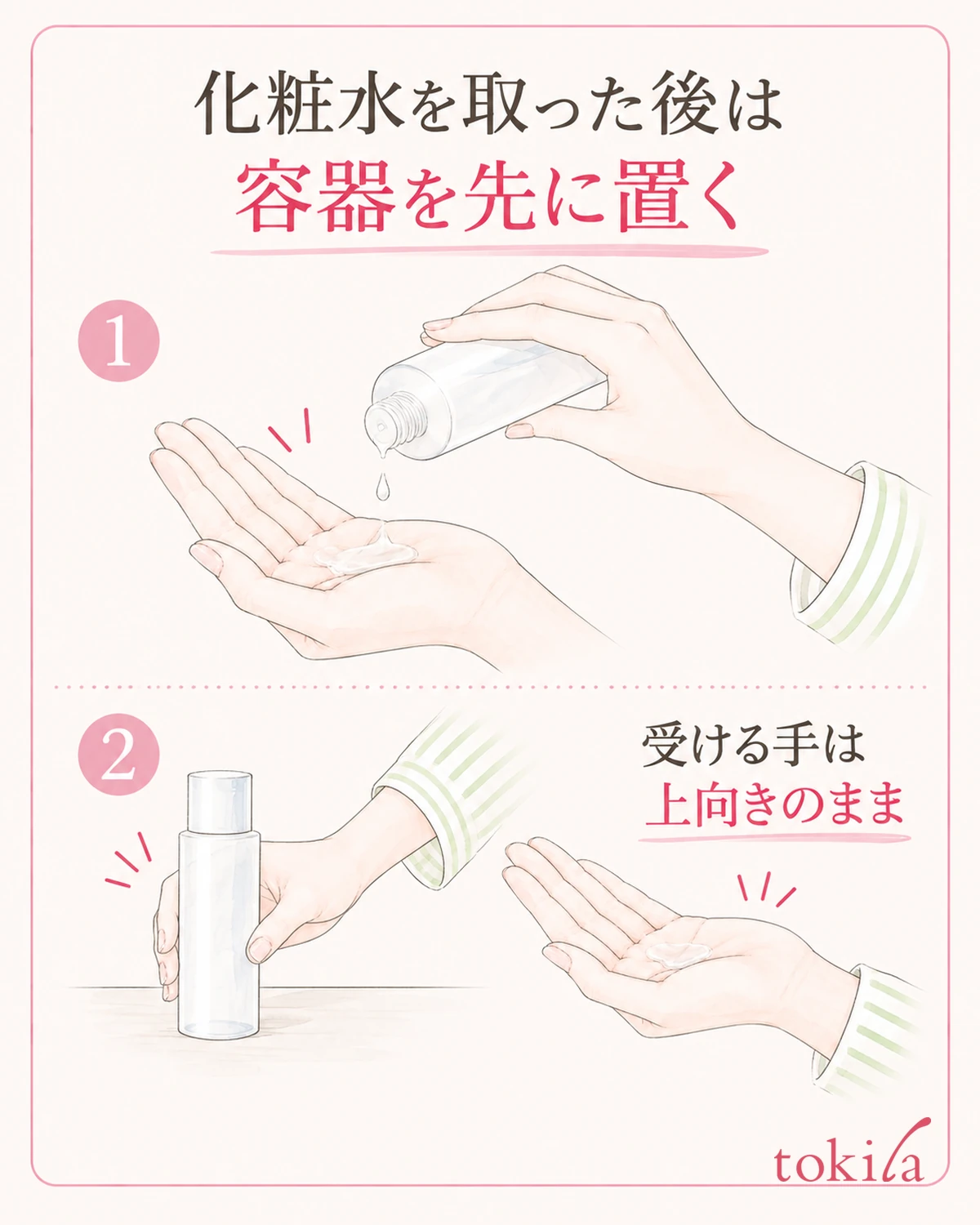
With a bottle type, look at the center of your receiving hand and then point the outlet. Do not press the mouth of the container against your hand; handle it at a position where the liquid falls into your hand. Instead of shaking it hard without watching how it comes out, dispense it the way your product specifies, and once you have the amount you need, return the container to its original orientation.
Even when it comes out poorly, do not widen the outlet with a needle or pull out the inner stopper on your own judgment. Check whether the cap or lock is opened correctly and whether the container's directions give an operating instruction. A lot may come out right after you squeeze hard, so before testing it near your face, go back and check how you dispense.
With a pump type, place your receiving hand under the spout and follow the indicated number of pumps and way of pressing. Do not treat a partial press as an exact half amount, and do not count many small presses as one. Also check that the nozzle is not pointing away from your hand and that the base does not move when you press the container.
After dispensing, set the container in a stable place. So that you do not have to search for the cap with one hand or put the bottle back on a distant shelf while liquid is in your hand, clear the spot to set it down beforehand. Avoid wet or tilted surfaces, and place the container so it will not tip over before moving on.
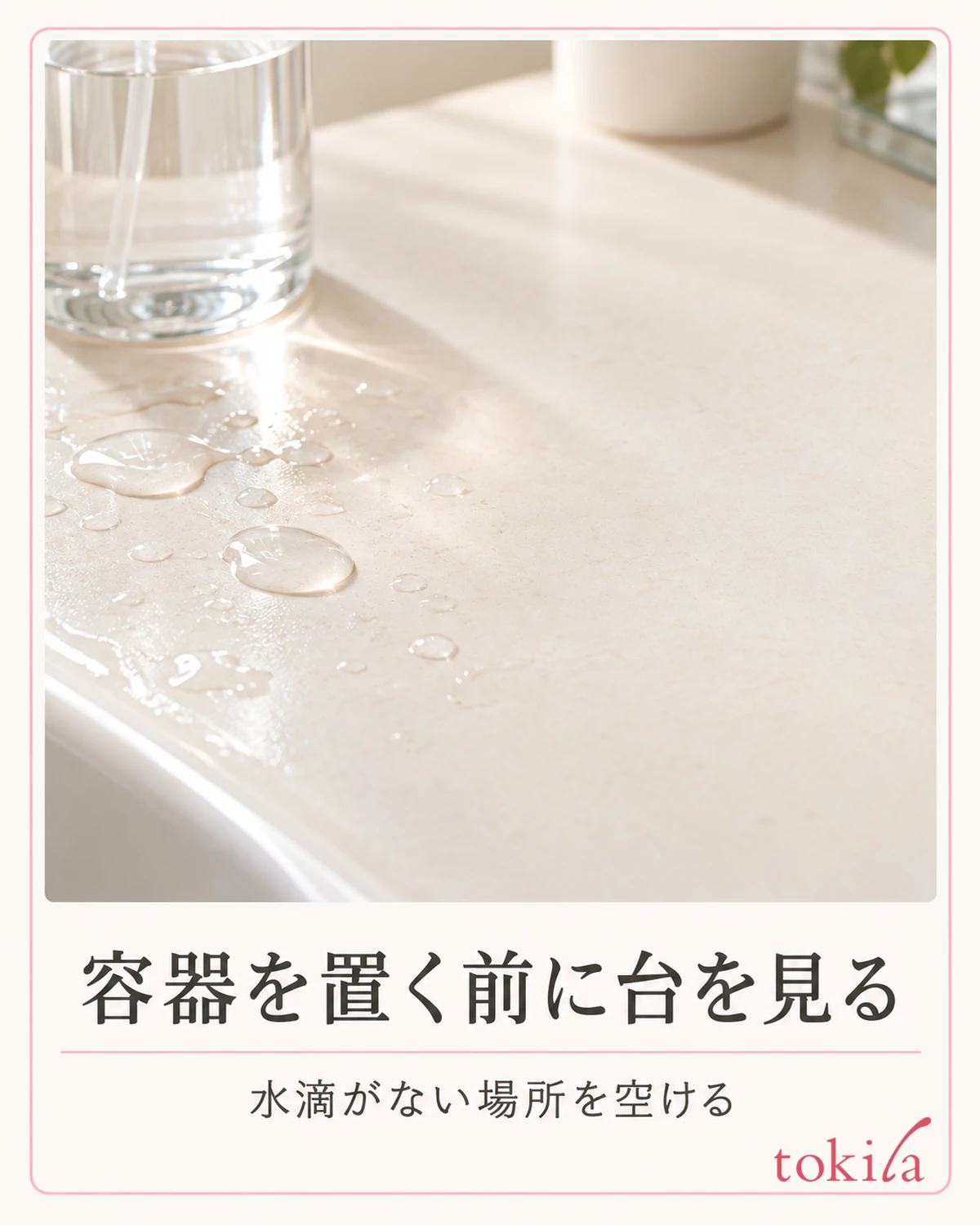
Another point to check is not tilting the hand that holds the liquid toward the container you are setting down. Move the hand that sets down the bottle and the receiving hand separately, and keep the receiving side facing up. If the desk is far, adjust your working position before stretching your whole body, and do not try to hurry the toner to your face in a strained posture.
4. Do not flip your hand over all at once; work the toner in with the fingers of your other hand
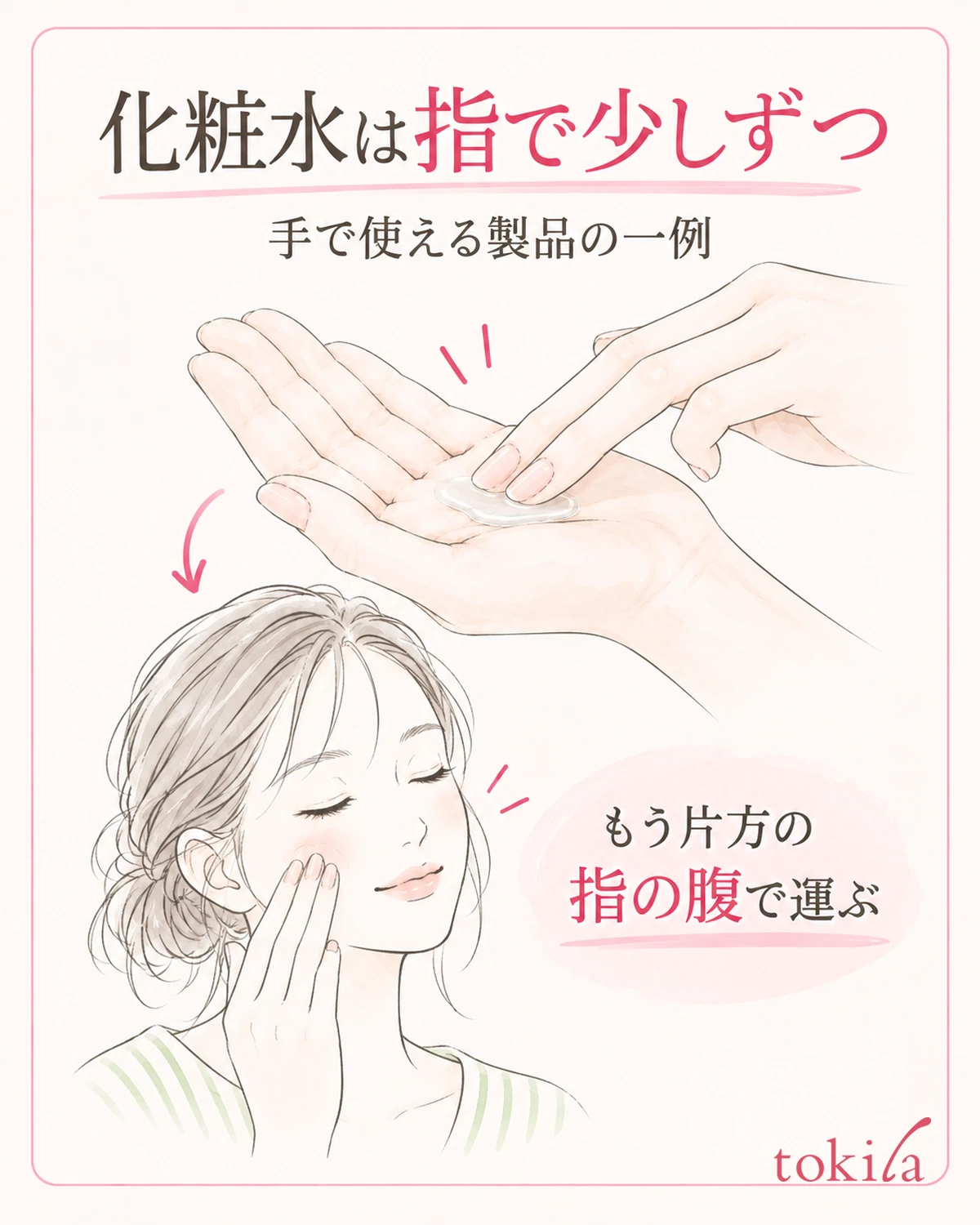
For a toner whose directions describe use by hand, there is a method of keeping the receiving hand palm up, moving the toner little by little onto the pad of a clean finger of the other hand, and working it into the face. If the liquid runs when you press both hands together with force while it is still in your palm, check your product's directions to see whether you can break this carrying movement into small steps.
If you take it with your fingers, use the pads rather than the nails, and spread it gently on the areas indicated, such as the cheeks and forehead. Reduce the big flipping movement of the hand just before you press it to your face, and carry only the amount you will use. The illustration is one example of the movement and not the instruction for every product. If a product directs you to spread it with both palms, follow that procedure first.
When you touch your skin, do not apply force that moves the skin a lot. Do not turn it into rubbing your cheeks repeatedly to chase the liquid that is running, or patting hard to work it in. Even when you lay your palms against the skin, bend your fingers softly to follow the shape of your face and touch lightly the area the product indicates.
Be careful around the eyes and mouth so the liquid does not run inward. Do not stretch the explanation of applying it to the whole face to mean applying it all the way to the edge of the eyelids or the inside of the lips. Read the instructions on the areas where it can be used, and if it gets into your eyes, follow the product's precautions. It is also important not to assume that irritation is only a problem of the amount or the shape of your hand.
When you finish working it in, take your hand away once. You do not need to judge the amount on your face only by the dry feel of your hand, or press for a long time until the liquid is no longer visible. After you finish the specified way of use, move on to the steps for the emulsion or cream you use next. Being able to carry it without spilling and the cosmetic's effect increasing are separate matters.
5. If you spill, do not recover it; decide which movement to change next time
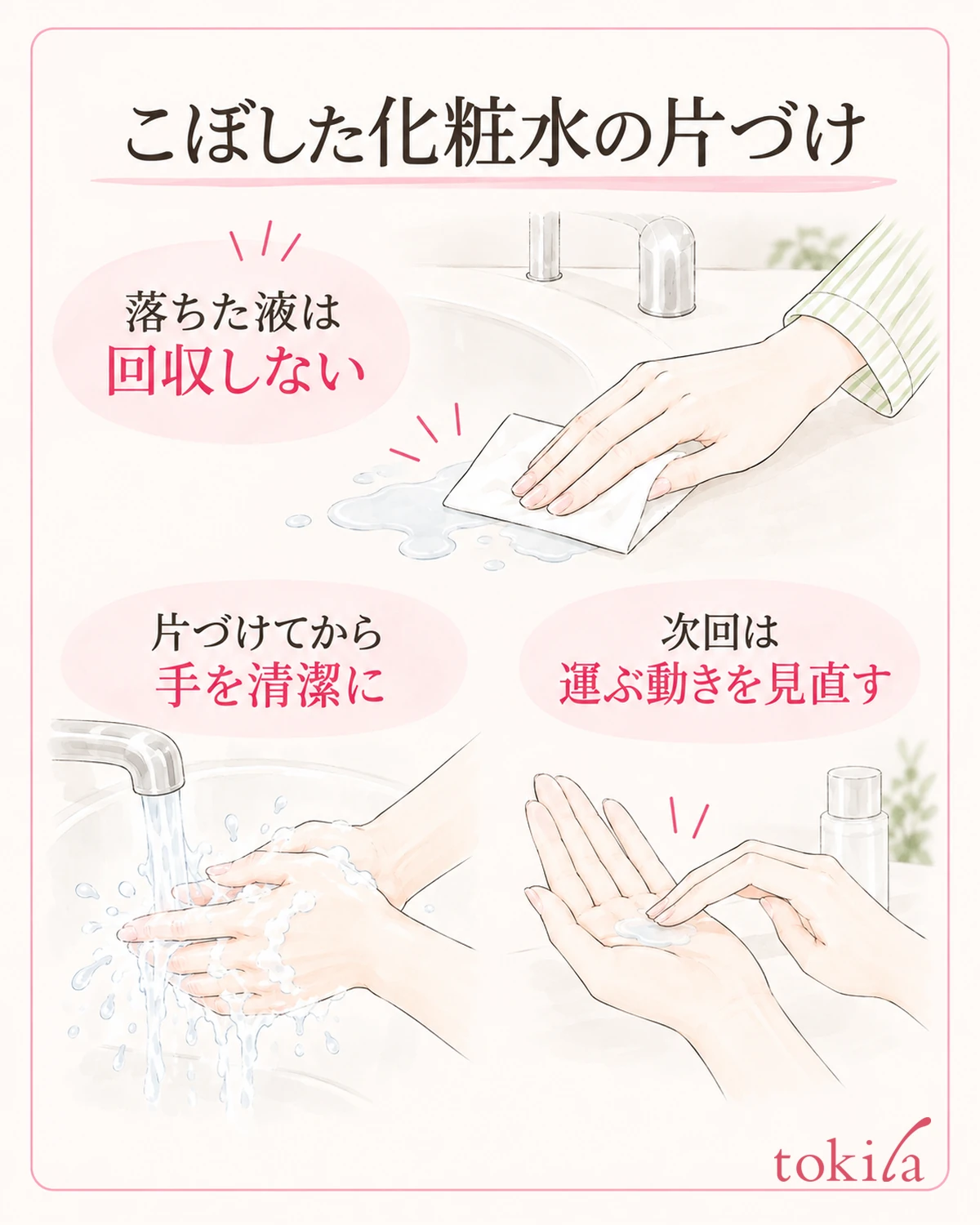
Liquid that has fallen on the sink or floor should be cleaned up, not scooped back up with your fingers and applied to your face. Do not return it to the container either. If you end up with leftover toner in your hand that you will not use, do not pour it back into the opening or store it in another empty container. Dispose of it according to the product's and your local area's guidance, and wipe up any slippery spots as well.
If there are instructions for caring for the mouth or nozzle, tidy it by that method and close the cap. Do not touch your face directly with a hand that has wiped the floor or touched dirty paper. After cleaning up, wash your hands before resuming, and if you cannot tell how far you have applied, do not recklessly add the whole amount again.
Next time, pick one movement from "when taking it," "after receiving it in your hand," and "when carrying it to your face" and review it. Decide something specific, such as aiming the outlet at the center, receiving it with your fingers together, or setting the container down before using the fingers of your other hand. If you also change the type of toner and the total amount at the same time, it becomes hard to trace which movement caused the spill.
If it spills every time, also check whether the container suits how easily your hand moves. If you use a pump or a replacement part, limit it to ones whose compatibility with that product and way of use you have confirmed. Do not transfer the liquid to another container just because of its thickness, or assume that turning it into a spray would let you use the same amount.
First read the specifications for the amount and the tool, receive the toner in an upturned hand, and carry it to your face after setting the container down. If you try this order calmly, you will find it easier to spot the movement where you stumble. If you are wondering how to handle taking too much cream, also check how to portion out a moisturizing cream you dispensed too much of, treating its conditions separately from those of a liquid toner.