Even when you add water, your cleansing oil doesn't turn as white as you expected. Do you feel it isn't emulsifying, and keep rubbing your face round and round? Before chasing whiteness, check whether the oil you have needs an emulsifying step at all.
Some oil-type cleansers have you add a small amount of water after working them into your makeup, and others are simply rinsed off as they are. Here we divide the checks for using a rinse-off cleansing oil into five. Don't judge whether it has cleansed by color alone; sort out the order in the directions, the water on your hands and face, how you work it in, and the rinsing. For wipe-off products, balms, and milks, please check how each of them is used.
1. Before chasing whiteness, check whether the product needs emulsifying
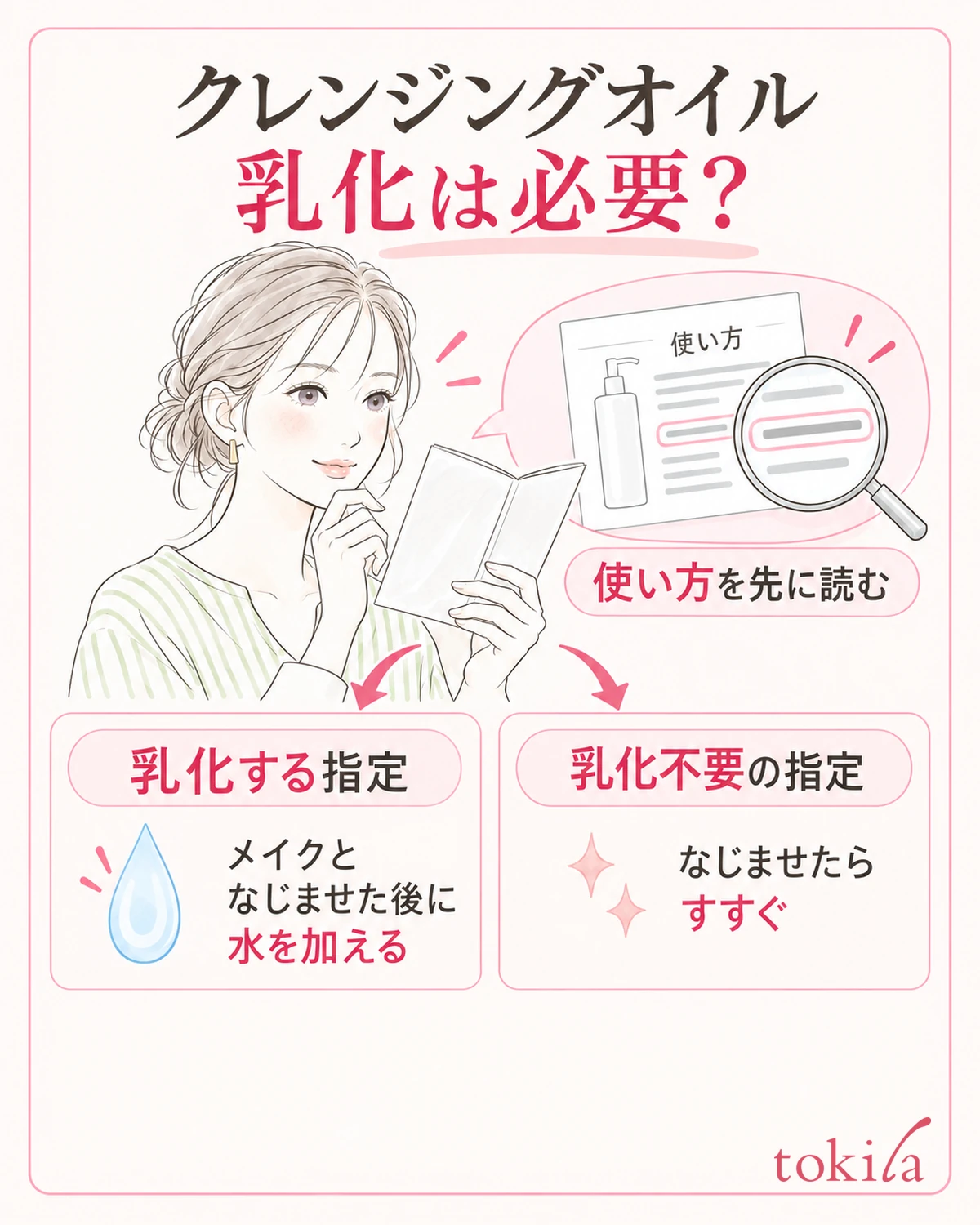
First, read the "Directions" on the container or outer box and look for the sentence that comes after working it into your makeup. If it says "add a small amount of water and work it in" or "make it cloudy white before rinsing off," it is a product with that step. On the other hand, for a product described as "no emulsifying needed," don't add a whitening step; work it in as specified and rinse.
Emulsifying here means the step of blending cleansing oil with water. Some products use the milky cloudiness as a guide, but it is not a task meant to make every oil the same shade of white. Don't link the two by thinking that near-transparent means failure, or that pure white means it has surely come off.
Even if you can't find the word emulsify in the directions, there is no need to decide right away that it isn't needed. Read whether the step of adding water is written in some other way. If you can't confirm how to use it, check the procedure before experimenting on your face. It is important not to add steps to match a video about a different product.
If you have two bottles on hand, check each one separately. The shape of the pump, the color of the liquid, or simply being called the same kind of oil does not mean the directions are the same. After you switch to a new product, set aside the way of adding water and the waiting time that you learned with the previous bottle, and build the order from the new directions.
If you are already working it into your face, don't keep adding fresh oil just to make it turn white. Once you know which steps are needed, move on to the rinsing for that product. There is no need to leave it on your skin for a long time just to check the whiteness.
2. Match the water on your hands and face and the amount you use before starting
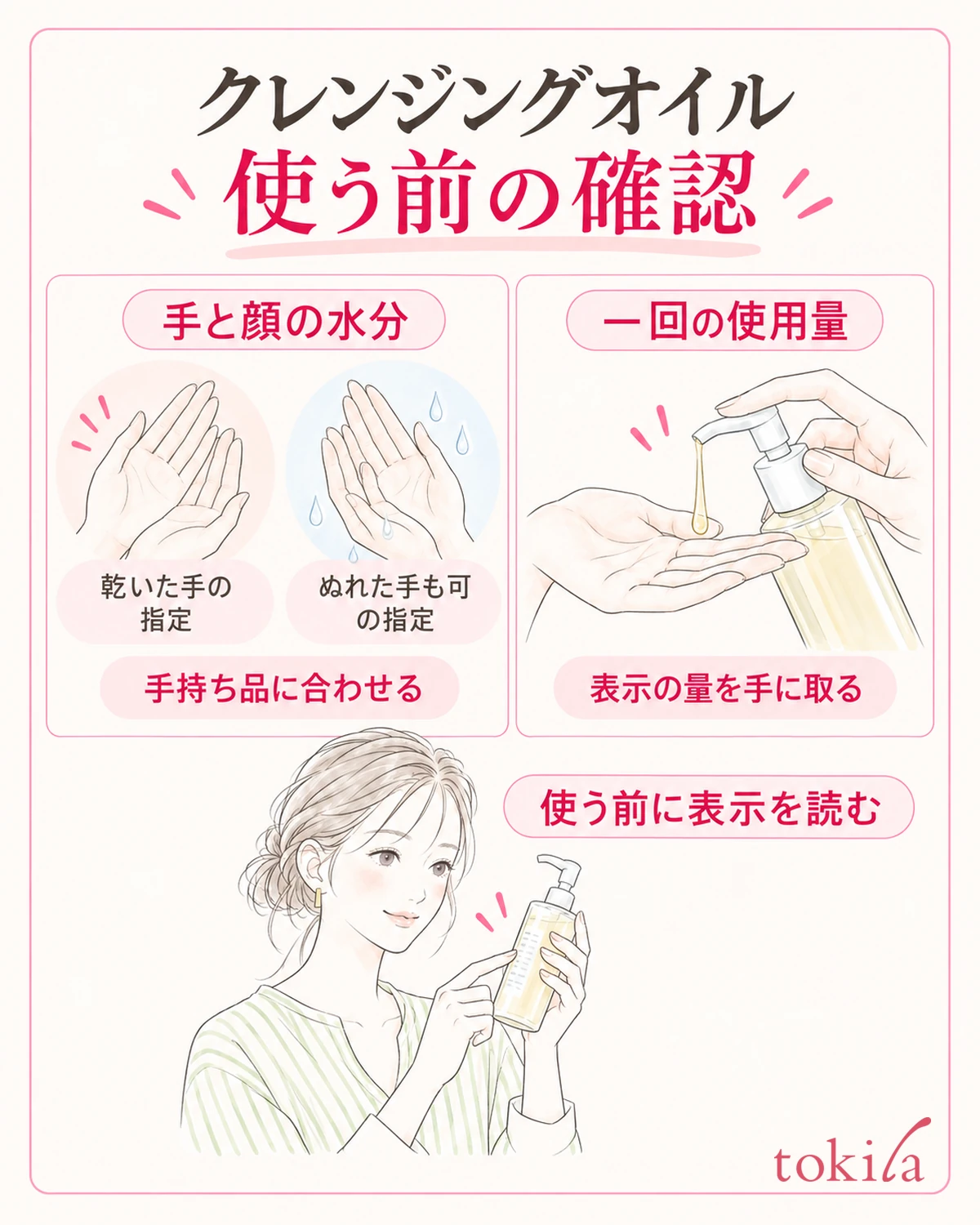
The next time you use it, check the conditions of your hands and face before dispensing the oil. For a product that specifies "dry hands," wipe off the water droplets after washing your hands before you take it. Some products "can also be used with wet hands," but don't carry that specification over to another oil. Whether it can be used in the bath and whether you wet your face before using it do not necessarily mean the same thing.
If it is specified for use on a dry face, follow that condition. Don't assume that wiping only your hands is enough and leave water droplets on your face. On the other hand, you don't need to rub hard with a towel for a product that can be used on wet skin just because you're worried about failing. If you are going to wipe off the water, you can also check how to press a towel against your face without rubbing.
If the liquid already looks white in your palm before you use it, it does not mean that emulsifying on your face is finished. For a product used with dry hands, check the water conditions before taking it out next time. Instead of adding more oil on the spot to restore its thickness, go back to how the product you are using is meant to be handled.
Base the amount on the single-use amount of your current product. The amount in one pump differs from container to container, so don't match the number of pumps to your previous product. Don't increase or decrease it your own way, thinking that less is gentler on skin or that more turns white more easily; first get to a state where you can use the specified amount.
Also read what kind of makeup you are removing. First check whether a special remover is specified for things like waterproof eye makeup or long-wearing lipstick. Don't try to solve makeup that comes off differently by rubbing for a long time with an all-over-face oil.
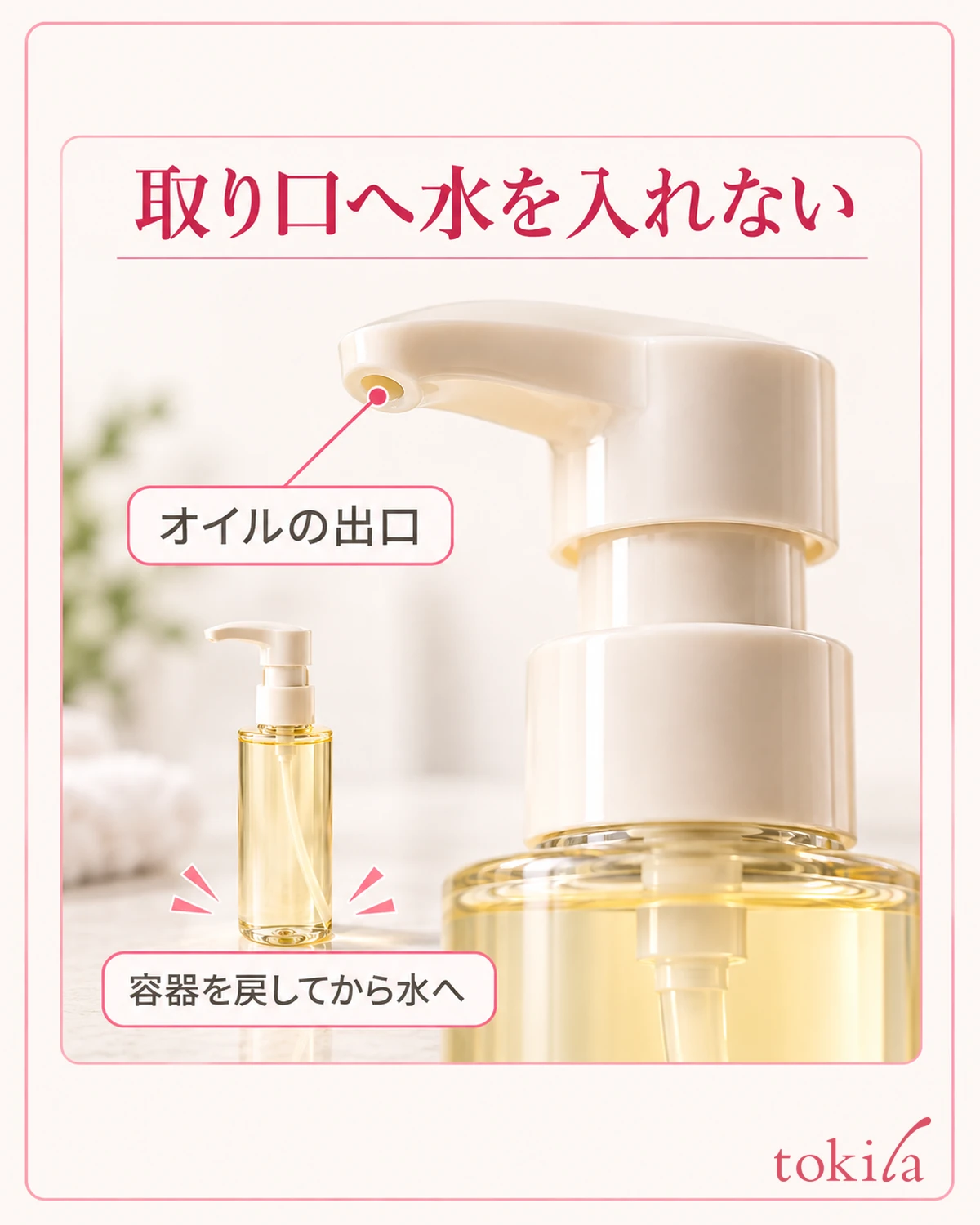
What you look at in the preparation stage is the water on your hands, the water on your face, the amount for one use, and the makeup you are removing. If you add water while holding the container, water can get into the spout or the contents, so once you have taken the oil, put the container back in a stable place. Add water only at the step and place shown in the directions.
3. If it is specified to emulsify, add a small amount of water after working it in
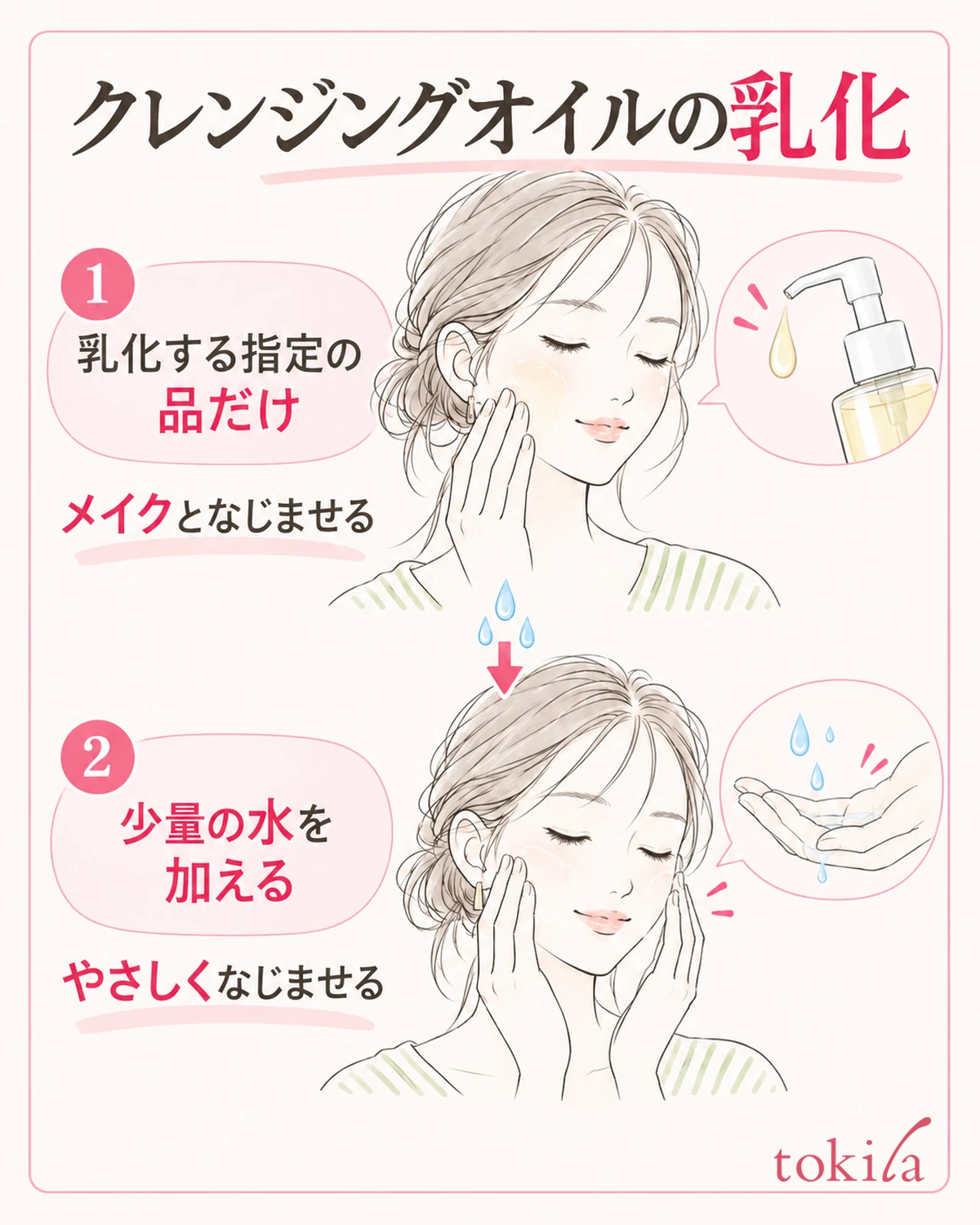
For a product that is emulsified, don't mix water and oil in your palm from the start; use it in the order specified. First spread the oil gently over your face and work it into your makeup. There is no need to press your fingers into the skin or to look for each pore and rub it hard.
If you are next told to add a small amount of water or lukewarm water, work the water you scooped into the oil on your face. Keep the motion of pouring a large amount of water suddenly separate from the motion of adding a small amount and working it in. If a specific way or number of times to add it is given, follow that guidance first.
The white areas in the diagram are a schematic way of explaining the emulsifying step. The goal is not for it to become so white that your skin color doesn't show through, or for left and right to be equally white. It is also different from a foaming face wash, so don't turn it into continuing to move your fingers until bubbles form.
When working it in, use the pads of your fingers and cut down on rubbing the same spot back and forth many times. Keep the liquid from running into your eyes or mouth, and follow the product's precautions for using it near the edge of your eyes. If you have eyelash extensions or false lashes, also check the conditions for adhesives that can be used and the order in which to remove them.
Even if it seems hard to turn white, stop for a moment before adding force or time. Review the amount you used, whether you worked it into your makeup first, and whether this is a product with a step for adding water. There is no need to pin down a single cause on the spot. Once you have done the specified steps, switch from the whitening step to rinsing.
4. Don't decide when you are done rinsing by whiteness or the number of rinses alone
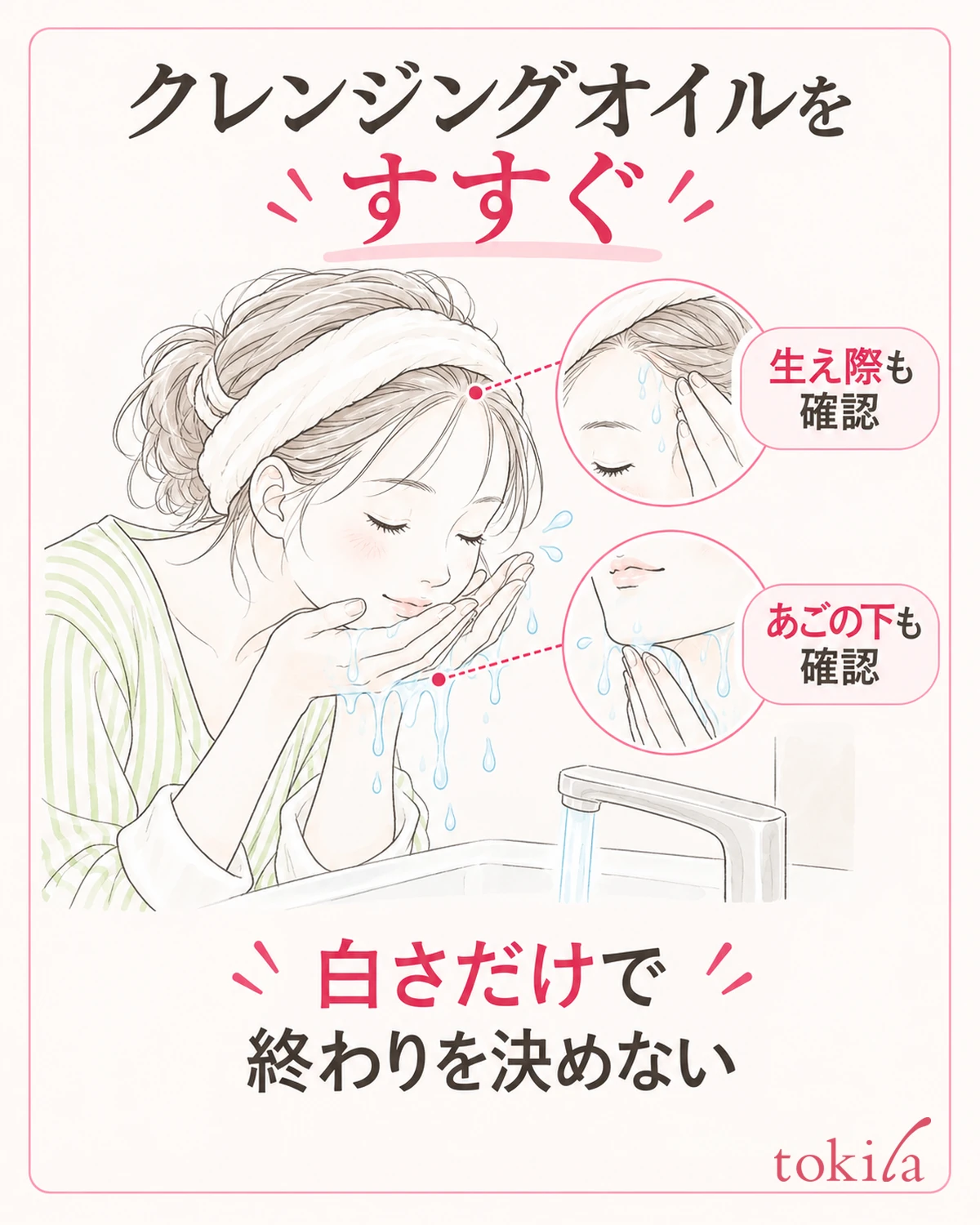
Whether or not you emulsify, finish by rinsing well with the product's method. Follow the specification of water or lukewarm water, and don't try to wash it off all at once with hot water or strong water pressure. If the number of rinses is written, treat it as the instruction for that product, and don't replace it with a number common to all oils.
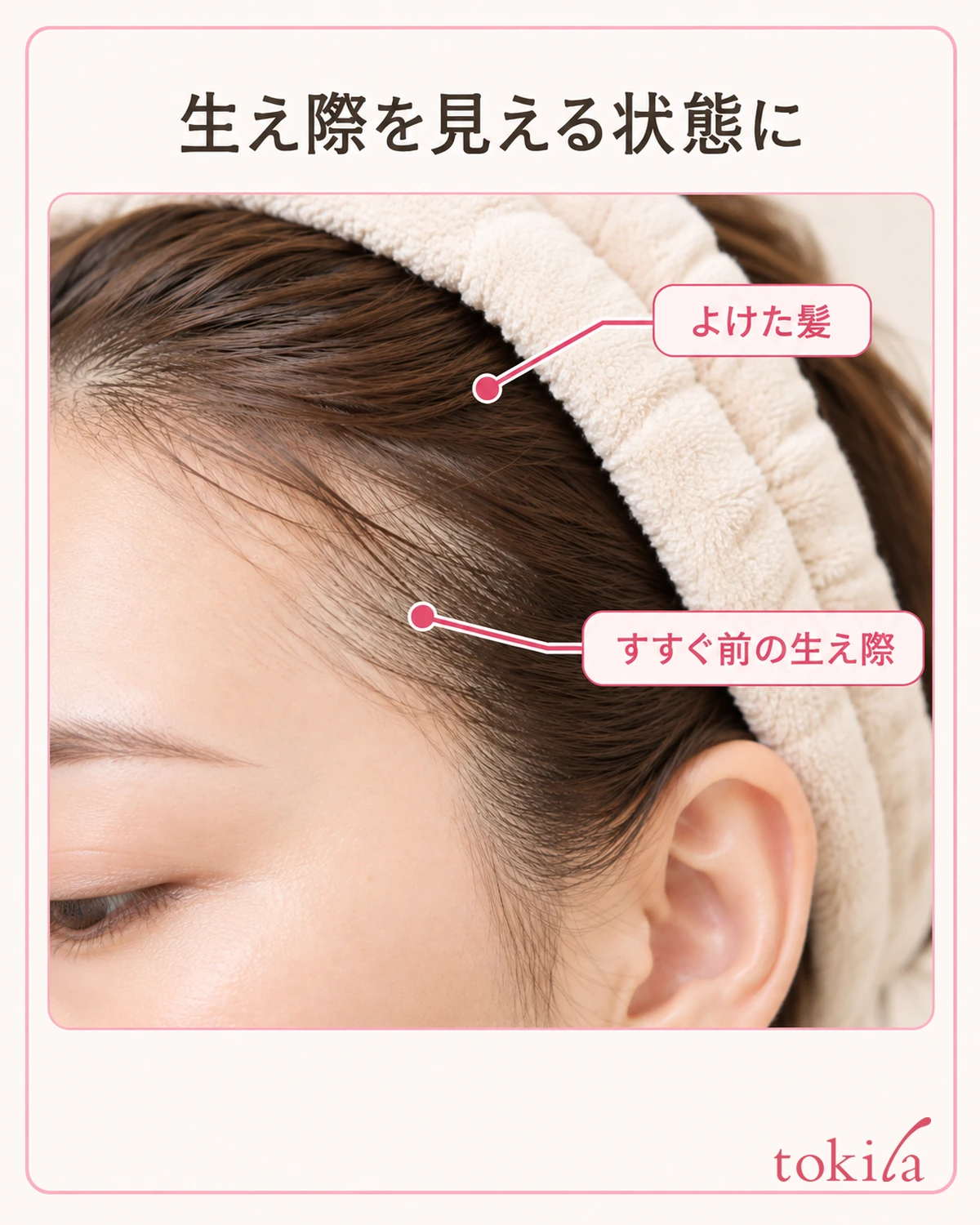
If you keep your hair away from your face, it is easier to check the hairline, in front of the ears, and under the chin. Don't stop after splashing water only on your cheeks; review the whole area you worked the product into. If you have trouble keeping your hair out of the way, see where to put a face-washing headband and how to tuck your hair away.
Don't decide by a single sensation, such as thinking it is clean if your fingers squeak to a stop, or that it hasn't all come off because it still feels a bit slippery. If a film-like residue or leftover color bothers you, check whether there are places you haven't rinsed yet and whether the product was suited to your makeup. Don't judge by scratching with your nails or wiping hard with a towel.
If color on hard-to-remove eye makeup remains, before repeating cleansing of your whole face including your cheeks, check the area and the cleansing method you can use. If it gets into your eyes, follow the product's precautions, and don't keep going in order to finish the look. If pain or a feeling of something foreign remains, please consult a medical institution.
When you move on to rinsing, take your working hands off for a moment and switch to the motion of receiving water. If you keep stroking your cheeks while comparing the whiteness in the mirror, the step of moving the oil around gets long even though you think you are rinsing. Be aware of where the steps in the directions divide, and bring the rinsing water to each part of your face.
Whether you need a face wash after rinsing also differs by product. No emulsifying needed and no double cleansing needed are separate conditions. Don't decide that you must add a face wash because it didn't emulsify, or skip the face wash because it is an oil; read the steps through to what comes after use.
5. Next time, record the one step you changed rather than the whiteness
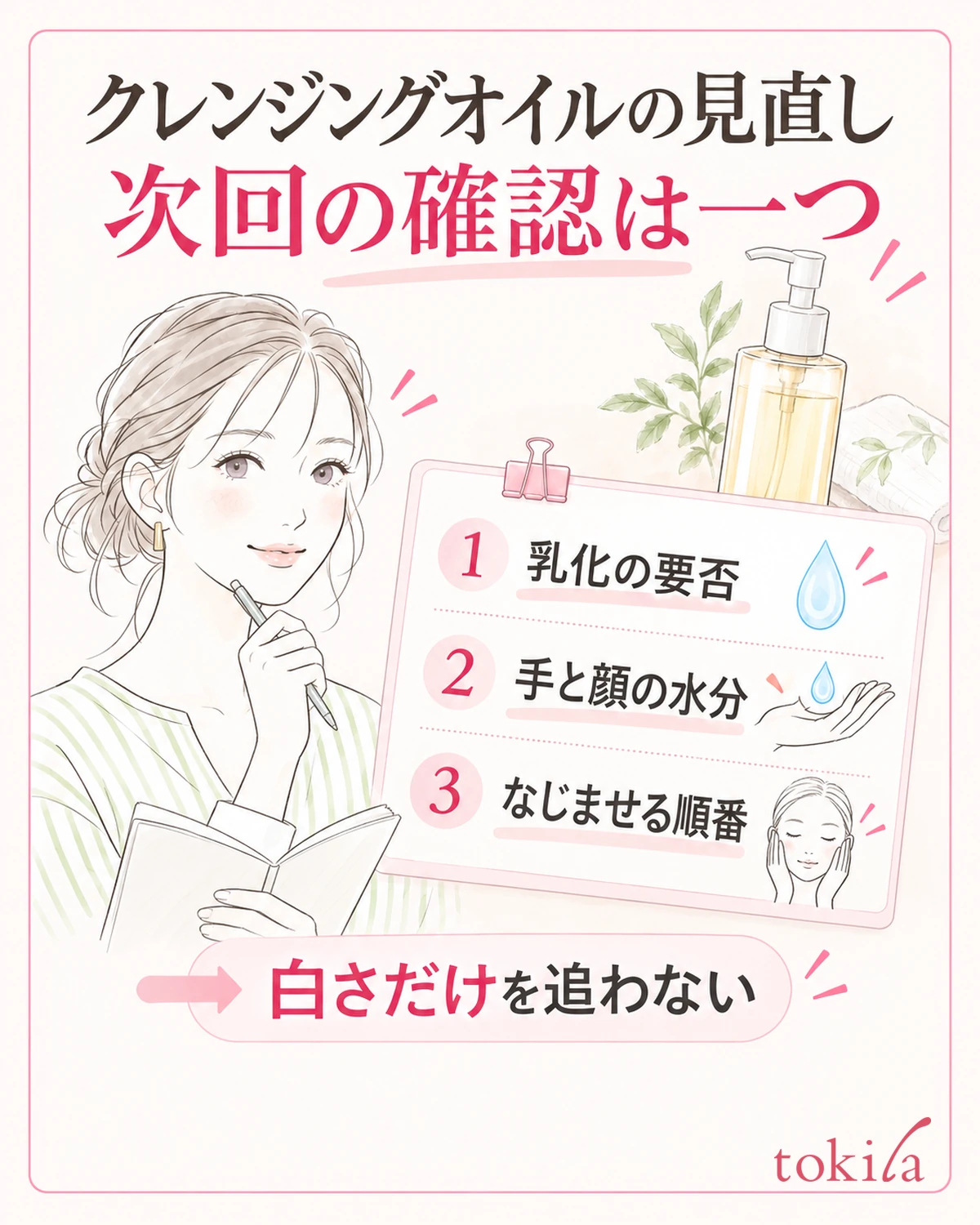
When you finish using it, sort out which kind of trouble you had: "it didn't turn cloudy even after adding water," "color remained after rinsing," or "I felt irritation while working it in." If you lump all of these together as "emulsifying failed," you can no longer see which step to fix next. Think of whiteness, makeup left behind, and abnormalities of the skin as separate.
Narrow what you check next time down to one. If you had overlooked the dry-hands specification, write "wipe the water off my hands before taking the oil"; if the order of emulsifying was wrong, write "add water after working it into my makeup," that is, an action tied to the product's directions. Don't use a record of how many minutes you kept going until it turned white as the standard for success.
Also keep the product name in the record. This is so that the notes for a bottle that needed emulsifying and one that didn't do not get mixed up. A newly bought product will not necessarily follow the same order, so treat your notes not as a substitute for the directions but as a cue for remembering where to reread.
If it still feels hard to handle under the same conditions, review how well the type of makeup matches the way of removing it. Rather than changing the amount, the order of use, and the condition of your skin all at once, sorting out where you have trouble makes it easier to compare with the product's explanation. Please do not add face wash or water to the bottle on your own, or mix in another oil.
If you have redness, itching, or pain, don't turn it into an experiment of continuing to use it while changing the steps. Stop according to the product's precautions for use, and if the abnormality continues, consult a medical institution. Move away from the thinking that "it's fine as long as it emulsifies" and put the condition of your skin first.
You can start checking your cleansing by reading each product's steps. Check whether emulsifying is needed, match the water on your hands and face, work it in and rinse in the specified order. Not chasing only whiteness, and choosing the steps your current bottle needs, is the basic way to use it without hesitation.