You want to pin up your hair with a kanzashi, but you can't tell how to fasten it with the single pin you have. You copy a photo, yet the shape and ornament are different, so you can't repeat the same motion. In that case, before looking for how to insert it, separate "is it something to gather the hair?" from "is it something to decorate finished hair?" This helps you organize how to choose.
This article is a guide to choosing a kanzashi with a shaft that goes into the hair, based on its purpose and structure. It does not show a rotation direction or insertion angle that applies to every kanzashi. In addition to whether it has one prong or two, check the instructions for the piece you own, the hairstyle you want to match, and where to hold it, and look for a combination you can use comfortably.
1. First decide: "gathering" or "decorating"
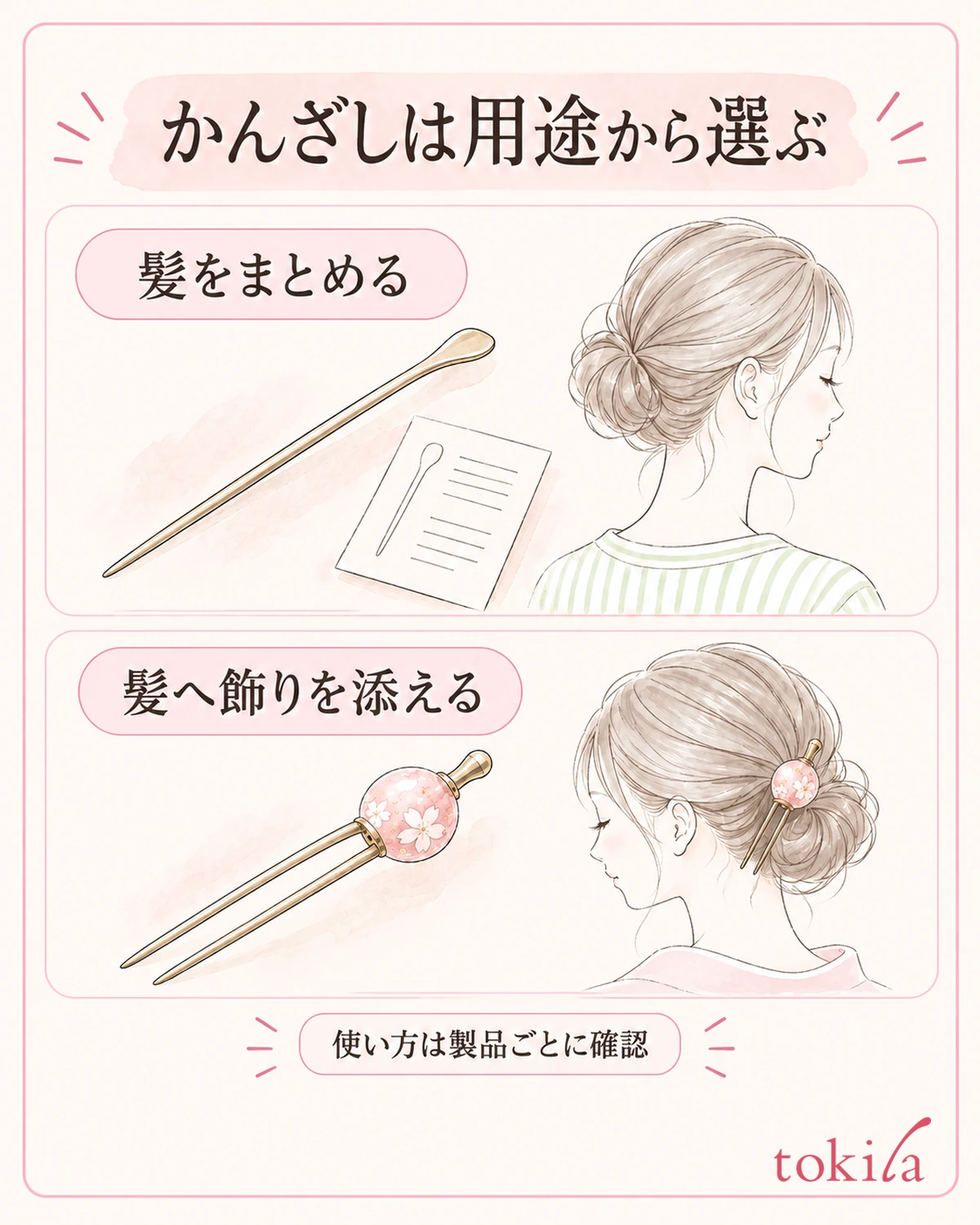
First, put into words the role you want the kanzashi to play. Do you want to gather a section of hair to create a hairstyle, or add an ornament to hair already finished with an elastic or pins? Separate these two before reading the intended use in the product description. Even if you like the look, it may not work for the role you have in mind.
If it is for gathering, look at the usage examples to see how the hair is held. Check whether the method uses only the kanzashi, whether you first tie the hair with an elastic, and whether other fasteners are needed. It is important not to read "use it alone" as meaning no additional tools are required.
If it is for decoration, think together about the hairstyle you will make first. Whether you add a small bead ornament to a low bun, or show a large ornament on top of gathered hair, changes the base you prepare and the position you want to show. Do not count on the ornament to hold the style again; compare with the finished example in the instructions.
When comparing before buying, gather not only the front photo of the product but also the back and the usage examples. If you plan to add an ornament to your current hairstyle, look for an example of it being inserted into that kind of finished hair. If there is no information on how to fasten it and only the size of the ornament is clear, keep it as a candidate for looks, and decide that it is usable only after checking the instructions.
If you are unsure, narrow it down to one occasion, such as "I want to add an ornament to my usual updo." If you look separately at how glamorous the photo is, how it fastens, and what preparation is needed, you can ask specific questions in the shop about whatever is still unclear. You don't have to solve the skill of making the hairstyle and the pleasure of choosing an ornament all at once.
If you are using something you already own, look for the backing card or instructions from when you bought it. Even if you find a different product with a similar shape, do not treat that alone as the instructions for your own piece. Rather than trying it without knowing its use, matching the product name, the overall form, and the shape of the shaft lets you narrow down what information you need next.
2. Look at how the shaft connects to the ornament, not just the number of prongs
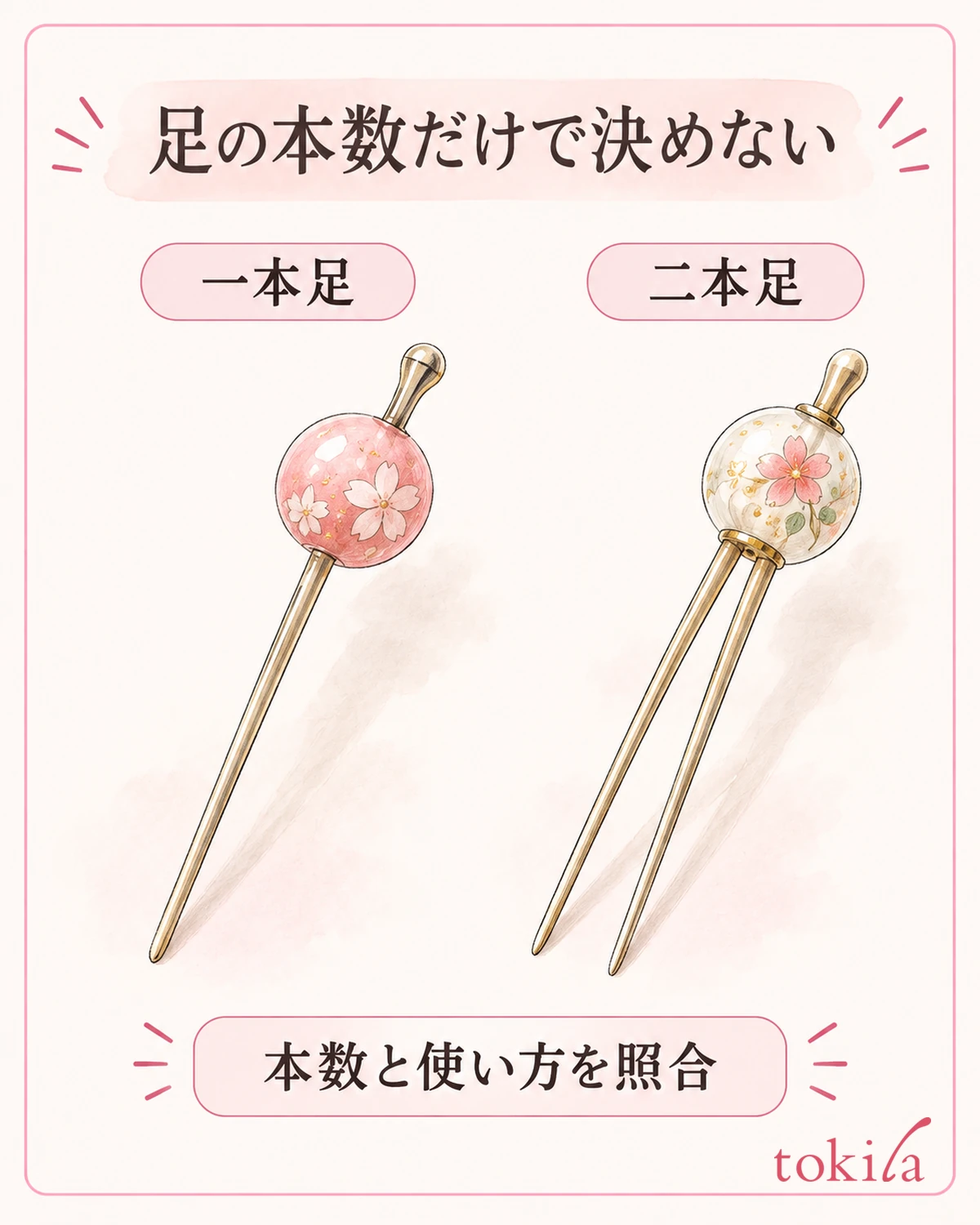
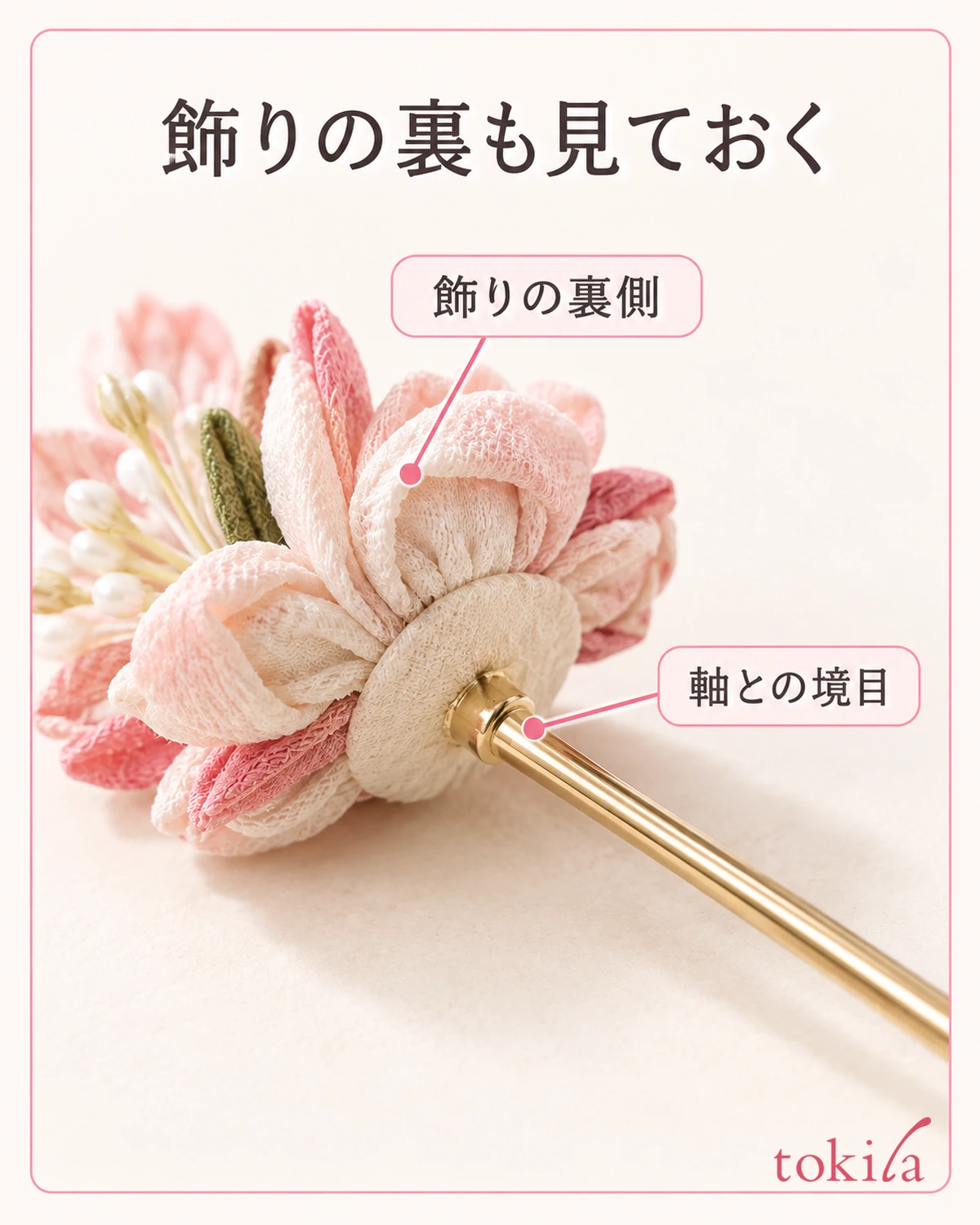
Place it on a desk away from your hair and look at its shape from the ornament to the tip. Is it a single shaft, or split into two? Is the shaft straight, or does it have a curve? Check not only the ornament on the front but also the joint as seen from the back. Understand the part that goes into the hair separately from the part that is shown.
A one-prong kanzashi can be used to wind and gather hair, or inserted into finished hair. However, this does not mean that any one-prong kanzashi can be twisted hard. Materials, shaft lengths, and the way ornaments are attached all differ. Check against the instructions which use your piece is designed for.
Two-prong kanzashi also include those for decorating finished hair and those that, by that product's method, are used to hold an updo. Try not to decide across the board that "it has two prongs, so it's only for decoration" or "it's metal, so it can be turned to fasten." The number of prongs is a clue for identifying the tool, not the answer to how to fasten it.
Also look with your eyes at the shape where the tip of the shaft tapers, the gloss of the surface, and any step at the base. Change the light and trace the outline, and if you notice anything such as a chip, a bend, or a lifted joint, refrain from using it. There is no need to test its strength by pressing it against your fingers or scalp. Do not try to bend it back into shape on your own judgment either.
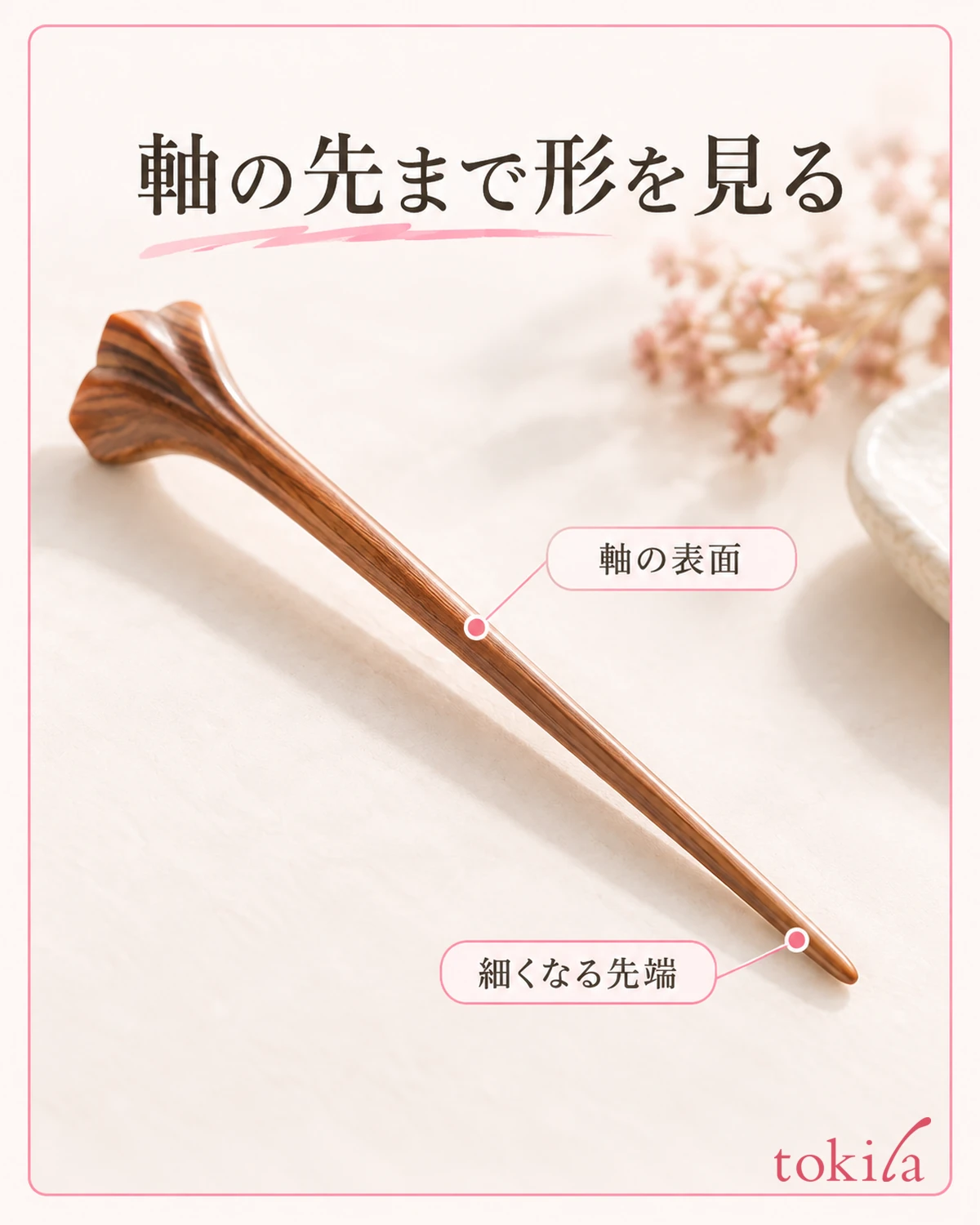
Also distinguish the length that goes into the hair from the total length including the ornament. If the product lists dimensions, check what is measured from where to where. Even with the same total length, a different ornament size changes how the shaft looks. Do not assume that dimensions alone guarantee how well it stays or how much hair suits you.
3. Check the way to make the hairstyle and the tools used against the instructions
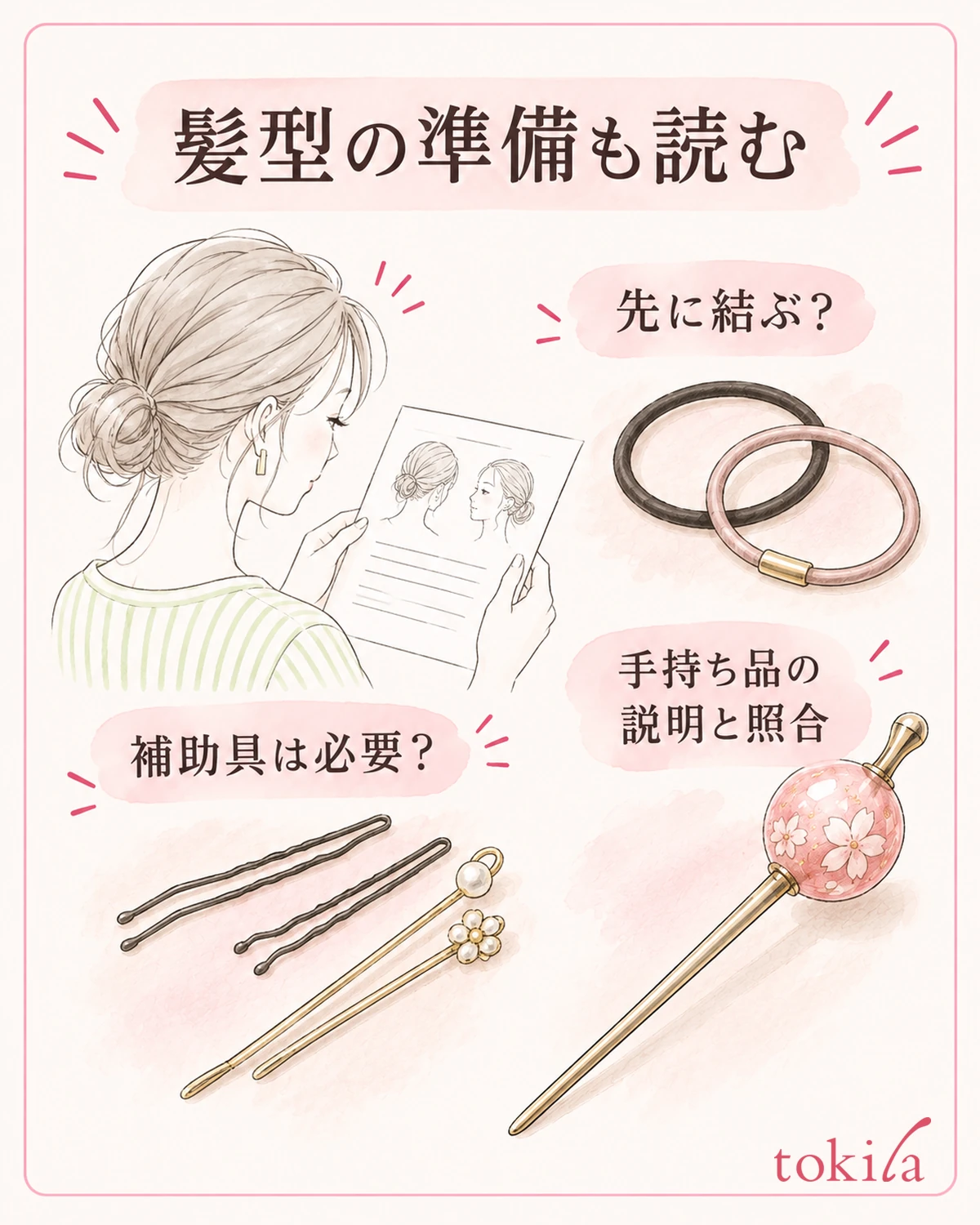
Once you have chosen a photo of the hairstyle you want, go back and read from the first step. Does it start after tying the hair, does it twist a section of hair, or is the shape already made with pins? If you check the preparation that does not appear in the finished photo, it becomes easier to judge whether you can follow the same method with the tools you have.
If conditions on hair length or amount are written, check that range. If the ends do not reach the base, do not try to make up for it by pressing hard with the kanzashi. Keep the option of switching to a different hairstyle if the length is not enough, or to the method your own piece is explained for if the amount of hair to gather is different.
In the photos of the instructions, first check whether the person is shown from behind or from the front so that you do not misread left and right or front and back. It does not always look like the same left and right as yourself in a mirror. Rather than memorizing only the arrows, check against the text which hand supports the hair and which side of the shaft you hold, and check any movement you don't understand while the piece is away from your hair.
Do not replace the tool in the instructions with a different kanzashi that merely has a similar shape. The movement differs between a method that turns the shaft and one that simply inserts it. Even among two-prong kanzashi, some cannot adjust their direction. If you lose track of the steps partway through, do not keep turning it while it is in your hair; take it out for the time being and go over the diagram again.
If the instructions use an elastic or pins, also check their types and the order. Do not assume that adding a kanzashi will fix a loose knot or a pin that has lifted. If the ends of the bun itself will not stay in, first review how to tidy ends that stick out of a bun.
When you practice, set aside time to look at your hands and hairstyle in a mirror. If you note specifically where you got stuck in the instructions, such as "I don't know how much hair to scoop up" or "I lose track of the front and back of the ornament," what to ask next becomes clear. Do not try increasing the force, adding styling product, and turning in a different direction all at once.
4. Decide the direction of the ornament and where it shows against your clothes
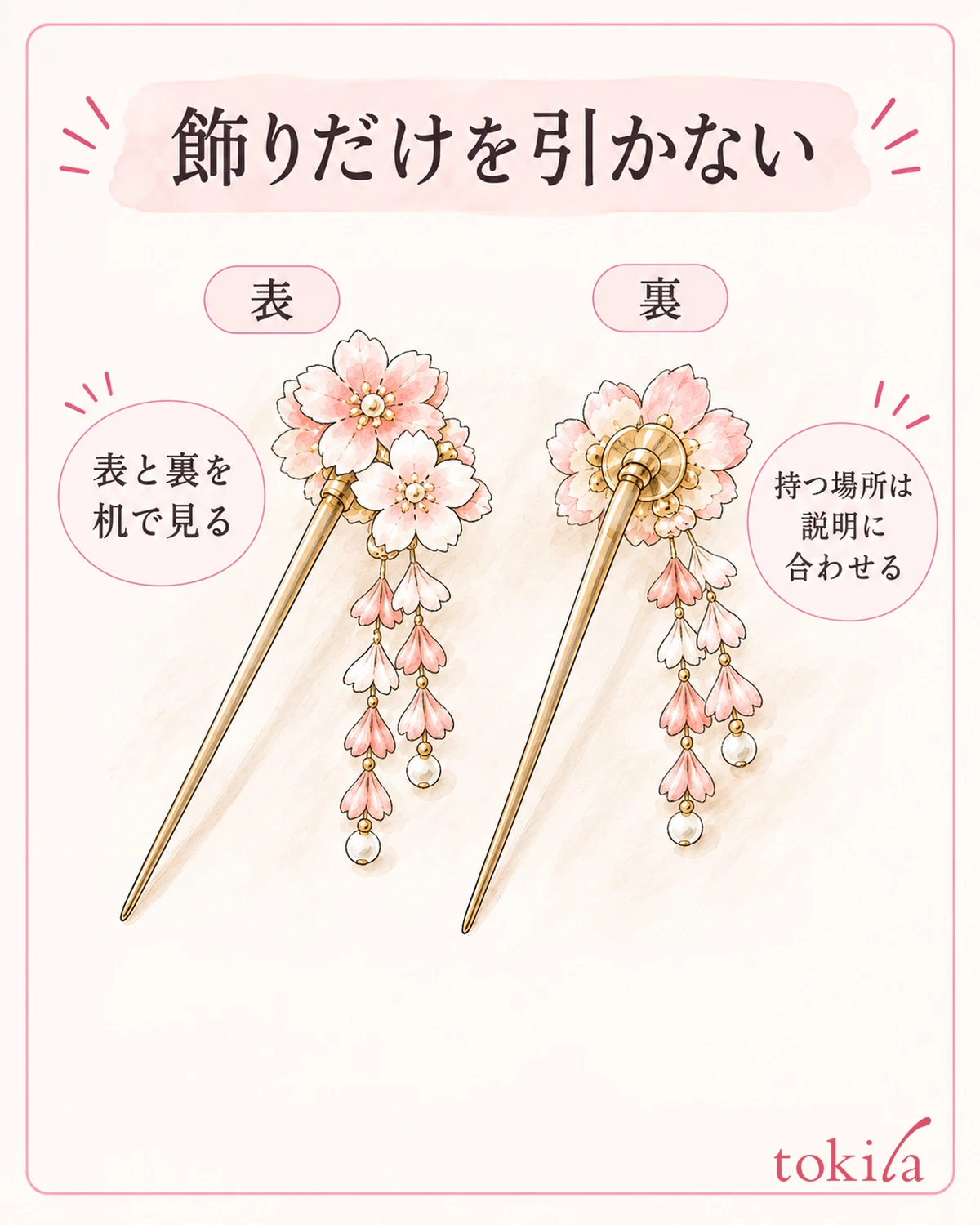
Once you know the use and how to fasten it, think about the direction in which you want the ornament to show. Look away from your hair at the front of a bead or flower, the direction of a hanging ornament, and how the decoration connects to the shaft. Do not try to twist only the ornament to face forward after inserting it into your hair. Check beforehand whether it is designed so that its direction can be changed.
When handling a piece with an ornament, support the part the instructions indicate for holding. Do not pull on petals, thin chains, or hanging parts as if they were handles. At the stage of checking the front and back on a desk, you can turn it by holding the shaft side without pulling on the ornament, and see what is on the back.
In the mirror, look not only from behind but also from the side. Even if you like the whole kanzashi, in practice some parts go into the hair and are hidden. Instead of fastening it shallowly or forcing the shaft to stick out in order to show every ornament, choose a visible position within the range where it stays as described in the instructions.
When matching it with clothes, compare while including neighboring items such as the height of the collar, glasses, and accessories at your ears. You could also enjoy it with everyday clothes rather than limiting it to days you wear Japanese dress, but you do not need to settle on a single size or color that suits you. Choose according to whether you want the ornament to stand out or blend into your clothes.
Once the position of the gathered hair and the position of the ornament are decided, return to your usual posture. If it touches your clothes or accessories, pulls your hair, or the shaft presses against you, take it off and reconsider the combination before going out in that state. Do not decide to adopt it on looks alone; also check that you can handle it comfortably.
At the stage of choosing a color, you can also place your clothes and the ornament side by side and look at them. For example, with a plain collar and a small bead ornament, compare a combination of close colors with one of distant colors, and choose the impression you want to enjoy. Because lighting also changes the reflection of metal, do not decide from the color in a single photo; imagine the clothes and light of the day you will wear it.
5. What to do when you can't use it, and what to check before putting it away
If you look into how to use it and still can't judge, don't force yourself to finish the style. If you gather the name of your piece, photos of the whole and the back, the hairstyle you want, and the step you are unsure about, it becomes easier to ask for the information you need. Rather than just "it doesn't stay in," telling them which role you want to use it for is the starting point.
If you feel pain or a strong catch partway through, stop pushing. Do not turn it when you can't see the shaft, or grab the ornament and pull it out in one go; check how to remove your piece. If you can't see the state of it yourself, ask someone to help, and avoid repeated attempts while the hair is tangled.
After use, check the shaft and ornament on a desk. How to deal with hair or dirt on it depends on the combination of material, such as wood, metal, or resin, and the decoration. Even if a metal shaft is visible, it is not necessarily fine to soak the flowers or glued parts in water. Avoid washing or heating that is not in the care label.
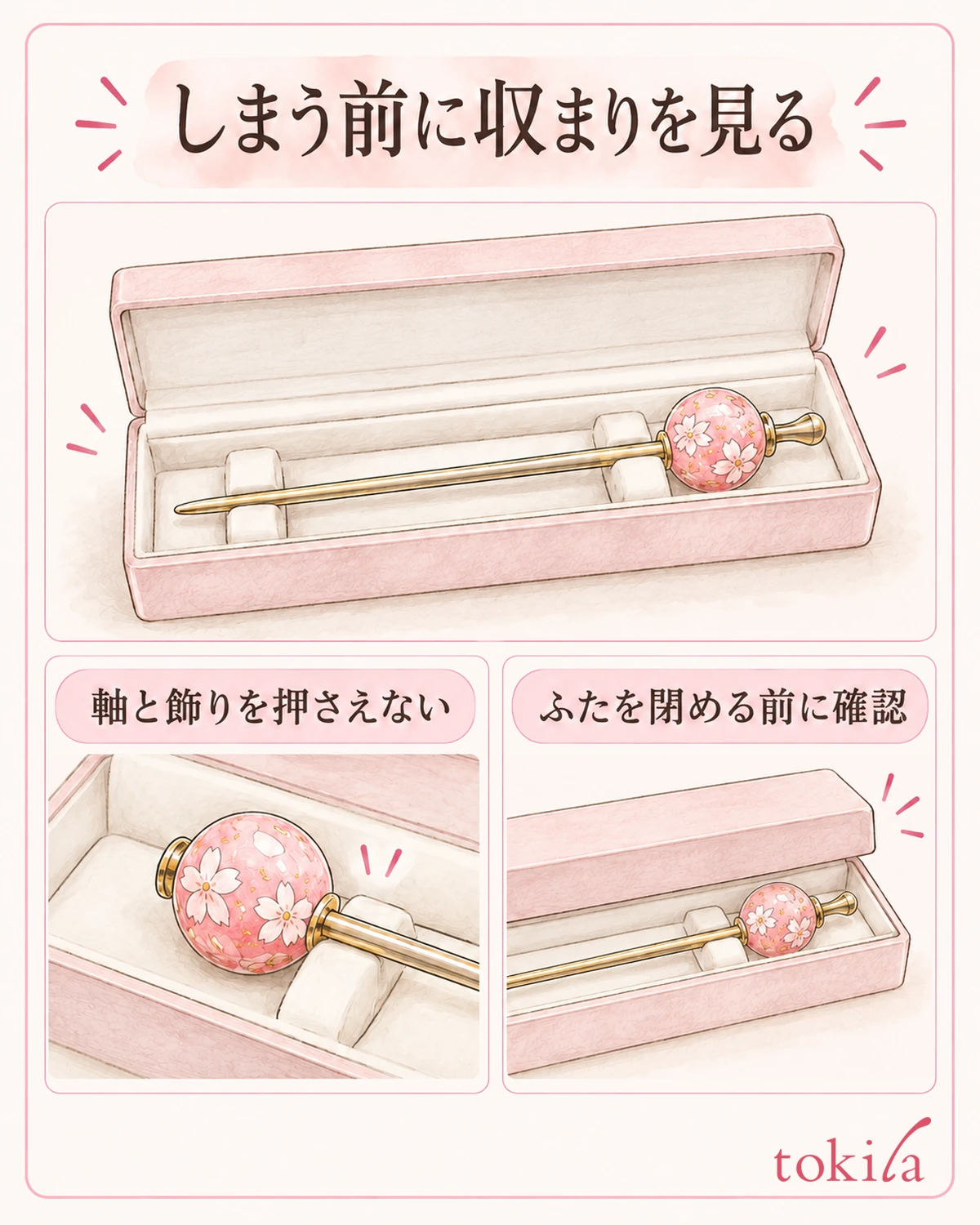
For storage, choose a place where the shaft and ornament are not pressed by other hard objects. If there is a dedicated box or protective material, look at which part it is made to support before putting the piece back. If the lid will not close, do not press it down from above; check whether a hanging ornament is caught on the edge and whether the shaft is slanted.
The next time you choose, keep what you learned this time about its use separate from the points you still want to check. Something like "I understand how to add an ornament, but I will check separately how to gather hair" is enough. Rather than deciding the method by the number of prongs alone, look in the order of purpose, structure, hairstyle, and where to hold it, and find the one that suits your own preparation.