You put on a scrunchie but the fabric shifts to one side, or the knot looks bigger than when you saw it in the store. In that case, before increasing the number of times you tighten it, try thinking separately about the fastening mechanism and how much fabric shows. The inside of the loop is the part that holds your hair, and the fabric spreading outward is the part that accents your look.
Here, centering on fabric-covered, loop-shaped scrunchies, I introduce steps for choosing the width, surface texture and how it overlaps once worn. For types with a different form, such as ones where you tighten a cord, go by the explanation for the one you have. I make no claims that it will always prevent marks from tying, that it will not damage hair, or about a number of wraps that suits everyone.
Look at the Fastening Mechanism and Separate How You Use It
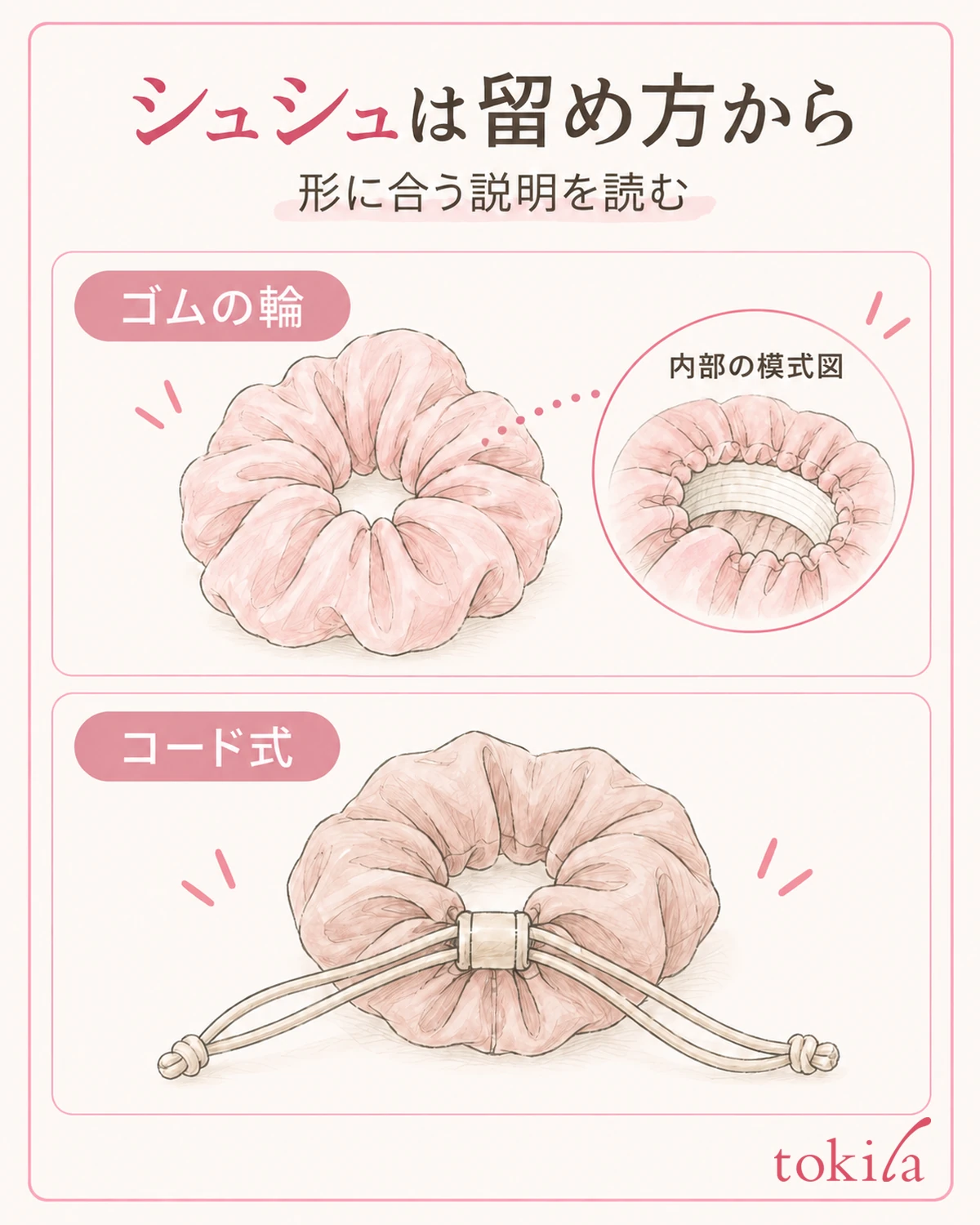
First, before passing it through your hair, put the scrunchie on a desk and look at the inside. Check whether it is a loop with elastic running through the fabric, or whether it has a cord coming out with an adjusting part attached. Even under the same name, the place you move differs between one where you twist and layer the loop and one you pass over hair already tied with a separate elastic and then tighten.
On a typical fabric-covered loop, pulling only on the outer gathers to the left and right does not tell you the length or condition of the elastic inside. Lightly support the loop by hand, spread it within a comfortable range and let it return, and look separately at how the fabric is uneven and how the elastic recovers. You do not need to undo the stitching or cut the fabric to see the inside.
For a cord type, check on the diagram on the packaging which part to press, where to pull, and whether there is an instruction to tie your hair first. Do not pull while pressing the adjusting part against your hair; use it once you understand the mechanism in your hands. Do not carry over a method of wrapping the fabric around many times as it is to one with a different form.
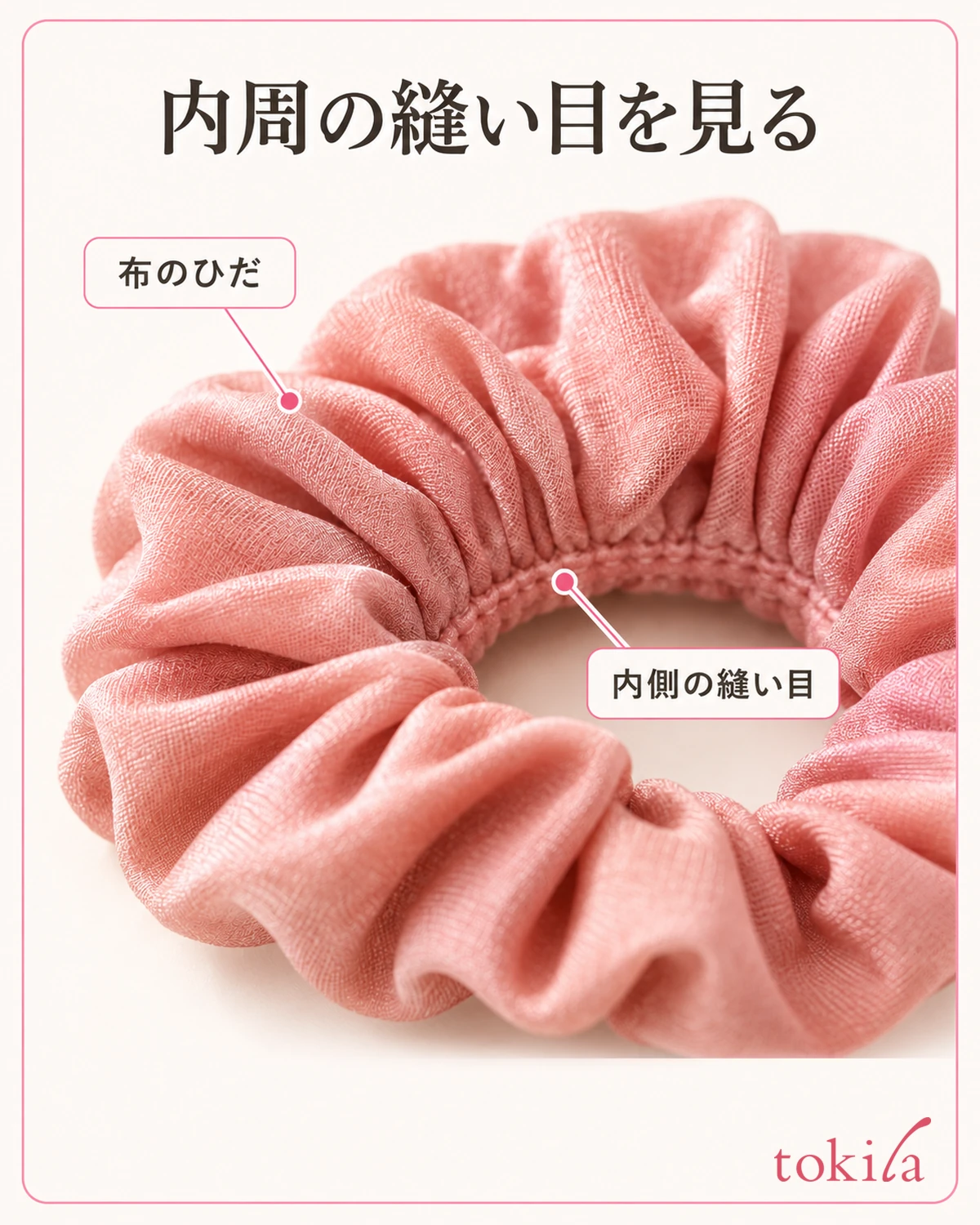
If a loop stays stretched and does not recover, or the core shows through a tear, do not keep testing it by pulling hard; set it aside. Whether the structure allows the elastic to be replaced also differs by item. Even if you want to keep a favorite fabric, do not choose with the assumption of unexplained disassembly or tying on extra elastic, and judge whether it can be repaired by the guidance for the one you have.
When choosing, it helps to organize if you check the fastening part before the name of the outer fabric. If you keep the explanation sheet from when you bought it, store the section on how to put it on and care together with the color and price tag, and you are less likely to be lost on the day you use it again after a while.
Separate here the days you want to tie your hair with only the scrunchie from the days you want to add it as decoration to hair that is already tied. Rather than layering the fabric loop to its limit because it does not hold well, choosing a size and type that suit the purpose makes it easier to move on to adjusting the look.
Compare the Fabric Width by Holding It Against the Knot
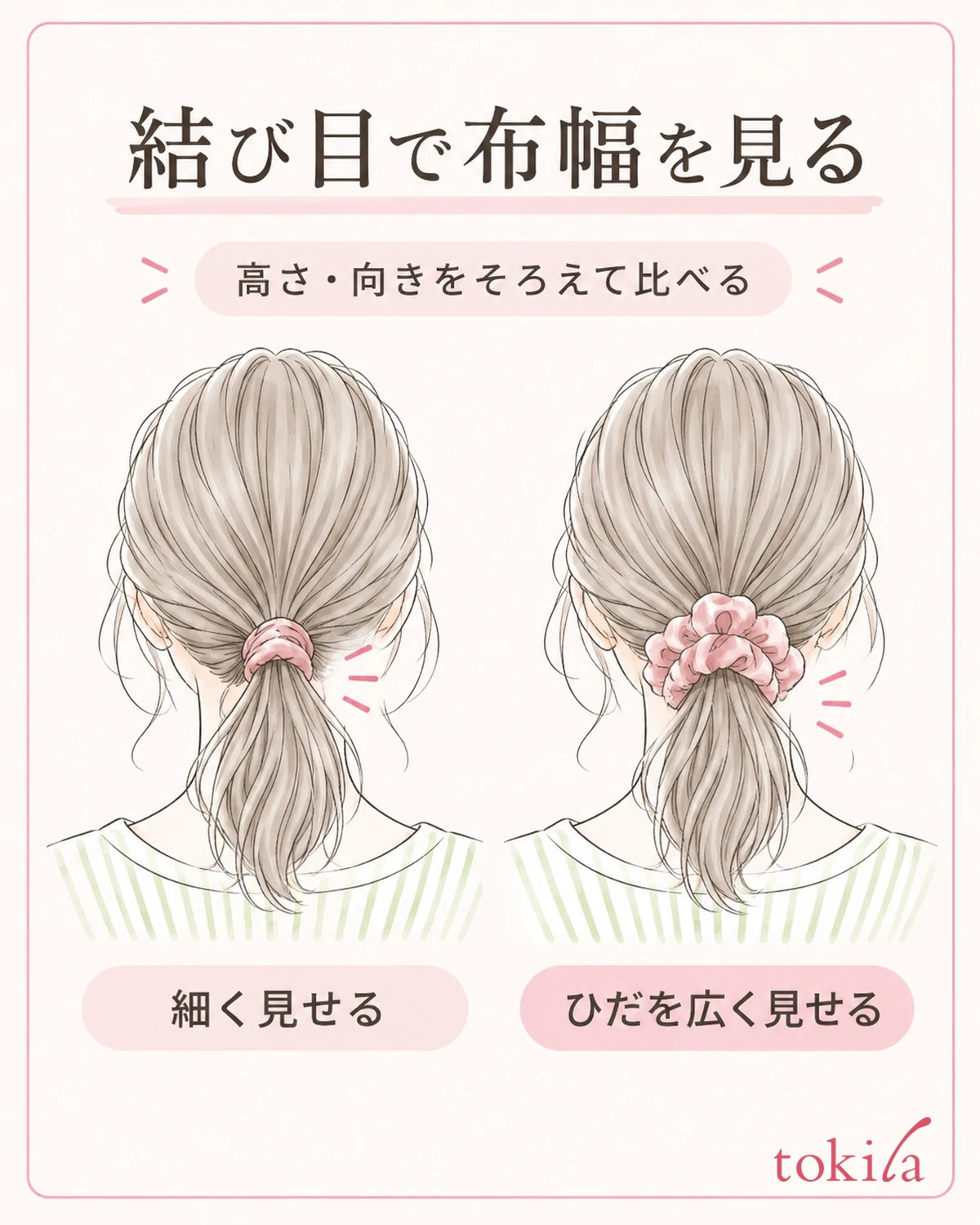
When choosing a size, do not decide by the outer diameter laid flat alone; look in a mirror at how it looks with the fabric held against a knot at the height you want to wear it. Even if the outer diameters are similar, a different center hole, fabric width and density of gathers changes how much shows around your hair. First pick one, and check how much fabric shows from the front, side and back.
If you want it to look understated, consider one where a thin band of fabric shows around the bundle of hair. If you want to enjoy the presence of the fabric, there is the idea of showing the gathers spreading outward. Without deciding that wider is better, or that more hair requires a bigger one, look together at the length of your hair and the shape of the collar you will wear that day.
While you compare, do not change the height at which you gather your hair or the direction you face the mirror. If you compare with a low knot and then move only one to a high position, it is easy to confuse the difference in fabric width with the difference in hairstyle. If you have two, hold them against it in turn under the same conditions; if you have only one, look at the overall area in a mirror from a little distance.
If the fabric touches your collar or hood when you turn to the side, do not try to solve it by tying your hair tightly; review candidates for the width and where you wear it. If you plan to sit in a chair, you can also check with a comfortable motion whether leaning back would press on a large decoration.
If you look at dimensions in online shopping, also distinguish whether the outer diameter is from one edge of the fabric to the other, and whether the inner diameter is the center hole. Do not conclude how it will look on your own knot from the numbers alone; use them as a guide for comparing the same part of the scrunchies you already have.
If you plan to let your hair down after taking it off, it is also important not to decide how marks will remain from the softness of the fabric alone. When you need to fix marks, go to steps for smoothing hair elastic marks. Think separately about how to choose the width and how to deal with creases that are already there.
Look at Shine, Sheerness and Texture Between Your Hair and Your Clothes
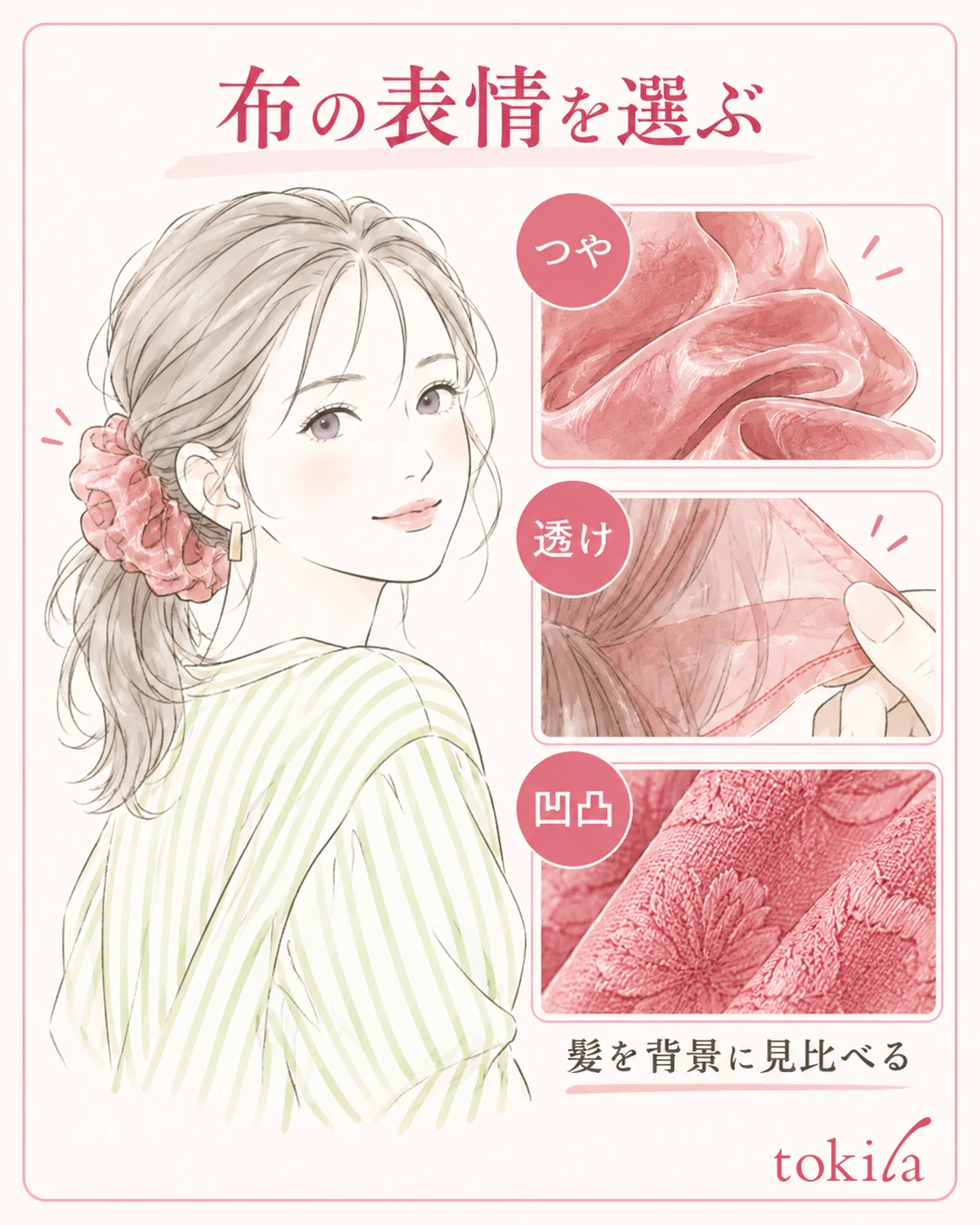
Even scrunchies that look the same color change in impression with the shine and texture of the surface. First look at it against your hair, in a room with your usual brightness. Check whether the part catching the light looks like a thin white line or whether the whole face of the fabric looks calm. You do not need to shine a strong light on just one spot and decide whether it is good or bad.
With a glossy fabric, the position of bright lines moves with the direction of the gathers. Do not assume that the part that looked bright in a photo is the color of the fabric itself. Turn it a little and look at the color that remains after the line of light has moved. On a day you want the shine to be the star, you can choose in the mirror, including how other accessories catch the light.
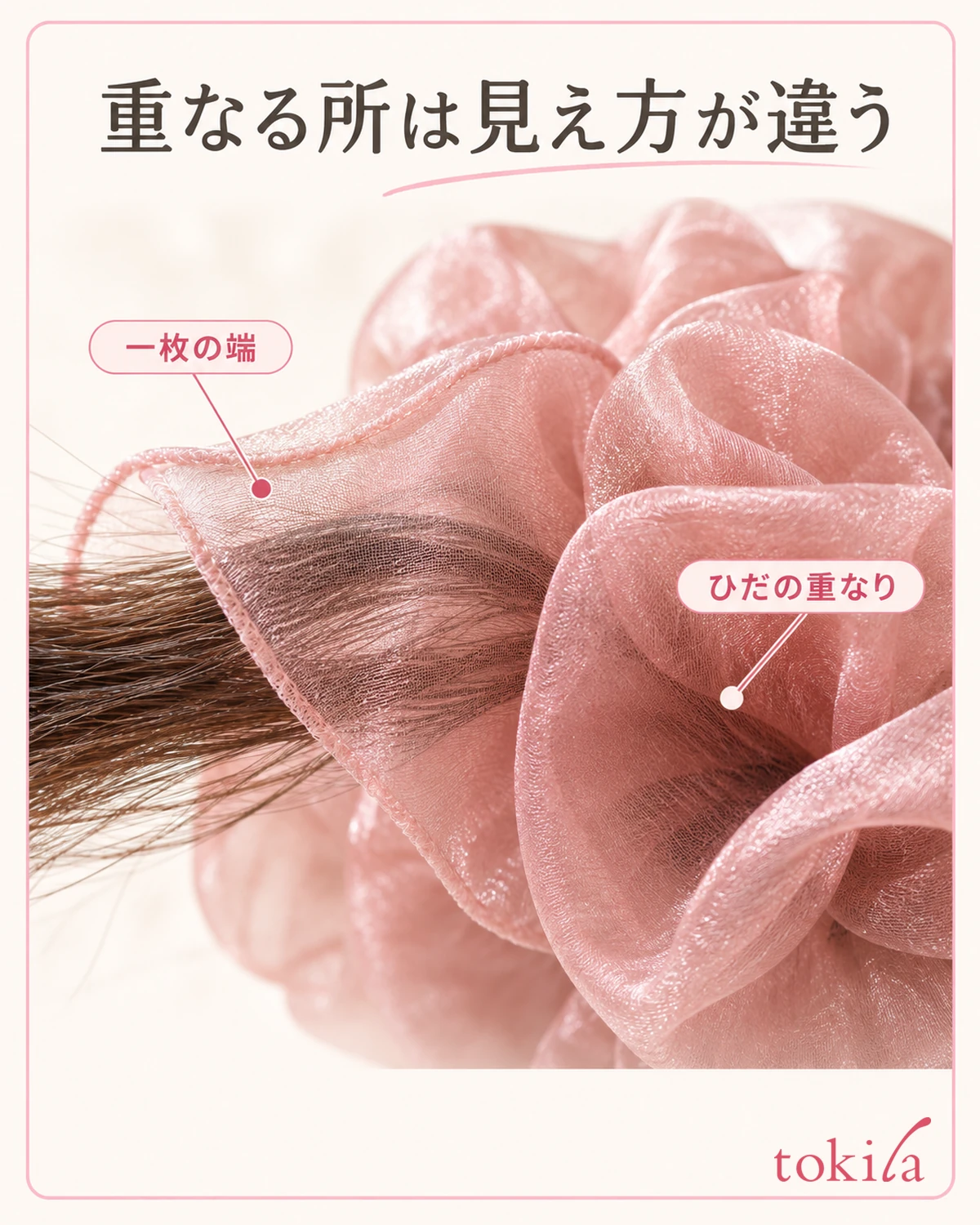
With a sheer fabric, compare how your hair looks at the edge where there is little overlap and at the center where many layers overlap. At the edge the hair beneath is visible, but where the gathers come together the colors layer. Do not choose by looking only at the part that looks thin; check the light and dark that form around the knot as part of that scrunchie's character too.
With fabrics that have woven texture or fringe, distinguish loose threads from the original design. Before you pull on decorative threads to tidy them or cut what you take for fraying, look at the original form. If your hair gets tangled in the surface, do not pull the fabric; stop moving and free it from the few strands you can see.
With patterned ones, the pattern you see on a single spread-out piece of fabric differs from the one you see with the gathers drawn together. If you like a large pattern, looking at which part will come to the outside when worn adds to the fun of choosing. You do not need to spread even the inner loop by force to show the whole pattern.
If you are unsure how to match it with your clothes, use either one color at the neckline or the texture of the clothes' surface against the fabric as your axis of comparison. Rather than changing color, width and gloss all at once, comparing, for example, a matte fabric and a glossy fabric against the same clothes makes it easier to choose what you want to enjoy. Even in similar colors, you do not need to match the same texture.
Fasten Your Hair, Then Shape the Outer Gathers
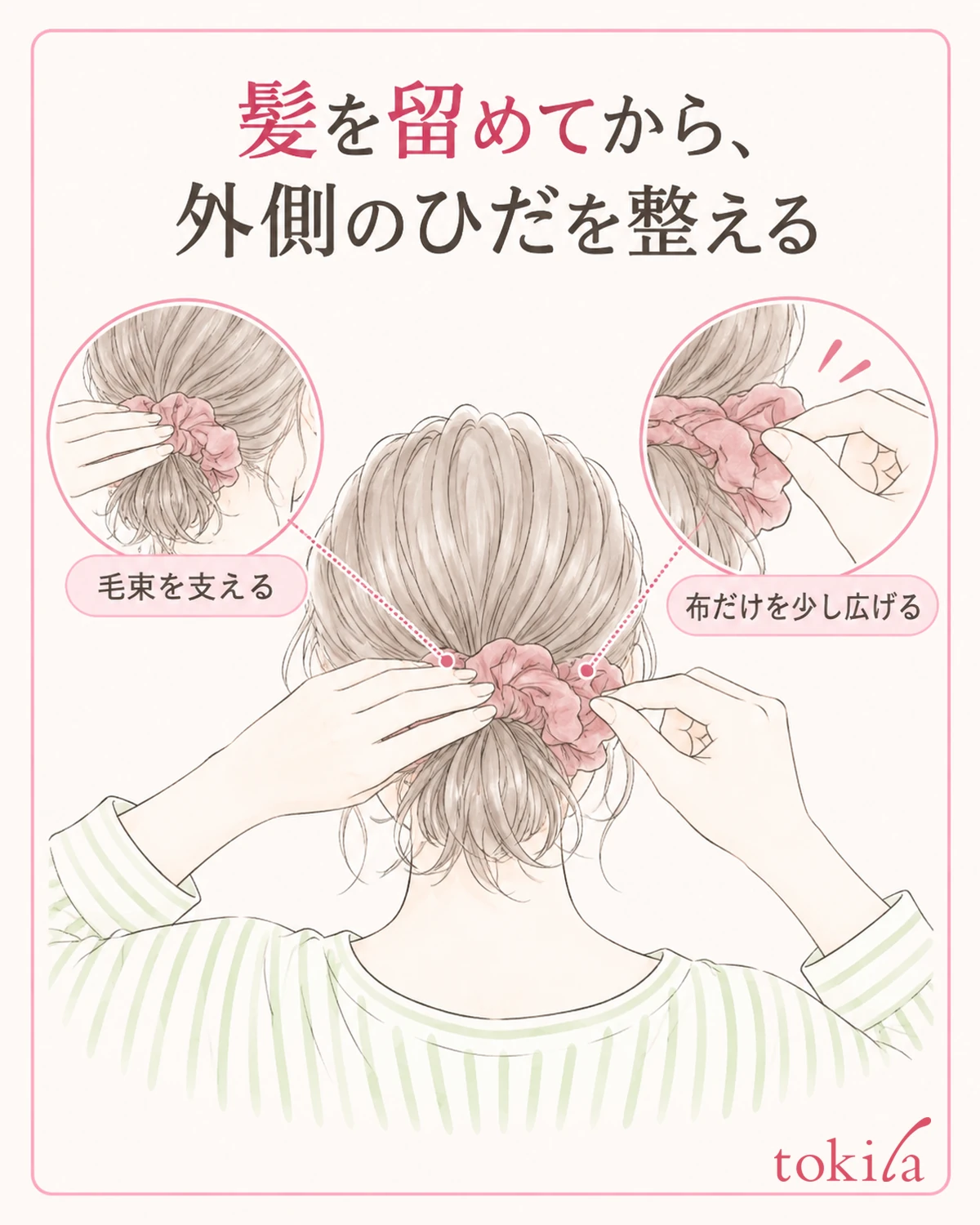
Put on the scrunchie you chose according to the type you have. Even when using a typical elastic loop, do not aim for a set number of wraps; handle it within the range you can pass over the bundle of hair comfortably. You do not need to pull and layer the fabric to the point where your scalp is pulled and hurts, or the loop will not go through.
If it is the type that builds a base with a separate hair elastic, first gather your hair with that elastic, then add the scrunchie as explained. This does not mean using two will always hold it; it is a way of using it that separates the base and the decoration. Even if you want to hide the visible elastic, take care not to pull your hair up hard together with the scrunchie's fabric.
When you have finished fastening it, support the bundle of hair near the knot with one hand and spread only the outer fabric little by little with the fingers of the other. If you smooth one large crease before moving on to the next, it becomes easier to see the unevenness of the gathers without retightening the inner loop. You do not need to make all the gathers the same width.
If your hair moves too when you think you are fixing the fabric, let go once and review where you are pinching. If fine hairs have gotten into the overlap of the fabric, loosen that loop before pulling them out. Do not repeat this without being able to see the back in a mirror; use a hand mirror or the like so you can see the boundary between the knot and the fabric.
If the fabric swells a lot on only one side, first see whether the crease in that part has gone inside. Fix it from the one spot that bothers you. Rather than turning the whole loop round and round to move the pattern or gathers, smooth a small crease and make a break where you let go.
For the finish, let go and slowly turn your face to the left and right to check. If only the direction of the fabric bothers you, adjust the outside; if the whole knot sinks, review the base or the type. When adding it to a bun too, take care not to mix up how to tell which ends to leave out and which to tuck in with the work of spreading the decorative fabric.
Check the Care Label and Store the Fabric Without Crushing It
When you take it off, loosen the inner loop little by little before sliding only the fabric toward the ends of your hair. For a cord type, follow the specified release method and do not pry open the adjusting part by force. After you take it off your hair, look in a bright place for any hair left caught in the fabric and whether the stitching or the connection of decorations has opened.
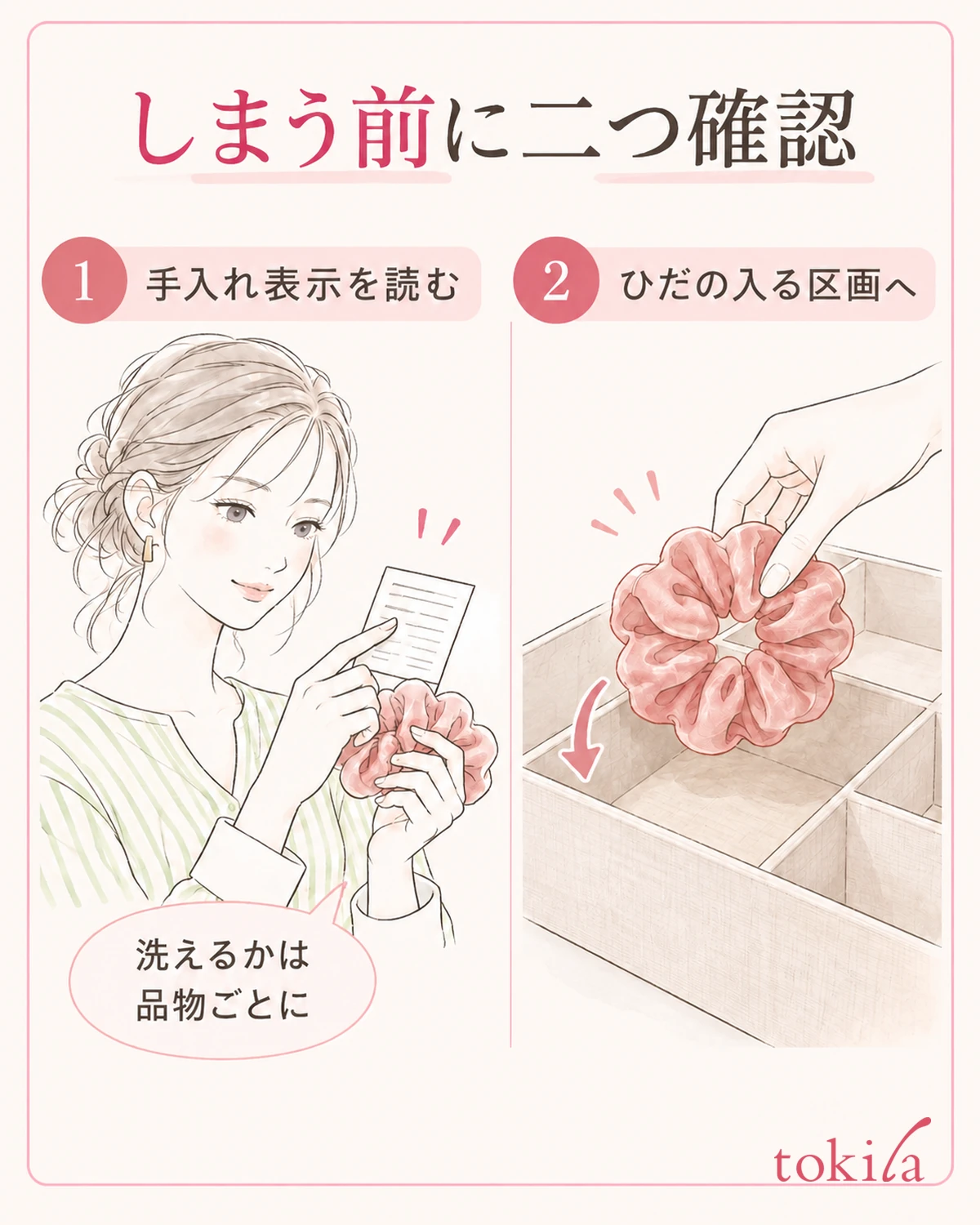
If it gets damp with sweat or water, do not assume a scrunchie can be washed entirely; read the care label on the one you have. Some are specified not to be washed. Do not decide the method by the fabric material alone; go by the product's conditions, including adhesive, metal fittings and decoration, and do not use boiling water or bleach on one whose washing method you do not know.
As a place to store them, consider small compartments where the edge of the fabric or decorations will not catch on zippers, hook-and-loop fasteners and the like. If you push a wide piece of fabric into a narrow gap, it is hard to check its shape the next time you take it out. Do not wrap the loop around many more times to make it smaller; leave it with room for the gathers to fit.
If you line up several, a way of placing them so you can see from above the colors and surfaces you want to choose is also convenient. When similar colors run together, try dividing them in the order you choose them, such as glossy ones and textured ones. Do not leave them in direct sunlight for long for display, and follow the product's label for storage conditions.
On days you carry it with you, put the one you will use while out in separately from other fasteners, and it is easier to find the edge of the fabric when you take it out. After you get home, do not leave it at the bottom of your pouch; look for dampness or anything stuck to it, then return it to its usual storage place.
For your note for the next time you choose, record not only the color name but the occasion you will use it and the part you want to show, such as "I want it to look slim on a low knot" or "I want to add sheer gathers to a plain neckline." If you know the role of tying your hair and the role of enjoying the fabric, even the one you own can become a chance to change how you match it.