The foam has formed in your face-wash net, but when you try to take it out, it slips through your hands. You squeeze the net again and again, and soon you are not sure where to hold it. When that happens, before adding more cleanser, take another look at the shape of the net and how you hold it to take the foam out.
This article covers foaming cleansers and face-wash nets that work by squeezing the foam out. It explains where to hold the net, how to move your fingers, and how to prepare your hand to receive the foam. Please treat it separately from cleansers that come out of a pump as foam, products used without lathering, and how to use a face-wash puff.
1. Check the shape of the net and the part you take the foam from
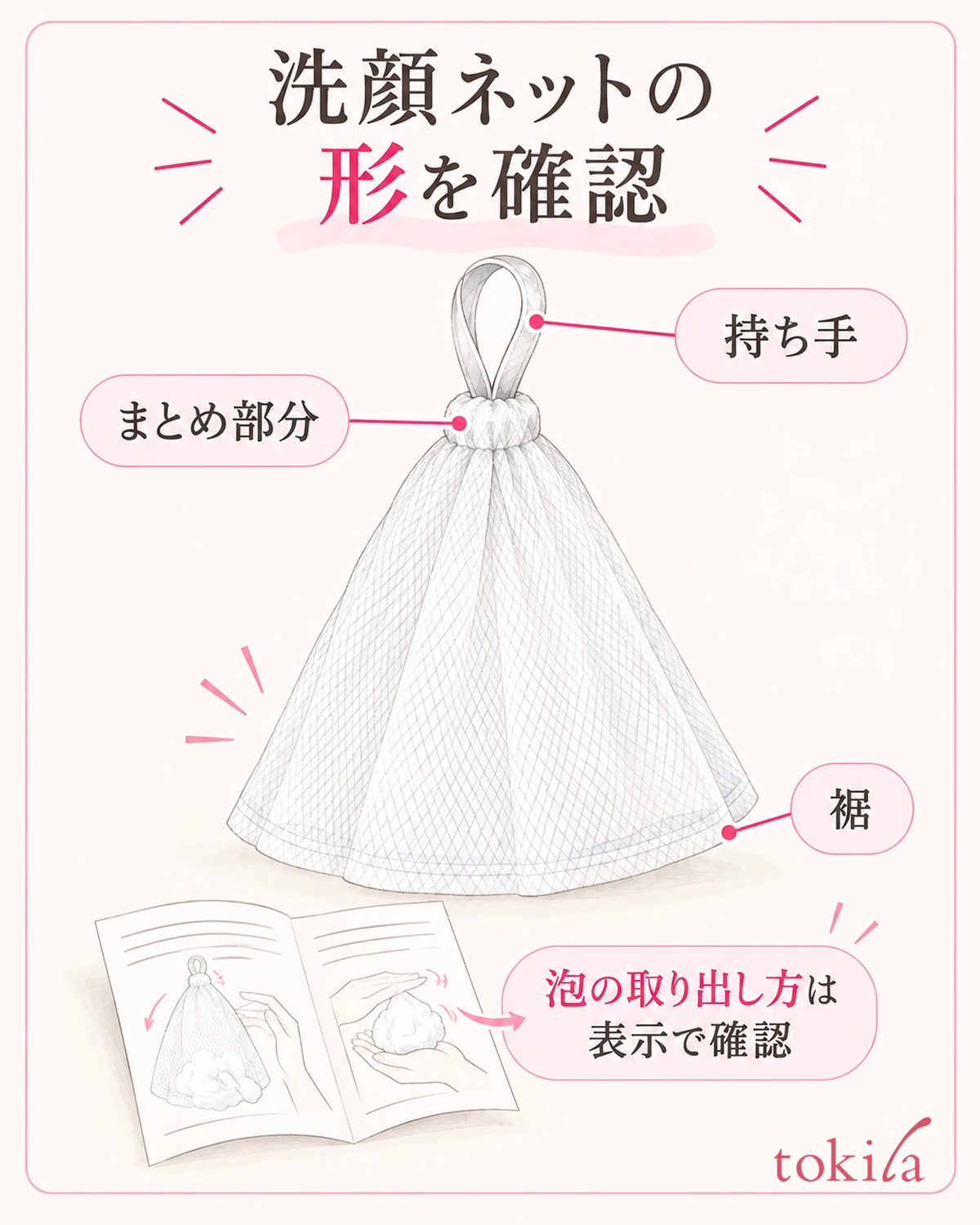
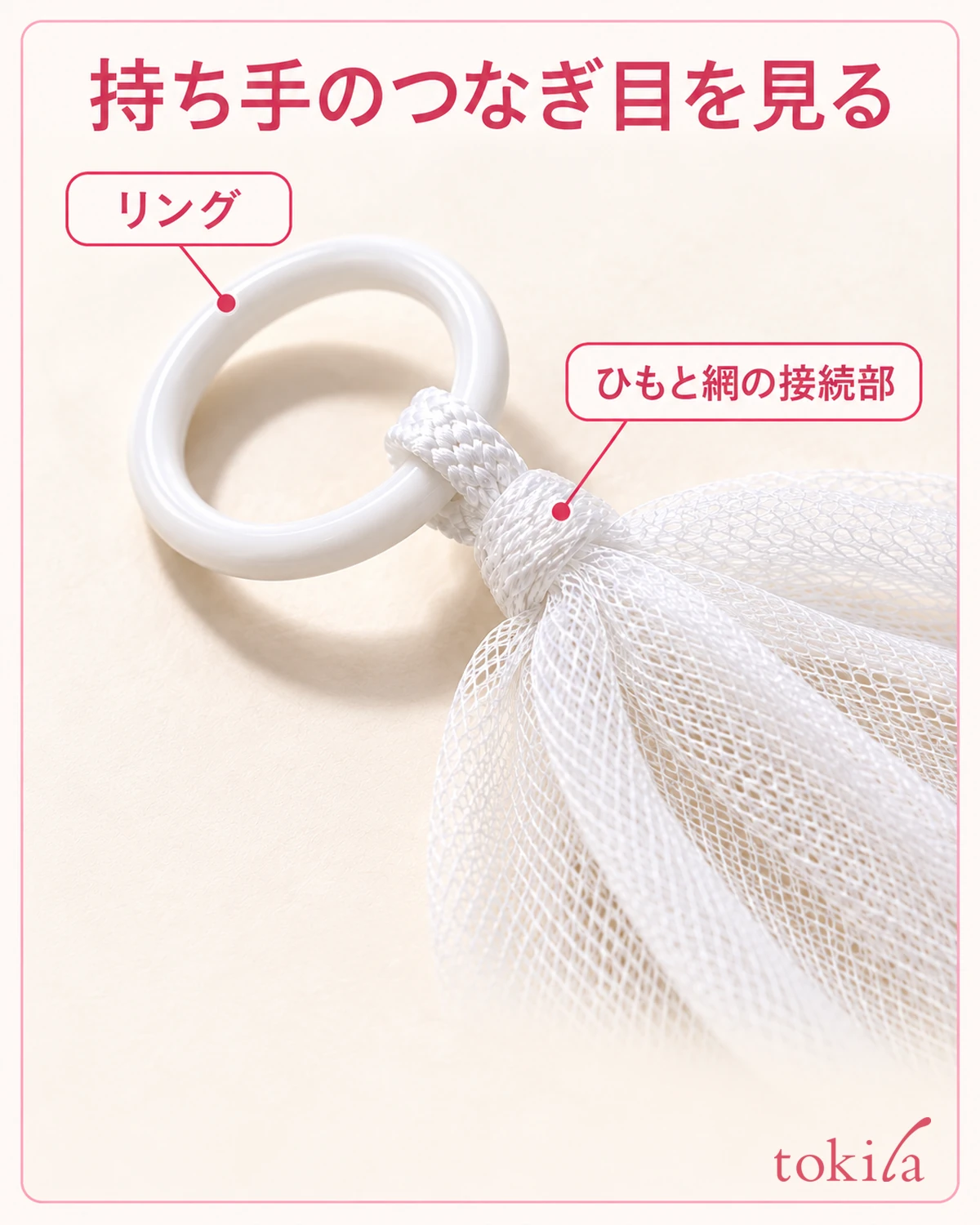
First, compare the net you have with the instructions that came with it. Find the ring, the cord, the part where the net is gathered, and the flared hem. Even if there is a ring, decide by the instructions whether it is meant to be held when taking out foam or is mainly a part for hanging the net. It is important not to apply the movements of a similar-looking but different product.
What is covered here is the method of supporting the handle side with one hand, pinching the net with the other hand, and gathering the foam toward the hem. For shapes that do not show this movement, or those that use a dedicated cup or part, follow the steps that suit their structure. A bag in which you put soap and a net that you use to lather the soap taken out of it are not treated as the same thing either.
If the net is rolled up and you cannot see the handle or the hem, straighten it once and check which end is the top. Rather than fumbling in the foam and pulling hard, knowing where to hold before you lather means you do not have to change your grip midway. Do not retie the cord or take parts off unless the instructions say so.
A lathering net is a tool for getting the foam you made into your hand. Do not turn it into a motion of pressing the net itself against your face or rubbing your skin with the mesh. Check on the cleanser's label as well whether it needs to be lathered and whether it is compatible with a net. The amount of foam alone cannot tell you how well it cleans or whether it suits your skin.
When you read the instruction sheet, read "the part you hold when lathering" and "the part you hold when taking out the foam" separately. If the way you hold the net changes in a product, check which hand you move midway. Do not assume the same way of taking out foam just from the size of the net or the fineness of its mesh.
2. Before taking the foam out, set up your hands and how you hold the net
Before making foam, wash your hands and put the cleanser and the net where you can read their instructions. Follow your product's instructions for the order and amount of wetting the net, adjusting the moisture and applying the cleanser. Even if the foam is hard to take out, do not start by putting in a large amount of cleanser or adding a lot of water at once; begin with the preparation as specified.
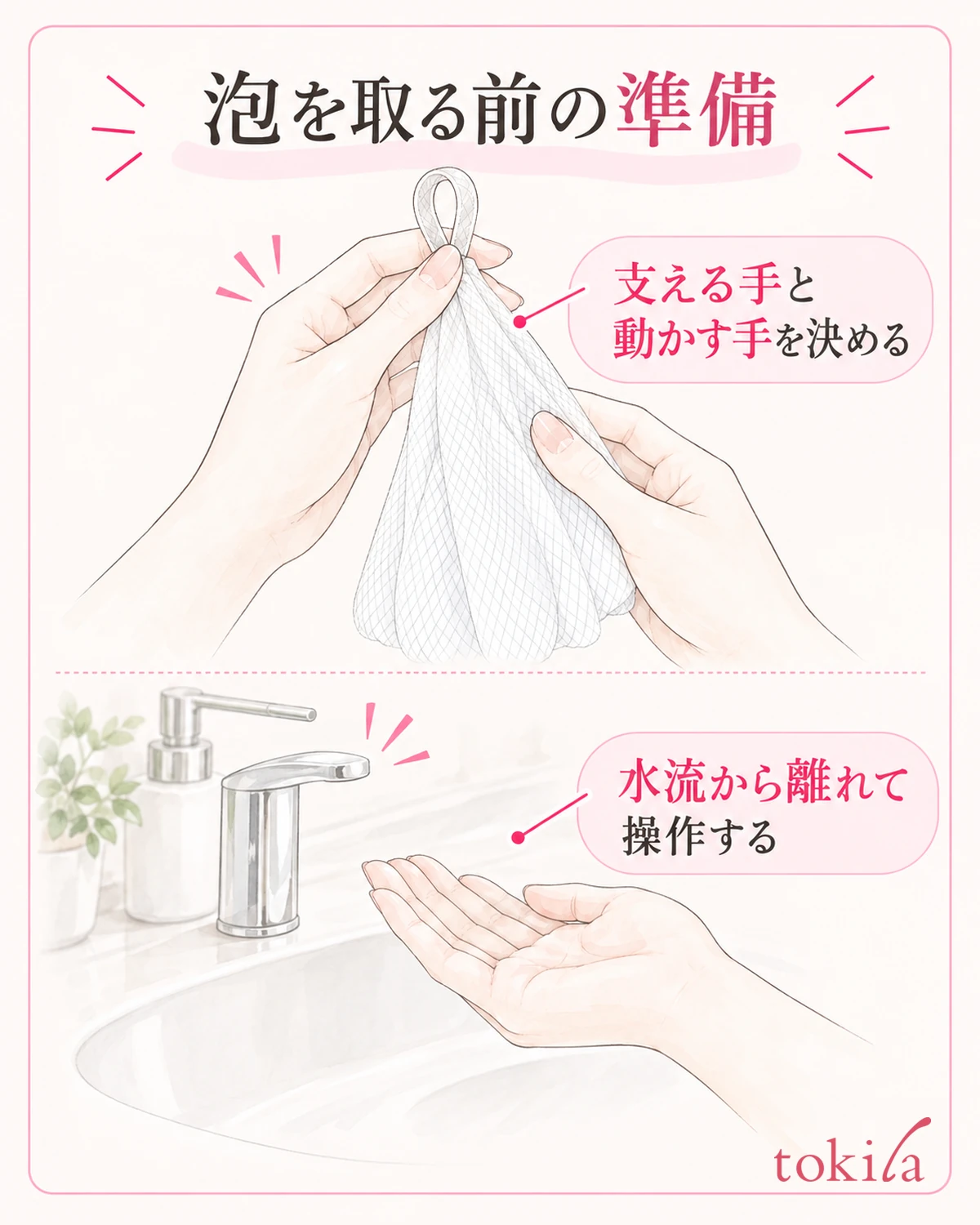
Decide the roles of the hand that supports the handle and the hand that gathers the foam. For example, with a product that tells you to hold the ring, support the ring with one hand and place the other hand on the handle side of the net. The number of fingers and how you pass them through depend on the size of the part and the instructions. If your fingers go in tightly or catch, there is no need to force them in.
Work over the sink and clear a space in advance to receive the foam. If the faucet is still running, move your foam-gathering hand and the net to a position where they do not enter the stream. If water hits them while you are taking out the foam, it becomes harder to check the state of your hands. Separating the stage of adjusting the water from the stage of taking out the foam reduces confusing moves.
Also check that long nails or rings are not caught in the mesh. If the hand supporting the ring is covered in foam and slippery, do not pull hard; adjust your grip again. The goal is not to stretch the net tight and fix it. Move on to the next step only after your hands are steady and you can tell the handle from the part where you gather the foam.
Finish the cleanup after making the foam, such as closing the cleanser container or returning the soap to its place, before the motion of taking the foam out. If you look for a lid with a hand holding foam, the direction of your hand tends to change. Preparing what you need first makes it easier to carry the foam you gathered straight to washing.
3. Slide your fingers from the handle side to the hem to gather the foam
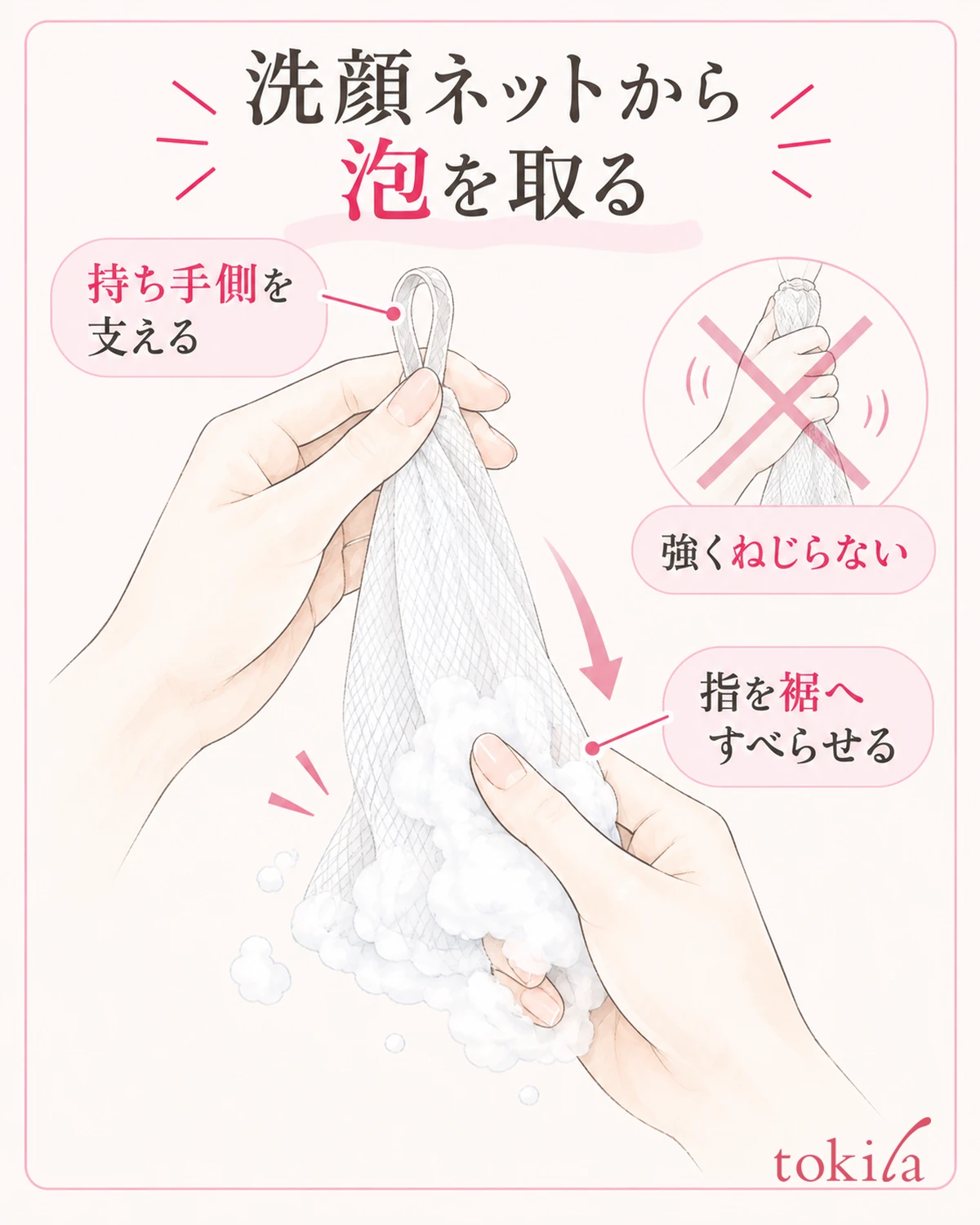
With a net that you squeeze the foam out of, lightly pinch the net with the fingers of the other hand while supporting the handle side. Slide your fingers along the net from near the handle toward the hem, and gather the foam into your hand. It is not a strong left-and-right twisting motion like wringing a rag. Rather than picking at the mesh with just your fingertips, check the position where you pass the net through and move slowly.
Take the foam out so that it collects on the side of the moving hand. If the hand pulling the handle up and the hand gathering the foam pull apart from each other with force, you are more likely to drop the foam at the end. Do not pull out all the way to the hem suddenly; move while watching whether the foam is collecting in your hand. When you let go of the end of the net, too, keep the hand that receives the foam facing the same way.
There is no need to crush the mesh tightly to collect all the foam at once. Even if a little remains in the net, consider whether the foam you got into your hand is enough to wash as the cleanser directs. If you take more, lightly make the same movement again from the handle side. Do not try to gather foam by force with fast repeated back-and-forth motions or by scratching the mesh with your nails.
Move the foam into your hand before bringing the net to your face. Put the foam on your palm and then go on to the steps for the cleanser you are using. If it falls on the way to your face, first check whether your hand is receiving it, and whether you tilt it at the moment you let go of the net, rather than piling the foam up high.
To check the foam gathering in your hand, look at your hands rather than your face in the mirror. Look to see whether the hand holding the ring is moving and whether the foam-gathering hand goes back up midway. There is no need to squeeze the fibers of the mesh one by one; the points to check are keeping the grip shown for the product and moving along the whole net.
4. If the foam falls or stays behind, go back to the step where you stumbled
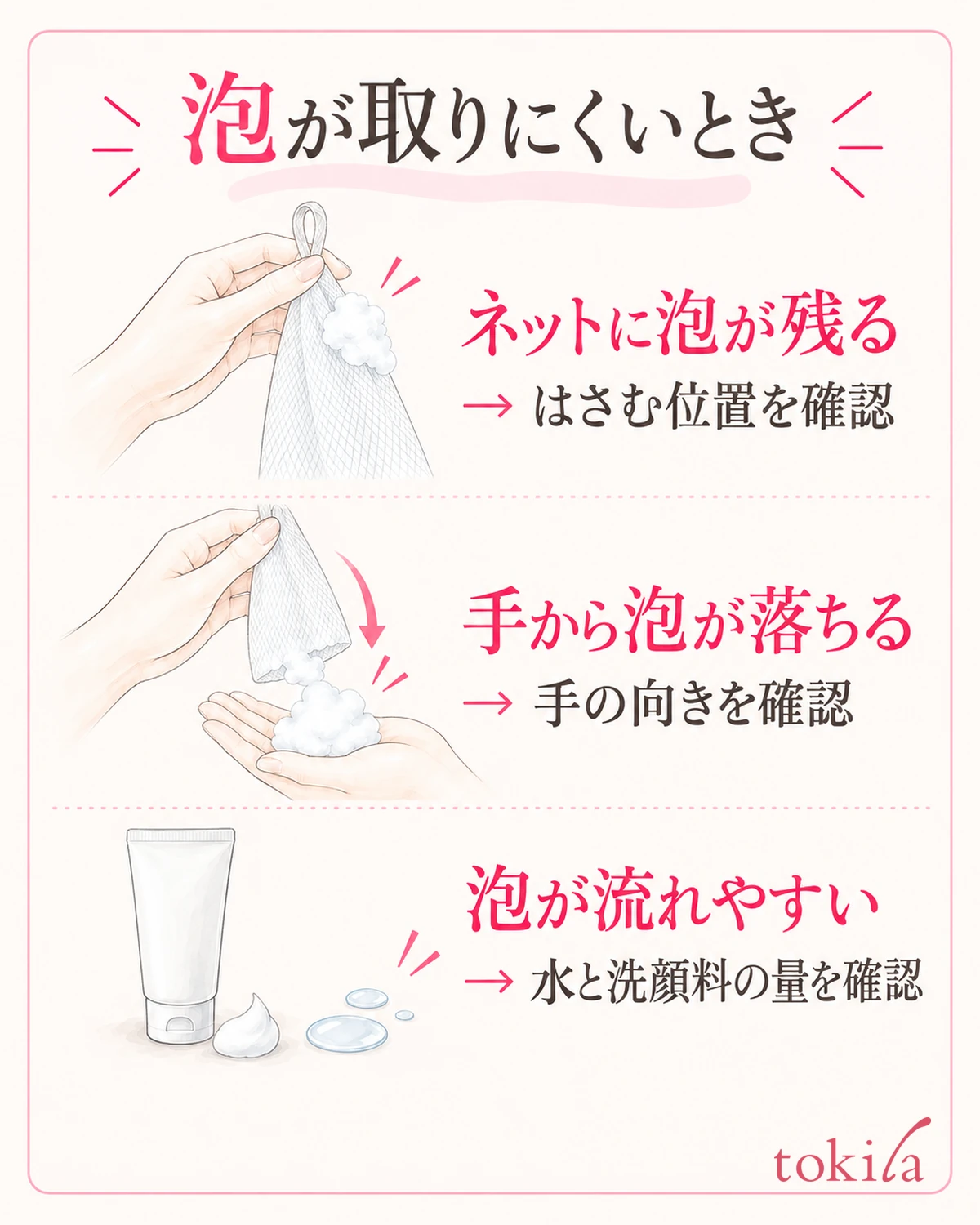
If the foam has formed but does not move into your hand, first check where you are pinching the net. Gripping only the hem makes it hard to gather the foam left on the handle side. Look again at the positions of the handle and the hem, and start from the starting position shown in the instructions. Before adding force, check from where and in which direction you are moving.
If the net slips out from between your fingers midway, check whether you are supporting the whole net with only the foam-gathering hand. Keep the role of the hand that supports the handle, and use the moving hand for gathering foam. Conversely, if you pull the handle side too hard and the mesh becomes taut, bring your hands closer together and regrip. Do not try to take it all out while stretching it long with its shape lost.
If the foam itself runs off quickly, review not only the taking-out movement but also the preparation. The amount of moisture, the amount of cleanser and the way of lathering differ by product. Even if it feels thin, do not add unlimited cleanser; next time check the specified amount and preparation. Foam firmness, or not falling when turned upside down, is not a pass condition for every cleanser.
Avoid picking up foam that fell on the sink and using it on your face; prepare new foam. If your hands or the net get dirty, do not continue while they are dirty. If you notice a tear in the net, a detached part or a tangled cord, do not try to fix it by pulling hard on the spot; stop using it and check the product's guidance on replacement and care.
Even after you have taken enough foam, you may keep going because the thin foam left in the mesh bothers you. Do not make taking it all out your goal; judge whether you can move on to washing your face. Rather than hurrying to press the foam onto your face so it does not fall from your hand, connect to the way of washing specified for your cleanser.
5. After use, rinse off the foam and dry the net for next time
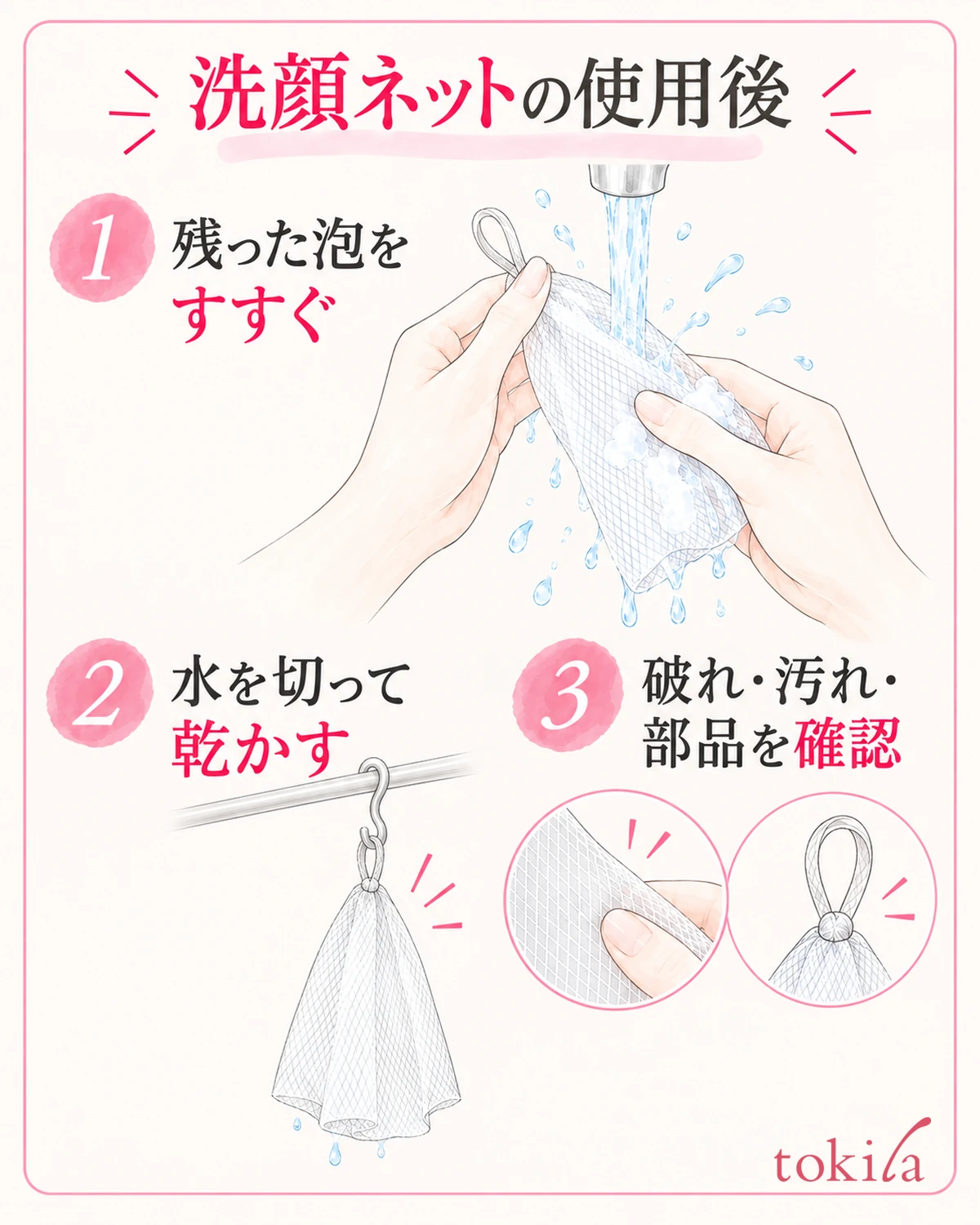
When you finish washing your face, rinse the foam and cleanser left in the net off thoroughly. Check whether foam remains in the folds and around the handle, and rinse while spreading out the shape of the net. Avoid storing it with foam left in it and using it as is for your next wash. If there are instructions on the detergent for care, whether it can go in a washing machine, or how to wash it, stay within them.
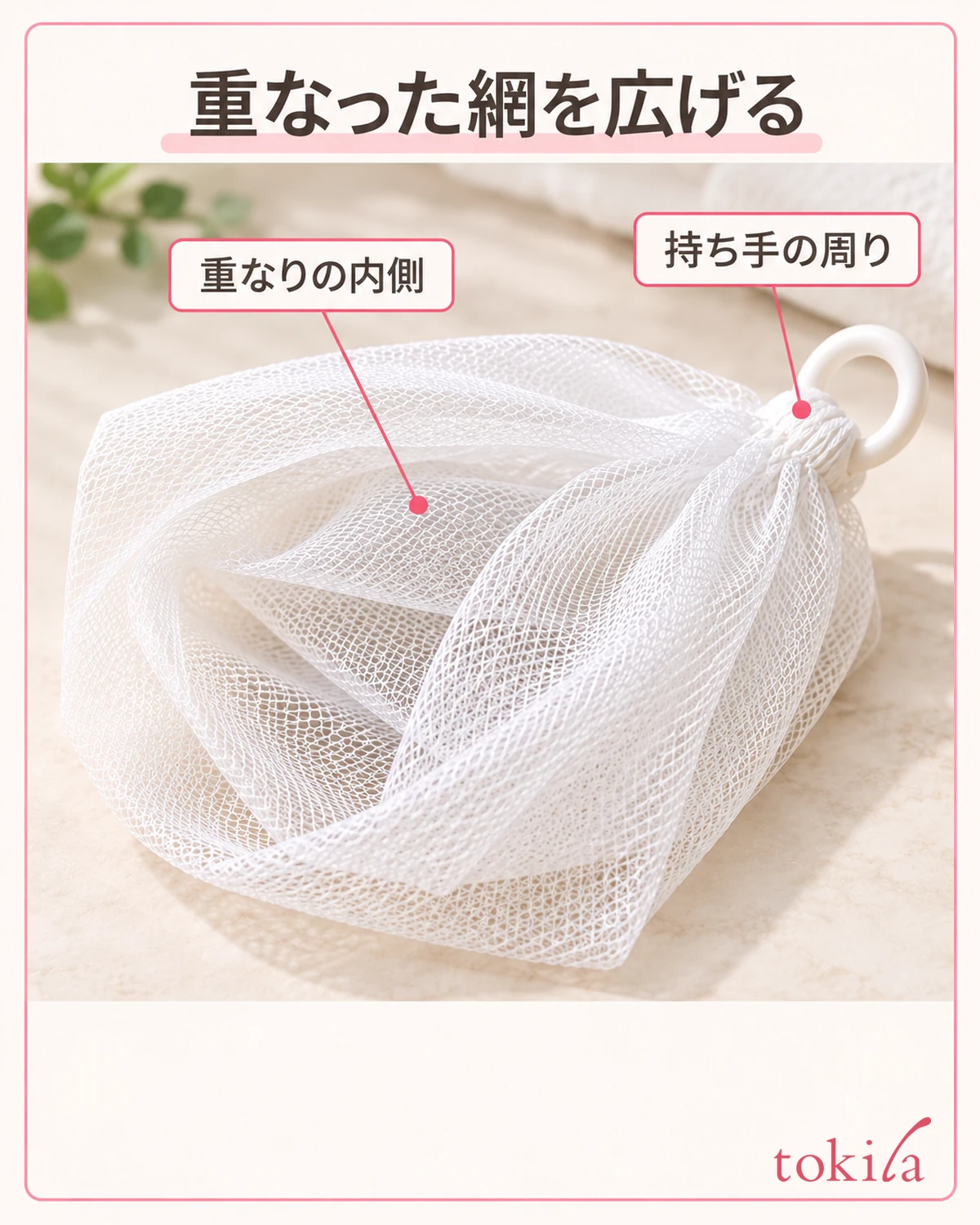
Drain the water and hang the net in a well-ventilated place where it can dry, in line with the product's instructions. Do not leave it rolled up on a wet shelf or put it away damp in a closed bag; arrange the overlaps and let it dry. If there is a part for hanging it, the way to attach it and the conditions of the surface also follow the product. Do not add your own disinfection with high heat or bleach.
Before the next use, check the mesh for tears, the handle and cord for looseness, and any dirt or smell. Rather than setting a replacement time by a fixed number of days, look at the product's guidance together with its actual condition. Do not immediately decide that foam has become hard to take out because you used too little cleanser; also check whether the condition or shape of the net has changed from before.
Next time, pick one movement you hesitated over this time and review it, such as "decide the hand that supports the ring first" or "move your fingers from near the handle." The aim is not to increase the amount of foam, but to take it out without dropping it and move on to washing without pressing the net directly against your skin. For how to take moisture off after washing, see also the steps for taking moisture off without rubbing with a towel.
If the handle is slippery when wet, next time think about preparation so that not much cleanser gets on the handle before you make foam. If storage space is tight, arrange the dried net in a position where it is easy to take and does not catch on other things. Rather than trying to solve hesitation with hand strength, review separately whether it happened in preparation, handling, or storage.