You may love a two-tone bag on its own, yet feel it never quite settles when you pair it with your clothes. Even within a single bag there are places where you see color: a light body with a dark handle, or two colors that differ front and back. Before treating the bag as a single-color accessory, check which surfaces are actually visible.
This article introduces steps for taking one two-tone bag you already own, keeping it fixed, and choosing the color that connects to your outfit. The goal is not to match both of the two colors to your clothes, nor to reduce the number of colors to a set number. Today, start by thinking about which part of the bag you want to show.
1. Look at the bag's large surface, edges, and handles separately
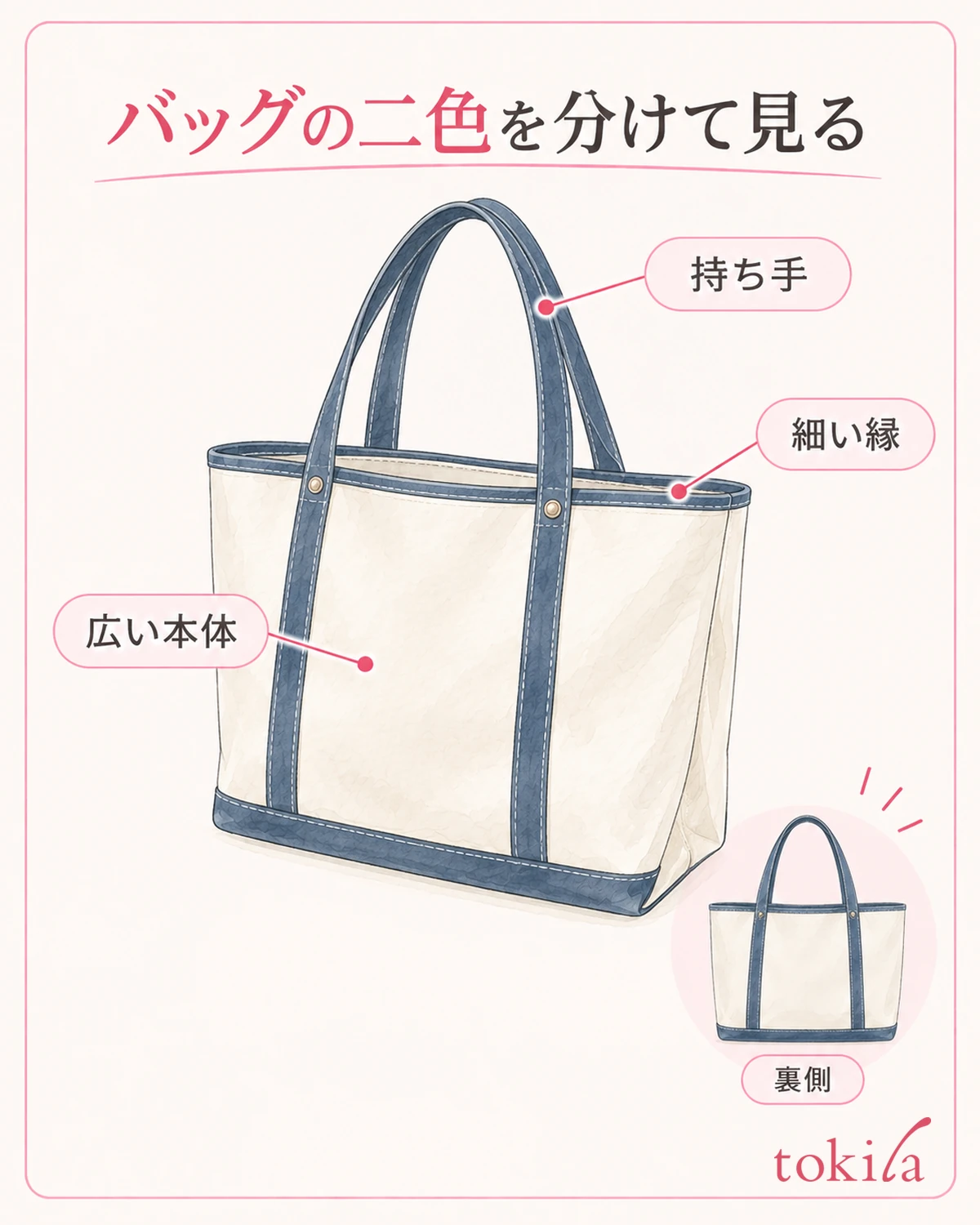
First, place the bag somewhere with little unevenness in the light and look at it from the front. Check where each color is: the large surface of the body, the edges of the opening and base, the handles, and the shoulder strap. Rather than settling on precise color names, try putting the area and the place into words together, as in "wide ecru and thin navy."
Even with the same two colors, a body split in half top and bottom and a bag where only the handles differ show a different balance. Do not apply the same way of pairing just because there are two colors; first look for the switching point on your own bag. If there are patterns or metal fittings, keep them separate from the two colors of cloth or leather.
When you check the color of the edge, also look at whether it is thin piping, a band folded over to the front, or the side itself. A color that looks thin from the front can widen when it wraps around the side. Looking at seams and overlaps is to find where the colors are, not to judge the material or quality from a photo alone.
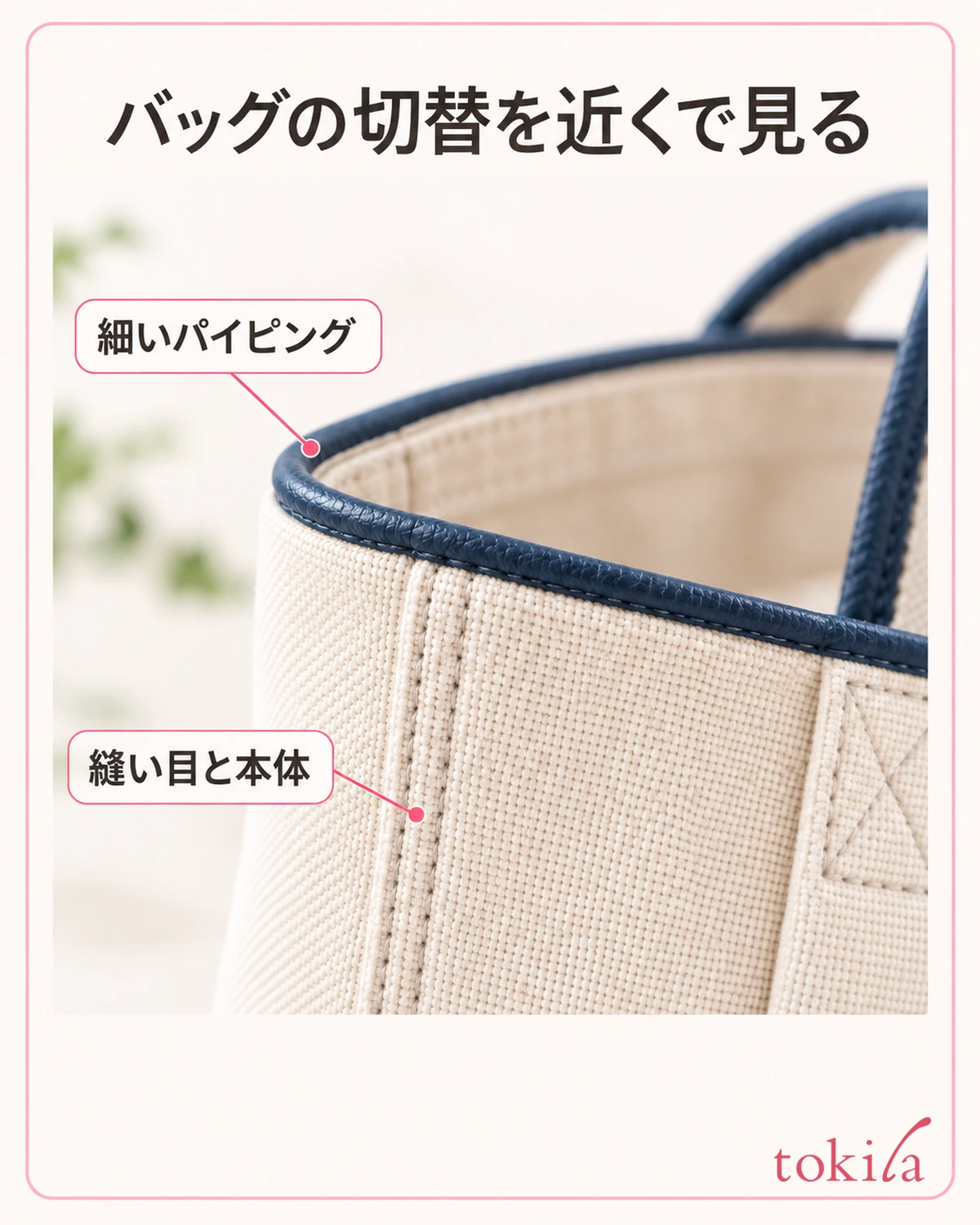
Next, turn the bag slightly and look at the back and the sides. If the color scheme differs front and back, check first the side that often faces outward. A color that appears only on the base may show when you set the bag down but hide when you carry it. Rather than trying to show every color all the time, choose the range that is visible when you are actually using it.
The lining may be visible only when the bag is open. Check it only as far as needed for putting things in and taking them out; you do not need to carry the bag open to show a color. If there are removable parts, do not decide they can be removed from looks alone, and follow how your own bag is meant to be used.
Finally, choose one spot that caught your eye first. Is it the light body, the dark edge, or the two handles you can see from a distance? With this observation as your starting point, before adding more outfit candidates you can think about which color of the bag you want to build a relationship with.
2. Decide whether to blend the large surface or pick up the small color
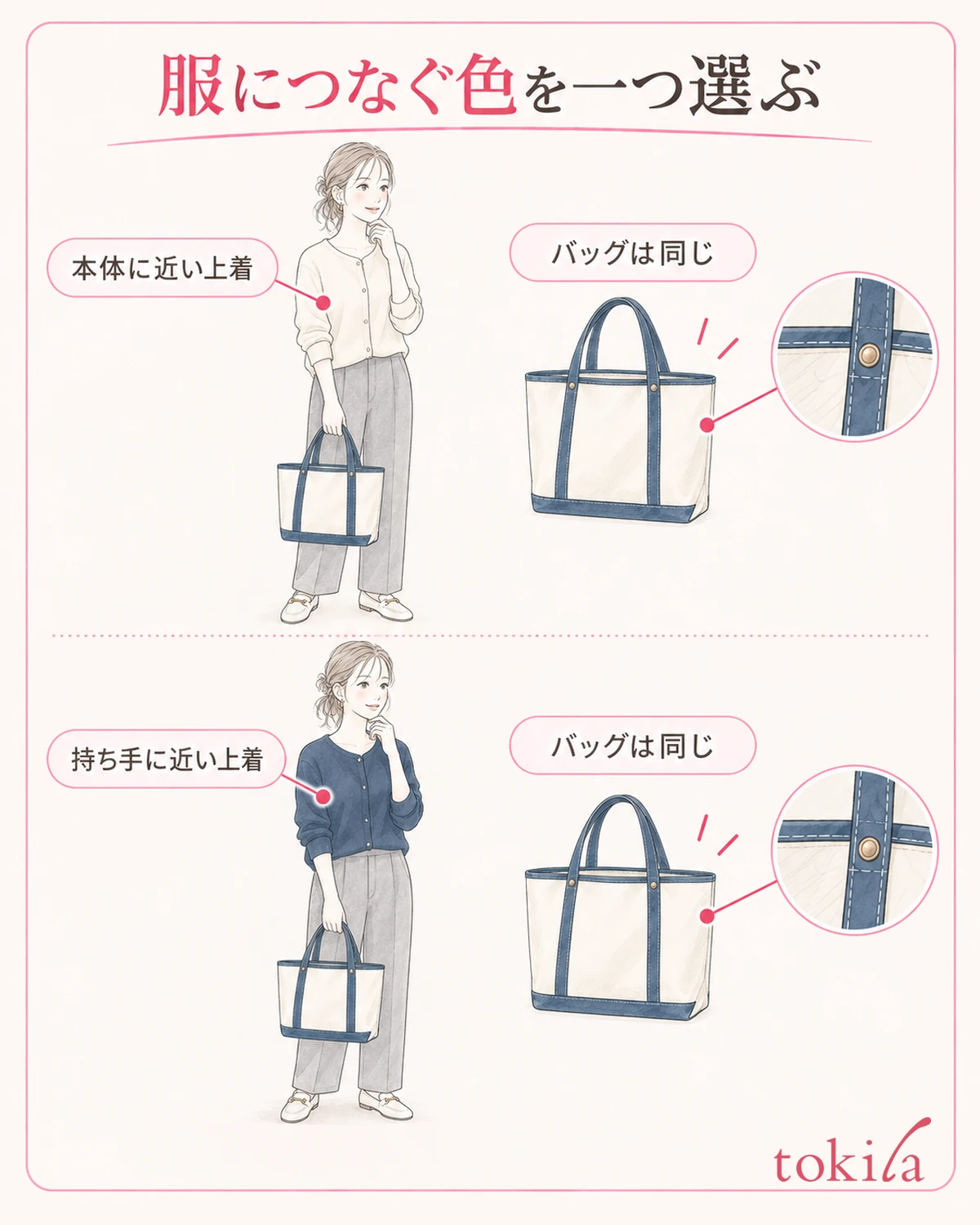
With the bag fixed, try on one outfit for today. First compare from one side: do you want to blend the large body with your clothes, or connect the small color of the edge or handle to somewhere in your outfit? Neither is a higher rank; they are choices about which part you want to show.
For example, with an ecru body and navy handles, pairing it with a jacket close to ecru lets you look at the relationship between the body and your clothes. Pairing it with a jacket or pants close to navy is a way to look at the relationship between the small color of the handles and your clothes. This is an example to try with what you own, not a guarantee that the same color name will always work.
At first, change just one piece of clothing. When you change the jacket, keep the bag, bottoms, and shoes fixed. If you add accessories one after another because you cannot decide which of the two colors to pick up, you easily lose sight of why you liked something. During the comparison, keep the same mirror, the same light, and the same carrying position.
You can compare even if you do not own clothes in a similar color. Rather than a match in tone, another approach is to take clothes of similar brightness or of a similar calm intensity as candidates. Do not buy more just to look for a perfect match; first check how the outline of the bag looks with the clothes you already have.
On a day when you want to show both colors clearly, going back to plain clothing candidates makes it easier to notice the color switch of the bag. This is not a rule that you must not use patterned items, though. When connecting colors into a pattern, you can also use color-coordination techniques as a clue.
You do not need to match both of the bag's colors to separate pieces of clothing. If you feel one connection, you can leave the other color as an accent. If you like a combination that matches neither, that is also a candidate. Rather than erasing color, judge by whether you were able to choose the part you want to show today.
3. Look at how the handle and body overlap in the way you usually carry it
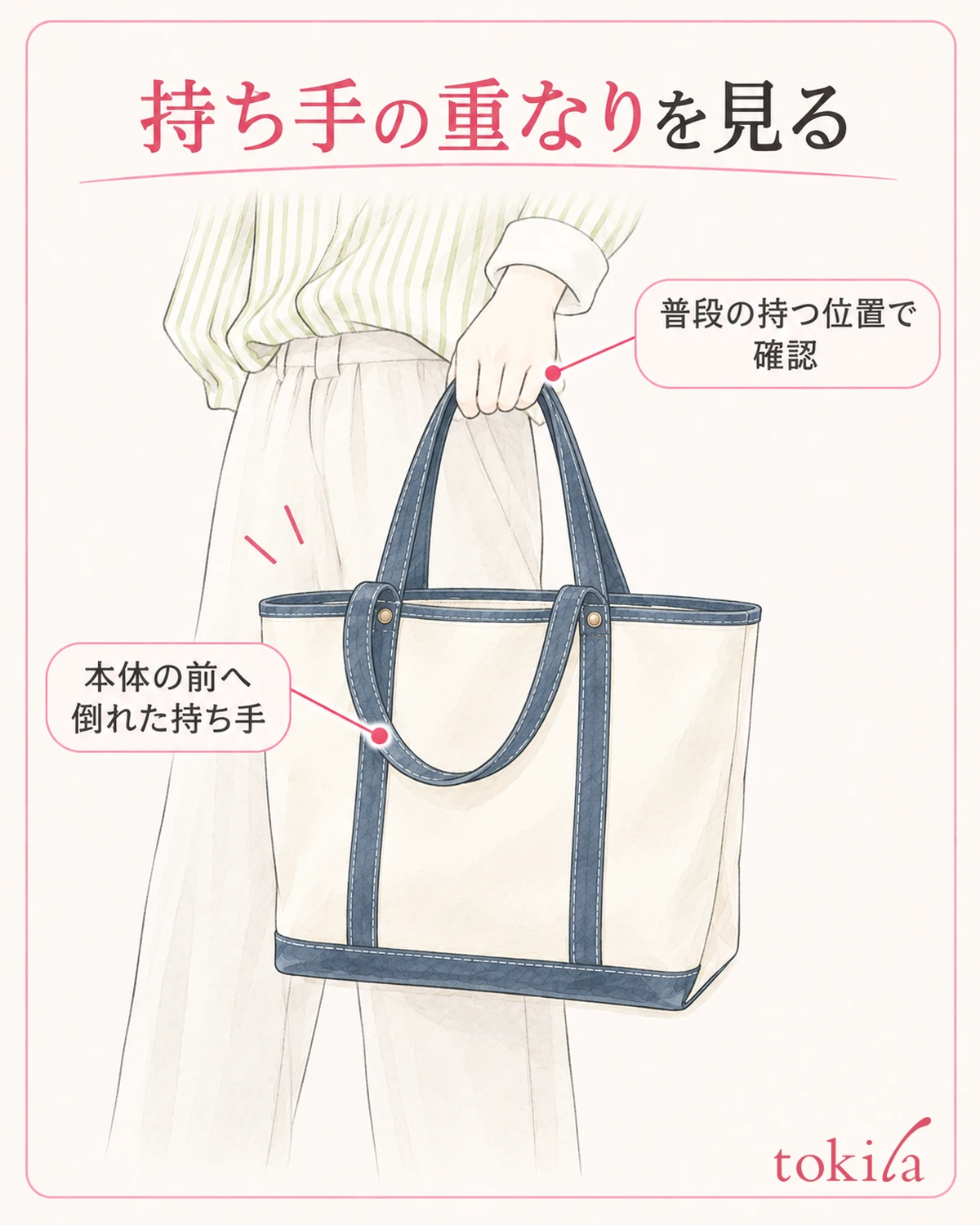
Once you have separated the colors with the bag laid flat, return to the way you usually carry it. If it is a handbag, let your arm hang naturally; if it is a shoulder bag, put it on your shoulder, and look in the mirror without pulling it too far in front of your body. The visible shape of the small color changes between when the handle stands up and when it falls forward over the body.
When a dark handle overlaps a light body, a thin band shows at that spot. Conversely, a handle that tucks in toward your body may not be as visible as it is when the bag is laid flat. Look not only at the strength of the color but also at which outlines actually come out over your clothes.
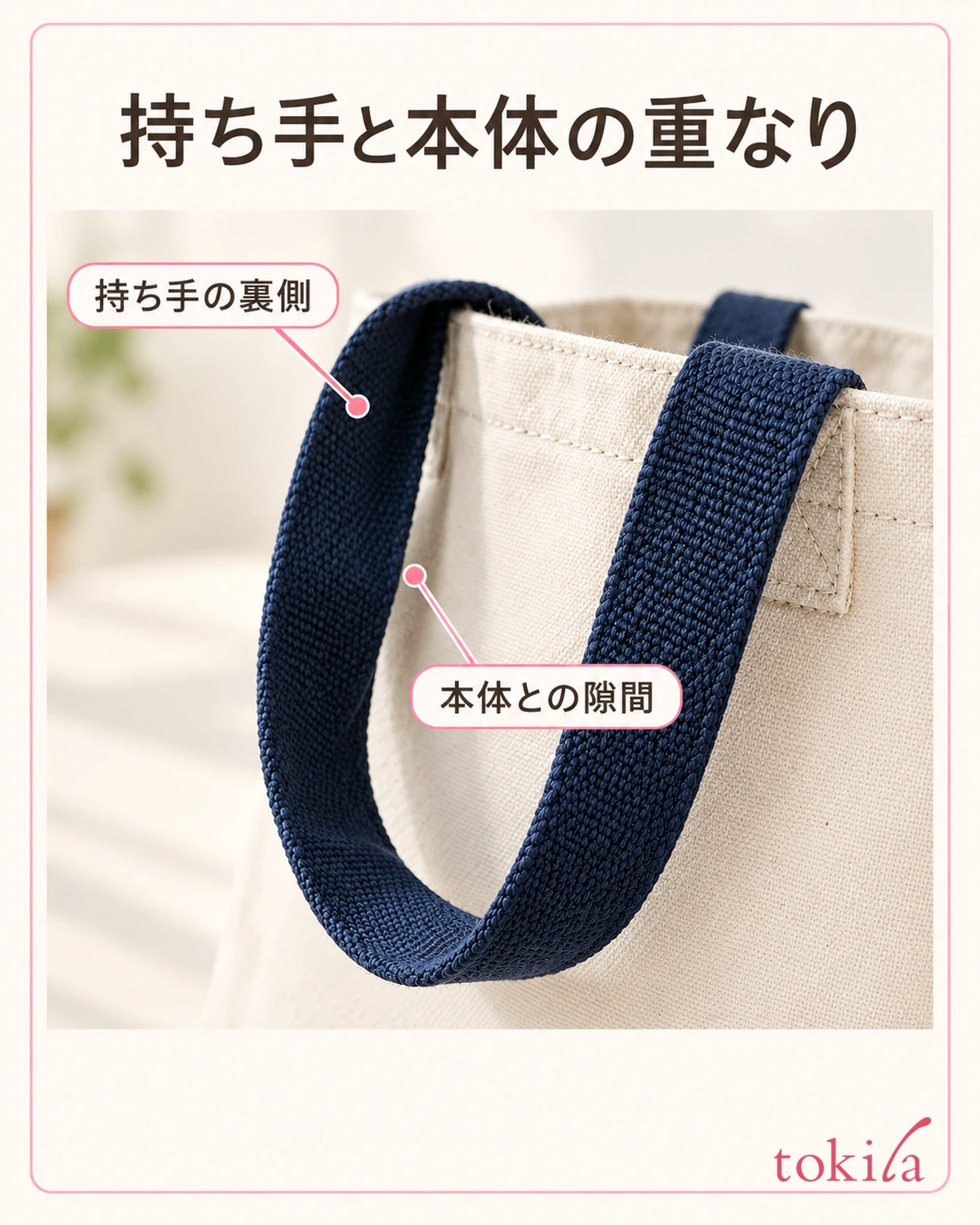
The positions where cloth or leather overlap are easier to check when viewed slightly from the side. Look at the front and back of the handle, the gap between it and the body, and the seam where the colors switch. If the back is a different color, count it separately from the front color, and instead of deciding the structure from a photo alone, check it by returning to the sight of carrying your own bag.
On days when you use a shoulder strap, include in your full-body view not only the body but also the band running from the shoulder. When the color of the band passes over your jacket for a long stretch, the impression can differ from the one you chose by looking only at the short handles. If both the two handles and the shoulder strap are visible, check whether you like it including that overlap.
Even if the length is adjustable, do not change it to an extreme position just for the sake of color. First protect a way of using it that is easy to walk in and lets you put things in and take them out. Also do not do anything to reduce the visible color, such as stuffing in a handle that cannot be removed or forcing the shape to fold.
Switching the hand you carry it with is the last check. This is because the places where it overlaps the seams or pockets of your clothes change. Even if it looks put together on one side only, you do not have to hold that pose all the time. Keep the combination you like, including the everyday switching of hands.
4. Compare the light-dark contrast of the color switch and the sheen of the material separately
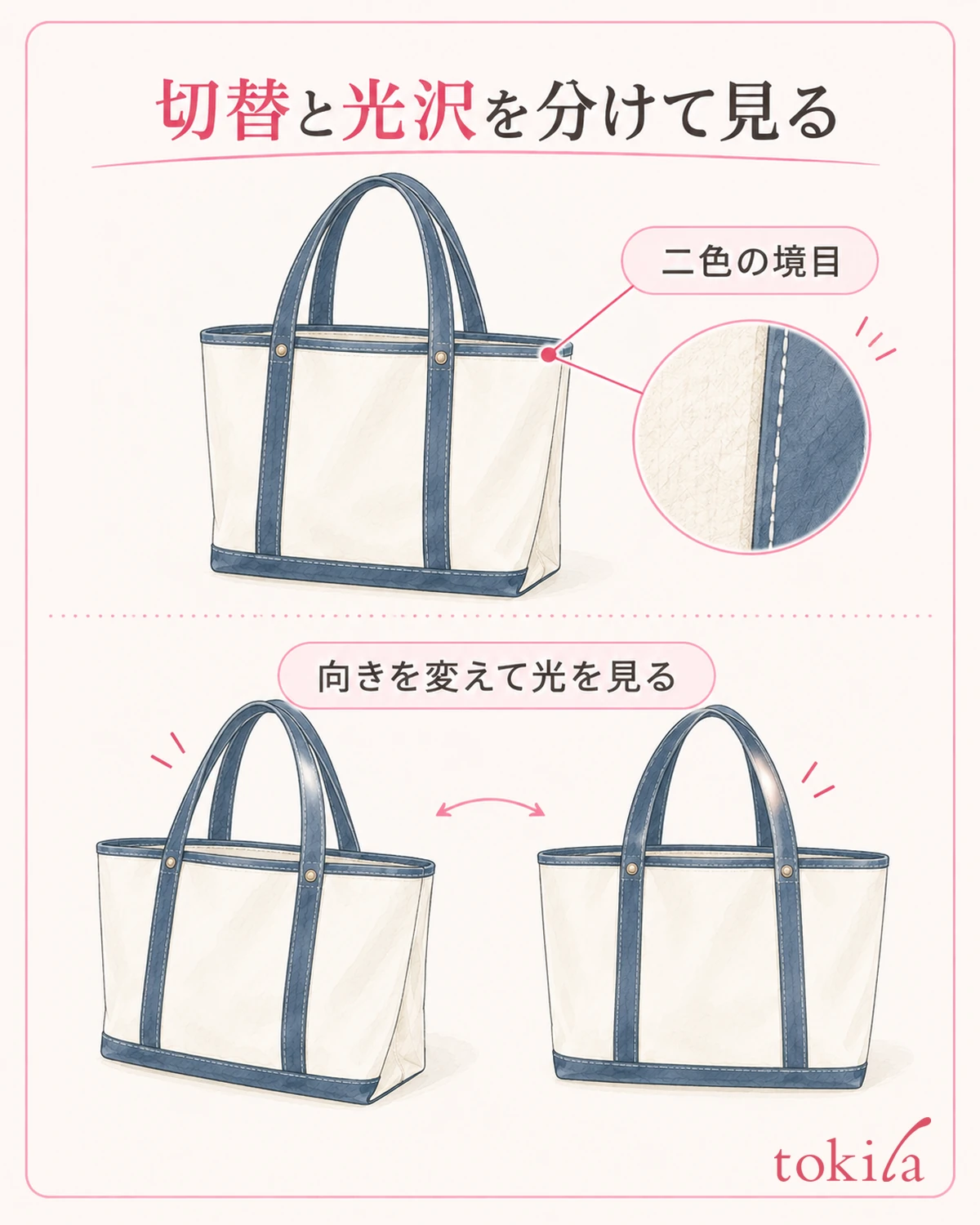
If the boundary between the two colors feels stronger than you expected, look at the difference between the light color and the dark color. Even a small dark edge can register as an outline. Even if you bring your clothes' color closer only to the large surface, the way the edge looks remains; that is not a failure, but also an element for enjoying that bag's color scheme.
If you want to keep the boundary, go ahead to the full-body look as it is. If you want to calm it down, change the one piece that overlaps behind the bag to a brightness close to one of the two colors and compare. You do not have to unify your clothes completely in two colors; first review just one boundary that bothers you.
If clothes with the same color name still feel different when paired, separate the tone of the color from the gloss of the surface. With a handle that returns strong light and a body of cloth that looks soft, the places that look bright change depending on the angle. Do not treat a single point of glare as the color of that whole part.
Without changing the mirror and the lighting much, turn your body slightly left and right and see whether the reflection moves. This is not a process of rubbing the material to remove the sheen or applying a chemical that changes the color. Limit yourself to checking the impression you get at the angles of the actual item.
There are also bags whose two colors are close in brightness, so the switch is not conspicuous. You can choose whether to keep that gentleness or to show the bag through the boundary with your clothes. Rather than deciding that you must always create a contrast of light and dark, or add a vivid color, take your preference for today as the standard.
If you are unsure about the relationship among accessories, including shoes, you can go on to how to compare the colors of shoes and bags. Here, sort out the two colors inside the bag first, and then add the footwear afterward, so that there are not too many things to think about at the same time.
5. Check with your full outfit including a jacket, and record why you chose it
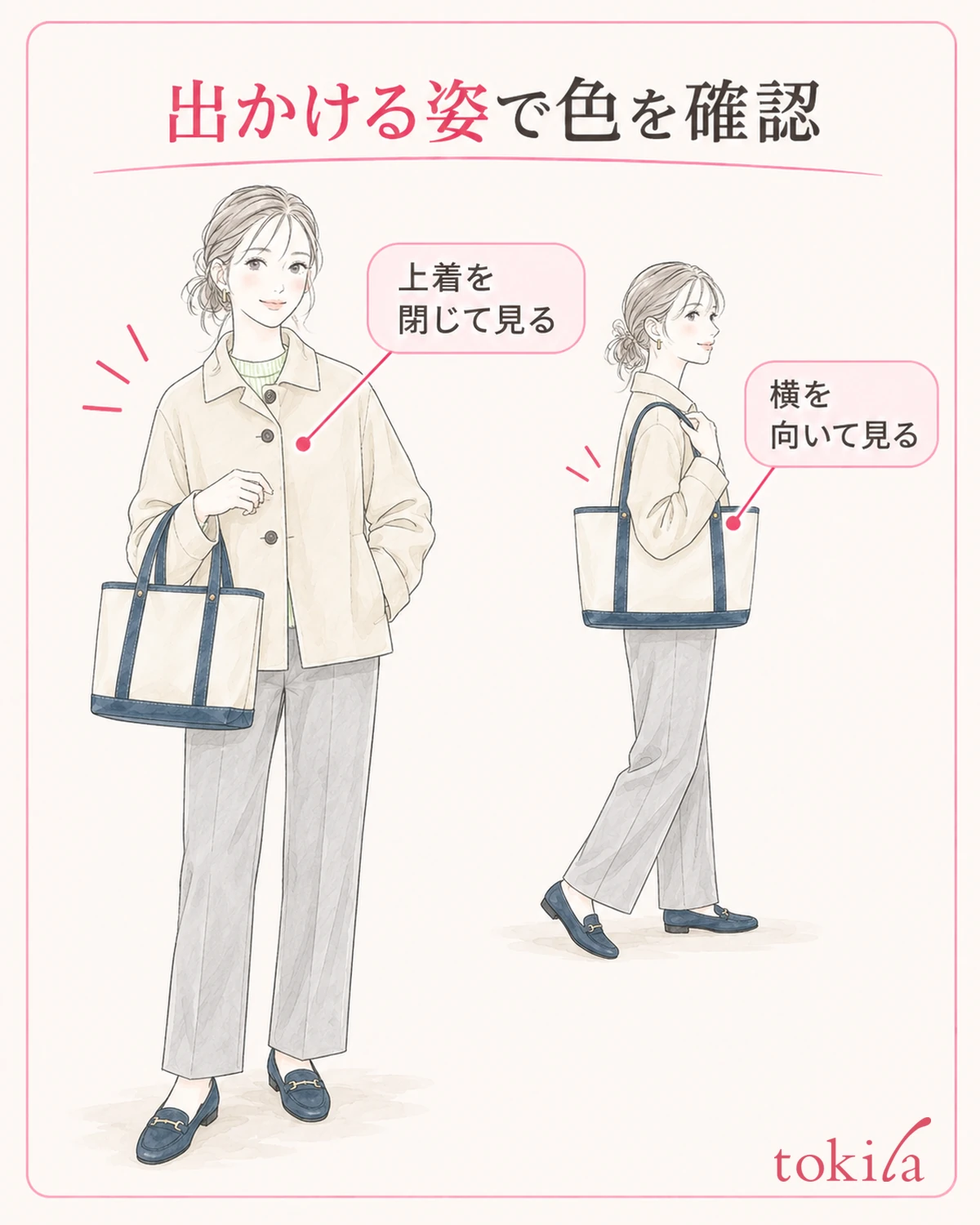
Once your candidate is decided, put on even the jacket and shoes you will actually wear out, and look from head to toe. When you close the front of the jacket, the color behind the bag changes. If you will go out with it closed, check it closed; if you plan to take it off partway, check how you look with it off as well.
From the front, see whether the relationship you chose is still visible, such as "the large body connects to the clothes" or "the navy of the handles connects to the pants." Include the color of the side that shows when you turn sideways and take a few steps. You do not have to fix the balance of the two colors at a single still moment.
Check once, in a place where it is no trouble, also under the light of the time you will go out. When you move to different light, look at the clothes and bag together, and do not compare only with your memory of the previous place. Avoid harming your items for the sake of comparison, such as leaving them in direct sunlight for a long time or setting them down in a place that gets dirty easily.
If you are still unsure, go back to your first outfit and choose again the spot that bothers you most today. Change only one piece: the jacket if it is the large body, or the clothing behind it if it is a long shoulder strap. Do not think you have learned the effect of color alone after changing the bag, clothes, and shoes all at once.
A photo and a short note are enough for a record. You can keep the part you want to show and the clothes you fixed, as in "light jacket for the ecru body, keep the navy handles." Because photos also involve correction and differences in screen color, do not treat them as evidence of a precise color match; use them as an aid for remembering the combination.
Before deciding that a two-tone bag is difficult, separate the large surface from the small color and check the balance that shows in your usual posture. Choose one color to connect to your clothes, and finally return to the full-body view. With this order as a starting point, try looking for a combination you like that keeps the difference between the two colors.