Your nails are a color you love on their own, but the moment you put on your outfit, your fingertips seem to stand out. You have no time to repaint, yet next to your cuffs something feels a little unsettled. On days like that, before taking off your nail polish right away, try reviewing the clothes and rings nearby one at a time. Even if the nail color is fixed, you still have choices on the side you pair it with.
Here we introduce a way to compare nails that are already finished with today's outfit, moving from your hands to your whole body. Instead of treating matching colors or skin tone type as the right answer, you choose by whether you want your fingertips to blend in or to enjoy them as an accent. How to apply and remove nail polish are separate steps.
1. Compare your nails and cuffs under the same light
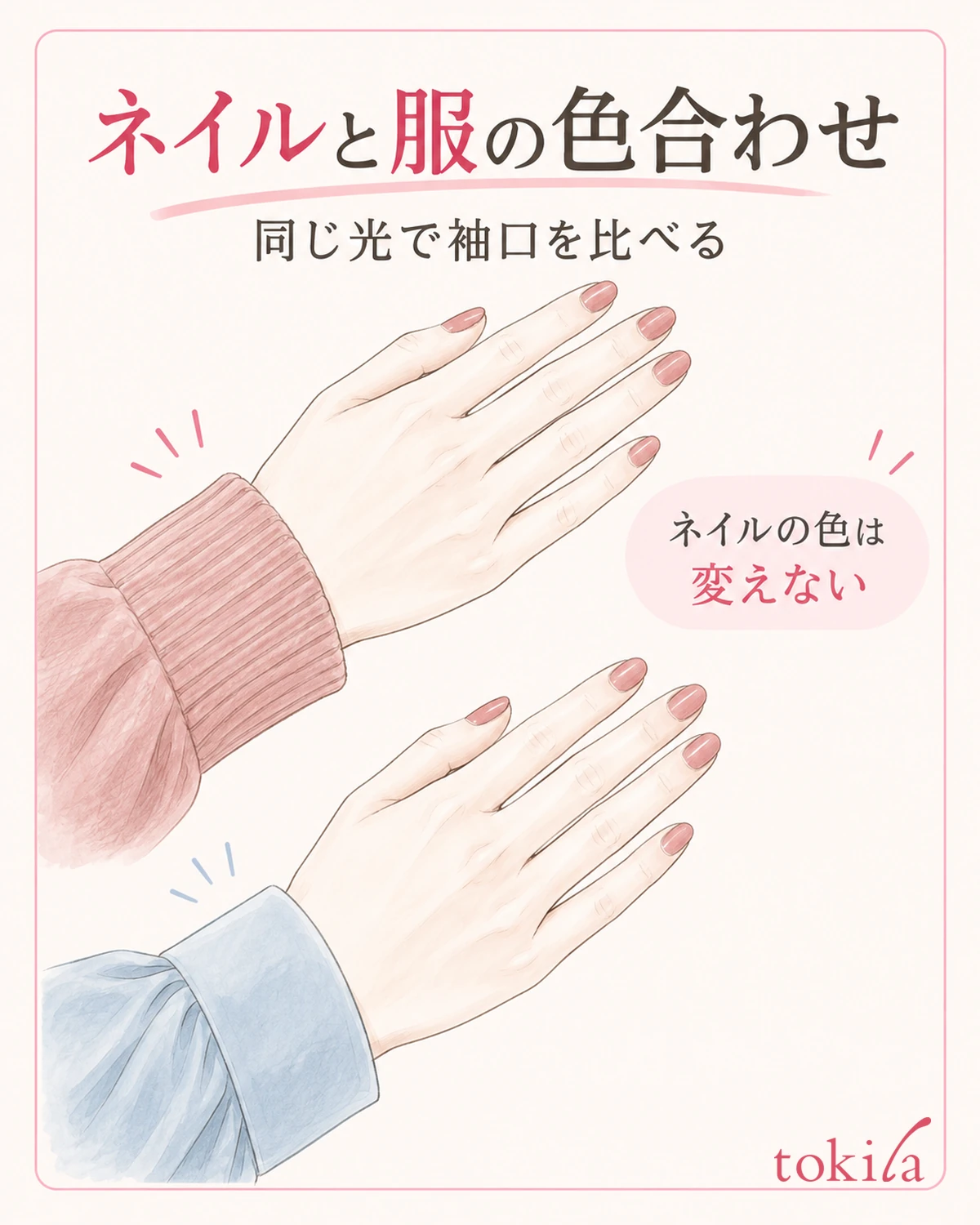
First put on one outfit you will wear today and let your hands come out naturally from the cuffs. If your nails are not yet dry or are still being finished, do not touch the clothes; complete the drying or curing steps for your product first. You do not need to press the fabric with your nails or pinch and pull the sleeve to compare.
At first, do not bring your hands close to your face; place them where both your nails and cuffs are visible, such as on a desk or in front of your waist. If the nails on your two hands have different designs, place each hand in the same spot in turn and look. Avoid comparing a left hand sitting in the shadow of the lighting with a brightly lit right hand.
When the light changes, so does how colors look. While you switch candidates, keep the place you stand, the lighting and your hand orientation the same. If you want to compare under a window and under room lighting, do not look at the clothes of only one; check both candidates under the same conditions each time. This is not to decide that either light is absolutely correct.
Next, put the one point that bothers you into words. Separate what it is, such as tone, how much it stands out, or the decoration: "the red of my nails looks strong," "the blue of the sleeve and the pink of my nails feel far apart," "the pattern and the glitter catch my eye at the same time." Do not try to fix everything from the start; choose one point you want to change today.
Depending on the surrounding colors, the same color can give a different impression. Even if your nails look brighter after you change the sleeve, the color of the nails themselves has not necessarily changed. Check whether you like both how it looks with only the nails and how it looks with the cuff alongside. Use photos only as an aid to record, and go back to the real thing for any difference you noticed on the screen.
If it is hard to change clothes, it is fine to go only as far as holding another cuff near your hand to compare. However, the area and shadow differ between fabric laid on a desk and clothes actually worn. After narrowing down the candidates, put them on and check again in the range you normally see.
2. Decide whether to blend in or make your fingertips stand out
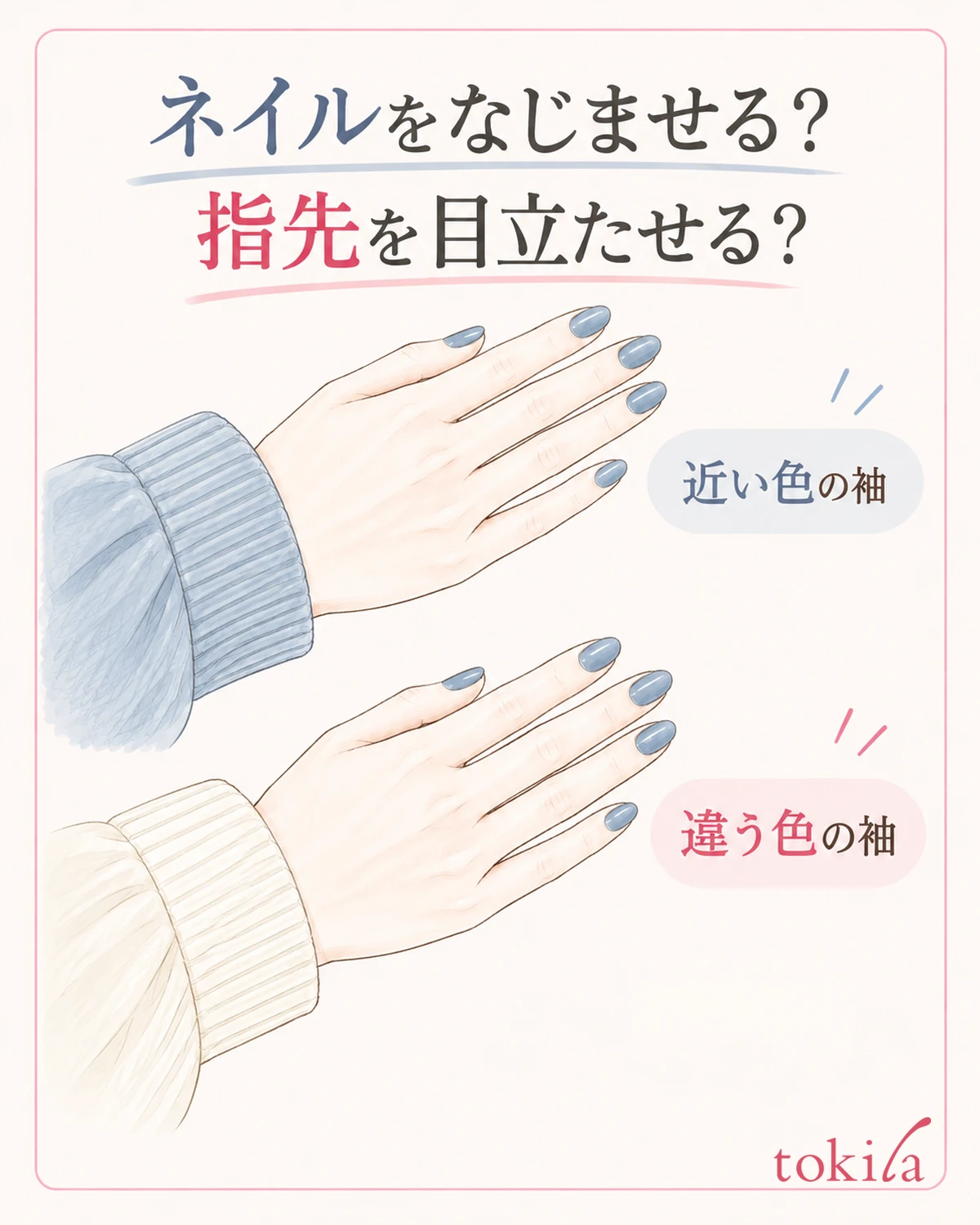
On days when you want to keep your hands quietly put together, you can start with a cuff in a tone close to your nails. If your nails are a muted pink, a place to start is pairing one calm pink piece of clothing. Rather than looking for a color with the same name, place the real item nearby and see whether you sense a shared tone.
Even if the tones are close, a difference remains when the sleeve is very vivid and the nails are pale. If it feels unsettled even though the colors are close, check the brightness or vividness. Rather than thinking "they are both pink, so they should go together," choose by which one catches your eye first and whether you like that way of standing out today.
On the other hand, on days when you want the nails to be an accent, it is fine to leave a color different from the sleeve. Try it with the clothes you have, such as red nails with a gray sleeve or blue nails with a white sleeve. Looking out of place against your clothes is not the same as not liking it. On a day you want to show off your fingertips, you may even enjoy the difference.
Narrow the candidates to two at most, "clothes in a similar color" and "clothes that keep the difference," and look at them alternately without changing your nails. If the shapes of the clothes also differ, do not consider it a comparison of color alone. Include the width, length and material of the sleeve, and judge which you like better as today's look.
If both feel strong, there is also the idea of trying a sleeve in a neutral color such as white, black or gray. However, black will not necessarily blend in, and white will not necessarily be subdued. A large difference in brightness can make the nails stand out more clearly, so check on your hands.
When you want to sort out color vocabulary,the basics of tone, brightness, vividness and color coordinationcan also be a useful reference. Rather than memorizing terms, deciding first whether you want to show your nails today or blend them into your clothes will settle the direction of your choice.
3. For patterned clothes, use the one color visible near your hands as a clue
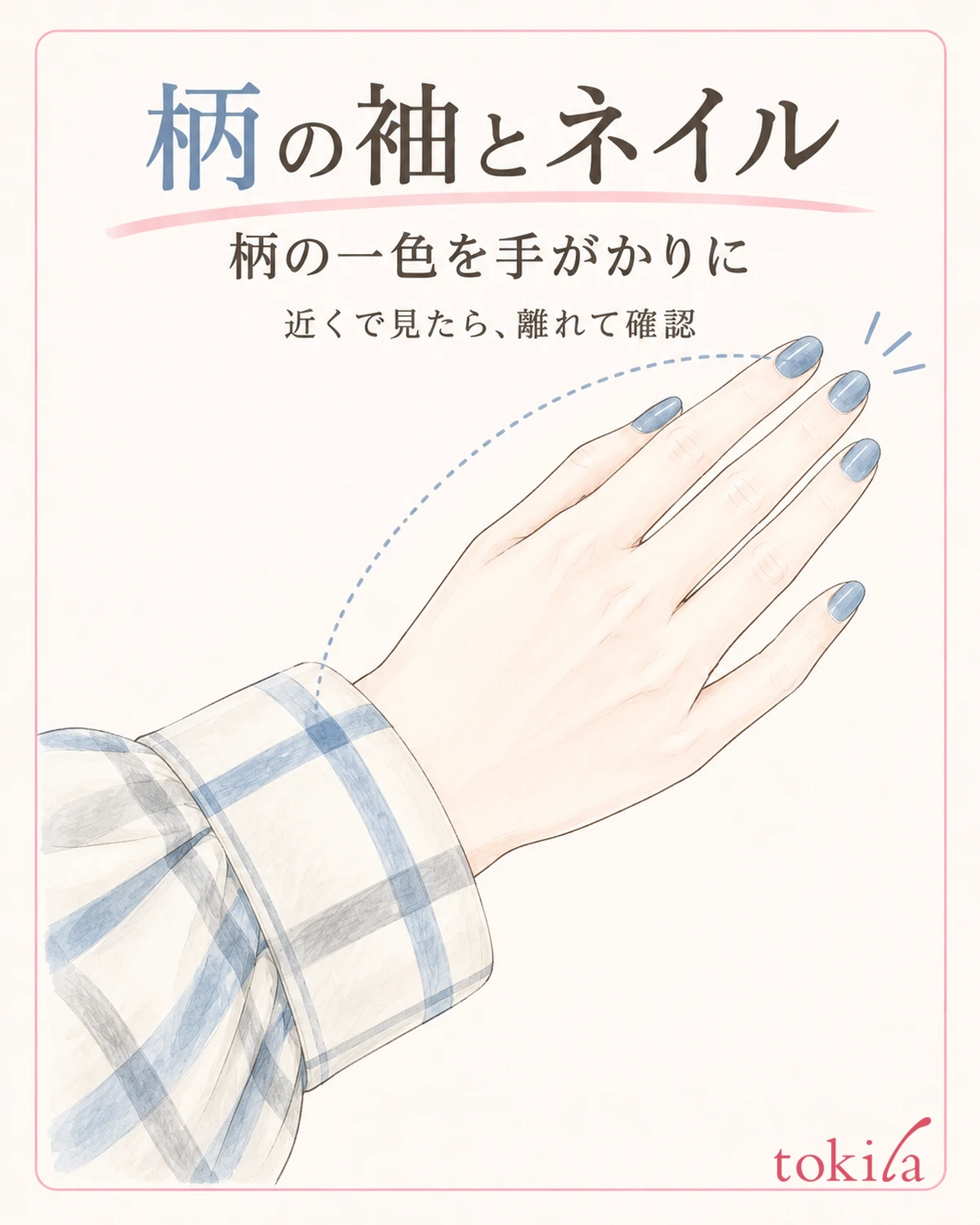
When matching with patterned clothes, rather than counting all the colors of the garment at once, first check which colors are visible near the cuff. For a floral print, the petals, leaves and ground color; for a check, the thick lines and thin lines. Even on the same garment, the part showing at the edge of the sleeve changes the impression of your hands.
If the pattern includes a color close to your nails, you can use it as a clue. For example, blue nails with a check that has thin blue lines. You do not need to match the nails and lines to exactly the same color; check whether you can feel a connection when you look yourself.
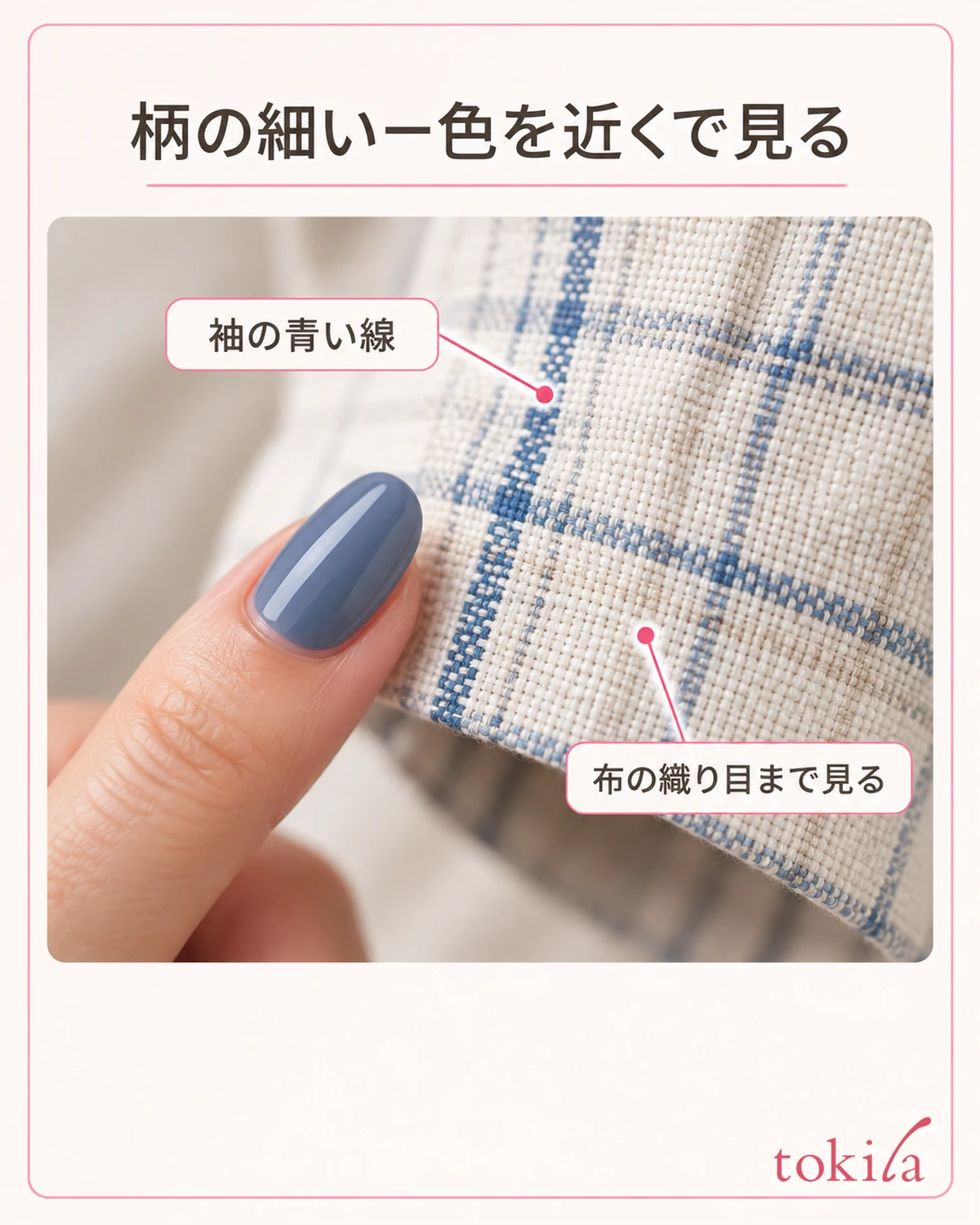
Even without a close color, you do not have to rule that garment out. Go back to whether you want to enjoy both the nails and the pattern, or make one of them stand out. On a day you want the pattern to be the star, one idea is to layer a plain outer piece you own and compare, changing how much of the pattern shows near your hands.
If you roll up your sleeves, do so within a range that is comfortable and does not strain the garment's construction. For clothes where a different color appears on the inside of the rolled part, include that color as one you actually see. You do not need to twist or tightly fasten the sleeve to show one favorite color in the pattern.
With glitter or multicolor nails, the nails themselves carry several pieces of color and light information. If the pattern's lines and the fine decoration overlap and feel busy, first try switching to a plain sleeve. Conversely, if you like it better with the pattern, you can simply enjoy it. The aim is not to uniformly reduce the amount of decoration.
Even if you pick up one small color in a pattern, it may be almost invisible from a distance. Do not make a close-up match the only condition for completion; check on the upper body or whole body afterward. Creating a color correspondence is just one way of choosing.
4. Take off one ring and look at color and shine separately
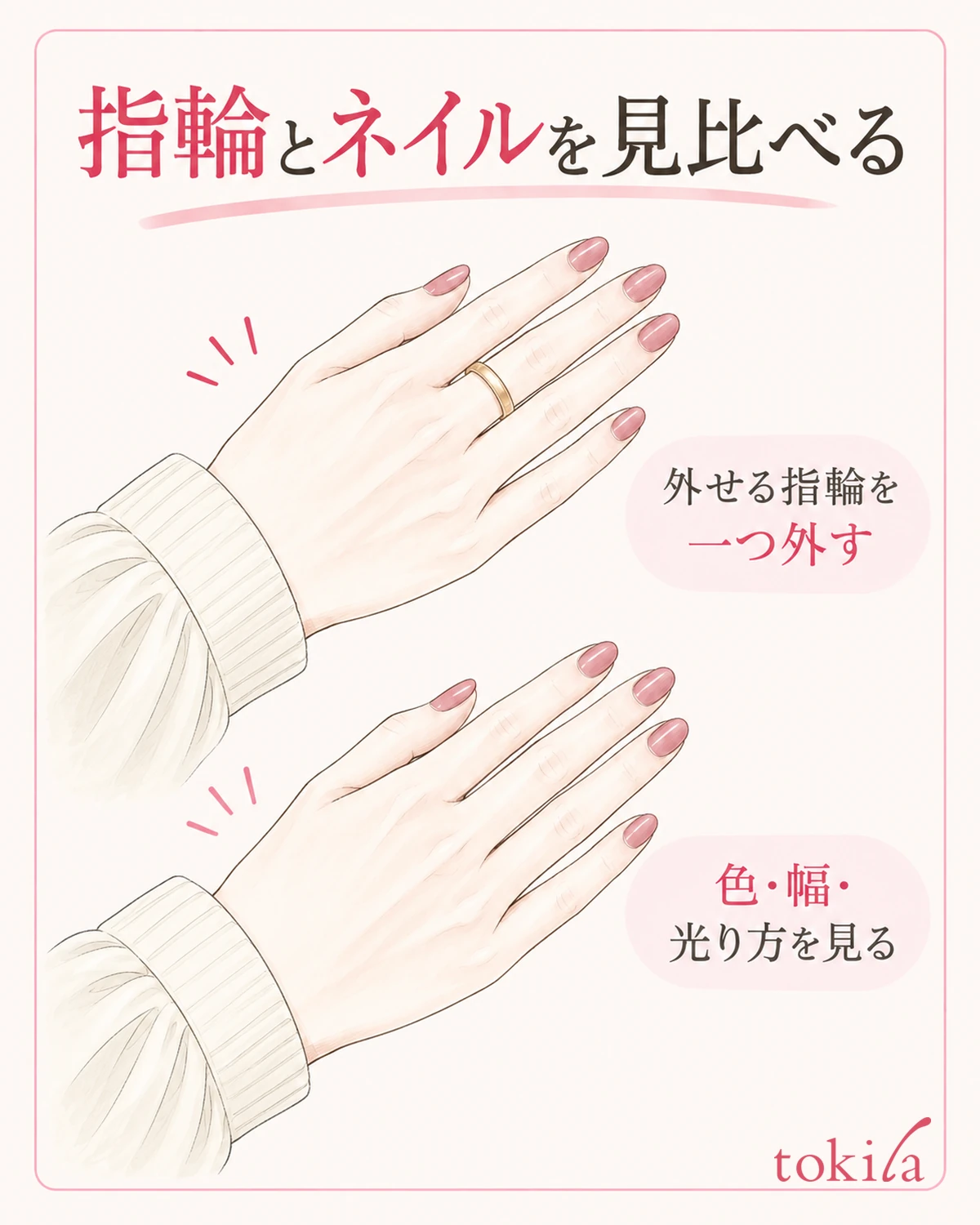
If you like just the sleeve and nails but feel unsettled once you add a ring, take off just one removable ring and compare. Do not change all the accessories or clothes at once; check how the one that was added looks. If there is a ring you do not take off, use the state with it left on as the baseline.
For rings, look not only at the metal color but also at the width, the stone color and the reflections. A thin silver band and a silver band with a large stone are the same color but occupy different areas to the eye. Rather than quickly deciding "gold does not suit these nails," separate out what is standing out.
Tilt your hand slightly and check how the nails and ring shine. Do not judge from a momentary strong reflection alone; look with your fingers naturally extended as well. There is the idea of enjoying glitter nails together with glossy metal, and the idea of toning down the ring to make the nails the star. Do not rub or polish the surface to remove the shine.
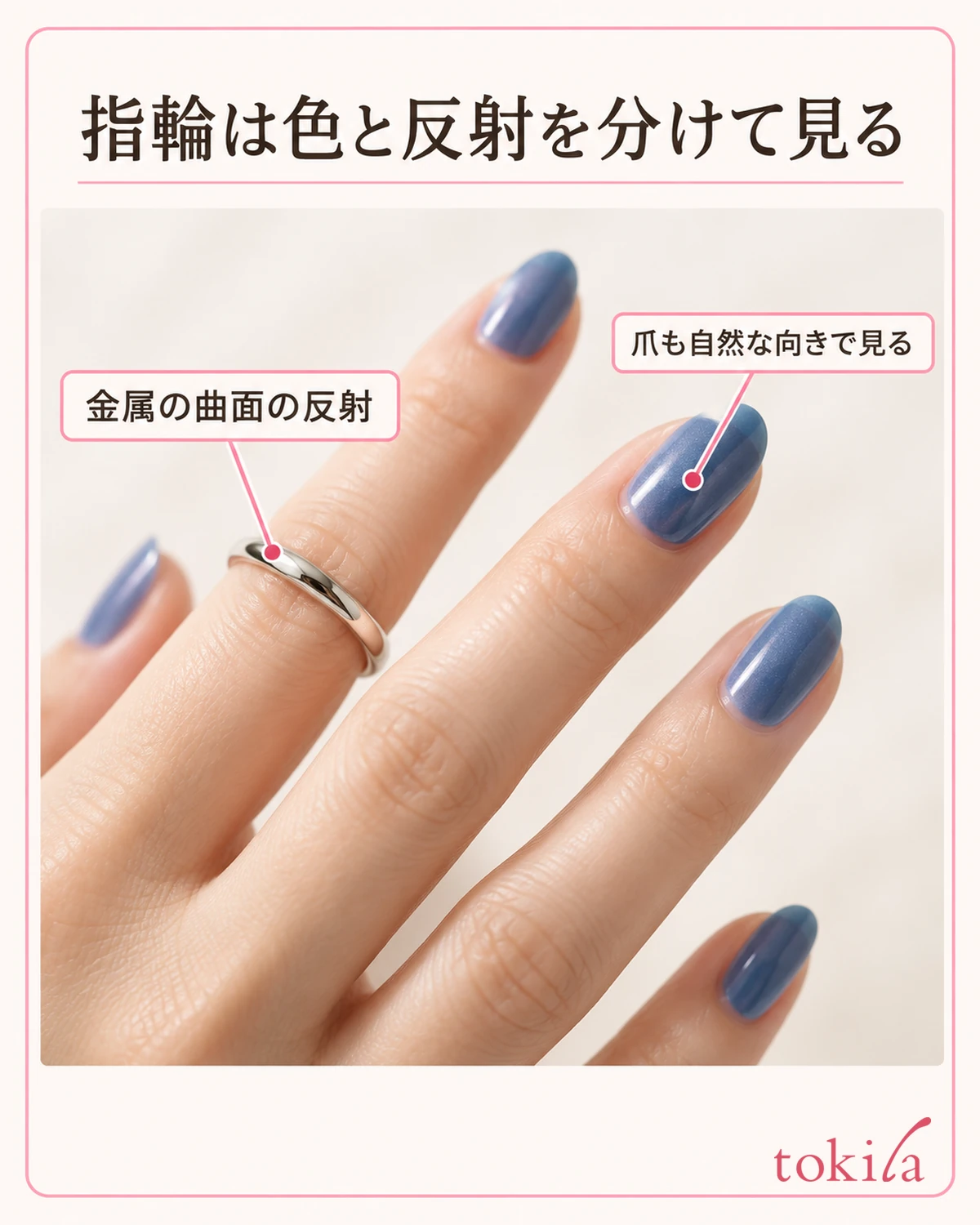
If you have another ring, try one that fits the same finger. If thickness changes as well as color, treat it as a comparison where color and shape were changed together. Do not force a tight ring onto another finger or let a stone touch nail decorations, or otherwise wear things in a strained way for looks.
Put a removed ring in a designated case, and do not leave it on the edge of a sink or in a clothing pocket. Even if removing it lets you compare, if the place makes you worry about losing it, it is enough to just try it after you get home. You do not need to pull on a ring that does not come off easily just to compare.
When you want to combine gold and silver accessories themselves, go tothe steps for reviewing the star piece and placement of gold and silver. Here, look at the relationship with your nails and choose what to keep one by one.
5. Return to your usual hand position and decide the finish on your whole body
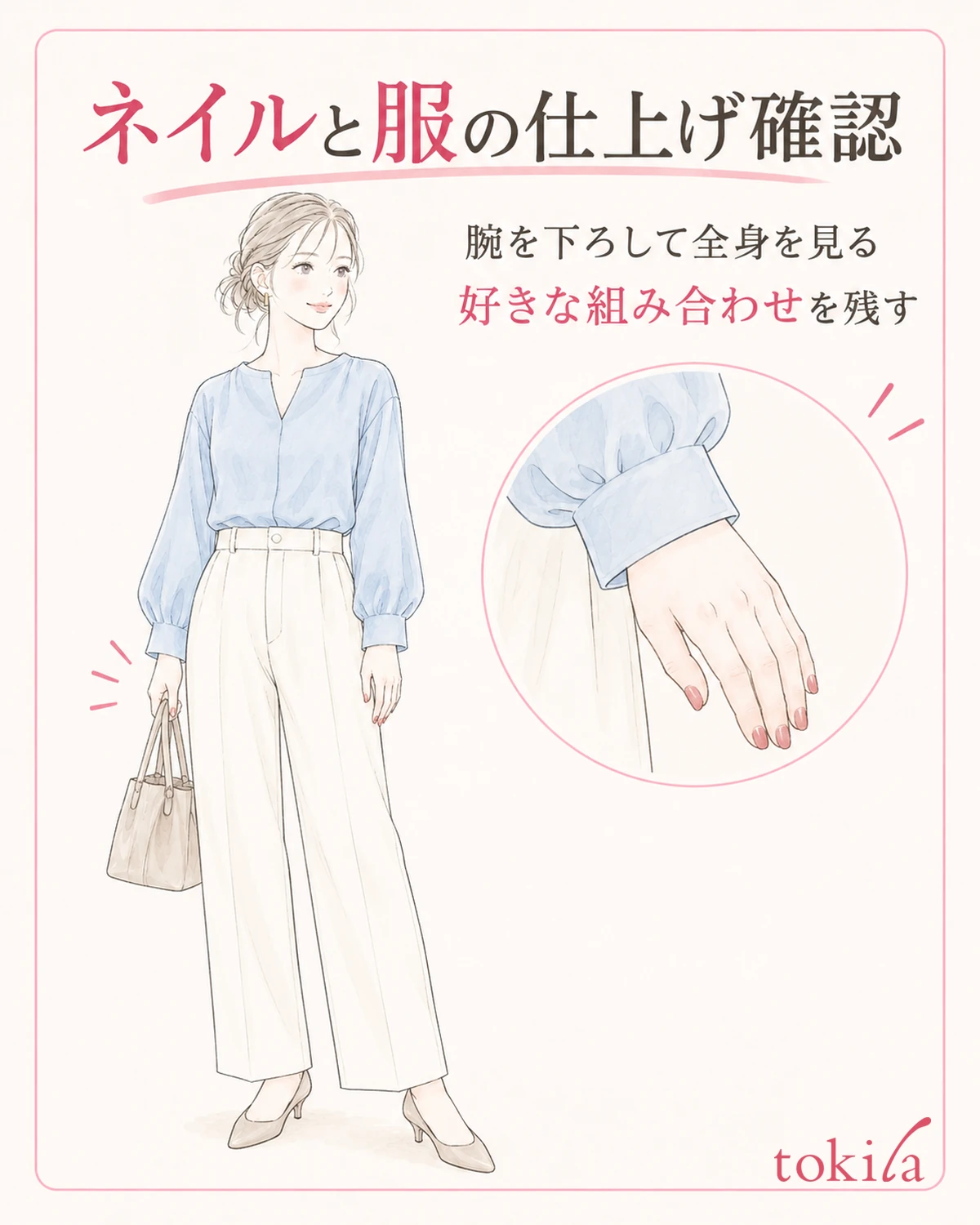
Once you have decided on the candidates for your hands, step back a little from the mirror while still dressed. Let your arms hang naturally and check in the postures you often take today, such as holding a bag or sitting at a desk. Do not decide how the whole look hangs together from a photo of your nails raised beside your face alone.
If the clothes have sleeves that cover the back of your hand, see how much of your nails shows when you move your arm. With short sleeves, you will see your arm between the cuff and your fingertips. It is no surprise if the impression differs from the close-up comparison. Choose, at the actual distance, whether you want to keep the color of your fingertips.
When hesitation returns, go back to the point that bothered you that you first put into words. If you want to tone down how strong the nails look, put the sleeve candidate back. If the decoration feels like too much, try taking off the ring you added later. Do not change nails, clothes and accessories all at once; start with what you can undo right now.
On days when you have no time to repaint, it is fine to finish with the combination of clothes and nails you can use today. You do not need to layer another liquid on finished nails in your own way just to match colors. The option also remains of choosing clothes first and then picking the color on the day you next change your nails.
Briefly record combinations you like, with color and place, like "blue nails + white sleeve + thin ring." If you keep a photo, include the clothes as well as your hands so you can tell which sleeve you wore. If the light looks different on another day, check against the real thing instead of treating the record as an absolute color sample.
In matching nail and clothing colors, making everything the same color is not the only answer. Look at the cuff under the same light, choose between blending in and standing out, check the pattern and the ring, and return to your usual posture. In this order, try to find the hands and outfit that today's you likes.