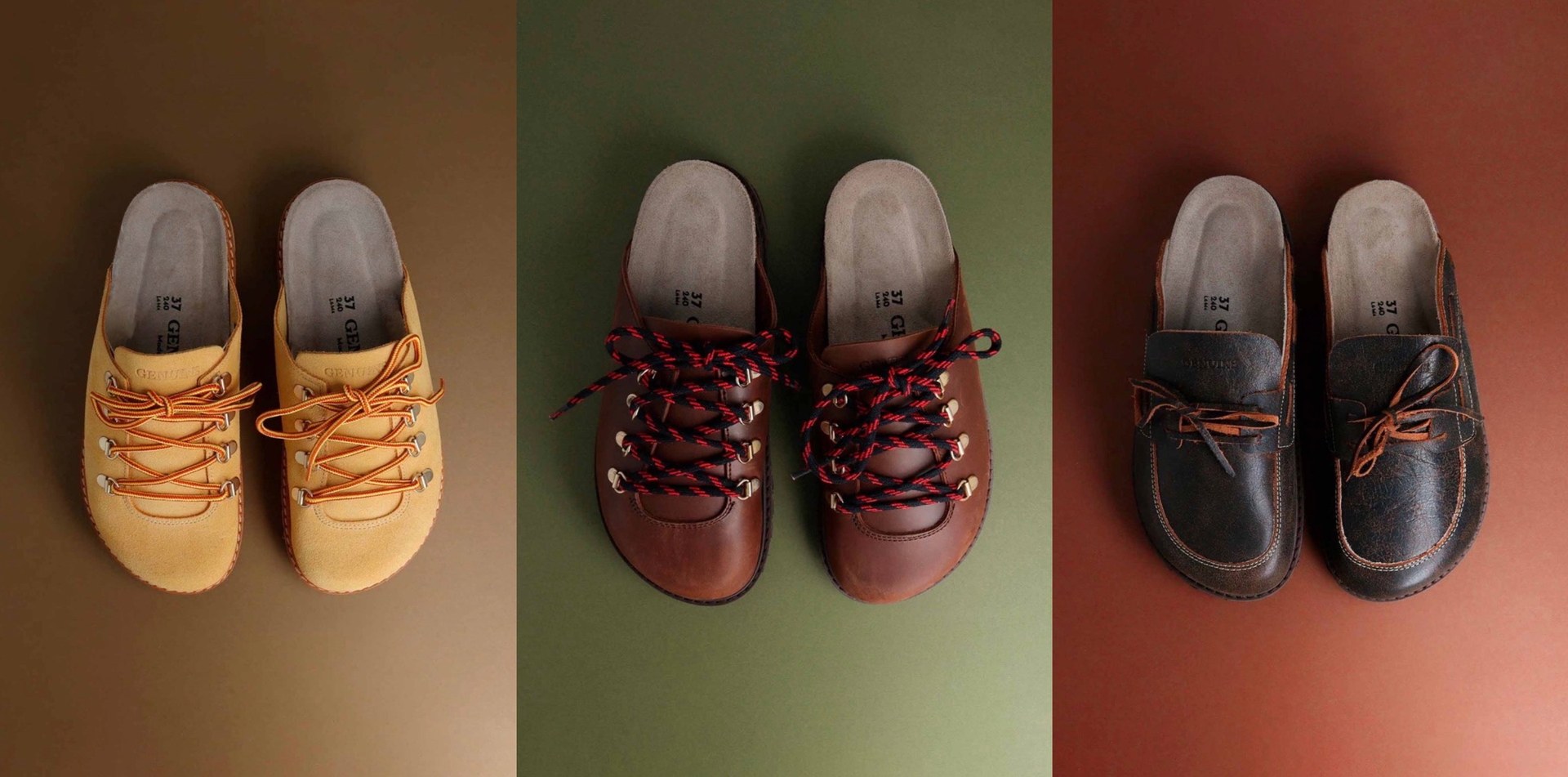
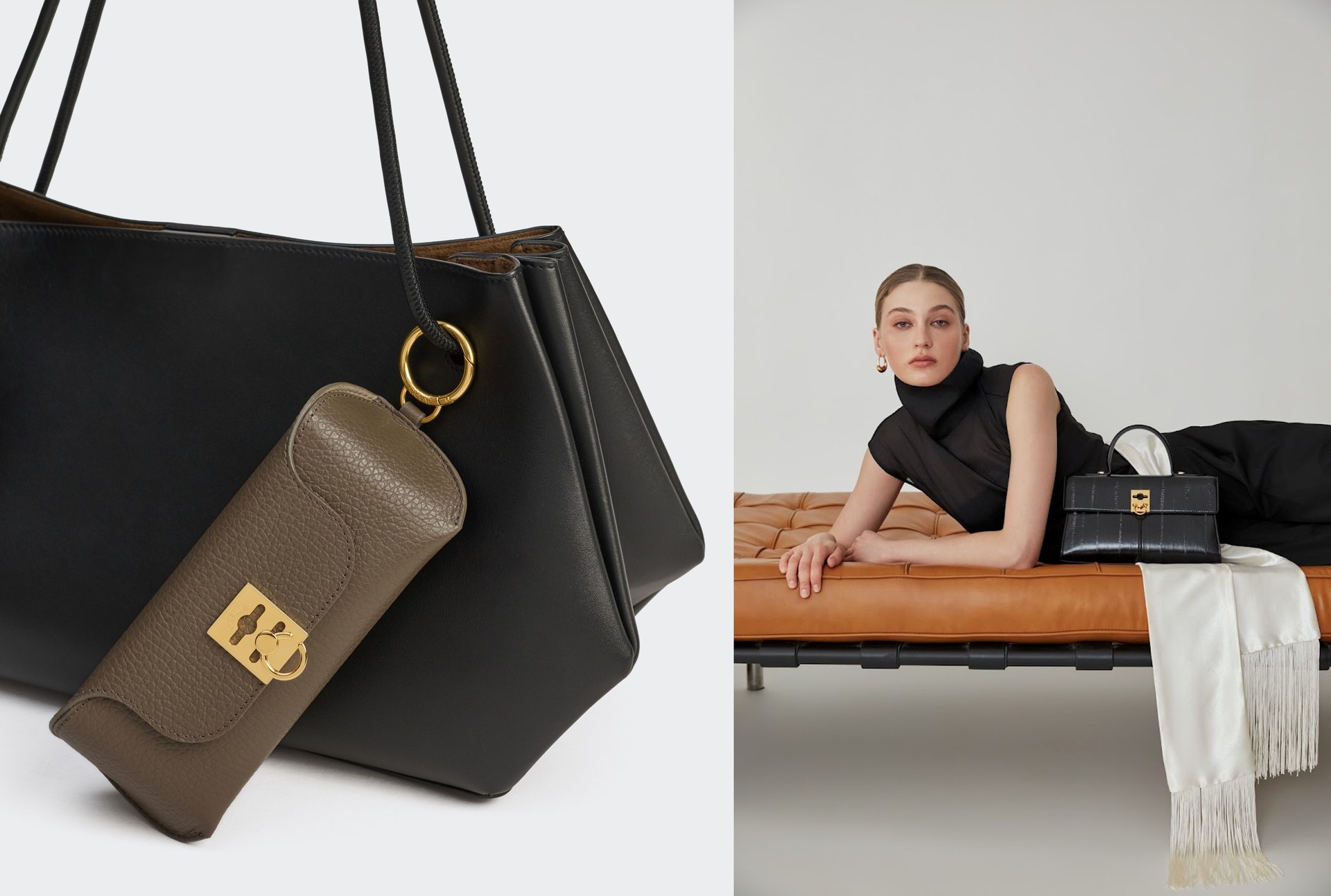
You love the colors of your shoes and your bag when you line them up, but when you wear them, the two seem to drift apart. You want to change one of them but are not sure what color to choose. In that case, before matching the two to the same color, try looking at your whole outfit, including the clothes between them. The combination in your hands and the combination that includes your feet are viewed under different conditions.
This article introduces a way to decide on one pair of shoes to wear today and compare by swapping the bags you already own. Rather than treating a color match as the right answer, choose according to whether you want to blend them in or make an accessory stand out. It can also help you organize your thoughts before deciding which color to buy next.
1. Put on the shoes and look with the bag held in its usual position
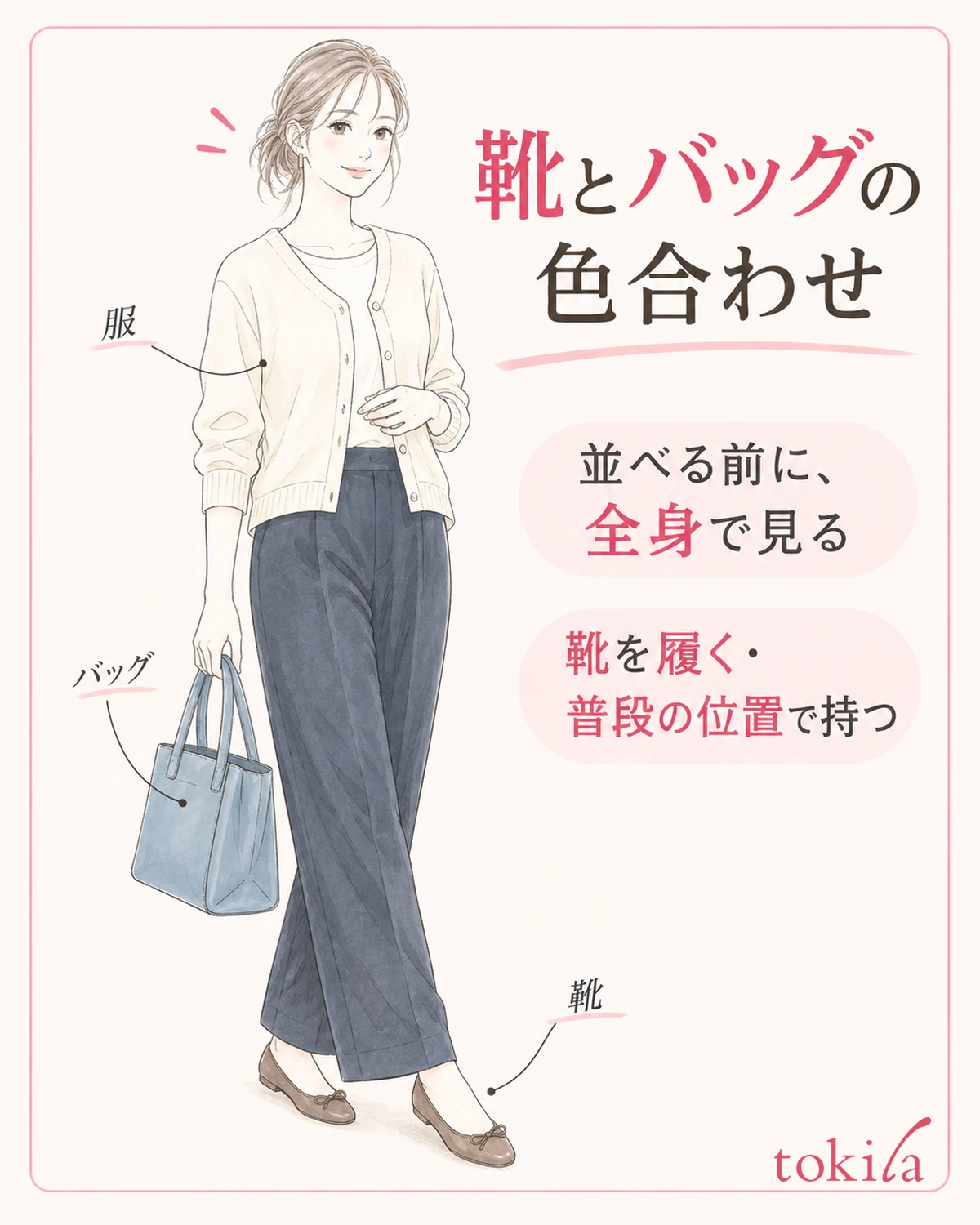
First, put on today's clothes and shoes, and hold the bag you will use. If you are indoors, check in a place where you will not dirty the floor, and make your candidates shoes that are comfortable to walk in and a bag that holds the things you need. You do not need to choose cramped shoes or a hard-to-use bag just to compare colors.
In a full-length mirror, look from head to toe at once. Just placing the bag right next to the shoes to compare does not show you the distance at which you will actually use them. For a handbag, return it to the position where you usually carry it; for a shoulder bag, to where it hangs on your shoulder, and check including the area that overlaps your clothes.
Here, put into words what you mean by "somehow it doesn't match" by naming the spot that bothers you. Is it that only the bag catches your eye as bright, that the black at your feet looks strong, or that the tones of the two accessories feel far apart? Choosing one first makes it easier to decide which to swap in the next comparison.
For example, suppose you pair brown shoes and a blue bag with an ivory jacket and navy pants. There are days when you want the blue bag to be the star, and days when you want the accessory colors to come together quietly. The goal changes even with the same outfit, so do not decide it is a failure just because there are two colors.
While comparing, keep the mirror, lighting, and where you stand the same. Also keep the side you carry the bag on the same, and do not pull only one of them in front of your body. Once you have picked a point that bothers you from the front, turn your whole body slightly to the side and look at the side view and the color of the handle in your actual posture too.
If it is hard to decide on the clothes first, choose just one top-and-bottom set you often wear. Rather than starting to look for a combination that goes with many outfits at once, check with today's single set first so that the comparison does not spread too far.
2. On days you want to connect the colors, compare starting with a bag close to the shoes
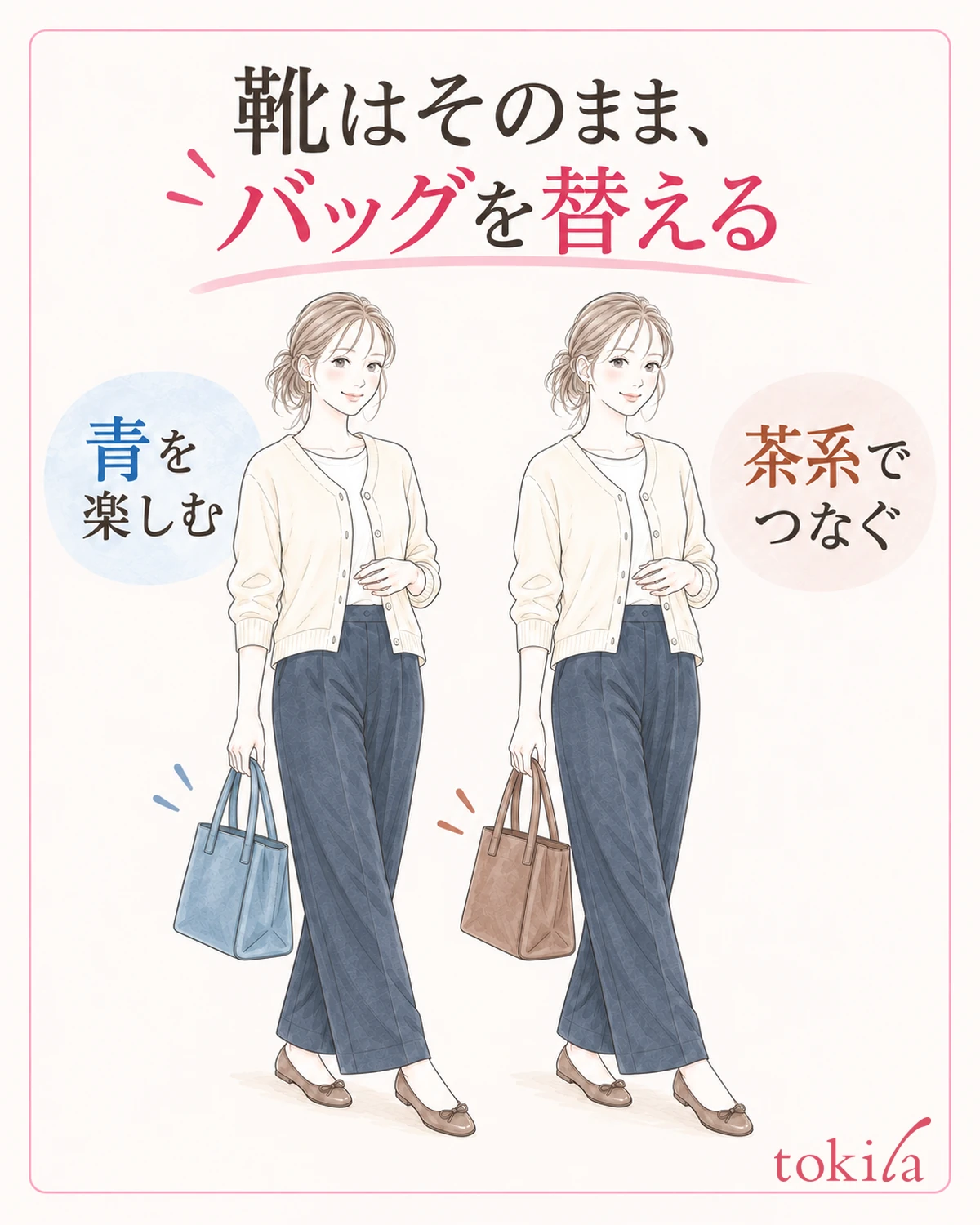
On days when you want to feel a shared color between the two accessories, try one bag in a color family close to the shoes. With brown shoes, a brownish bag; with black shoes, a black or dark gray one, and so on, which you can choose from what you own. It is not a task of matching the exact same dye or material.
First leave the shoes as they are and swap only the bag. Even among browns, a reddish brown, a yellowish brown, and a dark chocolate brown give different impressions. Do not judge by the name, thinking "it's brown, so it should match"; look to see whether you feel a shared color within your whole outfit.
Even if the tones are close, a bag that is lighter than the shoes can make your hand area stand out clearly. Choose whether to feel the unity while enjoying the difference in brightness, or to move closer to a similar brightness. If, after moving toward the same color, you feel there is too much dark area, you may go back to the first bag.
Conversely, you can try a combination whose tones differ but whose brightness or vividness is close. A candidate that keeps the difference, such as navy shoes and a muted green bag, is one example. Do not change tone, brightness, and vividness all at once; decide what you want to share, one thing, and compare.
Narrow the candidates down to two at most: the first bag and the bag you swapped in. If you like both, you may decide by the belongings you will carry or where you are going. If you want to sort out color terms, you can also see how to combine colors in color coordination.
If you have only one candidate, just putting into words the colors the shoes and bag share and the colors that differ is enough. Rather than preparing a new bag only to make the comparison work, keep the option of pairing the same bag with different shoes on another day.
If the two bags also differ in size, do not consider that only color was compared. Judge your overall like or dislike as candidates that differ in both color and area. You can try it even if you do not have another color of the same shape, but it is important not to say that the difference in shape is also an effect of color.
3. Check the color of the clothes between the two accessories
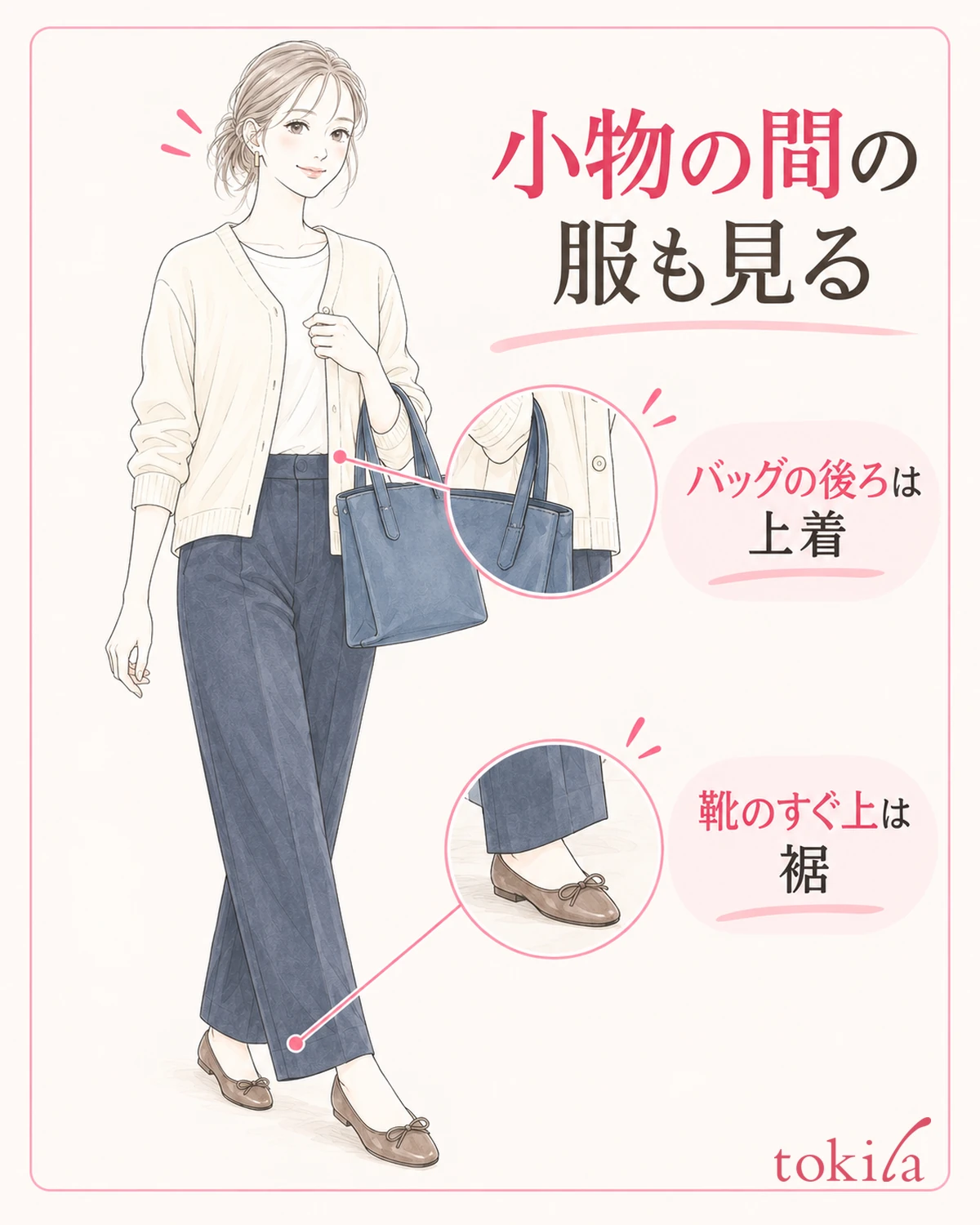
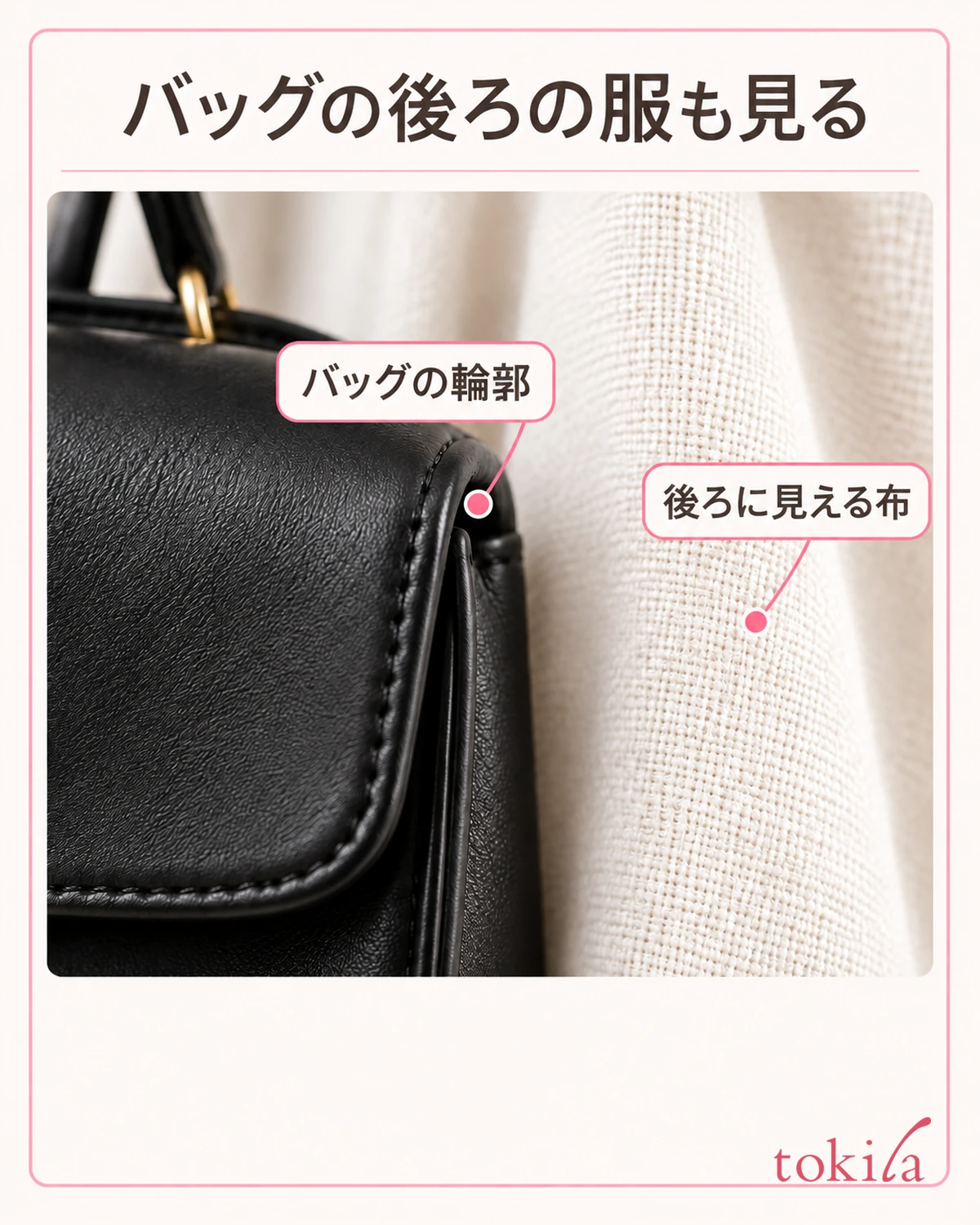
When the combination of shoes and bag feels disconnected, look not only at those two but also at the jacket and bottoms visible between them. The bag overlaps your clothes, and the shoes show beneath the hem. Colors lined up in your hands alone cannot show you their relationship with the surrounding colors.
For example, carrying a black bag against light clothes makes its outline stand out clearly, and against dark clothes it can give a different impression. Do not decide that black is always unobtrusive or that white always blends in; look at them together with the clothes they actually overlap. Check your feet as well, including the color of the hem.
If you want to calm the bag down, in addition to making it the same color as the shoes, you can try one bag in a color close to the jacket or bottoms. With navy pants and brown shoes, one idea is to carry a navy bag and build a link on the clothes side. You can also choose to leave the shoes as a single accent.
On days when you want to keep the bag fixed, swap just one piece of clothing for the comparison. If you change the jacket, leave the shoes, bag, and bottoms as they are. If you change both the jacket and the shoes at once, it becomes harder to think about why you liked it in terms of the link between colors.
Whether the front of the jacket is open or closed also changes the color seen behind the bag. If you will keep it closed when out, use the closed look as the reference, and if you plan to take it off indoors, check that look too. There is no need to keep it open and put up with the cold or discomfort just for the color scheme.
If you pick colors from patterned clothing, you can go on to how to match accessories to one color in a pattern. This time the step looks at the relationship between two accessories and the clothes, so do not add new patterns or accessories first; compare using the colors you can see now.
If a color close to the bag is already included in part of the clothes, also look at your whole outfit with it left in place. Before adding a new small color, check whether your current clothes already show a shared color. On days when that color is hidden by the jacket, you can go back to the impression of the accessories alone and judge from that.
4. Even with the same color, look separately at gloss and visible area
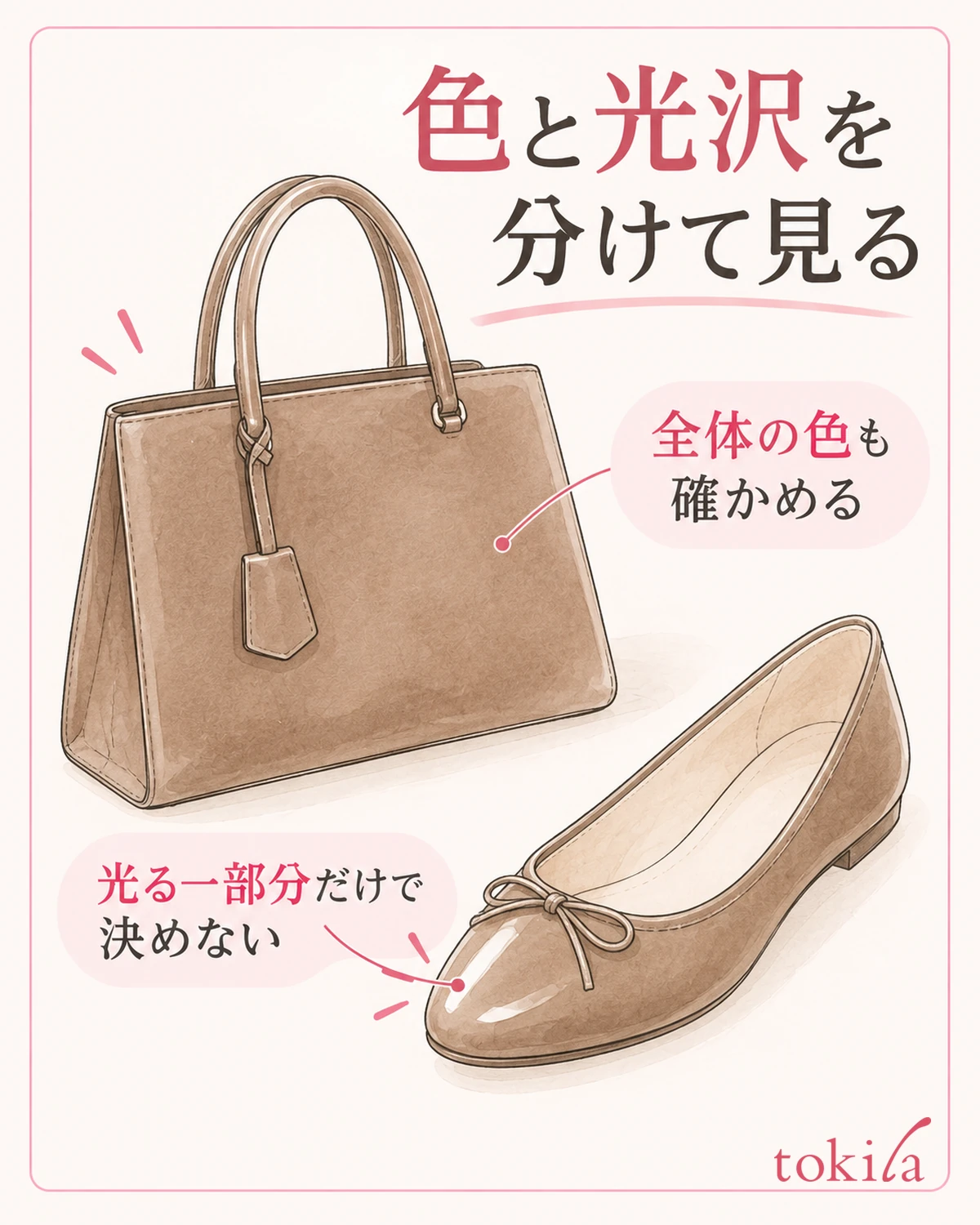
If, although you brought the colors closer, only one of them stands out, look at how the surface shines. Even in the same black family, glossy shoes and a bag that receives light softly look different. Do not assume that a color name alone gives the same impression of material.
Without changing your position in front of the mirror much, change the angle a little and look. Check whether the bright reflection on the toe of the shoe or on part of the bag moves, and whether the area that shines differs between the front and the side. Do not compare using only a single white point of reflection as the color of the whole item.
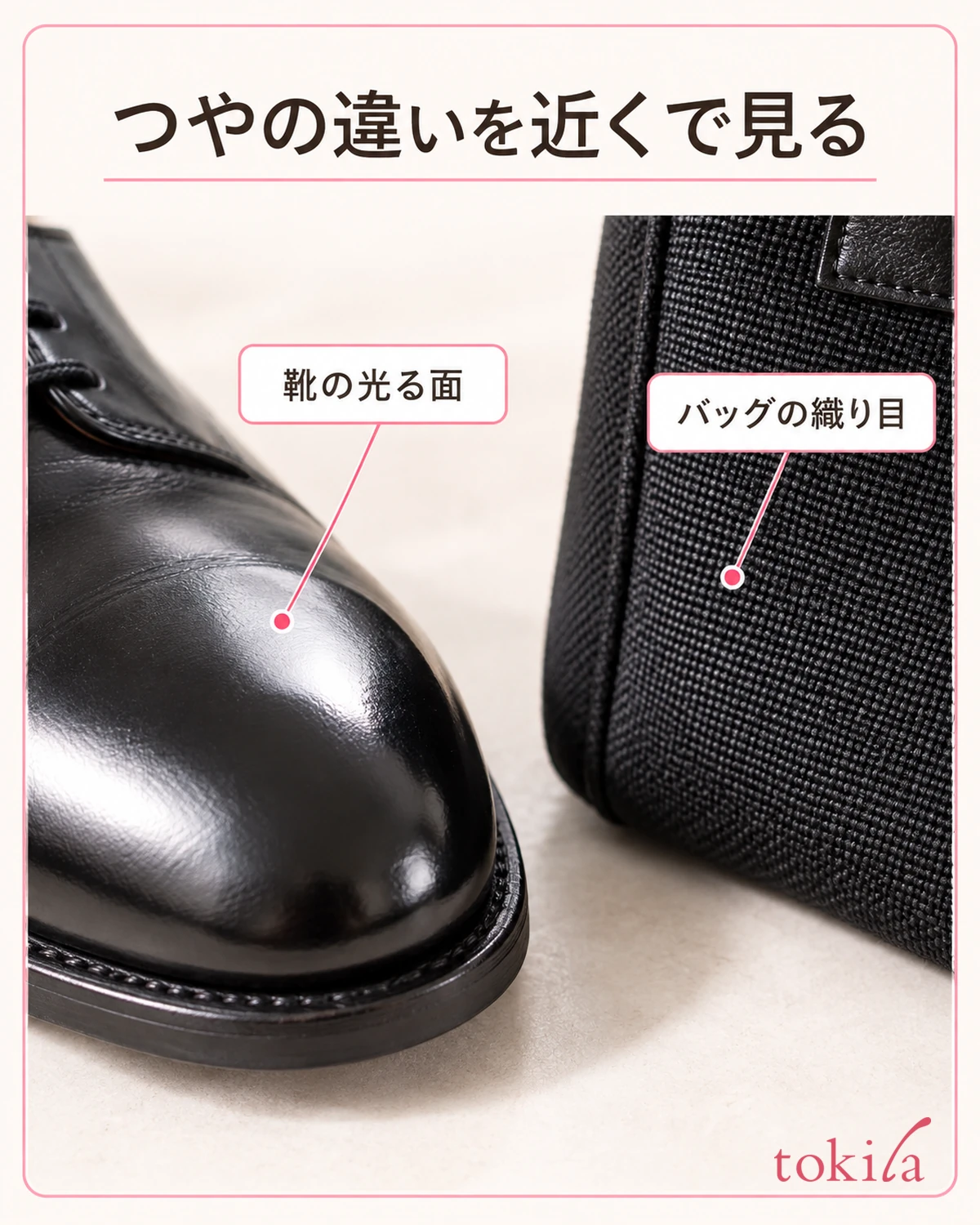
On days you want to match the surface sheen, try a bag with a similar shine if you have one. On days you want to enjoy different textures, you can keep that difference. Since you are comparing the appearance here, do not extend this to steps such as rubbing to remove the gloss or applying chemicals of your own.
Next is the visible area. A large bag in blue and a little blue showing at the toe of a shoe take up different amounts of your whole outfit even in the same color family. Check in the mirror not only whether the two colors are the same, but which one you want to show more strongly. There is no need to apply a fixed area ratio.
Compare the area by changing how you carry the bag only after you have finished comparing colors. Carried on the shoulder and carried in the hand, the position where it overlaps your clothes changes. Compare within ways of carrying you can actually use, and do not fold it or cram things in forcibly just to make it look smaller.
For a bag whose hardware or handle is a different color, observe it separately from the color of the body. Hiding the hardware is not necessarily the right answer. If you can put into words which part catches your eye first, that becomes a clue for choosing whether to change the color or to enjoy that detail.
5. If you are unsure, go back one step and check how it looks when you walk
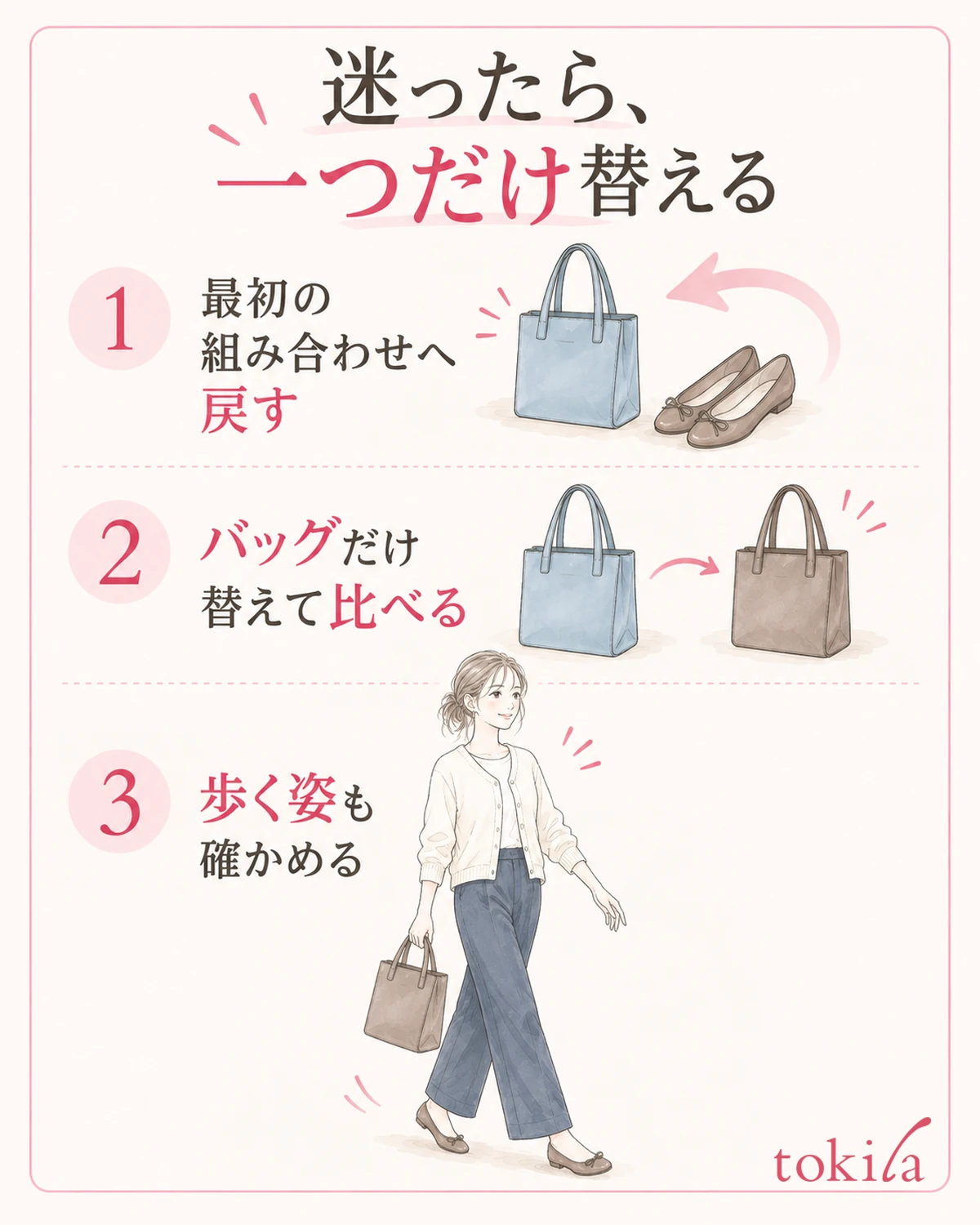
If you have swapped in several candidates and lost track, return to the first clothes, shoes, and bag. Then choose again what you want to blend: the two accessories with each other, the bag with the clothes, or your feet with the hem. You do not need to bring every boundary closer to the same color at the same time.
Change just one candidate that suits your goal: a bag in a close color if you want to link the two accessories, or a bag close to the clothes if you want to tone down the strength at your hand. If you like neither, go back to the original, and it is fine to choose a combination that is easy to use that day.
Finally, not only standing and facing front, but carry the bag, take a few steps, and turn slightly to the side. When you walk, the positions of your clothes and bag move, and the amount of shoe that shows changes too. Rather than whether it looks put together at one still moment in front of the mirror, check whether you like it the way you usually carry it.
If you keep a photo, take a full-body shot with the same mirror, lighting, and distance. If you bring only one bag forward, or take the photo from closer to your feet, the comparison conditions change. Because screen brightness and automatic correction also play a part, do not judge that the colors match perfectly from a photo alone; look at the real items too.
A short one-line note is enough for a record, such as "brown shoes with a navy bag, links with the pants" or "black shoes and a black bag, keep the difference in gloss." Keeping the reason you liked it together with the clothes you wore gives you a starting point the next time you are unsure about accessories alone.
If you buy something new, first make concrete what is missing in today's combination. Choose including the things you need to carry, your walking plans, and any dress code, and do not look too hard for a single color that must go with every outfit. Try looking for a combination that lets you enjoy the accessories you want to use, while keeping the differences among what you already have.