You put on hair oil, and the ends clump into thick strands or your bangs stick to your forehead. If you notice this before heading out, it is tempting to fix it quickly with a brush or a dryer. First, don't add any more styling product, and check where the oil has built up. The area you need to deal with differs between just a part of the ends and the whole head, including the roots.
This article covers the situation where you applied too much oil as the finishing step of styling, after your hair was already dry. It separates methods that remove the oil completely from methods that only tidy up the look temporarily, and explains them in order, from partial adjustments to washing again. For products made only for wet hair, for the scalp, or for use before a hot iron, follow the directions printed on the container first.
1. Check what the oil is for and where your hair looks heavy
Start by reading the container and confirming that the product can be used as a finish on dry hair. Leave-in treatments and styling products may look alike, but the timing and amount for using them differ. Don't assume that anything called "hair oil" can be used the same way on both damp and dry hair.
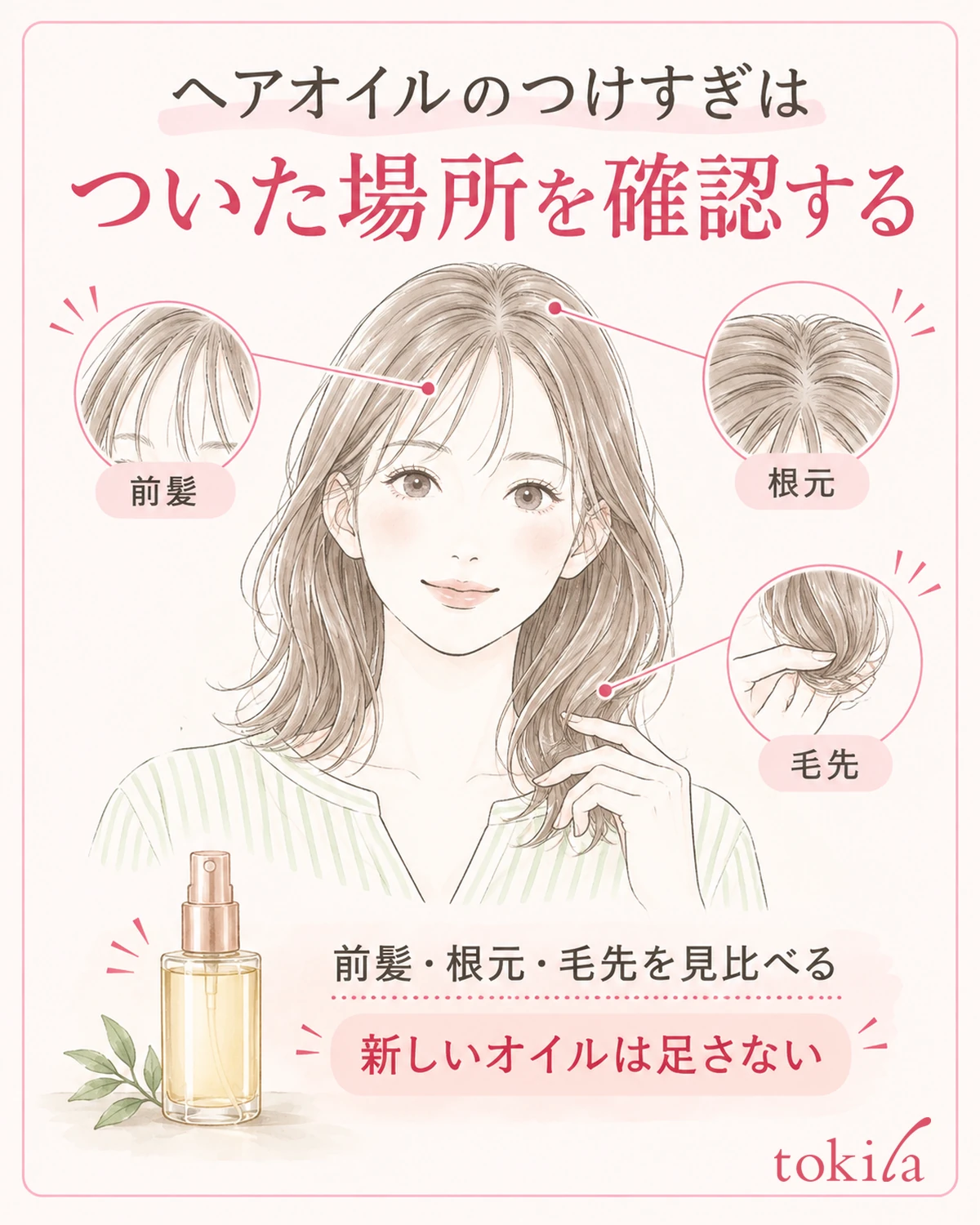
Look at your hair in a mirror from the front and the side, checking in order from the bangs and the top of the head down to the ends below your ears. See whether thin strands are separating naturally or whether a wide area is stuck together as one mass. As you move your hair gently, note where the problem is: only the ends feel heavy, the roots are also flat, or only the surface is shiny. This makes it easier to choose the next step.
A strand-like finish is not a failure in itself. Compare the result with the style you wanted: you wanted your bangs to fall softly but they have clumped, or the ends you wanted to move lightly are too tightly bunched. Don't judge the amount only by the shine of reflected light. Look under lighting close to what you normally use, and also check how your hair feels and moves.
If there is oil left on your hands, wash and dry them before touching your hair. This keeps you from transferring more oil to your bangs or roots while you look for the heavy spots. If the brush you used also has a lot of oil on it, don't run it through your whole head as it is. Prepare a different tool that has been cleaned in a way suited to the product.
If it is only a part of the ends, go on to the partial adjustment below. If the roots and bangs are also heavy over a wide area, first think about whether you have time to wash your hair again. If you have itching or irritation on your scalp, stop using the product instead of continuing to fix your hairstyle, and follow the instructions on the product. Treat this separately from a problem that is only about how your hair looks.
Before you start adjusting, also decide how much time you have before you leave and what finish you want today. If you are tying your hair back and keeping some strand texture at the ends, a small partial adjustment may be enough. On the other hand, if you want your bangs to fall softly, it suits your goal better to take the time to wash and dry. Rather than switching methods each time the look changes a little, do one thing, check it, and wash again if it is still difficult. Breaking it up this way also keeps you from touching your hair over and over.
2. For a part of the ends, press lightly with a towel and look again
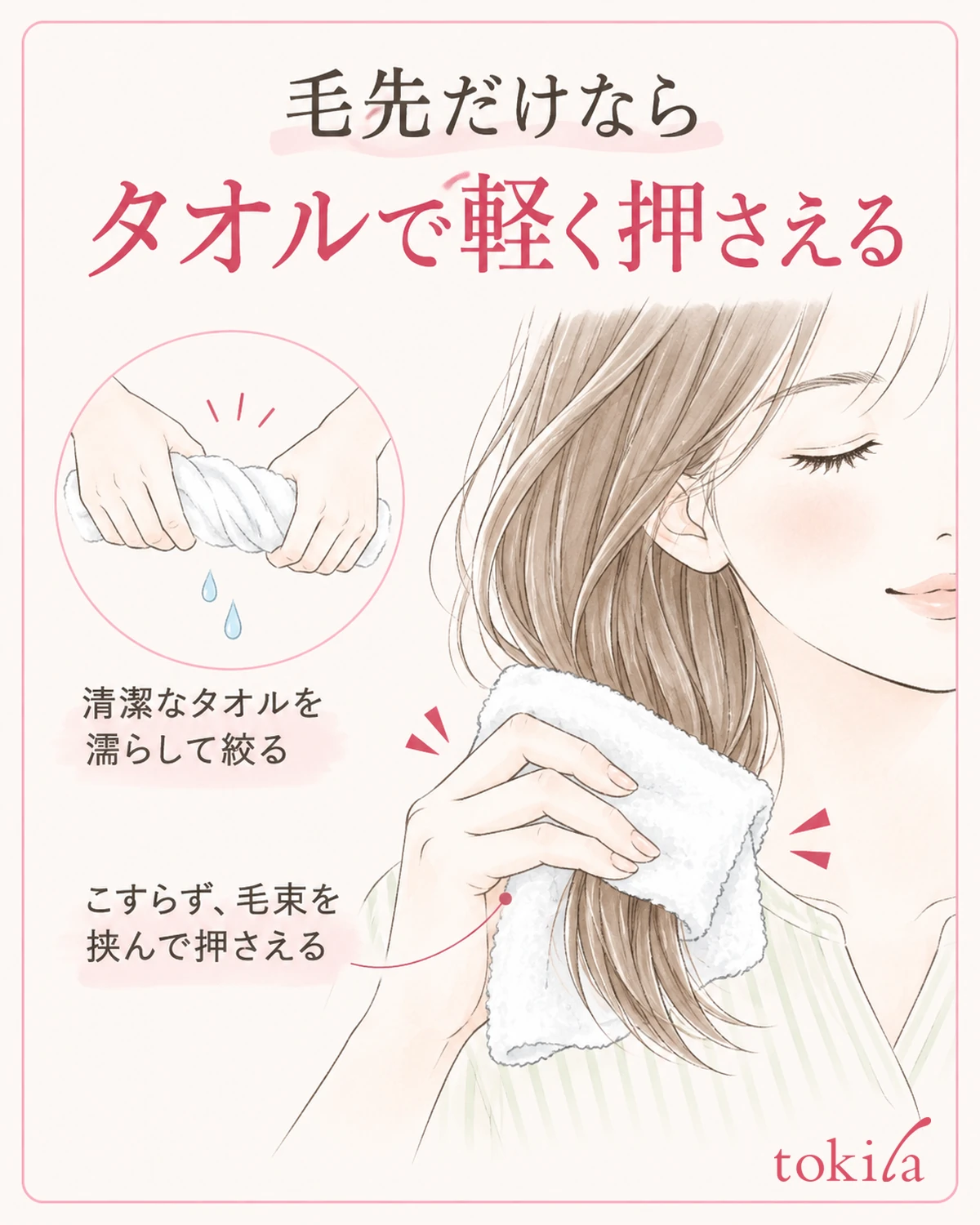
When there is too much oil on only a small area of the ends, separate out just that section of hair. Wet a clean, soft towel with water and wring it out well so that it does not drip. Don't slide the towel hard along your hair. Instead, sandwich the section in the towel and press lightly, with the idea of transferring the excess oil on the surface little by little.
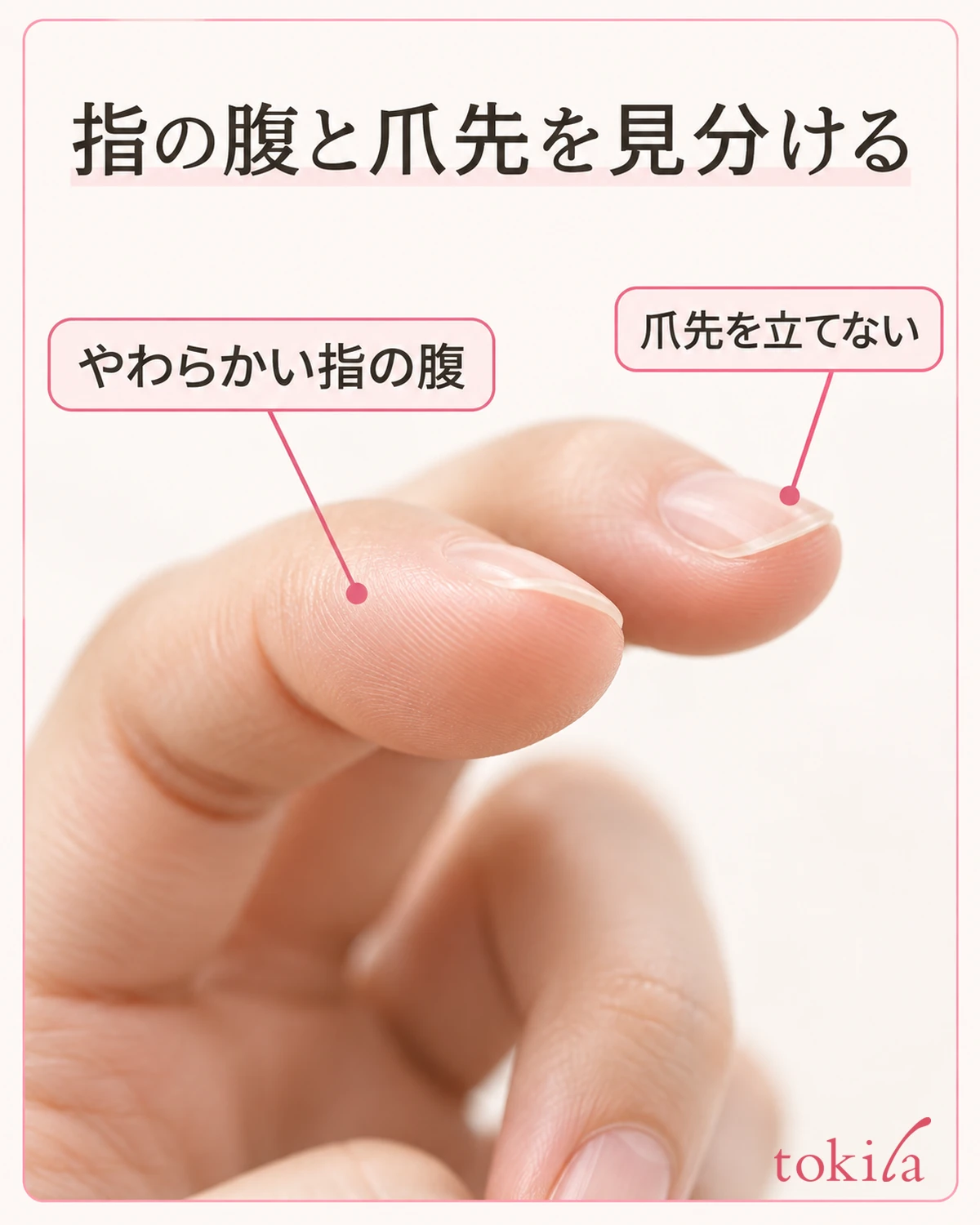
Support the section with one hand, and with the other hand fold the towel to wrap the spot you are concerned about. Don't pull it up to the roots, and don't twist and wring the ends. Press once, then take the towel away and check how the section holds together and how it feels. It is important not to keep rubbing the same spot over and over without checking for a change.
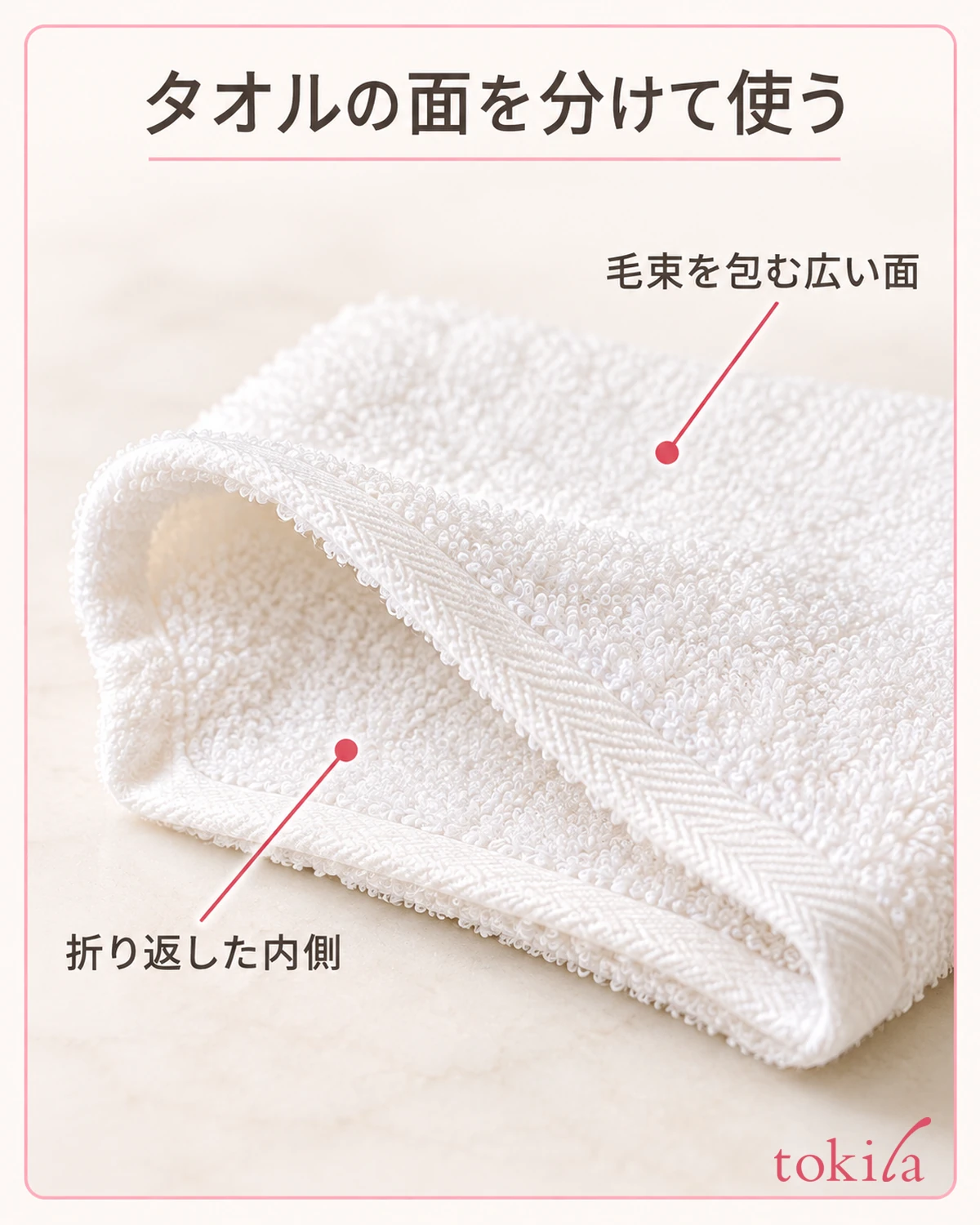
When oil has transferred to the part of the towel you are using, switch to a side you haven't used yet. If you stroke your whole head with a large area of the towel, oil can move from the heavy spots to other places. If the section you want to fix is mixed with neighboring hair, gently separate it with your fingers and start again. You do not need to pull your hair hard to separate it finely.
This technique only tidies the surface in part, and it cannot remove all the oil from your hair. If heavy strands remain after pressing, the sticky area is spreading, or you feel like repeating it many times, stop for now and move on to washing again. Don't try to bring your hair back to its original smooth feel with a towel alone.
Once moisture has transferred to your hair, dry it at the distance and setting that suit your dryer's instructions. Don't keep the heat on one spot; keep moving it while you check whether the hair is dry. The goal is not to burn off the oil by raising the temperature. After it dries, look again, and if it still feels heavy, choose the next method without adding new oil.
3. If the roots or the whole head feel heavy, wash again and dry
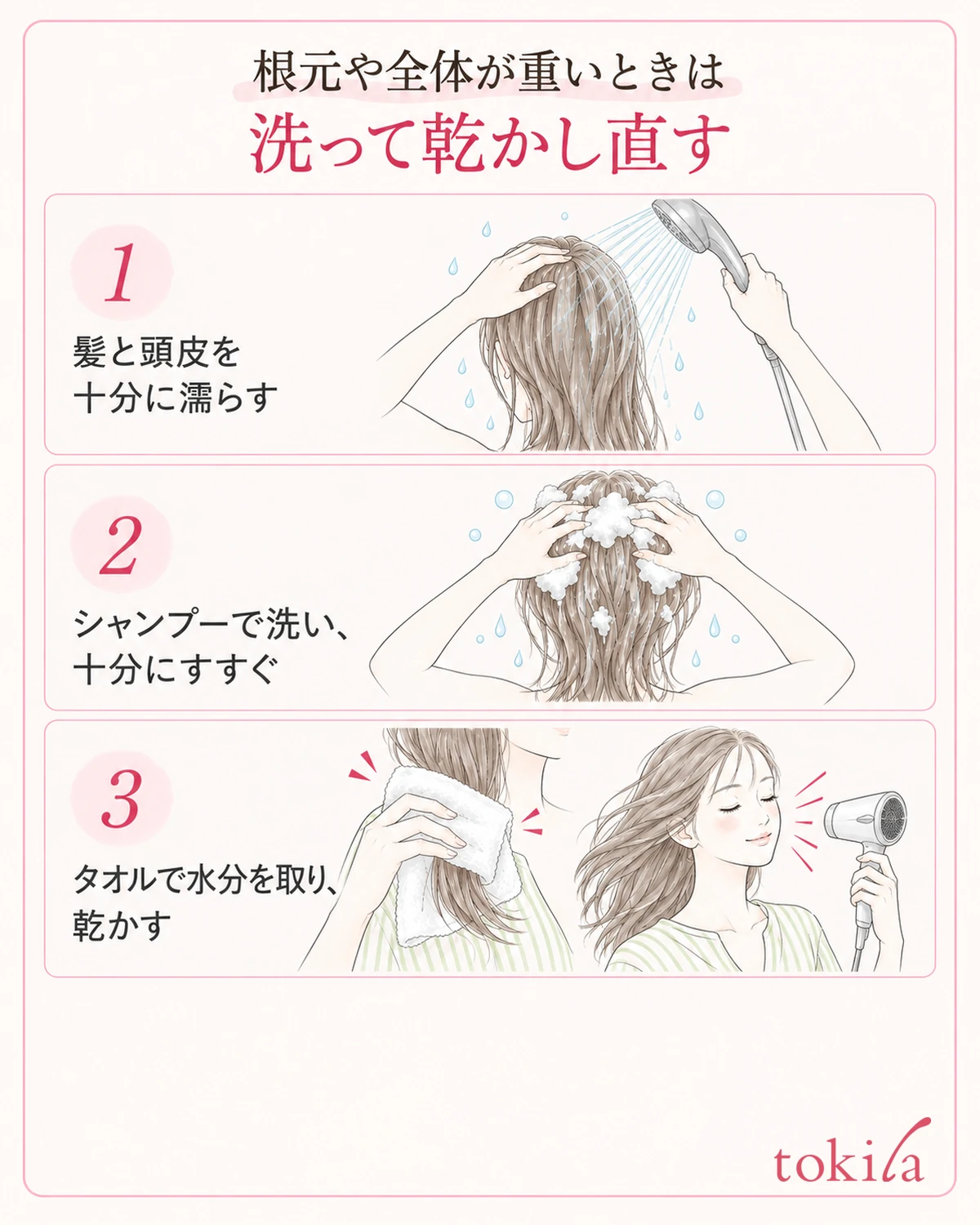
If the oil went on widely from the bangs to the roots, if your whole head is stuck down as if it were one sheet, or if a partial adjustment is not enough, washing off the oil makes it easier to rebuild the finish. Before you begin, make sure that you have time before you leave to dry your hair as well as wash it.
When you wash, first wet your hair and scalp thoroughly. Use your usual shampoo in the amount shown on the label, and wash with the pads of your fingers. Even if there is a lot of oil, you do not need to add undiluted shampoo again and again or use your nails. Don't rub your hair strands hard against each other; work the lather out to the ends as well and rinse.
Even when the lather is weak, check how wet your hair is and how far the shampoo has spread before you immediately add a lot more. If it does not feel clean even after rinsing once, check the washing instructions and cautions of the product you are using. Don't fix the number of washes for every product, and don't rely on repeating strong cleansing again and again.
When you rinse, part your hair above the ears and at the back of the head as well, not just on the surface, so the water reaches your scalp. If you use conditioner or similar products, follow the label too, and don't pile on more than needed just because your hair felt heavy. After washing, press the water out with a towel and dry your hair while checking how dry it is from the roots and the inside.
Once your hair is dry, look in the mirror once without adding anything. Only if the ends need a finishing product, use one that is specified for dry hair, and adjust the amount based on the label. Rather than putting back the same amount as before washing, decide where you need it today before you use it. You can also review the basics of drying in our article on towel-drying and blow-drying.
4. If you can't wash, style your hair without adding oil
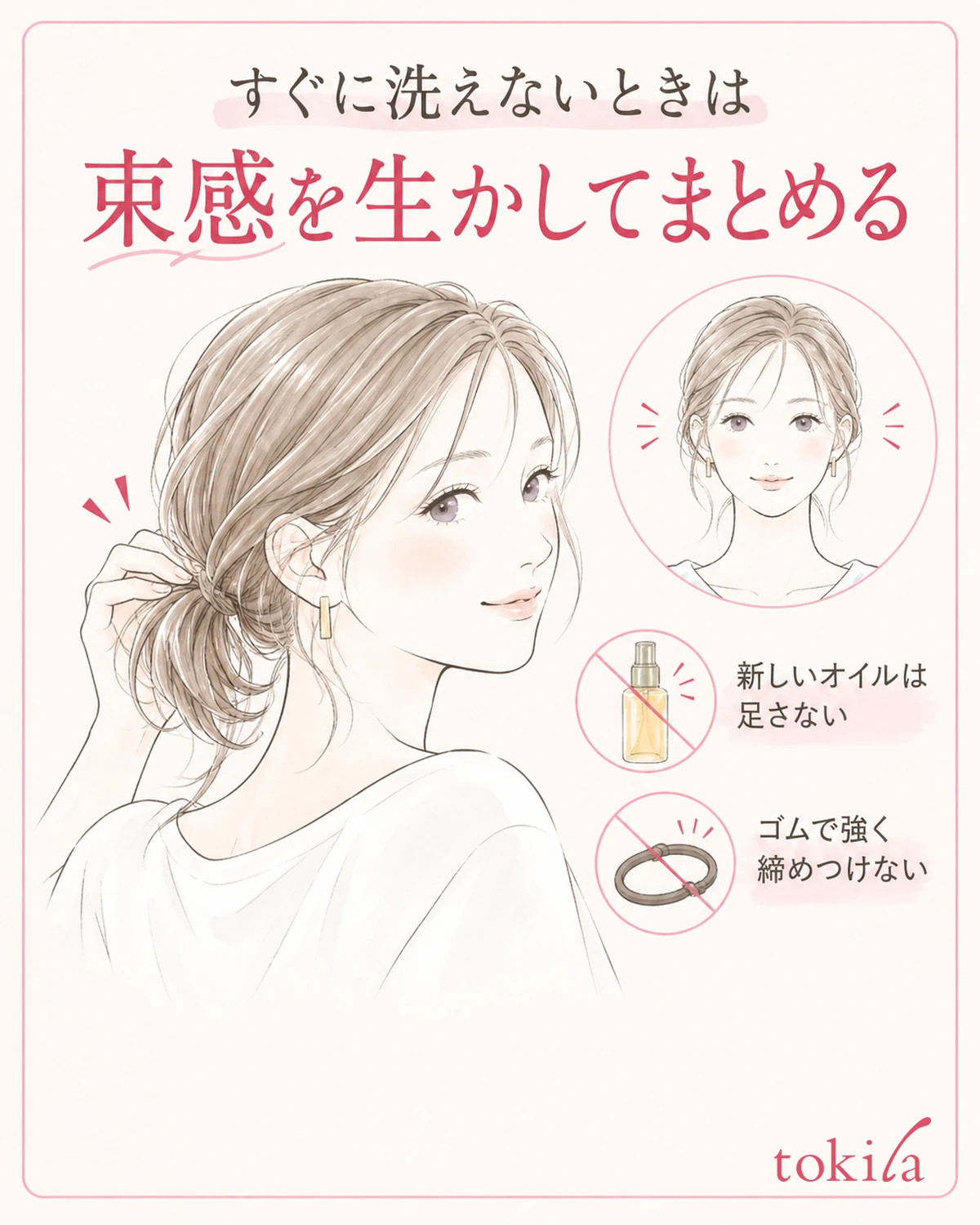
If you can't wash right away, don't insist on fully restoring a light, dry texture. Think of a hairstyle that makes use of the strand texture you have now. If your hair is long enough, choose a form that you can do without strain, such as tucking the hair around your face behind your ears or tying it in one low ponytail. This is not a state where the oil has been removed; it is a way of temporarily changing how your hair looks.
After washing and drying your hands, slowly separate the strands you are concerned about with your fingers. If it is only strand texture at the ends, it is fine to leave it and tie your hair back. If your bangs are stuck down, do not put new oil on your hands. Stay within what you can tidy without pulling, such as changing the direction the hair falls.
When you tie your hair, don't tighten the elastic hard to flatten it by force. Look in the mirror from the front and the side, and also check that the tied part is not painful or pulling strongly. If you try to even out the surface shine by adding oil to places that had less, the heaviness of the whole head can increase.
Avoid sprinkling face powder you have on hand, or food powder, on your hair on your own judgment. Even if you have a product for hair stickiness, check what kind of residue it is meant for and how to use it first. A product meant for sebum or sweat will not necessarily remove excess styling product in the same way.
Also avoid applying a high-temperature iron again and again to restore lightness. Both oils and heat tools have conditions of use, so first check whether the product can be used before ironing and whether your hair is dry enough. When you have time, wash and restyle, and don't keep layering more styling product on top of an emergency fix.
5. Next time, follow the amount on the label and apply to different areas separately
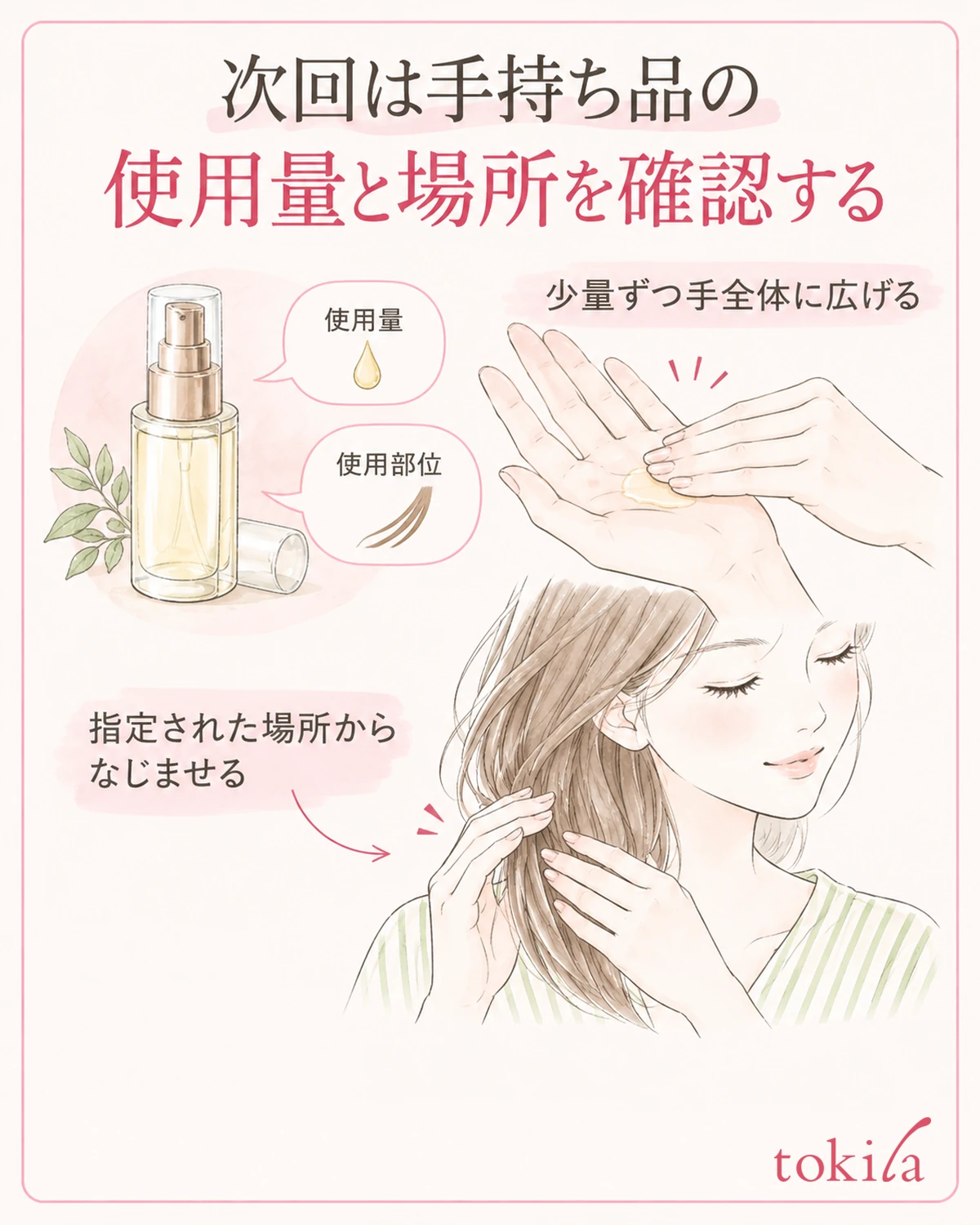
When you prepare for next time, first check the amount and timing written on the container. Even one pump can dispense different amounts, and the texture of oils differs too. Don't set a flat rule like "this many pumps for medium length." Think about the guideline of the product you use together with your own hair length and volume.
If the product lets you adjust a little at a time, don't dispense all the amount you think you need at once. Divide it into stages within the range on the label. Spread it thinly over your palms and between your fingers, then work it into the specified areas. For a product meant mainly for the ends, start with the ends and the inner layers. Decide the order in which you touch your hair beforehand, so that the first, larger amount does not land only on the bangs.
You also don't need to treat every oil the same, as if none can be used at the roots. Some styling products are designed for use near the roots, so check the label of the product you have. What you want also differs between a day you want soft volume at the roots and a day you want a sleek, tight style. Match the use area to your goal.
After working it in once, look at your whole head in the mirror and decide whether to add more only to the places that need it. You don't have to use up whatever is left on your hands on your bangs. For a product that is not specified as usable on skin, don't repurpose it as hand care; wash it off. That also keeps it from transferring later from your hands or tools to your bangs.
It helps next time if you note down the amount and place that worked well in concrete terms, such as "used less than the label's guideline and applied to the ends first." Pick one trouble spot among amount, place and order, and start your review from there. If you want to organize your hair care, you may also want to read our guide to the roles of hair care products and how to choose them.