You want to pair a brooch with a solid-colored coat, but it looks different laid out than it does when worn. Look beyond the colors to the folded collar, the spaces in the ornament, and the metal's reflections. Even with one small piece, a change in the surrounding fabric changes the conditions you are comparing.
This article explains how to choose one coat and one brooch you already own, then check brightness, outlines, surface reflections, and the area actually visible. Rather than deciding that certain colors suit everyone, consider your preferred look separately from whether the piece can be attached to the garment without strain.
1. Choose one coat and the brooch you want to show
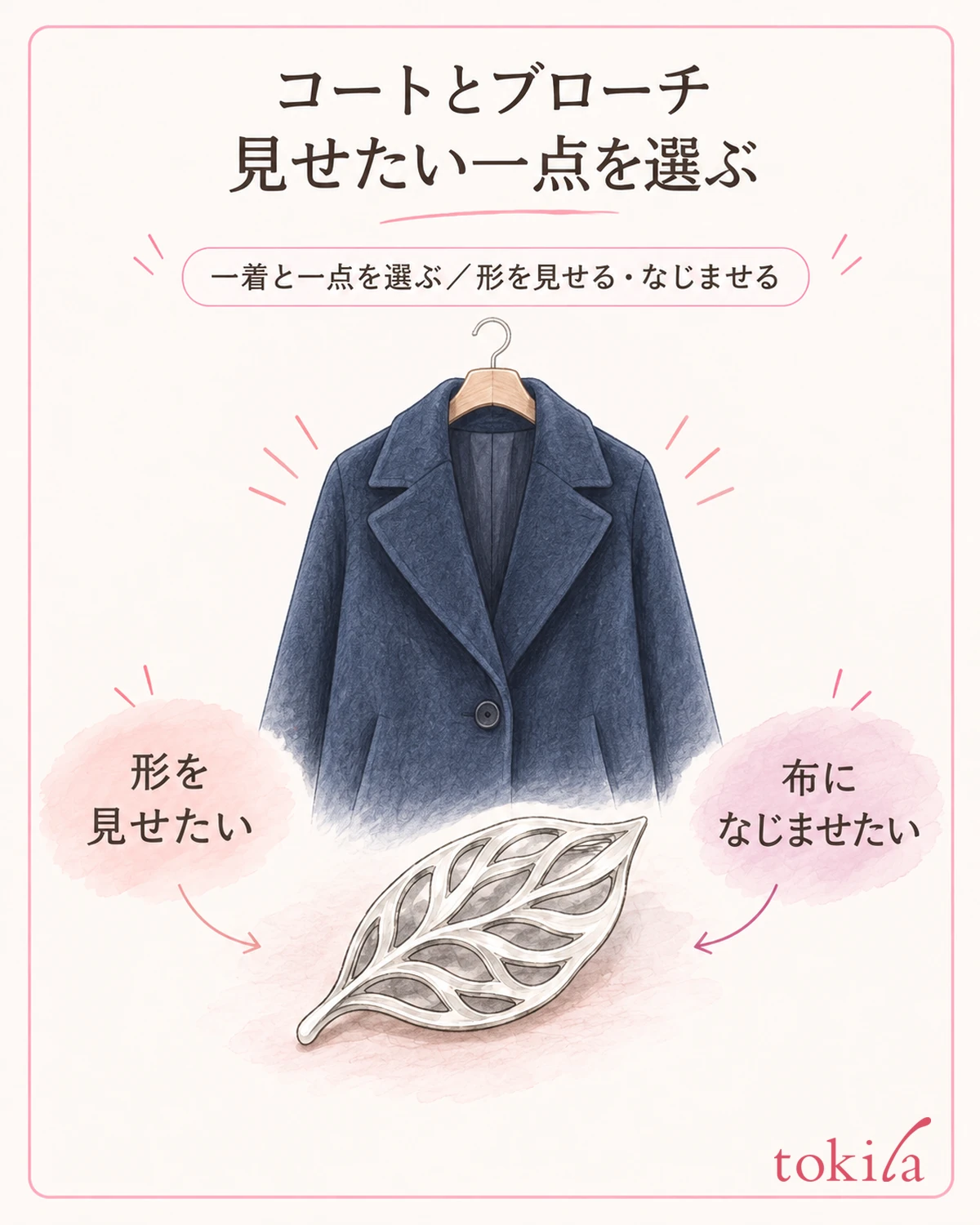
Start by taking out the coat you want to wear today. Do not decide by color names such as black, navy, or beige alone; look at the actual collar and front panels in a bright place. Even solid-colored fabric has a weave, nap, seams, and buttons, so observe broad surfaces separately from the details.
Next, choose one brooch. Do you want to show its flower or leaf shape, add a point of shine, or let it blend quietly into the coat? Putting your aim into words lets you compare without treating a noticeable ornament as a mistake in itself.
If you have several options, first narrow them down to two. Even among flower shapes, a solid design and an openwork design reveal different amounts of fabric underneath. Judge more than the outer dimensions: check how much of the coat's color shows through the ornament.
While comparing on a table, place each brooch on a clean, soft surface with its clasp closed. There is no need to pile ornaments together or drag them over the coat. Choose possible colors and shapes by looking at the front while the pin tip remains covered.
Even if you like the color, check separately whether the brooch can be used on the garment. Handling varies with the fabric's thickness and stretch, the clasp structure, and the brooch's weight. Do not assume every coat can hold any brooch. If the garment's and ornament's instructions do not establish compatibility, stop at comparing them before attachment.
You do not have to reproduce a combination seen in a store or on a screen. Taking out one coat and one brooch you own can also help you decide whether you want a different color or a smaller shape. Choosing from what you already have is an option today, too.
2. Compare brightness and outlines near the collar
Bring the coat and brooch under the same light. Looking at the coat by a window and comparing it with your memory of the brooch under a light bulb changes more than color. Avoid a position where strong light falls on just one side, and align their front-facing surfaces before observing.
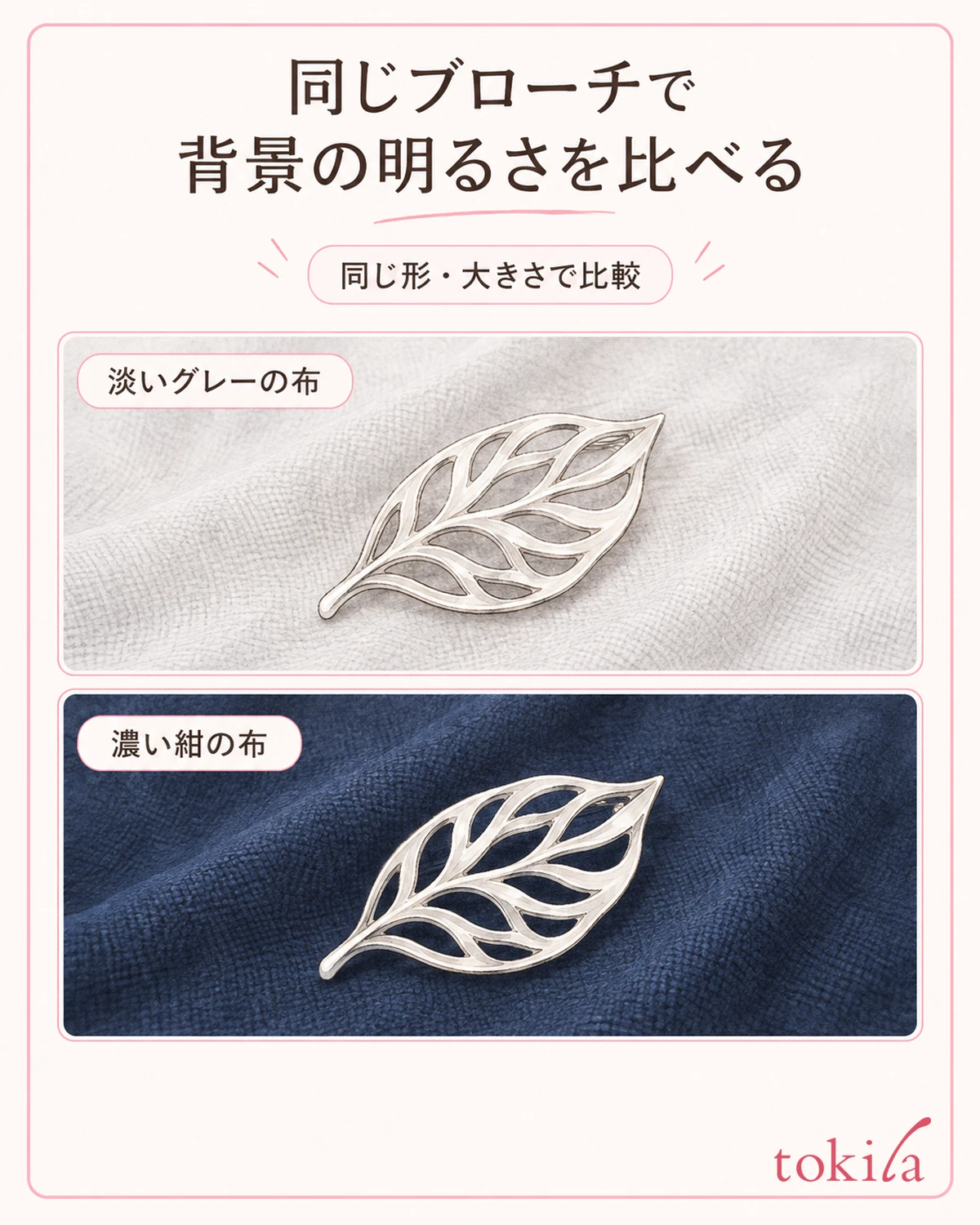
First, look at the difference in brightness. A pale ornament against dark navy fabric may have an easier-to-see edge. An ornament close to the fabric in brightness may have a softer-looking outline. Neither is automatically correct; check whether you can see the shape you want to show today.
For example, if you place silver-colored ornaments of the same size and shape against pale gray and dark navy fabric, the background color is the main change. If you compare two pieces with different shapes and sizes, do not attribute the difference in appearance to color alone.
Before trying a brooch at the collar, you can lay the coat flat and compare it with the closed brooch on a surface beside it. There is no need to keep piercing the fabric to find a color match. Narrow down your options, check the attachment position and compatibility, then attach it using the method specified for your piece.
Once attached, look for overlaps between the ornament's outline and the collar fold or front edge. If you can see the color but have trouble reading the shape, a nearby seam or change in level may be the reason. Trace the visible boundaries one by one before changing colors.
When changing the position, avoid searching by making repeated holes in the fabric. Remove the brooch, secure the pin tip, and then consider another option. If you are unsure how to remove it, usethese steps for checking a brooch clasp and the fabricinstead of repeatedly trying to open or close it in ways that do not suit its structure.
3. Separate the colors of metal, stones, and fabric from reflected light
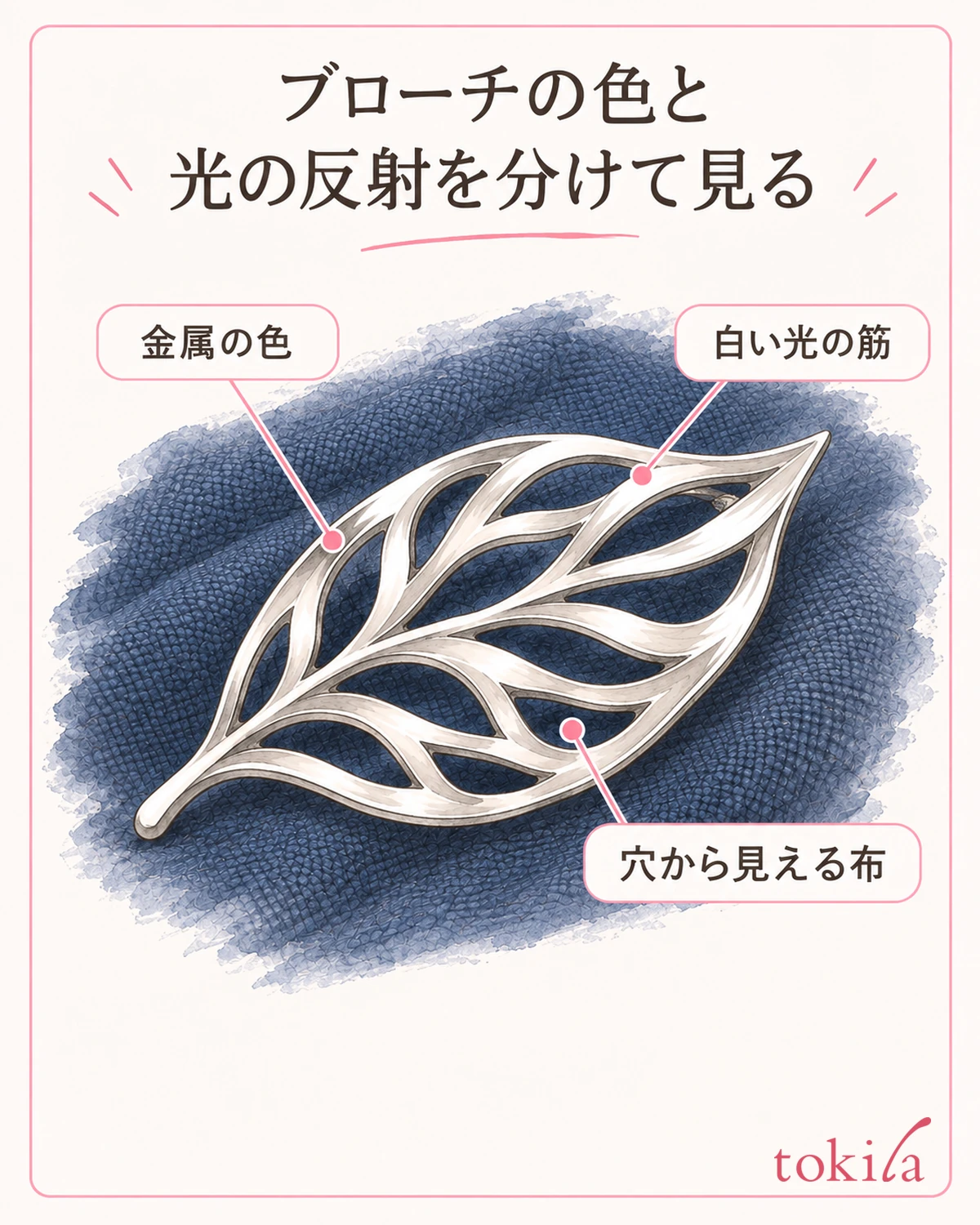
A brooch's front may contain several elements: metal tones, colored stones or resin, and fabric or thread colors. If a gold-colored rim surrounds a white ornament, do not call the entire piece gold; look at the rim and center separately. Check which parts remain visible from a distance.
Here, gold and silver describe visible colors. Appearance alone does not establish the type of metal, surface treatment, or suitability for your skin. Consider care separately from color coordination: do not polish or soak a piece with unknown materials simply because it looks tarnished.
On a glossy surface, a bright streak appears where light strikes. If the streak moves when you slightly change the angle, you are seeing reflection as well as surface color. A white reflection does not necessarily mean the ornament itself is white; also check an angle without direct, strong light.
An openwork leaf shape lets the fabric's color show between the metal outlines. Its gaps may look different on a white tabletop and against a dark coat. Treat the openings as places where the fabric underneath is visible, rather than counting them as the ornament's own color, to make the differences easier to understand.
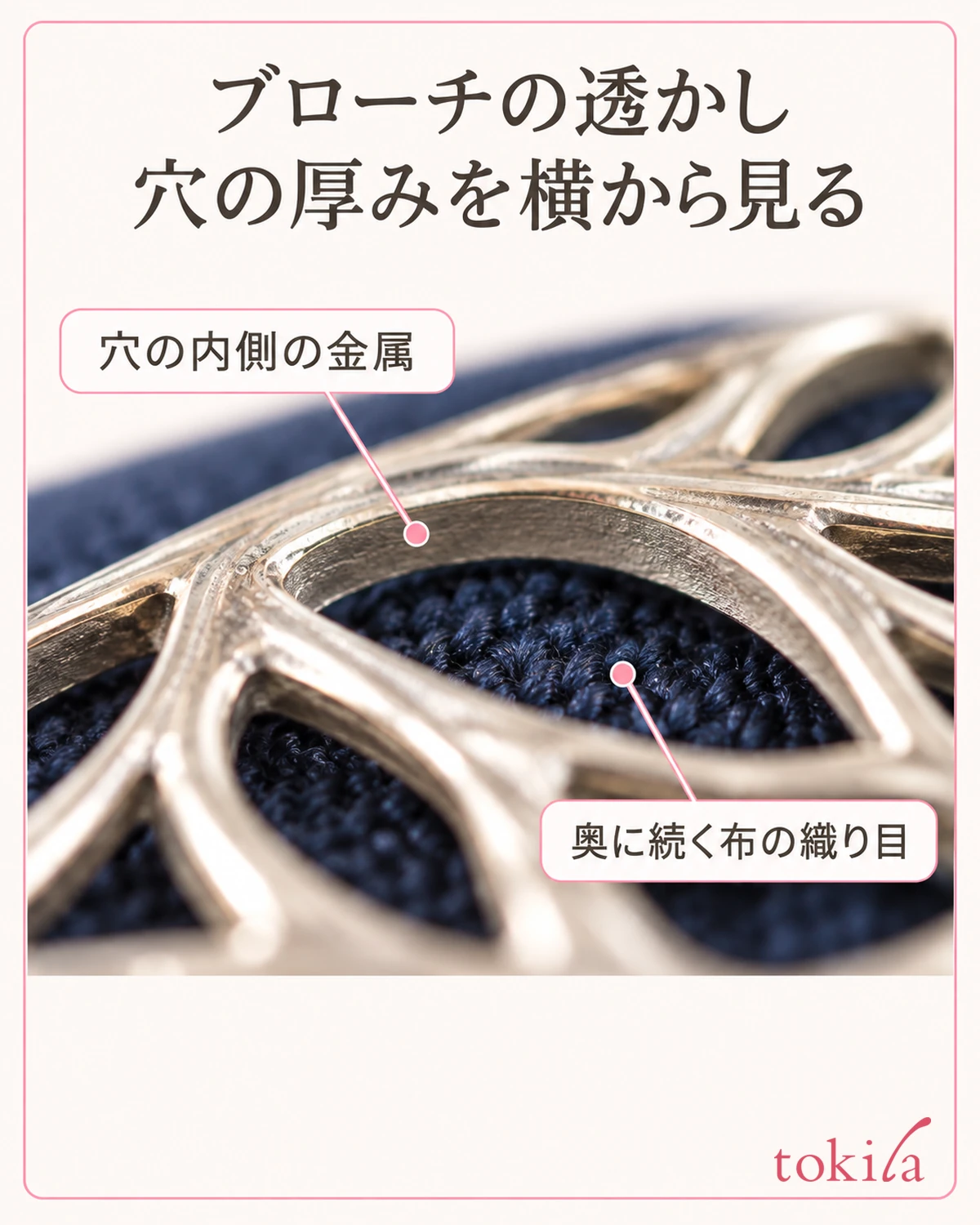
On a coat with a nap, the shadows of fine fibers appear alongside reflections from the metal surface. Even similar beige tones do not give fabric and metal the same texture. If the piece stands out despite similar colors, consider its three-dimensional form and how it reflects light as possible reasons.
If you want to coordinate the metal colors at your ears or hands, choose the brooch first, then add one other piece. There is no obligation to make everything the same color. If you want to enjoy two metal tones together, usethis guide to comparing gold- and silver-colored accessoriesto work through the coat's color separately from adding ornaments.
4. Check the visible areas with the coat open or closed and with accessories
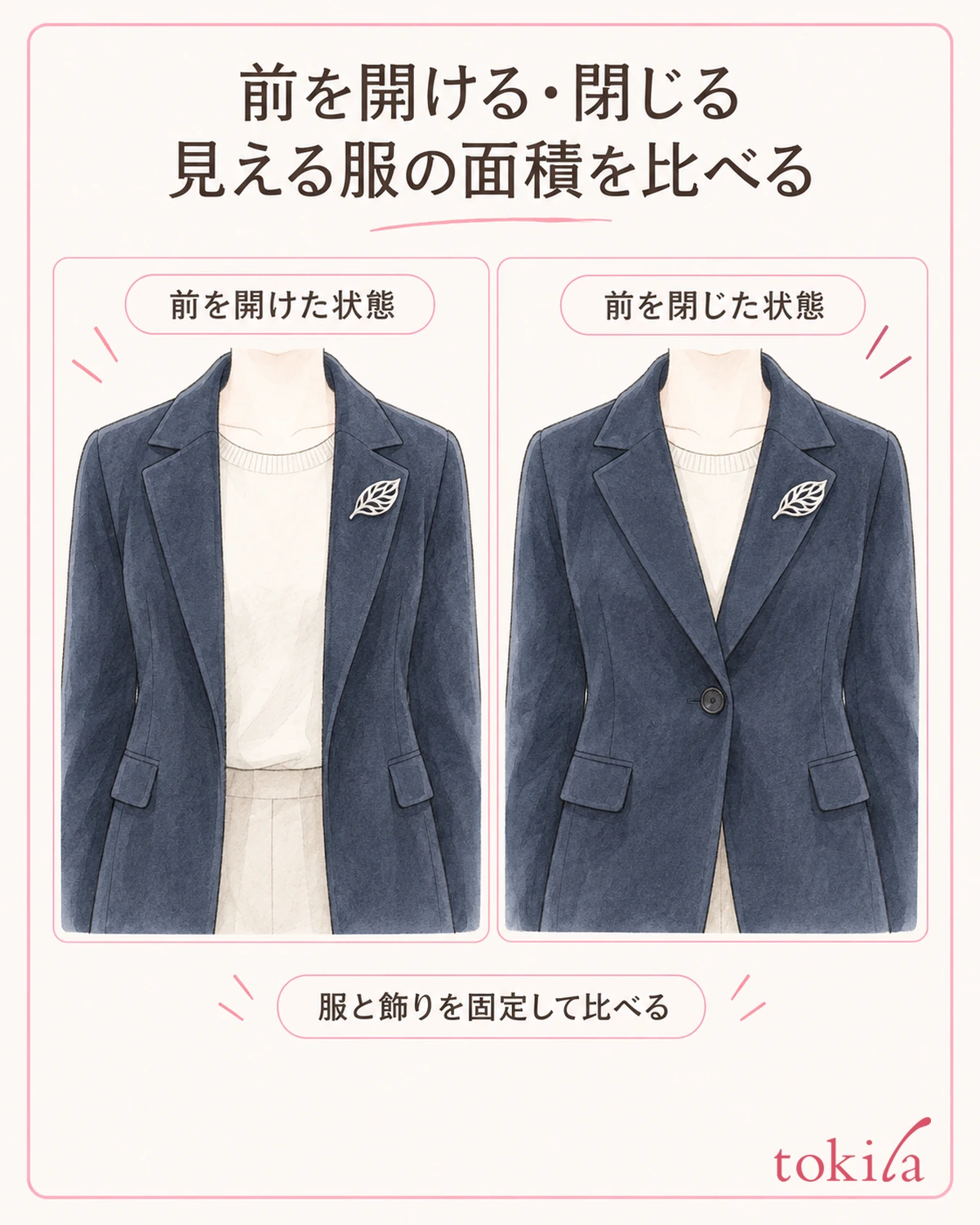
Finally, arrange the coat as you normally wear it and look in a mirror that shows your upper body. With the front open, the clothes underneath are visible; with it closed, the front edges and buttons appear together. Return from the tabletop color arrangement to the combination of colors you will actually see today.
The area of clothing visible around the collar changes between an open coat and one closed at a position that fastens without strain. Even with the same brooch, the nearby colors may differ. Keep the coat and inner clothing unchanged while comparing, and change only the front opening.
If you use a scarf, arrange it as usual. Check whether it hides the brooch, touches the ornament, or catches at the collar. You do not need to put up with an awkward wrap or an uncomfortable neckline just to display the colors. You can also choose a day without an ornament.
Check where your bag's shoulder strap passes, too. If it overlaps the brooch, address the contact before the colors. Do not force the ornament down or hook the strap onto its fitting. If you cannot choose a position within the attachment instructions, switch to another ornament.
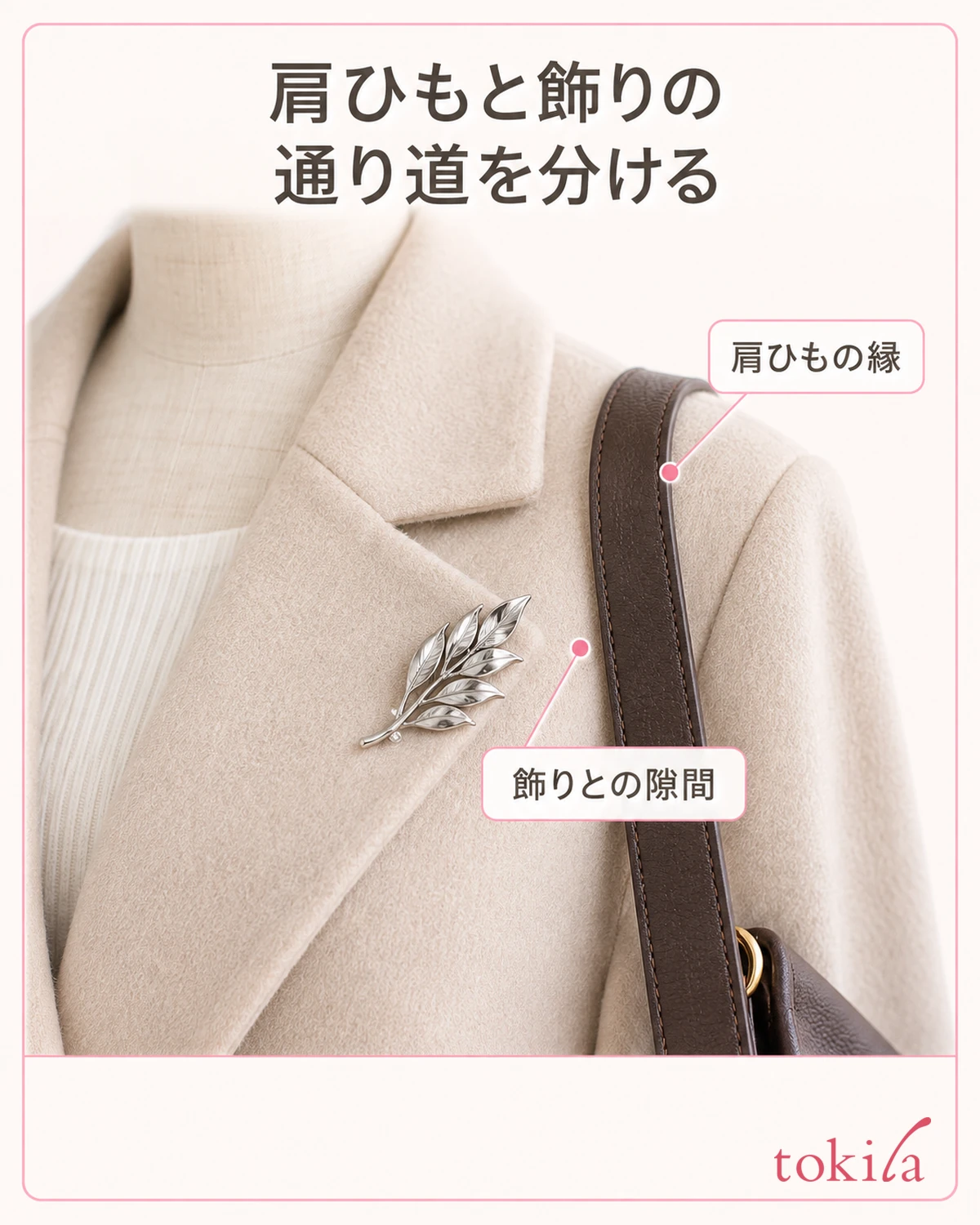
If the buttons or bag hardware feel too noticeable, also compare the look with the brooch removed. This lets you check whether you like the colors already present before adding more to pull the look together. Rather than hiding every noticeable accessory, choose a combination in which the piece you want to feature is clear.
Turn sideways and sit down to check for pulling in the fabric or a tilted ornament. Even if it looks aligned from the front, reconsider how you use it if movement remains difficult. Check both your color preference and whether the fabric and clasp can be used without strain.
5. Choose one reason for hesitation and try combinations you own
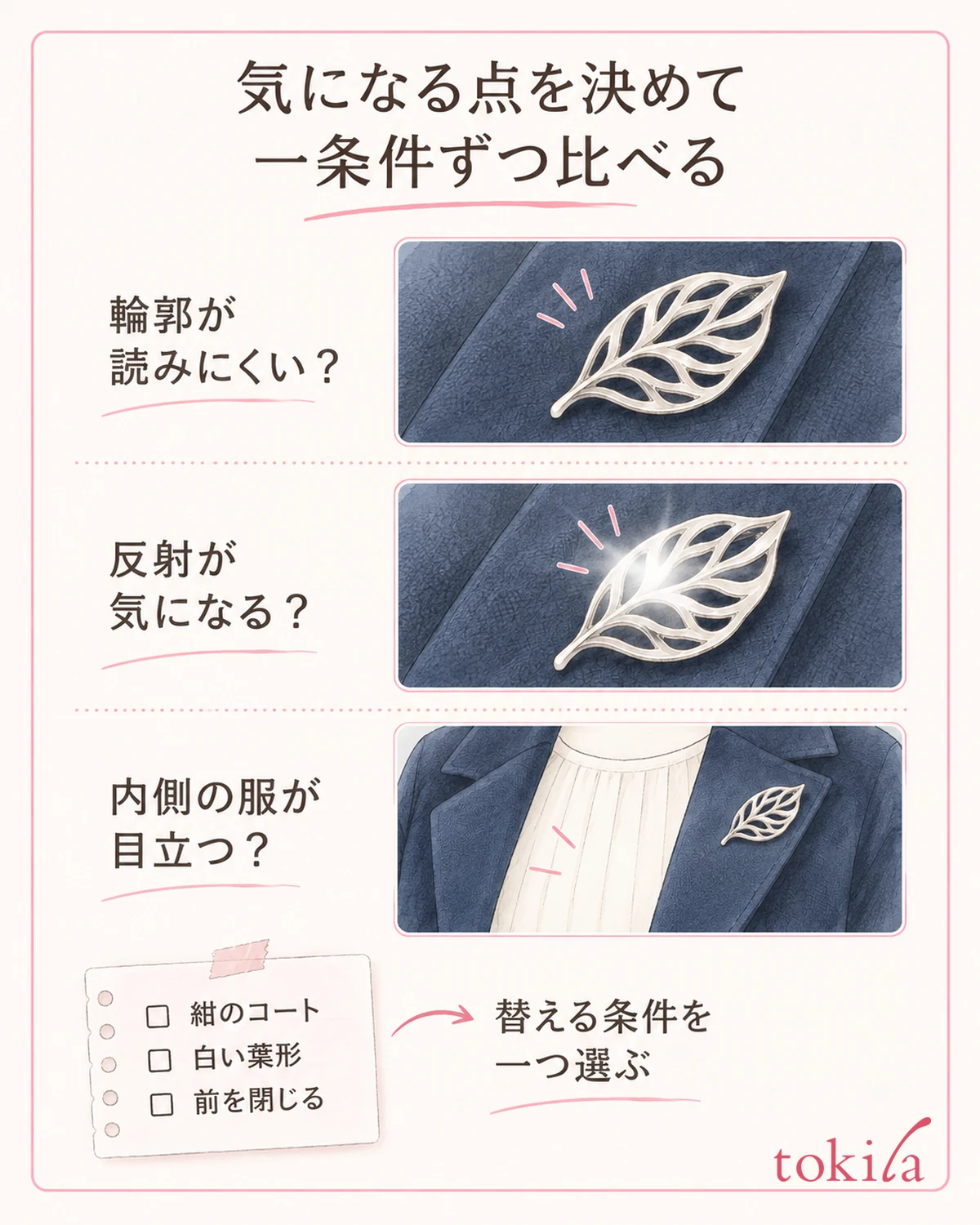
If you are still unsure, choose one concern: the outline is hard to read although you want to show the shape, the shine draws your attention, or the inner clothing seems to add too many colors. Breaking a vague sense of mismatch into visible features helps narrow down what to change.
To show an outline, one option is to compare another brooch you own with a different brightness on the same coat. If reflections bother you, consider a less glossy piece. If the shape and size also change, record those differences instead of attributing the result to a single reason, such as its silver color.
If the clothes underneath bother you, keep the brooch and coat unchanged and switch only the inner garment. Changing the clothes, ornament, and bag together makes it harder to tell what you liked. Try one condition at a time, and stop once you find a combination you enjoy.
If taking photos, shoot one close-up and one showing your upper body in the same place. Automatic brightness and color adjustments on a smartphone change the appearance, so do not judge the actual colors from the screen alone. Briefly include how you wore it in your notes, such as a navy coat, a white leaf shape, and the front closed.
When finished, remove the brooch using the method specified for your piece, secure the pin tip, and store it. Next time, check the fabric surface and clasp again, even if you plan to use the same position. Keeping a record of colors you like is separate from leaving the brooch attached.
You can begin matching a brooch with a solid-colored coat by checking its shape, the background's brightness, reflections, and the visible areas when worn in that order.The color-coordination guidescan also help you enjoy combinations with the clothes you own, without being bound to fixed color pairings.