When you set out to buy liquid foundation, similar bottles can have very different descriptions of their finishes and application methods. Assuming that every liquid gives a dewy finish, or that one pump covers the entire face, may make a new purchase hard to fit into your usual makeup routine.
This article compares options before buying a liquid foundation. Work through how much glow or coverage you like, what you want to apply it with, and which other products you will use with it. Treat the detailed steps in How to Choose a Foundation Shade as a separate decision.
1. Describe glow and coverage separately
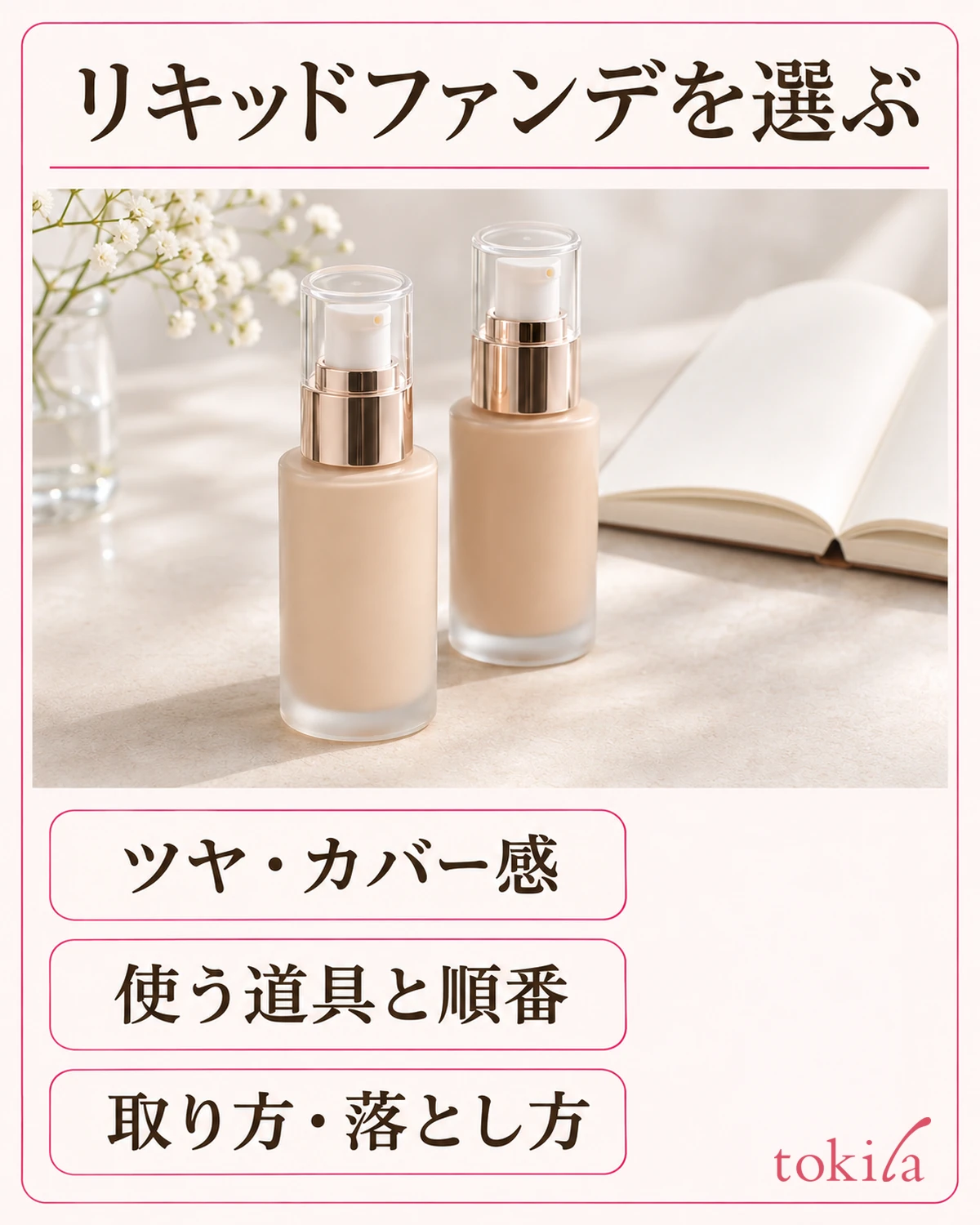
First, write down your desired finish in two separate fields. One concerns how light looks on the skin: for example, whether you want to retain glow or keep shine subdued. The other concerns how much of your skin color shows through: whether you want to preserve its natural appearance or even out the color of particular areas. More glow does not necessarily mean sheerer coverage, and matte does not always mean heavy coverage.
Read in-store and product descriptions with these two aspects in mind. Words such as "natural" and "full" can suggest different finishes to different people. Separately identifying whether you want to retain glow or the appearance of bare skin makes it easier to compare candidates described in different terms.
If you only want coverage on part of your cheeks, consider whether you really need a product that makes your whole face opaque. Conversely, a description of sheer coverage does not promise that layering will let you freely adjust it to your desired coverage. Check whether the layering instructions and finish description suit your purpose.
Also separate the reasons you want coverage: do you want to even out uneven color, or make the overall appearance of your skin more uniform? Rather than assuming every concern must be concealed to the same degree, distinguish the finish you want across your face from adjustments to individual areas to clarify your requirements.
When looking at photographs, consider the face angle, lighting, primer, and powder as well. Do not infer from a brightly lit photograph alone that a product makes pores or uneven texture disappear. The photographs here organize selection criteria; they are not tests of any particular product's color or wear.
If you are unsure of your preferences, start by choosing one kind of day: for example, less shine at work or more of your skin showing through on days off. This makes it easier to narrow the first candidates to two than listing requirements for one product to meet every situation.
2. Check how it feels when spread thinly and how the shade looks
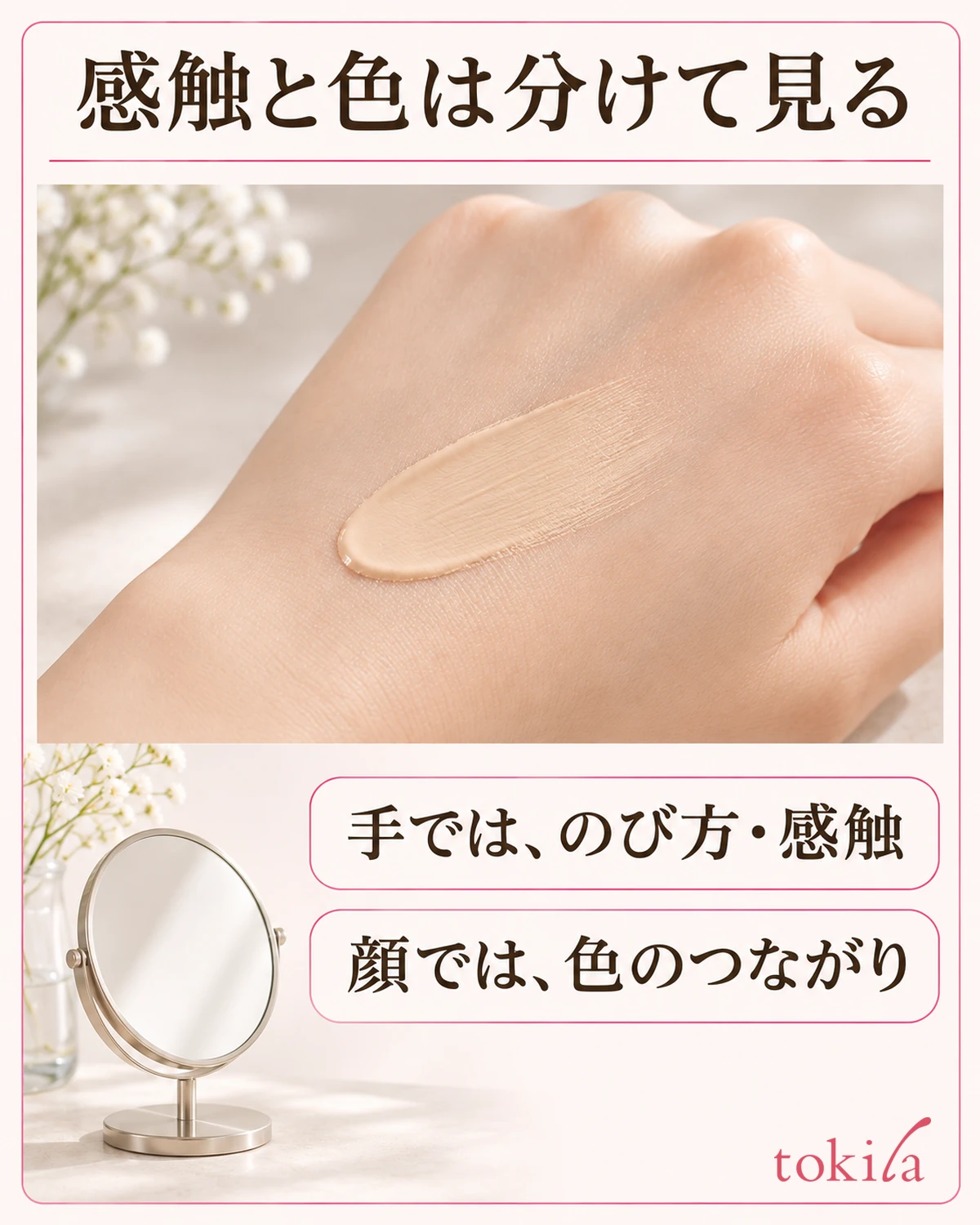
Separate the consistency of the liquid coming out of the container from how it feels after being spread thinly. A thick-looking product will not necessarily still feel heavy after spreading. Do not judge its effects on skin from its appearance, assuming that a fluid product makes moisturizing unnecessary or a rich one prevents dryness.
If you can test it in-store, follow the store's procedure and the specified application area. When testing on the back of your hand, observe spreadability and feel after spreading; do not use it as a substitute for matching the shade on your face. If facial testing is possible, ask whether you can check it under primer conditions similar to your usual routine.
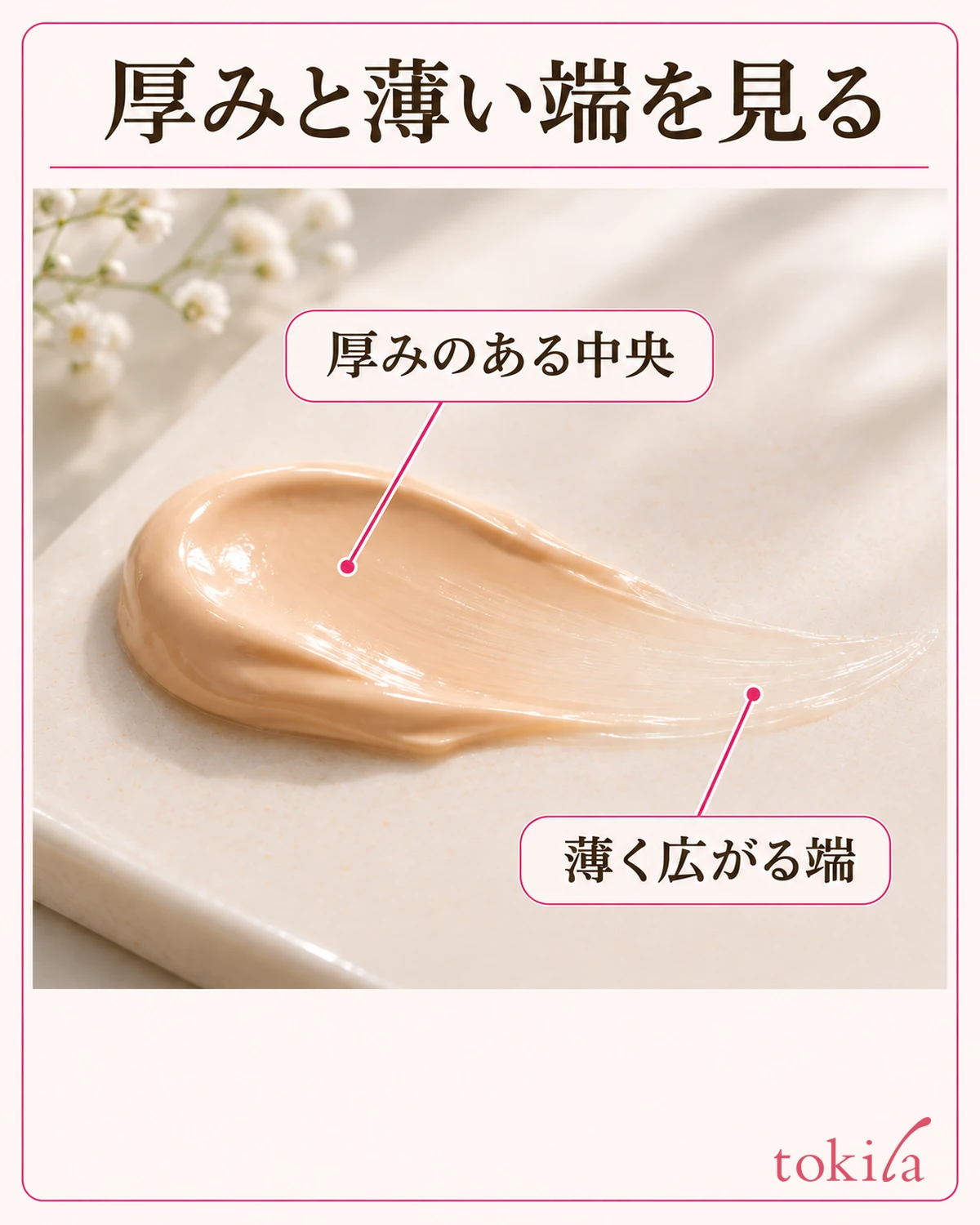
The supplementary photograph shows a close-up of the thick center and thinly spread edge of the same beige material. It does not rank two products; it helps separate the dispensed state from the thinly spread state. Do not treat the photograph's color or sheen as the actual color of a product you plan to buy.
Use shade numbers only as a starting point for finding candidates. The same number as your current product does not necessarily mean the same shade across different ranges or types. When buying online, compare shade names, swatches, and descriptions of brightness and undertone, leaving uncertain items unconfirmed. Do not assume screen colors guarantee a match to your skin.
If you cannot decide immediately after testing, briefly note the candidate's name, tested shade, primer used, and your concerns. Rather than stopping at "heavy" or "stands out," separate tactile feel from a face-to-neck shade mismatch to make the next item to check clear.
3. Match your preferred tools to your usual base routine
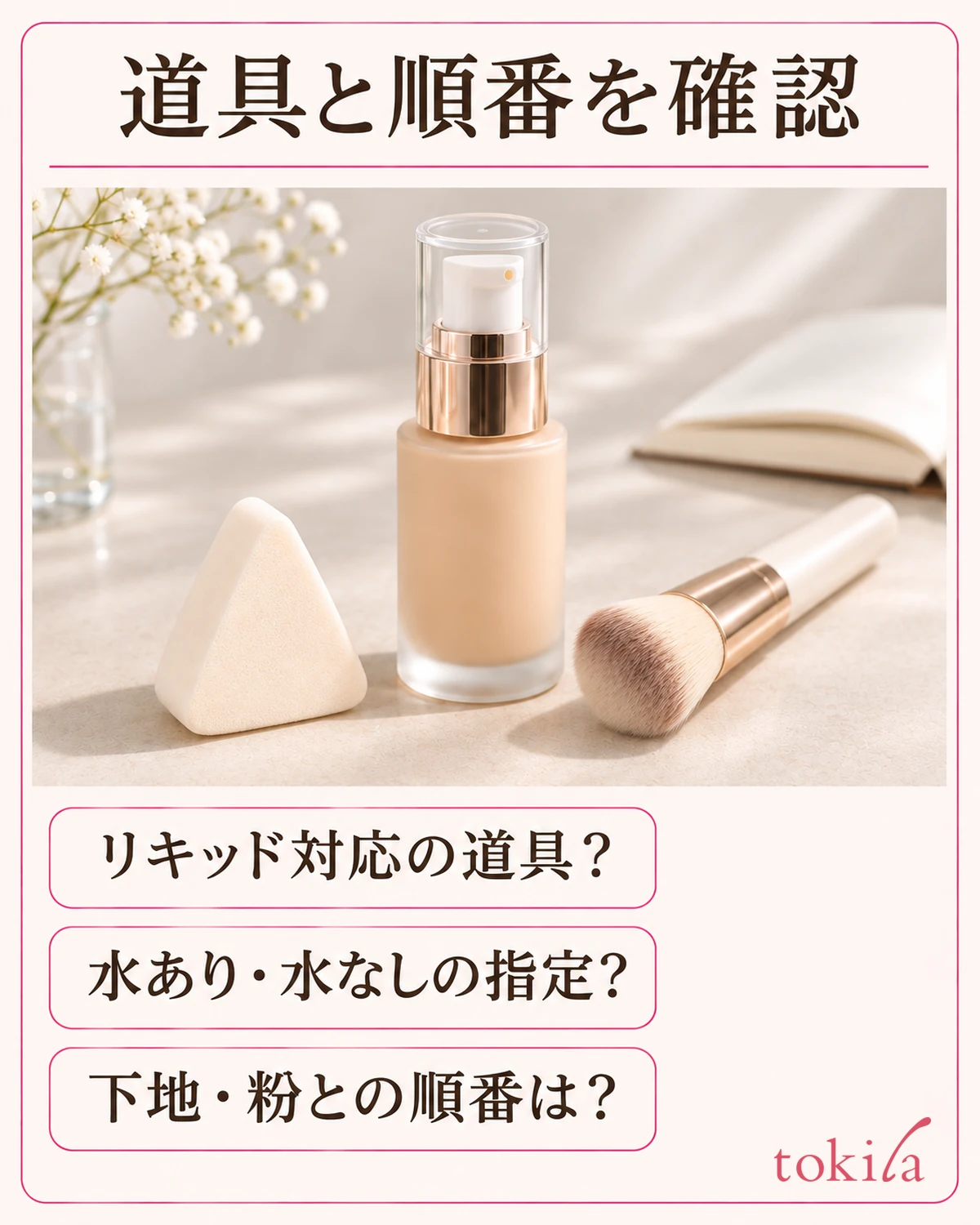
Consider whether you want to use fingers, a sponge, or a brush. However, a tool suitable for liquid foundation does not guarantee the same application method for every product. Check the candidate's instructions for tools, amounts, and where to dispense it before deciding whether your existing tools will work.
For a sponge, check its compatibility with liquid foundation and whether it can be used damp. For a brush, check that it is suitable for liquids. If you need a new tool, consider the preparation and cleaning involved as well as its cost, separately from the foundation itself.
Next, review combinations with your current sunscreen, primer, concealer, and powder. Do not treat products described as needing no primer and products applied after primer as having the same conditions. Even a multifunction product does not mean you can skip sunscreen amounts or reapplication; prioritize each product's labeling.
If you chose a product to retain glow, check how to use finishing powder too. Look for instructions on whether to layer powder and whether to use it all over or only where needed. A photograph featuring the foundation alone may not match the finish after layering your usual full routine.
If brush streaks bother you after purchase, do not immediately assume you chose the wrong product; see How to Address Liquid Foundation Brush Streaks. Here, rather than repeating tool techniques, focus on confirming before purchase that you can meet the usage conditions.
4. Read dispensing, shaking, and removal instructions before choosing
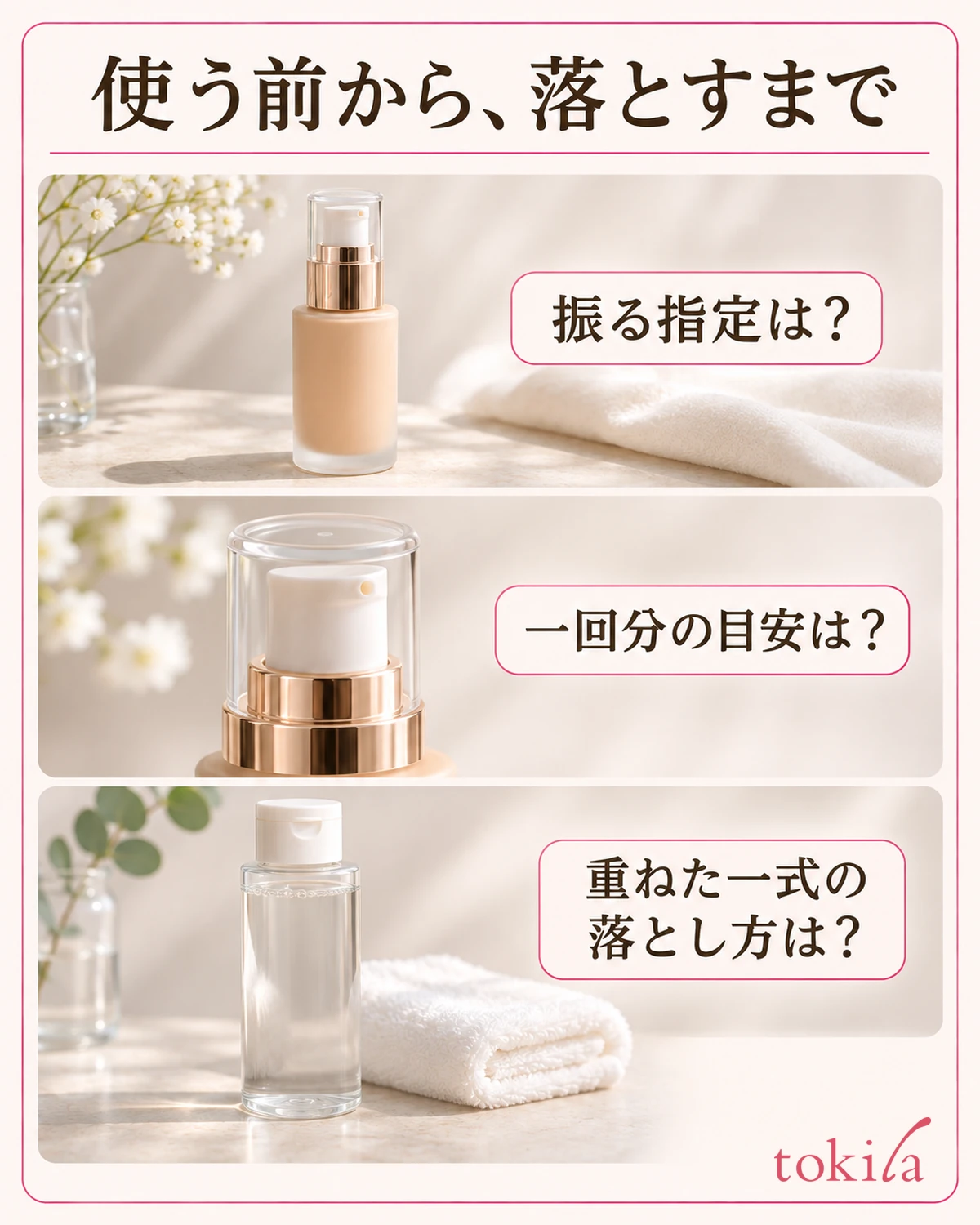
Even among liquids, some products need shaking before use and others have no such instructions. Do not decide from appearance alone to shake vigorously because the container rattles, or skip shaking because the liquid seems runny. If a number of shakes or an orientation is specified, read it as that particular product's procedure.
With pumps and tubes, check what a single-use amount refers to. Do not carry terms such as "one pump" or "an appropriate amount" directly across products; check whether they mean enough for the whole face or an amount to adjust as you go. Initial pump priming instructions are also separate from the amount to apply to skin each time.
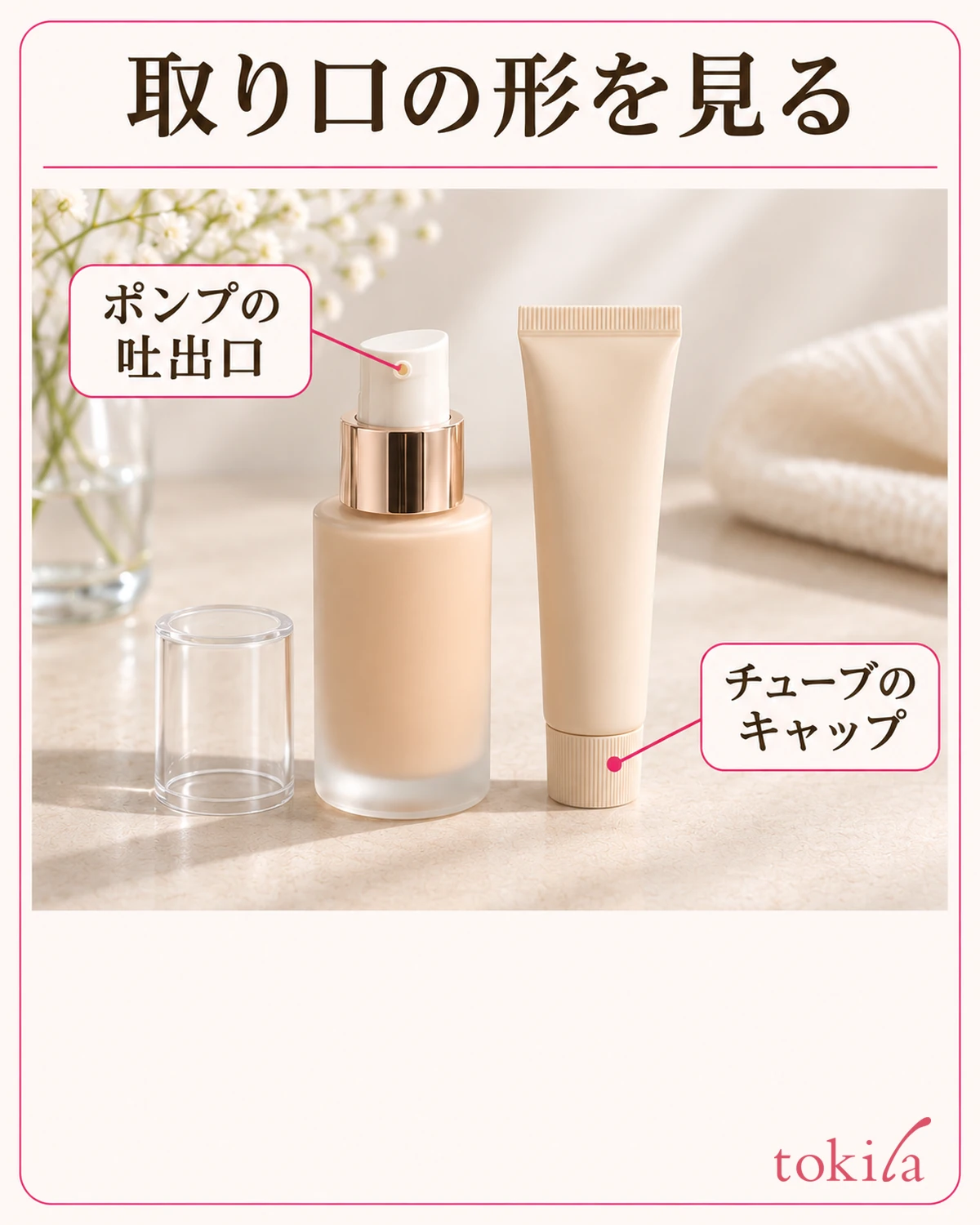
The supplementary photograph enlarges a closed tube and the dispensing opening of a pump with its cap removed. It shows the opening shapes and where the container is pressed or opened. Do not judge coverage from the container shape or apply one pump's method to every product.
Check removal instructions before buying too. Even if a product is described as washable with soap, separate conditions still apply to the primer, sunscreen, and other layers. Switching just one product to an easier-to-remove option does not mean your entire makeup routine no longer needs cleansing.
For candidates with refill pouches or replacement cartridges, also check whether you have the matching main container. A similar-looking pump from another range may not fit. When buying for the first time, note the sales unit so you do not mistake a refill alone for the complete product.
If you want to carry it, read about caps, locks, and storage. A small container does not automatically mean decanting is permitted; do not choose on the assumption that you can transfer it to an unspecified container. Keep candidates that fit comfortably into everything from morning preparation to evening removal.
5. Compare two candidates using the same items and choose your main occasion
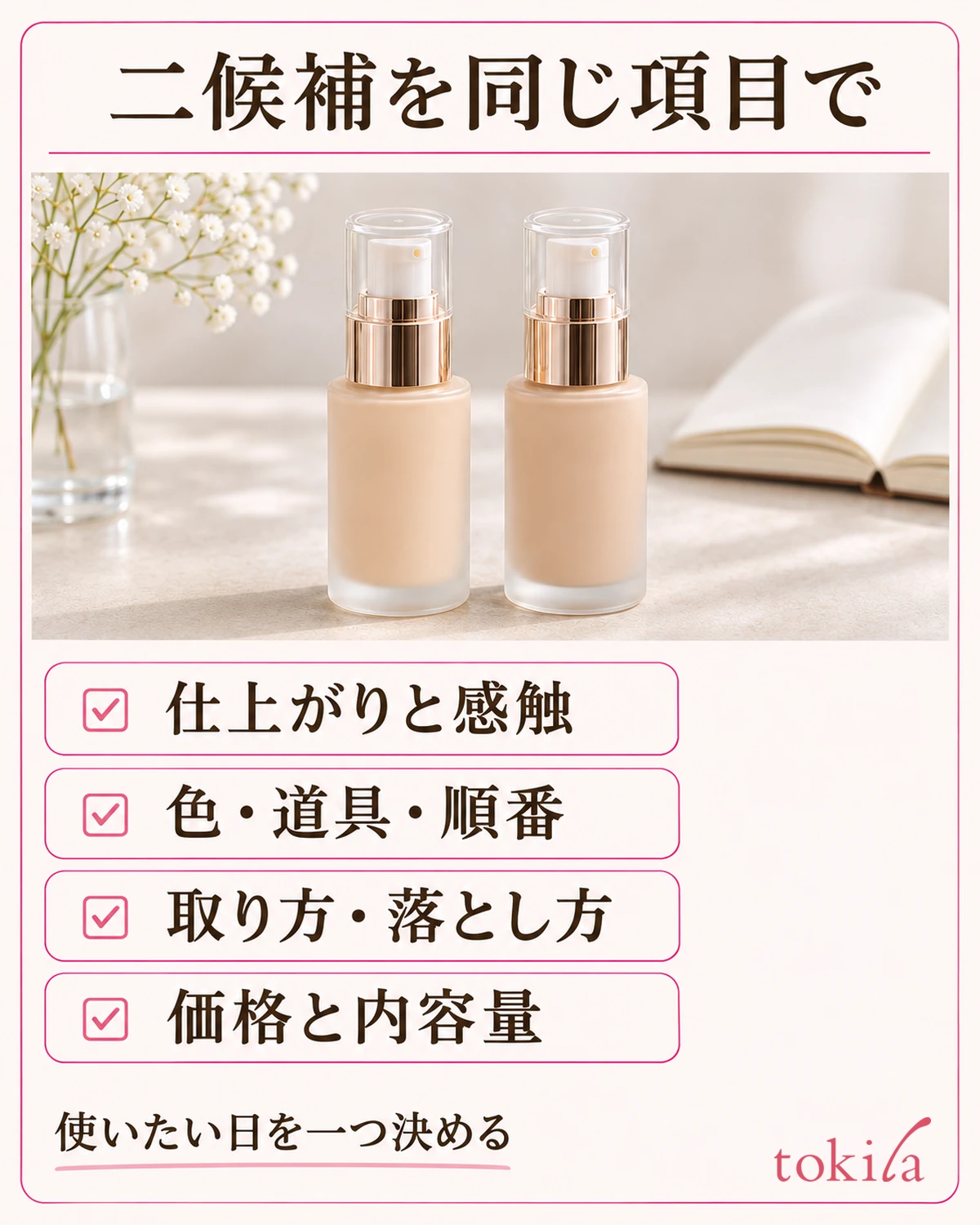
Finally, compare finish, feel after spreading, shade, tools and order, and dispensing and removal in the same sequence. Rather than examining only glow for one and price for the other, fill out the same fields for both. Leave unknown items as questions to confirm instead of filling them in from imagination.
Compare prices and quantities using equivalent sales units, distinguishing standard and small sizes and main containers and replacement cartridges. Do not calculate daily costs without knowing the amount used each time and frequency. Separating any tool costs from the product price also helps identify candidates that work with what you already own.
If both meet your purpose, return to your initial occasion. Do you want a short routine every morning, or to enjoy your preferred glow on days off? Being able to explain your reason for choosing in one sentence, rather than counting shades or descriptions, helps stop the candidate list from growing endlessly.
After purchase, prioritize the actual product's instructions over your comparison notes. If the result is thicker than expected, review amounts, tools, and primer conditions one at a time before immediately switching products. However, do not try to resolve redness, itching, or other abnormalities through technique alone; stop use and follow the precautions.
Rather than choosing liquid foundation from similar-looking containers, compare the finish together with the steps in your daily routine. Choose one occasion, confirm the conditions you need, and look for a product that fits your makeup routine.