You loved the umbrella on its own, but once you put it with your clothes you hesitate a little. When that happens, before choosing by color name alone, try looking at the open canopy and the closed umbrella separately. The part that spreads wide above your head, the inside you see on the side facing your face, and the handle in your hand each connect with your outfit in a different way.
Here, using the umbrellas and clothes you already own, we introduce a way to compare the outer color, see-through materials, the area around the face, and how it looks when you carry it, in that order. This is not a diagnosis that settles on one color that suits you. First check the purpose you need, such as rain, parasol, or all-weather, and the labeling, and then look for combinations you like within that range.
Look at the outside, the inside and the closed umbrella separately
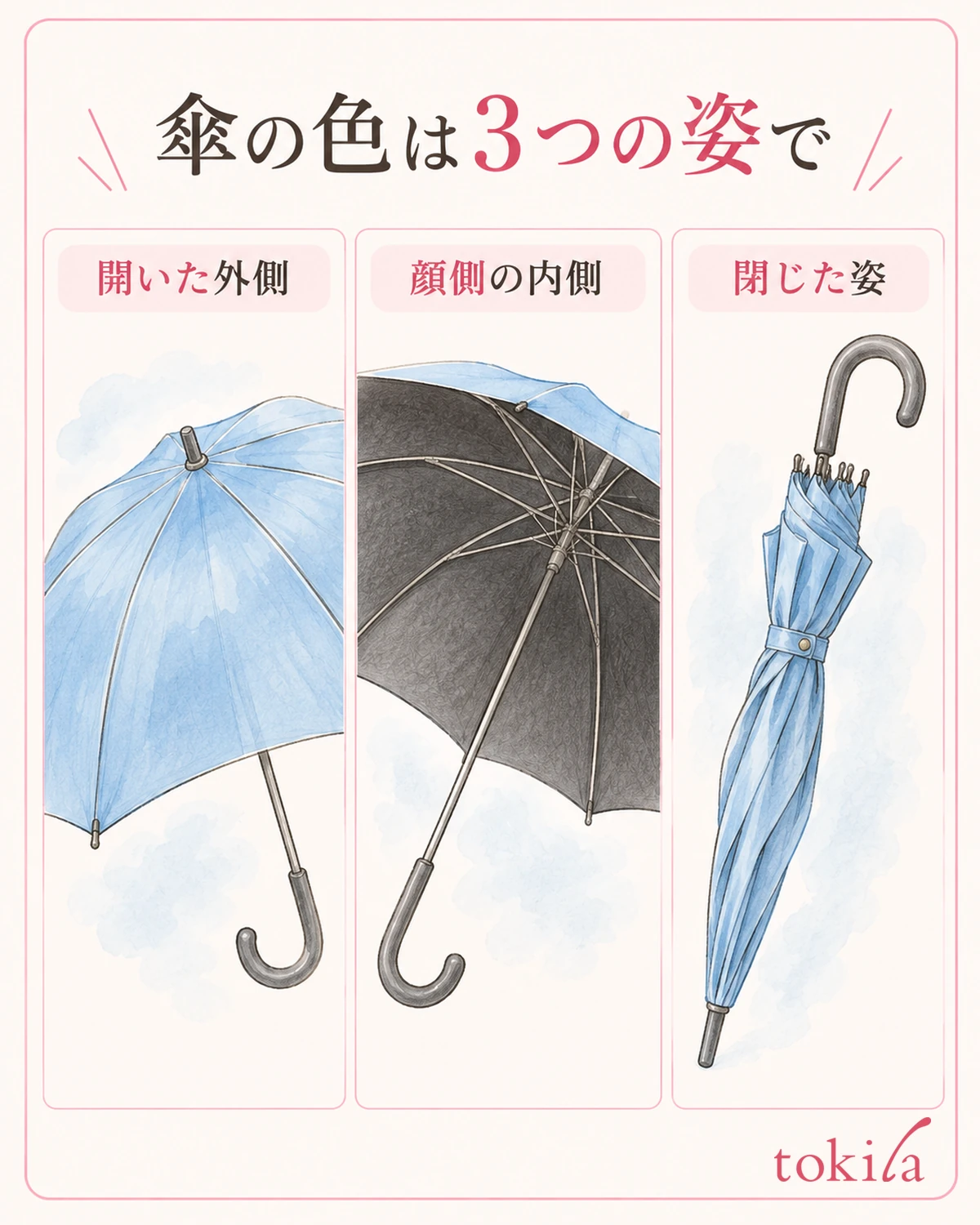
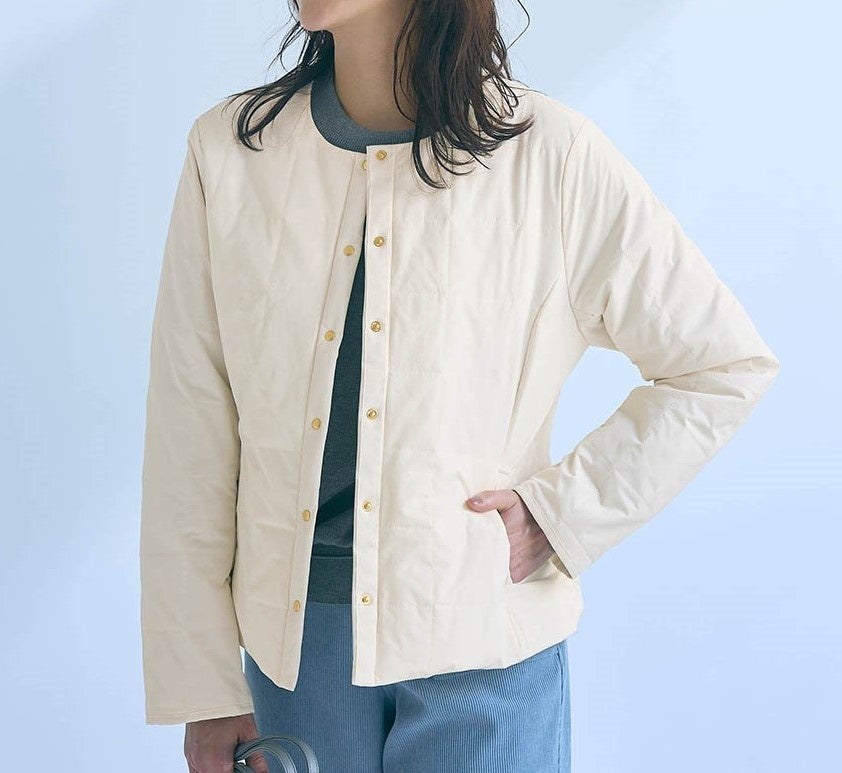
First, decide on one jacket or coat for the day you will use the umbrella. Use the clothes that are actually visible from outside as your reference, such as your usual coat for commuting or the jacket you plan to throw on on a day off. If you choose a color based only on what you wear underneath, the surfaces that look large when you go out will be swapped.
Check not only the outside of the open umbrella but also the inside that the person holding it sees. Even if the outside is a light color, the inside may be black, or the pattern may differ between the two sides. Do not assume that the color you see on the outside will also be near your face; look at both sides of the umbrella you own.
When you open it to compare, choose a place with enough room so it will not hit people or objects around you, and operate it following the instructions. In a store, check whether you may open it and where you can try it. You do not need to force it open in a narrow entryway or a place where people pass just to match it with your clothes.
If you cannot try it open, first set the dry umbrella, still closed, beside your jacket and look at the relationship between the colors. At this stage, what you can tell is part of the fabric and the color at hand. Do not treat it as having confirmed how it looks on the face side; set that aside as a point to recheck when you can open it.
Also choose one thing you want to enjoy today, such as "I want to make the blue of the umbrella stand out" or "I want to keep it close to the color of my clothes." The umbrella does not always have to be the star. If you decide the direction you prefer first, it is easier to compare combinations with one outfit than to keep adding candidates.
For example, with a navy coat and a blue umbrella, there are days you want to see a cluster of similar colors and days you want only the umbrella to look bright. Even within the same "blue family," brightness and vividness are different. Choose by looking at the two side by side, rather than by whether the color names are the same.
Tell apart the see-through surface from the color of the edge and ribs
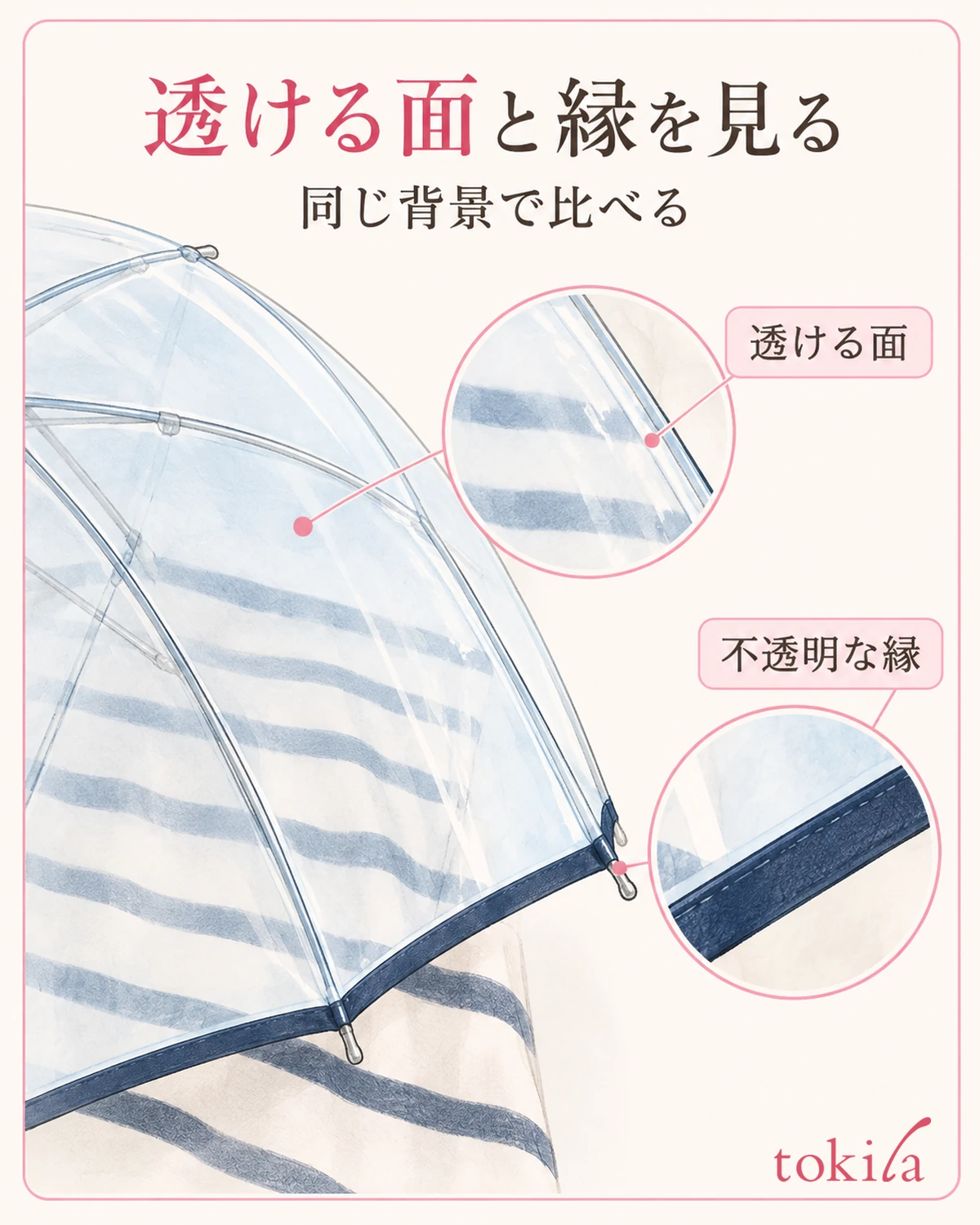
With a transparent or translucent umbrella, you can see the background on the other side in addition to the color of the fabric itself. The impression in front of a shelf is not necessarily the same as the impression against the sky or buildings. When comparing with your clothes, do not change the background midway; first look at the two candidates in the same place.
With colored transparent material, separate the parts where your clothes show through the canopy from the parts hidden by the trim. Even if the whole surface looks pale, only the thin line of the edge may stand out clearly. Try checking the color of the large surface and the color of the thin outline separately.
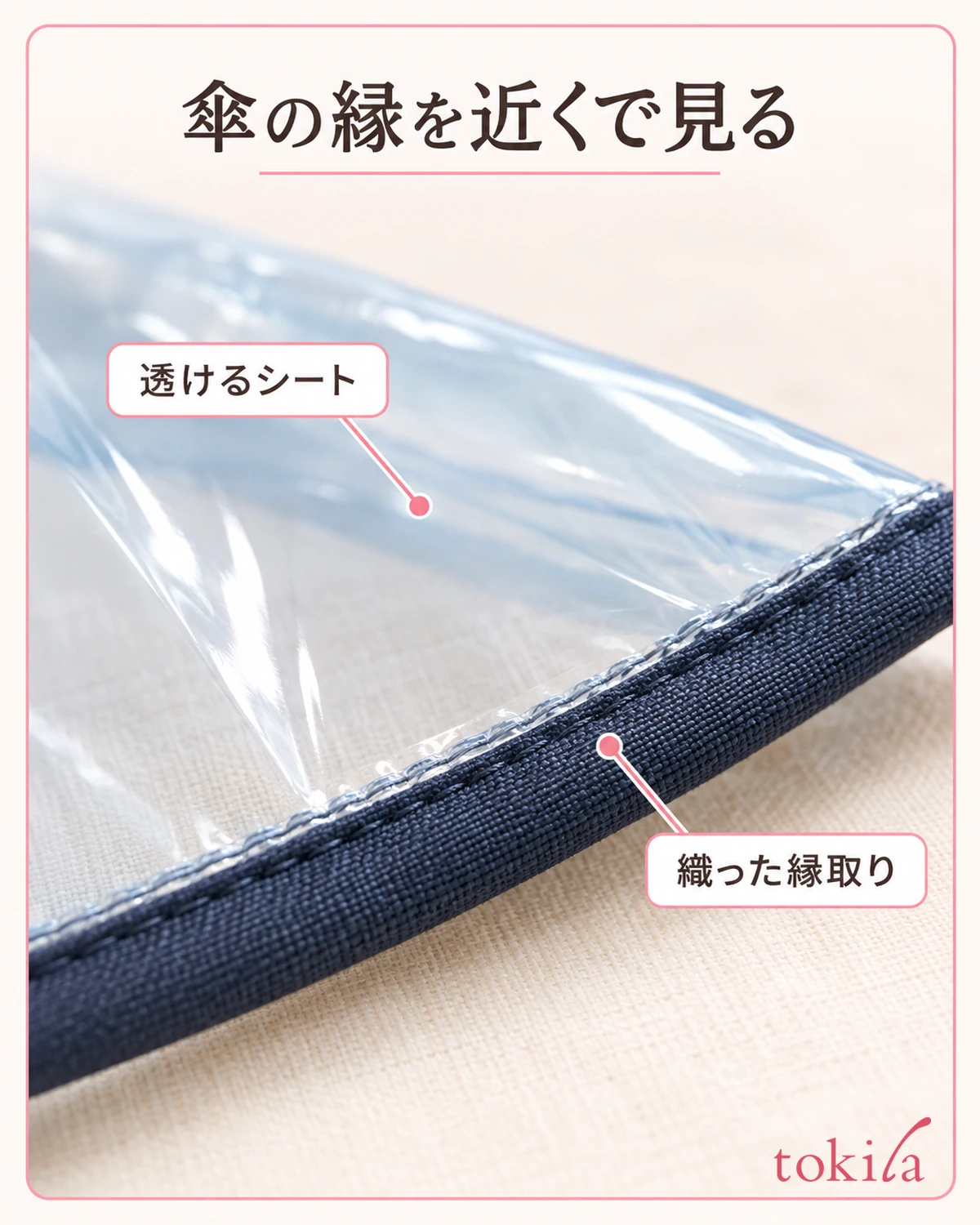
When looking up close, view the edge of the umbrella from an angle and look for the boundary between the see-through sheet and the opaque trim. You do not need to pull the fabric hard or move the joints of the ribs. Gloss and how much it shows through are hard to judge from photos alone, so check with the actual umbrella you own.
If there is a pattern, look not only at the colors of the pattern but also at the plain or transparent areas left between them. Even with the same pink pattern, the amount you see differs between an umbrella with small flowers scattered about and one with broad areas of color filled in. It is easier to sort out if you try one of two approaches: bringing one color of the pattern into your clothes, or leaning toward the ground color between.
The ribs and the shaft of the umbrella are also elements that can be seen from the inside depending on the angle. However, do not paint the metal fittings to match colors, or attach decorations that interfere with operation. Observe the colors already there, and think within the scope of changing the candidates for clothes and belongings.
You cannot judge that because it is see-through it offers enough protection from sunlight, or that because it is a dark color it is always cooler. Read color and gloss separately from the labeling of uses and performance such as for rain, UV or light blocking. Before deciding on a color scheme you like, check that the umbrella meets the conditions you need on the day you use it.
Fix your clothes and compare similar colors with an accent
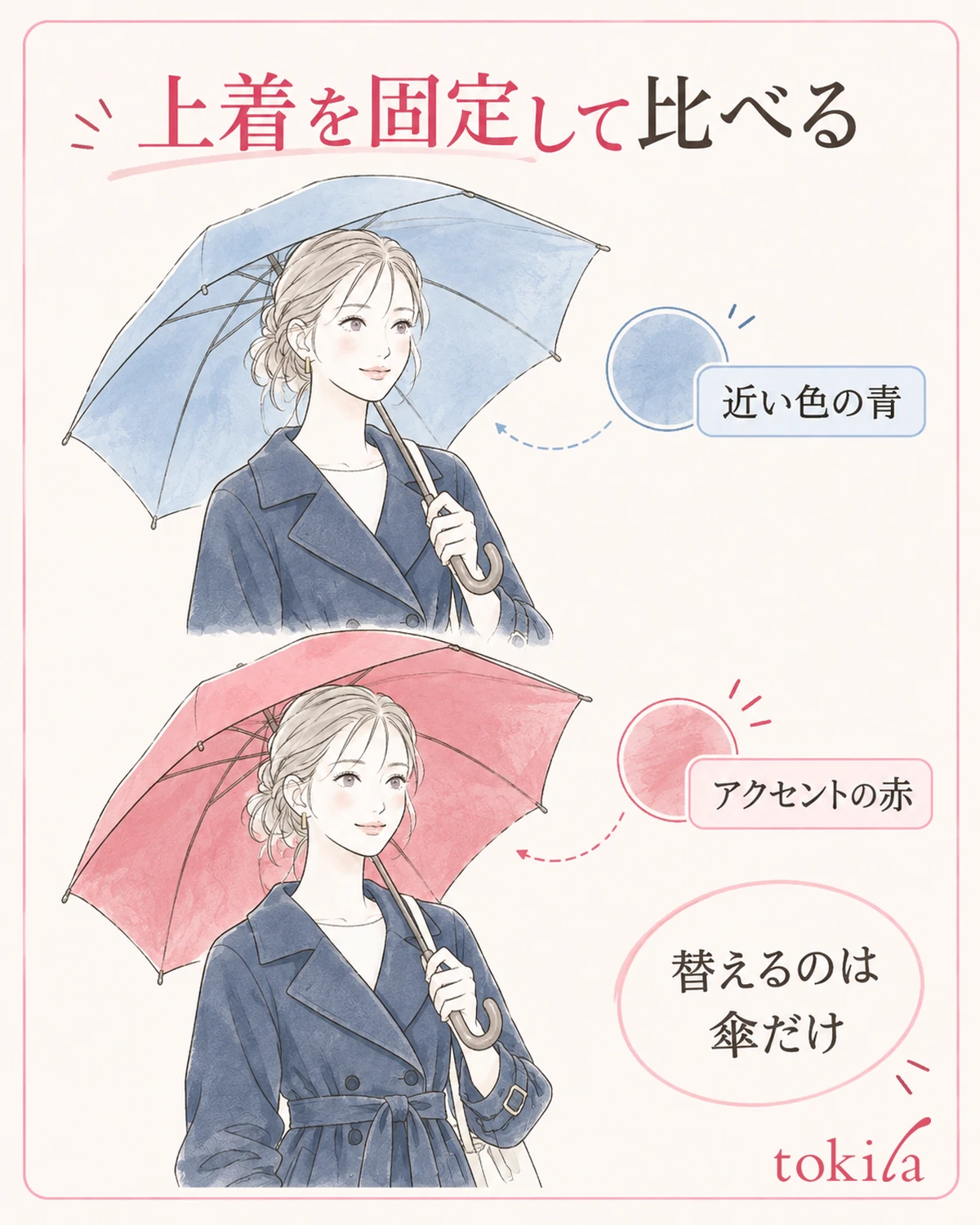
Once you start comparing, leave your jacket and bag as they are and change only the umbrella candidates. If you change both clothes and umbrella at once, it becomes hard to tell what you liked. If you own only one umbrella, it is also fine to keep the umbrella fixed and change jackets one at a time.
The first is an umbrella close to the color of your jacket. Try the closer directions first, such as an ecru or light brown umbrella with a beige jacket, or a blue-family umbrella with a navy jacket. You do not need to look for exactly the same color; including differences in brightness, look at the overall cohesion yourself and choose.
The second is a combination in which you put a color different from your clothes on the umbrella. It is a candidate when you want to enjoy the color of the umbrella, such as a muted red umbrella with a plain navy jacket. If the contrast feels strong, reviewing the vividness and brightness of the umbrella's color before changing your whole outfit lets you keep your axis of comparison.
When matching with patterned clothes, there is also a way to connect one color in the clothes to the umbrella. For a blue and white pattern, compare a candidate that picks up the blue with one closer to the white. You do not need to add every color in the pattern one by one to the umbrella or shoes.
If you choose using only a small color swatch, it can be hard to imagine the area of the umbrella when open. If you can try the actual umbrella, look at the outside surface too, holding it the same way. Even when narrowing candidates from photos on a screen, do not treat the displayed color as exactly the same as the real one; use it as a stage for checking the direction of light and dark and the placement of the pattern.
If you are unsure, return to two points: "can I enjoy the color of the umbrella today?" and "does it feel calm when seen together with the jacket?" General color coordination is also summarized in the article on color scheme basics. Rather than leaning toward a fixed right answer, use it as material for comparing differences in your own hands.
Check the area around your face and how it looks closed and held
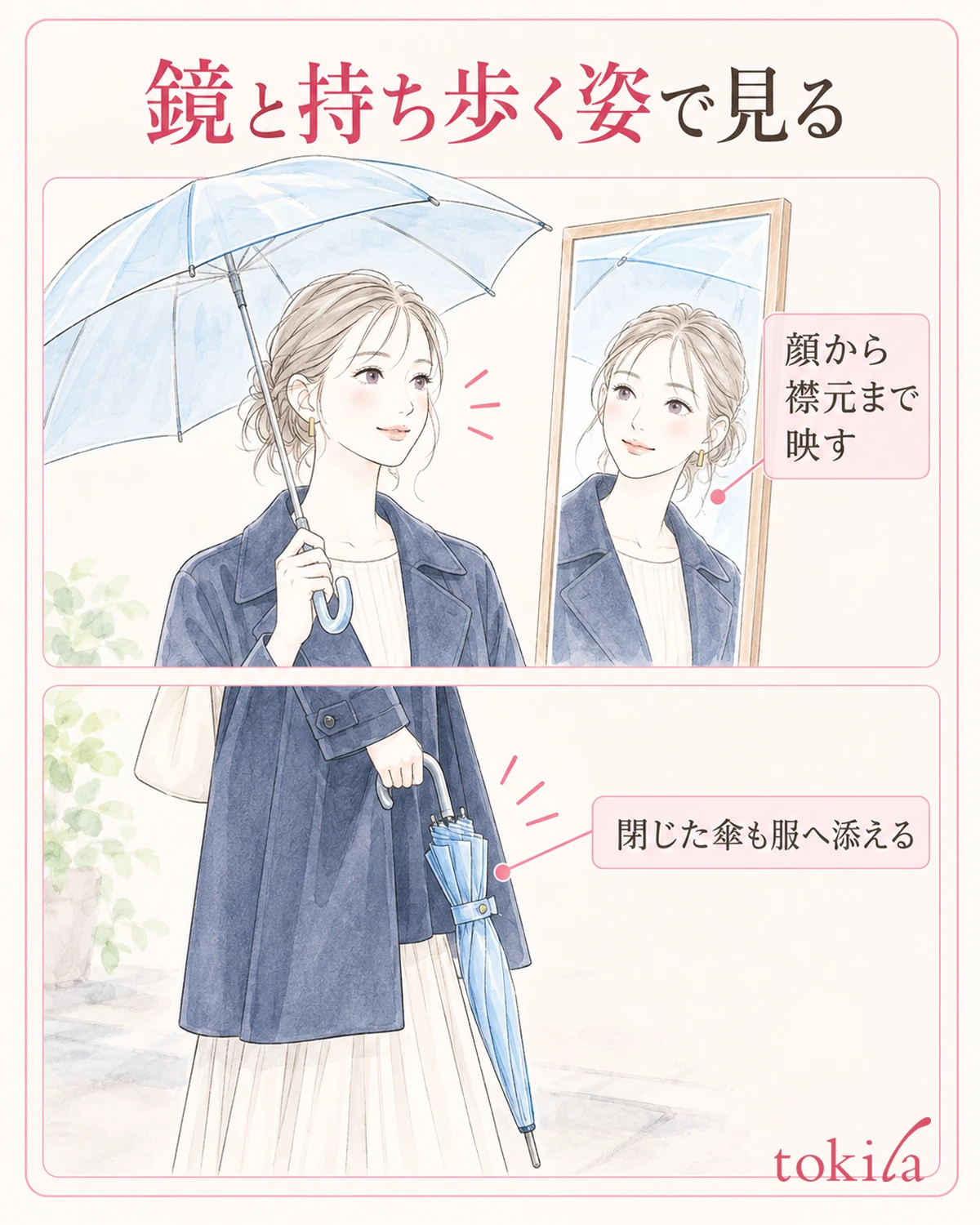
If there is a place where you can open it safely, hold it at the height you would actually use it and check in a mirror that shows from your face to the collar of your jacket. Separate the viewpoint of others seeing the outside of the umbrella from the viewpoint of seeing the inner surface on your own face side. Do not lower it deeply to see and hold it in a way that blocks your view.
When comparing how your face looks, match the lighting, the direction you face, and the distance from the mirror. With a bright window on one side and a dark wall on the other, the difference between umbrellas gets mixed with the difference in light. Rather than asserting how your skin changes, look together with your face, hair and collar in the same place, and confirm your preference.
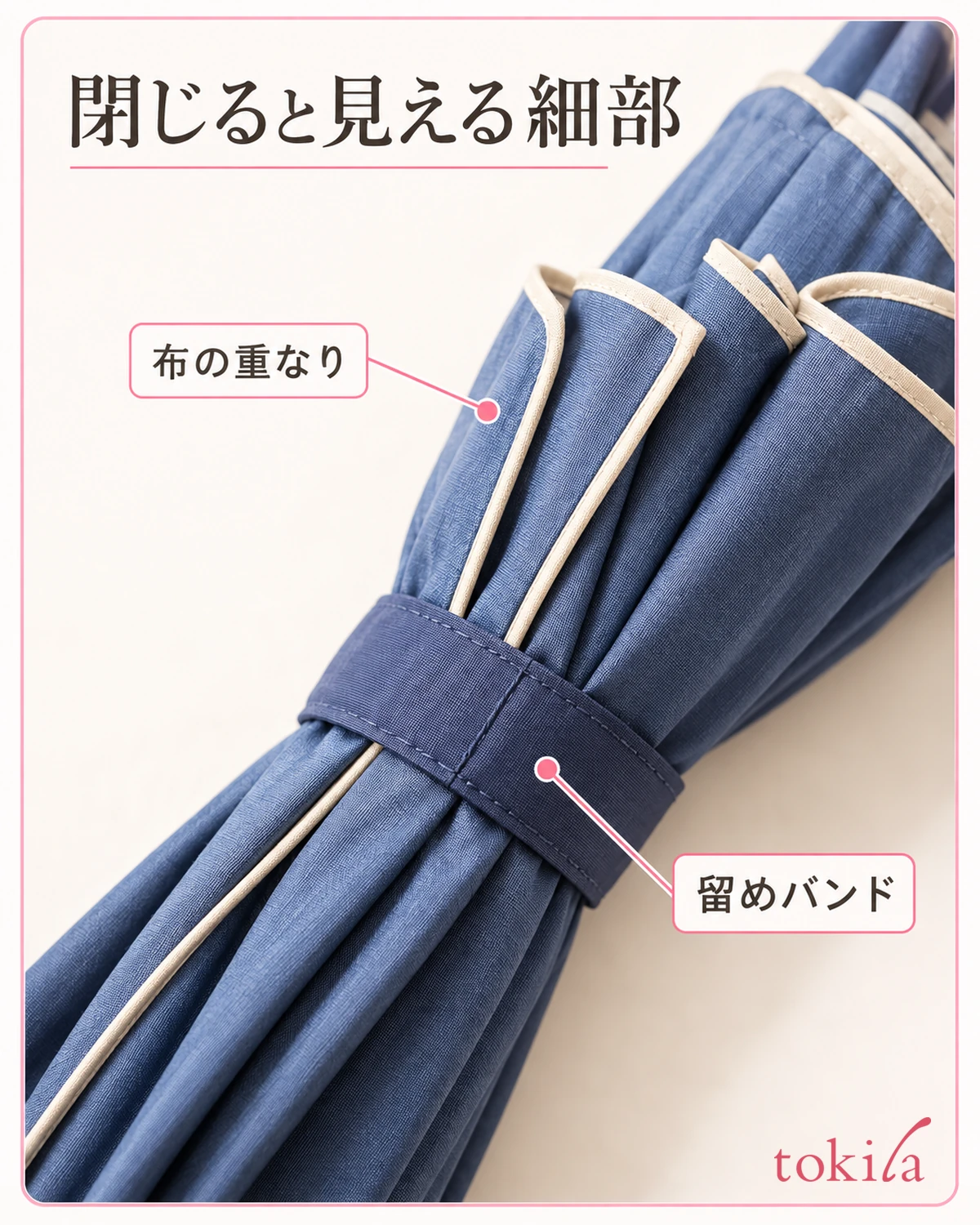
Next, close the dry umbrella, and set it beside your jacket as it looks when folded in the usual way. The color surface that was large when open becomes long, narrow folds. Look at spots that are easy to notice when closed, such as the color of the fastening strap, the edge peeking out from the overlapping fabric, and the color of the handle.
For a folding umbrella, the color of the storage pouch is also part of how it looks when you carry it. If you will carry it in the pouch for a long time while out, check the relationship between the pouch and your bag, not just photos of it open. Avoid forcing it into a different pouch that does not fit in size or purpose just to match the pouch color.
On days you use glasses or a hat, look at yourself wearing them as you normally would. However many colors there are near your face, you do not always have to reduce them. If you were hesitating while looking only at the umbrella, putting your usual hairstyle and collar in the mirror as well makes it concrete which spots bother you.
A color scheme you decided on in an indoor mirror can also change in impression with the weather and light. Do not expect it to look the same in every place at once; check what you can see in a safe place before going out. You do not need to step out into the road or a spot that blocks passage to take a selfie with an umbrella.
If you are unsure, change just one thing and go back to the conditions of use
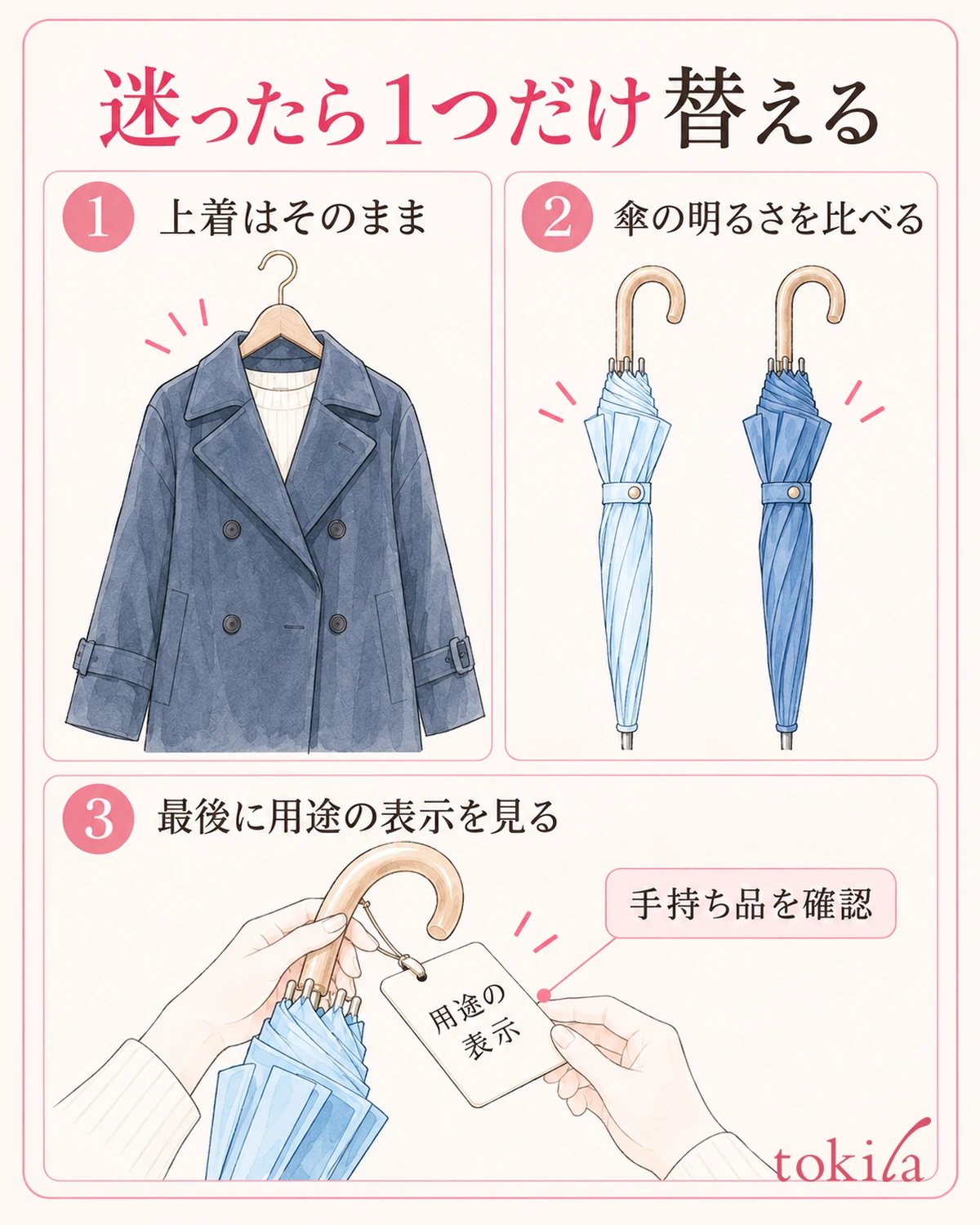
If the colors have multiplied and do not come together, before changing the umbrella, try one idea of switching the jacket to a plain one. If both the umbrella and jacket are patterned, first fix one and look at candidates with fewer patterns or colors on the other. On days you want to keep the personality of both, it is fine to choose that combination.
If a light color looks vague, look at the trim and the handle before making the whole umbrella darker. Sometimes just having an outline gets it closer to what you like, and sometimes you want to change the color of the surface. If you separate which one bothers you, you can narrow down candidates and avoid unnecessary extra purchases.
Conversely, if you feel only the umbrella stands out, return to a color close to your jacket, or try a candidate whose vividness is gentler. Rather than deciding you are bad with an entire color name, such as "red is difficult," think of it as the relationship between that one umbrella and today's clothes.
At the final stage of choosing, apart from the color scheme, return to ease of holding, opening and closing, visibility, and the labeling of the uses you need. Even if you like the color, you do not need to force a choice that does not suit the situation in which you will use it. Conditions such as whether it can be used in the rain should be checked on the label of the umbrella you own, not by how it looks.
Do not hold a wet umbrella against your clothes to compare colors, or put it back in your bag while closed. Handle the moisture after use, drying and storage according to the product's care instructions. If you review the color scheme, lining it up with the same jacket after it has dried keeps you from mixing in the difference from its wet state.
For the next time you use it, it is handy to briefly remember the combinations you liked, such as "with the navy coat I want to show a broad blue surface" or "I like the edge when it is closed." By looking in order at the outside, inside, see-through parts and closed shape, you can find what you like about an umbrella that you would not notice from color names alone.