When you prepare skincare to take on a trip, moving everything into small empty containers is not always the answer. Keeping a container suited to the contents, its storage conditions and the usage instructions is also part of the preparation. Before cutting down your luggage, decide what you will take in which container.
This article covers choosing and packing before departure. It is a procedure for checking whether the products you own can be decanted, and preparing, including the option of not transferring them. Pouring a dedicated refill into the main bottle, and the carry-on conditions for aircraft and the like, are checked separately. The aim is to leave yourself in a state where you can tell how to use everything at your destination.
1. Line up the situations you will use products in, and choose what to take
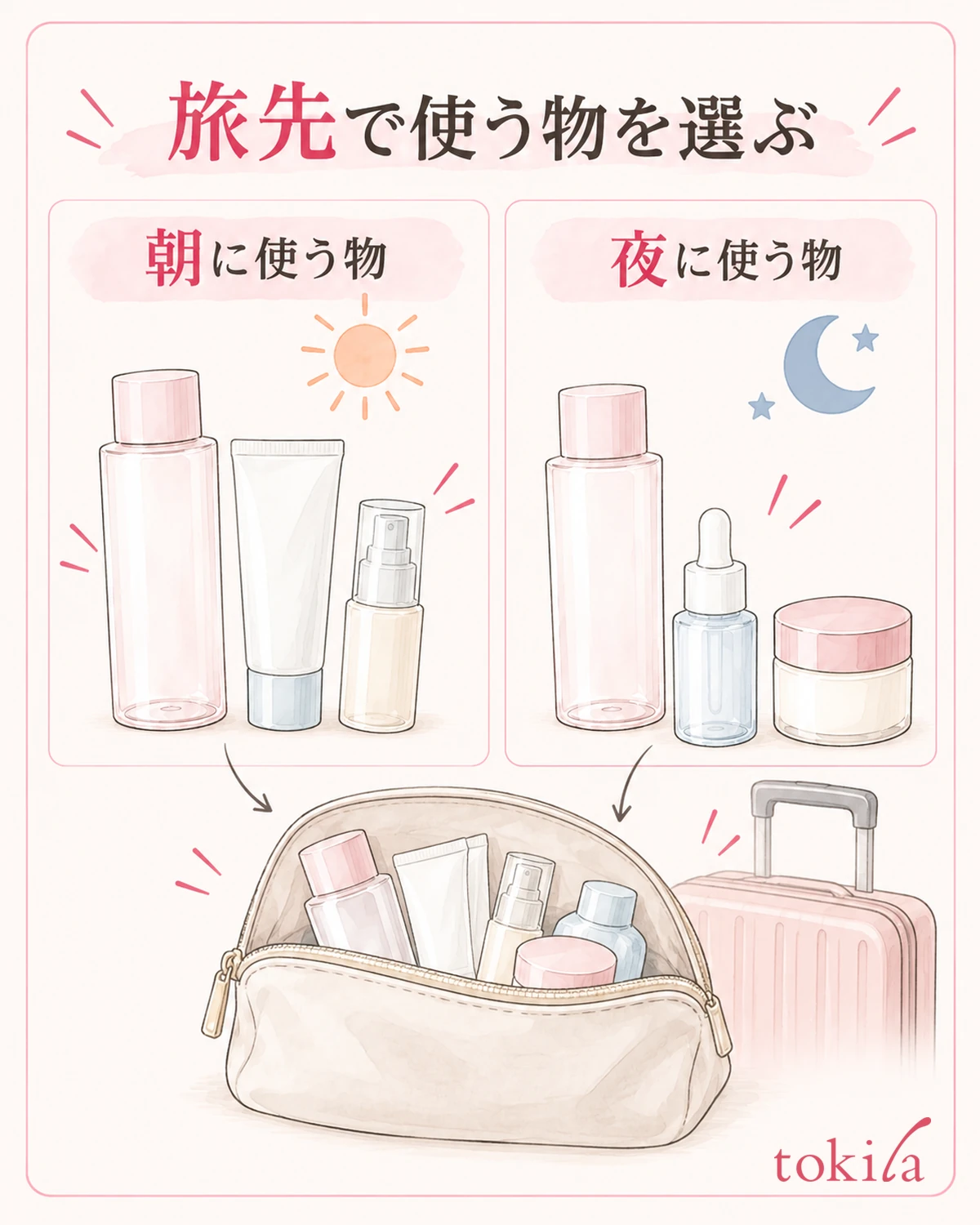
First, write down on paper or your smartphone what you will use in which morning and night situations. Start with the products you normally use, such as cleanser, moisturizer and daytime UV protection. Rather than increasing the number of items, prioritize being able to tell when each one is used.
Do not decide the amount you need by the number of nights alone; look at how many times you will actually do your routine, such as the night you arrive and the morning you go home. If your products have a recommended amount per use, compare that label with how much is left. Do not judge "it should be enough" just from the apparent size of the container.
Not replacing your usual products with a small product you are using for the first time, just because it fits in your luggage, is also an option. Keep separate the plan to try a new combination during the trip and the preparation to bring your usual routine. Even with samples, check the order of use and the precautions.
Set aside products you do not plan to use without opening their original containers. You do not need to open all the bottles you took out "just in case." If you put them back in order of use, it also makes it easier to notice if you have mixed up a toner and an emulsion of similar size.
When sharing with family, do not equate using the same container with the same contents suiting everyone. Check who plans to use what, and make the precautions on each product readable. Once what you will bring is decided, move on to checking containers and labels.
Do not combine items that need separate handling, such as medicines, with cosmetics in one unlabeled container. The list you make here is for organizing your belongings and does not set new amounts or expiration dates. If you are likely to run short at your destination, review the remaining amount of the original product and how to prepare it before departure.
2. Check whether you can decant, and also choose to keep the original container
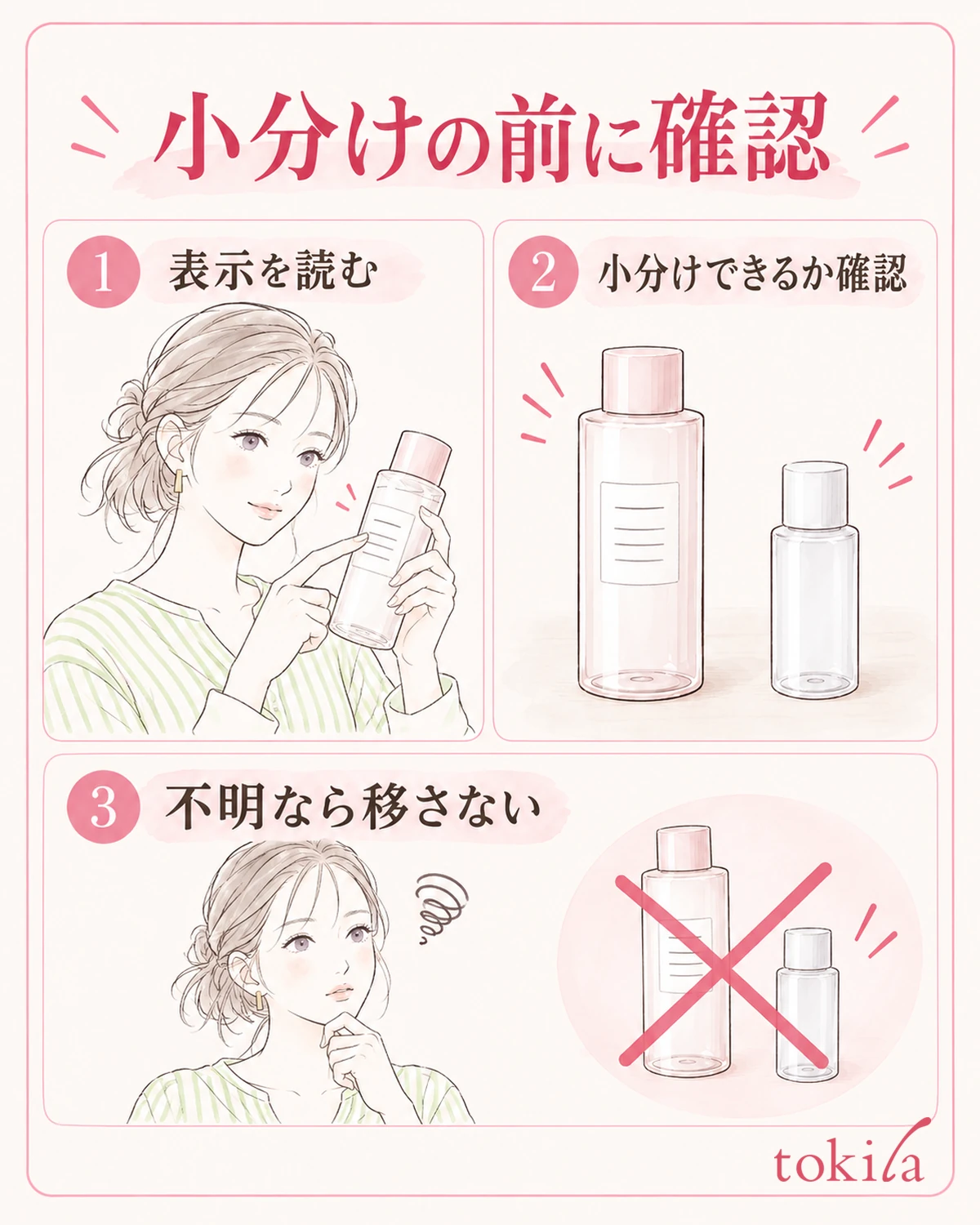
Cosmetic containers are chosen with both protecting the contents and getting them out in mind. Even if you have travel-size bottles on hand, you cannot always freely transfer the original product into them. First read the product's label and check whether it gives any guidance on transferring to another container.
"A refill is available" also does not mean you can put it into an off-the-shelf small bottle. A product used with a matching main container requires that combination. For dedicated refills, think about it separately from decanting for travel, using checks before refilling a lotion.
For a product that does not recommend transferring, or whose compatibility you do not know, consider carrying it in its original container instead of opening it and hesitating. If the same product has a travel size, you can also choose it after checking that product's usage and precautions.
Even if switching to a transparent container makes the contents easier to see, it does not necessarily block light like the original container. We also do not assume that a colored bottle will always block light. Do not judge compatibility with the contents from appearance or color alone; go back to the point where each product's specification can be confirmed.
For foaming products and pump types, the container's mechanism is part of how it is used. Do not assume you can substitute one just because the opening fits or the pump can be pressed. We do not add steps for modifying your containers or cutting tubes to convert them for travel.
When you cannot confirm whether it is allowed, do not assume that treating the small bottle with boiling water or alcohol solves it; switch to preparing without transferring. When the conditions of the contents and container are unknown, you cannot judge it usable just because it looks clean. Do not decide to reduce the amount first; keep the conditions of the products you use.
3. Keep the product name, usage and precautions checkable at your destination
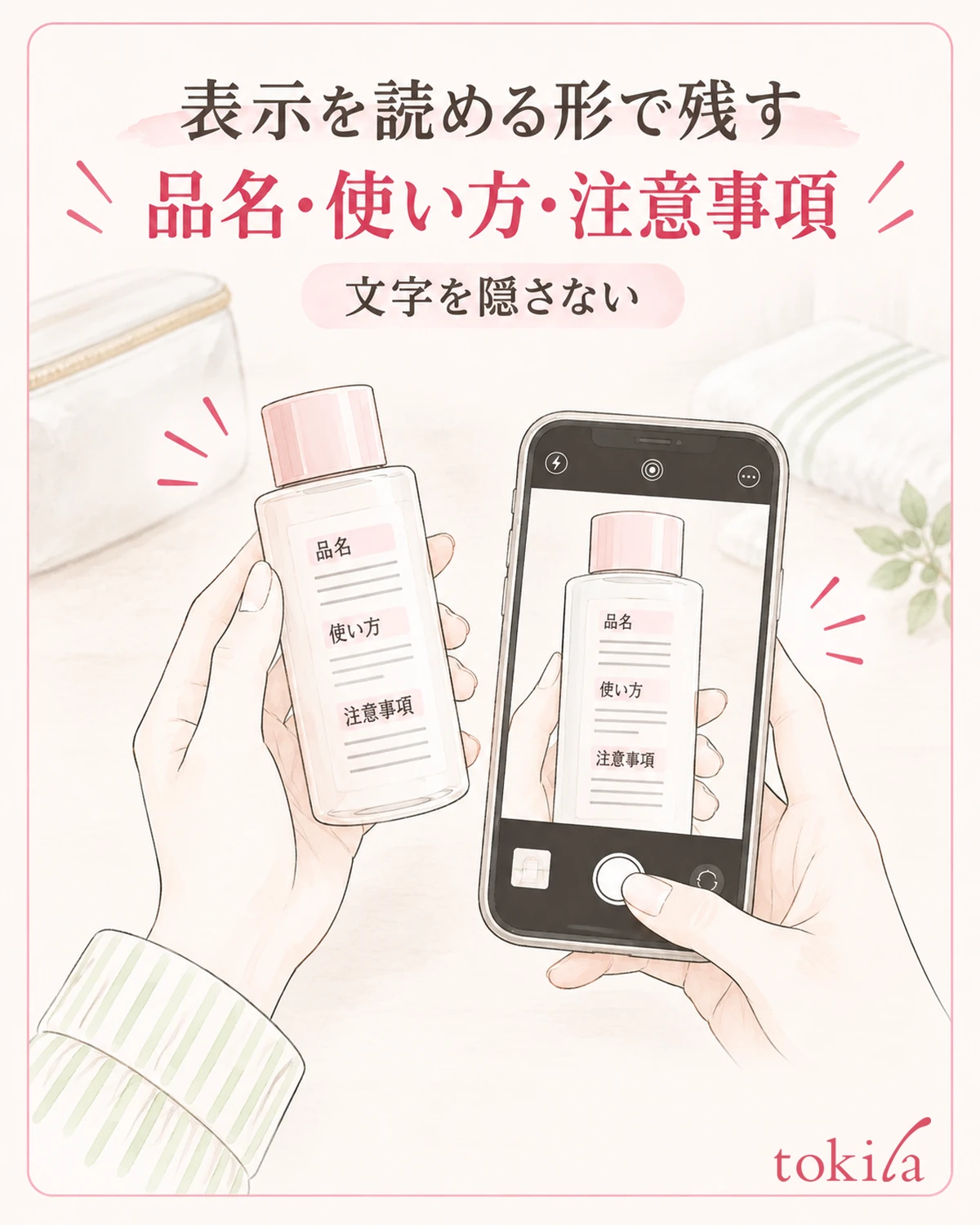
Once you have chosen the containers, check whether you can tell what each product is at your destination. Read the product name, type, directions and precautions on the main body in turn. Some information is only on small labels or the outer box, so do not treat preparation as complete just by looking at the front of the bottle.
If you do not bring the outer box, consider keeping the necessary labels in a readable photo or copy. Zoom in on the spot to check that the text is not washed out white by light and that the edge of a round bottle is not cut off. What matters is not only that you took the picture but that you can read it later.
In your record, keep a product name that distinguishes it from other types in the same series. Do not call the type of contents by container color alone, such as "white" or "blue," and compare it with your own list of when you normally use it. If it sits next to a family member's, make sure you can tell whose product it is.
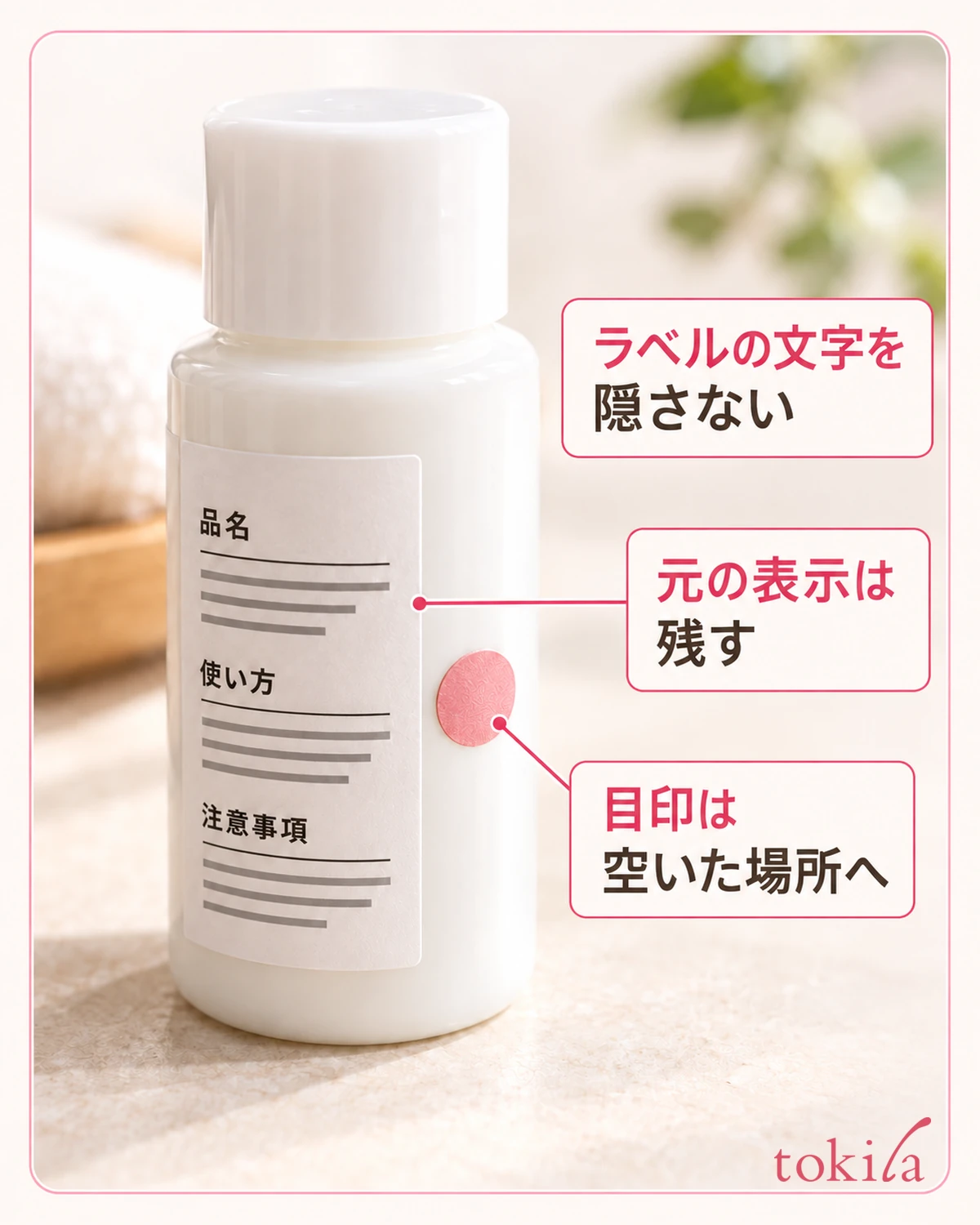
Do not cover the original label with decorative stickers or peel off the product name or precautions. If you add a marker, choose a position that does not hide the original text. Even when you supplement with photos, treat them as a reference to make checking easier at your destination, not as a change to the original label.
Do not rewrite the guide to the amount to use or expiration from memory alone. Even if you record the opening date, it does not mean you can use the product for any period you like from that day. Keep the expiration and post-opening conditions that come with the product separate from your own preparation notes.
Think about situations with no connection too, and check whether you can open your copy on the device itself and whether you can carry the necessary paper instructions with you. For a product whose name you no longer know, do not guess the contents by appearance or smell and use it; lead to the decision to hold off on using it until you can confirm.
4. Check the lid and opening, and store it where it will not be pressed
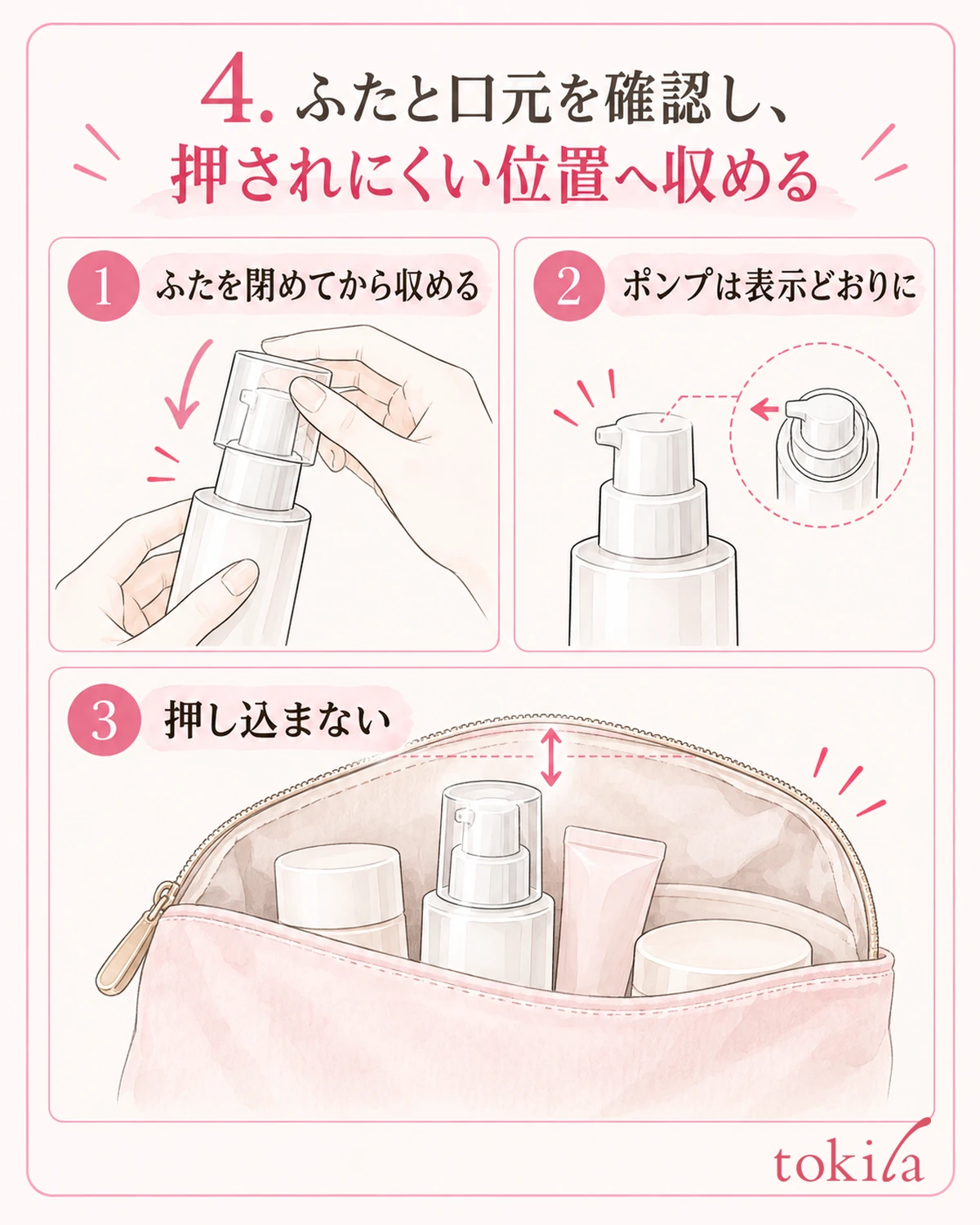
Before putting it in your luggage, check the opening for dirt and how the lid fits. Follow the product's instructions for tidying the opening, and close the lid while checking that it is not at an angle. Do not assume that twisting hard is right; if the container specifies how to close it, confirm using that method.
If there is a pump lock or protective cap, put it in the state the product's instructions describe. Do not turn the pump head while forcing it down, and do not modify a spare cap you own so that it fits. Do not treat turning the container upside down and shaking it as a leak test for every product.
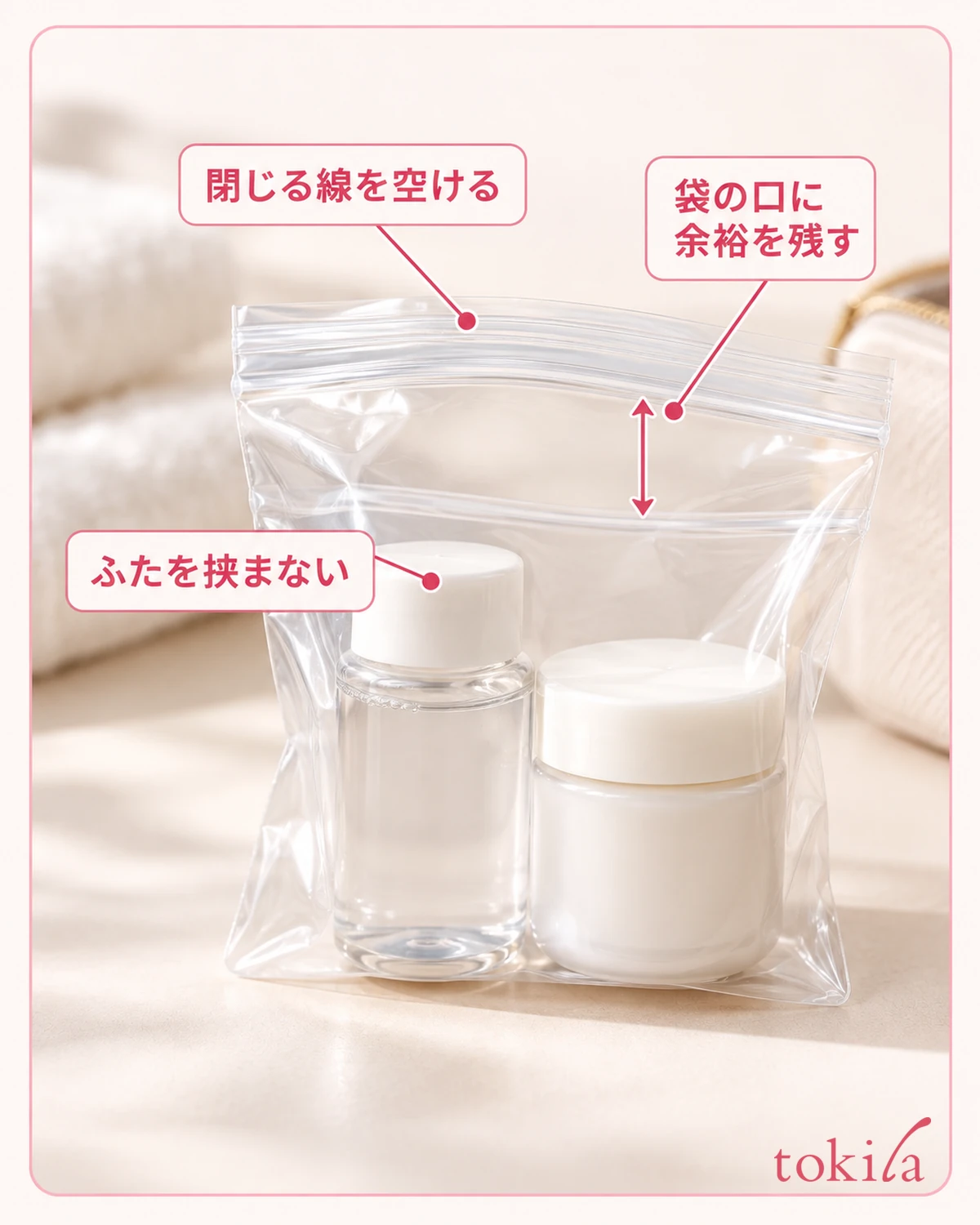
When putting items in a bag or pouch, check that no lid is left open and then place them in a stable orientation. Avoid arrangements where hard objects press directly on the pump or a thin tip, and check that the zipper closes without forcing. Using a bag is no guarantee against leaks.
Before closing the mouth of the bag, check that no container lid or fabric is caught at the edge. Do not stuff everything inside and pull the closing line to make it fit. Check by eye the room between the containers and the bag, and choose an arrangement where things can go back to the same place each time you take them out and put them in.
Storage precautions such as high temperatures and direct sunlight are conditions you also want to check while traveling. Putting it inside your luggage does not necessarily meet the temperature conditions. When choosing where to put it, also check that it is not in an environment the original container's label says to avoid.
For capacity and packaging when bringing items on transportation, check the conditions of the flight or carrier you will use separately. Even small products sold for travel are not treated as automatically permitted. This packing procedure alone does not mean you have met the conditions for boarding or shipping.
5. After arriving and after returning home, check the state of the contents and containers
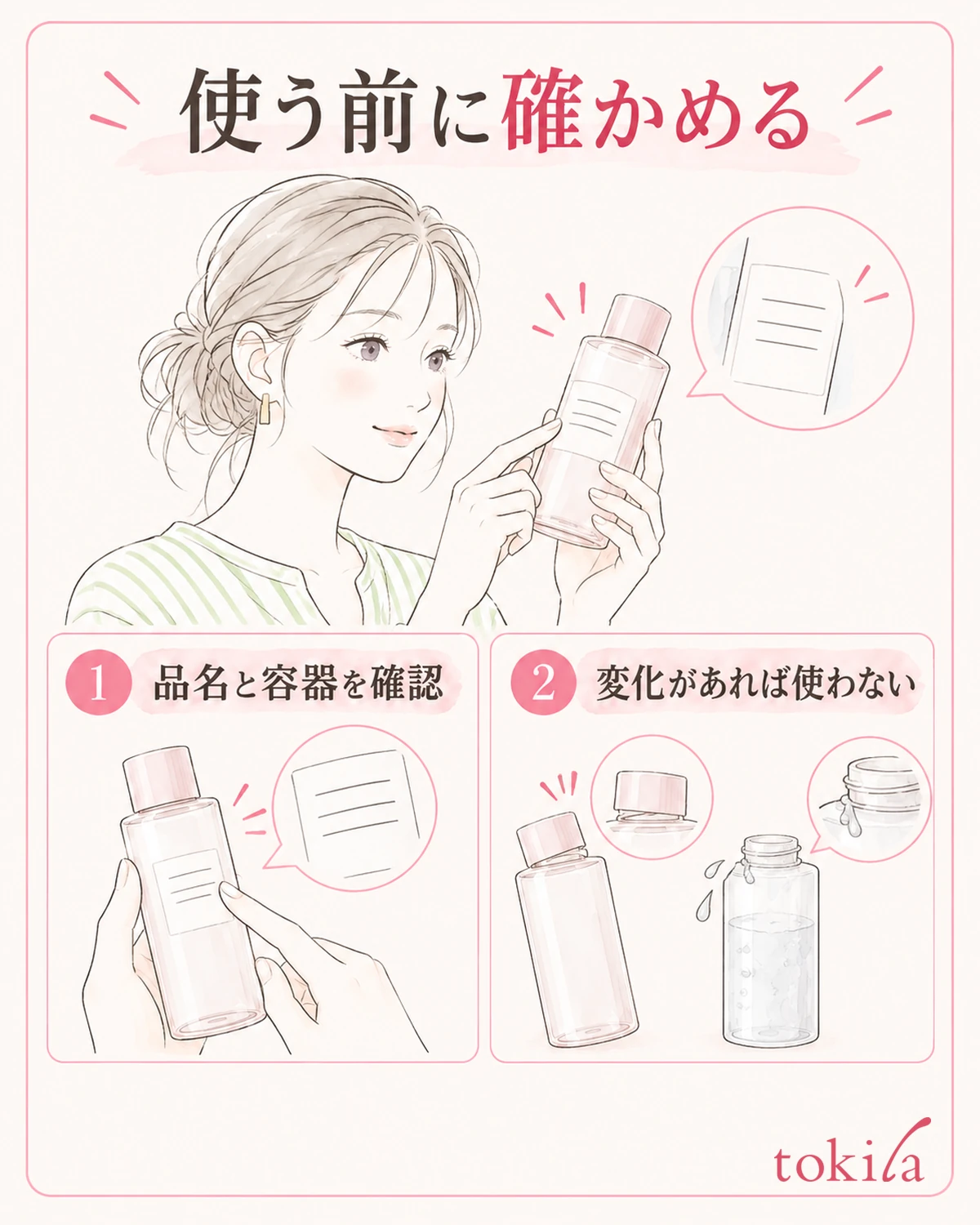
When using products at your destination, compare the product you will use with your list and labels before taking it out. Do not line up open bottles on the narrow edge of a washbasin; handle them one at a time in a stable place. Even with your usual containers, check whether the fit of the lid or the opening has changed after being carried.
If liquid has leaked inside the bag, do not collect what spilled and return it to the bottle. Do not use liquid when you do not know which container it came from, or contents that have mixed together, and check the container's damage and how it closes. Do not keep topping it up by looking only at the amount left.
If the color, smell or separation of the contents is different from usual, do not add water or mix it on your own judgment; hold off on using it and check how to consult the manufacturer. We also cannot say there has been no change in quality just because it looks the same. If you notice any abnormality in your skin, put the product's precautions ahead of your travel plans.
When you finish using it, tidy the opening and lid by the product's method and return it to a place that fits its specification. Do not leave it on a window sill at your lodging or in a place that gets hot, and keep the label readable. Finish tidying up with the product name and usage still clear for the next time you use it.
After returning home, do not pour what is left back into your usual containers; handle each product according to its own instructions. The records you kept during trip preparation are for looking back at what you took and when. Do not treat the single experience of "no problems during the trip" as proof of compatibility with another container or of long-term storage.
Next time, review one by one the products you planned to bring versus those you actually used, and anything you struggled with when reading the labels. Do not make reducing the contents your only goal; choose the products you need, keep the containers and labels, carry them closed, and check before using them. Prepare in a way that makes this flow clear.