You want to shape your ends with a round brush, but cannot tell which diameter to choose, or worry that your hair will wrap around it and become stuck. Before practicing how to rotate a round brush for the first time, check the barrel size and the section of hair you will handle. Hair meets a different surface than it does on an ordinary flat brush.
Here, we explain how to choose a cylindrical, nonelectric round brush and prepare before bringing it to your ends. This is not a guide to heated brush styling tools or rollers that stay secured in your hair. Follow the instructions for your own product and start with an amount of hair you can handle comfortably.
1. Distinguish a cylindrical brush from a roller that stays in your hair
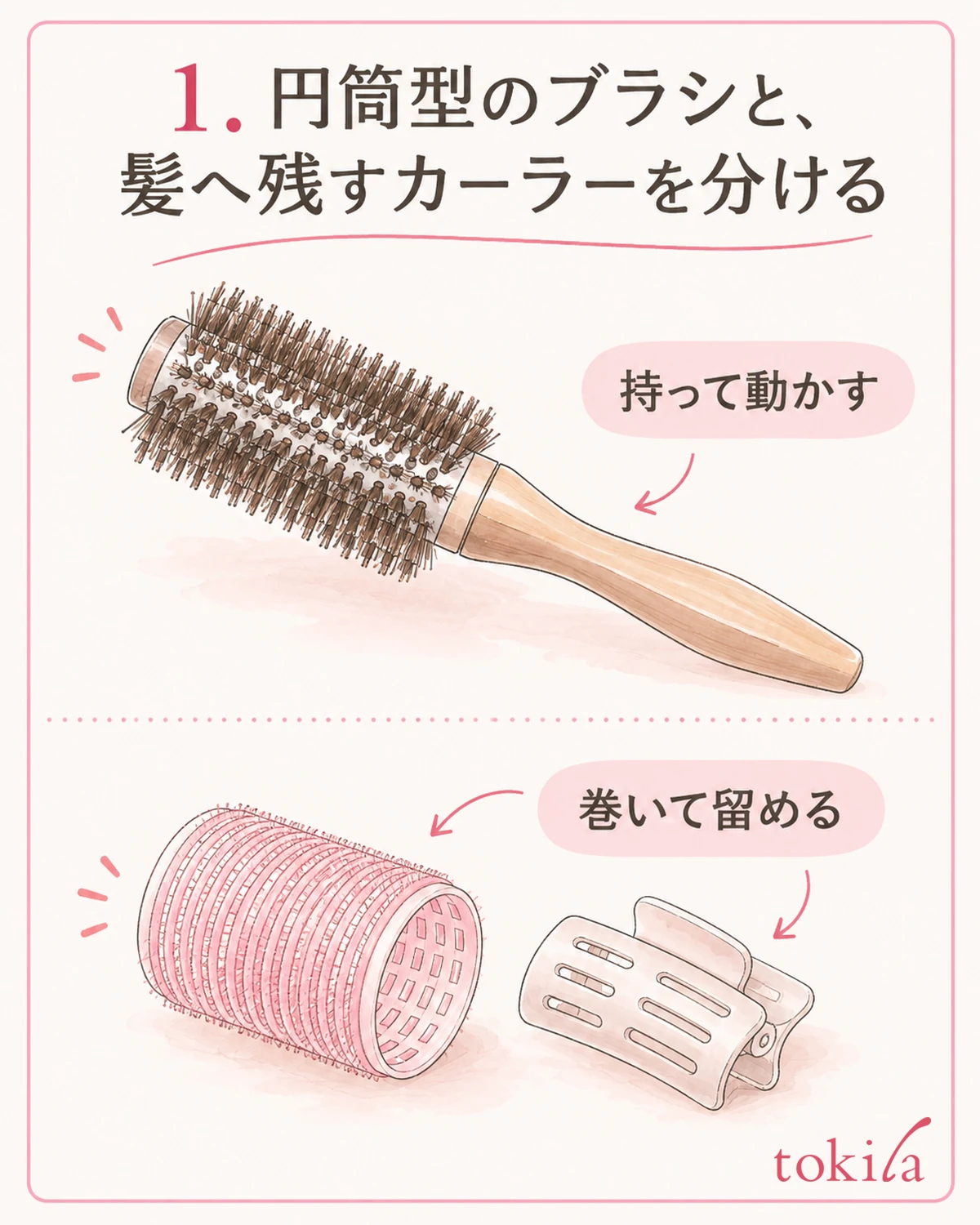
First, place the tool on a table and look at its handle, cylindrical base, and the bristles or pins set around it. A round brush shapes hair as you move its handle. Its role differs from that of a roller secured in a section of hair; do not use the two in the same way simply because both are round.
If the tool has a power cord, charging port, or temperature display, distinguish it from the manual brush discussed here. Do not decide how to use an electric brush solely by whether its power is on; read its own instructions. Even a brush without a built-in heat source needs to be checked for heat resistance and permitted conditions when used with a hair dryer.
Bristle arrangements vary by product: some have densely packed short bristles, while others include longer pins. Look from the side to see whether hair will touch the tips of the longer pins or the shorter bristles between them. Rather than treating all the projections around the barrel as teeth of the same length, identify the surface that supports the section of hair.
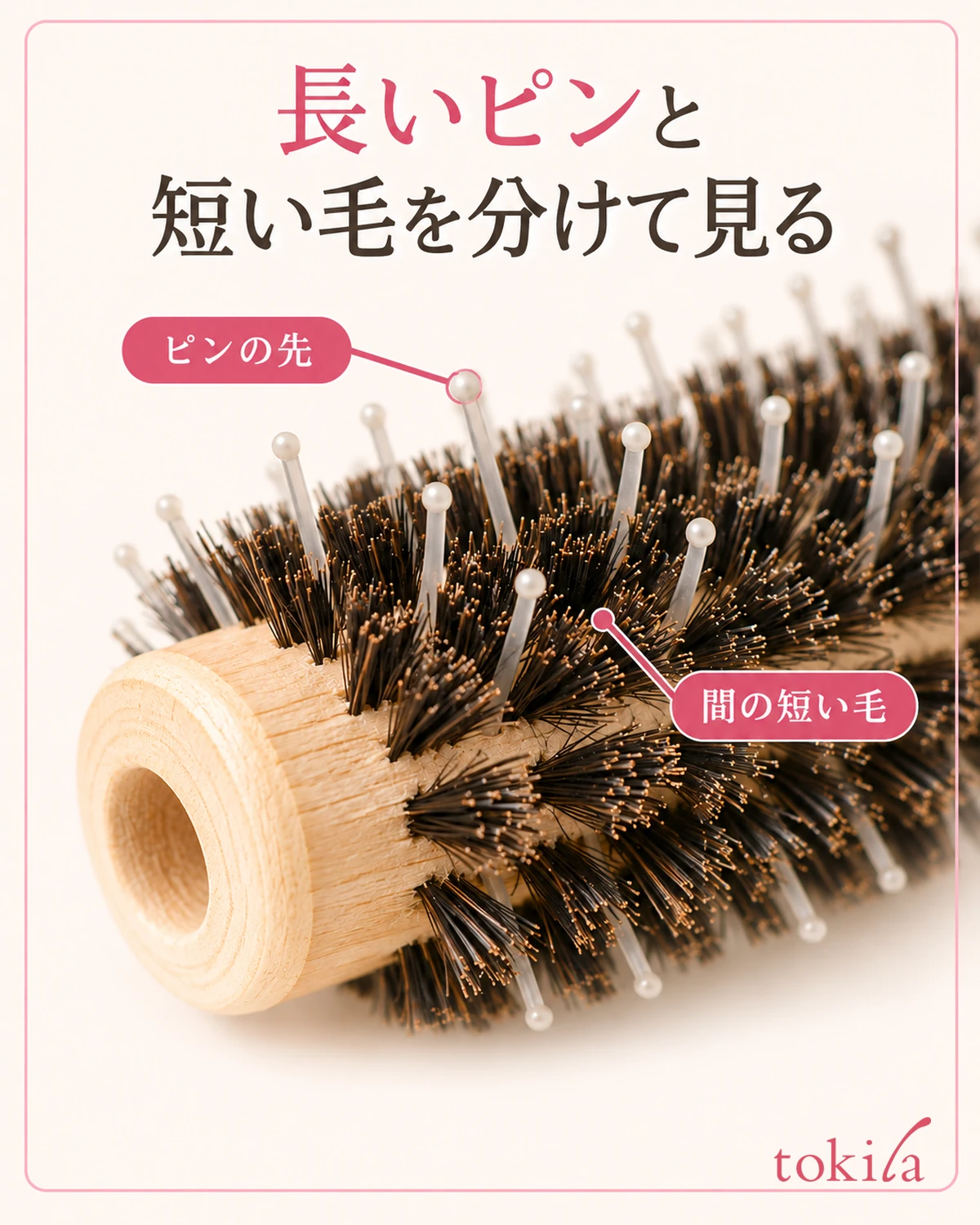
Before use, check for bent or missing pins, badly displaced bristles, and a loose handle. If rounded tips are chipped or there are scratches that catch hair, set the brush aside before trying it through your hair. Follow that brush's instructions for removing dirt and leftover hair, too.
If the tool is hard to identify, look for its original product label or model number. The name "round hairbrush" alone does not tell you whether it is suitable for wet hair, hot air, or detergent. Preparation starts by avoiding hot air or immersion in water while the permitted conditions remain unknown.
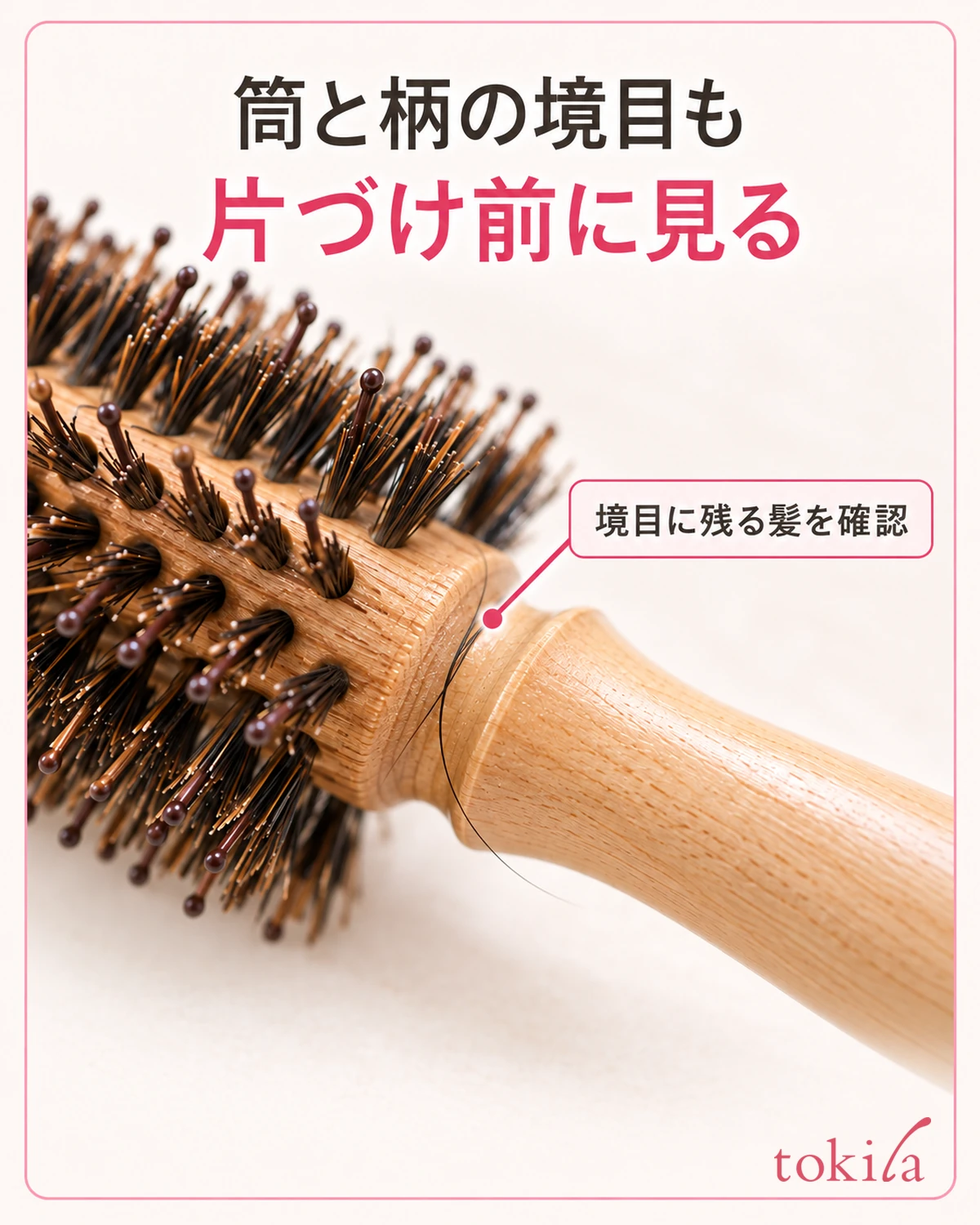
It is also important to be able to see the barrel while holding the handle. When long hair winds around the base of the handle, the ends visible from the front may not show the whole situation. Checking the junction of the barrel and handle first gives you a reference point for seeing where hair has gone during use.
2. Check hair length and the diameter including the bristle tips, not just the barrel
Next, choose one area to work on, such as your bangs, the hair around your face, or long ends. Consider how far that hair will lie along the barrel. The checks differ between short hair whose ends barely reach and long hair likely to overlap in several turns.
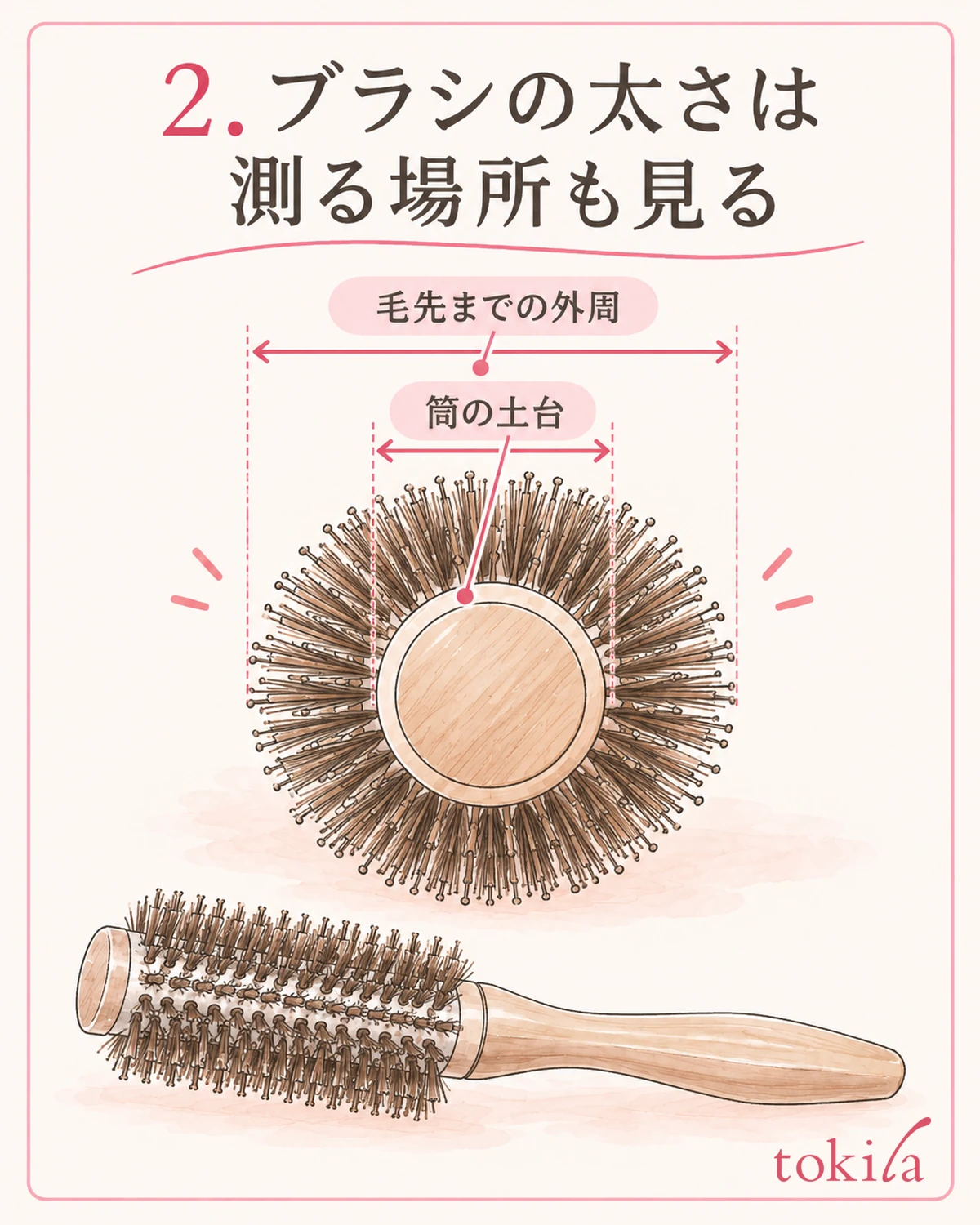
When comparing diameters, read whether the measurement is for the barrel base or includes the tips of the bristles or pins. Even if two products show the same number, their outer surfaces will differ if they were measured at different points. Look at the measurement description and side profile rather than choosing from product photos alone.
For example, when shaping short bangs, check whether you can keep track of the ends, including how you hold the brush. There is no need to push a thick barrel deep into your hair or pull hard on ends that do not reach in order to wind them around it. Start with sizes described as suitable for the length you intend to work on.
Do not assume that a thicker brush is always easier for long hair, or that a smaller barrel always makes a stronger curl. Bristle material and density, hair length, placement, and movement also vary. Along with a photo of your desired result, identifying the area you want to style can make choosing easier.
If you can hold a brush in a store, grip it without hair on it and see whether you can bring it to your ends without bending your wrist sharply. Weight and handle length are separate from visible diameter. Use the same hand when comparing options and check whether your fingers slip and whether you can see the barrel's direction.
When shopping online, read each product's size labels individually, too. An M in one series does not necessarily have the same circumference or handle length as an M in another. To compare with a brush you own, look at total length and diameter separately and decide which you want to change.
3. Detangle and separate the section from surrounding hair
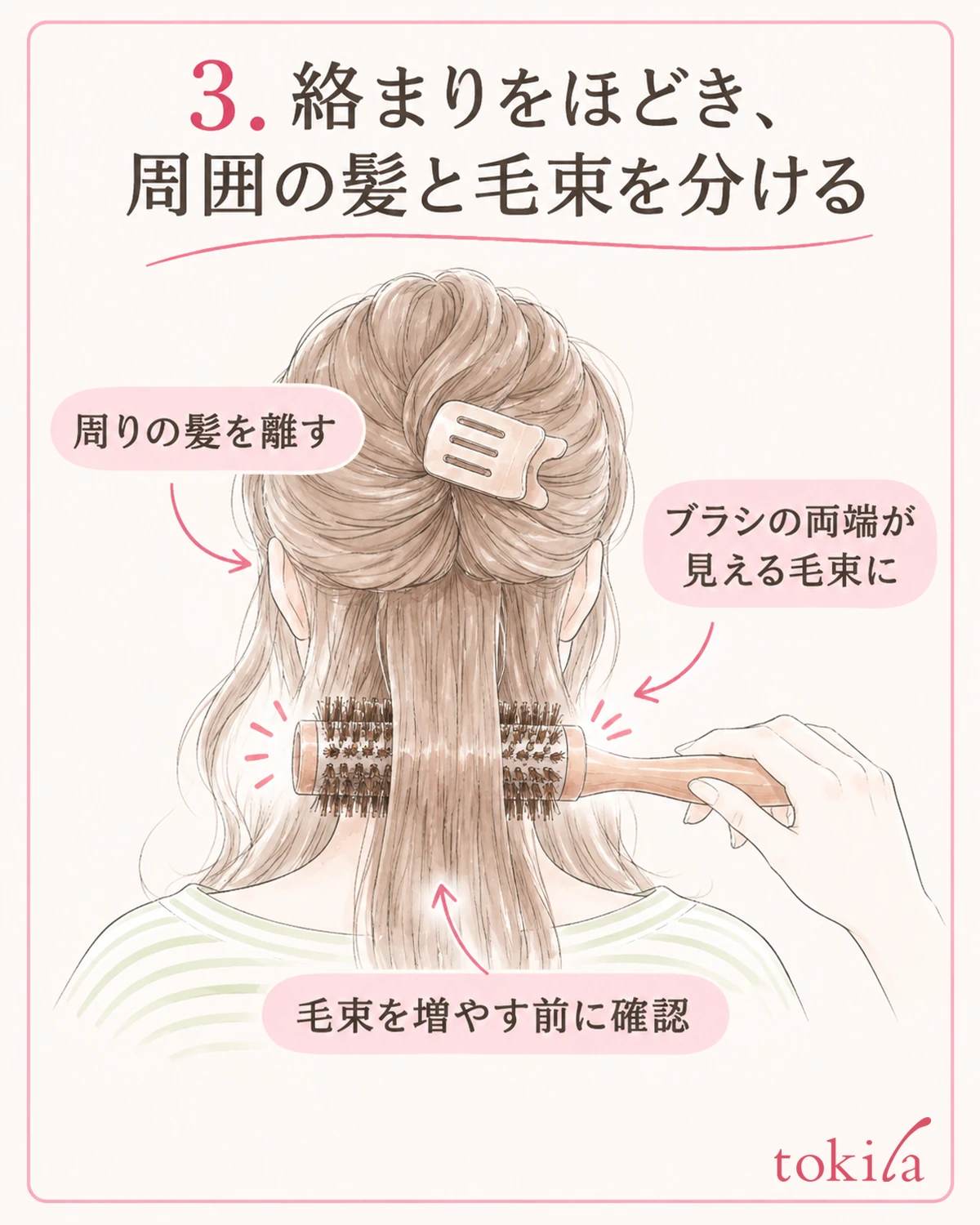
Match the hair's moisture level to the instructions for the brush and any appliance used with it. Do not turn a brush intended for dry hair into a tool you force through wet roots. Read the conditions before adding water or styling products, and decide what state your hair should be in before preparing it.
If the ends are tangled, first work through them gradually with a suitable comb or other tool. Check the ends, then the middle, then the roots, stopping where it catches. Rather than winding tangled hair around the round brush and then trying to pull it free, leave it down and prepare it until your fingers or tool can pass comfortably.
Handle a section that fits on the brush's surface without spilling far beyond its ends. Instead of trying to finish a thick section at once, use clips or similar tools to keep surrounding hair away. Rather than specifying one width in centimeters for everyone, aim to see both ends of the brush and the edges of the hair resting on it.
Support the separated section with your hand without pulling hard at the roots. If long hair at the side might enter the barrel, separate and secure it again before applying the brush. When working on bangs, avoid pointing the barrel toward your eyes, and position yourself so you can see your hands and hair ends together in the mirror.
If even a smaller section catches immediately, lower the hair before rotating further. Check separately for remaining tangles, hardened styling product, and damage to the brush. To review hair catching, see also preparation and order before combing your hair.
After sectioning, check whether short hairs have fallen from the clipped side. Picking up neighboring hair after starting to move the brush puts more hair around the barrel than you intended. Set the brush down, separate the fallen hair, and then resume, rather than forcing your way through while switching your grip.
4. Before adding heat, check that the brush can move away from the ends
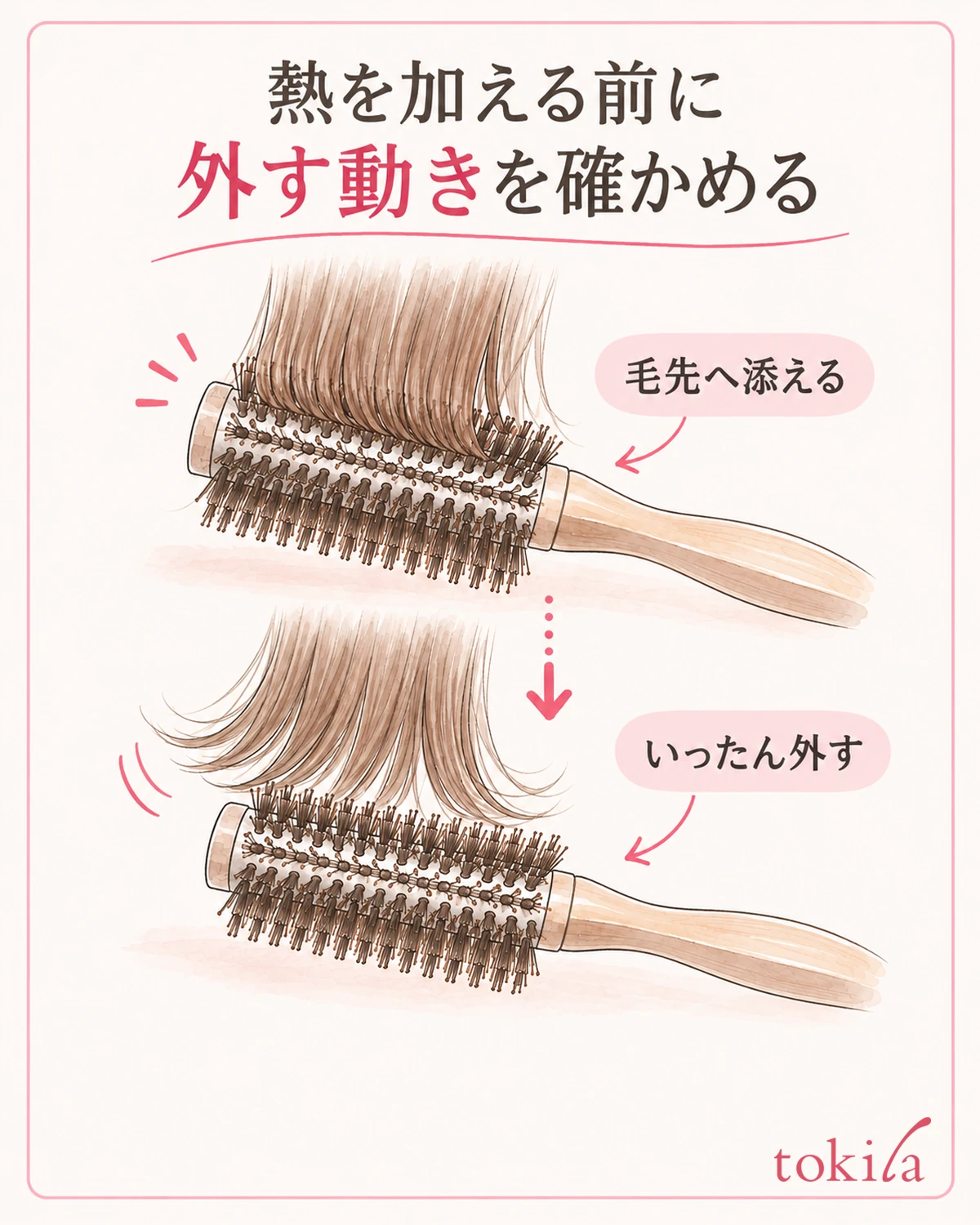
Start with the hair dryer set down and check where to apply the brush according to your product's instructions. Place the barrel beneath the ends and use the mirror to see where the hair rests on it. While still unfamiliar with the movement, avoid starting by winding the brush several turns up to the roots.
Next, remove the brush without wrapping the hair far around it and check that the ends release readily. If the hair travels behind the barrel and you lose track of how to remove it, stop there. Support the section and retrace the direction in which you applied the brush, rather than continuing to rotate toward further entanglement.
Once you have confirmed that it moves, check the distance, airflow direction, and temperature settings in both the brush and appliance instructions if using a hair dryer. Do not apply a holding time shown for one product as a universal number of seconds for every tool and hair type. Do not press the dryer's outlet against the brush either.
If you feel heat, pain, or resistance during use, stop the airflow before checking the section. Do not try to pull the brush free with one hand while hot air is still blowing; put the appliance in a safe place. If you cannot loosen the tangle, do not pull hard; ask someone nearby or a hair salon for help if needed.
Even if the shape changes when you let go, do not immediately add more rotations or heat. First check whether the section was too thick or the ends slipped free midway. Rather than aiming for a perfect shape in one attempt, check whether you can continue comfortably placing the hair on the brush, removing it, and lowering the section.
Mirror placement is part of preparation when one hand holds the brush and the other directs airflow. If you cannot see your hands without twisting your neck, return to a movement you can perform without airflow first. You do not need to aim to try large wrapping movements at the back of your head alone in one session.
5. Review the area you worked on and store the brush without crushing the bristles
After removing the brush, use the same mirror to look at the ends and all of your hair. Even if you styled only your bangs, turn your face slightly left and right to check whether they fall into your eyes and blend with the surrounding hair. Distinguish the shape while the barrel supports it from the shape after you let go.
For next time, choose just one condition to change: brush diameter, section size, or placement. If you greatly change the section size on the day you switch brushes, it becomes harder to tell what made handling easier. You might leave a short note such as, "It was easier to remove when I could see the edges of the bangs."
After use, check for hair left around the barrel. Follow the product's care instructions and do not force hard tools between the pins. The washable area depends on how the bristles are attached and on the base material; do not assume a tool can be washed all over simply because it is for hair.
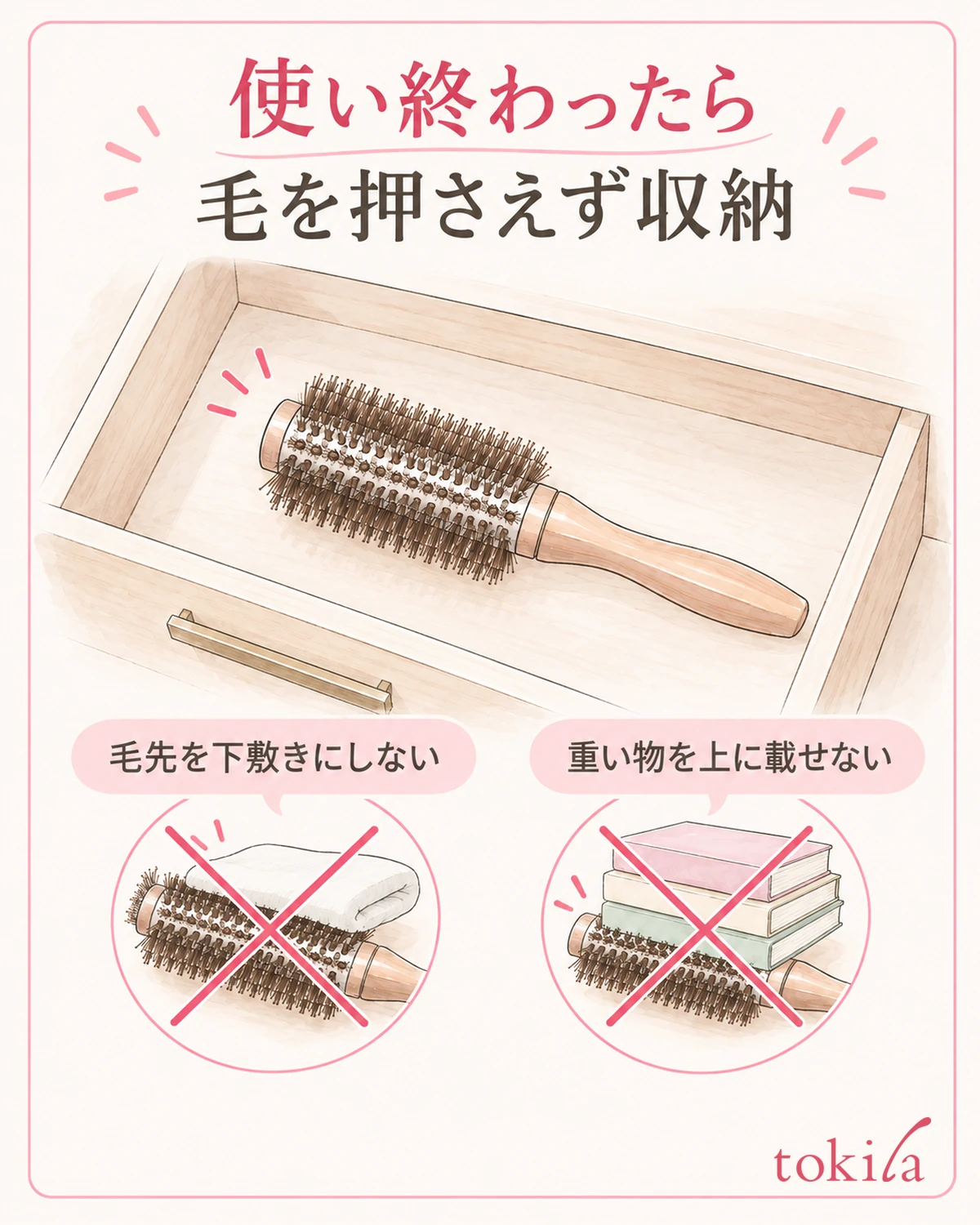
If used with a hair dryer, check that no warmth remains before storing. Choose a correctly sized cover if using one, and put the brush away without crushing the long pins or short bristles. Avoid placing heavy items on the barrel in a drawer, and arrange it so the bristle tips will not catch when you take it out next time.
Preparing a round brush means identifying its round form, considering the diameter in relation to the hair you will use it on, separating surrounding hair, and checking that you can remove it. On days when movement is difficult, it is fine to reduce the area you style at once. Use the hair how-to guides to choose the steps you need now.
If the opening of a cover is narrow, do not force the bristles inside to make them fit; choose a suitable storage method instead. When carrying the brush, check that other items are not pressing against the barrel even if only the handle is visible in your bag. Checking for displaced bristles after taking it out helps prepare for the next use.