You are working lotion in when the cotton pad suddenly turns fuzzy, leaving fine fibers on your cheeks. If it keeps happening even with a fresh pad, it is hard to tell whether the cotton quality is the only cause or whether changing how you use it would help. Without adding any pressure, start by working out at which stage the pad gets fuzzy.
This article covers toners you can use with a cotton pad. In five diagrams, it explains the pad's surface before use, how to soak it, how to support it with your fingers, and how to move it over your skin. It puts the tools, amount, and directions of the products you already own first, and it does not recommend sticking with cotton pads or using the same amount for every toner.
1. Separate fuzziness before use from a pad that breaks down partway

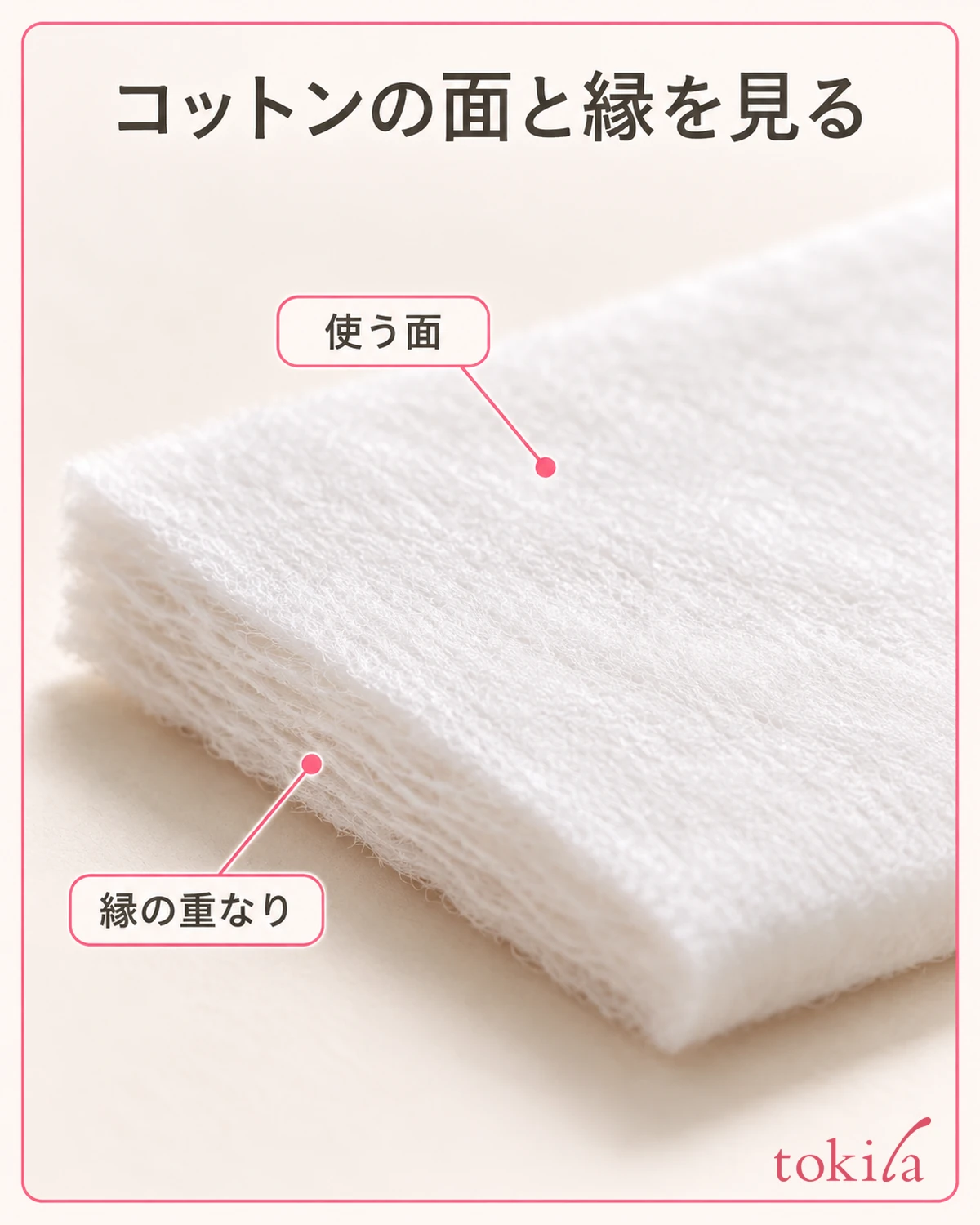
First, take out one new, dry pad and look at its surface and edges. Separate whether it is already badly loosened when it comes out of the bag, whether it curls up after soaking, or whether fibers come off after it moves over your skin. Rather than lumping everything together as "fuzziness," compare the pad before and after use, and you can narrow down which step to check.
When checking the dry surface, avoid pulling at the fibers with your fingers again and again. This is so you do not loosen them and then conclude that "it was fuzzy from the start." If the surface you would use is already torn or dirty, replace the pad with a new, clean one rather than reshaping it for your face.
Next, read the toner's container or outer box to see whether cotton pads are allowed and how the amount per use and the way to apply it are described. Do not assume that a toner meant to be applied by hand will work the same way if you simply switch to a cotton pad that looks less likely to get fuzzy. Even if both hands and cotton pads are allowed, check the amount for each.
Cotton pads also differ in structure and purpose: some are for makeup application, some for wiping, and some are the type you peel apart before use. Whiteness or thickness alone does not make a pad suitable for every use. If the bag explains which side to use or which way to hold it, check that before you change its shape.
This article deals with patting toner in for moisture. Treat it separately from makeup removal, wiping off dead skin cells, and cotton pack treatments that stay on for a long time, in both the products and the handling. The starting point is not to carry over the time or the pressure of a different use just because the fibers left behind are the same.
Keep the pad you put on the table apart from the ones left in the bag, and do not touch the rest with wet hands. If pads are already loosened before use, one after another, also check whether they are being squashed in the bag or whether you are pulling the edge hard when taking one out. Store them as the bag says, and never put back a pad that has been soaked.
2. Soak in the specified amount and check for dry spots on the side that touches your skin
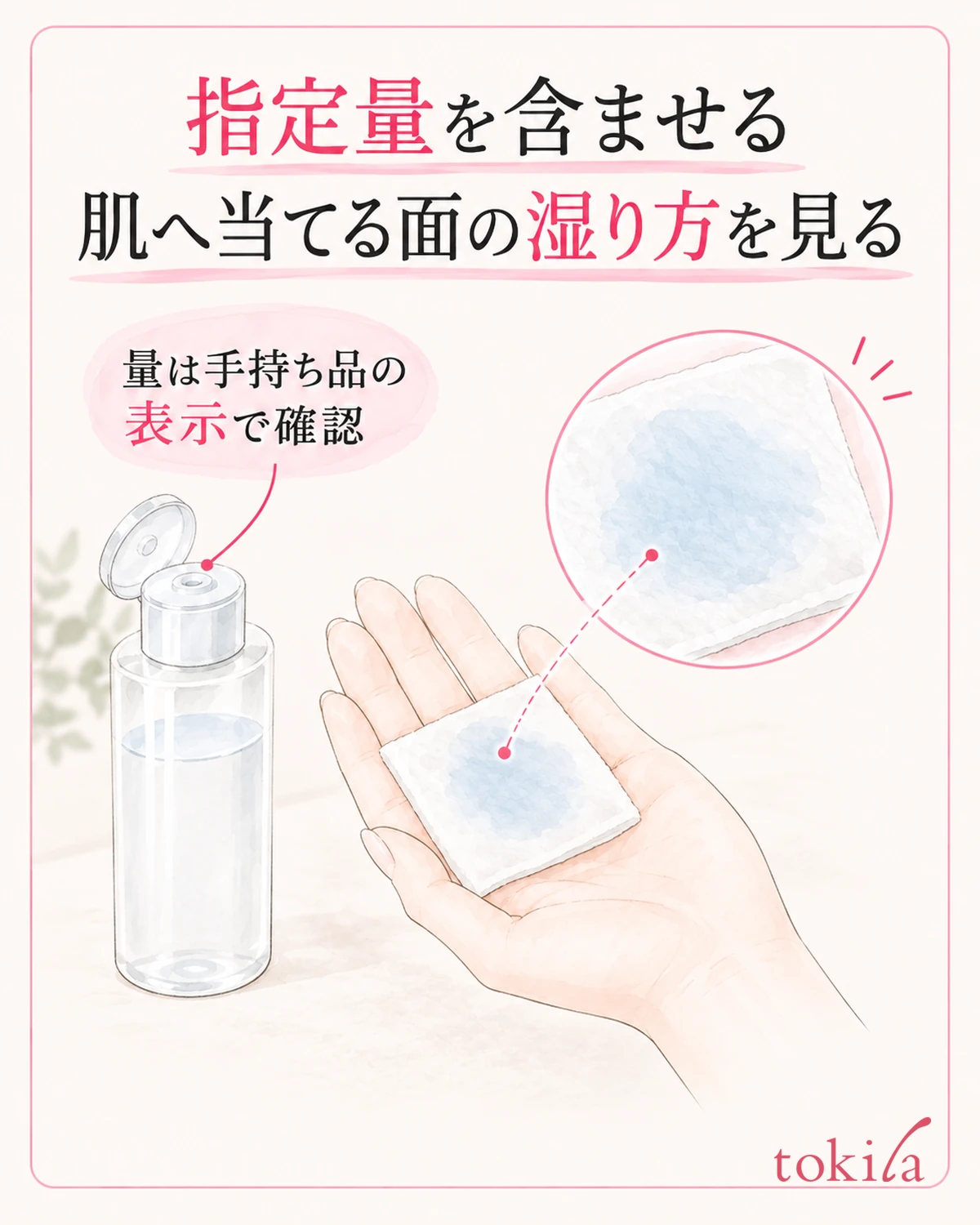
Place a new pad on your clean hand and soak it with the amount the toner specifies. Rather than folding it over from the start and trapping the liquid in one spot, take the toner the way the directions say, and look at which parts of the side that will touch your skin are moist. If only the center is wet and the surroundings stay dry, do not rub that wide surface hard as it is.
Amounts such as "a coin-sized dollop" or "so many pumps" should be based on the directions for the toner you are using now. Do not simply reuse the guideline for another product or another size of pad. Even when you switch to a larger, thicker pad, the liquid does not necessarily spread evenly, so go back and check the combination of tool and amount.
If there are directions on how to moisten it, work the liquid in within that range. Looking at the side you will use while it rests on your palm, check that the liquid is not lopsided and that a dry edge is not about to touch your skin. Do not wring it out hard to reduce the amount or add water to spread it; follow the product's directions.
Pouring on a lot will not necessarily solve the problem. If the liquid drips and is hard to handle, do not shake or squeeze the pad near your face; set the container down for a moment. Before adding more than the specified amount again and again, review whether the pad's size and the way you use it match the directions.
If the pad starts to feel dry or catches partway through, do not keep moving it and add more pressure. Check the directions for the product you own to see whether it is fine to add more liquid. You cannot accurately measure how much has gone onto your skin just by how much is left in the pad, so take care not to lose track of the total by adding more repeatedly.
3. Support the surface with your fingers so only the pad does not slip
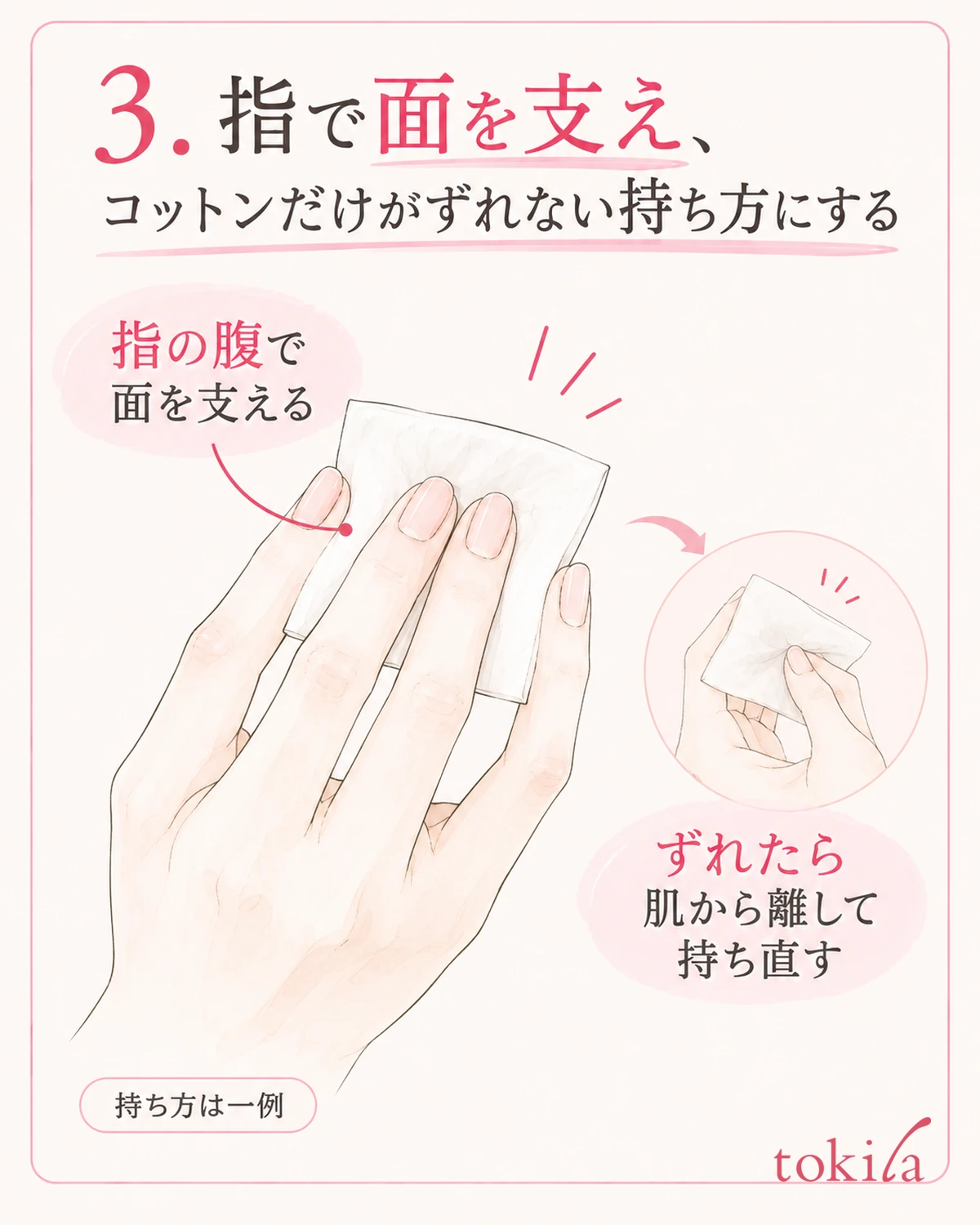
Place the soaked pad on your fingers and support the back of the side that will touch your skin. One common way to hold it is to rest the surface on your middle and ring fingers and lightly pinch both ends with your index finger and little finger. Line your fingers up naturally and arrange them so that the surface does not bend sharply. If the bag shows a different way to hold it, follow that structure.
If you pinch only the edges and leave the center floating in the air, the surface tends to wrinkle when it touches your skin. Conversely, gripping it hard squeezes the surface you spread out into a small clump. Rather than increasing how hard you pinch, check whether the pads of your fingers are behind the side you want to use, and it becomes easier to follow how it makes contact.
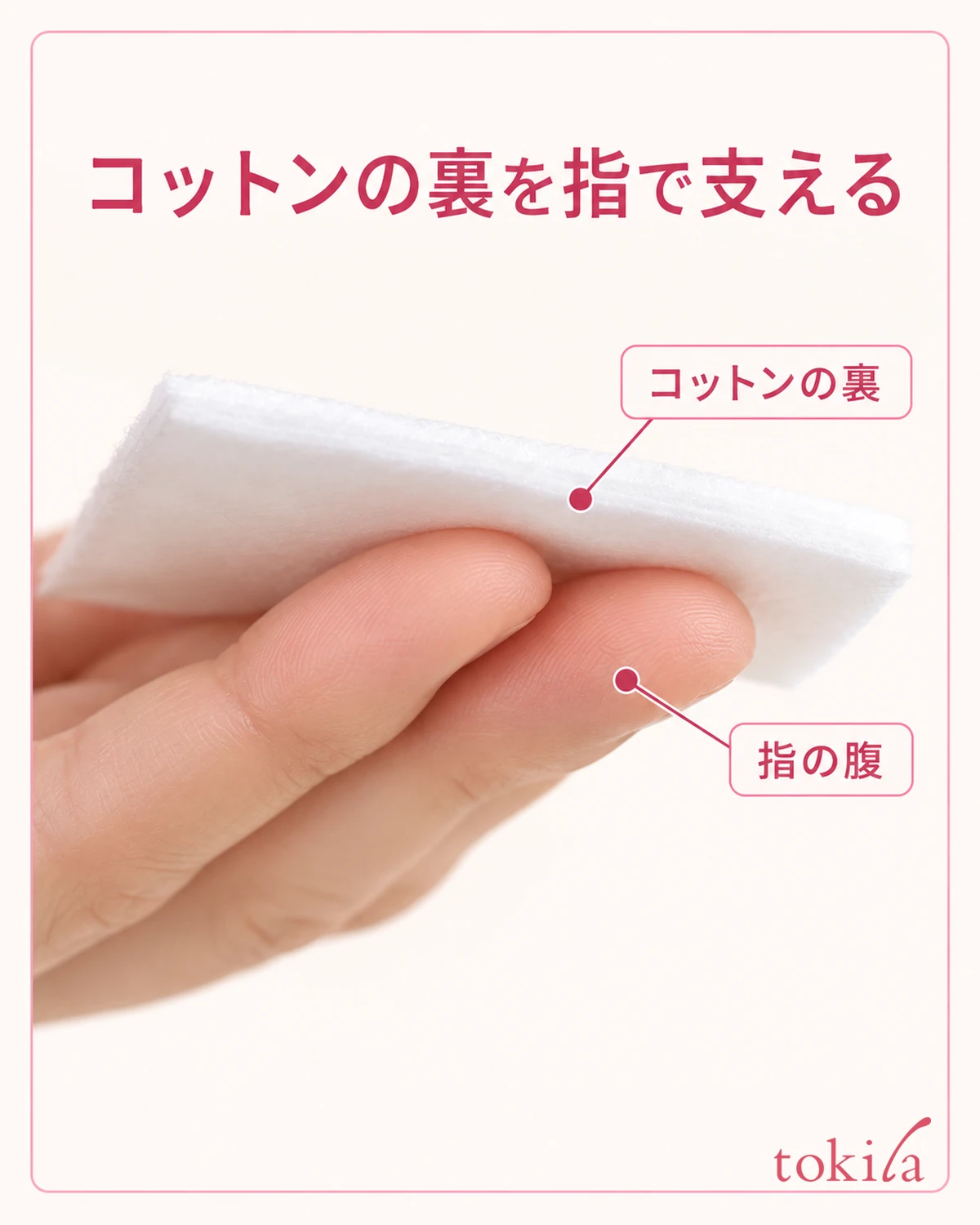
Depending on the length of your fingers and how easily they move, it may be hard to keep the same shape. Rather than forcing yourself to copy the finger positions in the diagram, look for a way to hold it that does not drop the pad, does not let your nails touch your skin, and still supports the surface. Do not spread your fingers so wide that it hurts, or keep pinching hard.
When you press it against the roundness of your cheek, curve your fingers a little softly. Rather than pressing it on like a flat board, let it follow your skin while watching the surface that touches. If only the edge is pressing hard, change the angle you hold it at before increasing pressure, and go back to a position where the surface makes the contact.
If the pad slips off your fingers partway, do not pull it back while it is still pressed on your skin; lift it off once and reposition it. Replace a pad whose surface has fallen apart and is hard to support with a new one. Keeping it in a state that suits its original purpose is easier to judge than adding steps such as tearing it thin over and over to spread it out.
When you apply it to a narrow area such as beside the nostrils, you do not need to roll the pad into a hard corner and push it in. Follow the directions for where it can be used, and turn the direction together with the fingers supporting it. If the surface wrinkles only in small areas, check the angle you hold it at in that spot before reducing the amount of liquid overall.
4. Check how to move it, and do not go back and forth over your skin
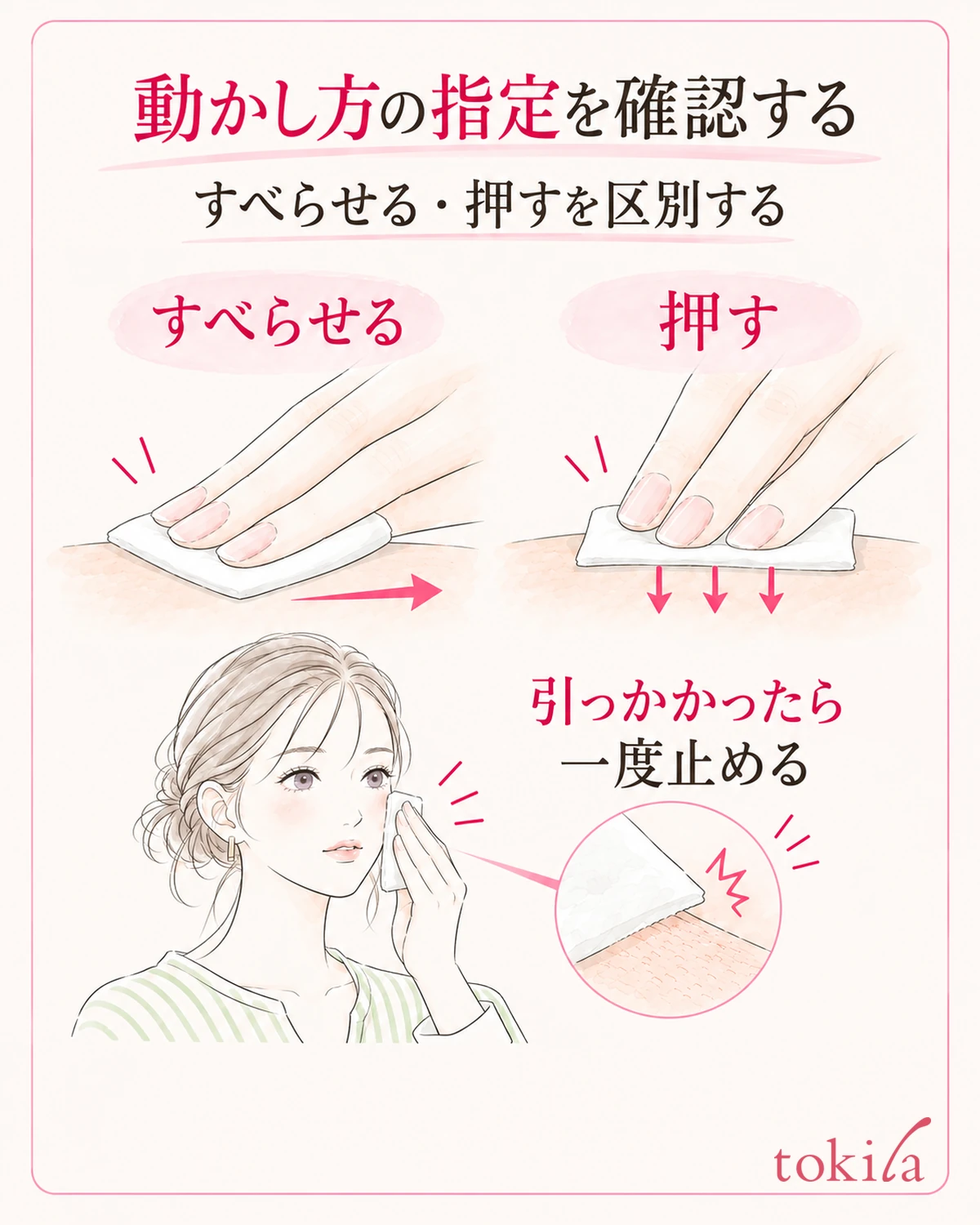
Before you move the pad, check the directions for use for both the toner and the cotton pad. Directions to glide over the skin and directions to press on gently are not the same movement. Since your aim is to work the toner in, do not switch to a wiping motion that scrapes off dirt.
For the gliding method, if there is an explanation of the grain of the fibers or the direction to move, follow it. The long side and the fiber direction do not always match in every cotton pad. If the bag has an arrow or similar marking, check it, and do not decide the direction from appearance alone. Avoid trying it over and over on your skin when you do not understand how to use it.
When moving it, do not apply so much force that your skin is pulled noticeably. If the pad catches, do not move it faster; lift it off for a moment. Check by hand whether the moisture, the support of the surface, and the indicated direction are still in order, and then decide whether you can keep going.
If the directions say to press it on, use a motion of gently placing and lifting the surface, and do not change to a method of tapping hard and repeatedly. Pressing on the same spot for a long time, or going back and forth until fibers come off, does not necessarily mean you need more care than the directions call for. If there are instructions on the area to use it on and how many times, keep to that range.
Take care around the edges as well so that no liquid or fibers get into your eyes or mouth. If you notice redness, stinging, or any other abnormality, do not just correct how you hold it and carry on; stop using it and follow the product's precautions. Keep it in mind that a pad that gets less fuzzy and a tool that suits your skin right now are separate matters.
5. If it gets fuzzy, lift it off once, and next time review just one condition
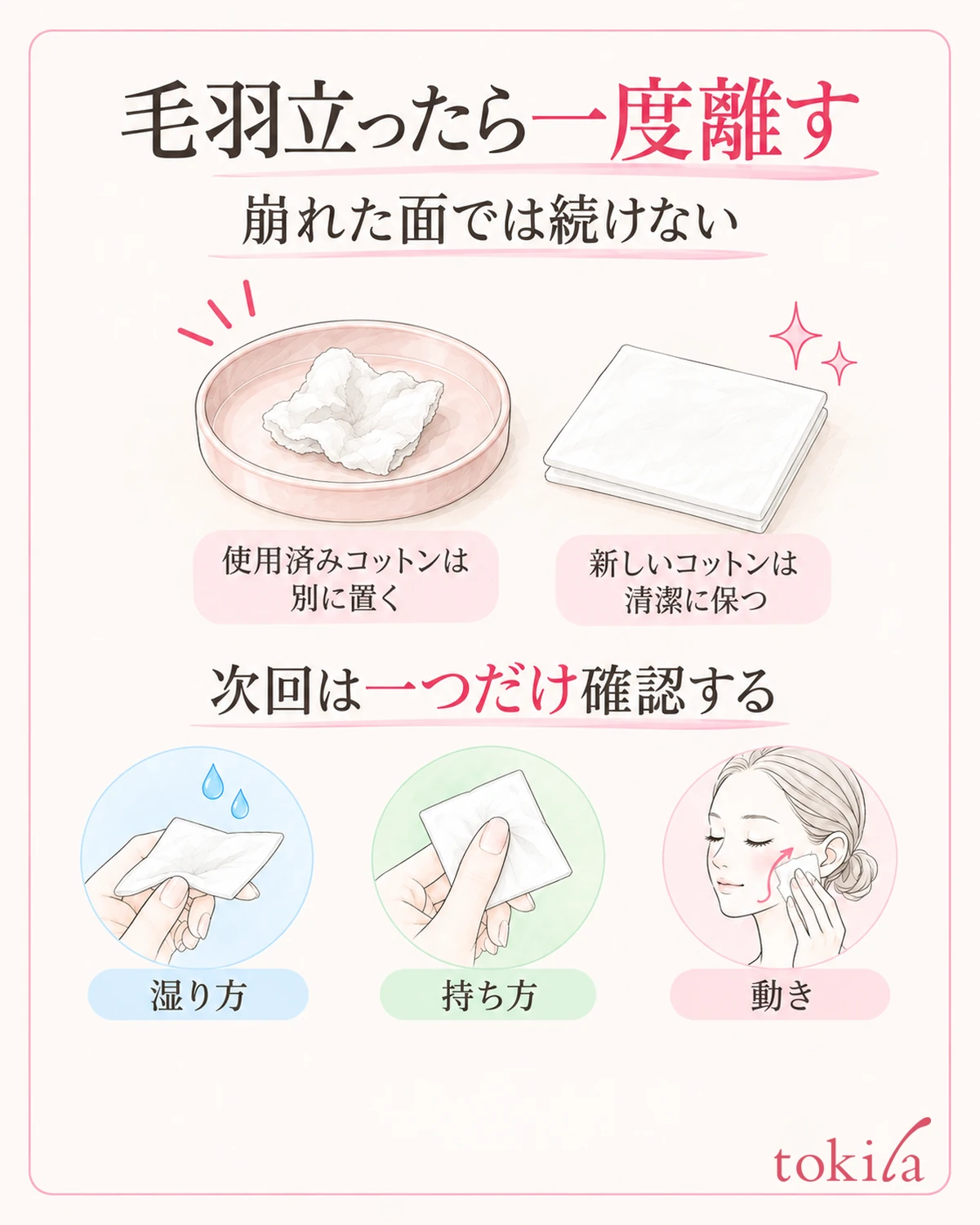
If a lot of fibers come off the side you are using, or the pad curls up, lift it off your skin once. Do not try to rub off the remaining fibers with a surface that has broken down; finish with that pad. Rather than picking at fuzz on your face and pulling it, first switch to a new, clean pad and check whether you need to continue at all.
If visible fibers remain on your skin, do not rub your skin with your nails or tweezers either. If there is irritation or any abnormality, do not repeat the removal; stop using it and follow the precautions. It is also important not to decide from the look in the mirror alone whether something is a fiber or dryness of the skin.
Next time, recall just one stage where the fuzziness appeared. If it was right after soaking, check the moisture of the surface; if it was while moving, the support and direction; and if it was near the end, whether you kept going on a dry surface. Before changing the toner and the cotton pad at the same time, line up the directions you should follow against what you actually did, and the point to adjust will become clear.
It helps to remember what you reviewed in terms of actual actions, such as 'I did not let a dry edge touch my skin' or 'when it slipped, I lifted it off and held it again,' so you can use it the next time. Do not judge by counting only how many times fuzz came off; also check that you are not putting unreasonable force on your skin.
If the toner can also be used by hand, you have room to choose to pat it in by hand, depending on your skin condition and how easy it is to move. In that case too, reread the amount and the steps. If it runs off when you take it into your hand, how to shape your hand and carry toner without spilling it lets you check an operation separate from cotton.
What matters is not holding fuzziness down with force but checking, in order, the condition before use, the amount, the support, and the movement. If you tend to rub when removing water droplets right after washing your face, you can also check how to press a towel to take off moisture. Separate the steps for each tool, and settle on an easy routine that suits what you already have.