You take out the hair roller from your bangs and the ends scatter sideways, or the hair looks bent partway along. When that happens, before winding it again with more force, check which part caught as you took it out. Yanking the whole section out in one motion and slowly separating the surface where the hair touches the roller can be thought of as two different movements.
This article focuses on bangs rollers that don't use electricity, and explains what to check before taking one out, where to put your hands, and what to check if it stops partway. Clip-integrated types, types fastened with a separate pin, and types where the hair grips the surface are built differently. Follow the removal method in the instructions for the product you have, and don't apply the same operation to heated rollers or electric curlers.
1. Before Removing, Check the Fastener and How the Hair Is Wound

Start with a mirror in front of you, in a position where you can see both ends of the roller and the roots of your bangs. If you also prepare a place to put the pins you take out, you won't have to look for somewhere to set them down while holding the roller with one hand. If your hands slip, wipe off any water or styling product before you touch it.
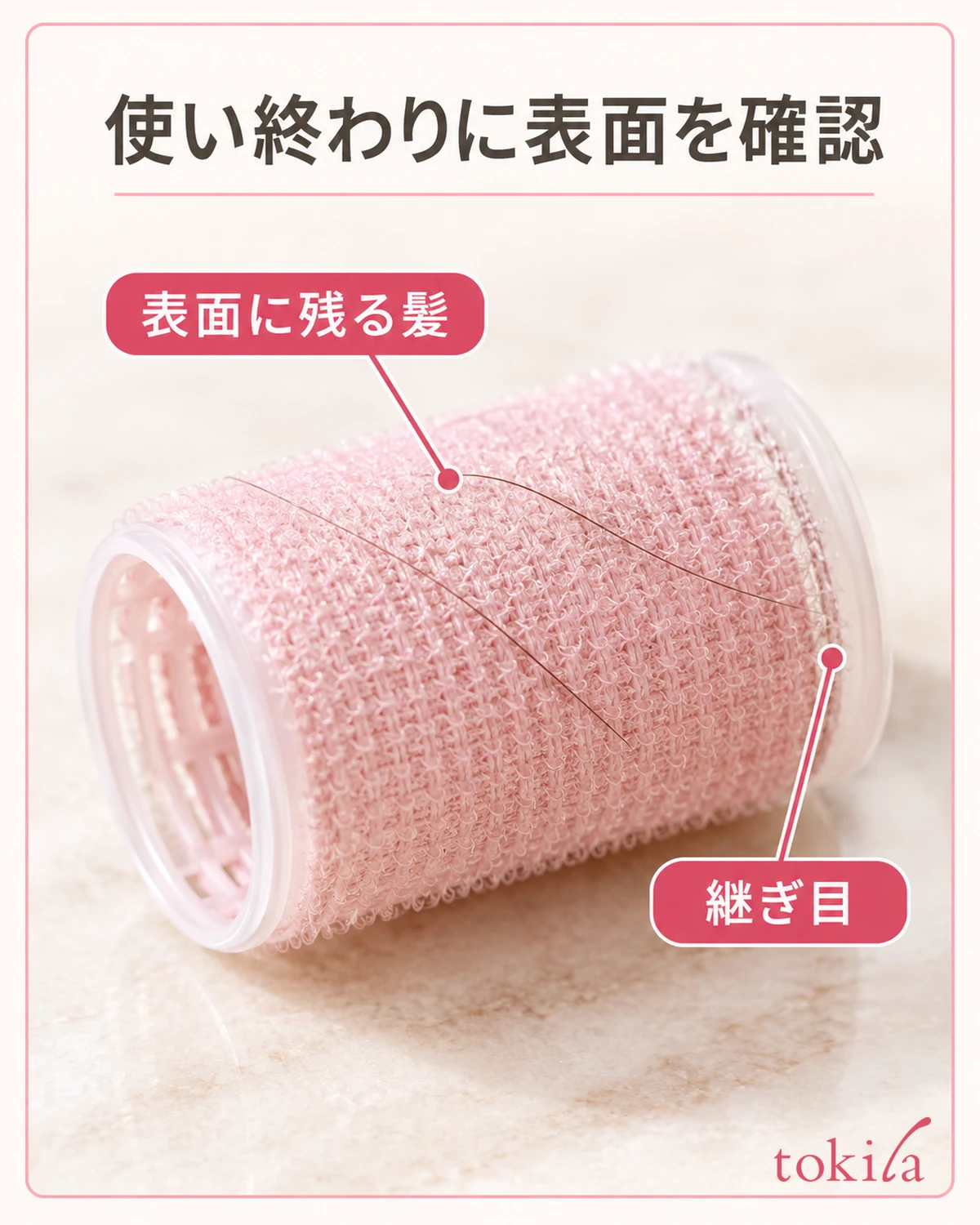
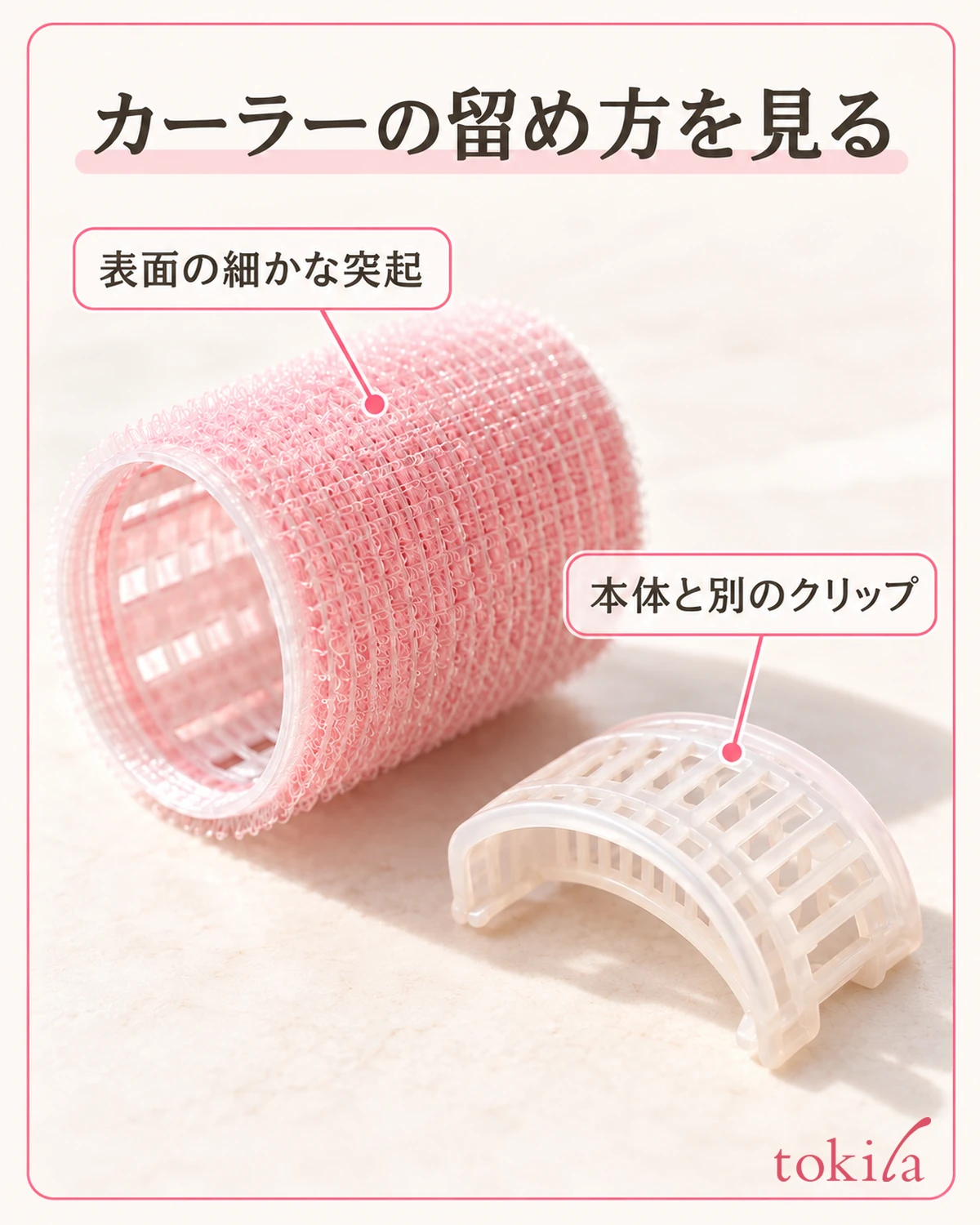
First, tell apart what is holding the hair. Check whether it is a clip or pin separate from the tube, an opening and closing clip attached to the tube, or fine projections on the surface that hold the hair. Don't pull only on the handle you can see; make sure where to open it to release the hair.
Next, look at which way the ends were rolled in and whether any hair sticks out sideways from the end of the roller. If you have rolled in hair from the sides as well and you move it looking only at the center of the bangs, you will miss where the stray hair is caught. If you aren't sure which direction you started winding, don't turn it by force to find out; check the mirror and the diagram in the instructions.
Also check on the label of the product you have whether it may be heated, and whether it specifies drying or cooling before removal. The same waiting time or temperature doesn't work for every roller. Don't touch something that is still hot with bare hands, and don't apply extra heat to a product whose instructions don't mention it; go on only after the conditions for removal are met.
Here we don't judge how the result turns out, but sort out three things: the type of fastener, the position of the ends, and the conditions for removal. If you can't find the steps, don't treat the diagram of a similarly shaped product as the right answer; stop until you have checked the explanation for the type of the product you have.
2. Support the Body, Then Release the Specified Fastener
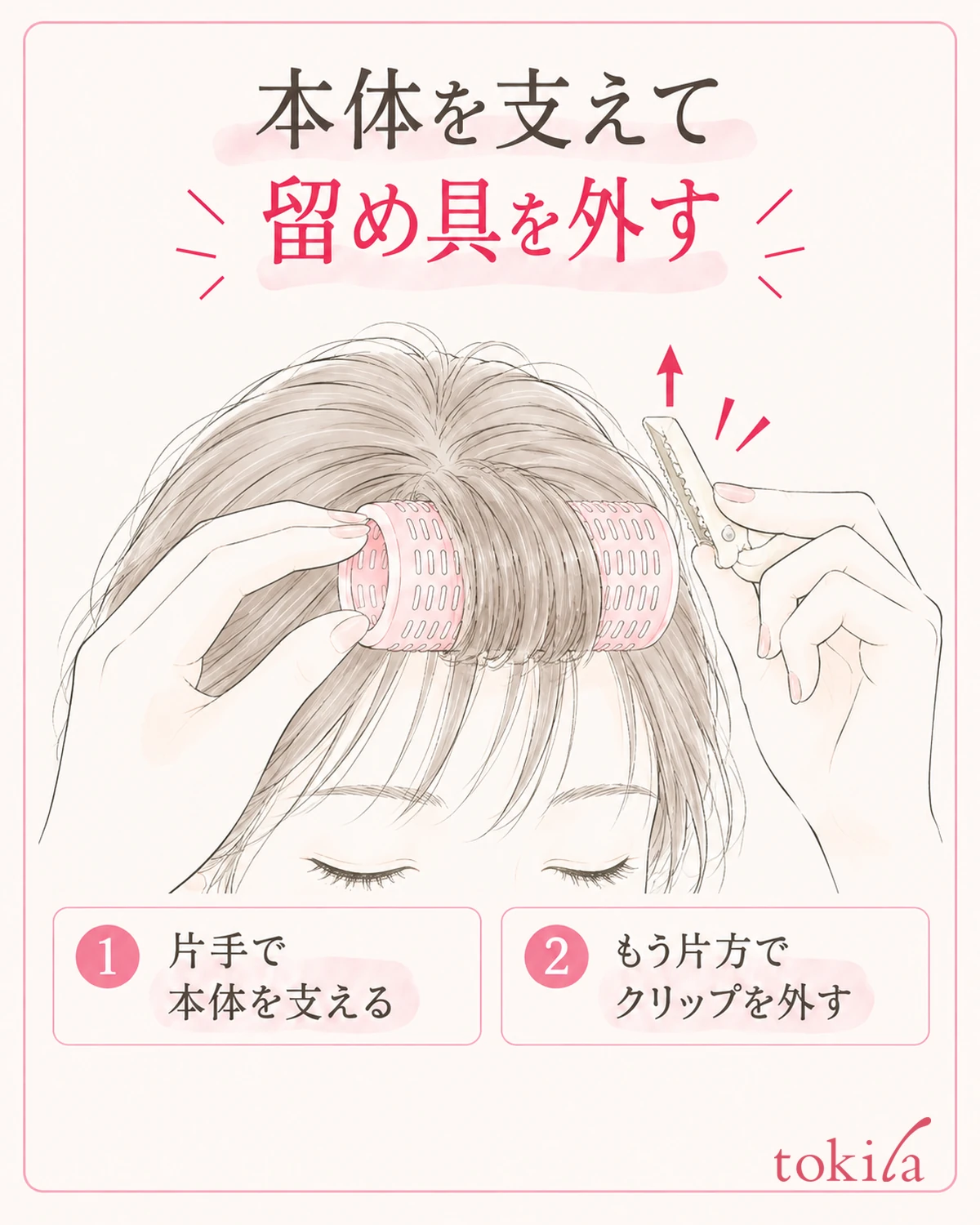
For a type fixed with a separate pin or clip, first rest one hand on the roller body to support its position, and release the fastener with the other hand. Check in the mirror whether the force of pulling out the pin is also moving the body. The supporting hand isn't there to pull the hair from the root; it holds the tube so that it doesn't suddenly fall or roll while the fastener is released.
An integrated clip is not necessarily a removable part. Check where it opens and how wide, and open and close it as specified without taking it apart. Don't switch to methods such as twisting the handle while hair is caught, or pulling the hair out with the fastener still closed. A type that holds only by its surface may have no pin to remove.
When the fastener is off, look at both ends of the body again. Check that no other clip remains and that no short hair from the side has worked into the shaft or the seam. If only one side won't move, don't pull hard on the side that moves; look for the place where the hold remains.
Because both hands are occupied, don't hold the parts you removed in your mouth; put them in the place you decided on beforehand. Work in a position where the roller won't be pulled even if you turn your face away from the mirror. If it is hard to see your hands, adjust the position of the mirror and the height of your chair before you resume, rather than keeping your arms raised.
The moment the fastener is off, don't try to shape the curl; first check that the hair is free to come away. If you feel resistance here, don't go on to the next turn; check that spot first.
3. Looking at the Surface Where the Hair Touches, Release It Little by Little
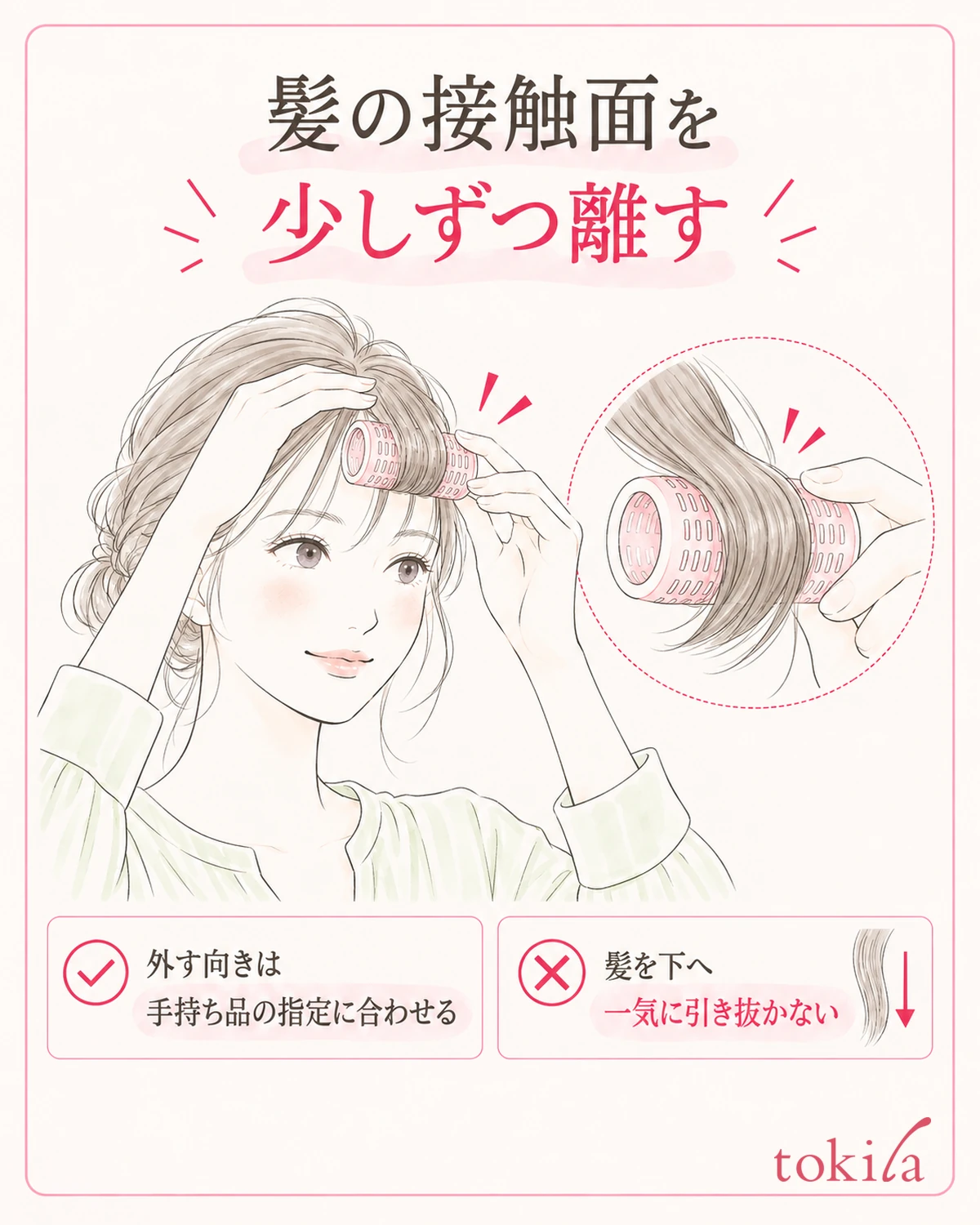
Match the direction of removal to the instructions for the product you have. If you only remember the words "the direction you wound it" and "the opposite direction," they can be read differently depending on which side you look from and on the product's mechanism, so check from which surface of the diagram the hair comes away. The diagram in this article shows how the contact between the hair and the tube is undone; it is not a specification of rotation direction common to all products.
Control the movement of the body with one hand, and rest the other lightly on the section of hair near the root. Don't pinch the section hard with your fingers; support it just enough to feel whether the root is being pulled along. Don't pull the hair taut into a straight line; move slowly, only as much as the hair comes away from the tube.
After moving it once, look at the boundary between the hair still on the surface and the hair that has already come away. Go on only over the range that separates without resistance, and don't pull the whole of the bangs down in one go. Even when the instructions for your product say to turn it as you take it out, don't make the rotation and movement suddenly large; do it at a speed where you can check the contact surface.
If the ends are the last to remain, don't pull only there to tear them free; keep supporting the body and check where the hair is caught. Don't dig by pushing a fingernail into the projections on the surface or pushing a thin tool into the hair. If it is tangled beyond what you can check by hand, don't add force; switch to the next check.
Once it has come off completely, put the roller down on the desk first, and then touch your bangs. Instead of combing the ends again and again right away, look in the mirror at how they fall naturally and check where they are disordered. If you separate the operation of taking it out from the operation of finishing, it is easier to look back at which stage the shape changed.
4. If It Catches, Stop and Tell Which Place Isn't Moving
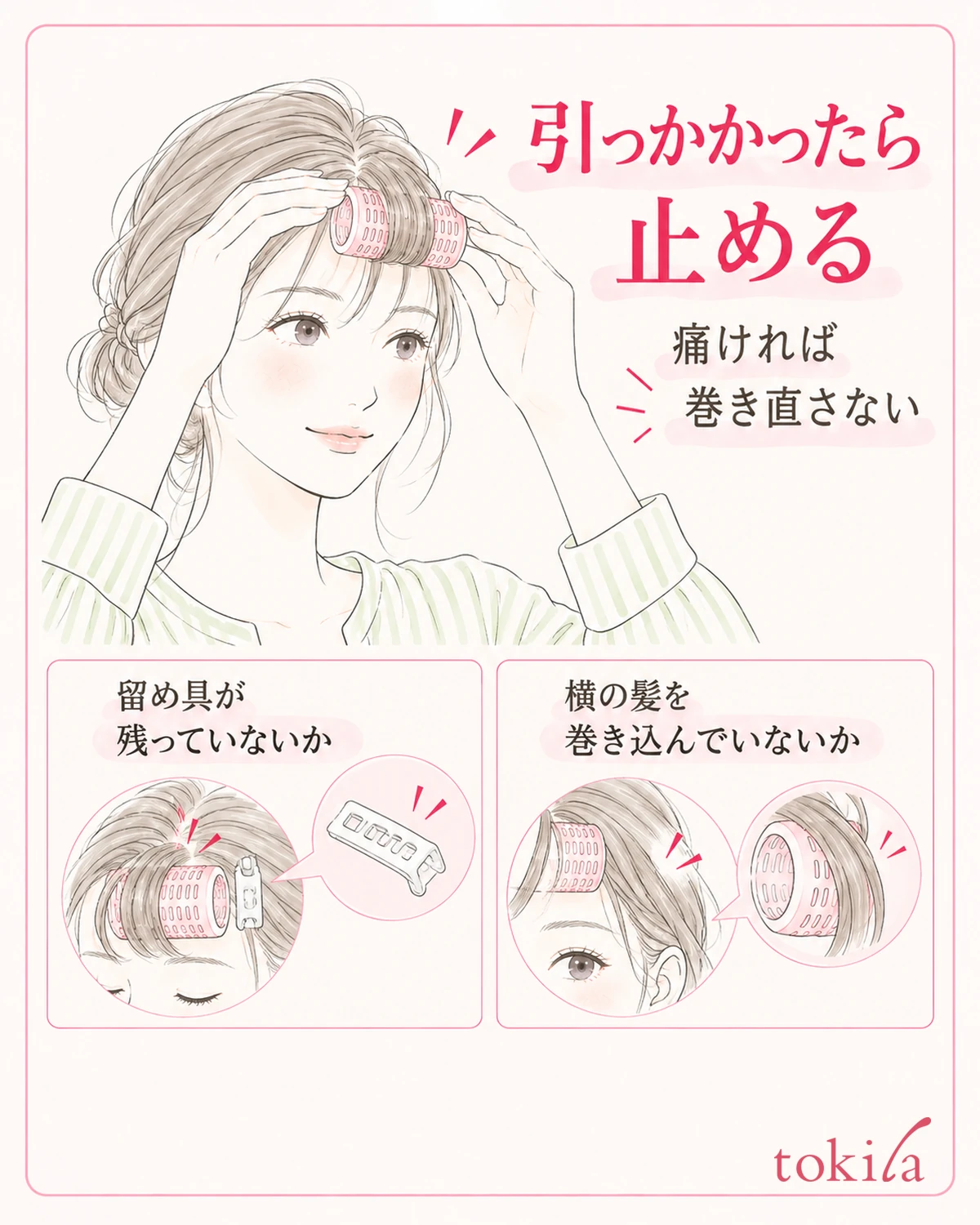
If it stops partway, if your scalp is being pulled, or if it hurts, don't increase the pulling force. Support the body and stop the movement, then look in order at what remains of the fastener, hair rolled in from the side, and tangling between the ends and the surface. Don't choose to hold the painful spot and pull while bearing the pain.
Even if it looks as if only one strand of hair remains in a visible place, you may be pulling the section behind it at the same time. Don't turn your face suddenly; change the angle of the mirror or have someone who can help look, and check where it is held. Avoid leaving the body hanging in the air, and check while keeping it supported.
If it is already so tangled that it won't come off, put stopping the forced pulling ahead of keeping the curl. We don't recommend solutions based on your own judgment here, such as cutting the hair with scissors, breaking the tube, or pouring in a lot of water or oil. Don't keep touching parts you can't see; choose to have the actual roller and the condition of your hair looked at, for example at a hair salon.
If the ends scatter after the body has come off, distinguish that from a state where tangles remain. First take your hand away and watch how the bangs fall, then gently align only the sections that bother you with your fingers. When you apply styling product right away, follow the amount and conditions of use for the product you have. Don't assume that adding something will always fix the shape.
If the pain or discomfort in your scalp continues, give up rewinding that day. Just because the hair came away doesn't mean you need to put the same strain on it again right away. On a day when you are short of time, don't try to force it back to the ideal curl; choose a finish you can do with the tools you have, such as a hairstyle that settles comfortably with a fastener.
When you compare how your bangs look after removal, match the parting and the angle at which you look in the mirror too. What you look back on changes depending on whether the roots are in the same position and only the ends are scattering left and right, or the whole section has moved sideways. You don't have to judge the whole winding a failure from the shape of the ends alone.
5. Before Winding Next Time, Review the Width of the Section and the Overlap of the Ends
Next time, record one place where it stopped this time. Words like "the hair at the right end remained," "the ends caught on the surface," or "the body moved too when I released the fastener" are enough. Don't sum it up as "my hair is bad"; separating the position that wouldn't move from what your hands were doing at the time makes it easier to choose what to review.
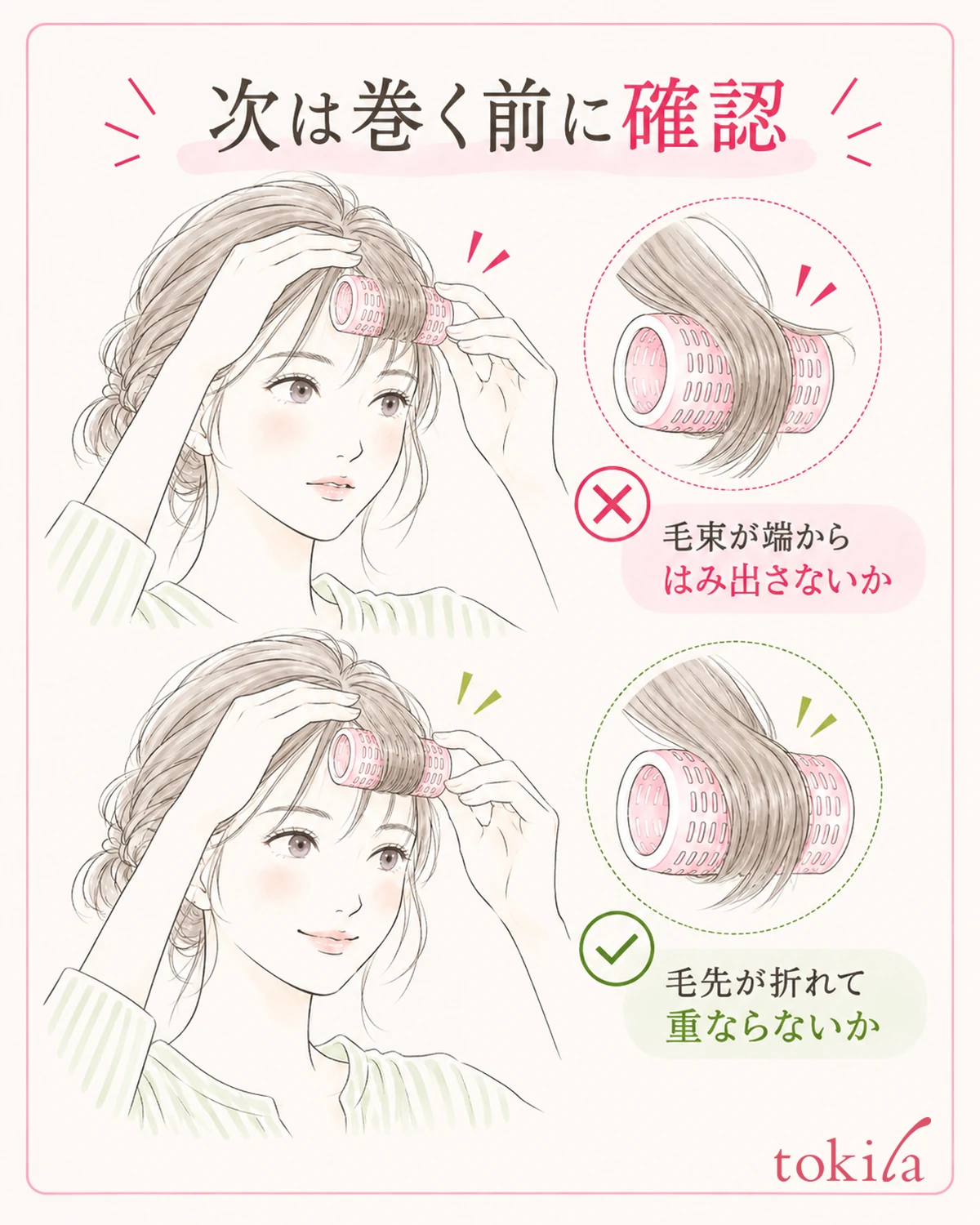
If you rolled in hair from the sides, next time separate the bangs from the side hair before winding and check that the section doesn't stick out past the end of the body. The suitable width and amount of a section vary with the length and density of your hair and the width of the body, so don't apply a fixed number of centimeters to everyone. Check the range that fits comfortably in the product you have.
If the ends were bent or scattered, look back at whether the ends were overlapping or sticking out sideways before winding. Align the flow of the hair when there are no strong tangles, and check in the mirror how the ends settle before winding. If you are concerned about the tool you use to comb your hair, you can also see how to remove hair from a hairbrush and clean it.
If you change the amount of the section, the winding direction, the waiting time, and the styling product all at once, it becomes hard to tell what was different. For the next try, decide on one point in the steps to check, such as supporting the body before releasing the fastener. Don't change product specifications such as whether heating is allowed or the waiting time just to compare.
Before trying to solve the catching by adding more oil, also review how much is already on. For checking when you have applied too much, see what to do when you've used too much hair oil. When taking it out, choose operations that fit the structure of the product you have, in this order: support, release the hold, separate the contact surface little by little, and stop if there is resistance.
Don't use the body for the next section of hair with hair still left in it; tidy it by following the care instructions for the product you have. If you find chipping on the surface or a deformed fastener, stop using it rather than trying to compensate with the amount you wind. Think of checking next time as separate from tricks for continuing to use a damaged tool.