You went to put on a knit and found small bumps on both shoulders. There are no marks yet, but the shoulders that hung on thin hangers are starting to bother you. Before you reach for water or heat to fix them, take another look at how you store the knit. If you start from the option of folding it so the shoulders don't carry the weight alone, you may find something you can change even with the storage you already have.
This article sums up what to check before putting dry knits back into everyday storage. Think of how you dry them after washing and how you store them before wearing as separate matters. Don't decide on a method from the fiber name alone; give priority to the care label and any storage notes on the garment. It does not introduce a method that is sure to remove marks that have already formed, or a way of hanging that works for every knit.
1. Tell shoulder marks apart from how the hanger touched
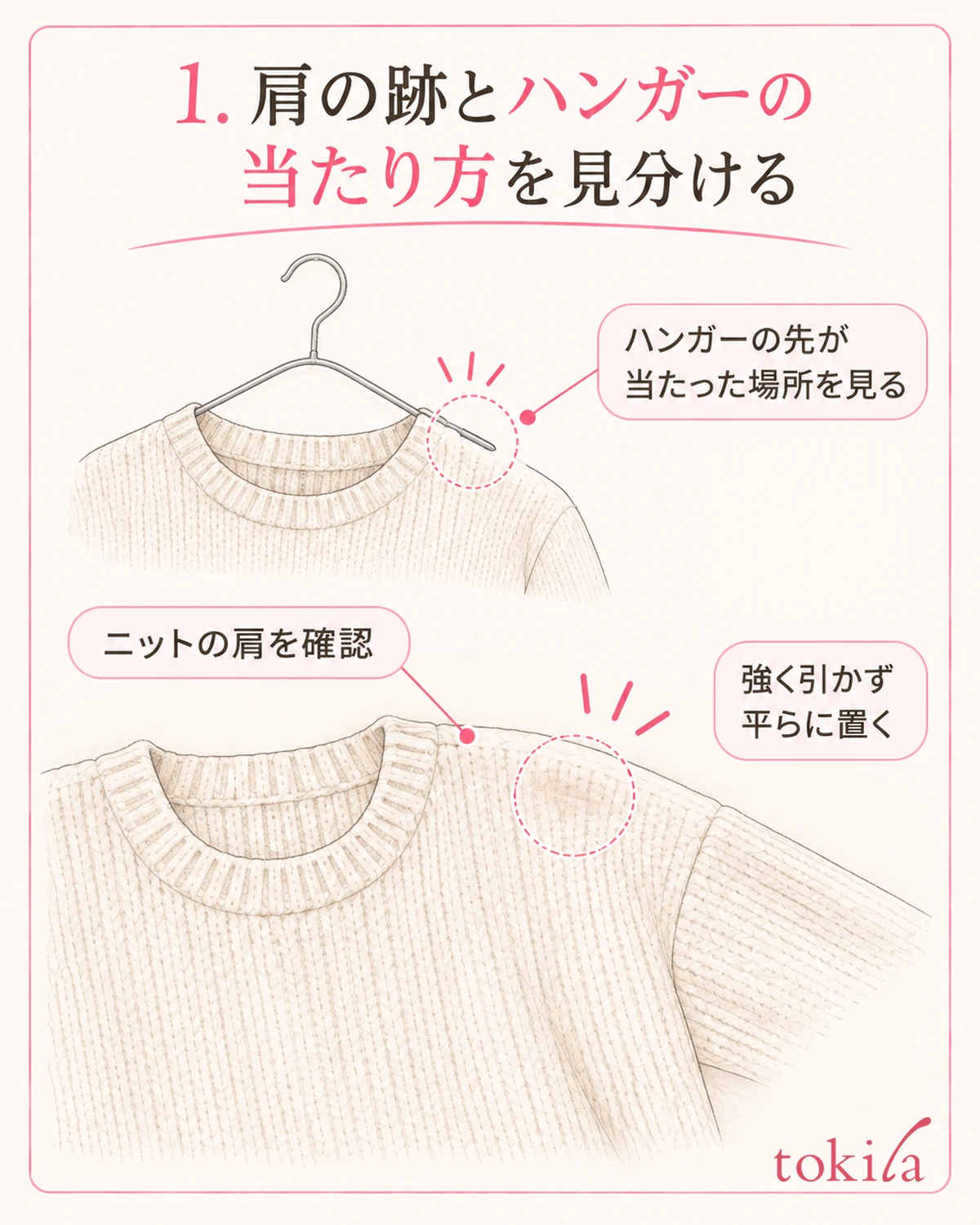
First, spread the knit out flat on a clean surface after taking it off. Check whether the bumps on the left and right shoulders line up with where the tips of the hanger were pressing. Put the hanger you took out beside it and compare whether its tips stuck out past the shoulder seams, or whether it was supporting the garment at a single point on the inside.
Some designs have low shoulder seams, and some knits have no seams at all. Don't assume it is always fine as long as the hanger tips line up with the left and right seams. Rather than stretching the garment to even out its shape, check where the weight seemed to gather while it was hanging.
If there are horizontal lines on the front body, or only the cuffs are creased, look at those separately from the localized marks on the shoulders. It is important not to blame the hanger for everything, including fold lines and marks pressed in by neighboring clothes. If you pick one spot that bothers you, it is easier to narrow down what to change in how you store it.
You don't need to rehang it in the same place over and over to check. Don't pull hard on the shoulders or crush the bumps while it is on; lay it flat for now. If the stitches look pulled or a thread is sticking out, don't try to tug it back into place.
Before putting it back on the same hanger, make room for folding just one garment. Rather than waiting until you have finished tidying all your storage, try changing where the knit that is bothering you now is kept. For ways to compare when you can't decide on outfit combinations, see steps for comparing clothes in the same color.
If it is hard to tell whether the left and right were different in shape to begin with, look at the whole garment laid flat before hunting for a photo from when you bought it. Don't chase tiny changes at the shoulders alone; check whether they overlap with a spot that bothers you when you wear it. If you take photos, take them in the same orientation, and don't use them to guess how much it has stretched later.
2. Choose folded storage based on weight, knit structure, and the label
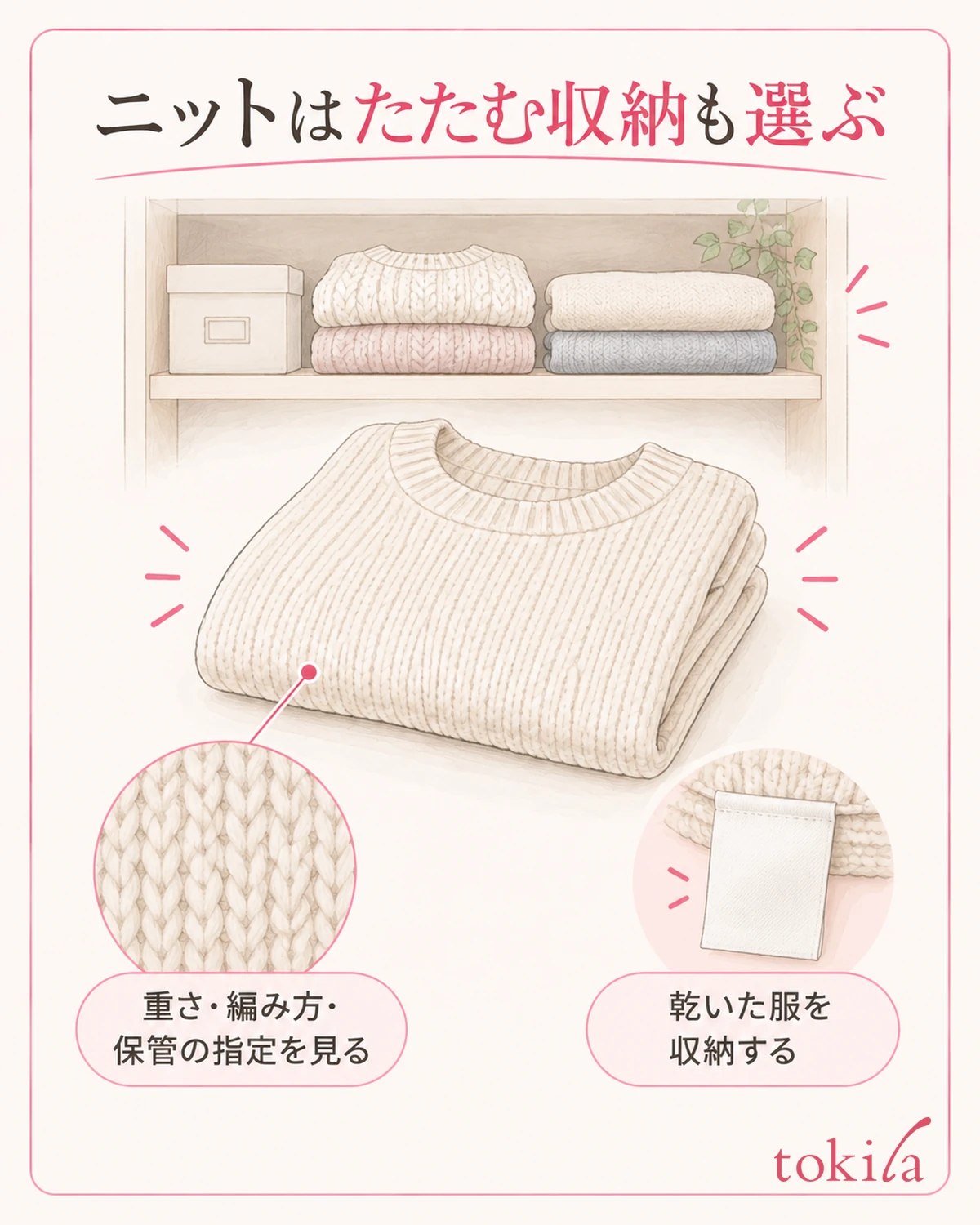
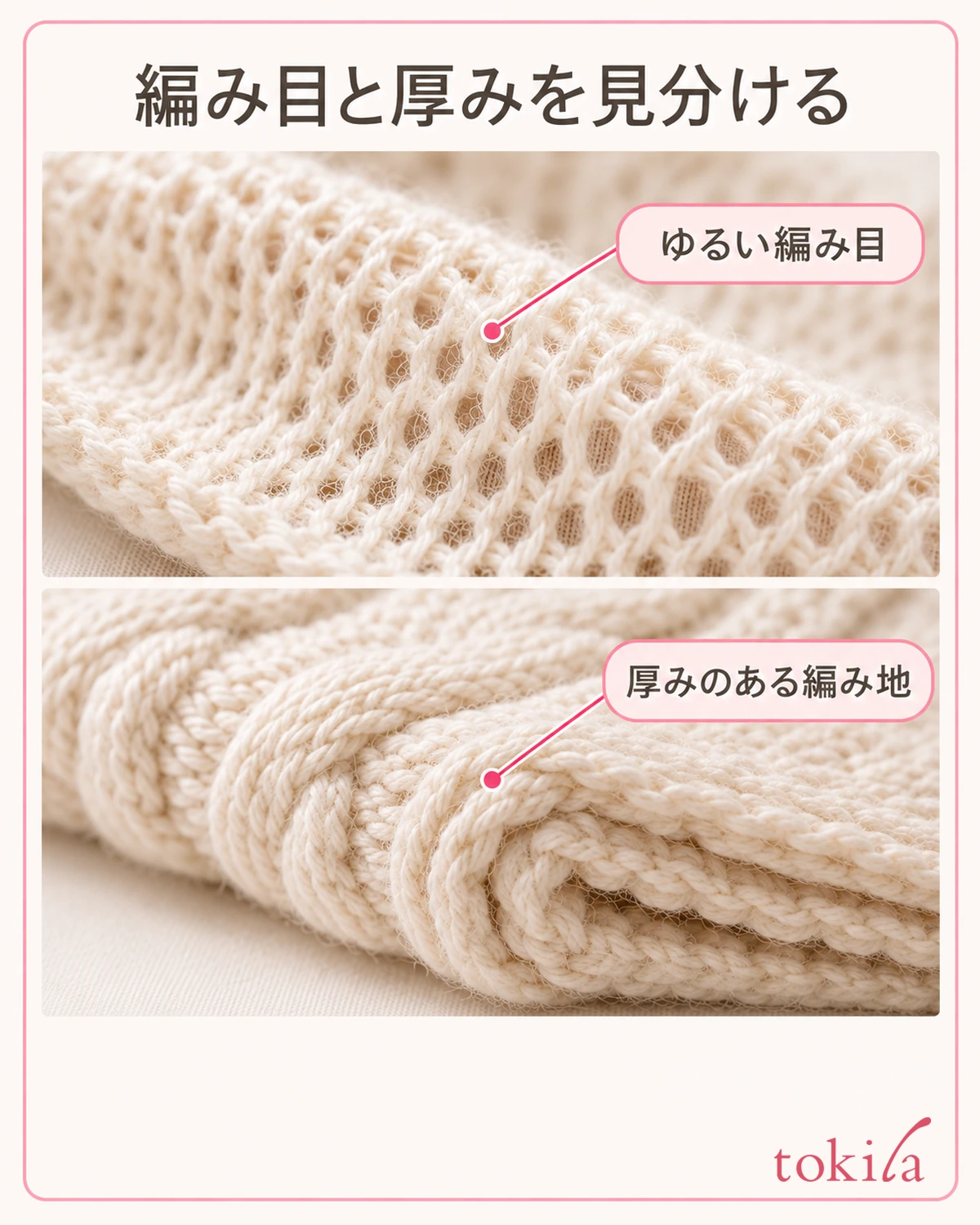
Avoid having the narrow part of the shoulders alone support a heavy, thick knit or a loosely knit garment for a long time. If a garment looks like it would stretch when hung, its shoulder tips stand out, or marks have bothered you before, first consider folding it and placing it on a shelf or in a drawer.
There is no need to sort by a single fiber name, such as "fold all wool" or "cotton can be hung." Even with the same material, weight, knit structure, embellishments and garment length differ. If the label has a storage instruction, give priority to that garment's conditions. Don't conclude how to store a dry garment from the flat-drying symbol on the care label alone.
Avoid hanging a wet knit on a storage hanger and moving it into storage as it dries. After washing, the weight of the water adds to the load, so first finish drying it by a method that suits the label. The way of folding introduced here is not a substitute for a drying method.
If your shelves aren't free, before cramming things in to make room, think about whether you can move heavy clothes to a different level. Rather than buying expensive storage goods first, you can start by securing enough width for one garment to lie flat and enough room for a hand to reach in and take it out. There is no need to keep folding it narrower to fit a small box.
When choosing a new hanger, don't decide it is suitable just because it is called a "knit hanger." Check the shape of the shoulders, the width of the supporting surface, how well it resists slipping, and how its size relates to the garment. Not slipping and not stretching are separate conditions. If the shoulders are pulled while hanging, you can go back to folding even with a soft-material hanger.
For a garment you are unsure about, first move just one garment to the folding spot and see what condition it is in the next time you wear it. What you change is the storage method, not the detergent or iron temperature at the same time. Even if the marks seem to have lessened, don't treat it as a promise of the same result for every knit; remember it as how easy that particular garment is to handle.
3. Put the sleeves inside and fold the body in as few folds as possible
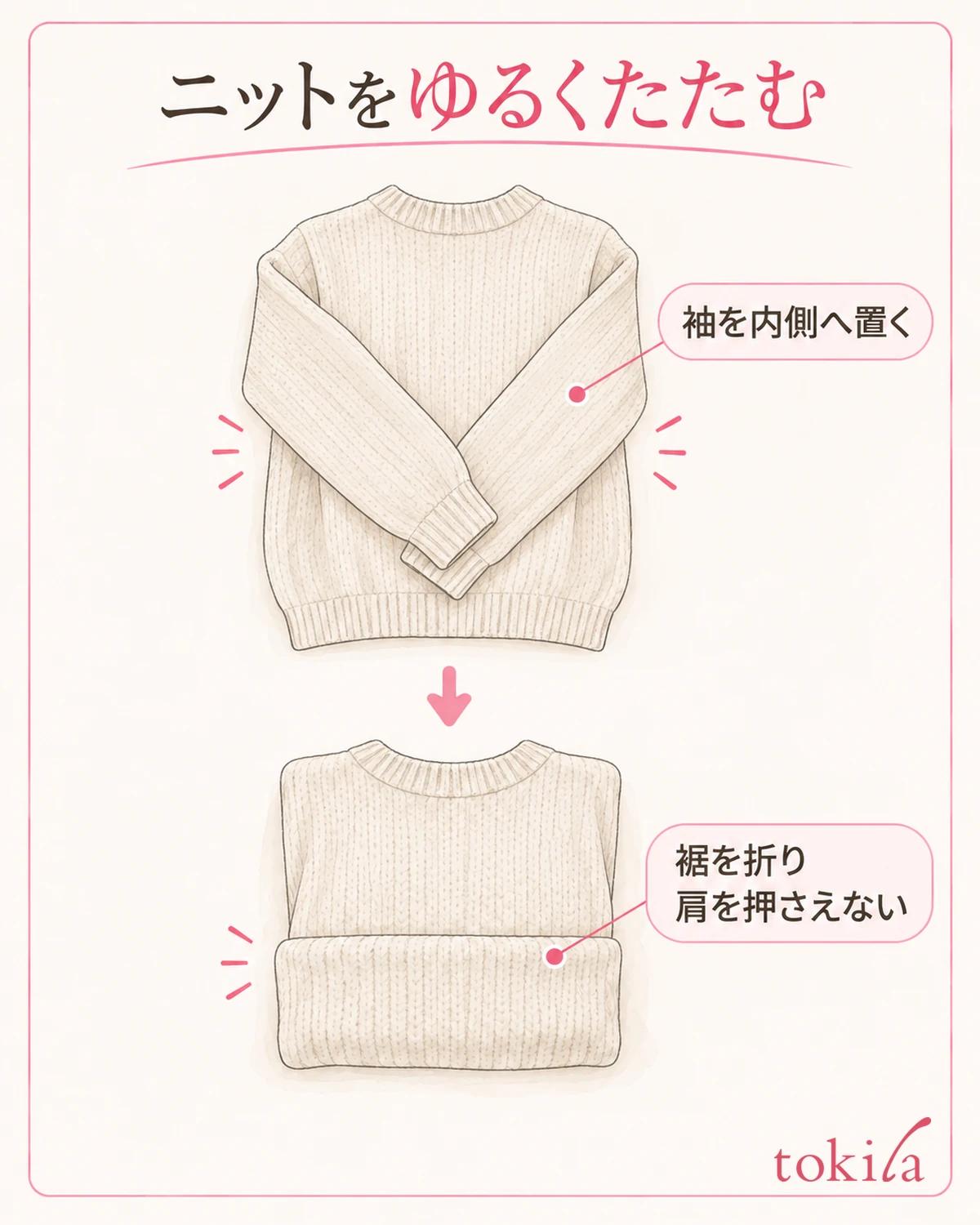
Before folding, lay the knit on a clean table or cloth with the back side facing up. Check that the neck and hem are not twisted, and smooth the shape with your palms without pulling. If a sleeve has tucked under the body, lift it out and lay it flat again.
Fold one sleeve in over the body, and lay the other on top. There is no need to stretch the cuff to reach the hem or to fold in the base of the shoulder sharply. If the sleeve is long, fold it back loosely once more at a spot where it doesn't stick out far beyond the body.
Next, fold the hem side up to fit the depth of the shelf. See first whether folding it in half is enough, and adjust the fold position if not. The goal is not to make the smallest square but to make a shape that sits stably as a whole without pressing hard on the shoulders or collar.
For garments with a thick collar or decorative buttons, check whether hard parts press strongly against another surface. Don't press the decoration down to reduce thickness, or stack parts that might snag on the stitches with them exposed. For garments of special shapes, don't force the same way of folding; check the accompanying instructions.
After folding, don't press it down hard with your body weight. If you need to push to close the drawer, review not only the way of folding but also how many pieces you put in. There is no guarantee that creases will disappear completely, but you can choose a way of placing that does not add more folds and pressure.
If the sleeve length or body width differs from the sample garment, the shape after folding will also differ. Don't pull the fabric to line up the edges exactly on the same line; look for the position where the thickness of your own garment sits evenly. If folding it again each time becomes a complicated procedure, also reflect on whether you are putting too much priority on the dimensions of the box.
4. On the shelf, put lighter clothes on top and fit things in without cramming
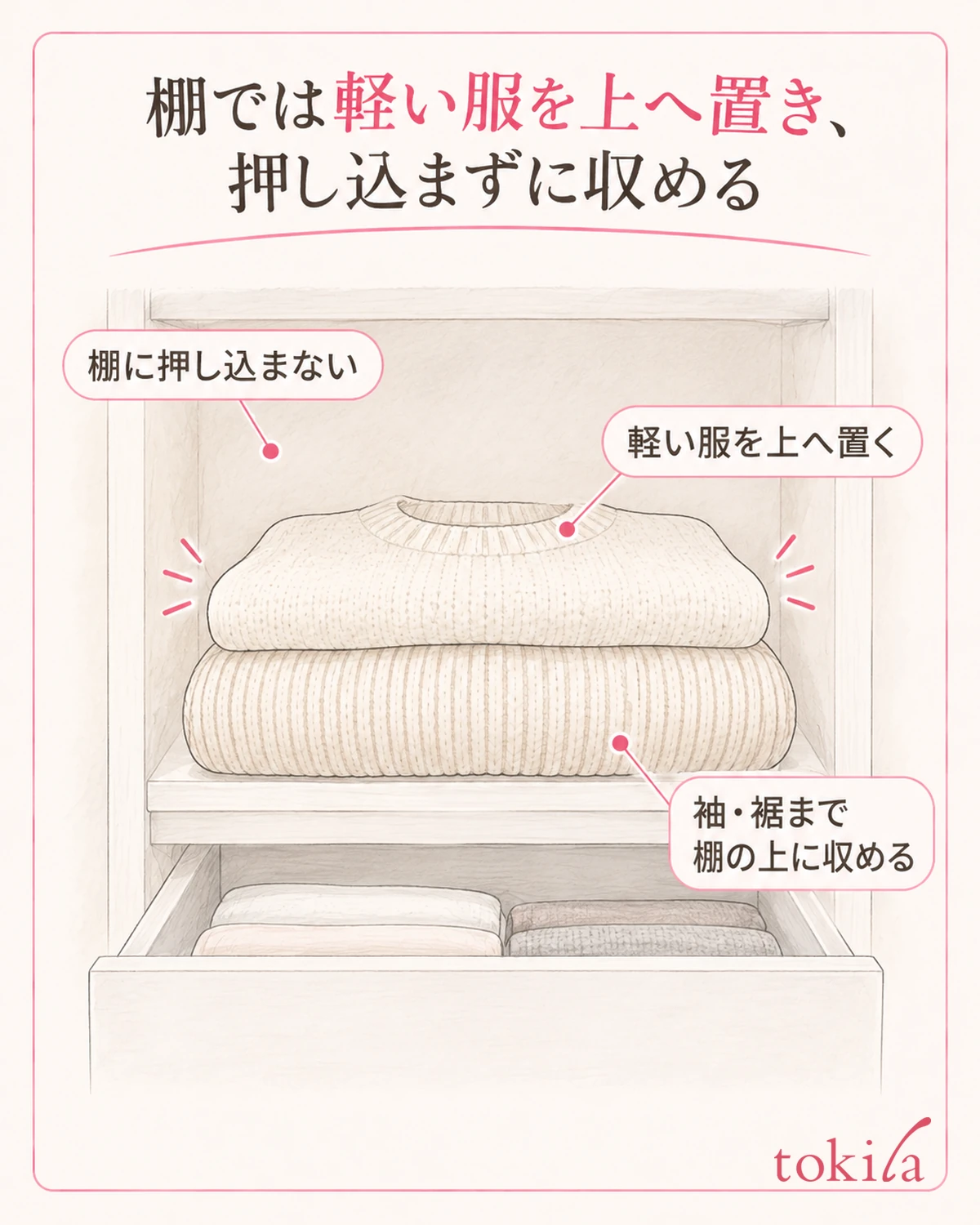
Place folded knits without pushing them under heavier clothes. If you stack them, keep the bottom stable and, as a rule of thumb, put lighter items on top. Splitting them into low groups, rather than building a tall pile, means you don't have to yank out the one at the bottom.
Also check whether a sleeve has dropped over the edge of the shelf or into the back of the drawer. Even if it looks stored, if only part of it is hanging down, that part stays pulled. Fit the whole garment so it rests on the surface of the shelf and does not get caught in the drawer rails or corners.
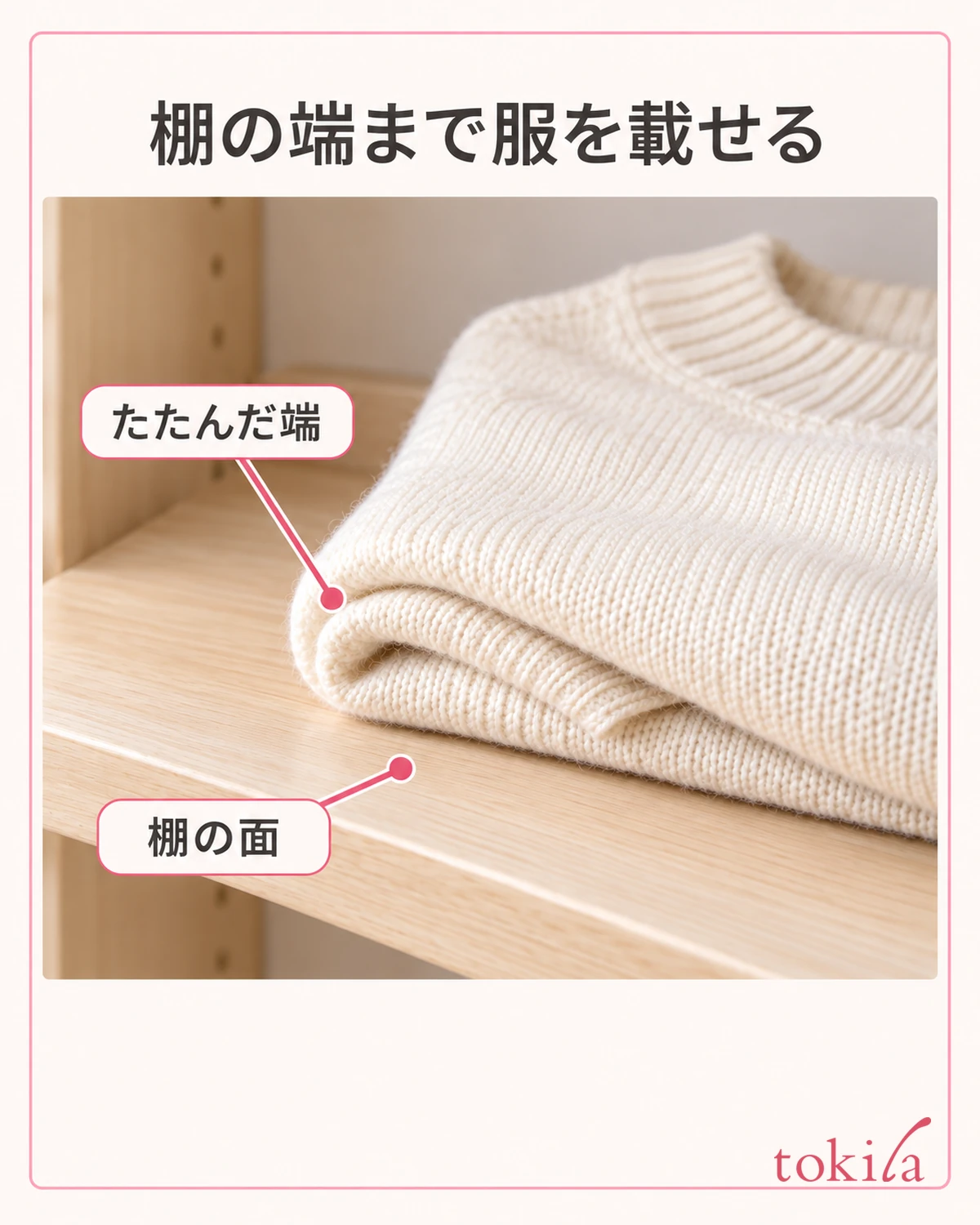
There is no need to match the spacing between items to a fixed number. A rule of thumb is whether you can take out a knit when you grab it, without pressing hard on other clothes or snagging it on embellishments. If you use dividers, first check that their corners and surfaces won't snag on the stitches.
Before closing the drawer, open and close it once slowly. If the clothes hit the lid or the shelf above, don't push them down; move one garment to another place. Don't count it as finished storage if the drawer won't close without force each time.
For clothes you need to hang, follow the instructions for the garment and hanger, and check that the shoulder tips don't stick out and that the weight of the hem doesn't pull the top. There is no need to carry over a complicated wrapping method you saw online to a garment with different embellishments or knit structure. If the contact at the shoulders bothers you, prioritize a place for folding.
If you move the garment you wear most often to a place where you can take it out without moving many clothes above it, it is also easier to keep the same shape when you put it back. Decide first how often you wear it and how big the garment is, rather than the order in which you pack the shelf. Another thing to check is not to compress thick clothes to the same height as thin ones just to make the storage look uniform.
5. Check the shoulders when you take it out, and don't force a fix on marks that bother you
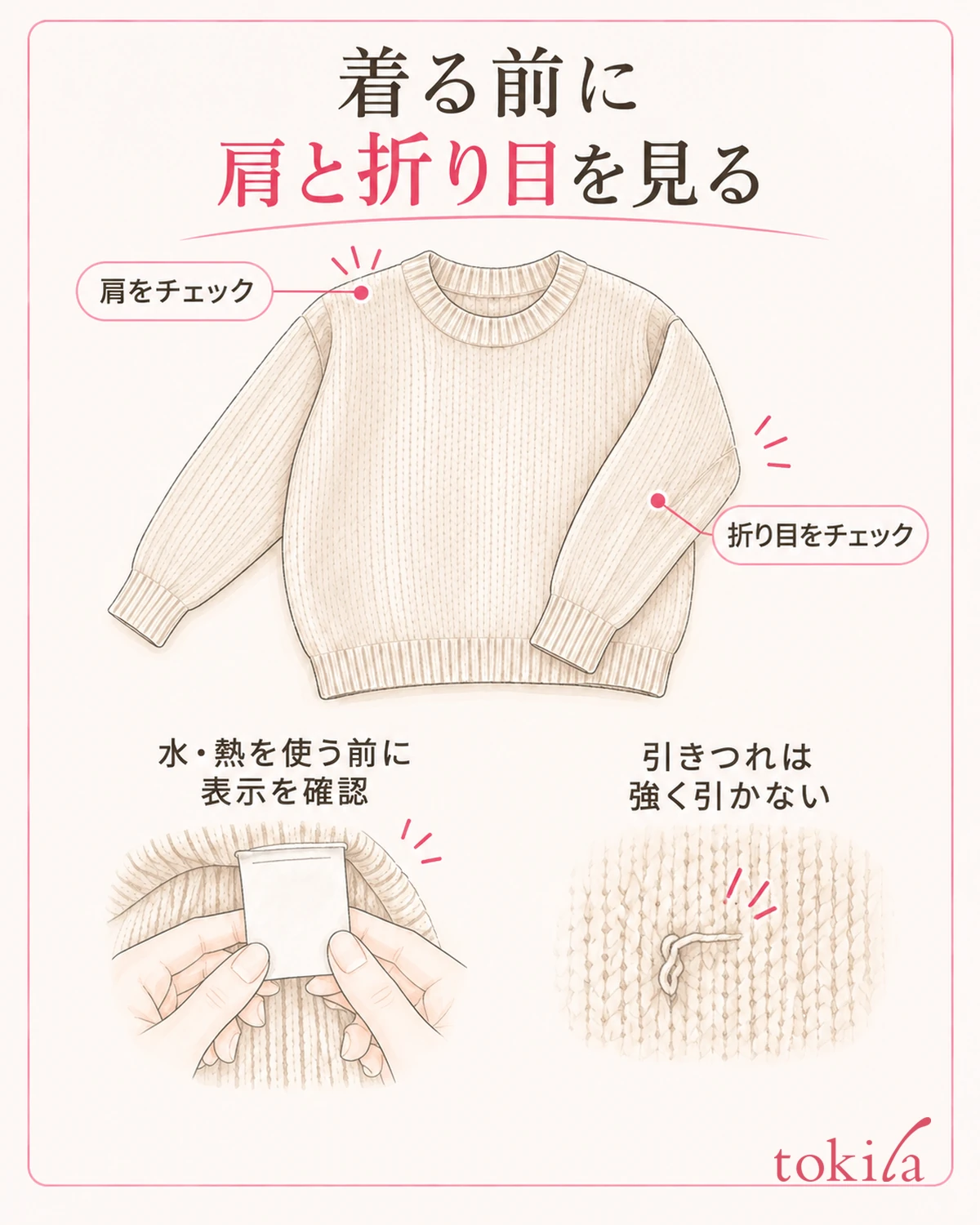
The next time you wear it, take it out of storage, lay it flat, and look it over: shoulders, collar, sleeves, and hem. Check not only for bumps on the shoulders but also for strong lines at the folds and for decorations that were pressing against another surface. If something bothers you, review the fold position or the way of stacking that corresponds to that spot.
Even if a mark remains on the shoulder, don't immediately spray it with water or apply hot steam. The conditions under which water or heat can be used differ from garment to garment. Read the label, and if you can't decide, or if there is also pulling or discoloration, don't go ahead with a forced fix at home; consult the shop where you bought it or a garment-care service.
Even for garments that can be ironed, check the instructions for temperature, pressing cloth, and whether steam is allowed. Pressing hard on a single point on the shoulder to flatten it should not become the standard way of fixing it. Also avoid assumptions such as "a little water will restore it" or "it will surely disappear as you wear it," and handle the garment while watching its condition.
A short note pairing a garment with where it is stored, such as "thick knits on the upper shelf" or "don't stack the one with decorations," is enough as a record for next time. Rather than replacing all your storage goods at once, deciding the place starting with the garments that bothered you reduces the hesitation of going back to the same way of hanging.
Before going out, separate the storage check from the outfit check. If you want to compare the colors and areas that show after wearing a garment whose storage you have settled, you can also use ways of thinking about color schemes for clothes and accessories. Reviewing where the knit's shoulders are supported leads to being ready to wear the garment you already own without strain.