YH Research Co., Ltd. has released a report analyzing market trends for makeup tools in detail: "Global Facial Makeup Tools Top Companies Market Share and Ranking 2025." The report surveys and analyzes product definitions, market size, the competitive landscape, product classification, applications, regional structure and supply chain trends.
It focuses in particular on shifting demand patterns between online and offline sales channels, technological advances and business opportunities in the supply chain.
The global makeup tools market to exceed US$7.6 billion by 2032
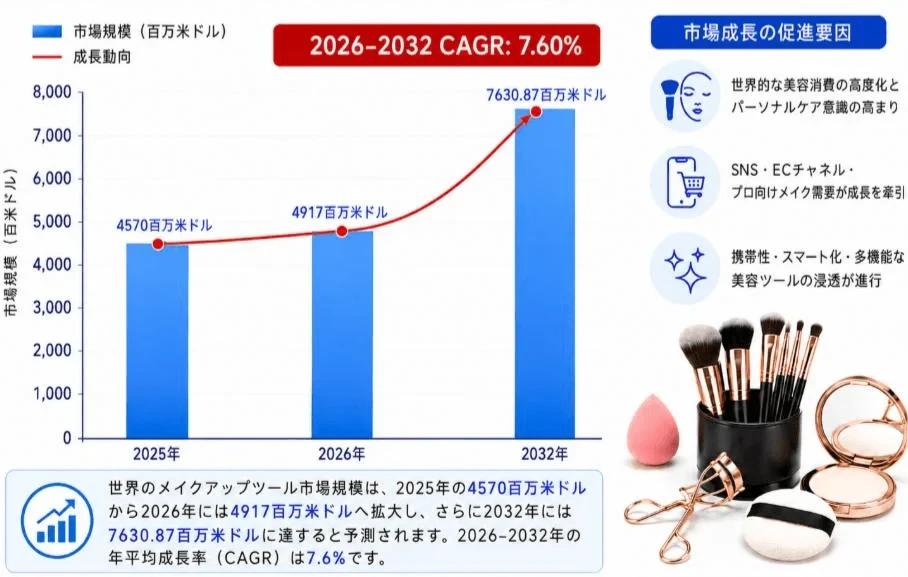
According to YH Research, the global makeup tools market is expected to reach about US$4.57 billion in 2025 and about US$4.917 billion in 2026.
It is then forecast to grow at a compound annual growth rate (CAGR) of about 7.6% from 2026 to 2032, reaching about US$7.63087 billion in 2032.
The main drivers of market growth are the increasing sophistication of beauty consumption worldwide, the spread of social media and beauty-related content, the rapid expansion of e-commerce channels, growing awareness of personal care and rising demand for professional-grade makeup tools.
As consumers place more importance on precise finishes, ease of use, hygiene, safety and personalized experiences, makeup tools are evolving into products with specialization, smart features, multifunctionality and a premium feel.
Definition of makeup tools and the direction of their evolution
Makeup tools are specialized implements used during makeup, skincare and beauty treatments to help apply, blend, finish and cleanse cosmetics.
Main products include makeup brushes, makeup sponges, puffs, eyelash and eyebrow tools, beauty devices and related accessories. Materials include synthetic fibers, animal hair, sponge, silicone, plastic and metal parts, and the products are made through mold manufacturing, hair implantation, injection molding, surface finishing and precision assembly.
Against the backdrop of premiumization of makeup products, growing demand for professional beauty services, the expansion of e-commerce sales channels and the increasing adoption of eco-friendly materials, the makeup tools industry is evolving toward higher performance, personalization, set sales and the introduction of smart technology.
Key players and analysis of the competitive landscape
Key players in the global makeup tools market include international beauty conglomerates, specialist makeup brush and beauty sponge brands, personal care companies with diversified businesses, retail chains and regional color cosmetics brands.
Representative companies and brands include L'Oréal, Shiseido, Estée Lauder, LVMH, e.l.f. Beauty, Paris Presents, Sigma Beauty, Beautyblender, Avon, Etude House, Chanel, A.S. Watson Group, ZOEVA, Chikuhodo, Hakuhodo, Morphe, Mao Geping and Perfect Diary.
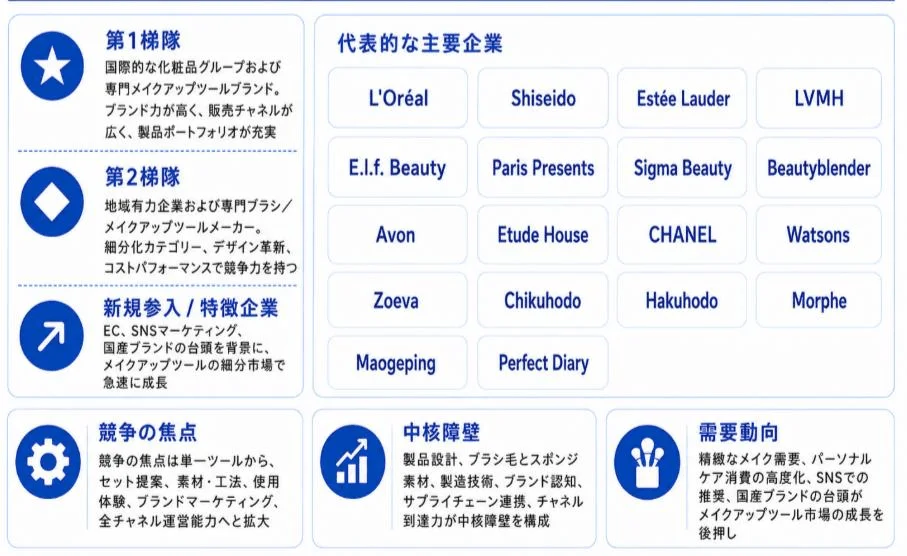
Because the makeup tools category covers a wide range of products, including makeup brushes, beauty sponges, puffs, eyelash curlers, cosmetic sponges, cleaning tools and portable beauty accessories, companies' business strategies differ greatly.
Conglomerates emphasize sets sold with color cosmetics and rollouts as part of their brand portfolios, while specialist manufacturers focus on premium makeup brushes, professional-grade tools and niche beauty accessories.
Competition is likely to center on factors such as product materials, ergonomic design, comfort in use, durability, ease of care and aesthetics. Electric facial cleansers, smart beauty mirrors, electric makeup brush cleaners, multifunctional beauty devices and eco-friendly reusable tools are expected to become more widespread.
Product classification and diverse sales channels
By product type, makeup tools are mainly classified into makeup brushes, eyelash curlers, cotton and other auxiliary tools. Makeup brushes account for the largest share of this category.
Because they can pick up powder, blend evenly and apply precisely, they are widely used for foundation, blush, eyeshadow, eyebrows and lip makeup. Premium brushes emphasize the softness and resilience of the bristles, ergonomic design, durability and the use of eco-friendly materials.
As for sales channels, makeup tools reach the end market mainly through two routes: online and offline. Online sales include general e-commerce platforms, official brand stores, social commerce, live commerce and cross-border e-commerce.
Against the backdrop of the spread of the mobile internet, beauty-related content marketing and changing consumer buying behavior, online sales have become a rapidly growing channel for makeup tools. Online channels offer advantages such as wide reach, rich product information, quick consumer feedback and flexible marketing costs.
Offline sales channels include department stores, cosmetics specialty stores, beauty salons, multi-brand beauty variety stores, supermarkets and brand-operated stores. In these channels, consumers can experience the material, texture and performance of products in person, which allows for more efficient purchasing decisions.
Going forward, with the evolution of new retail models, combining online content marketing with offline experiential services is expected to become a major sales trend in the makeup tools industry.
Regional market overview and future growth opportunities
The global makeup tools market is structured so that the three major regions of Asia-Pacific, Europe and North America drive growth together. Asia-Pacific is the main production and consumption region for makeup tools, and China, Japan and South Korea have an advantage in supply chain capability.
China has become a global supply base for makeup tools thanks to its comprehensive manufacturing foundation, cost competitiveness and the rapid growth of domestic beauty brands. In the Japanese market, premium brush manufacturing, natural hair materials and precision processing technology are valued, while in the South Korean market, product innovation and more sophisticated consumption are advancing against the backdrop of makeup trends and social media marketing.
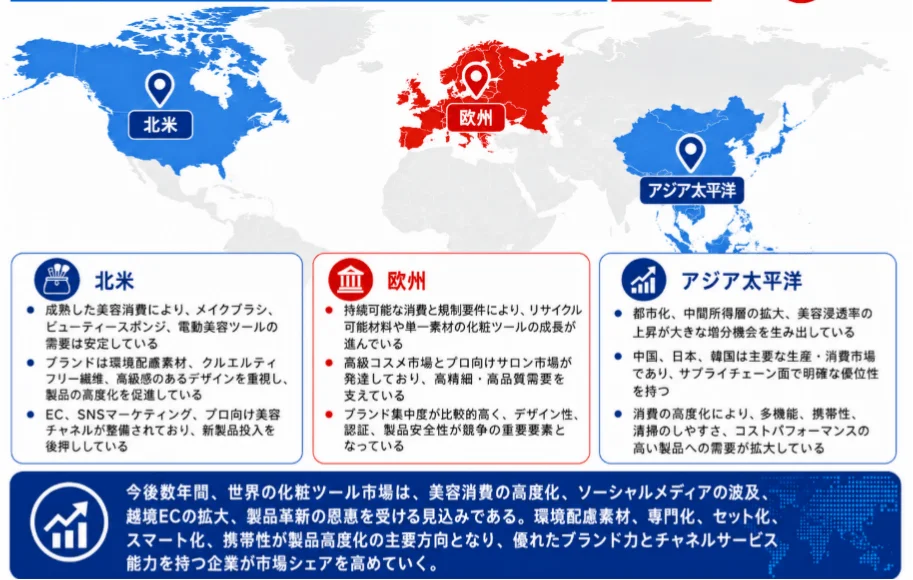
The European market is driven mainly by demand that values premiumization, specialization and brand value. France, Germany, the United Kingdom, Italy and others have strong systems of luxury cosmetics brands and specialist makeup tool companies. Consumers are showing growing interest in product design, eco-friendly materials, feel in use and brand value.
The North American market is growing thanks to a mature beauty consumer market, demand from professional makeup artists, the development of e-commerce channels and more sophisticated personal care spending. In the United States in particular, there are many specialist makeup tool brands and innovative companies, and functionality, user experience, social media influence and brand awareness are competitive factors.
Future market opportunities are expected to concentrate in three main directions. First, in Asia-Pacific, quantitative demand is expected to grow with the expansion of emerging consumer groups, the growth of the e-commerce market and the rise of domestic beauty brands. Second, in Europe and the United States, product upgrades are likely to advance through premium beauty demand, services for professionals and the adoption of eco-friendly materials. Third, added value will rise through smart features, personalization and multifunctionality, and multifunctional makeup tools, portable designs, antibacterial materials, eco-friendly brush bristles, customizable sets and new product marketing using social media are expected to become new growth opportunities.
Supply chain structure and points for higher added value
The upstream of the cosmetic tools industry chain mainly includes brush bristle materials, handle materials, sponge and soft materials, metal parts and packaging-related materials. Bristle materials include synthetic fibers such as nylon, PBT and PET, animal hair such as goat hair and horse hair, and plant-derived fibers.
In the midstream, processes include product design, structural development, mold making, injection molding, aluminum processing, metal press processing, brush forming, hair implantation, bristle-tip cutting and shaping, sponge foaming, assembly, surface coating, plating, silk screen printing, laser engraving, cleaning and disinfection, performance testing and quality inspection.
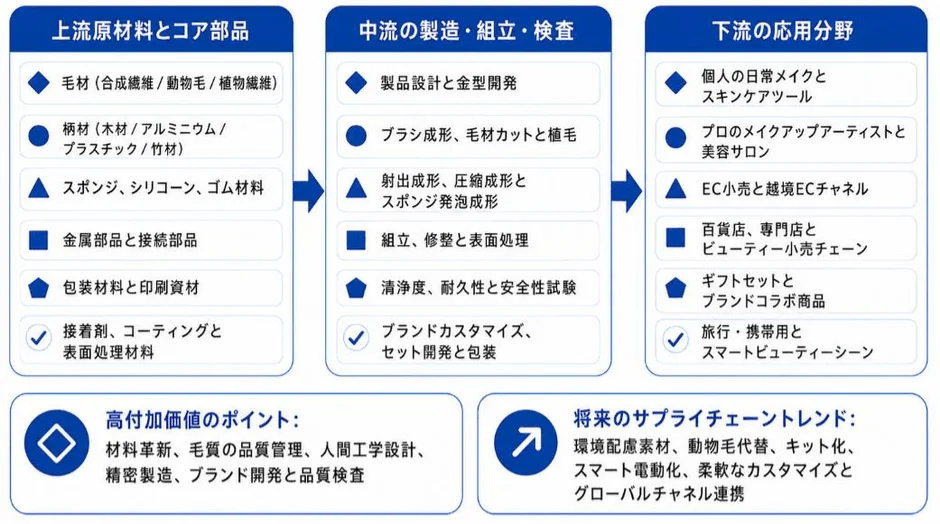
The downstream segment includes individual consumers, professional makeup artists, beauty salons, makeup schools, cosmetics brands, retailers, e-commerce platforms, cross-border e-commerce channels and the gift market, and is applied to everyday makeup, professional makeup, portable beauty for travel and smart beauty.
Added value in the industry chain is concentrated in processes such as bristle performance, ergonomic design, precision manufacturing, functional innovation, surface treatment, brand development and quality control. The supply chain is expected to develop in the direction of eco-friendliness, smart features, set products and globalization.
This article was prepared based on data from YH Research Co., Ltd.'s research report "Global Facial Makeup Tools Top Companies Market Share and Ranking 2026."
YH Research Co., Ltd. official website: https://www.yhresearch.co.jp
Report details: https://www.yhresearch.co.jp/reports/1120767/face-make-up