According to a survey released by SDKI Analytics on September 11, 2026, the aroma chemicals market is expected to reach about US$10.92 billion by 2035, growing at a compound annual growth rate (CAGR) of about 6%. The company analyzes that this growth is backed by expanding chemical production around the world and a shift in demand toward sustainable products.
The survey targeted 555 market participants and was conducted in North America, Latin America, Asia-Pacific, Europe, and the Middle East and Africa. It covers growth factors, challenges, opportunities and the latest market trends.
Aroma chemicals market expected to expand to US$10.92 billion by 2035
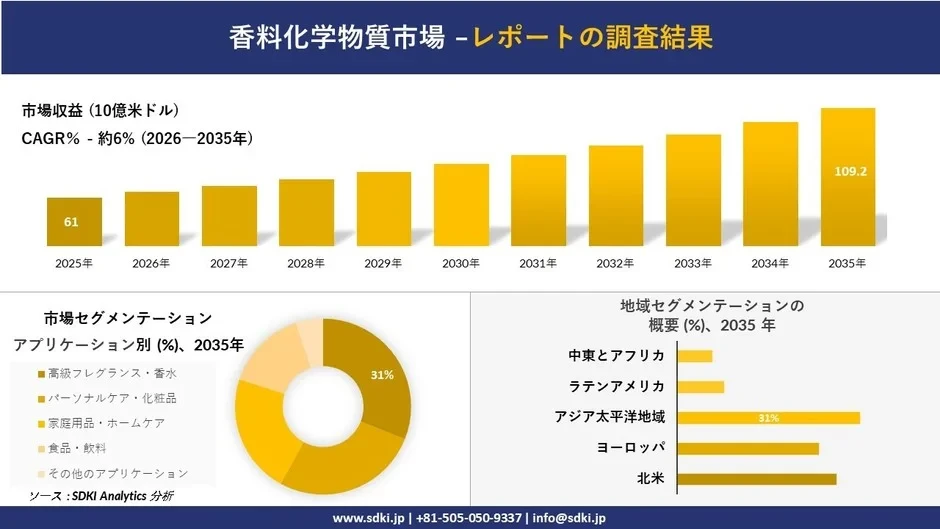
SDKI Analytics' analysis puts the aroma chemicals market at about US$6.1 billion in 2025, and forecasts that it will reach about US$10.92 billion in 2035. The CAGR over the forecast period is about 6%.
Details of this market research report can be found on the SDKI Analytics website below.
Aroma chemicals market research report
Factors driving market growth
SDKI Analytics analyzes that the growth of the aroma chemicals market mainly stems from expanding production of chemicals and petrochemicals around the world.
For example, according to data from the Indian Chemical Council, production of major chemicals and petrochemicals rose from 45.64 million tonnes in fiscal 2015-16 to 58.62 million tonnes in fiscal 2024-25, a CAGR of 2.8% over the same period.
The growing shift toward sustainable and bio-based products is also supporting the market. It is pointed out that consumers increasingly seek fragrances and personal care products containing bio-based or natural ingredients.
Efforts in sustainability and innovation
To meet this demand, manufacturers around the world are working on products that take sustainability into account and minimize reliance on synthetic ingredients.
In October 2025, BASF's aroma ingredients brand launched "Isobionics® Natural alpha-Farnesene 95," a new flavor ingredient with 95% purity. This ingredient is suited to developing lime-flavored products.
According to SDKI Analytics' research, companies in the aroma chemicals market have been expanding their businesses in recent years.
In June 2026, BASF launched "Micadelva," a new non-allergenic citrus aroma ingredient that serves as an alternative to orange terpenes. The company has introduced "Safe-by-Design" principles to develop aroma ingredients that combine high functionality with excellent regulatory compliance.
In August 2025, Takasago International Corporation gave an oral presentation at the "Flavors & Fragrances 2025" conference in Germany on "promiscuous enzymes (enzymes with broad substrate specificity)" effective for bio-manufacturing, based on joint research with Kobe University.
A trial-reading edition of the market research report, offering strategic insights to support executive decision-making, can be requested below.
Aroma chemicals market research report (trial-reading edition)
Luxury fragrances lead the market
By application, the aroma chemicals market is segmented into luxury fragrances and perfumes, personal care and cosmetics, household products and home care, food and beverages, and other applications.
Among these, the luxury fragrance and perfume segment is forecast to hold a large 31% market share by 2035, backed by growing demand for luxury fragrances and perfumes and rising consumer purchasing power.
To meet this demand, manufacturers around the world are focusing on developing distinctive, premium scents. For example, in January 2026, Escentric Molecules launched a limited-edition fragrance to mark the brand's 20th anniversary. The product is a set of 200 ml bottles of the brand's signature scents "Molecule 01" and "Escentric 01." "Molecule 01" is based on perfumer's alcohol and contains the aroma chemical "Iso E Super" at a concentration of about 65%.
Asia-Pacific leads the global market, and Japan's market is also expanding
According to SDKI Analytics' analysis, the Asia-Pacific region is expected to lead the global aroma chemicals market with a 31% share during the forecast period.
This is due to rising demand for natural and clean-label products and the rapid expansion of the cosmetics and fragrance ecosystems in China, India, Japan and South Korea. China's National Medical Products Administration (NMPA) has said that China's cosmetics market will exceed 1 trillion yuan in 2024.
The market's growth is also supported by increasing consumption of aroma chemicals, processed foods and beverages, and fragrances and perfumes, and by consumers' growing preference for premium, differentiated fragrances. For example, in February 2026, Givaudan opened a new fragrance creative center, "10 Capital," in Jakarta, Indonesia.
Meanwhile, Japan's aroma chemicals market is expanding thanks to the rapid consumption of cosmetics and personal care products, along with the growing adoption of natural and sustainable raw materials by manufacturers in the food and personal care industries.
Major companies in the aroma chemicals market
The major companies in the global aroma chemicals market named in SDKI Analytics' research report are as follows.
BASF
Givaudan
International Flavors & Fragrances Inc.
Takasago International Corporation
Symrise AG
The top five companies in the Japanese market are as follows.
Takasago International Corporation
Nippon Koryo
T. Hasegawa
Niwa Koryo
Mitsubishi Gas Chemical
A free sample of this report can be requested here.
Free sample report
Related market research reports
About SDKI Analytics
SDKI Analytics aims to provide reliable, detailed and thorough market research and insights. In addition to researching and providing detailed market reports on growth indicators, challenges, market trends and the competitive landscape, it supports its client companies' business transformation.
Company information
Company name: SDKI Analytics
Address: Cerulean Tower 26F, 15-1 Sakuragaoka-cho, Shibuya-ku, Tokyo 150-8512
Representative: Isao Furukawa
Phone: +81-50-5050-9337
Website: SDKI Analytics official website
Social media:
X (Twitter): SDKIResearch X (Twitter)
Facebook: SDKIResearch Facebook