You like the color of a hat when you look at it by itself, but when you pair it with your usual clothes, only the top of your head seems to stand out. On days like that, before rushing to buy a new one, try looking again at the jacket you are wearing today and your hair together with the hat. The color of the hat fabric, the shadow cast by the brim, and the line where it meets your hair can each be checked separately.
Here we introduce a way to compare when you want to blend a hat you already own into your outfit. It is also a checking routine you can use on days when you want to enjoy a hat that stands out. Rather than deciding that one particular color must suit a given hair color or skin tone, widen what you look at from around your face to your whole body, and look for combinations you like.
1. Put on today's jacket, fix your hair, and look for the boundary that bothers you
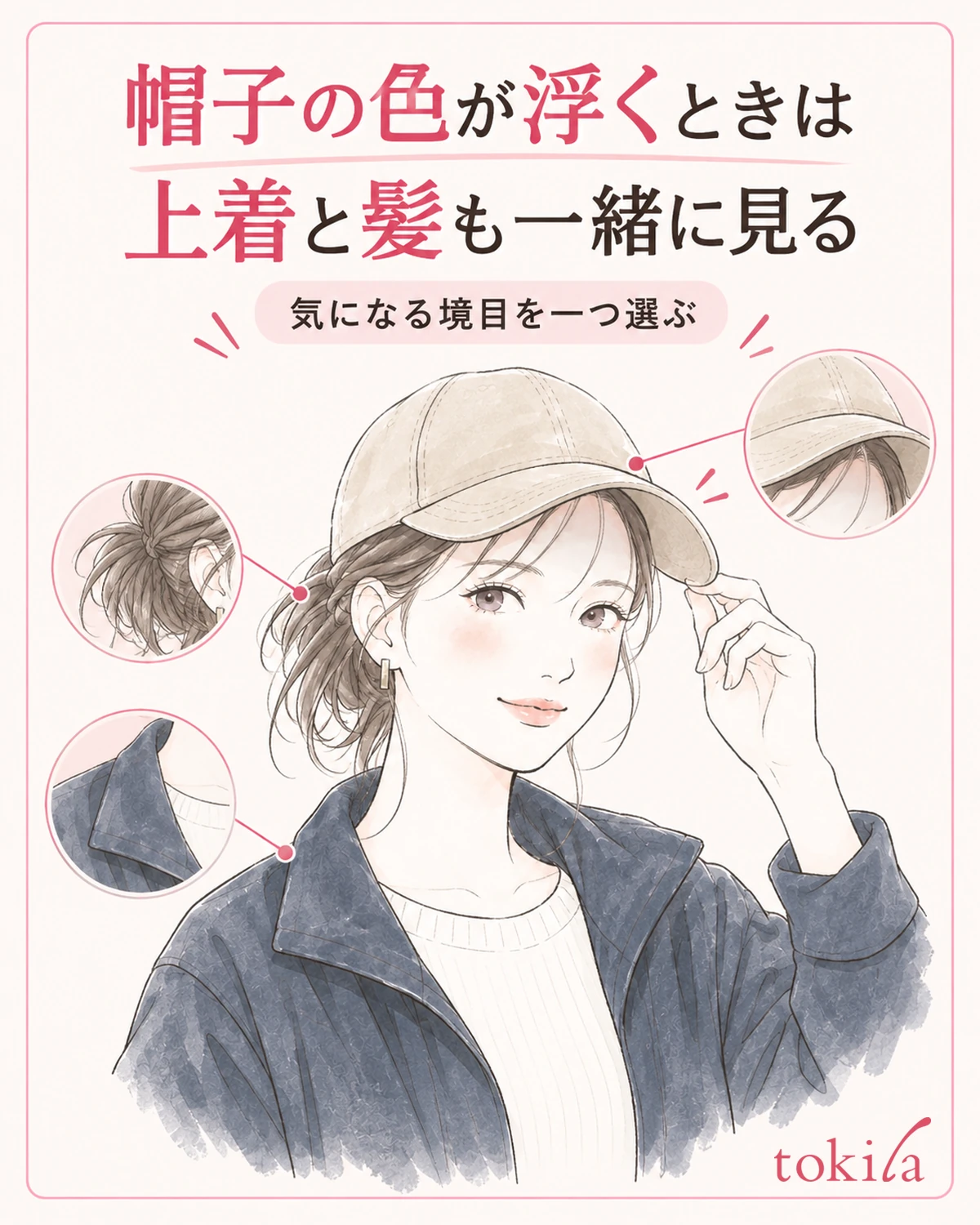
First, put on the jacket you will wear outside and style your hair the way you usually do. Just holding the hat in your hand and putting it next to your face won't show you how your hair looks with it on or how the brim's shadow falls. Check the front and back and the size, put it on in a position where it sits steadily without strain, and get everything from your head to your chest into the mirror.
Next, pick one spot where your eye stops. Look at whether the line between the hat and your hair is sharp, whether the hat's brightness is strong, or whether it feels far from the color of your jacket. Rather than summing it up as "the hat doesn't suit me," the starting point is to separate the place and how it looks, such as "the bright surface on top of my head bothers me."
A hat standing out is not in itself a failure. Decide first whether today you want the hat to be the star or want it to blend into the whole outfit. Even with the same combination, the choice changes if the impression you are aiming for changes. Move on to the next comparison only on days when you want a calmer look.
While you try things on, match the jacket collar, how the front is opened, and where your hair is tucked behind your ears as closely as you can. If you wear your hair down in the first shot and tied up in the second, the area of colors other than the hat changes too. Use your usual look as the baseline first, and compare hairstyles separately later.
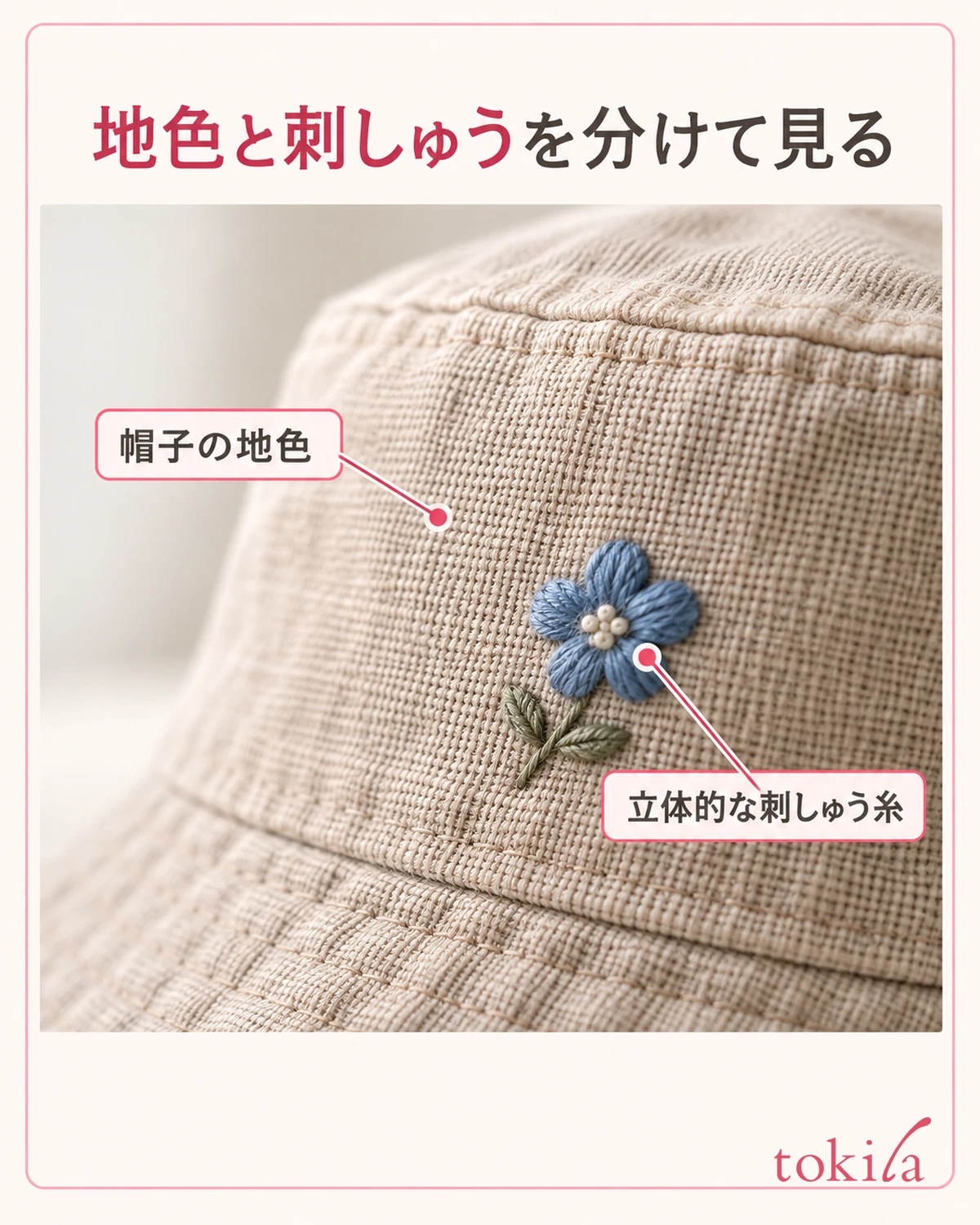
For a hat with a pattern or embroidery, distinguish the ground color from the color of the decoration. Even if the plain parts are close to your clothes, your eye may be drawn to a large motif. Rather than going by the color name alone, check which part you want to stand out, and it becomes easier to choose between switching to a plain candidate and making that hat the star.
If you want to check the shape and how to wear it first, you can also refer to Hat types and how to wear them. If you compare colors after settling the shape, it is harder to confuse a difference in color with a difference in how the hat is tilted.
When comparing two hats, don't layer them on your head at the same time or keep holding one in one hand; try them on one at a time. If you adjust where it sits on your forehead and how your hair fits, and then take your hands away before looking, you get closer to how you would normally wear it. Set aside for now any hat that is too tight or slips out of place from the color comparison.
2. Compare a color close to your jacket with colors of different brightness
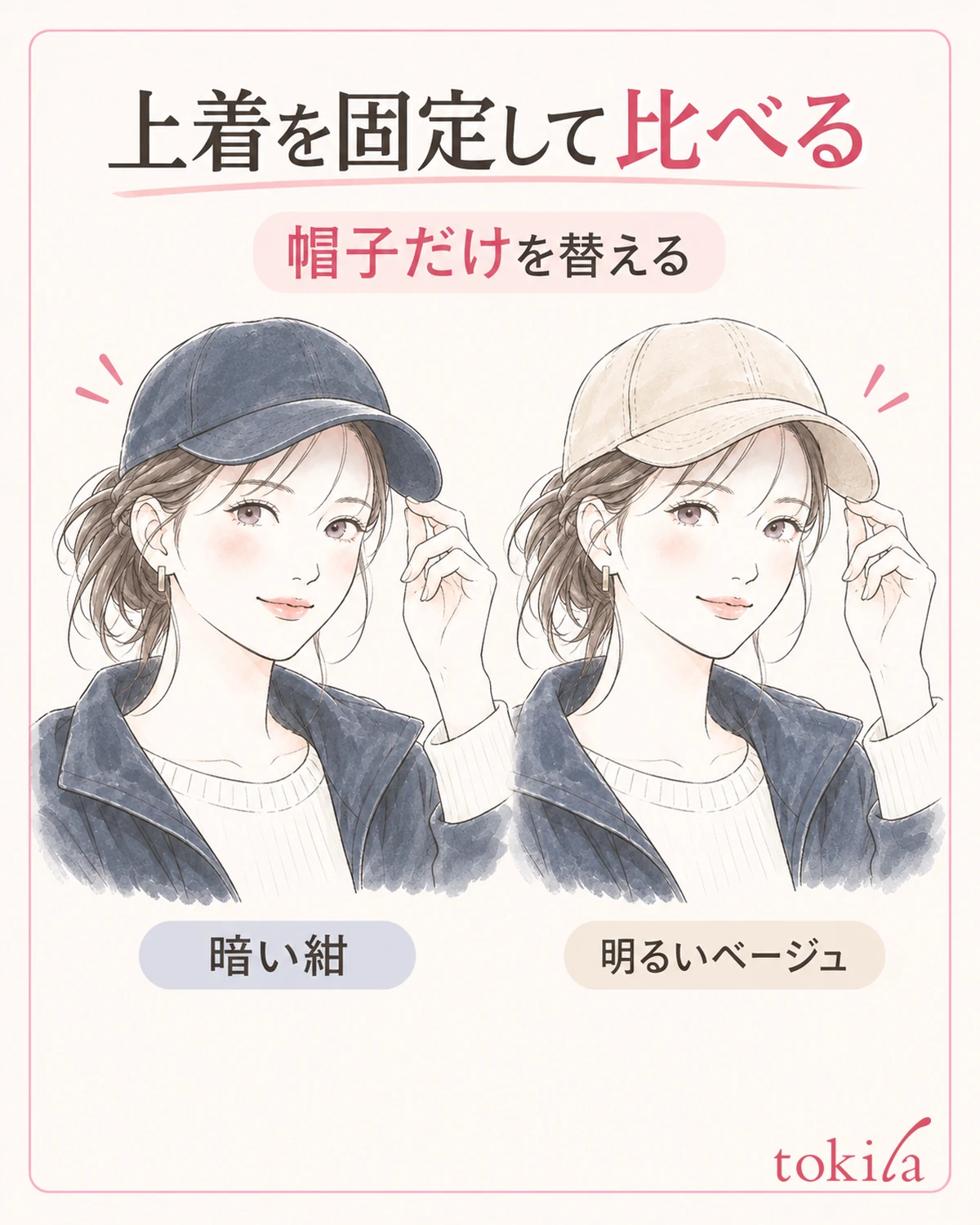
One idea for blending in is to try a hat in a color family close to your jacket. With a navy jacket choose a navy-family hat, with a brown-family jacket a brown-family one, and so on, from what you already have. The color doesn't have to be exactly the same. With the hat on, check whether you sense a color shared by your head and upper body.
Next, leave the jacket as it is and switch to hats of different brightness. For example, match a navy jacket in turn with a dark navy hat and a light beige hat. Compare whether the colors seem to continue with the darker one, and whether the position of your head becomes clear with the lighter one. Both are examples of color schemes you could choose, not models for deciding which is better.
If the candidates are similar in shape, the difference in color is easier to compare. If you only have a wide-brimmed hat and a small knit cap, remember that the shape and the area covered change as well. Rather than giving a single reason such as "it stands out because it is a bright color," judge whether you like that combination as a whole.
Look at both in the same mirror, under the same lighting, standing in the same spot. If you move close to the mirror to adjust one and look at the other from a distance, even the size the hat takes up on your head feels different. After readjusting it, lower your hands once and go back to the same position to compare.
Black is not always understated with every outfit, and white is not always light. On a light outfit a black hat stands out clearly, and on a dark outfit a bright hat can become the accent. Together with the jacket, check where you want to draw the eye.
If the color names are close but it still feels unsettled, also look at differences in redness, yellowness, and sheen. Rather than forcing the colors to be close, there are cases where adding a difference in brightness suits your taste better. When you want to sort out the relationships between colors, go back to How to combine colors in color coordination and try it with today's actual items.
If you have only one color candidate, you can also compare by fixing the hat and changing the jacket. In that case, keep your hairstyle and the position of the hat, and put on the jackets one at a time. Don't swap two hats and two jackets at the same time; check one pair at a time to see which combination you liked.
3. Look separately at the color boundary with your hair and the shadow cast by the brim
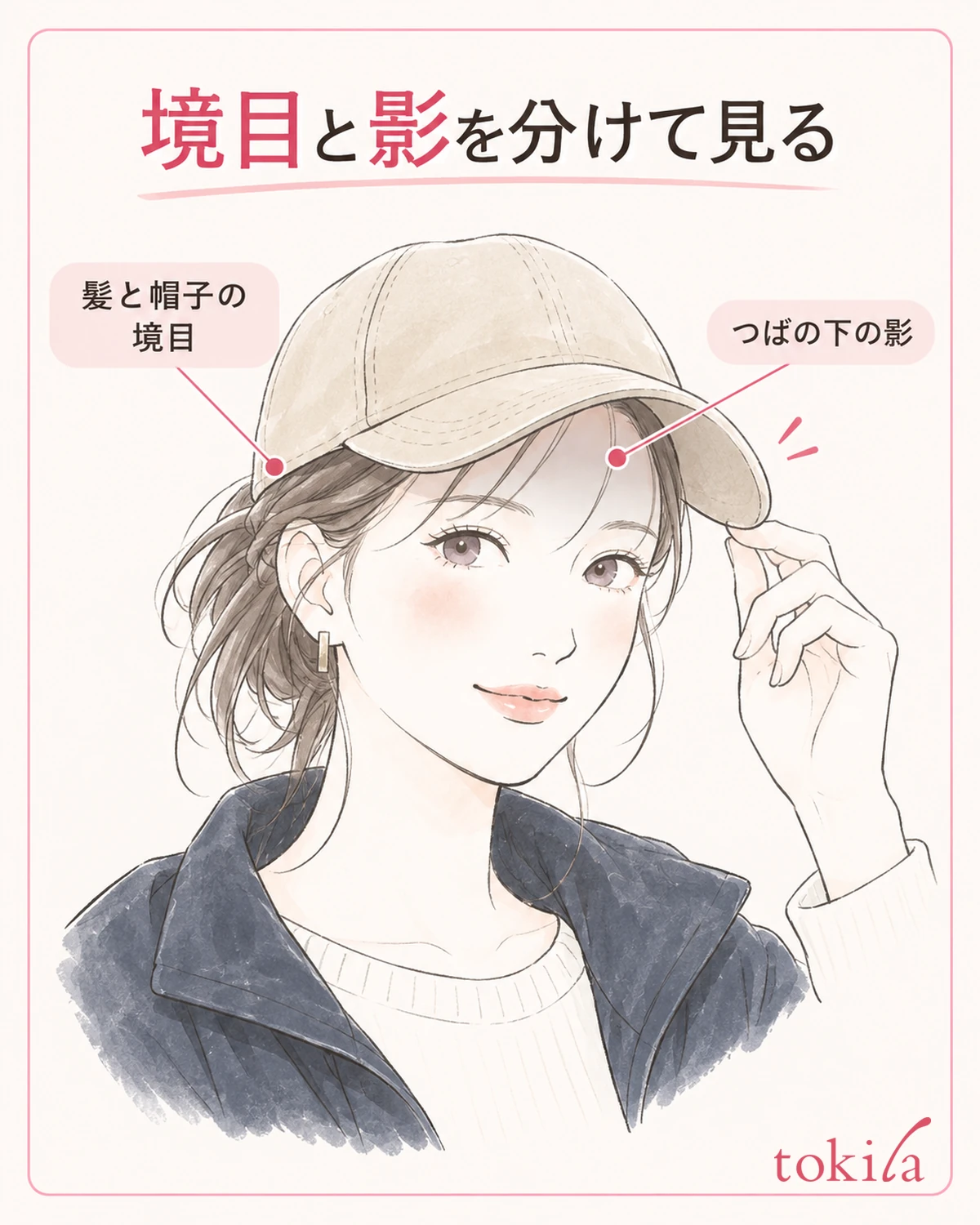
Once you have settled on a hat candidate, check the area near your face. Look at whether a dark hat following dark hair feels like a single surface, or whether the boundary with a bright hat feels strong. Don't choose by the rule that black hair must have this color; check in the mirror the amount of hair you can actually see and the outline of the hat.
If only your forehead or eye area looks dark, also check the shadow of the brim, separately from the color of the hat itself. A useful guide is to see whether the whole fabric is dark or only the part under the brim. Even if you feel it looks dark, don't jump right away to a conclusion about how well it goes with your skin tone or hair color.
When checking the shadow, don't change hats, and keep the direction of your face and your standing position the same. If possible, with the same combination, look also in a different place with different lighting where your face is easy to see. This step is to check whether the shadow around your eyes changes with the lighting; it is not a step for comparing two hats under different lighting.
Whether the brim can be raised or lowered depends on the structure of the hat. Don't bend a stiff brim, or wear the hat so deep that it narrows your view, just to match colors. Keep it at a position where you can wear it safely, and on days when you also wear it to avoid glare, put that function and the comfort of wearing it first.
If you can't decide whether to tuck your hair behind your ears, take the hat off, style your hair to one side, and put the hat on again. Don't pull your hair hard while shifting the hat; check the amount of hair visible around both ears and at the nape. Even if the boundary you like changes with how much hair you leave out, that doesn't mean you need to change your hair color.
4. With a vivid hat, check the connection with one color in your clothes
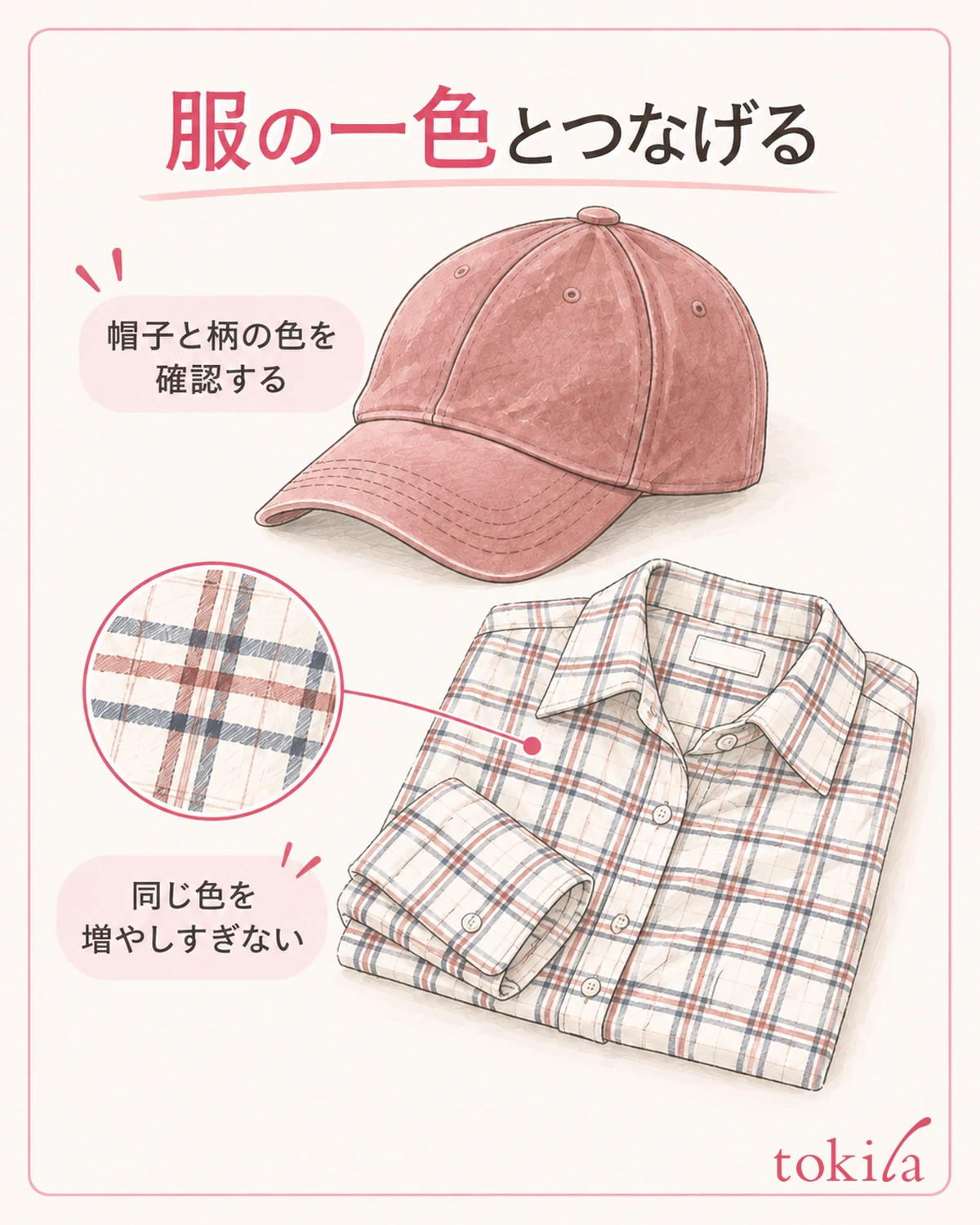
On days when you want to wear a vivid hat, first try making that hat the star. Pull your jacket and bag together in calm colors you already own, and look from your head to your waist in the mirror. If you separate using a vivid color from adding several more colors to your whole outfit, you can choose the point you want to enjoy.
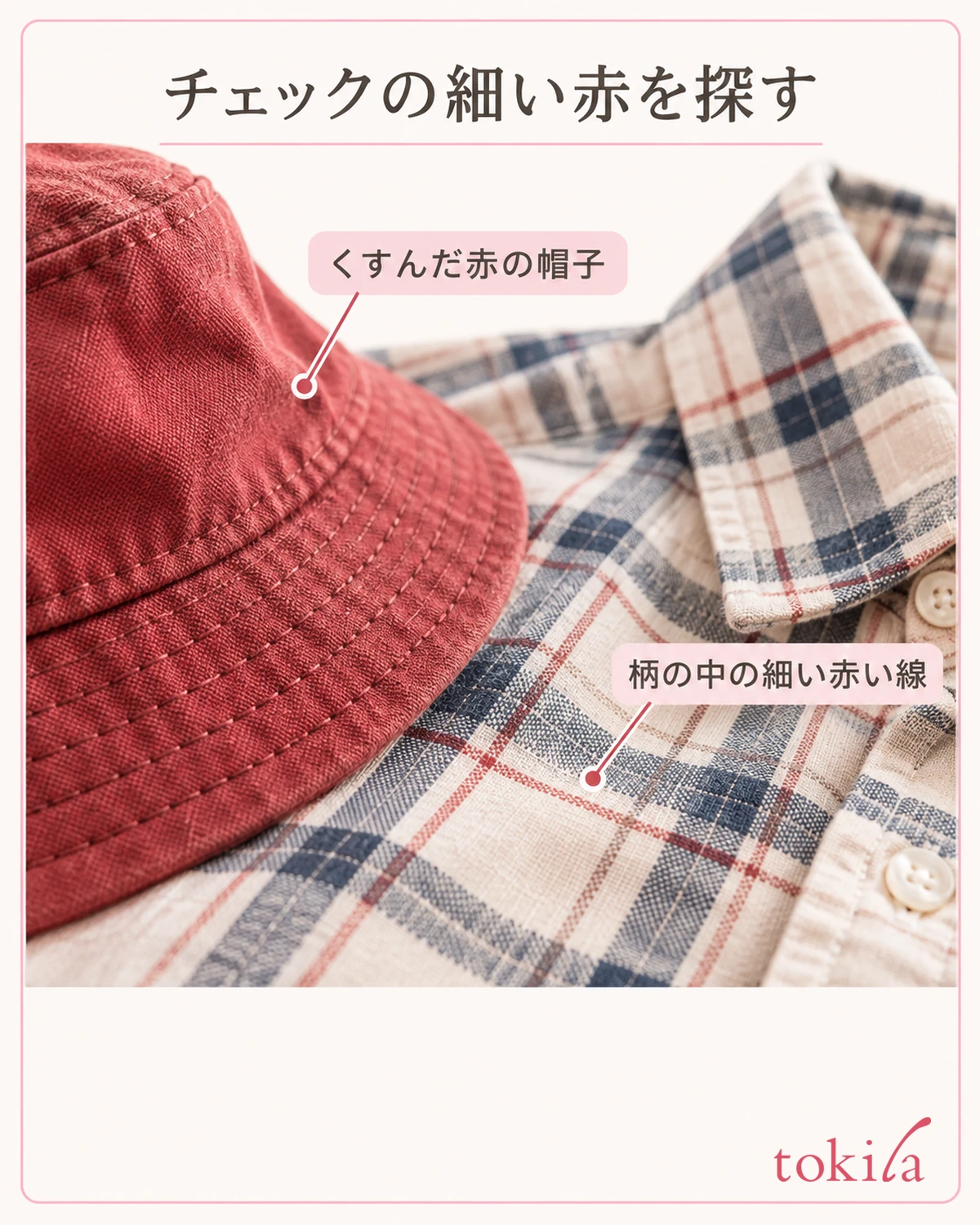
If only the hat feels disconnected, look for a similar color in the clothes you are already wearing. Even a small shared color, such as a thin line in a pattern or one part of a top, is a candidate to try. Before buying a new item in the same color as the hat, look at the clothes you already have.
For example, consider pairing a dull red hat with a checked shirt that has a few red lines. See whether you sense a connection between the lines showing from under the jacket and the color of the hat. The red doesn't have to be exactly the same; check how the actual items come together, including differences in depth of color and the fineness of the pattern.
To look for a shared color, there is no need to pull out your collar forcibly or put on layers that are uncomfortable. On a day when you go out with your jacket closed, the closed look is the basis for your judgment. If colors seem to connect indoors but are hidden outside, choose whether to use that day's hat as a standalone accent.
It is also not essential to match the hat, bag, and shoes all to the same color. Try a shared color in just one place first, and consider the next only if it still bothers you. If you feel there are too many eye-catching spots, put back the one item you changed just before and look again.
5. Check your whole body and your profile, and keep the combination
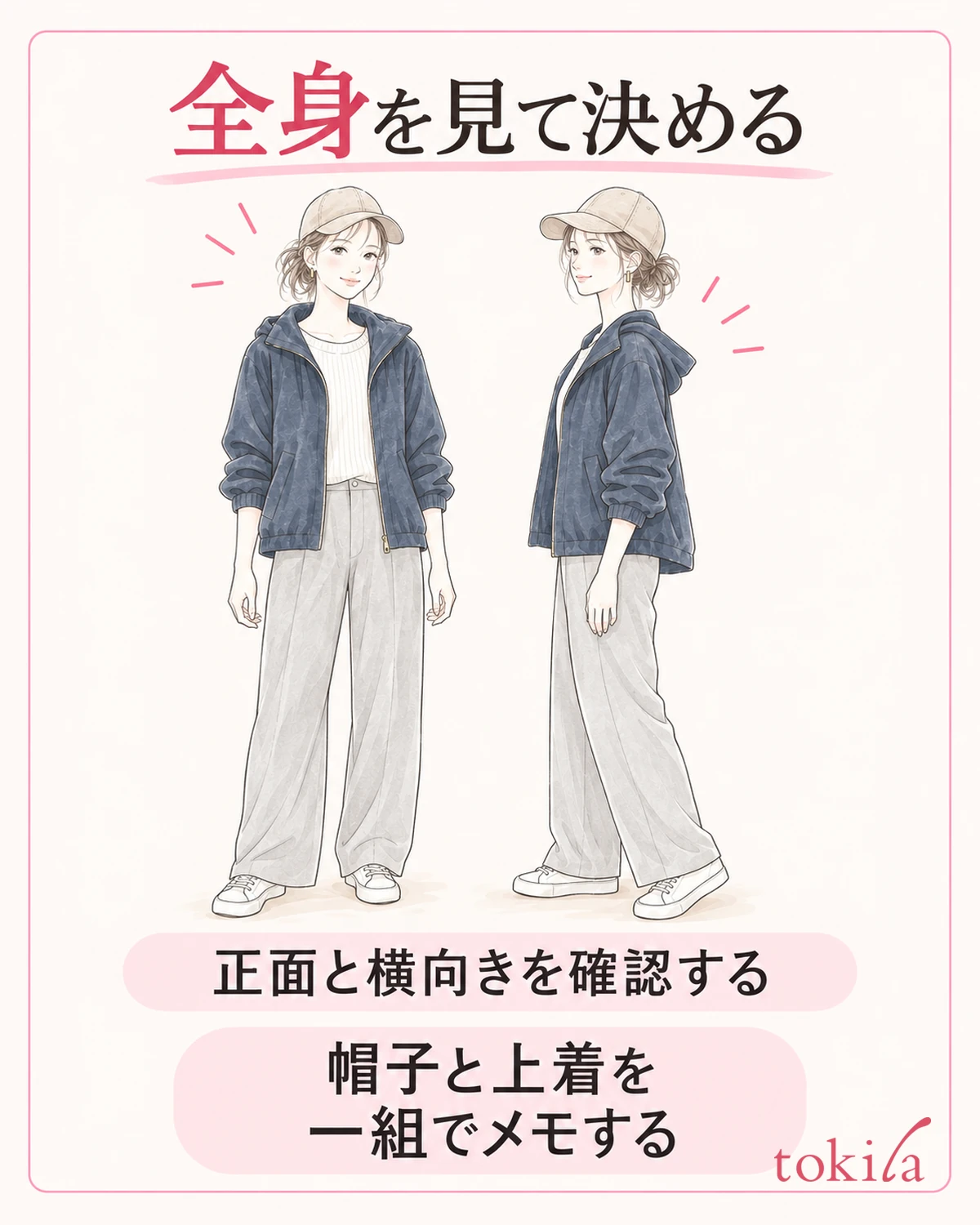
Finally, check in a mirror that shows your whole body. Even if it looks calm around your face, the role of the hat can change once your jacket, bottoms, and shoes come into view. Don't reach a conclusion with your face pressed close to the mirror; also carry the bag you will use today, and go back to how you will look when you go out.
After the front view, turn slightly to the side and look at the area of color of the brim and the back of your head. Turning your whole body, rather than just turning your face, lets you check the connection with your jacket. Don't tilt the hat to peer into the mirror, and also check that you are wearing it steadily.
If something still bothers you, go back to the spot you chose first. If it is the difference between the hat and the jacket, swap one hat candidate; if it is the boundary with your hair, check how much hair shows; if it is only darkness around your eyes, look at the lighting and the brim's shadow. Before you keep changing one garment after another, narrow down again what you are checking to a single thing.
For combinations you like, note the clothes and the hat as a pair, such as "navy jacket with a dark navy hat" or "red hat with the thin red in the check." If you use photos too, colors may differ from the real thing because of correction by the camera or screen. Use photos as an aid for remembering combinations, and check fine differences in color in the mirror as well.
On a day when you switch to a different jacket, or when you have tied your hair up, it is fine to look again at the same hat. Rather than thinking the last combination was a failure, check it as a day when the neighboring colors and the visible area have changed. Try using a hat you like differently on days when you want it to blend in and on days when you want it to be the star.
On a day when you plan to take your hat off while you are out, take a look at how you look without it at the end as well. Check whether the jacket you chose to match the hat's color is still an outfit you like even without the hat. If you feel it only works while you keep the hat on, you can also keep the option of putting one item of clothing back.