You bought a scarf you love, but when you pair it with a coat, the area around your face feels heavy. Before changing the color, try separating what bothers you in the mirror. The scarf's own color, the shadow under your chin, the boundary with your clothes, and the width of fabric showing are each different things to check.
This article introduces steps for rethinking the color balance around your face using the scarf and clothes you already have. It is not a method for diagnosing your skin tone or guaranteeing that a particular color will certainly improve your complexion. It is a way of comparing so that you can work the colors you like into today's outfit and the place you will be, without strain.
1. Look at the weight of the color and the shadow under your chin separately
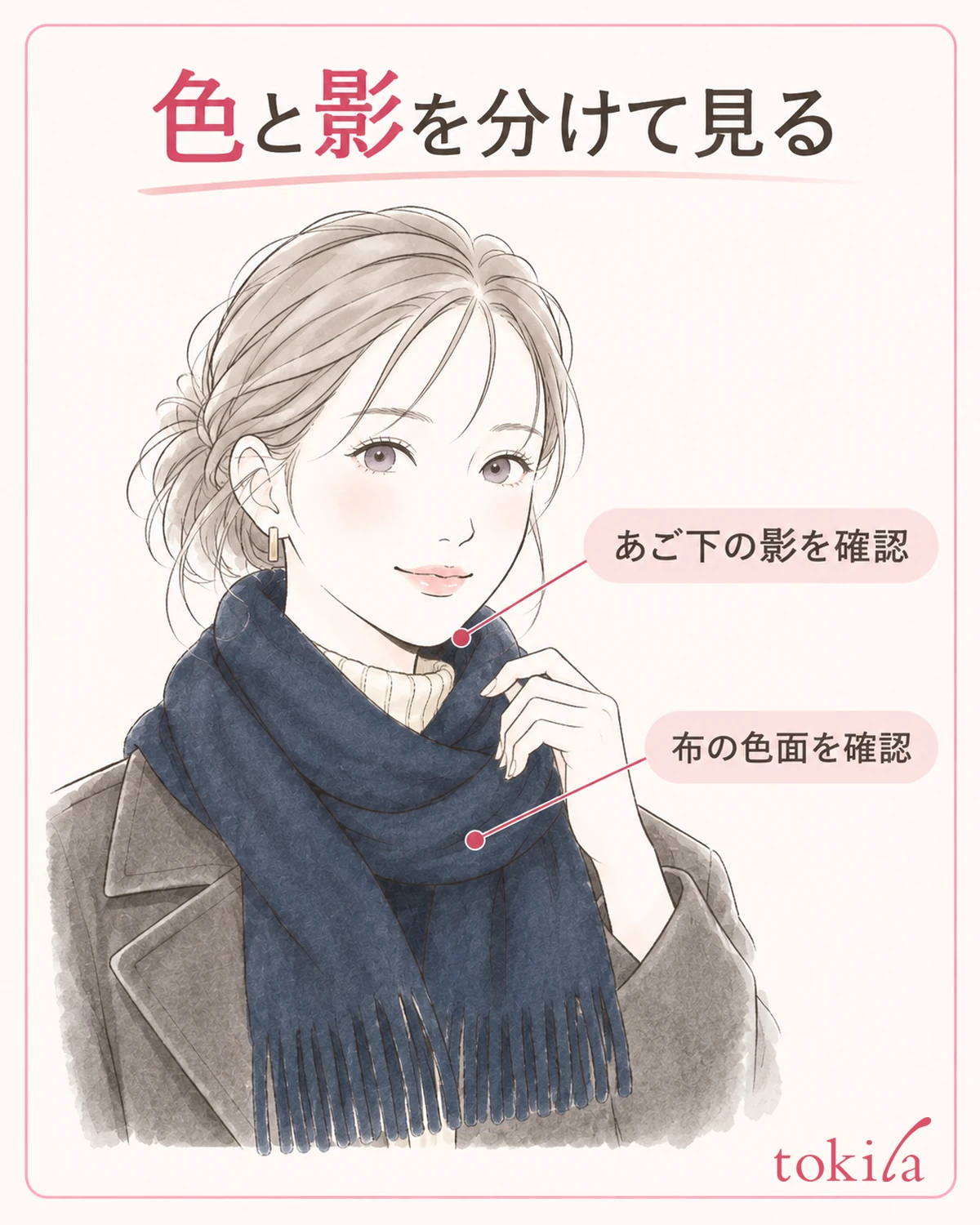
First, put on the coat and scarf you usually wear, and stand in front of a mirror where you can see from your face to your chest. When you choose with the fabric just laid on a desk and when you bring it near your face, the area of color you see and the colors next to it are different. Start by putting into words what looks dark.
Check whether the whole scarf looks dark, whether a shadow appears only right under your chin, or whether the coat and the fabric look like one continuous mass. If you have the fabric pulled up high under your chin, loosen it a little so it isn't tight on your neck, and look again in the same mirror. This is to see whether the shape of the shadow changes with the height of the fabric before you decide you dislike a dark color.
The trick to comparing is not to raise or lower your face and move the fabric at the same time. If your face turns, the way the light falls changes too. If you tend to lean toward the mirror only when you adjust the scarf, step back to your original spot after adjusting and check with your shoulders relaxed.
An outfit in which a deep color continues over a wide area can feel calm and cohesive. The shape you choose can differ between a day when you want to reduce the heaviness and a day when you want to pull things together in a deep color. If you first decide what mood you want for today, you can choose without making switching to a lighter color the only answer.
Rather than thinking broadly that "my complexion looks bad," deciding on a spot, such as "the shadow under my chin bothers me" or "a dark area continues down to my chest," makes it easier to choose the next step. Compare cases where you need to choose a different color with cases where adjusting how much fabric shows is enough to get closer to what you like, without deciding from a single impression.
Here, raising or lowering the fabric is not treated as a technique to make your face look smaller or a way to change your skin tone. If the fabric against your chin is uncomfortable or restricts the movement of your neck, sort out how it feels to wear before comparing colors. You don't need to put up with tightness or discomfort just to check a color scheme.
2. Match the mirror and the lighting, and compare in the same position
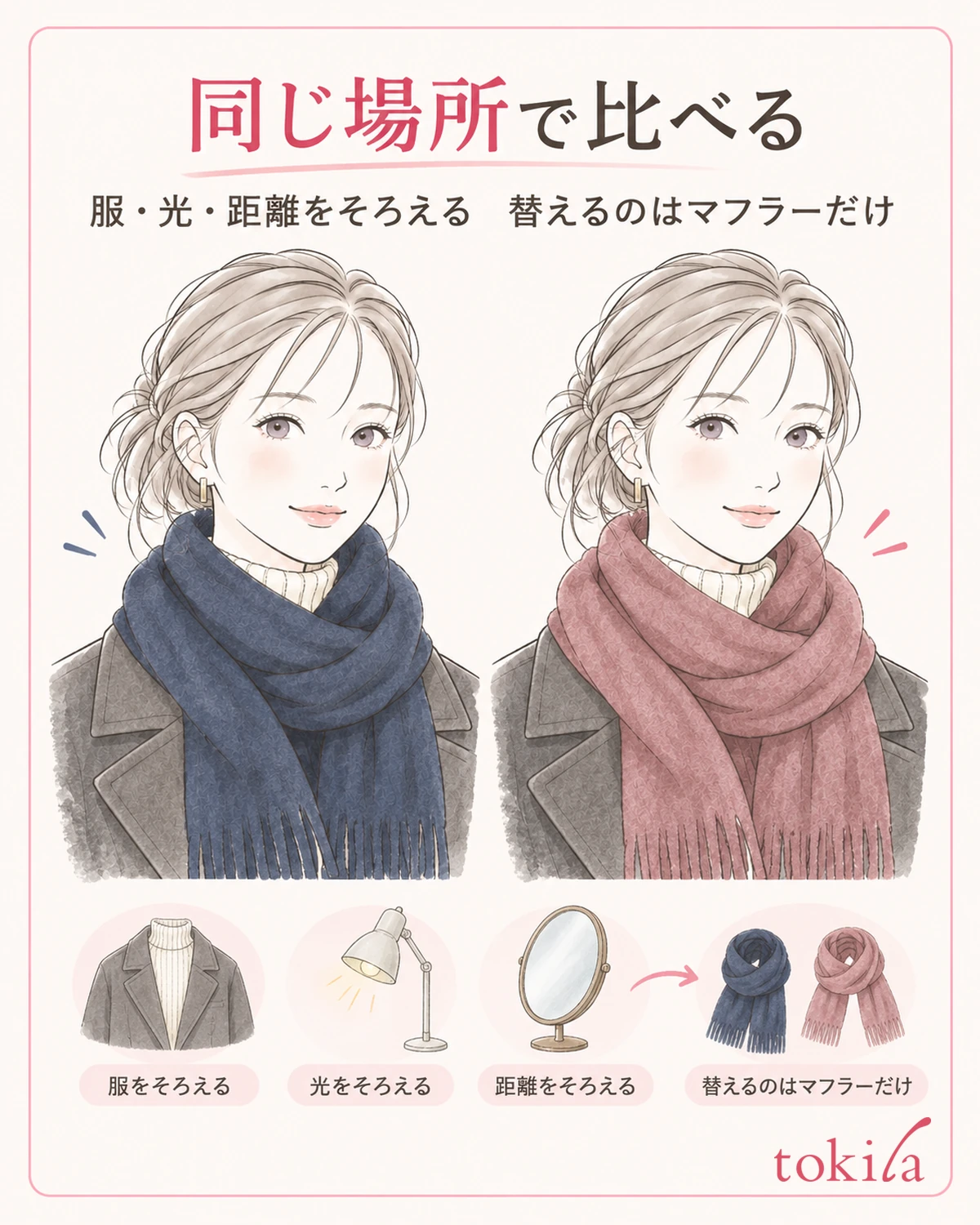
Next, decide on one place to compare in. Avoid places where light from a window mixes with strongly colored lighting, or spots where the window behind you is so bright that your face is hard to see, and use a mirror in which you can see your face and the fabric without strain. Don't compare a combination seen by a window in daytime and one seen in an entryway at night as if the difference were which color is better.
When comparing two scarves you own, keep your clothes, hair, distance from the mirror, and face direction the same, and swap only the scarf. If you wrap only one thickly or drape only one widely over your shoulders, the differences in color and area get mixed together. First compare in a similar, comfortable form, and check the wrap you actually want to use afterward.
Even the same fabric looks different depending on the light and the surrounding colors. Don't aim to make it look the same color everywhere; check how it feels in the place where you will spend a long time today. For an outfit meant for outdoors, it can be enough to arrange the shape indoors and then look at the whole in a safe place once you are outside.
Photos on your smartphone can help you remember the shape you wrapped. However, screen brightness and camera correction can make the colors of the fabric and your skin look different from how they look to the naked eye. Avoid lining up photos from different days and deciding what suits you from slight differences in color; in the end, check the real thing in the mirror.
If your conclusion changes every time you change the lighting, you don't have to think of it as failing to choose one. You can divide the choice by occasion: "I like this combination outdoors in the daytime" or "indoors I'd like a bit of the collar to show." If you remember the place you used as your standard, you will hesitate less the next time you take it out.
3. Check the boundary between the scarf and your clothes with the color of the collar
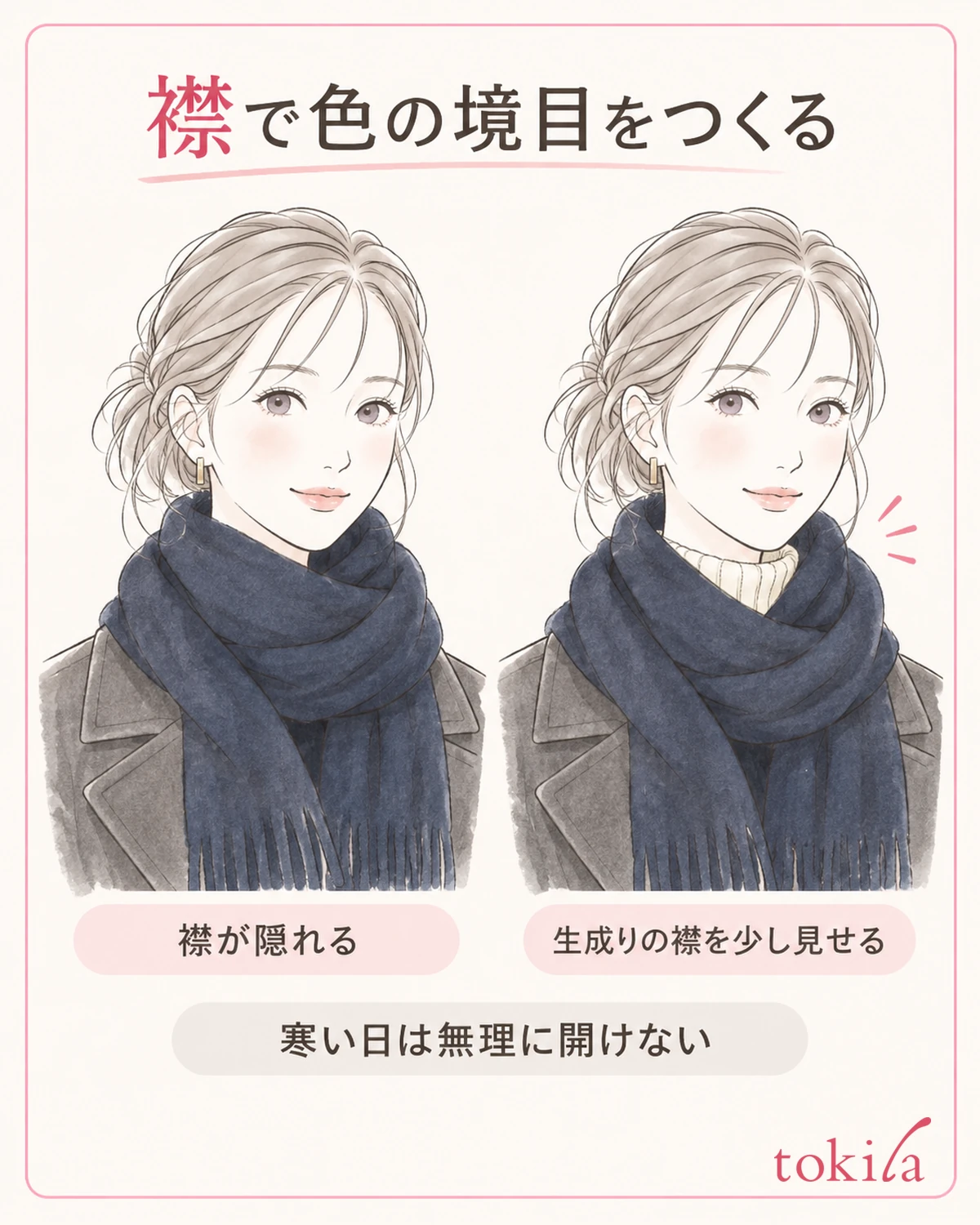
If a dark scarf and a dark coat run together and feel heavy, look at the boundary between them. If your outfit lets the collar of a shirt or knit you already have show without strain, take the scarf off once, arrange the position of the collar, and wrap it again. Rather than stuffing several more pieces of cloth around your neck, this makes use of how the clothes you are already wearing look.
For example, consider pairing a charcoal coat with a navy scarf, with an ecru collar showing between them. Check whether the two dark areas, the coat and the scarf, look separated with the light collar between them. This does not mean the color scheme is right for everyone; it is one example of a comparison that changes the boundary.
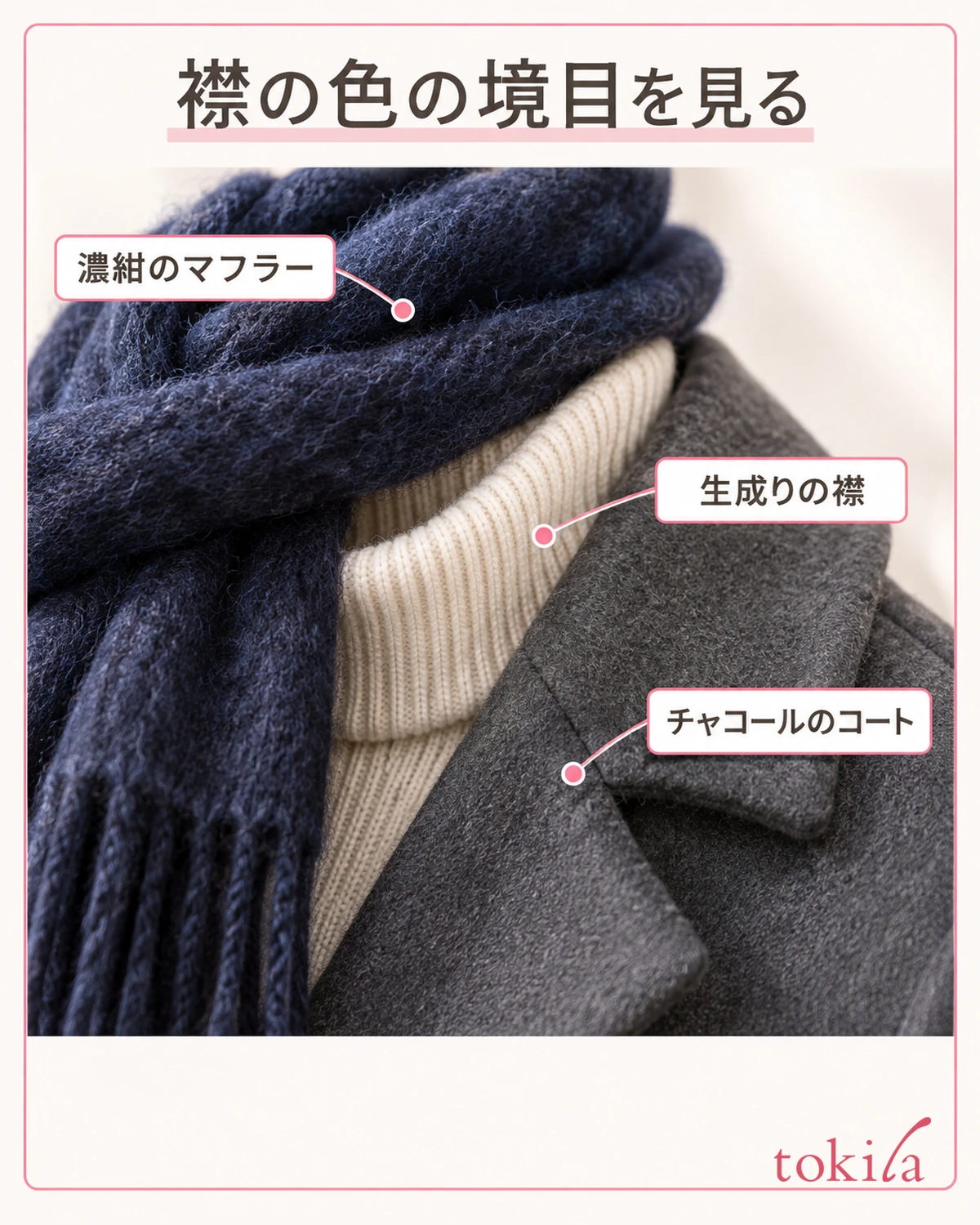
Once you have checked the state with the collar showing, bring the scarf back up slightly and compare it with the state where the collar is hidden. Change only how much of the collar shows, and avoid changing the coat's buttons or the direction of your face at the same time. Whether the collar's color calms things down or the extra color makes it more noticeable is something to judge with your actual clothes.
If you are already wearing a shirt with a pattern, also look at whether what shows at the collar is the base color or thin lines. If it bothers you because it overlaps finely with the scarf's pattern, hiding the collar a little may get closer to your taste than showing more of it. Try it within what is visible of the clothes you already have, without preparing new ones.
If showing the collar makes you cold, the fabric shifts, or your neck feels cramped, you don't have to stick with that form. On days when you wear the coat closed, the closed state is the standard. After keeping the form you need for warmth, choose between moving on to the next adjustment of visible width or switching to a different scarf.
If you want to sort out the cohesion and contrast of a color scheme, color coordination methods can also help. After learning the basic ideas, check in the mirror not only whether the color names match around your neck but also in what order the colors sit next to each other.
4. Before changing the color, adjust the visible width and the position of the pattern
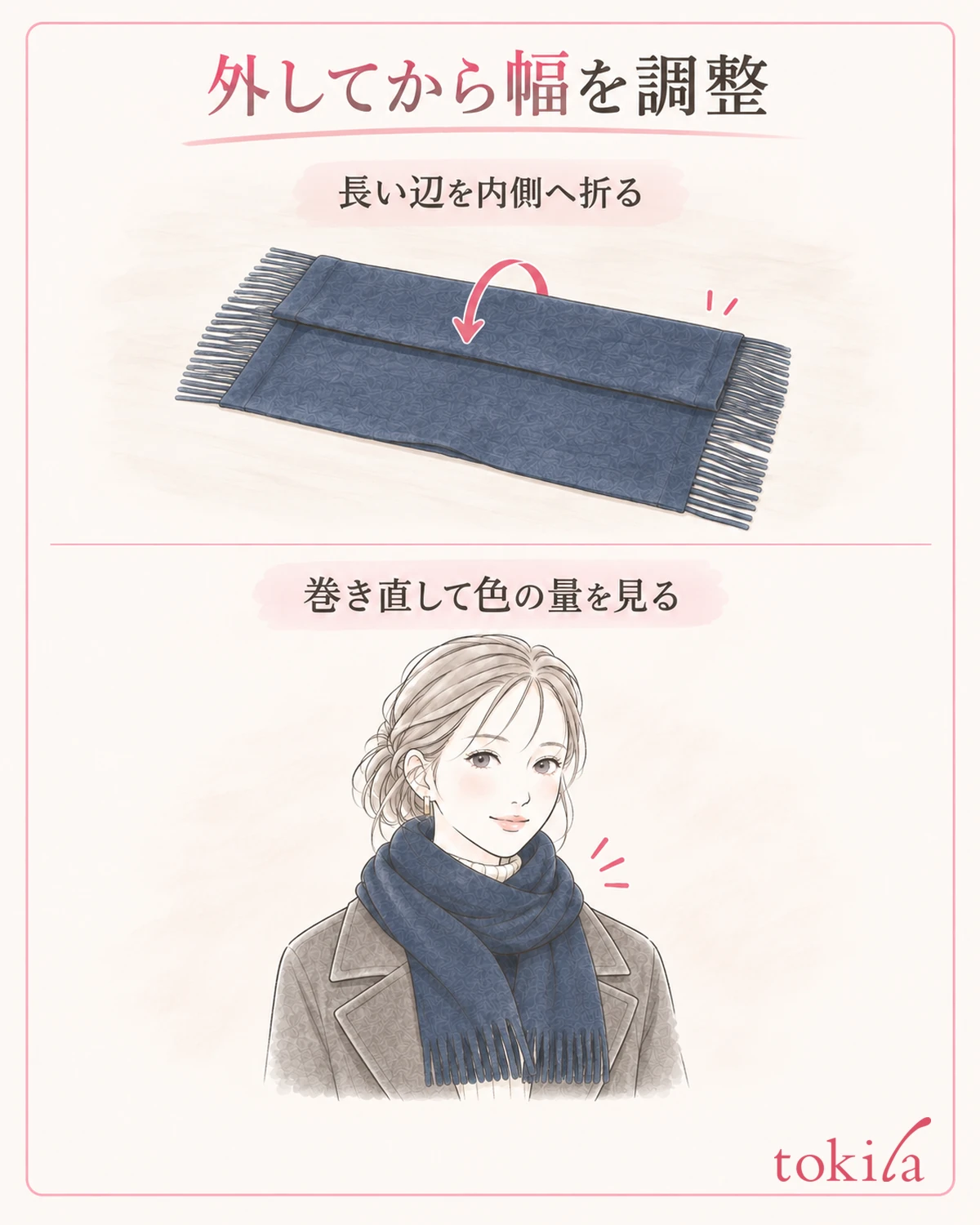
Even the same scarf has a different amount of color depending on whether it shows broadly at your chest or is gathered narrowly. If a large area bothers you, take it off once, lay it flat, and fold the long edges inward to adjust the width. Avoid making it look narrower by forcing the thickness in or wrapping it tightly around your neck.
After changing the folded width and wrapping it again, look from your face down to the front of the coat from the same position as before. Check not only your neck but also how much of a color area the two ends hanging down in front make. If the narrower one is closer to your taste, use that width; if the thickness of the fabric spoils the shape, go back to the original width that feels comfortable.
For fabric with checks or a color scheme, look at which color appears closest to your face. With the scarf off, look at the right side of the fabric, change the fold position slightly, and try bringing a different colored part to the front. Also check whether the structure allows the reverse side to show and whether the edge finishing or tag will stick out, and don't assume both sides can be used equally.
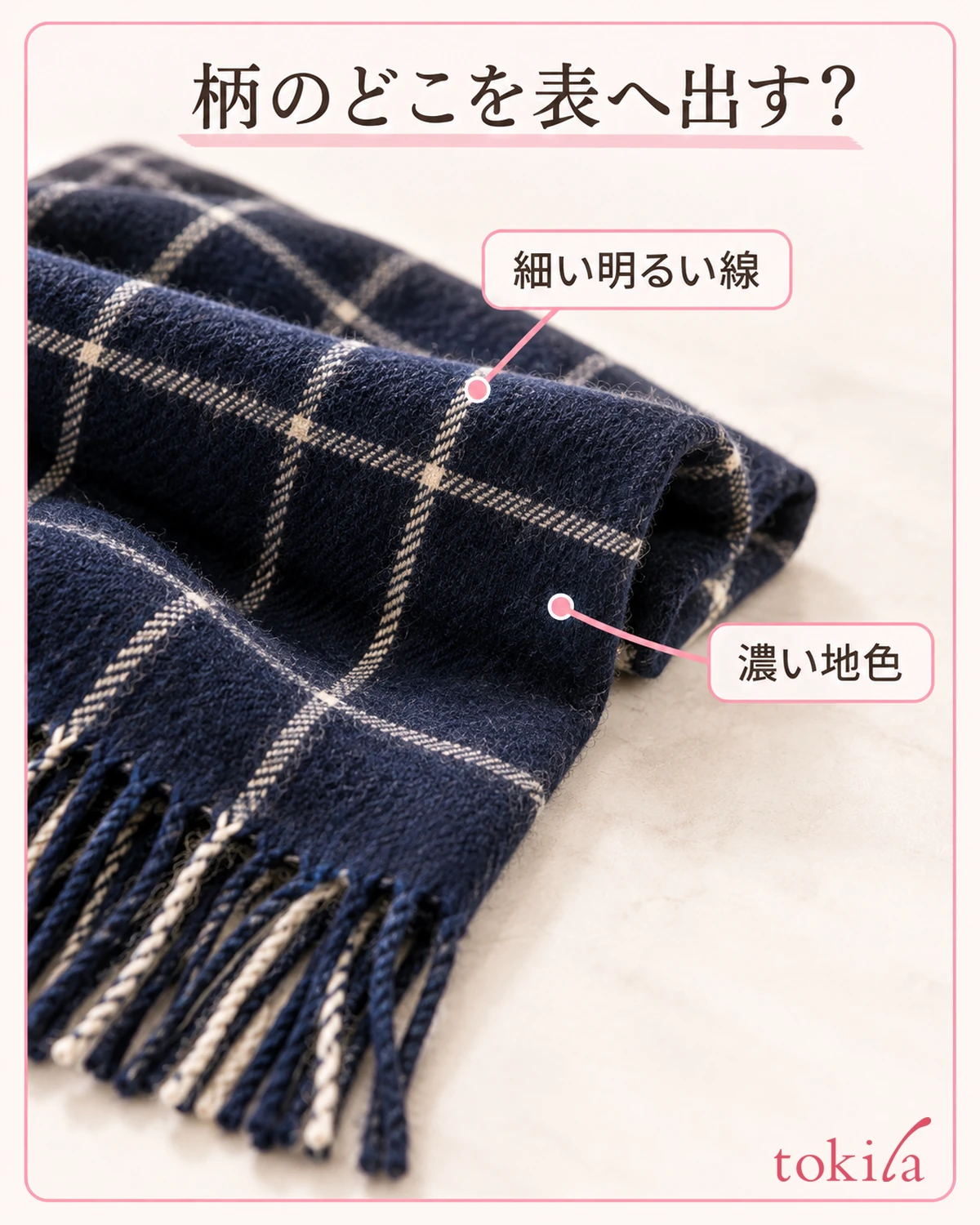
Showing a light part of the pattern does not mean the skin on your face will necessarily look brighter. What to look at is whether the order and amount of colors around your face come closer to a cohesion you like. As an option you can try without changing the fabric, look for the position you prefer.
Narrowing the width can make the front end longer or make the wrapped shape shift more easily. If the colors look right but it is hard to handle, go back to the way you wrapped it. When you want to check the types and basic shapes, look at the basics of stoles, scarves, and neckerchiefs and choose a form that suits the length and thickness you have.
5. Look at the whole with your coat closed, and decide today's combination
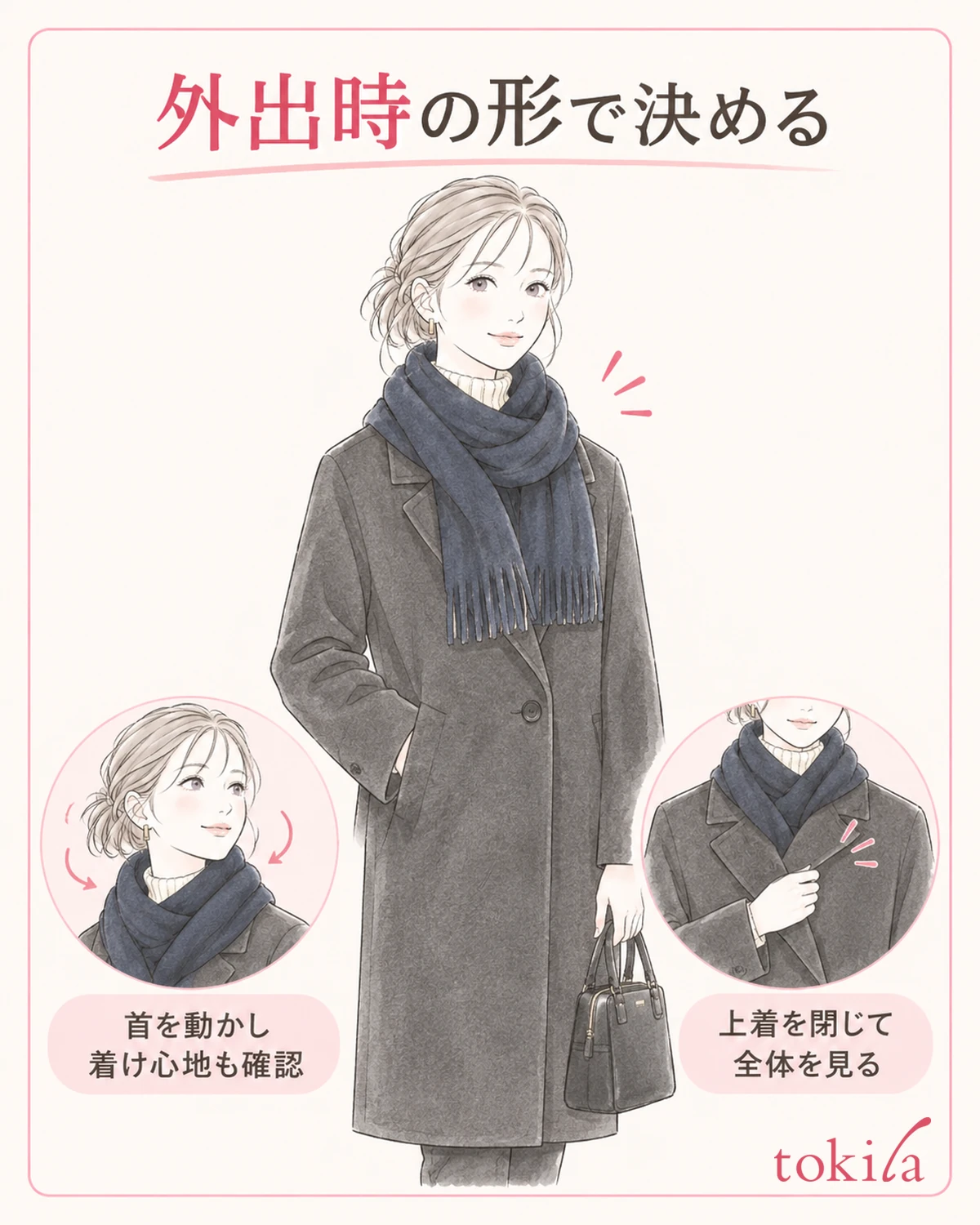
Finally, close your coat as you would when going out, hold your bag, and look at the whole in the mirror. A collar that was visible with the coat open may be hidden, or the area of fabric hanging in front may increase. Here you check the difference between the shape you arranged only in part indoors and the shape you will actually use.
After looking in order from near your face at the scarf's color, the collar's color, and the coat's color, shift your eyes to the cohesion of the whole from a little farther away. If you feel the color is concentrated too much around your neck alone, choose from the operations you tried this time: return the width, change the position of the pattern, or use a different piece. You don't need to keep adding new accessories.
When in doubt, go back to the spot that bothered you first. For the shadow under your chin, it is the height of the fabric; for the connection of dark areas, the boundary with the collar; for the amount of color, the folded width. Rather than redoing everything, linking the spot you thought was the cause to the result after adjusting makes it easier to judge whether you have come closer to your taste.
When you ask family or friends, telling them what you are comparing, such as "Which cohesion do you like better, with the collar showing or hidden?", rather than just "Which suits me?", makes it easier to get useful opinions. When other people's impressions differ from your own taste, you are free to choose for yourself, including how it feels to wear.
After deciding, move your neck from side to side and move your shoulders lightly to check how it feels to wear and how the fabric sits. If changing the shape for the color scheme makes the fabric keep touching your face or the ends catch on things more easily, give priority to a wrap that is easier to handle. Choosing by looking at color and ease of use together is useful for everyday outfits.
If you keep a note for next time, rather than a note that only avoids a color such as "navy doesn't work," briefly remember a pairing of clothes and action such as "with this coat, show the ecru collar" or "bring the thin lines of the check to the front." On days when the season, lighting, or clothes have changed, compare again in the mirror even with the same color.