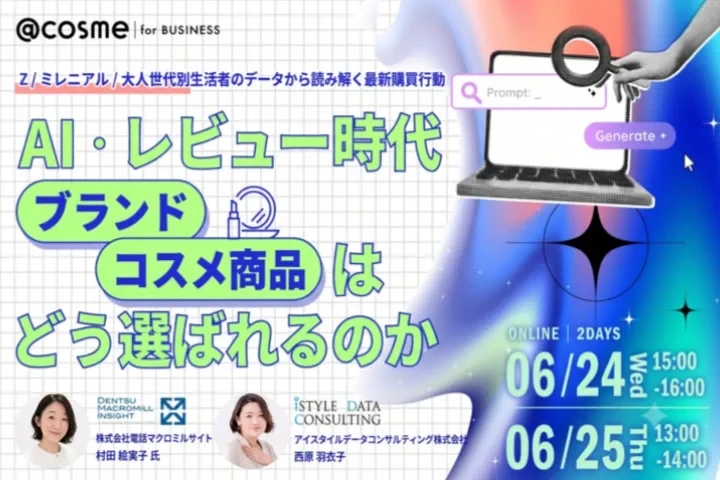
Dentsu Macromill Insight, Inc. and istyle Inc. have published a research report summarizing the contents of their jointly held webinar, "How Will Brands Be Chosen in the Age of AI and Reviews? Latest Purchasing Behavior Read from Consumer Data by Gen Z, Millennials and Mature Generations."
The report was produced to clarify how the spread of conversational and generative AI such as ChatGPT and Gemini is changing consumers' purchasing behavior in beauty and cosmetics. It combines an "AI Usage and Beauty Purchasing Behavior Survey" of 1,300 men and women aged 15 to 59 nationwide, the latest survey of @cosme members, and a text analysis of the @cosme review database.
Even in the age of AI, reviews remain the main driver of purchase decisions
The word "AI" is appearing far more often, but its use in purchase decisions is limited
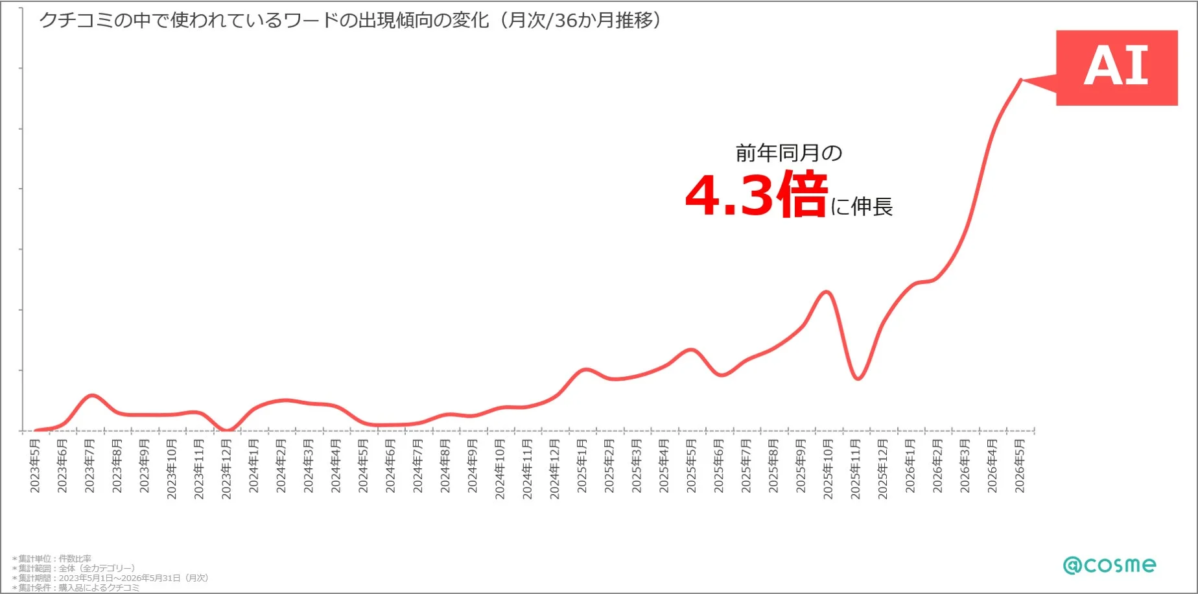
According to an analysis of reviews posted on @cosme, the frequency of the word "AI" increased 4.3 times year over year. This figure shows that AI has quickly become familiar to consumers, approaching the frequency of words such as "advertising" and "influencer."
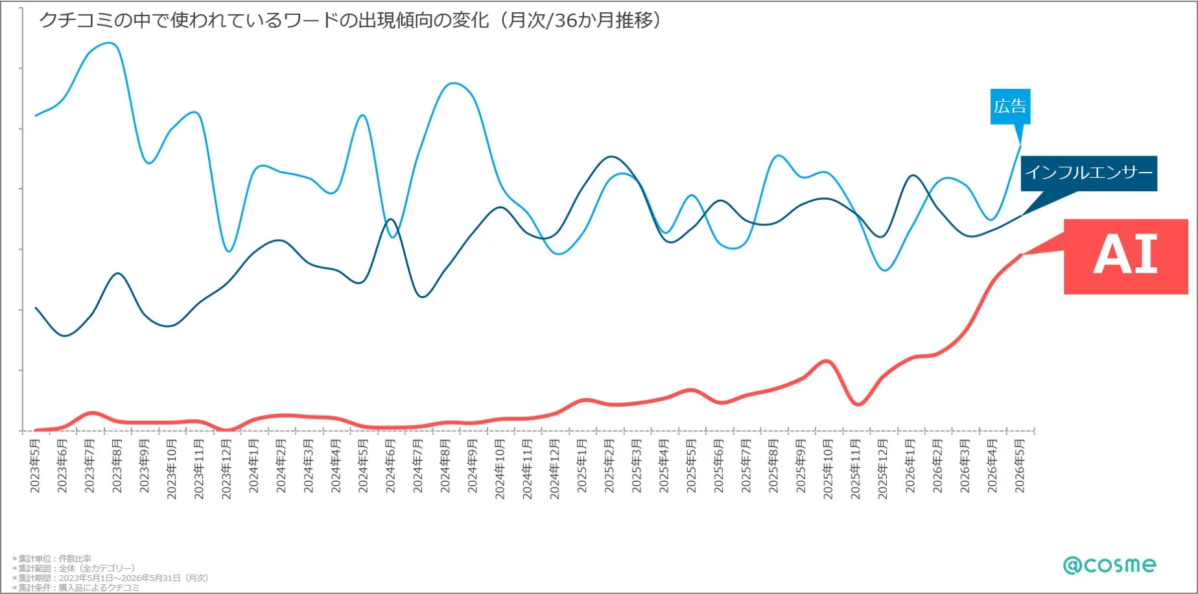
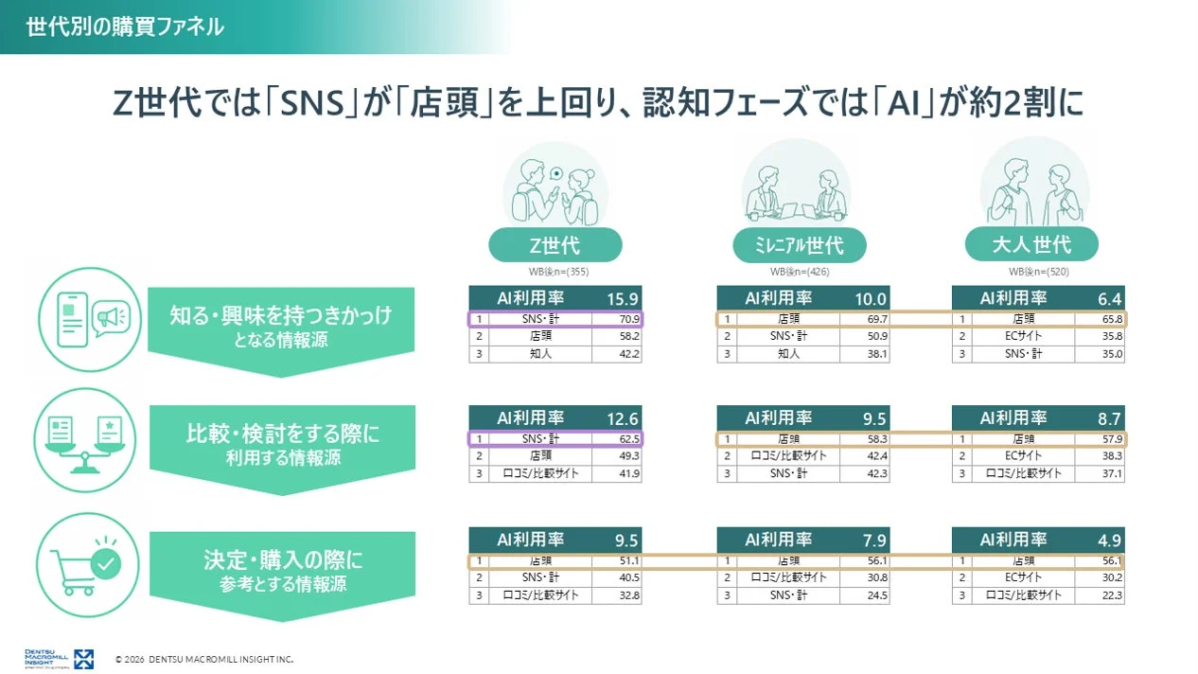
However, looking at AI usage rates in the purchase funnel for beauty products and services, even among Gen Z, the highest group, it is only 15.9% at the "trigger to learn about or become interested (awareness phase)" and 12.6% at "comparison and consideration." At the "decision and purchase" stage, it stays at 9.5%. The result shows that although AI is becoming familiar as an information tool, its use in beauty purchase decisions remains limited.
Consumers trust reviews more than AI
To the question, "When choosing beauty products or services, if the information from AI, reviews and influencers differs, which do you refer to most?", the largest group, at 40.2%, answered that they refer to reviews most.
This was followed by "I refer to all of them about equally" at 32.6%, while only 8.4% said they refer to AI information most and 4.8% said they refer to influencer information most.
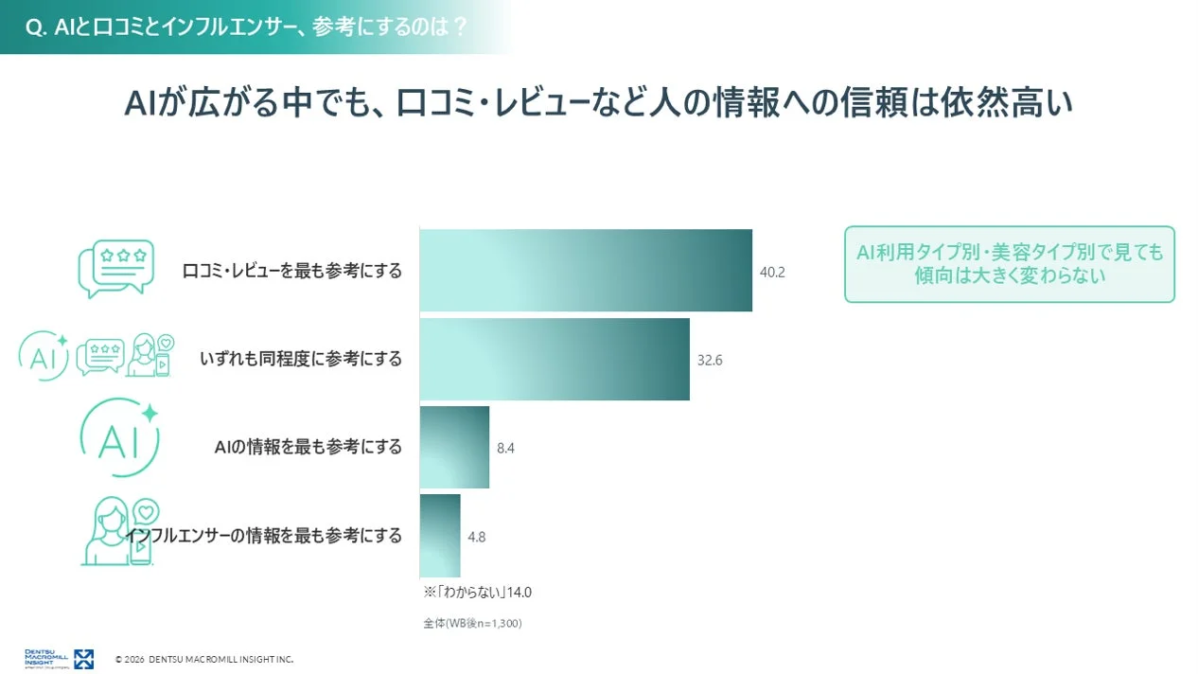
These results suggest that consumers do not rely on AI information alone. They make purchase decisions while checking information from multiple angles, combining recommendations and diagnostic results presented by AI with real experiences such as reviews and sources such as social media.
Younger people move away from "buzz"; AI becomes a partner for finding "products that suit me"
In a survey that istyle conducted among @cosme members in April 2026, in response to the question "Do you want to buy cosmetics that are 'trending, popular or buzzing' on social media, YouTube or TikTok?", the share fell by 7.2 points among teens and 6.3 points among people in their 20s compared with 2022.
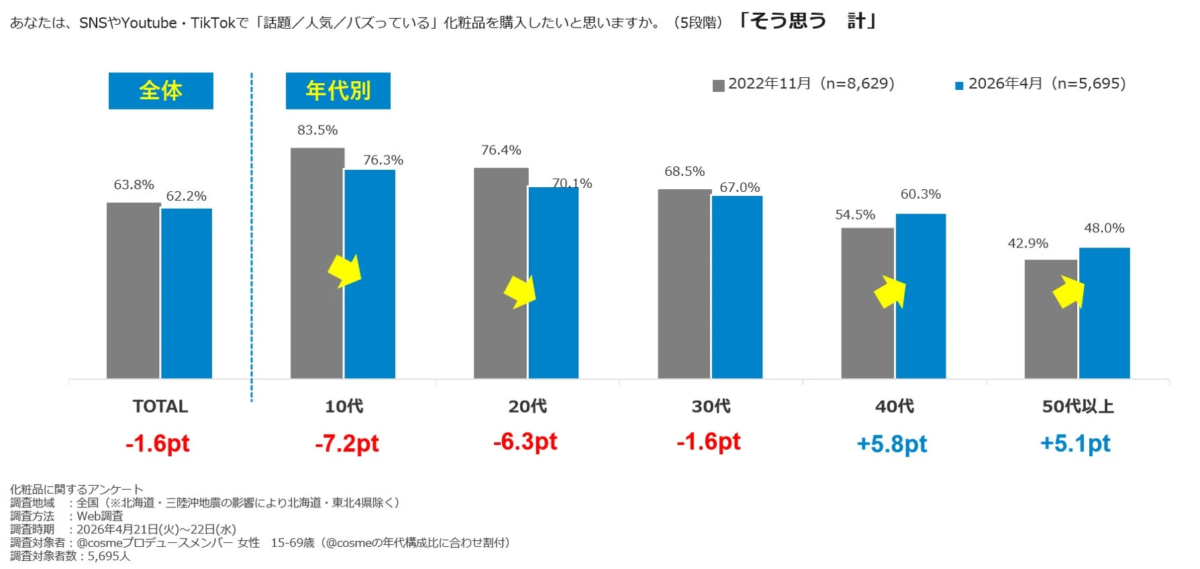
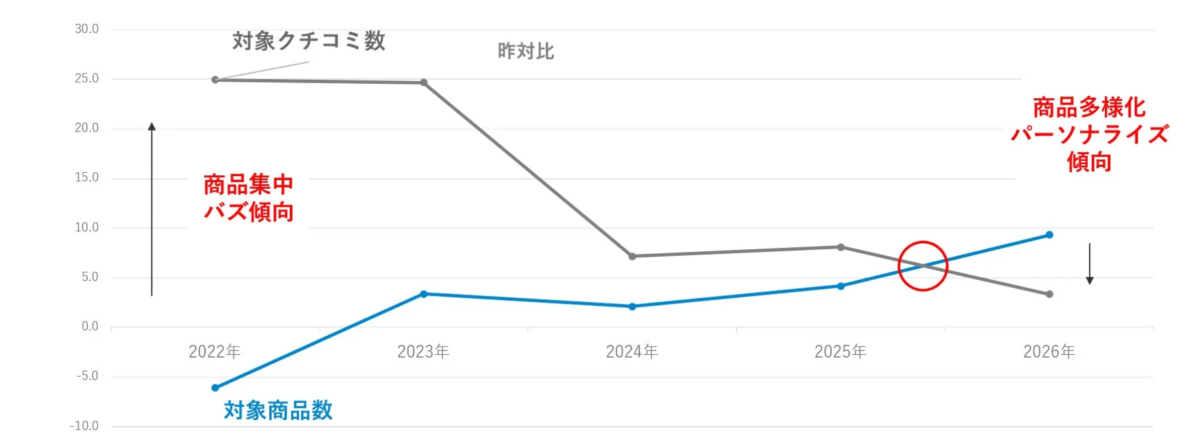
Mainly among younger people, a growing number of people do not simply buy "buzzworthy products" but tell AI about their skin type and concerns and choose products based on "what suits me." The spread of AI is thought to be boosting this trend.
Changing needs seen in AI prompts by generation
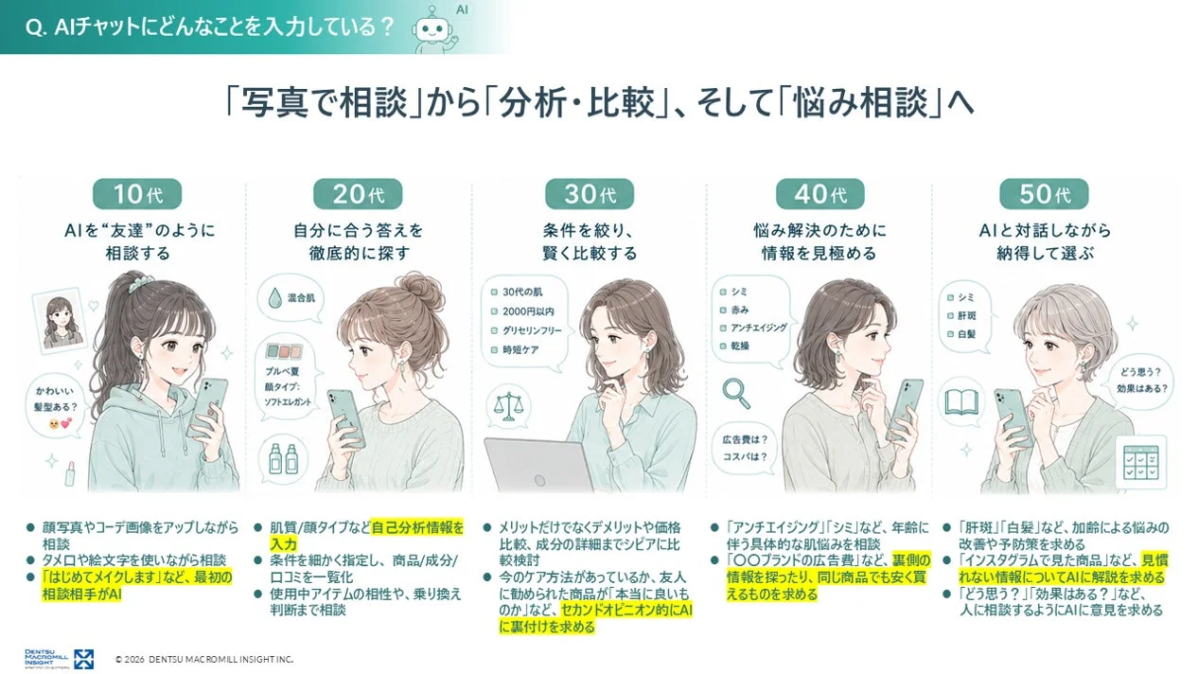
An analysis of the prompts (questions) consumers enter into AI chat revealed that each age group has a different sense of distance from AI and expects a different role from it.
Teens: They tend to use AI like a "friend," as the first person to consult, with prompts such as "I'm trying makeup for the first time."
20s: They enter detailed self-analysis information such as skin type and face type (summer blue base, soft elegant, etc.) and search thoroughly for answers that suit them.
30s: They narrow down conditions such as "skin in your 30s," "under 2,000 yen" and "glycerin-free," and characteristically use AI as a second opinion to seek confirmation.
40s and 50s: They look for solutions to age-related concerns such as spots, melasma and gray hair, and even dig into behind-the-scenes information such as "How much does brand XX spend on advertising?", tending to choose with conviction through dialogue about things that are hard to discuss with people.
AI and beauty advisors coexist; post-purchase support is the key to building repeat customers
@cosme reviews include accounts of using AI chat not only for "comparison before purchase" but also for "support after purchase."
For example, one user who bought the "ADDICTION The Eyeshadow Palette" was considering throwing it away because the gradation was not working out; after consulting AI, they were advised on a way to apply it without using every color, and raised their rating from 3 stars to 5. In another case, a user had ChatGPT build an optimal care routine for "Takami Skin Peel" and continues to use it.
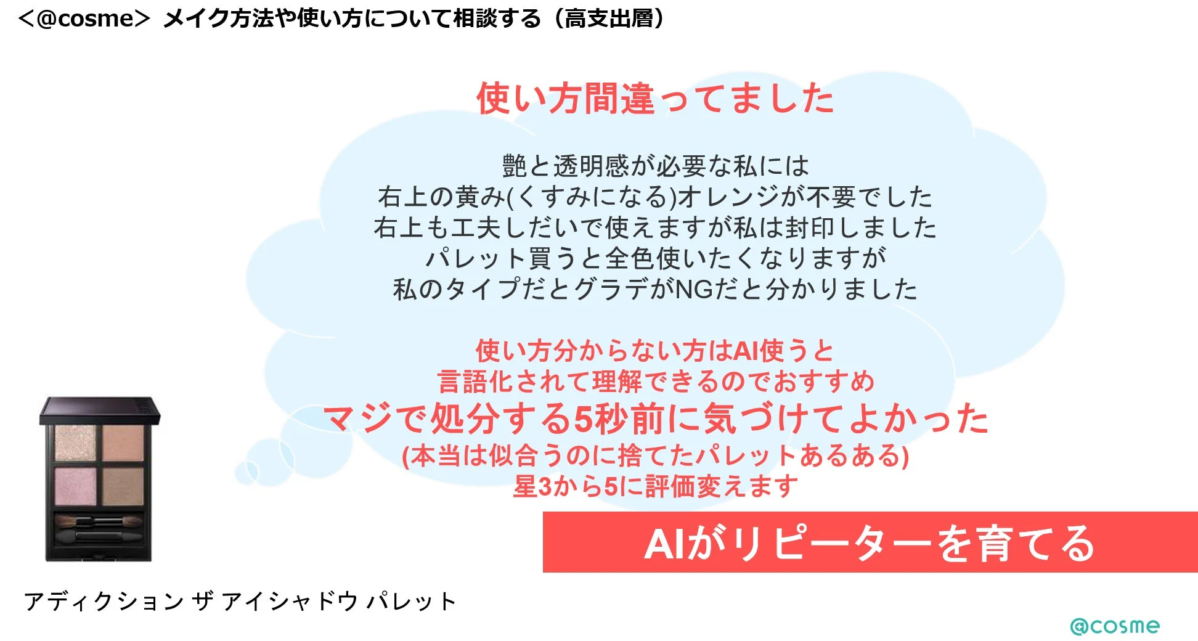
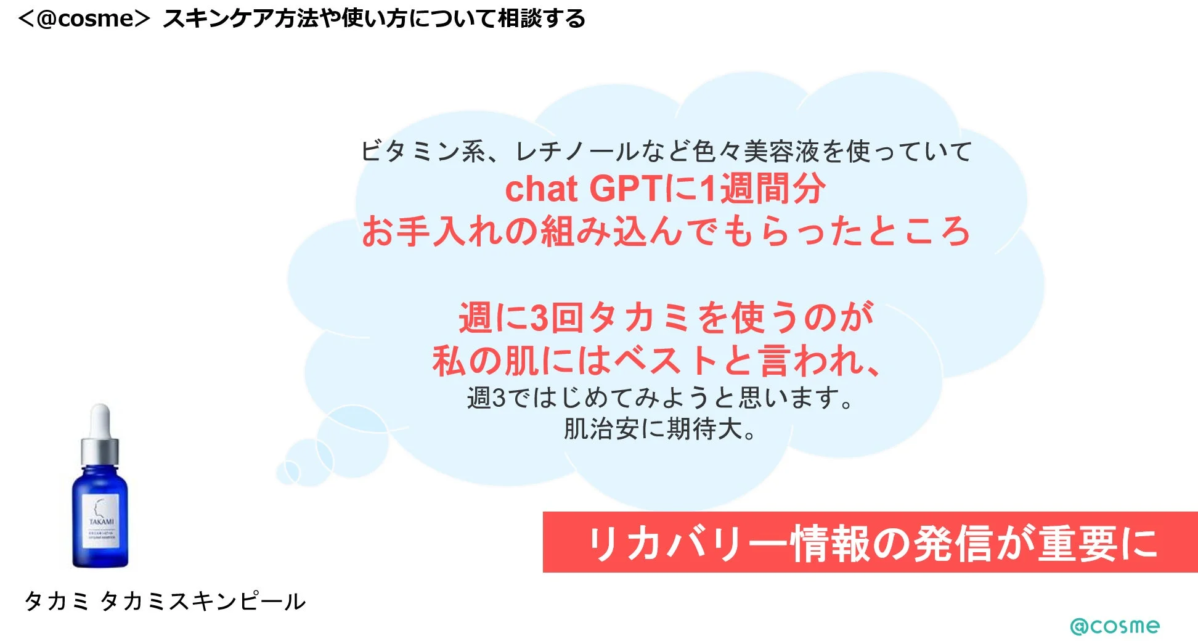
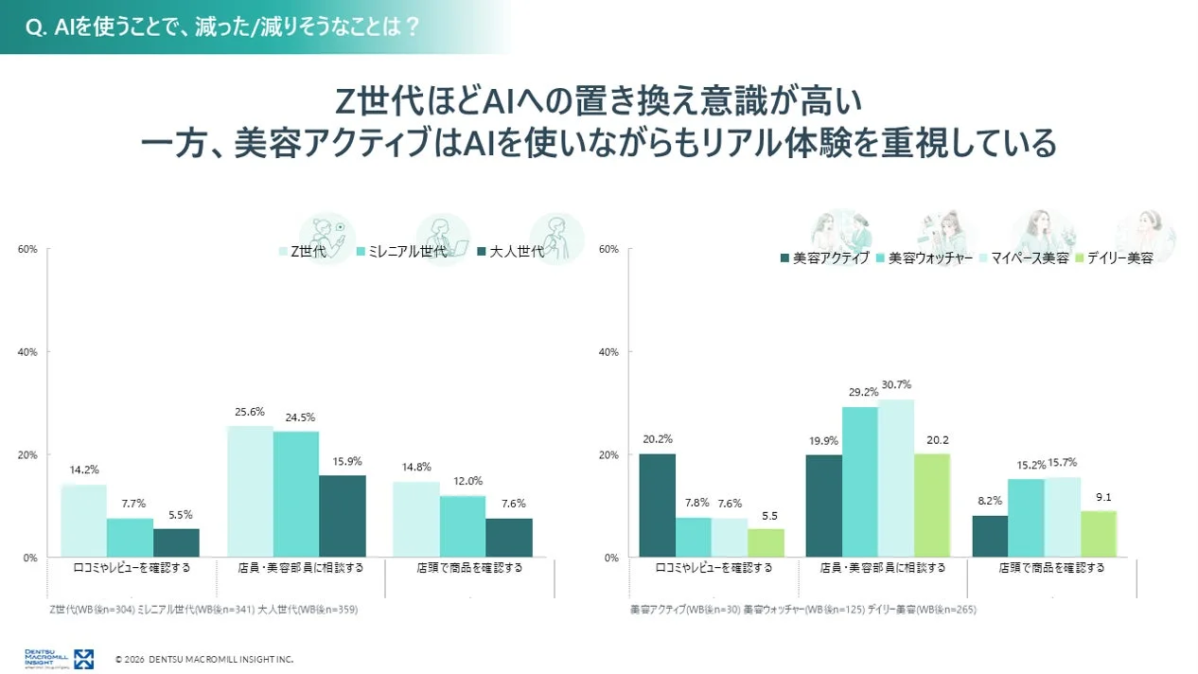
These examples suggest that AI is being used in situations where people previously consulted shop staff or beauty advisors. In fact, a certain number of consumers (25.6% of Gen Z and 24.5% of Millennials) said that using AI reduces how often they "consult shop staff or beauty advisors."
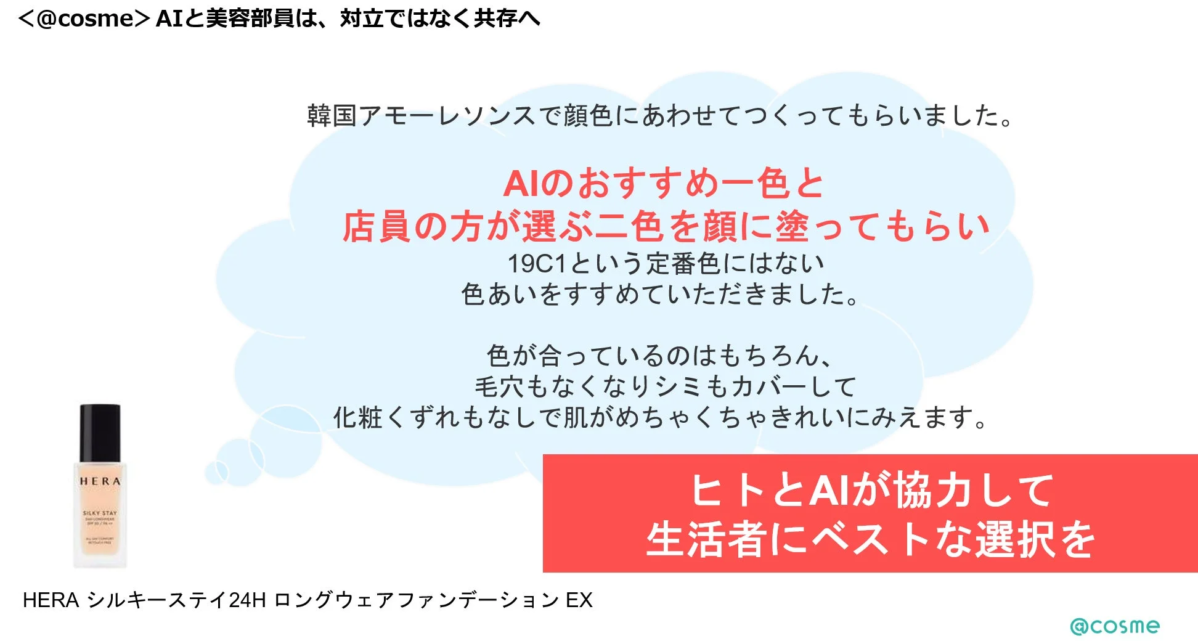
On the other hand, AI does not seem to be a complete replacement for beauty advisors. In an account of getting a custom-made foundation in Korea, one person said, "I applied one shade recommended by AI and two shades chosen by the staff to my face, and found the best shade for me, which is not among the standard colors," suggesting the possibility of a coexistence in which people and AI work together to arrive at the best choice.
Brands are expected to share scientific evidence and fresh reviews
The spread of AI will likely change how cosmetics brands communicate. Until now, specialized papers, difficult scientific evidence and back data from research and development tended to be hard for consumers to reach. But AI can explain the logic of even expert-oriented information in an easy-to-understand way in response to consumers' questions.
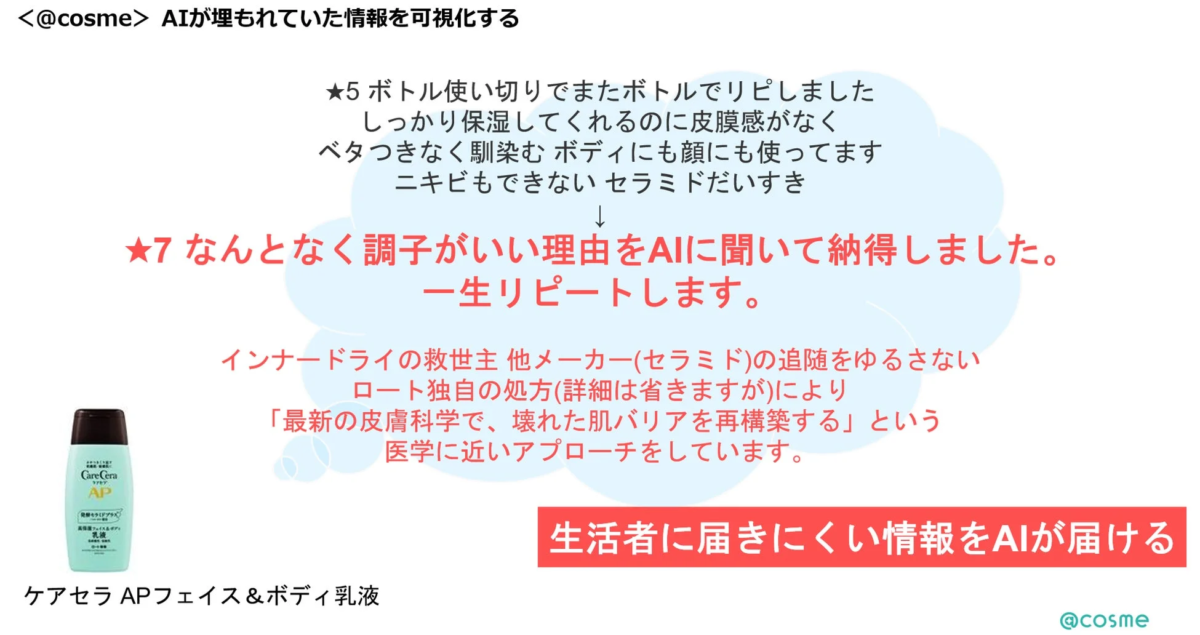
Among the @cosme reviews is one from a person who had been using the "Carecera AP Face & Body Emulsion" without much thought, asked AI why, and "was convinced by Rohto's original formulation and an approach close to medicine that rebuilds a damaged skin barrier, and decided to buy it again." This shows a way of using AI in which people check the reasons after use, not to gather information before purchase. Information that had been buried can now reach consumers more easily through AI, and the technological strength of brands that have accumulated research and development may be evaluated more highly than ever.
The results of this survey suggest that consumers do not rely on AI alone. A way of using both and judging by referring to both, asking AI and then also checking the voices of people who have actually used the product, is taking hold.
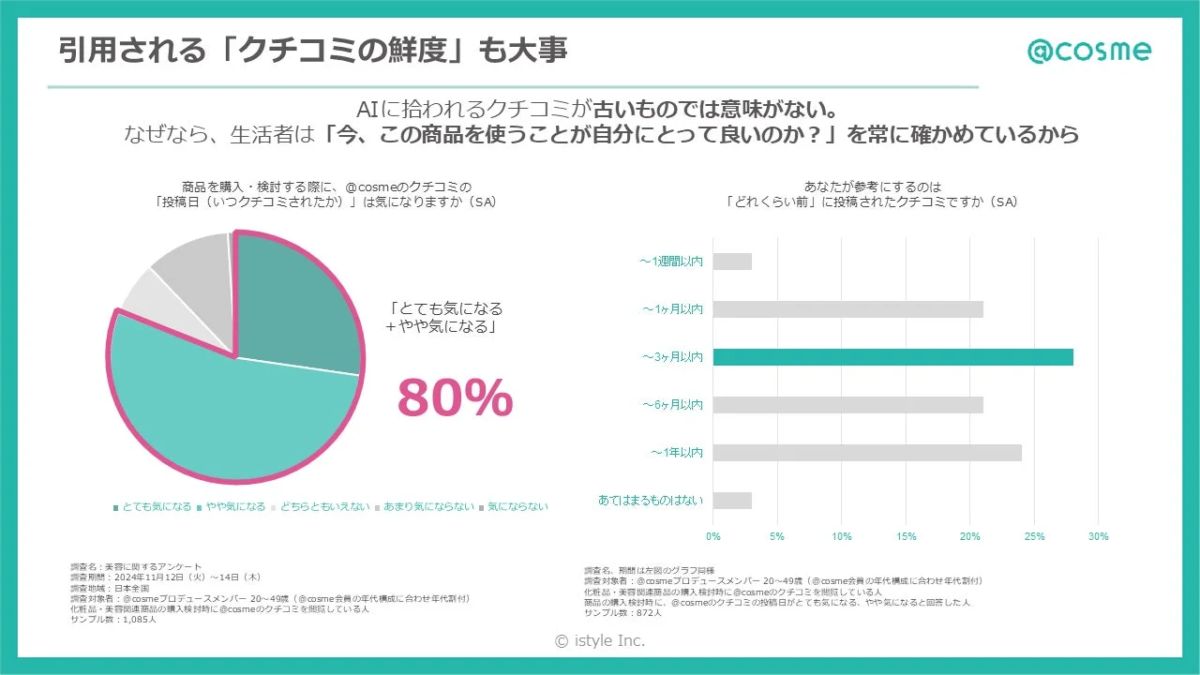
Data also shows that 80% of consumers pay attention to the posting date of reviews when considering a product purchase. This highlights that they judge after checking who wrote it and when. Even when AI gives an answer, its foundation is the primary information written by consumers. The more AI spreads, the more the freshness and volume of that information will be called into question.
From this, the report concludes that the following two communication strategies are required for brands to continue to be chosen by consumers in the coming age of AI.
- Proactively communicate specialized research data and scientific evidence: Through AI, even difficult information can reach consumers in an easy-to-understand way. Regularly communicating the technological strength and formulation commitments of brands that have accumulated research and development will lead to gaining trust through AI.
- Appeal to unique benefits to draw out "passionate primary information" from consumers: This means consistently communicating a product's unique benefits, such as "skin that looks like you slept three more hours" for "DECORTÉ Liposome Advanced Repair Cream" and "creating a skin-like finish" for "RMK Lasting Gel Creamy Foundation." Creating an environment in which such distinctive appeal words are put into words in consumers' own accounts and accumulated is thought to become an asset in the age of AI.
Detailed content, including a video of the webinar "How Will Brands Be Chosen in the Age of AI and Reviews? Latest Purchasing Behavior Read from Consumer Data by Gen Z, Millennials and Mature Generations" that uses the data from this survey, is available on the following page.
- Detailed webinar information: https://hubs.ly/Q04s3yVL0
The survey was conducted by Dentsu Macromill Insight, Inc. It was carried out over the internet among 1,300 men and women aged 15 to 59 nationwide from April 15 to April 20, 2026.
Dentsu Macromill Insight official website: https://www.dm-insight.jp/
istyle Inc. official website: https://www.istyle.co.jp/
istyle news page about this survey report: https://www.istyle.co.jp/news/info/2026/08/20260807.html