Spray sunscreen is one option for covering broad areas such as the arms or reapplying while out. However, seeing a mist does not mean you have applied the required amount to your skin. Check the directions for your particular product to see whether it can be sprayed directly onto the face and whether it should be spread by hand afterward.
This article covers preparation for sunscreen sprays and mists, how to handle them on the face and body, missed areas, and reapplication while out. It does not test the UV protection of any particular product. Rather than using the same spraying time or distance for every product, follow the intended uses and directions for yours.
1. Read the sunscreen’s intended uses and application areas
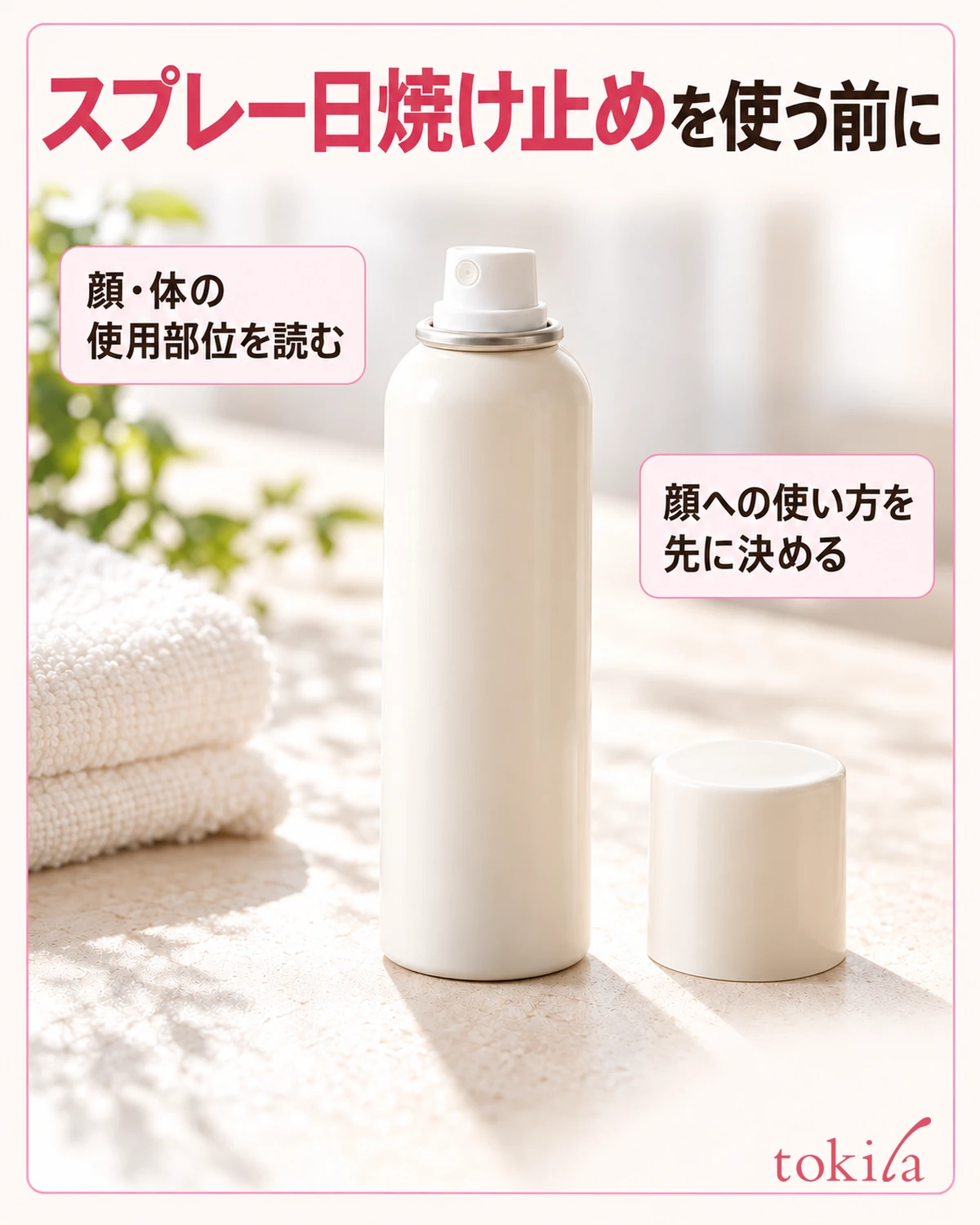
First, check the container or outer packaging to confirm that the product is intended as sunscreen. Toner mists and makeup-setting sprays serve different purposes even when their containers look similar. Do not assume that all products released as mist are equivalent; check each permitted application area, such as the face, body, or hair.
Even a product suitable for both face and body may require different spraying methods. Read directions for spraying directly onto the arms separately from instructions to dispense into the palm before applying to the face. Do not add your own assumption that closing your eyes makes direct facial spraying acceptable.
This article focuses on use on the skin. Do not extend a product without instructions for hair or scalp use to spraying along your part. Check permitted and prohibited areas around the lips and eyes as well. It is also important not to substitute a product labeled for body use for a facial product.
If you want to use it over makeup, check for directions allowing that use. Not every sunscreen can be added to a face wearing foundation. Decide whether you will use it before morning makeup or for reapplication while out, then look for the relevant instructions.
Reading how to remove it at night also helps you plan what to take with you. Even when sunscreen washes off with soap, makeup layered over it may not come off the same way. For details, see How to Remove Sunscreen and Layered Makeup to distinguish what you need to wash off.
Start by checking purpose, application areas, facial application, layering conditions, and removal, in that order. You do not need to memorize difficult-to-read labels; include the product name when noting instructions from the box. When replacing it with a different spray, do not carry over the previous spraying time or permitted application areas unchanged.
2. Check shaking instructions, spraying location, and container orientation
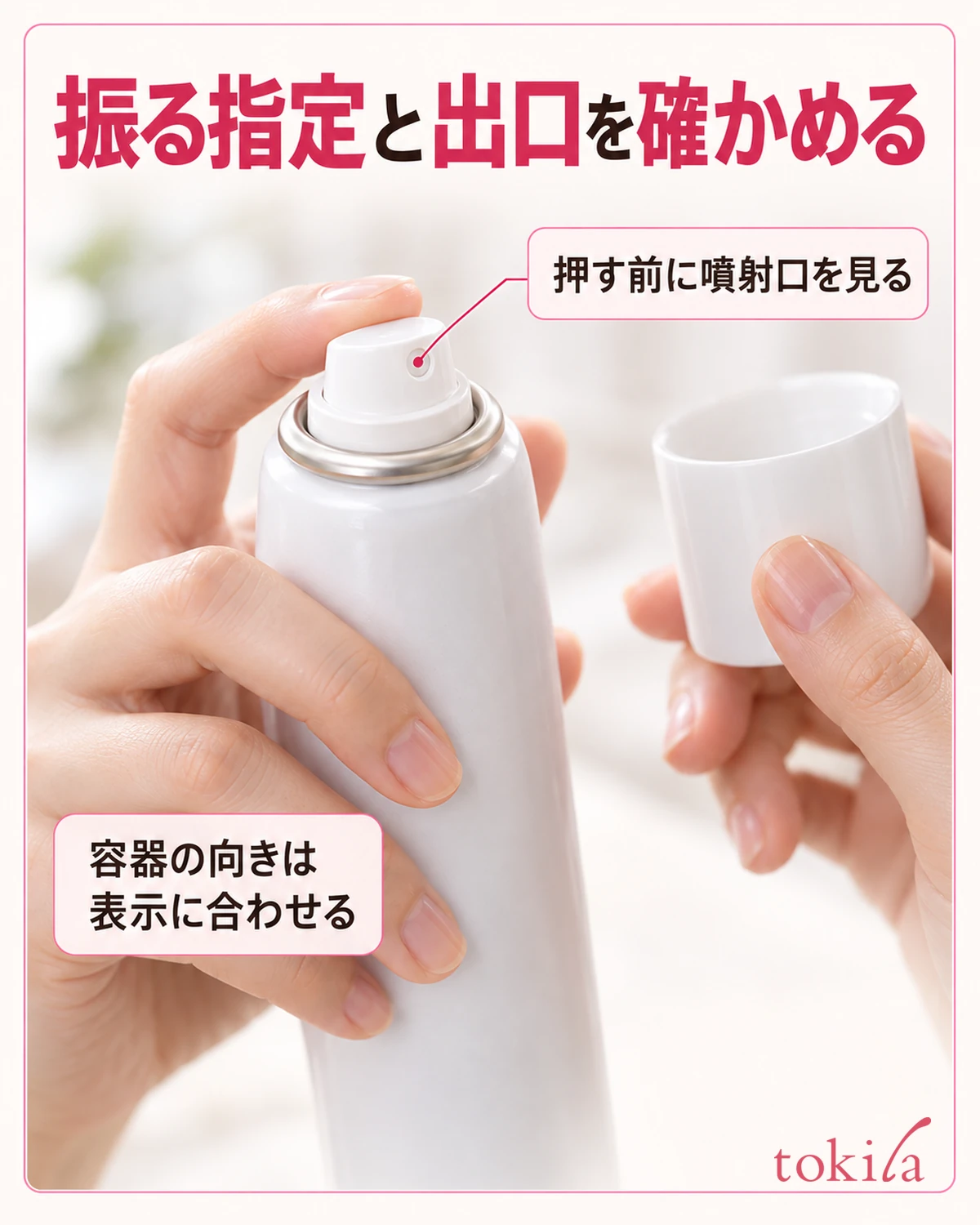
Before first use, check whether shaking is required. Some products must be shaken well, but their spray or mist format alone does not tell you. Follow any specified number of shakes or orientation. Do not replace those instructions with another cue, such as shaking until you hear a sound.
Shake as directed on the container, for example with the cap closed. Do not prepare it with your finger on the spray button, and do not point the outlet toward anyone. If you cannot tell which way the nozzle faces, inspect the outlet before pressing rather than bringing it near your face to test it.
Read precautions against inhalation and instructions on ventilation and flames for the place where you use it. If an aerosol can or other product carries a keep-away-from-flames warning, follow it. Do not use it near cooking flames or smoking, and avoid spraying large quantities into a confined space.
In windy places, the mist may drift onto other people. Do not point it toward anyone; move to a place that meets the product’s precautions before using it. Prepare a suitable environment first rather than spraying longer to compensate for mist that scatters away.
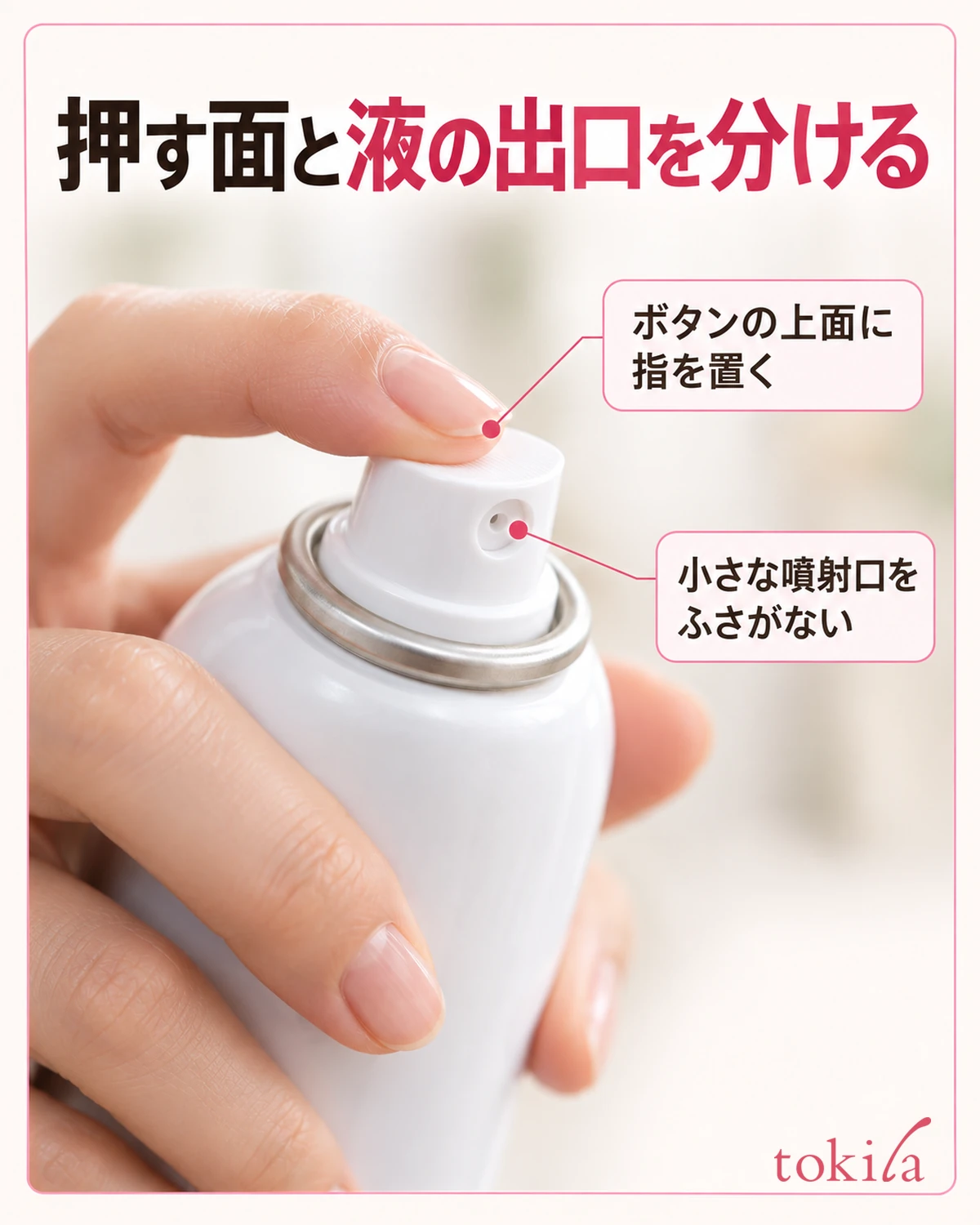
In the close-up photo, distinguish the top of the button you press from the small hole where liquid exits. The surface under your finger does not necessarily face forward. Do not press while blocking the hole with a finger or enlarge a blocked opening with a needle. If dispensing is abnormal, check the directions and condition of the container.
Whether it works upside down also depends on the product. Do not turn every can upside down and keep pressing just because you want to reach your back. Check for instructions on changing orientation, and prepare areas you can see rather than twisting your arm toward inaccessible places. Stop spraying before adjusting your grip.
3. Follow instructions to dispense into the palm for the face, then apply in small portions
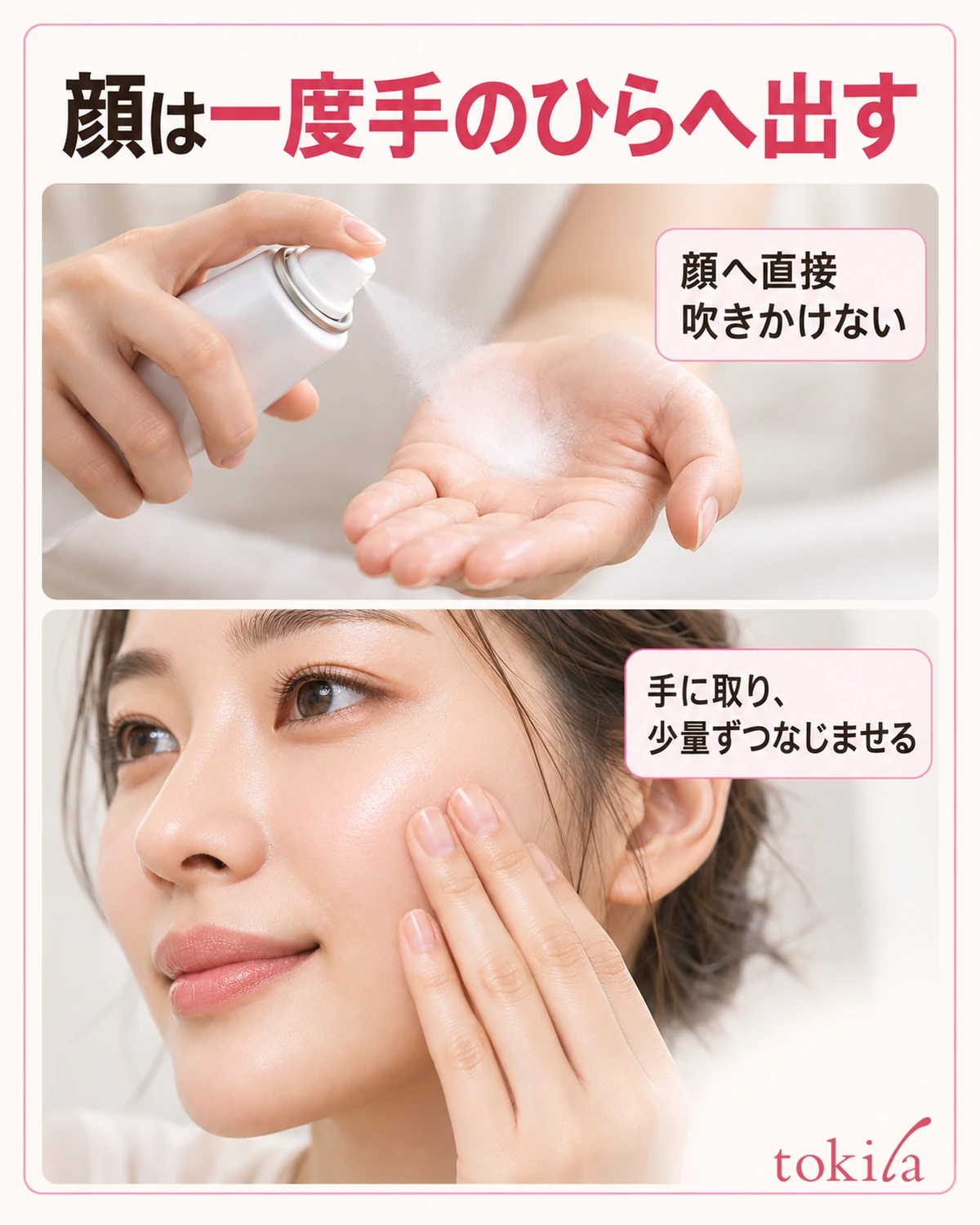
For a product suitable for the face that instructs you to dispense into your palm first, do not spray directly onto the face. Prepare clean hands and dispense as directed into a palm held away from your face and eyes. The key is not to add assumptions that closing your eyes or holding your breath permits direct facial spraying.
After dispensing into your palm, apply to the face in small portions. Here, small portions means dividing the amount transferred at a time, not reducing the total amount needed for the whole face. Check the indicated amount and layering method, and distribute evenly over permitted areas rather than concentrating it in one spot.
Work from broad cheek areas to the forehead, nose, chin, and elsewhere while watching where you touch. Let the surface of your hand follow your skin without pulling hard on your face. Keep it out of the eyes, nose, and oral mucous membranes, and do not push fingertips into small areas to reach them. Do not spread it into areas where use is prohibited.
Even a product suitable over makeup should be applied in that order if dispensing into the hand is specified. If foundation shifts, do not repeatedly rub hard to smooth it. Separate sunscreen application from correcting color or powder, and inspect the affected area before continuing.
It is also important not to treat photos of a nozzle near a cheek or mist around a face as examples of correct technique. For a product applied by hand, first confirm that the spray goes into the hand. Skin sheen or translucency alone cannot tell you whether the required amount has been applied.
If you cannot read the facial directions or do not know whether use over makeup is allowed, do not invent your own method. Another option is to choose a different sunscreen you have with clear purposes and instructions. Rather than aiming to cover your entire body with one spray, choose methods suited to each area.
4. Spray the body from the specified distance and check where to spread by hand
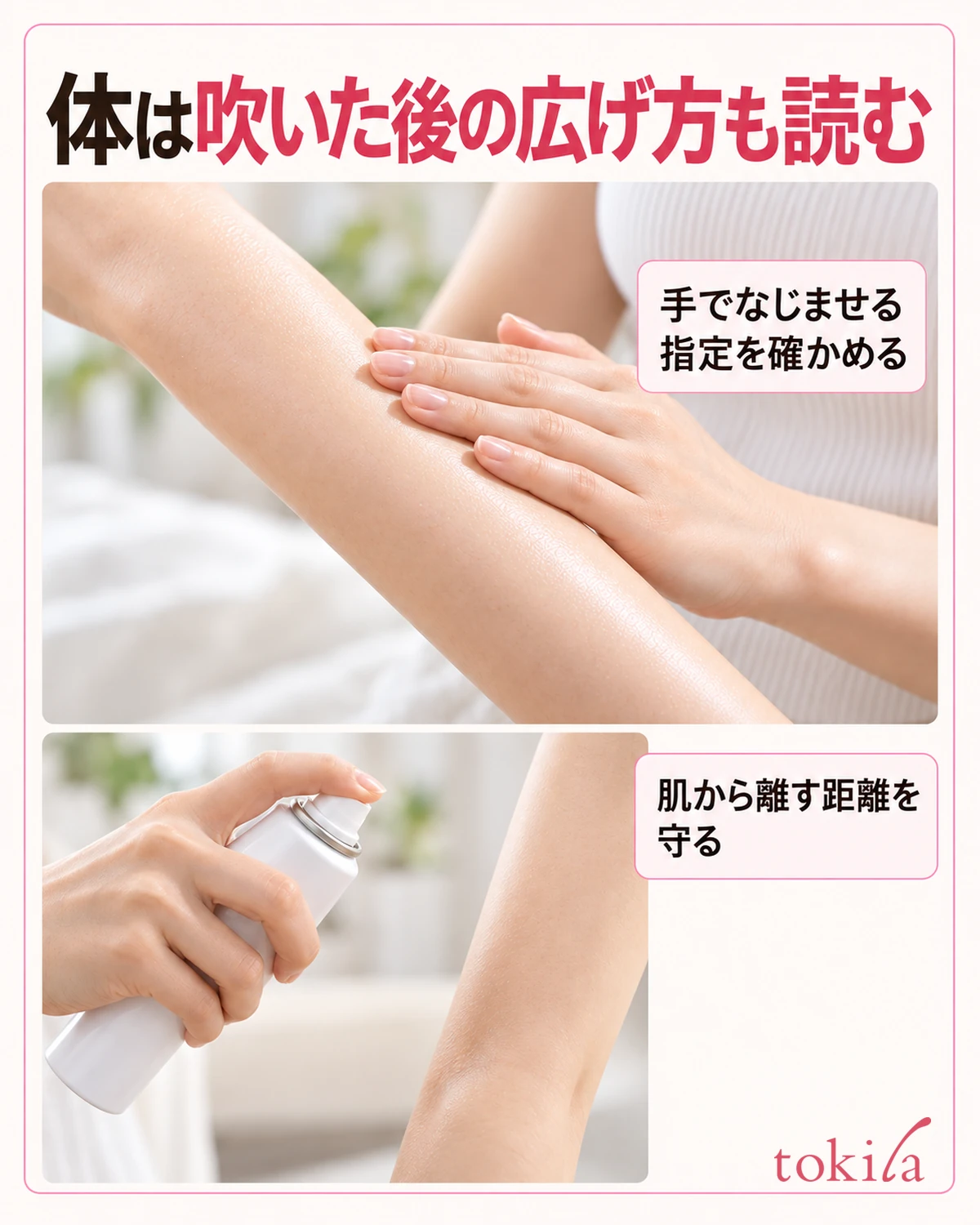
For a product that can be sprayed directly onto the body, read the recommended distance from the skin and spraying guidance. Do not hold it fixed too close; maintain the indicated distance. If there is a limit on continuous spraying in one place, observe that time too. Do not treat distances or seconds per arm remembered from another can as universal rules.
When using it on arms or legs, spray while checking the skin area to cover rather than scattering it widely onto clothing or belongings. Avoid turning the container toward your face while spraying. One wet spot does not mean enough product has reached the surrounding area; apply according to the label.
If instructions call for spreading by hand, lay your palm along the skin after spraying and distribute evenly. Watch where the surface of your hand makes contact rather than tracing a narrow line with a fingertip. You do not need to rub forcefully; finish spraying, then place your hand comfortably against the skin and continue.
Check not only the front of the arm but also its sides and the transition toward the back of the hand. The supplementary photo shows the curve from the top to the side of the arm and the nearby sleeve edge. This helps distinguish covered from exposed skin rather than finishing after treating only the surface visible from above.
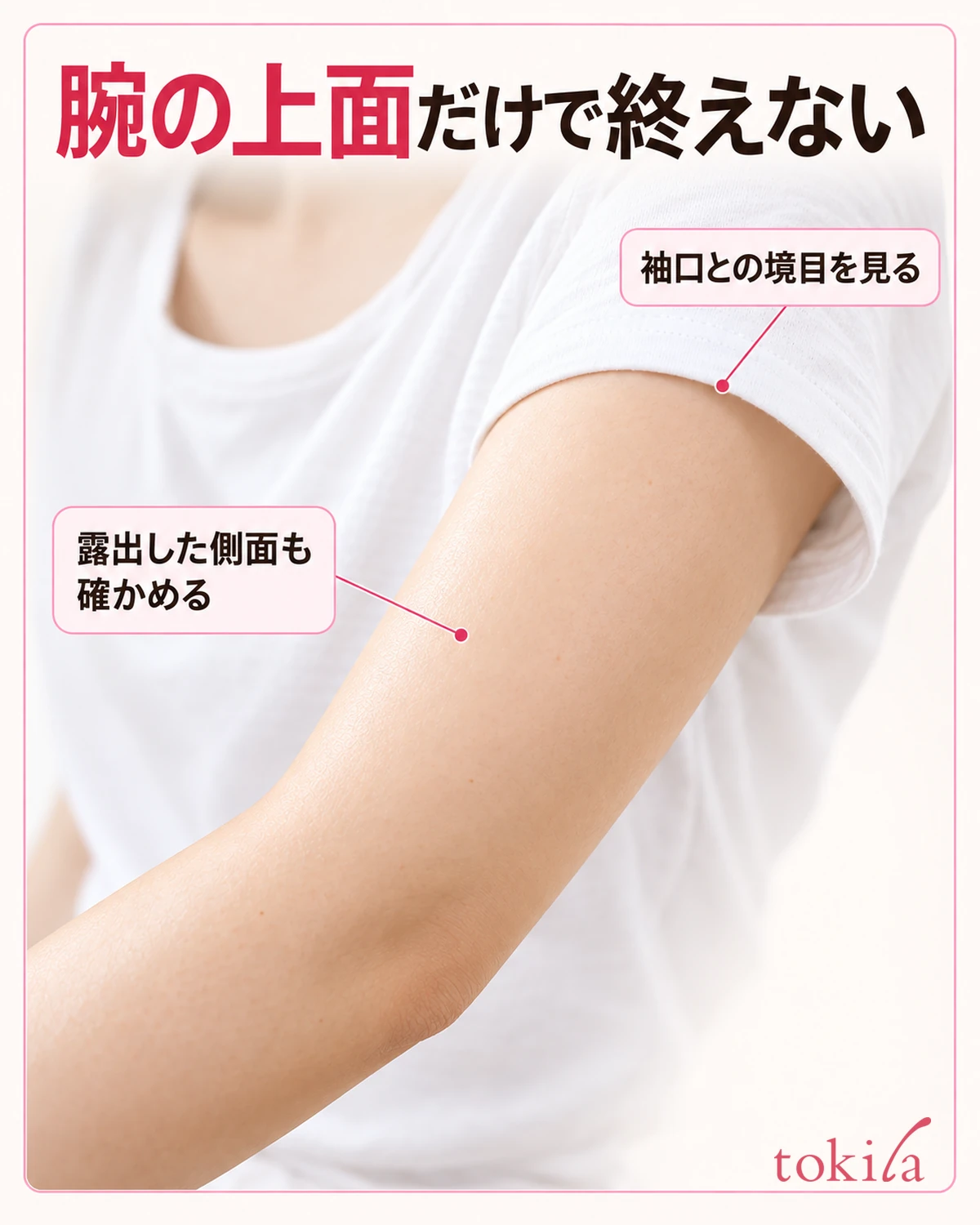
Also look for missed permitted areas such as the tops of the feet, around the knees, and the back of the neck. If hair or a collar blocks your view, adjust a mirror or your posture before checking rather than continuing to spray blindly. If your label does not explain neck application, do not assume that body use permits direct spraying there.
An even appearance does not mean that a sufficient amount for UV protection is present everywhere. With products that leave no white cast, the application boundary may be hard to see, so check coverage areas separately from the amount used. Do not use skin sheen or brightness alone as a sign that you have applied enough.
5. Reapply after sweating or friction, and plan storage while carrying it
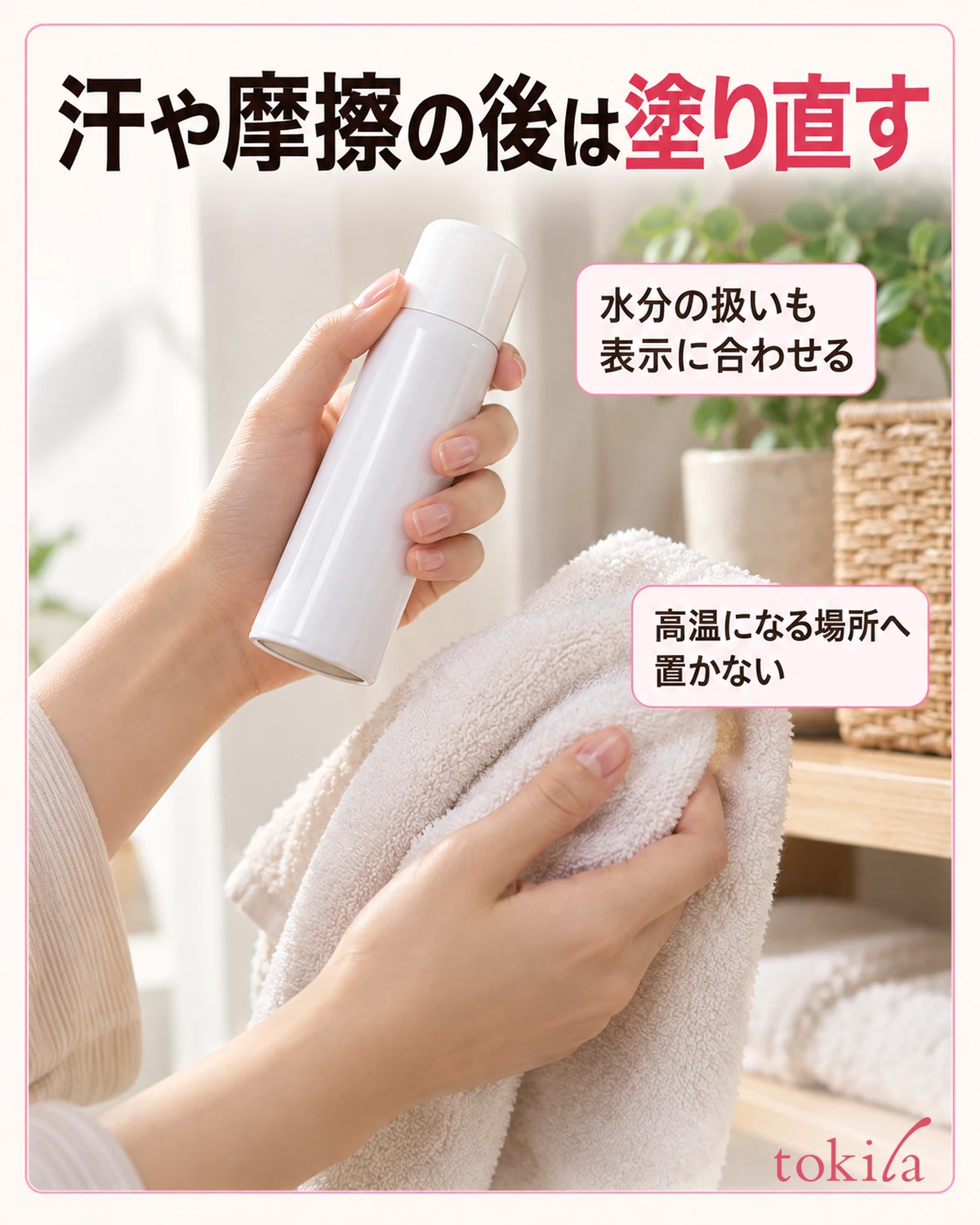
Do not consider one morning application the end; reapply regularly while out according to the directions. After sweating, towel drying, or entering water, follow the guidance for that product. A high numerical rating or water resistance alone does not eliminate the need to reapply.
Read how to handle sweat or moisture too. If drying is required, gently press a clean, soft towel or similar item against the skin, without rubbing hard, before reapplying. Consider areas rubbed by clothing as well, and return to each product’s instructions if you used different ones on your face and body.
If it is difficult to use while out, change your preparation—for example, move somewhere suitable or choose another format with a clear intended use—rather than shortening the distance or spraying time on your own. When using a solid product, see Checking Sunscreen Stick Surfaces and Application Areas as well.
After use, close the cap and other parts as directed. Do not leave aerosol cans in hot cars or direct sunlight; carry them under the storage conditions shown on the container. Do not heat, puncture, or transfer them into another container, and dispose of them according to the label and local procedures.
If redness, strong irritation, or another abnormality develops during application, stop use rather than continuing to correct uneven coverage, and follow the precautions. Distinguish suitability for skin use from whether your own skin currently tolerates it, and do not try to resolve an abnormality solely by adjusting the spraying amount.
Before your next use, review one point that confused you. Identify whether it was dispensing for the face, body spraying distance, the area to spread by hand, or the location while out. Build the sequence of reading intended uses, applying as directed, and checking missed areas and reapplication into your usual routine.